SPACE/COSMOS
SpaceX could eye record IPO this week as valuation soars past €1.61tn
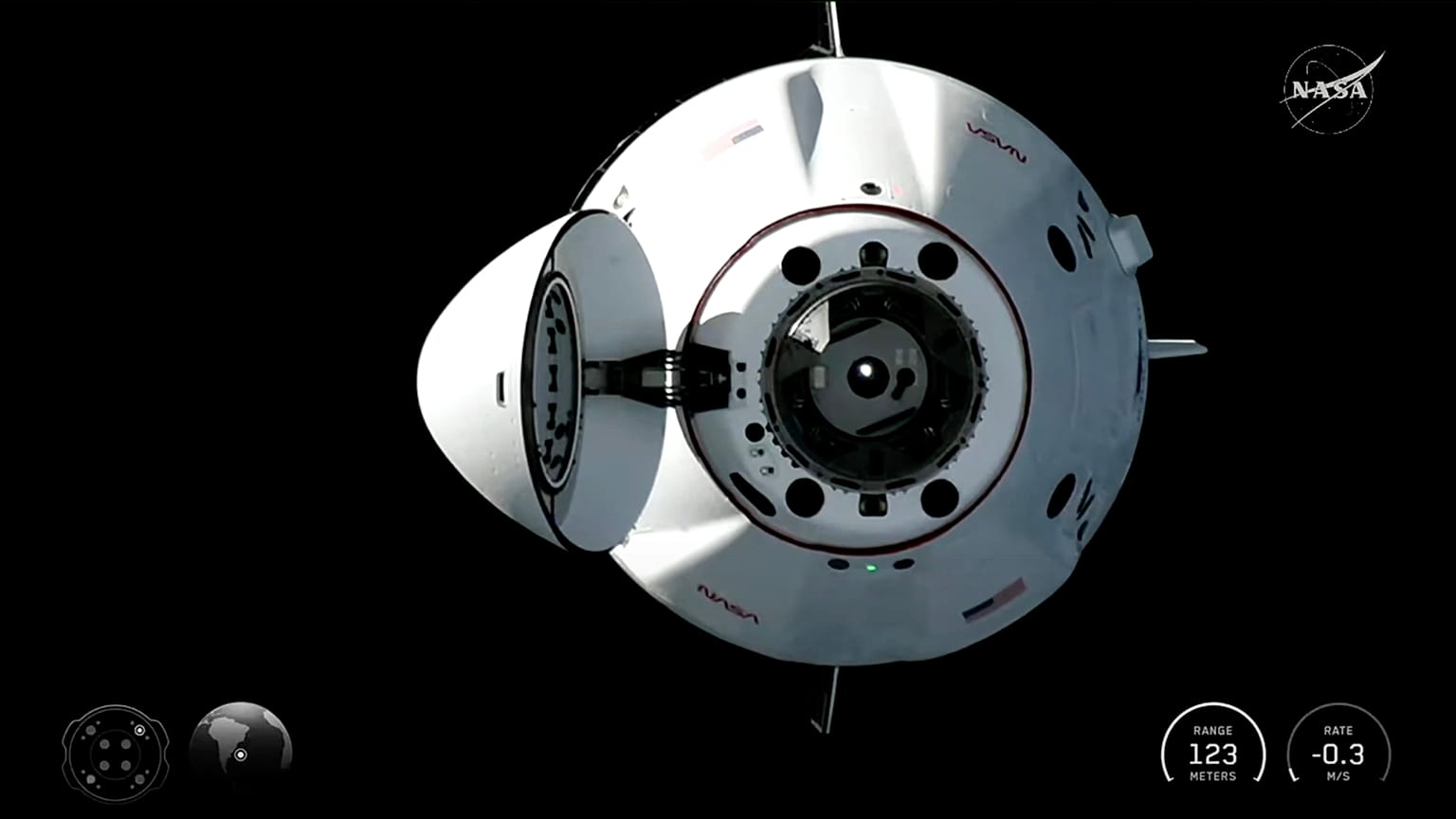
Elon Musk's rocket and satellite company could file paperwork with US regulators as soon as this week, in a listing that would dwarf Saudi Aramco's record 2019 offering.
Elon Musk's SpaceX is preparing to file a prospectus for an initial public offering as soon as this week, in what could become the largest stock market debut in history, according to the Information, a US technology news outlet known for well-placed industry sources.
The company could seek to raise more than $75 billion (€69 billion), the publication reported, citing a person with direct knowledge of the plans — significantly more than the $50 billion (€46 billion) raise previously anticipated ahead of a potential summer listing.
That earlier figure alone would have shattered the record set by Saudi Aramco's $29.4 billion (€27.1bn) offering in 2019.
Ahead of a rumoured mid-June debut, SpaceX is expected to be marketed to investors as a platform business targeting a valuation of about $1.5 trillion (€1.38tn), or roughly 94 times its 2025 revenue, according to Morningstar.
The Information puts the potential valuation even higher, at more than $1.75 trillion (€1.61tn).
The engine of that valuation is Starlink, the company's satellite internet service.
Morningstar estimates SpaceX generated nearly $16 billion (€14.7bn) in revenue and $7.5 billion (€6.9bn) in EBITDA in 2025, driven almost entirely by explosive subscriber growth in the Starlink segment.
The IPO narrative also encompasses two highly aspirational capital deployment targets, including data centres in space and Moonbase Alpha, a self-sustaining lunar city, though analysts note the latter has no clear revenue pathway.
SpaceX's path to market has grown more complex following its acquisition of Musk's artificial intelligence company xAI in February, structuring it as a wholly owned subsidiary in an all-share deal that valued the combined entity at about $1.25 trillion (€1.15tn).
While the move broadened the company's narrative as an AI and space infrastructure platform, it adds business integration complexity that is difficult for investors to underwrite.
SpaceX has never filed a public financial statement, meaning investors have so far had to rely on secondary data and analyst estimates.
Thousands of pico-satellites may transform how phones connect to space
Researchers develop an innovative solution that could lower costs and improve reliability for direct-to-device satellite links
image:
This work proposes an innovative system in which the elements of a phased-array antenna are distributed among thousands of extremely small satellites, avoiding the costs and risks associated with relying on a single large satellite.
view moreCredit: Institute of Science Tokyo
Swarms of pico-satellites could work together as a single large antenna for direct-to-smartphone communications, as reported by researchers from Japan. Instead of relying on a single large satellite with a phased-array antenna, the team showed that pico-satellites orbiting Earth in formation could each carry individual phased-array elements and be synchronized wirelessly. The proof-of-principle experiment demonstrated reliable, high-quality data transmission, paving the way for cheaper, more reliable network coverage worldwide.
The idea that ordinary smartphones could connect directly to satellites, known as direct-to-device (D2D) satellite communications, has gained momentum in recent years. The goal is to provide coverage virtually anywhere on Earth, including remote places such as oceans and deserts, where conventional ground networks fail or cannot reach. To establish links between orbiting satellites and smartphones, phased-array antennas are a well-established solution. These antennas are made up of many small radiating elements that work together. By carefully controlling the timing of the signals transmitted or received by the elements, the arrays can electronically steer the beam, relocating coverage areas without relying on moving mechanical parts.
However, deploying phased-array antennas in space comes with serious drawbacks. The satellites needed are large, extremely expensive to launch, and vulnerable to failure—if a single key component breaks, the entire satellite could be damaged and rendered useless. A deeper technical challenge lies in the fact that, for a phased array to work, all antenna elements must be synchronized with high precision. Coordinating thousands of antenna elements in space without linking them via physical cables is an enormous technical hurdle.
To address these issues, a research team led by Associate Professor Atsushi Shirane from the Laboratory for Future Interdisciplinary Research of Science and Technology, Institute of Science Tokyo (Science Tokyo), Japan, has proposed an innovative solution. Instead of relying on a single large satellite, the team envisioned a system in which tens of thousands of pico-satellites would fly in formation and function together as a single large phased-array antenna. Their paper, which describes the proposed idea in detail, will be presented at the 2026 IEEE International Solid-State Circuits Conference (ISSCC) on February 15–19, 2026.
At the core of their work is a new ‘non-wired’ phased-array architecture called the “spatial wireless combining and distributing technology.” In this approach, a gateway satellite broadcasts a reference signal, which all the pico-satellites use to stay synchronized, even though they are physically separated. This solves the non-wired system issues of synchronizing the reference signal and combining or distributing communication signals transmitted via cables. The advantage of this design is that each satellite can operate without the need for local oscillators or synchronizing components, which consume substantial energy. “The proposed architecture enables the miniaturization of each unit,” highlights Shirane. “A compact size allows for utilizing rocket ride-share opportunities, resulting in significantly lower launch costs,” he adds, noting another major benefit.
To test their solution, the researchers designed and fabricated a compact transceiver chip using standard silicon CMOS technology—the same type of easy mass-production manufacturing process used in many everyday electronics. This enables each distributed pico-satellite to individually install a chip to function as a phased array antenna. They built small wireless modules and used them in proof-of-principle experiments that mimic the formation of satellites in space. Using signals based on the long-term evolution standard used in modern smartphones, the proposed system successfully demonstrated precise beam steering (aiming of the phased-array antenna) and high-quality data transmission, even with advanced modulation schemes.
Beyond cost savings, the proposed approach also improves reliability. Because the antenna elements are distributed across many satellites, the system does not depend on any single unit. “Our solution ensures high robustness. In contrast to conventional monolithic satellites, the overall network remains operational even if individual satellites fail,” explains Shirane.
Taken together, the results point to a new way of building D2D satellite communication systems through formation flight. If developed further, this technology could soon support future satellite networks that connect directly to everyday devices, thereby expanding global coverage while reducing costs and risks.
***
About Institute of Science Tokyo (Science Tokyo)
Institute of Science Tokyo (Science Tokyo) was established on October 1, 2024, following the merger between Tokyo Medical and Dental University (TMDU) and Tokyo Institute of Technology (Tokyo Tech), with the mission of “Advancing science and human wellbeing to create value for and with society.”
Method of Research
Experimental study
Subject of Research
Not applicable
Article Title
A Formation Flight Phased-Array Transceiver for Spatial Power Combining and Distributing Architectures in Direct-to-Device-Communication Satellite Constellations
Astronomers have spotted two giant gas planets forming around a baby star in deep space
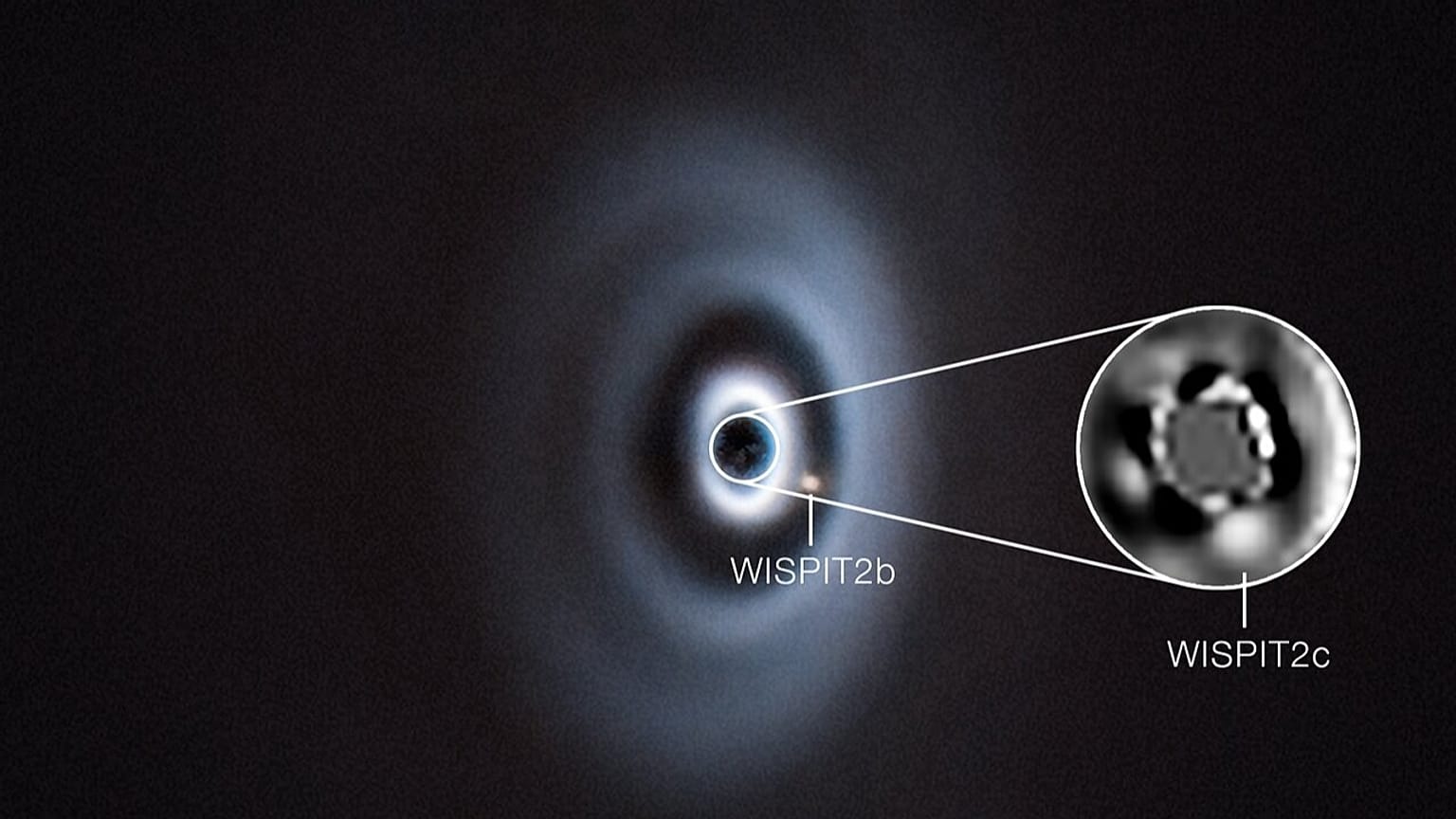
Using the European Southern Observatory’s Very Large Telescope, a team of scientists have observed two giant gas planets forming around a young star in what appears to be a new, emerging solar system.
Astronomers have caught something extraordinary happening in deep space - new planets being born, right now.
Around a young star called WISPIT 2, a team of reserchers have spotted not one, but two giant planets forming inside a swirling cloud of gas and dust. It’s one of the clearest, most real-time views we’ve ever had of how solar systems - including our own - come to life.
"WISPIT 2 is the best look into our own past that we have to date," says Chloe Lawlor, a PhD student at the University of Galway, Ireland, and lead author of the study published in The Astrophysical Journal Letters.
A rare planetary double in the making
The discovery makes WISPIT 2 just the second known system - after PDS 70 - where two planets have been directly observed forming around a star.
"These structures suggest that more planets are currently forming, which we will eventually detect," Lawlor said.
But unlike its predecessor, WISPIT 2's disc is unusually large and structured, marked by striking gaps and rings carved out by the emerging planets.
"WISPIT 2 gives us a critical laboratory not just to observe the formation of a single planet but an entire planetary system," said Christian Ginski, a co-author of the study and researcher at the University of Galway.
A growing planetary system
The first planet, WISPIT 2b, was identified last year - a massive gas giant nearly five times the size of Jupiter, orbiting far from its host star.
A second planet has now been confirmed closer in. "This detection of a new world in formation really showed the amazing potential of our current instrumentation," said Richelle van Capelleveen, a PhD student at Leiden Observatory and leader of the previous study.
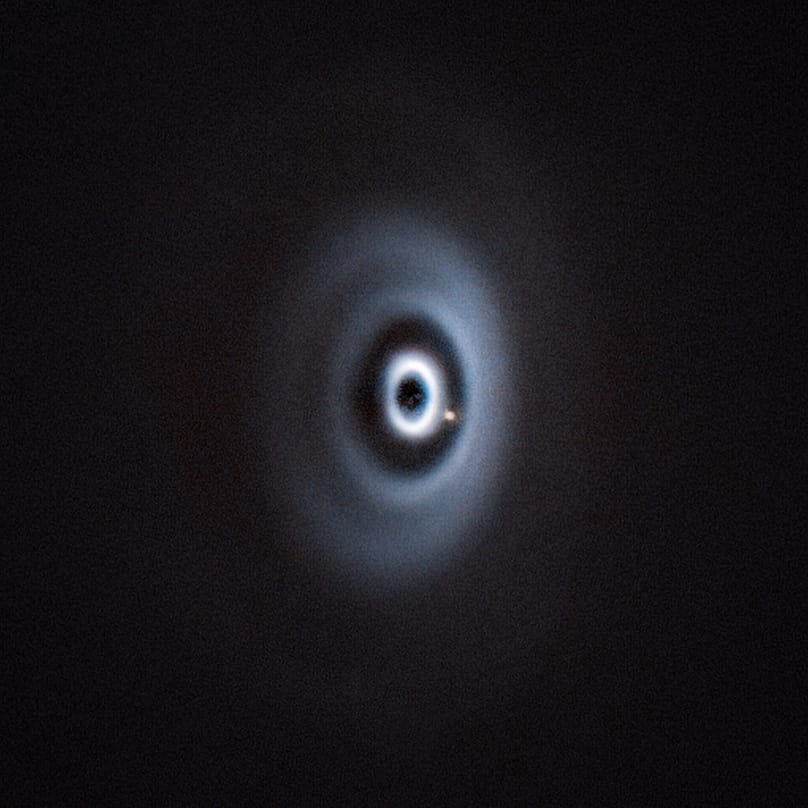
The newly confirmed planet, WISPIT 2c, sits four times closer to the star and is twice as massive as its sibling. Like WISPIT 2b, it is a gas giant - similar to the outer planets in our own Solar System.
To document and observe the planet, researchers from the University of Galway and Leiden Observatory used instruments at the European Southern Observatory, including the disarmingly literally-named "Very Large Telescope" and its interferometer.
How do planets actually form?
To understand exactly what's happening here, it's important to know how planet formation works - a fascinating phenomenon which unfolds over millions of years and what NASA describes as a snowball-like process.
“They start out as globs of gas and dust that orbit a central star, which itself may also be forming. Gravity and other forces cause material within the disk to collide. If the collision is gentle enough, the material fuses, growing like rolling snowballs,” reads a statement on NASA's website.
“Over time, dust particles combine to form pebbles, which evolve into mile-sized rocks. As these forming planets orbit their star, they clear material from their path, leaving tracks of largely empty space. At the same time, the star gobbles up nearby gas and pushes more distant material farther away,” it added.
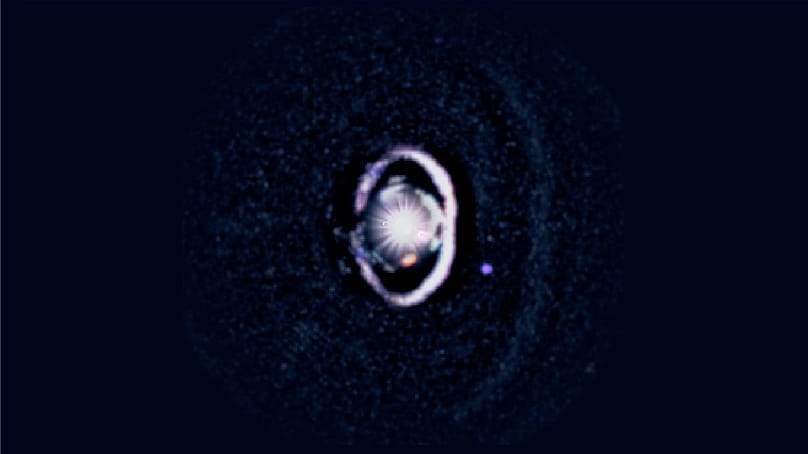
This cosmic snowballing eventually produces full-fledged planets. Some grow into rocky worlds like Earth, while others, if they gather enough gas before the surrounding disc disperses, can become enormous gas giants such as Jupiter and Saturn, and in this new study's case, WISPIT 2b and WISPIT 2c.
The possibility of a hidden third planet
Scientists think the story of this new emerging solar system may not end there. Farther out, another, smaller gap hints at the possible presence of a third, yet unseen planet.
"We suspect there may be a third planet carving out this gap," said Lawlor, "potentially of Saturn mass owing to the gap’s being much narrower and shallower".
Future research could confirm this suspicion, with astronomers already looking ahead to the next generation of telescopes. "With ESO's upcoming Extremely Large Telescope, we may be able to directly image such a planet," Ginski said.
XRISM Solves Famous Star’s 50-Year Mystery

Artist's impression of massive star gamma-Cas and its small-but-dense white dwarf companion. New data from XRISM show that the disc of material ejected by gamma-Cas is being consumed by the white dwarf star, generating X-rays. CREDIT: ESA, Y. Naze
An invisible companion consuming material from the naked-eye star gamma-Cas has been revealed as the culprit for curious X-rays coming from the stellar system. This closes the case on a mystery that has puzzled astronomers for more than fifty years.
Unique high-resolution observations made by the X-Ray Imaging and Spectroscopy Mission (XRISM) revealed that the X-rays are linked to the orbital motion of a companion white dwarf star, enabling astronomers to finally solve the mystery. The observations are detailed in a new paper led by Yaël Nazé of the University of Liège, Belgium.
“There has been an intense effort to solve the mystery of gamma-Cas across many research groups for many decades. And now, thanks to the high-precision observations of XRISM, we have finally done it,” says Yaël.
A mystery steeped in history
The star gamma-Cas (γ-Cas) is visible to Europeans every cloudless night. It makes up the central ‘point’ of the distinctive ‘W’-shaped constellation Cassiopeia.
Despite its prominence in the night sky, it has been shrouded in mystery since 1866 when Italian astronomer Angelo Secchi noticed something odd in its light signature. Its hydrogen ‘fingerprint’ was bright, whereas in stars like our own Sun this normally shows up as a dark line.
This weird feature inaugurated a new class of stars, called ’Be’ stars, merging the ‘B’ associated with hot blue-white massive stars with the ‘e’ from the peculiar hydrogen emission.
It took several decades before astronomers understood that these emissions were coming from a rotating disc of matter ejected by the fast-spinning star. Such discs can build and disperse over time, resulting in variations in the star’s brightness. This makes it a popular target for amateur astronomers still today.
As telescope observations became more refined, monitoring gamma-Cas’s motion was possible, revealing that it must have a low-mass companion star. Since the companion remains invisible to spot directly with telescopes, astronomers think it might be a white dwarf – a compact object with the mass of the Sun but the size of Earth.
Then, in the mid-1970s, a new mystery emerged: gamma-Cas was discovered to shine in unusual high-energy X-rays. Further studies found the origin of this X-ray glow to be mostly coming from extremely hot 150-million-degree plasma, shining with a brightness some 40 times greater than typically expected for such massive stars.
With the dawn of X-ray space telescopes including ESA’s XMM-Newton, NASA’s Chandra and the Germany-led eROSITA, astronomers have found around two dozen gamma-Cas-type stars with similar, unusual X-ray emission, making them a special group among Be stars in general.
The final two theories
Over the years, the explanation for the high-energy X-rays boiled down to two competing theories. Could the star’s local magnetic fields be interacting with that of its surrounding disc, producing the hot material? Or, are X-rays generated by the Be star’s disc material falling onto the white dwarf companion?
Finally, an instrument exists with high enough precision to solve the mystery: XRISM’s high-resolution spectrometer Resolve. In a dedicated observation campaign XRISM revealed that the signatures of the hot plasma follow the orbital motion of the otherwise invisible companion star. In other words, the white dwarf companion consumes material from gamma-Cas, emitting X-rays as it does so.
“The previous work using XMM-Newton really cleared the way for XRISM, enabling us to eliminate numerous theories and prove which of the last two competing theories was correct,” says Yaël. “It’s extremely satisfying to have direct evidence to solve this mystery at long last!”
Understanding that gamma-Cas objects are Be type stars paired with a white dwarf that’s accreting material, solves the X-ray mystery. But it also opens up another curiosity in terms of how the wider population of this type of binary systems forms and evolves.
Such pairs were long expected to be common, mainly among low‑mass stars. However, new research shows they are rarer than predicted and instead tend to occur in high‑mass Be stars.
“We think the key is in understanding how exactly the interactions take place between the two stars,” says Yaël. “Now that we know the true nature of gamma-Cas, we can create models specifically for this class of stellar systems, and update our understanding of binary evolution accordingly.”
“It’s incredible to see how this mystery has slowly unfolded over the years,” says Alice Borghese, an ESA Research Fellow specialising in the field of high-energy astrophysics. “XMM-Newton did so much of the groundwork in ruling out various theories about gamma-Cas. And now with the next generation of advanced instrumentation, XRISM has brought us over the finish line.”
“This wonderful result underlines the strong collaboration between XRISM’s Japanese, European and American teams,” adds Matteo Guainazzi, ESA’s XRISM Project Scientist. “This international team combines the technical and scientific expertise needed to solve the X-ray Universe’s biggest mysteries and open new avenues for research.”
High-resolution observations made by XRISM have revealed the origin of the curious X-rays coming from naked-eye star gamma-Cas: matter falling onto its companion, a white dwarf star.
Credit
ESA, Y. Naze
XRISM solves famous star’s 50-year mystery
European Space Agency
image:
Artist's impression of massive star gamma-Cas and its small-but-dense white dwarf companion. New data from XRISM show that the disc of material ejected by gamma-Cas is being consumed by the white dwarf star, generating X-rays.
view moreCredit: ESA, Y. Naze
An invisible companion consuming material from the naked-eye star gamma-Cas has been revealed as the culprit for curious X-rays coming from the stellar system. This closes the case on a mystery that has puzzled astronomers for more than fifty years.
Unique high-resolution observations made by the X-Ray Imaging and Spectroscopy Mission (XRISM) revealed that the X-rays are linked to the orbital motion of a companion white dwarf star, enabling astronomers to finally solve the mystery. The observations are detailed in a new paper led by Yaël Nazé of the University of Liège, Belgium.
“There has been an intense effort to solve the mystery of gamma-Cas across many research groups for many decades. And now, thanks to the high-precision observations of XRISM, we have finally done it,” says Yaël.
A mystery steeped in history
The star gamma-Cas (γ-Cas) is visible to Europeans every cloudless night. It makes up the central ‘point’ of the distinctive ‘W’-shaped constellation Cassiopeia.
Despite its prominence in the night sky, it has been shrouded in mystery since 1866 when Italian astronomer Angelo Secchi noticed something odd in its light signature. Its hydrogen ‘fingerprint’ was bright, whereas in stars like our own Sun this normally shows up as a dark line.
This weird feature inaugurated a new class of stars, called ’Be’ stars, merging the ‘B’ associated with hot blue-white massive stars with the ‘e’ from the peculiar hydrogen emission.
It took several decades before astronomers understood that these emissions were coming from a rotating disc of matter ejected by the fast-spinning star. Such discs can build and disperse over time, resulting in variations in the star’s brightness. This makes it a popular target for amateur astronomers still today.
As telescope observations became more refined, monitoring gamma-Cas’s motion was possible, revealing that it must have a low-mass companion star. Since the companion remains invisible to spot directly with telescopes, astronomers think it might be a white dwarf – a compact object with the mass of the Sun but the size of Earth.
Then, in the mid-1970s, a new mystery emerged: gamma-Cas was discovered to shine in unusual high-energy X-rays. Further studies found the origin of this X-ray glow to be mostly coming from extremely hot 150-million-degree plasma, shining with a brightness some 40 times greater than typically expected for such massive stars.
With the dawn of X-ray space telescopes including ESA’s XMM-Newton, NASA’s Chandra and the Germany-led eROSITA, astronomers have found around two dozen gamma-Cas-type stars with similar, unusual X-ray emission, making them a special group among Be stars in general.
The final two theories
Over the years, the explanation for the high-energy X-rays boiled down to two competing theories. Could the star’s local magnetic fields be interacting with that of its surrounding disc, producing the hot material? Or, are X-rays generated by the Be star’s disc material falling onto the white dwarf companion?
Finally, an instrument exists with high enough precision to solve the mystery: XRISM’s high-resolution spectrometer Resolve. In a dedicated observation campaign XRISM revealed that the signatures of the hot plasma follow the orbital motion of the otherwise invisible companion star. In other words, the white dwarf companion consumes material from gamma-Cas, emitting X-rays as it does so.
“The previous work using XMM-Newton really cleared the way for XRISM, enabling us to eliminate numerous theories and prove which of the last two competing theories was correct,” says Yaël. “It’s extremely satisfying to have direct evidence to solve this mystery at long last!”
Understanding that gamma-Cas objects are Be type stars paired with a white dwarf that’s accreting material, solves the X-ray mystery. But it also opens up another curiosity in terms of how the wider population of this type of binary systems forms and evolves.
Such pairs were long expected to be common, mainly among low‑mass stars. However, new research shows they are rarer than predicted and instead tend to occur in high‑mass Be stars.
“We think the key is in understanding how exactly the interactions take place between the two stars,” says Yaël. “Now that we know the true nature of gamma-Cas, we can create models specifically for this class of stellar systems, and update our understanding of binary evolution accordingly.”
“It’s incredible to see how this mystery has slowly unfolded over the years,” says Alice Borghese, an ESA Research Fellow specialising in the field of high-energy astrophysics. “XMM-Newton did so much of the groundwork in ruling out various theories about gamma-Cas. And now with the next generation of advanced instrumentation, XRISM has brought us over the finish line.”
“This wonderful result underlines the strong collaboration between XRISM’s Japanese, European and American teams,” adds Matteo Guainazzi, ESA’s XRISM Project Scientist. “This international team combines the technical and scientific expertise needed to solve the X-ray Universe’s biggest mysteries and open new avenues for research.”
Journal
Astronomy and Astrophysics
Method of Research
Observational study
Subject of Research
Not applicable
Article Title
Orbital motion detected in γ-Cas Fe K emission lines
Article Publication Date
24-Mar-2026
The origin of the mysterious X-rays from Gamma Cas identified
Astronomers have just solved a fifty-year-old stellar mystery! A study of the prototype Be star, γ Cassiopeia, provides the first direct evidence that this emission originates from a magnetic white dwarf orbiting the star.
University of Liège
image:
Gamma Cas consists of a Be-type star surrounded by a disk of material; some of this material flows toward the companion; a second disk forms around the companion, and the material eventually flows toward the poles, where it emits X-rays (green arrows). Some of these X-rays are reflected by the surface of the white dwarf (purple arrows).
view moreCredit: University of Liège / Y.Nazé
Visible to the naked eye in the constellation Cassiopeia, the star γ Cas has puzzled astrophysicists for half a century. It emits X-rays of an intensity and temperature incompatible with what one would expect from an ordinary massive star. Observations, carried out using the Resolve instrument aboard the Japanese XRISM telescope, now allow us to attribute this emission to the white dwarf orbiting γ Cas. This also confirms the existence of a family of binary systems long predicted to exist but never identified. The results of this study, led by astronomers from the University of Liège, have been published in the journal Astronomy & Astrophysics
γ Cassiopeia was the first Be-type star to be identified as such by the Italian astronomer Angelo Secchi in 1866. Be stars are fast-rotating massive stars that regularly eject matter. This matter forms a disc around the star, the presence of which is revealed by characteristic emissions in their optical spectrum. In 1976, it became apparent that γ Cas emitted X-rays with a luminosity approximately forty times greater than that of comparable massive stars, with plasma heated to over 100 million degrees and unusually rapid variability. Two decades of monitoring by major space observatories subsequently revealed around twenty objects sharing these same properties, forming a subclass of stars dubbed ‘γ Cas analogues’. Astronomers at University of Liège have, in fact, played a crucial role, having identified more than half of these objects.
“Several scenarios had been proposed to explain this emission,” explains Yaël Nazé, an astronomer at ULiège. “One of them involved local magnetic reconnection between the surface of the Be star and its disc. Others suggested X-rays to be linked to a companion, whether a star stripped of its outer layers, a neutron star, or an accreting white dwarf*." Astronomers at ULiège had already ruled out the first two types of companions based on contradictions between observations and theoretical predictions. The accreting white dwarf and magnetic interactions remained possible candidates, but no observation allowed to choose between them.
To settle the matter, the team conducted a campaign using Resolve, the microcalorimeter on board the Japanese XRISM space telescope, an instrument that provides spectra with unrivalled precision and is revolutionising high-energy astrophysics. Three observations were carried out: in December 2024, February and June 2025. These observations covered the full range of the binary system’s orbital motion, which has a period of 203 days.
“The spectra revealed that the signatures of the high-temperature plasma change velocity between the three observations, following the orbital motion of the white dwarf rather than that of the Be star,” the researcher continues. "This shift was measured with high statistical reliability. It is, in fact, the first direct evidence the the ultra-hot plasma responsible for the X-rays is associated with the compact companion, and not with the Be star itself."
The moderate width of these signatures (of the order of 200 km/s) provides additional information. It effectively rules out the case of a non-magnetic white dwarf, where accretion occurs in the inner regions of the disc, which are rotating rapidly and thus produce very broad signatures. The observations therefore suggest instead that the white dwarf is magnetic: the disc is then truncated and the magnetic field channels the accreting material towards its poles (see figure).
These results allow γ Cas and its analogues to be identified as Be + white dwarf binaries, a population of objects long predicted but never clearly identified. Astronomers at ULiège have also highlighted two distinctive features of this population: it mainly concerns massive Be stars, accounting for around 10% of them. Theoretical models, however, predicted a proportion not only higher but also linked to low-mass Be stars. “This discrepancy suggests a revision of binary evolution models, particularly regarding the efficiency of mass transfer between components—a conclusion that aligns with that of several recent independent studies. Solving this mystery therefore opens up new avenues of research for the years to come! Understanding the evolution of binary systems is crucial for comprehending, for example, gravitational waves, as it is indeed massive binaries that emit them at the end of their lives,” concluded Yaël Nazé.
This artist's impression visualises the massive star gamma-Cas and its small-but-dense white dwarf companion.
New data from XRISM show that the disc of material ejected by gamma-Cas is being consumed by the white dwarf star, generating the highly variable X-ray emission detected from the system.
The new observations are the first to detect that the X-rays closely follow the orbital motion of the white dwarf, and not gamma-Cas itself. This closes the case on a mystery that has puzzled astronomers for more than fifty years.
Credit
ESA / Y. Nazé
The star gamma-Cas (γ-Cas) makes up the central ‘point’ of the distinctive ‘W’-shaped constellation Cassiopeia. Close to the ‘pole star’ Polaris, it is visible to northern hemisphere observers every night.
The fast-spinning star is ejecting a rotating disc of matter, resulting in variations in its brightness. Small telescopes reveal this flickering brightness, making it a popular target for amateur astronomers.
Credit
Astronomy Now/Greg Smye-Rumsby
Journal
Astronomy and Astrophysics
Article Title
Orbital motion detected in γ Cas Fe K emission lines.
Article Publication Date
24-Mar-2026

No comments:
Post a Comment