Wednesday, April 01, 2026

The Iran War: A Great Carbon Emitter

 April 1, 2026

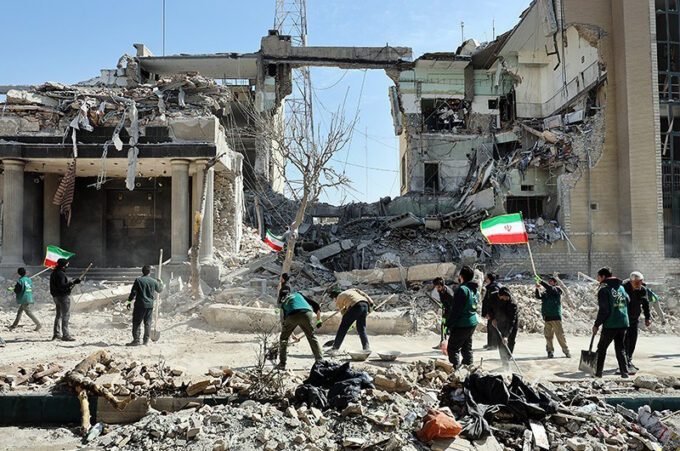
Photograph Source: Tasnim News Agency – CC BY 4.0

Truth may well be the first casualty of war, but death, injury and environmental degradation are bound to be keeping up in the hit lists.  Attacks on gas fields, oil refineries and petrochemical plants will always leave an impression once the conflict concludes.  In the case of carbon emissions, the most challenging obstacle in collective efforts to stay the rise of the earth’s temperatures, the Iran War is doing much to throw everything out of kilter.

The gloomy modelling from the Climate and Community Institute shows that the first fortnight of the Iran War, which began on February 28 as a crime against peace pursued by Israel and the United States, produced some 5 million tonnes of carbon dioxide.  To get a sense of proportion, the carbon pollution exceeded that of Iceland in one year.  The institute, in arriving at such figures, considered the carbon emissions arising from destroyed homes and buildings, destroyed fuel, the fuel used in combat and support operations, equipment embodied carbon (equipment lost) and missiles and drones.

To give a sense of the granular detail, a Lockheed Martin F-35 Lightning II fighter consumes roughly 5,600 to 6,500 litres of fuel during a single combat sortie lasting one-and-a-half to two hours.  The emission of carbon dioxide during such a mission is approximately that of 14-17 tonnes, the lifespan of a conventional passenger vehicle.  The company behind the production of the F-35 has also admitted that its sold products, in 2024, produced just under 14 million tonnes of carbon dioxide equivalents.

The authors of the Climate and Community Institute report further note that carbon costs will only rise in sharp fashion if the war persists.  Three reasons are postulated, and these do not even include such issues as the re-routing of commercial aviation traffic.  Firstly, as US and Israeli arsenals suffer depletion, “embodied emissions of building new weapons, along with fuel used to deliver them to the region, will rise.”  Secondly, the targeting of oil infrastructure in the region will result in the uncontrollable emission of fossil fuels, as what took place during the Gulf War.  Thirdly, the deployment of more naval vessels by other states to the Middle East, including France and the United Kingdom, ostensibly to protect their interests, will increase “emissions via [a] ‘defensive’ posture.”

Things do not end there.  The current obsession of the Trump administration’s pursuit of “energy dominance” will only see more fossil fuel production for reasons of energy security.  Reconstruction in the aftermath of the war will also cause emissions.  “Reconstructing infrastructure in the impacted region of 14 countries from Cypress to Azerbaijan – including homes, roads, hospitals, schools, oil and transport infrastructure – is not only costly but carbon intensive.”  The authors note with grim awareness that the emissions arising from rebuilding Gaza and Lebanon after the conflict “will produce at least 24 times more than the emissions from the war alone.”

Other conflicts have also been appalling emitters.  The hefty carbon footprint of the first 15 months of Israel’s campaign in Gaza arising from direct war activities, according to a multi-authored study published in April last year, exceeded the annual emissions of 36 individual countries and territories.  The total emissions would increase to 41 lowest emitting countries and territories if Hamas’s tunnel network and Israel’s “Iron Wall” protective fence were also included.  The authors arrive at a staggering figure of 32,275,089 tonnes of carbon dioxide equivalent (tCO2e) when pre-conflict and post-conflict related construction activities are included.  That final figure ranks higher than the annual emissions of 102 countries.

Broadly speaking, the Iran War has revealed how the continued reliance on fossil fuels is not only degrading in terms of environment but precarious in terms of security.  “Fossil fuel dependency is ripping away national security and sovereignty, and replacing it with subservience and rising costs,” explains Simon Stiell, Executive Secretary of the United Nations Framework Convention on Climate Change.  To that end, renewable sources of energy must be pursued with greater vigour.  “Meek dependence on fossil fuel imports,” he remarks, referring to European policy makers, “will leave Europe forever lurching from crisis to crisis.”  Renewable energy, however, will “turn the tables.  Sunlight doesn’t depend on narrow and vulnerable shipping straits.”

Brian Lee of Rethink Energy Florida builds on the theme with earnest seriousness, suggesting that “Energy security isclimate security.”  This is not a novel pairing; any serious policy in that sense “would treat accelerating renewable energy development not as an environmental gesture, but as a national imperative.”  Doing so would set “clear limits on the level of sea-level rise our coastal economies can endure as a second metric to the Paris Agreement’s 1.5 degrees C temperature increase limit – and align policy to stay below both.”

War has a nasty habit of suspending agendas and supplanting them with a murderous lunacy that becomes, for the duration of hostilities, dull and commonplace.  Important, pressing topics get marooned along the way.  When peace breaks out, those neglected topics return with a vengeance.  Along with the staining criminality of those who have soiled the peace, climate change is exactly one of those things, something that will storm back to the fore with menacing consequences.

Binoy Kampmark was a Commonwealth Scholar at Selwyn College, Cambridge. He lectures at RMIT University, Melbourne. Email: bkampmark@gmail.com

The Gulf States Economies are Facing the Challenges of War


 April 1, 2026

Photo by Ahmed Aldaie

How long will Gulf States bleed for war on Iran that the United States and Israel are waging? That’s a question a recent Newsweek article posed. According to the reporting, specialists from all six Gulf Cooperation Council (GCC) states describe a “growing frustration with the U.S. approach to the war with Iran and a perception of Trump prioritizing Israel.”

What The Guardian has called a “worst nightmare,” the war has impacted the GCC states, including Saudi Arabia and the UAE, to such a degree that they are consumed with fury as they absorb the shock of a conflict they did not want. The closure of the Strait of Hormuz and the Iranian attacks on energy infrastructure have placed particular pressure on regional economies. For the GCC economies, costs like these don’t have any corresponding political gains. The GCC’s bargain—American bases in exchange for defense and security—doesn’t look quite so beneficial at the moment.

Further, the GCC is a strategic hub of aviationtourism, and investment, and these industries are suffering because of the war. The Gulf states were aware of the implications before the war started. Once Israeli struck Doha in September without any reaction from the Trump administration, it served as both the “turning point” and the writing on the wall.

According to Qatari Prime Minister Sheikh Hamad bin Jassim Al Thani, the GCC States were pulled into a losing battle. He has warned of getting dragged into the conflict. At the same time, he points out that “the GCC possesses a radical, unconventional, and highly effective tool to force an end to the hostilities: a collective and complete halt of all oil and gas exports.”

GCC Skepticism

Israeli tactics, in particular, have escalated the conflict. Israel has attacked, for instance, a desalination facility in Iran and struck 30 oil storage tanks, thus precipitating Iranian and proxy attacks aimed at comparable GCC infrastructure.

As a result, GCC economies have had to suffer the unintended consequences of the war. A huge percentage of the population in the Gulf states depends on desalinated water. The states are now livid over the U.S. posture for its carelessness and an apparent determination to force Iranians to finally dig in their heels and produce a nuke.

Israeli strikes on Iranian political leadership accomplish the same thing. As Jeffrey St. Clair has observed, Israel assassinated Iranian top security official Ali Larijani “to stop any negotiated end of the war and to drag the U.S. deeper into it. In Iran, it will inevitably give more power to the most reactionary forces in the country.”

As Henry Kissinger once said, “To be an enemy of America is dangerous, but to be a friend is fatal.” Not surprisingly, GCC countries have lost trust in the United States and rewinding will be very difficult. The war has impacted interdependence and produced a “shadow of risk.” Tourism, banking, and data center construction will suffer not only short-term losses but long-term consequences because of the loss of U.S. credibility with its allies in its efforts to satisfy Netanyahu’s military ambitions. Companies like Amazon will not want to build any data centers only to be bombed again inside the year. Standard Chartered Bank recently had to evacuate and asked its Dubai employees to work from home.

The GCC is even questioning the legitimacy of U.S. bases. Even if the war ends soon, America has lost its reputation for providing reliable protection. In essence, GCC security issues of interdependence have only started.

GCC Optimism

The GCC is now raising some of the same questions as U.S. allies in Europe about the necessity to build an independent security capacity. “The conflict is accelerating the GCC’s push to diversify economic and defense ties away from exclusive reliance on the U.S., reinforcing a shift toward a more multipolar portfolio of partners,” observers Middle East expert Christopher Davidson. “At the same time, Gulf States are not abandoning Washington but are hedging by deepening relations with China, Russia, and other Asian powers in trade, finance, and arms. This reduces U.S. leverage over their economic strategies and nudges the security architecture toward a more transactional, multi‑supplier model.”

Concerning the consequences of Israel’s engagement in the region for GCC economies and regional stability, Davidson notes that,

Israel’s military actions, backed by the United States, have generated a perception in the Gulf that the region has been dragged onto the front lines, exposing their economies to shipping risks, higher insurance costs, and political backlash. As a result, the UAE and Bahrain (which signed the Abraham Accords) are likely to maintain normalization with Israel but shift toward quieter, less symbolic cooperation to manage domestic opinion and regional relationships, especially with Iran. This more discreet posture aims to preserve strategic benefits from Israel ties while limiting the economic and reputational spillovers of an unpopular war.

In terms of the GCC’s economic resilience in the face of intense geopolitical pressure, Davidson adds:

The GCC’s strong fundamentals, world‑class infrastructure, large sovereign wealth buffers, and relatively attractive regulatory environments—position their economies to remain resilient. In the long term, if the conflict delays or constrains Iran’s nuclear program, Gulf states could benefit from reduced security risks and more predictable investment conditions. They may also be well placed to capture future reconstruction contracts in Iran, should the regime soften or weaken, leveraging their capital and project‑delivery capacity to turn regional turmoil into opportunity.

The war has placed GCC economies under extreme pressure while disrupting global interdependence. The number of war crimes taking place in the conflict is undermining regional stability while producing a loathing toward the United States and Israel. As the war escalates, Gulf States are looking at their strategic interdependence and attempting to diversify beyond the Washington Consensus.

This first appeared in FPIF.

Daniel Falcone is a historian, teacher and journalist. In addition to CounterPunch, he has written for The Journal of Contemporary Iraq & the Arab WorldThe Nation, Jacobin, Truthout, Foreign Policy in Focus and Scalawag. He resides in New York City and is a member of The Democratic Socialists of America.