Jenipher Camino Gonzalez
DW with AFP, AP, Reuters
04.04.2026,
Artemis II is now closer to the Moon than the Earth. The astronauts on board have sent back eye-catching photos of our planet, and fixed a malfunctioning toilet along the way.

Astronauts captured a stunning shot of the globe, with the oceans topped by swirling clouds
Image: Reid Wiseman/NASA/ZUMA/picture alliance
The Artemis II mission successfully continued its lunar flyby path, passing the halfway point between the Earth and the Moon, NASA has said.
Artemis II astronauts are the first to fly towards the moon since Apollo 17 in 1972. They will not land, as their mission is a test of the capsule itself and the first steps of NASA's planned landing in 2028. The agency hopes to eventually establish a base on the moon.
MIssion control in Houston held a call with the four astronauts on board the Orion capsule at around 11:00 pm (4:00 am UTC) on Friday night, and informed them of the significance of their location.
"You are now closer to the moon than you are to us on Earth," said. NASA said they were 219,000 kilometers (136,080 miles) from Earth.
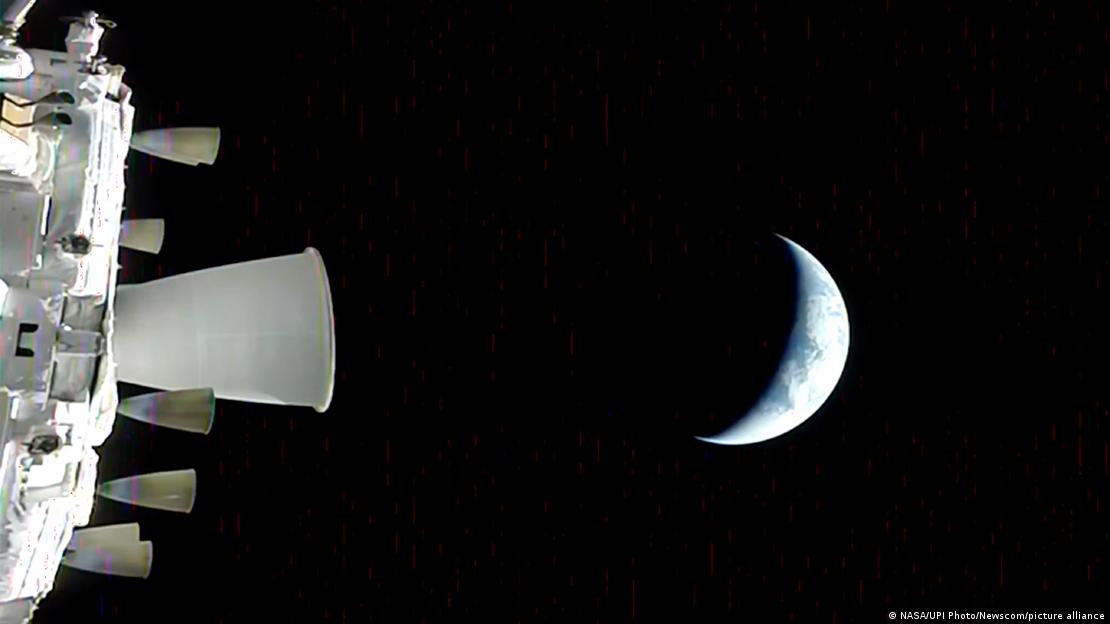
The Orion spacecraft will use the Moon's gravity to slingshot itself back to Earth without propulsionImage: NASA/UPI Photo/Newscom/picture alliance
The milestone comes just two days, five hours and 24 minutes after they took off from Cape Canaveral, Florida.
American astronauts Christina Koch, Victor Glover, Reid Wiseman and Canadian Jeremy Hansen are now on a so-called "free-return" trajectory, which allows Orion to use the Moon's gravity to slingshot around it before heading back towards Earth without propulsion.
"We all ... had a collective, I guess, expression of joy at that... We can see the Moon out of the docking hatch right now; it is a beautiful sight," Koch told mission control during the call.
Stunning photos and a broken toilet
As they swung around Earth, the astronauts took photos of our planet, which NASA has released.
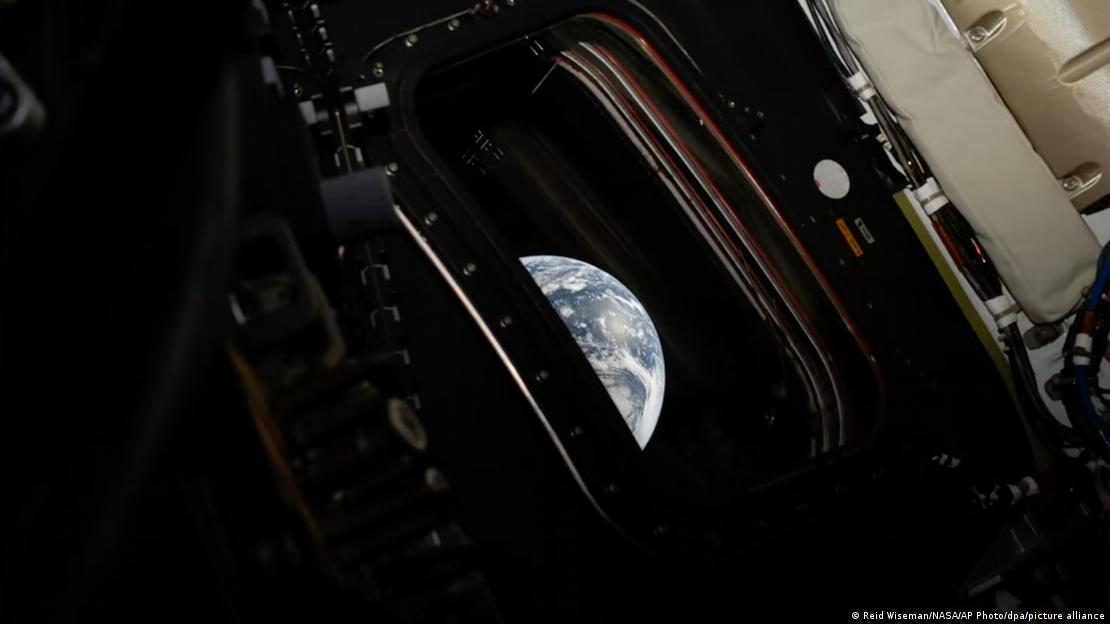
Among the photos taken by Commander Wiseman were a curved slice of Earth in one of the capsule's windows and a shot of the entire globe with the oceans topped by swirling clouds, where even a green aurora could be seen at the North Pole.
"It was the most spectacular moment, and it paused all four of us in our tracks," Wiseman said during a TV interview that the astronauts held.
The milestone comes just two days, five hours and 24 minutes after they took off from Cape Canaveral, Florida.
American astronauts Christina Koch, Victor Glover, Reid Wiseman and Canadian Jeremy Hansen are now on a so-called "free-return" trajectory, which allows Orion to use the Moon's gravity to slingshot around it before heading back towards Earth without propulsion.
"We all ... had a collective, I guess, expression of joy at that... We can see the Moon out of the docking hatch right now; it is a beautiful sight," Koch told mission control during the call.
Stunning photos and a broken toilet
As they swung around Earth, the astronauts took photos of our planet, which NASA has released.
Among the photos taken by Commander Wiseman were a curved slice of Earth in one of the capsule's windows and a shot of the entire globe with the oceans topped by swirling clouds, where even a green aurora could be seen at the North Pole.
"It was the most spectacular moment, and it paused all four of us in our tracks," Wiseman said during a TV interview that the astronauts held.
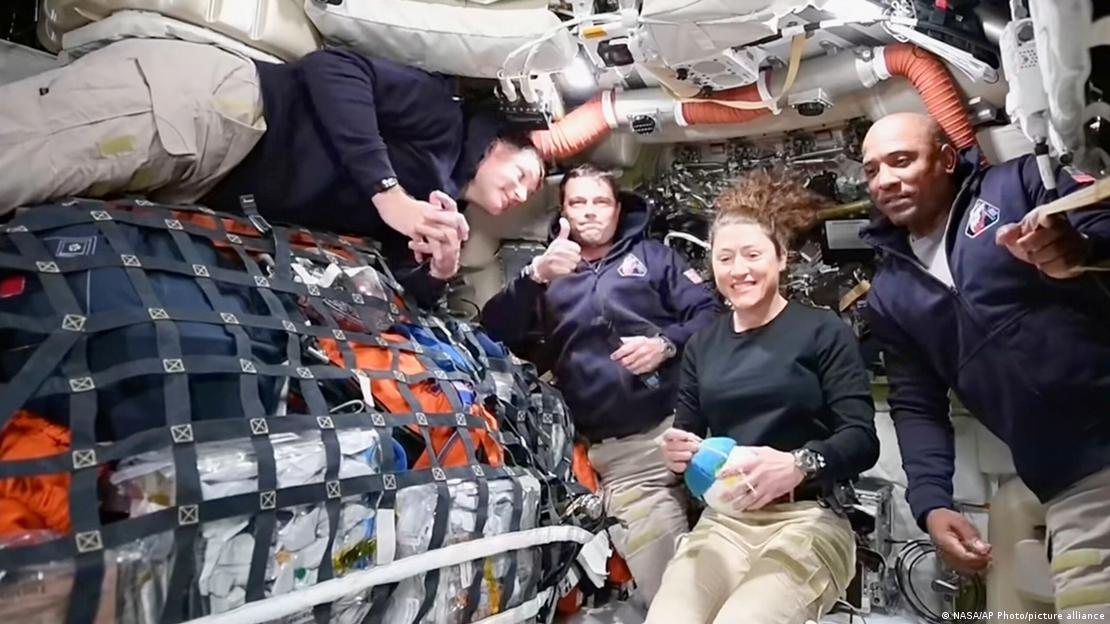
The Artemis II crew are working to make the spaceship a home during their 10-day missionImage: NASA/AP Photo/picture alliance
As their journey progresses, the astronauts have been settling into their confined space. They reported that it was a little bit cold inside the spacecraft, but that they were still making it a home.
During their first hours aboard Orion, they performed checks and fixed minor problems on the spacecraft, which included a communications issue and, crucially, a malfunctioning toilet.
Koch told the media that she was proud to call herself a space plumber.
"I like to say that it is probably the most important piece of equipment on board," Koch said. "So we were all breathing a sigh of relief when it turned out to be just fine," she added.
The astronauts have also already put in their first workouts, as each must spend 30 minutes a day exercising to offset the muscle and bone loss that occurs in zero gravity.
As their journey progresses, the astronauts have been settling into their confined space. They reported that it was a little bit cold inside the spacecraft, but that they were still making it a home.
During their first hours aboard Orion, they performed checks and fixed minor problems on the spacecraft, which included a communications issue and, crucially, a malfunctioning toilet.
Artemis II astronauts are the first to fly in the Orion capsule
Koch told the media that she was proud to call herself a space plumber.
"I like to say that it is probably the most important piece of equipment on board," Koch said. "So we were all breathing a sigh of relief when it turned out to be just fine," she added.
The astronauts have also already put in their first workouts, as each must spend 30 minutes a day exercising to offset the muscle and bone loss that occurs in zero gravity.
Artemis II astronauts ignite engines and head for lunar flyby
NASA’s Artemis II astronauts fired their engines and set course for a lunar flyby on Thursday, marking the first human departure from Earth orbit since 1972. The crew of three Americans and one Canadian will break distance records, witness a solar eclipse and pave the way for future lunar missions despite early challenges in orbit.
Issued on: 03/04/2026
By: FRANCE 24


Mission Control gave the final go-ahead minutes before the critical engine firing, telling the astronauts they were embarking on “humanity’s lunar homecoming arc” to bring them back to Earth. Koch replied: “With this burn to the moon, we do not leave Earth. We choose it.”
The next major milestone will be Monday’s lunar flyby.
Orion will zoom 4,000 miles (6,400 kilometres) beyond the moon before turning back, providing unprecedented and illuminated views of the lunar far side, at least for human eyes. The crew will even witness a total solar eclipse as the moon temporarily blocks the sun from their perspective.
While awaiting their orbital departure earlier Thursday, the astronauts savoured views of Earth from tens of thousands of miles high. Koch told Mission Control they could make out entire coastlines and even the South Pole, her old stomping ground.
“It is just absolutely phenomenal,” radioed Koch, who spent a year at an Antarctic research station before joining NASA.

NASA’s Artemis II astronauts fired their engines and set course for a lunar flyby on Thursday, marking the first human departure from Earth orbit since 1972. The crew of three Americans and one Canadian will break distance records, witness a solar eclipse and pave the way for future lunar missions despite early challenges in orbit.
Issued on: 03/04/2026
By: FRANCE 24
The Artemis 2 mission rocket was launched from the Kennedy Space Center at Cape Canaveral, Florida, on April 1, 2026. © Jim Watson, AFP
NASA’s Artemis II astronauts fired their engines and blazed toward the moon Thursday night, breaking free of the chains that have trapped humanity in shallow laps around Earth since Apollo.
The so-called translunar ignition came 25 hours after liftoff, putting the three Americans and a Canadian on course for a lunar fly-around early next week. Their Orion capsule bolted out of orbit around Earth right on cue and chased the moon to nearly 250,000 miles (400,000 kilometres) away.
It was the first such engine firing for a space crew since Apollo 17 set out on that era’s final moonshot on 7 December 1972. NASA reported preliminary indications that it went well.
NASA had the Artemis II crew stick close to home for a day to test their capsule’s life-support systems before clearing them for lunar departure.
Now committed to the Moon, the Artemis II test flight is the opening act for NASA’s grand plans for a Moon base and sustained lunar living.
NASA’s Artemis II astronauts fired their engines and blazed toward the moon Thursday night, breaking free of the chains that have trapped humanity in shallow laps around Earth since Apollo.
The so-called translunar ignition came 25 hours after liftoff, putting the three Americans and a Canadian on course for a lunar fly-around early next week. Their Orion capsule bolted out of orbit around Earth right on cue and chased the moon to nearly 250,000 miles (400,000 kilometres) away.
It was the first such engine firing for a space crew since Apollo 17 set out on that era’s final moonshot on 7 December 1972. NASA reported preliminary indications that it went well.
NASA had the Artemis II crew stick close to home for a day to test their capsule’s life-support systems before clearing them for lunar departure.
Now committed to the Moon, the Artemis II test flight is the opening act for NASA’s grand plans for a Moon base and sustained lunar living.
© France 24
14:52
Commander Reid Wiseman, pilot Victor Glover, Christina Koch and Jeremy Hansen will dash past the moon, then hang a U-turn and zip straight home without stopping on land. In the process, they will become the humans travelling the farthest ever from Earth, breaking the Apollo 13 distance record set in 1970. They also may become the fastest during reentry at flight’s end on 10 April.
Glover, Koch and Hansen have already made history as the first Black, the first woman and the first non-US citizen to launch to the moon. Apollo’s 24 lunar travellers were all white men.
READ MORE Artemis II launches historic flyby lunar mission with diverse crew
To set the mood for the day’s main event, Mission Control woke the crew with John Legend’s “Green Light” featuring André 3000 and a medley of NASA teams cheering them.
“We are ready to go,” pilot Victor Glover said.
14:52
Commander Reid Wiseman, pilot Victor Glover, Christina Koch and Jeremy Hansen will dash past the moon, then hang a U-turn and zip straight home without stopping on land. In the process, they will become the humans travelling the farthest ever from Earth, breaking the Apollo 13 distance record set in 1970. They also may become the fastest during reentry at flight’s end on 10 April.
Glover, Koch and Hansen have already made history as the first Black, the first woman and the first non-US citizen to launch to the moon. Apollo’s 24 lunar travellers were all white men.
READ MORE Artemis II launches historic flyby lunar mission with diverse crew
To set the mood for the day’s main event, Mission Control woke the crew with John Legend’s “Green Light” featuring André 3000 and a medley of NASA teams cheering them.
“We are ready to go,” pilot Victor Glover said.
Artemis II launches historic flyby lunar mission © France 24
00:39
00:39
Mission Control gave the final go-ahead minutes before the critical engine firing, telling the astronauts they were embarking on “humanity’s lunar homecoming arc” to bring them back to Earth. Koch replied: “With this burn to the moon, we do not leave Earth. We choose it.”
The next major milestone will be Monday’s lunar flyby.
Orion will zoom 4,000 miles (6,400 kilometres) beyond the moon before turning back, providing unprecedented and illuminated views of the lunar far side, at least for human eyes. The crew will even witness a total solar eclipse as the moon temporarily blocks the sun from their perspective.
While awaiting their orbital departure earlier Thursday, the astronauts savoured views of Earth from tens of thousands of miles high. Koch told Mission Control they could make out entire coastlines and even the South Pole, her old stomping ground.
“It is just absolutely phenomenal,” radioed Koch, who spent a year at an Antarctic research station before joining NASA.
© France 24
01:19
NASA is counting on the test flight to kickstart the Artemis programme and lead to a moon landing by two astronauts in 2028. Orion’s toilet may need some design tweaks before that happens.
The so-called lunar loo malfunctioned as soon as the Artemis crew reached orbit Wednesday evening. Mission Control guided Koch through some plumbing tricks, and she finally got it going, but not before using contingency urine storage bags.
Controllers also managed to bump up the cabin temperature. It was so cold earlier that the astronauts had to dig into their suitcases for long-sleeved clothes.
The contingency urine bags came in handy later. Mission Control ordered the crew to fill a number of empty bags with water from the capsule’s dispenser. A valve issue arose following liftoff, and NASA wanted plenty of drinking water on hand in case the problem worsened. The astronauts used straws and syringes to fill more than 2 gallons (7 litres) before pivoting to the moon.
(FRANCE 24 with AP)
01:19
NASA is counting on the test flight to kickstart the Artemis programme and lead to a moon landing by two astronauts in 2028. Orion’s toilet may need some design tweaks before that happens.
The so-called lunar loo malfunctioned as soon as the Artemis crew reached orbit Wednesday evening. Mission Control guided Koch through some plumbing tricks, and she finally got it going, but not before using contingency urine storage bags.
Controllers also managed to bump up the cabin temperature. It was so cold earlier that the astronauts had to dig into their suitcases for long-sleeved clothes.
The contingency urine bags came in handy later. Mission Control ordered the crew to fill a number of empty bags with water from the capsule’s dispenser. A valve issue arose following liftoff, and NASA wanted plenty of drinking water on hand in case the problem worsened. The astronauts used straws and syringes to fill more than 2 gallons (7 litres) before pivoting to the moon.
(FRANCE 24 with AP)
Artemis heads to the Moon as old rivals race to stake their claim
As NASA counts down to sending astronauts back to the Moon under the Artemis programme, countries are racing to secure their place in the lunar future – laying plans to build infrastructure on the surface and exploit its resources. More than 60 years after John F Kennedy called for cooperation in space, competition is once again driving the race to the Moon.
Issued on: 01/04/2026 - RFI

Artemis II will carry four astronauts – three Americans and one Canadian – around the Moon, in what will be the first crewed mission of the programme.
The launch is expected at Cape Canaveral, Florida in the United States, drawing attention around the world to a mission seen as a key step in returning humans to the Moon.
According to local Florida newspapers, some 400,000 people are expected to turn up to watch the liftoff, which is currently slated for Wednesday at 6:24 pm local time (22h24 UT)
More than six decades ago, the US was making a very different case for the future of space.

A call for cooperation
On 20 September, 1963, President Kennedy stood before the United Nations General Assembly in New York and delivered a message – aimed firmly at Soviet leader Nikita Khrushchev, even if his name wasn't heard.
Kennedy warned against the increase of military power on both sides of the Cold War divide – by both the US and the Soviet Union.
“Too long, we have increased our military budgets, our nuclear arsenals and our capacity to destroy all life on this hemisphere,” Kennedy said.
Calling for disarmament, he welcomed a Soviet proposal to keep weapons of mass destruction out of space.
“Why should man’s first flight to the Moon be a matter of national competition?” he asked.
Kennedy proposed a joint mission and said scientists and astronauts from different countries could work together, sending “not the representatives of a single nation, but the representatives of all of our countries”.

Back to the Moon
In 2017, US President Donald Trump announced plans to revive a programme similar to George W Bush’s cancelled Constellation programme, which would have carried astronauts to the ISS, as the successor to the US space shuttle programme, which was shuttered in 2011.
Trump's stated aim was to return to the Moon and stay there – if possible before China. To this end, the Artemis Moon exploration programme was established in 2017, with Artemis II set to be the first mission to carry astronauts.
The Canadian Space Agency is taking part, along with the European Space Agency (ESA) and Japan’s Jaxa, as is the United Arab Emirates through the Mohammed bin Rashid Space Centre. Italy has a separate bilateral agreement linked to the supply of a module for the lunar surface. French companies involved include Airbus, Latelec and ArianeGroup.
NASA’s Space Launch System is the most powerful rocket in history among those certified for crewed flights, but the mission carries risks.
Shortly before the launch of Artemis I in 2021, a liquid hydrogen leak during fuelling forced three members of a “red team” to go on to the launch pad and tighten bolts, in front of hundreds of tonnes of highly explosive liquids.
Building a lunar future
Artemis aims to build an overall system on the Moon and test what can be done there – making bricks, producing fuel, installing solar panels, and even a civilian nuclear power plant.
Europe has built the European Service Module, a crucial part of the Orion spacecraft that will carry the first crews around the Moon from Artemis II onwards. Four have been delivered, potentially enough for missions up to Artemis IV.
The astronauts are already training for their mission. In 2024 in Cologne, the ESA opened Luna, a lunar simulation site run jointly with the German Aerospace Centre (DLR), where crews can learn to move across artificial Moon dust.
Private companies too are now central to the programme – especially when it comes to landing systems, in which Blue Origin, the space company founded by Jeff Bezos, and SpaceX, led by Elon Musk, are both involved. While NASA will send the next humans on their journey to the Moon, private firms are expected to be the ones putting them on its surface.

Risks and rivalries
The Artemis programme should not be confused with the Artemis Accords, which date from 2020. Backed by Washington before the end of Trump’s first term, they created a legal framework around the exploitation of space resources and have now been signed by around 60 countries.
However, Russia was excluded from early talks, while China was not part of the process either. Russia is now working with China on its own lunar plans under the ILRS project and sees the Artemis Accords as centred on US interests.
France did not sign the accords until 2022, after checking they would not conflict with existing treaties, given the 1967 charter states that no state or private company can appropriate anything in space. By creating “safety zones” to protect activities on the ground, the accords raise the question of whether this amounts to taking control of territory on the Moon.
And by allowing private companies to exploit space resources, the Artemis Accords also raise the question of who gets to take possession of those resources.
“These questions will be discussed among those who can be part of the adventure and who will be able to go there. Artemis creates this framework,” said Lionel Suchet, deputy director general of the French National Centre for Space Studies.
The accords are also unusual in the way they were drafted and adopted.
“It is the first time we have had this kind of international act,” legal expert Lucien Rapp, scientific director of the Sirius Chair research programme, told RFI.
A text proposed “unilaterally by a space power” is being signed by other states, “but not all together, one by one”, Rapp said.
Trump plans to send humans to the Moon in 2028 if possible, setting out plans to “assert American leadership in space”, lay the foundations for a lunar economy, prepare for missions to Mars and inspire a new generation of explorers in a 2025 executive order.
Different countries may soon be operating side by side near the Moon’s south pole – Americans, Russians, Chinese, Indians and others, each with their own bases and projects – raising the practical question of how those missions will coexist, and whether cooperation will be possible on the ground.
The 1967 Outer Space Treaty says space should be used “for the benefit and in the interests of all countries”. But as new missions take shape, that principle will be tested.
This story was adapted from the original version in French by Igor Gauquelin
As NASA counts down to sending astronauts back to the Moon under the Artemis programme, countries are racing to secure their place in the lunar future – laying plans to build infrastructure on the surface and exploit its resources. More than 60 years after John F Kennedy called for cooperation in space, competition is once again driving the race to the Moon.
Issued on: 01/04/2026 - RFI
NASA's Artemis II Space Launch System rocket and Orion spacecraft rest on Launch Pad 39B at Kennedy Space Center in Cape Canaveral, Florida, on 31 March 2026, ahead of the crewed lunar mission. AFP - JIM WATSON
Artemis II will carry four astronauts – three Americans and one Canadian – around the Moon, in what will be the first crewed mission of the programme.
The launch is expected at Cape Canaveral, Florida in the United States, drawing attention around the world to a mission seen as a key step in returning humans to the Moon.
According to local Florida newspapers, some 400,000 people are expected to turn up to watch the liftoff, which is currently slated for Wednesday at 6:24 pm local time (22h24 UT)
More than six decades ago, the US was making a very different case for the future of space.
NASA astronauts Reid Wiseman, Artemis II commander, from left, Victor Glover, Artemis II pilot, Christina Koch, Artemis II mission specialist, and CSA (Canadian Space Agency) astronaut Jeremy Hansen, Artemis II mission specialist, right, in a group photograph as they visit NASA's Artemis II SLS (Space Launch System) rocket and Orion spacecraft, Monday, 30 March 2026, at Launch Complex 39B of NASA's Kennedy Space Center, in Cape Canaveral, Florida. AP - Bill Ingalls
A call for cooperation
On 20 September, 1963, President Kennedy stood before the United Nations General Assembly in New York and delivered a message – aimed firmly at Soviet leader Nikita Khrushchev, even if his name wasn't heard.
Kennedy warned against the increase of military power on both sides of the Cold War divide – by both the US and the Soviet Union.
“Too long, we have increased our military budgets, our nuclear arsenals and our capacity to destroy all life on this hemisphere,” Kennedy said.
Calling for disarmament, he welcomed a Soviet proposal to keep weapons of mass destruction out of space.
“Why should man’s first flight to the Moon be a matter of national competition?” he asked.
Kennedy proposed a joint mission and said scientists and astronauts from different countries could work together, sending “not the representatives of a single nation, but the representatives of all of our countries”.
Buzz Aldrin’s bootprint on the Moon in 1969 – one of the first marks left by humans on its surface during the Apollo missions. © NASA
No joint landing
Khrushchev left power in 1964. His son later said the Soviet leader had rejected an earlier offer so as not to reveal the Soviet Union’s technological lag, but might have accepted the second one. Instead, the two powers went their separate ways.
Less than six years after Kennedy’s assassination, the US landed on the Moon alone in 1969. Twelve Americans walked on its surface between 1969 and 1972.
At the same time, countries around the globe began setting rules for space. The 1967 Outer Space Treaty laid out principles for exploring and using space, including the Moon and other celestial bodies.
Further agreements followed – in 1968, rules were set for rescue operations and in 1972, responsibility in case of problems involving artificial satellites was clarified.
This cooperation continued after the fall of the Berlin Wall, first with regard to the Mir space station and later on the International Space Station.
But geopolitical tensions did not disappear with the lifting of the Iron Curtain.
"Fast-forward to today, and the current sharp escalation of security threats in and from outer space requires a legally binding agreement to preserve its peaceful nature," writes the UN on its website.
"However, the most recent attempts in the General Assembly and the Security Council to adopt a document on a weapons-free outer space have failed."
No joint landing
Khrushchev left power in 1964. His son later said the Soviet leader had rejected an earlier offer so as not to reveal the Soviet Union’s technological lag, but might have accepted the second one. Instead, the two powers went their separate ways.
Less than six years after Kennedy’s assassination, the US landed on the Moon alone in 1969. Twelve Americans walked on its surface between 1969 and 1972.
At the same time, countries around the globe began setting rules for space. The 1967 Outer Space Treaty laid out principles for exploring and using space, including the Moon and other celestial bodies.
Further agreements followed – in 1968, rules were set for rescue operations and in 1972, responsibility in case of problems involving artificial satellites was clarified.
This cooperation continued after the fall of the Berlin Wall, first with regard to the Mir space station and later on the International Space Station.
But geopolitical tensions did not disappear with the lifting of the Iron Curtain.
"Fast-forward to today, and the current sharp escalation of security threats in and from outer space requires a legally binding agreement to preserve its peaceful nature," writes the UN on its website.
"However, the most recent attempts in the General Assembly and the Security Council to adopt a document on a weapons-free outer space have failed."
Power play: why NASA is betting on nuclear to outpace rivals on the Moon
Back to the Moon
In 2017, US President Donald Trump announced plans to revive a programme similar to George W Bush’s cancelled Constellation programme, which would have carried astronauts to the ISS, as the successor to the US space shuttle programme, which was shuttered in 2011.
Trump's stated aim was to return to the Moon and stay there – if possible before China. To this end, the Artemis Moon exploration programme was established in 2017, with Artemis II set to be the first mission to carry astronauts.
The Canadian Space Agency is taking part, along with the European Space Agency (ESA) and Japan’s Jaxa, as is the United Arab Emirates through the Mohammed bin Rashid Space Centre. Italy has a separate bilateral agreement linked to the supply of a module for the lunar surface. French companies involved include Airbus, Latelec and ArianeGroup.
NASA’s Space Launch System is the most powerful rocket in history among those certified for crewed flights, but the mission carries risks.
Shortly before the launch of Artemis I in 2021, a liquid hydrogen leak during fuelling forced three members of a “red team” to go on to the launch pad and tighten bolts, in front of hundreds of tonnes of highly explosive liquids.
Russia's first lunar mission in 47 years smashes into the moon in failure
Building a lunar future
Artemis aims to build an overall system on the Moon and test what can be done there – making bricks, producing fuel, installing solar panels, and even a civilian nuclear power plant.
Europe has built the European Service Module, a crucial part of the Orion spacecraft that will carry the first crews around the Moon from Artemis II onwards. Four have been delivered, potentially enough for missions up to Artemis IV.
The astronauts are already training for their mission. In 2024 in Cologne, the ESA opened Luna, a lunar simulation site run jointly with the German Aerospace Centre (DLR), where crews can learn to move across artificial Moon dust.
Private companies too are now central to the programme – especially when it comes to landing systems, in which Blue Origin, the space company founded by Jeff Bezos, and SpaceX, led by Elon Musk, are both involved. While NASA will send the next humans on their journey to the Moon, private firms are expected to be the ones putting them on its surface.
The Moon rises over Dubai in June 2025. The United Arab Emirates is among the partners taking part in NASA’s Artemis programme. AFP - FADEL SENNA
Blue Origin has paused its space tourism flights to focus on its larger New Glenn rocket and its work on the Moon. Its first cargo lander, Blue Moon MK-1, arrived at NASA’s Johnson Space Centre in Houston in early February.
SpaceX, meanwhile, hopes to step up tests of its Starship system. In February, Musk said his company was now refocusing on the Moon, with the goal of building a first “autonomous city”.
“We can potentially achieve this in less than 10 years, whereas Mars would take more than 20 years,” Musk said – adding that launches to the red planet come every 26 months, while “we can do a launch to the Moon every 10 days”.
Blue Origin has paused its space tourism flights to focus on its larger New Glenn rocket and its work on the Moon. Its first cargo lander, Blue Moon MK-1, arrived at NASA’s Johnson Space Centre in Houston in early February.
SpaceX, meanwhile, hopes to step up tests of its Starship system. In February, Musk said his company was now refocusing on the Moon, with the goal of building a first “autonomous city”.
“We can potentially achieve this in less than 10 years, whereas Mars would take more than 20 years,” Musk said – adding that launches to the red planet come every 26 months, while “we can do a launch to the Moon every 10 days”.
Risks and rivalries
The Artemis programme should not be confused with the Artemis Accords, which date from 2020. Backed by Washington before the end of Trump’s first term, they created a legal framework around the exploitation of space resources and have now been signed by around 60 countries.
However, Russia was excluded from early talks, while China was not part of the process either. Russia is now working with China on its own lunar plans under the ILRS project and sees the Artemis Accords as centred on US interests.
France did not sign the accords until 2022, after checking they would not conflict with existing treaties, given the 1967 charter states that no state or private company can appropriate anything in space. By creating “safety zones” to protect activities on the ground, the accords raise the question of whether this amounts to taking control of territory on the Moon.
And by allowing private companies to exploit space resources, the Artemis Accords also raise the question of who gets to take possession of those resources.
“These questions will be discussed among those who can be part of the adventure and who will be able to go there. Artemis creates this framework,” said Lionel Suchet, deputy director general of the French National Centre for Space Studies.
Europe's quick-fit spacesuit to be tested aboard ISS by France's Adenot
The accords are also unusual in the way they were drafted and adopted.
“It is the first time we have had this kind of international act,” legal expert Lucien Rapp, scientific director of the Sirius Chair research programme, told RFI.
A text proposed “unilaterally by a space power” is being signed by other states, “but not all together, one by one”, Rapp said.
Trump plans to send humans to the Moon in 2028 if possible, setting out plans to “assert American leadership in space”, lay the foundations for a lunar economy, prepare for missions to Mars and inspire a new generation of explorers in a 2025 executive order.
Different countries may soon be operating side by side near the Moon’s south pole – Americans, Russians, Chinese, Indians and others, each with their own bases and projects – raising the practical question of how those missions will coexist, and whether cooperation will be possible on the ground.
The 1967 Outer Space Treaty says space should be used “for the benefit and in the interests of all countries”. But as new missions take shape, that principle will be tested.
This story was adapted from the original version in French by Igor Gauquelin

No comments:
Post a Comment