Wednesday, January 29, 2020


Towering dinosaur with radioactive skull identified in Utah 


The 155-million-year-old specimen was headless until a radiation detector located the skeleton's skull.
This illustration shows a pack of the newly discovered Allosaurus jimmadseni attacking a young sauropod. (Image: © Todd Marshall) 

Paleontologists hve discvered the skeleton and radioactive skull of a previously unknown species of Allosaurus. The fearsome two-legged dinosaur sported 80 sharp teeth and horns over its eyes when it lived about 155 million years ago in what is now Utah.

But researchers didn't know any of these details at first; originally, they found only the dinosaur's skeleton but not the head. Even so, the block of rock that encased the skeleton was so massive — it weighed 6,000 lbs. (2,700 kilograms) — that paleontologists had to use explosives to remove the fossils and a helicopter to transport it. 

It wasn't until six years later, in 1996, that the headless body and its skull were reunited.


That happy reunion was made possible by Ramal Jones, a retired University of Utah radiologist. Armed with a radiation detector, he located the radioactive skull not far from its body. It's not uncommon for dinosaur bones to be radioactive, as radioactive elements can leach into the bones over time from the surrounding sediment. Later, teams from Dinosaur National Monument excavated the dinosaur's head, which helped researchers identify the remains as a newfound dinosaur species. 
Scientists named the beast Allosaurus jimmadseni, after paleontologist James Madsen Jr. (1932-2009), recognizing him for his "herculean efforts of protecting, excavating, preparing and curating of many thousands of Allosaurus bones," the researchers wrote in the study.

During the late Jurassic period, A. jimmadseni lived on the semiarid flood plains of western North America. This dinosaur is the oldest species of Allosaurus, outdating Utah's better-known Allosaurus fragilis, which helped make the Allosaurus the state's official fossil. 
"Previously, paleontologists thought there was only one species of Allosaurus in Jurassic North America, but this study shows there were two species — the newly described Allosaurus jimmadseni evolved at least 5 million years earlier than its younger cousin, Allosaurus fragilis," study co-lead researcher Mark Loewen said in a statement. Loewen is a research associate at the Natural History Museum of Utah and an associate professor in the Department of Geology and Geophysics at the University of Utah.

This dinosaur was a big carnivore, measuring up to 29 feet (9 meters) long and weighing about 4,000 lbs. (1.8 metric tons). It had a narrow skull, horns in front of its eyes and a crest that ran from those horns to its nose. Each of the dinosaur's long arms ended with three sharp claws.

"The skull of Allosaurus jimmadseni is more lightly built than its later relative Allosaurus fragilis, suggesting a different feeding behavior between the two," Loewen noted.

Loewen and co-researcher Daniel Chure, a retired paleontologist at Dinosaur National Monument, detailed the study online Friday (Jan. 24) in the journal PeerJ.


Originally published on Live Science.

Black holes shouldn't echo, but this one might. Score 1 for Stephen Hawking?

\This isn't how black holes are supposed to behave.

By Rafi Letzter - Staff Writer

Black holes are infinitely dense objects surrounded by smooth event horizons.
(Image: © Shutterstock)

When two neutron stars slammed together far off in space, they created a powerful shaking in the universe — gravitational waves that scientists detected on Earth in 2017. Now, sifting through those gravitational wave recordings, a pair of physicists think they've found evidence of a black hole that would violate the neat model drawn from Albert Einstein's theory of general relativity.

In general relativity, black holes are simple objects: infinitely compressed singularities, or points of matter, surrounded by smooth event horizons through which no light, energy or matter can escape. Until now, every bit of data we've gleaned from black holes has supported this model.

But in the 1970s, Stephen Hawking wrote a series of papers suggesting that the borders of black holes aren't quite so smooth. Instead, they blur thanks to a series of effects linked to quantum mechanics that allow "Hawking radiation" to escape. In the years since, a number of alternative black hole models have emerged, where those smooth, perfect event horizons would be replaced with flimsier, fuzzier membranes. More recently, physicists have predicted that this fuzz would be particularly intense around newly formed black holes — substantial enough to reflect gravitational waves, producing an echo in the signal of a black hole's formation. Now, in the aftermath of the neutron star collision, two physicists think they've found that type of echo. They argue that a black hole that formed when the neutron stars merged is ringing like an echoing bell and shattering simple black hole physics.

If the echo is real, then it must be from the fuzz of a quantum black hole, said study co-author Niayesh Afshordi, a physicist at the University of Waterloo in Canada.

"In Einstein's theory of relativity, matter can orbit around black holes at large distances but should fall into the black hole close to the event horizon," Afshordi told Live Science.


So, close to the black hole, there shouldn't be any loose material to echo gravitational waves. Even black holes that surround themselves with disks of material should have an empty zone right around their event horizons, he said.

"The time delay we expect (and observe) for our echoes ... can only be explained if some quantum structure sits just outside their event horizons," Afshordi said.

That's a break from usually unshakable predictions of general relativity.


That said, data from existing gravitational wave detectors is noisy, difficult to properly interpret and prone to false positives. A gravitational wave echoing off some quantum fuzz around a black hole would be an entirely new sort of detection. But Afshordi said that in the immediate aftermath of the merger, that fuzz should have been intense enough to reflect gravitational waves so sharply that existing detectors could see it.

Joey Neilsen, an astrophysicist at Villanova University in Pennsylvania who wasn't involved in this paper, said that the result is compelling — particularly because the echoes turned up in more than one gravitational wave detector.

"That's more convincing than combing through data looking for a specific kind of signal and saying, 'aha!' when you find it," Neilsen told Live Science.

Still, he said, he'd need to see more information before he was absolutely convinced that the echoes were real. The paper doesn't account for other gravitational wave detections gathered within about 30 seconds of the reported echoes, Neilsen said.

"Because significance calculations are so sensitive to how you pick and choose your data, I would want to understand all those features more fully before I drew any firm conclusions," he said.

Maximiliano Isi, an astrophysicist at MIT, was skeptical.

"It is not the first claim of this nature coming from this group," he told Live Science.
"Unfortunately, other groups have been unable to reproduce their results, and not for lack of trying."

Isi pointed to a series of papers that failed to find echoes in the same data, one of which, published in June, he described as a "a more sophisticated, statistically robust analysis."

Afshordi said that this new paper of his has the advantage of being far more sensitive than previous work, with more robust models to detect fainter echoes., adding, "the finding that we reported... is the most statistically significant out of the dozen searches [I discussed], as it had the false alarm chance of roughly 2 out of 100,000."

Even if the echo is real, scientists still don't know precisely what sort of exotic astrophysical object produced the phenomenon, Neilsen added.

"What's so interesting about this case is that we don't have any idea what was left after the original merger: Did a black hole form right away, or was there some exotic, short-lived intermediate object?" Neilsen said. "The results here are easiest to make sense of if the remnant is a hypermassive [neutron star] that collapses within a second or so, but the echo presented here isn't convincing to me that that scenario is what actually happened."

It is possible there are echoes in the data, Isi said, which would be enormously significant. He's just not convinced yet.

Regardless of how all the data shakes out, Neilson said, it's clear the result here is pointing at something worth exploring further.

"Astrophysically, we're in uncharted territory, and that's really exciting." he said. The paper was published Nov. 13, 2019, in the Journal of Cosmology and Astroparticle Physics.


9 Ideas About Black Holes That Will Blow Your Mind
The 12 Strangest Objects in the Universe
8 Ways You Can See Einstein's Theory of Relativity in Real Life

Originally published on Live Science.

Founded by Frank Lloyd Wright, famed Taliesin school is closing

2020/1/28©Chicago Tribune
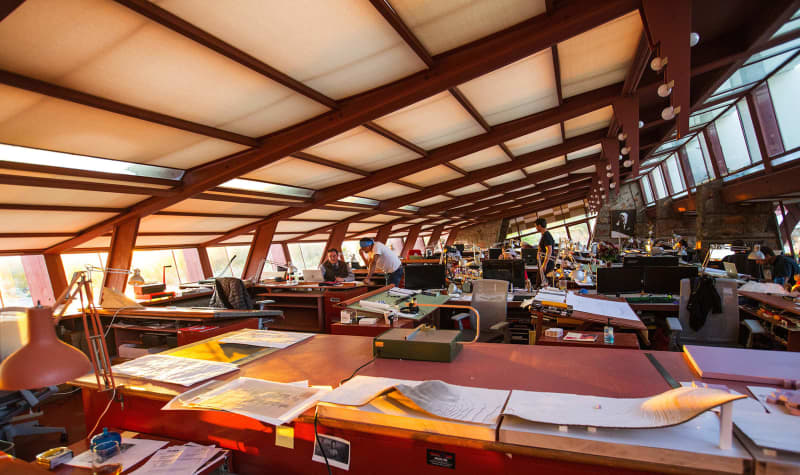
Interior of the classroom/drafting studio at Taliesin West. - Mike Siegel/Seattle Times/TNS

Founded by Frank Lloyd Wright during the Great Depression, the famous school of architecture that once bore his name will close at the end of June, the school announced Tuesday.

Called the School of Architecture at Taliesin and established by Wright and his wife Olgivanna in 1932, the accredited private graduate school offered a three-year master’s program that loomed large in the world of architecture because of its celebrated history and espousal of Wright’s philosophy of “organic architecture.”

Its early cohorts of students, known as “apprentices,” were part of what Wright and his wife called the Taliesin Fellowship. Initially located in Wright’s Taliesin compound in Spring Green, Wis., the school later expanded to Wright’s Taliesin West retreat in Scottsdale, Ariz.

Students rotated between the two Taliesins, spending the winter in Arizona. They served as both a source of income and labor for Wright during the bleak Depression years when building largely ground to a halt. Some later worked with the architect on such renowned projects as his spiraling Guggenheim Museum in New York.

“This is a sad and somber day for our school, our students and staff and the architecture community,” Dan Schweiker, chair of the school’s board of governors said in a news release issued Tuesday. The release added that the board made the “gut-wrenching” decision to close to the school on Saturday.

Schweiker added: “We did everything possible to fight for (the school’s) survival but due to other forces it was not meant to be.”

Schweiker did not elaborate. But the news release said the board was unable to reach an agreement with the Frank Lloyd Wright Foundation to keep the school open. The foundation, based in Scottsdale, owns the two Taliesin properties, which are open for public tours.

For its part, the foundation appeared to shift blame for the closing to the school’s board.

Leaders of the board told the foundation that the school “did not have a sustainable business model that would allow it to maintain its operations as an accredited program,” the foundation said in a news release.

But the school’s board did not approve a plan that would have allowed the school to develop new programs for which accreditation was not required and would have let second- and third-year students to finish their education, the foundation said.

“We are disappointed that (the plan) was not approved” by the school’s full board, Stuart Graff, the foundation’s president said.

In an email to the Chicago Tribune, the school’s president, Aaron Betsky, responded that the school had come up with a sustainable business model and accused the foundation of making unreasonable financial demands.

“The foundation offered us an ultimatum: Close by the end of July, or continue for one more year and one more year only, but only after giving up accreditation,” Betsky wrote.

In the wake of the decision to close the school, the foundation plans to expand educational programs, including K-12 teaching, adult education and programs for architects, preservation specialists and design professionals.

About 30 students are now enrolled at the school, according to its news release. The school is working out an agreement with a design school at Arizona State University that will let the students transfer credits to that school and get their degrees, it said in its news release.

Graff also promised to be sure that the shutdown “occurs in the best interests of the students.”

The decision to close the Taliesin school comes three years after it changed its name to the School of Architecture at Taliesin from the Frank Lloyd Wright School of Architecture and sought to gain financial independence from the foundation.

At the time, Betsky, then the school’s dean, said: “Adopting this new name … helps us secure our identity as an experimental, forward-looking architecture program rooted in the Taliesin Fellowship.”

The school’s closure comes at a time when the architect’s renown remains high.

Last year, the cultural arm of the United Nations placed eight Wright-designed buildings, including both Taliesin complexes as well as the Unity Temple in Oak Park, Ill., and Chicago’s Robie House, on the UNESCO World Heritage List, which honors sites of global cultural and natural significance.

———

(Kamin is a Chicago Tribune critic.)

———

©2020 Chicago Tribune
UAW reformers want to change how leaders are picked 

2020/1/28 ©Detroit Free Press

UAW president Gary Jones marches with Union workers in the Labor Day parade down Michigan Ave. Monday, Sept. 2, 2019 in Detroit, Mich. - Kirthmon F. Dozier/Detroit Free Press/TNS

A UAW group says it’s closing in on the support it needs from union locals to force a special convention that could lead to direct election of union leaders in response to anger over a long-standing corruption probe.

The group, Unite All Workers for Democracy, this week said 18 locals representing more than 40,000 workers have passed resolutions in favor of a special convention.

A key change being sought is a shift to direct election — “one member, one vote” rather than selection by delegates — of the union’s top leaders. The movement is fueled by anger at revelations from the federal corruption probe that has uncovered self-dealing and embezzlement by key union and auto company figures.

The group said it needs locals with a combined total membership of about 79,000 to pass resolutions in favor. The rules under the UAW constitution also require locals to be from at least five different states, which the release said the group has accomplished.

Justin Mayhugh, a founding member of the group and an activist in UAW Local 31 at General Motors’ Fairfax Assembly Plant in Kansas City, said the movement toward a special convention represents “a true display of solidarity” among locals.

“The membership understands how vital it is that they come together to take on the corruption at the highest levels of our union. Calling for a special convention to implement referendum voting of our International officers would be a historic step in the right direction. We are extremely hopeful that even more locals will pass Article 8 resolutions in the very near future,” Mayhugh said in a news release, encouraging interested members to reach out to the group through its website, www.uawd.org

Article 8 is the section of the UAW constitution where rules for establishing a special convention are described.

The group and its reform effort is a response to the federal corruption probe that so far has led to the downfall of past UAW President Gary Jones and former Region 5 Director Vance Pearson and charges against 13 and convictions of 11 former union leaders, members and Fiat Chrysler Automobiles officials. Jones has not been charged, but he has been implicated as an unnamed union official as part of a group accused of embezzling more than $1.5 million in union funds. Pearson is expected to plead guilty to charges of conspiracy to embezzle union funds and to use a facility of interstate commerce to aid a racketeering enterprise.

Angry membership

The scandal has angered many members and undercut the UAW’s historic image as a clean union. A Free Press story in November on the reform effort noted that the organizers were battling to convince members not to stop paying dues but to instead reform the union and work to avoid a government takeover.

The UAW leadership has highlighted a series of financial and ethical reforms aimed at rebuilding trust, and President Rory Gamble has pledged to leave his successors a clean union when he retires.

The UAW, which has more than 400,000 members, issued a statement noting its own reforms following a request for comment on the group’s efforts:

“Ultimately, the membership body makes these changes under the prescribed process for initiating, reviewing and voting on proposed changes. In the meantime, under the leadership of President Rory Gamble, working tirelessly with the board, the UAW continues to aggressively implement a series of critical reforms necessary to strengthen the union’s financial controls, oversight, and its overall accounting system.”

———

©2020 Detroit Free Press
Northern Lights: Stunning time-lapse video captures newly discovered aurora
2020/1/28  ©Full Stack Media Inc
Table of Contents
The new Northern Lights
A cosmic puzzle


Scientists have never seen anything like this on Earth before.

By piecing together a series of images, amateur photographers and a group of astrophysicists have discovered a new kind of aurora — auroral dunes — adding a layer of complexity to the already incredible aurora borealis.

It marks the first observation of an extremely rare phenomenon that takes place in Earth’s mesosphere, and gives scientists an unprecedented window into an unexplored area of our planet’s upper atmosphere.

The discoverycame when the photographers and aurora enthusiasts noticed something weird while photographing the Northern Lightsin action. One auroral form did not fit into any of the established categories of auroras.

Watch the full time-lapse video to see this strange phenomena in action:

The photographers and researchers described their findings in a study published on Tuesday in the journal AGU Advances.
The new Northern Lights

The Northern Lights are a type of aurora, which are phenomena caused by bouts of space weather. As the Sun emits charged particles in the form of solar wind, they excite oxygen and nitrogen atoms in Earth’s ionized upper atmosphere, causing auroral emissions that result in the varying colors of light that we see in the skies here on Earth.

The Northern Lights aren't the only aurora visible on Earth — if you are in the southern hemisphere close to the South Pole, then you might catch sight of its sister aurora, the aurora australis, or the Southern Lights.

Auroras take different forms: They can appear as patches of light, arcs that curve across the sky, or as rays breaking through the sky — and each one has its own fingerprint.

But the newly discovered aurora — dubbed ‘a dune aurora’ due to its sand dune-like shape — did not fit into any of the established categories.

As the video shows, the formation looks like a green-tinged pattern of waves dancing across a relatively unexplored area which lies between the Earth’s atmosphere and the edge of space — the mesosphere — located some 50 kilometers above the planet's surface.

But in order to figure out what this new type of aurora was, the team first had to identify whereit was. And to do that, the researchers looked further out into space — to the stars.
A cosmic puzzle

To identify the aurora, the team first mapped the stars that could be seen behind the aurora. By working out their elevation, the team could use them as a point of reference, enabling them to calculate the altitude and other key characteristics of the new auroral phenomenon.

To their surprise, the auroral dunes occur at a relatively low altitude — 100 kilometers — in the upper parts of the mesosphere. The mesosphere is the part of Earth’s atmosphere located between the stratosphere and the thermosphere. Because this area lies where Earth’s atmosphere and space meet, it is extremely difficult for satellites to observe.

"Due to the difficulties in measuring the atmospheric phenomena occurring between 80 and 120 kilometres in altitude, we sometimes call this area 'the ignorosphere'," Minna Palmroth, professor at the University of Helsinki and lead author of the study, said.

The researchers aren't sure what causes dune auroras, but they have some theories. The unfamiliar pattern could either be the result of wave forms in the particles being emitted from the Sun during solar wind events. But they could also be to do with the density of oxygen atoms in Earth’s atmosphere.

Very rarely, a gravity wave rises up through the Earth's atmosphere. And in even rarer cases, these waves can be funneled between the boundary of the mesosphere and the thermosphere. When that happens, so the theory goes, dune auroras may occur when solar wind excites the oxygen atoms in the channel. That releases light — the green, sandy beach-like waves we can see here on Earth. More research will be needed to confirm whether that is the case, however.

The discovery came somewhat by accident: Palmroth had asked for the help of Northern Lights enthusiasts to gather images of the light display for a book she was writing, A guide for aurora borealis watchers, which was published in late 2018.

"It was like piecing together a puzzle or conducting detective work," Matti Helin, a Northern Lights hobbyist who was involved in the discovery, said in a statement. “Every day we found new images and came up with new ideas.”

Tuesday, January 28, 2020


At N.J. rally, Trump warns people about loss of cows, saying there are no cows in Wildwood
2020/1/28©Advance Local Media LLC.


We’ve heard about “making America great again.”

But making Wildwood have cows again?

“I love New Jersey, and I’m thrilled to be right here back in the Garden State," PresidentDonald Trumpsaid at the start of his Tuesday nightrally at the Wildwoods Convention Center. "The Garden State.”

Later, Trump went on to talk about cows. Mainly, the lack of them in Wildwood (notwithstanding the existence of Lehigh Valley Dairy Farms on Spicer Avenue).

The bovine reference arrived when Trump was speaking ill of the proposed Green New Deal. He claimed that the measure, intended to take action on climate change, would somehow separate farmers from their cows.

“You don’t have too many cows in Wildwood, but if you do, they’re gone," Trump said, attempting to tailor the Green New Deal assertion to the local community.


Some noted the seemingly incongruous mention of cows in the Shore Town on Twitter.

"Democrats in Washington want to get rid of your oil and your cows. You don't have a lot of cows in WildWood, but if you have one, he's gone."

I love this guy pic.twitter.com/gMeRBJJqUw

— Red Walrus (@RedWalrus1)

I wish he were a cow in Wildwood 😜

— ImpeachedForLife😎 (@noah_zoey)

Trump now issuing an ominous warning about the Green New Deal.

Says it will lead to cows being gone.

Note: there are no known cattle ranches in shore town of Wildwood, New Jersey.

Well, I guess there never will be now. Sad. Sorry, cows.

— The Hoarse Whisperer (@HoarseWisperer)

The only cow in Wildwood, NJ. I think she is a @realDonaldTrumpfan!😎 pic.twitter.com/6c75N4IYap

— Darren Webb (@bfd400)
A month after Puerto Rico's earthquakes began, more than 4,000 still sleep outside
2020/1/28 ©Miami Herald
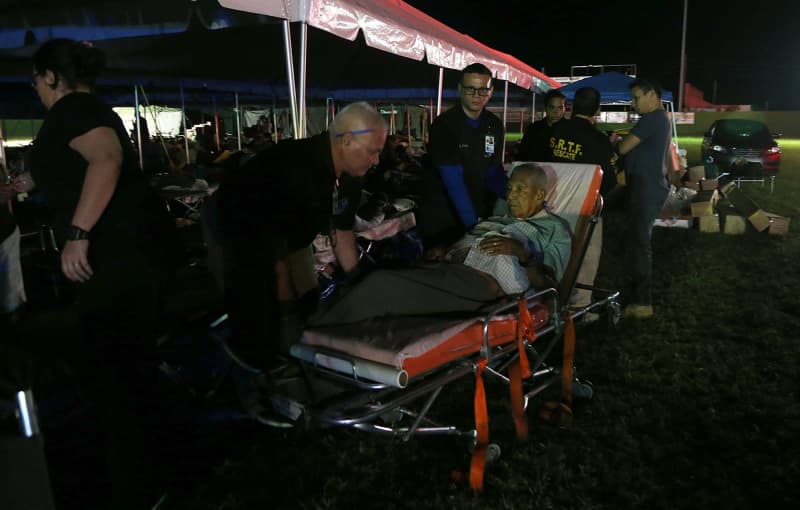
Pedro Portal/Miami Herald/TNS

SAN JUAN, Puerto Rico — A month after a series of powerful earthquakes began rattling Puerto Rico, about 4,600 people are still sleeping at emergency shelters — either because their residences are damaged or because they’re simply too afraid to go home.

At a news conference Tuesday, government officials said the quakes, which began on Dec. 28 and peaked on Jan. 7 with a magnitude 6.4 main shock, have damaged 1,390 buildings and completely destroyed at least 300. But most of the people who remain at municipal shelters and improvised camps are there out of sheer precaution, Gov. Wanda Vázquez said.

“During my visits to shelters and camps, I’ve noticed that although some people have lost their homes … many people simply don’t want to sleep under a roof,” she said. “Even when their house hasn’t been damaged, they prefer to be at the camps or under a tent for security.”

While the U.S. territory of 3.2 million people is accustomed to storms and hurricanes, these are the first major earthquakes to hit Puerto Rico in a century, and the psychic damage has been almost as bad as the physical damage.

Julio Seda, 55, has been living in a tent city in Guayanilla since Jan. 7. He realizes he’s one of the lucky ones, as his home has been unscathed by the earthquakes. And last week he was almost ready to quit sleeping in his car and go home, but on Saturday the area was hit by a powerful magnitude 5 aftershock.

“There’s so much speculation and fear that a bigger earthquake is coming and that has kept us living outside,” said Seda, who has been camping out with 13 other people. “It’s hard to go home while it’s still shaking.”

The Federal Emergency Management Agency has provided 1,086 people with $2.7 million in home repair and rental assistance aid due to the earthquakes. And the local government has been sending teams of therapists and psychologists to provide support.

“This isn’t the first country or area of a country that has seen constant earthquakes,” said Suzanne Roig, the head of Puerto Rico’s Mental Health and Anti-Addiction Services Administration, or ASSMCA. “We are trying to provide an education … but it takes time.”

Vázquez said local and federal officials are planning to have everyone out of sprawling emergency camps strewn along Puerto Rico’s southern coast within 60 days, even as aftershocks continue.

The government’s response to the earthquakes has come under intense scrutiny as Vázquez is hoping to win a second term in November’s general election.

Earlier this month, she came under fire after it was discovered that a warehouse full of emergency aid was never disbursed. She fired three of her Cabinet members in response and ordered a Justice Department investigation.

On Tuesday, she tried to highlight her government’s work, saying it has provided shelter to more than 62,800 people since the earthquakes started, distributed more than 144,700 meals and inspected more than 7,081 homes.

But Vázquez said there’s still “a long way to go” before the crisis is over.

The U.S. Geological Survey has said minor aftershocks are likely to continue for days, if not weeks, to come.

Seda said he’s getting used to the idea that quakes are part of his new reality. And he says he may go home this week if the tremors continue to subside.

“But it’s going to take time before I completely trust my house,” he said.

———

©2020 Miami Herald
Russian explorers discovered Antarctica 200 years ago. What we've learned about Earth's coldest continent.

By Dan Morgan - Associate Dean and Principal Senior Lecturer in Earth and Environmental Sciences, Vanderbilt University 

(Image: © Shutterstock)

Antarctica is the remotest part of the world, but it is a hub of scientific discovery, international diplomacy and environmental change. It was officially discovered 200 years ago, on Jan. 27, 1820, when members of a Russian expedition sighted land in what is now known as the Fimbul Ice Shelf on the continent's east side.

Early explorers were drawn there by the mythology of Terra Australis, a vast southern continent that scholars imagined for centuries as a counterweight to the Northern Hemisphere. Others sought economic bounty from hunting whales and seals, or the glory of conquering the planet's last wilderness. Still others wanted to understand Earth's magnetic fields in order to better navigate the seas.

I am a geologist who specializes in understanding the timing and extent of past ice ages. Much of my work focuses on the glacial history of Antarctica, and I've been privileged to conduct five field seasons of research there.

Related: Antarctica: The Ice-Covered Bottom of the World (Photos)

For the next two years I'll be working with a field team made up entirely of undergraduate students from Vanderbilt University to determine whether the East Antarctic Ice Sheet changes flow patterns as it changes shape. All of the research these budding scientists conduct will be done under the auspices of the Antarctic Treaty, a global agreement that promotes scientific cooperation and environmental protection.


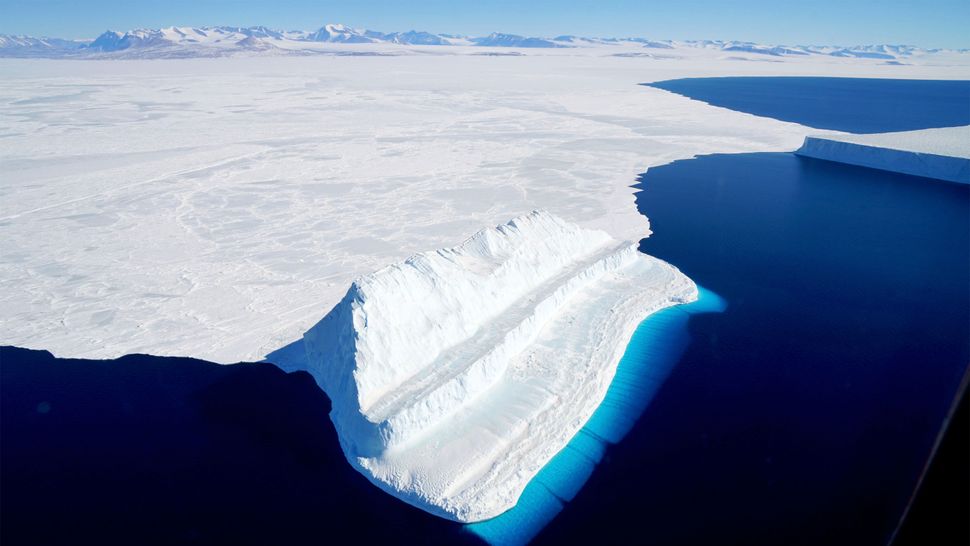
A flight to Victoria Land, as part of Operation IceBridge, snapped this image showing an iceberg floating in Antarctica's McMurdo Sound. (Image credit: Operation IceBridge)
Frozen but abundant

Antarctica separated from South America 35 million years ago, and its climate started to change. It began to grow ice sheets — masses of glacial land ice covering thousands of square miles. As plate tectonics shifted other continents, Antarctica became colder and drier. For the past 14 million years, it has been the frigid continent that persists today.

Antarctica is the only continent that was literally discovered, because it has no native human population. British explorer Sir James Cook circumnavigated the continent in 1772-1775, but saw only some outlying islands. Cook concluded that if there were any land, it would be "condemned to everlasting regidity by Nature, never to yield to the warmth of the sun."

Related: Facts About Antarctica: The Southernmost Continent

Cook also reported that Antarctic waters were rich with nutrients and wildlife. This drew sealers and whalers, mainly from England and the United States, who hunted the region's fur seals and elephant seals to near-extinction in the following decades. This hunting spree led to the discovery of the Antarctic mainland and its ice sheets, the largest in the world.
Reading the ice


Today, the combined East and West Antarctic ice sheets hold 90% of the world's ice, enough to raise global sea levels by roughly 200 feet (60 meters) if it all melted. Antarctica is the coldest, highest, driest, windiest, brightest, and yes, iciest continent on Earth. And 200 years of research has shown that it is a key component of Earth's climate system.

Despite the appearance that it is an unchanging, freeze-dried landscape, my research and work by many others has shown that the East Antarctica Ice Sheet does slowly thin and thicken over millions of years. Interestingly, my data also suggest that as the ice advances and retreats, it moves in the same patterns each time. Put another way, the ice flows over the same land each time it advances.

While East Antarctica adds and loses ice slowly, it is so large that it is a major contributor to sea level rise. Understanding how the ice has changed in the past is key to predicting how much and how fast it will melt in the coming years.

These questions are especially important in West Antarctica, where the bottom of the ice sheet is below sea level, making it very susceptible to changes in sea level and ocean temperature. By itself, the West Antarctic ice sheet has the potential to raise sea level by 16 feet (5 meters) if it collapses.

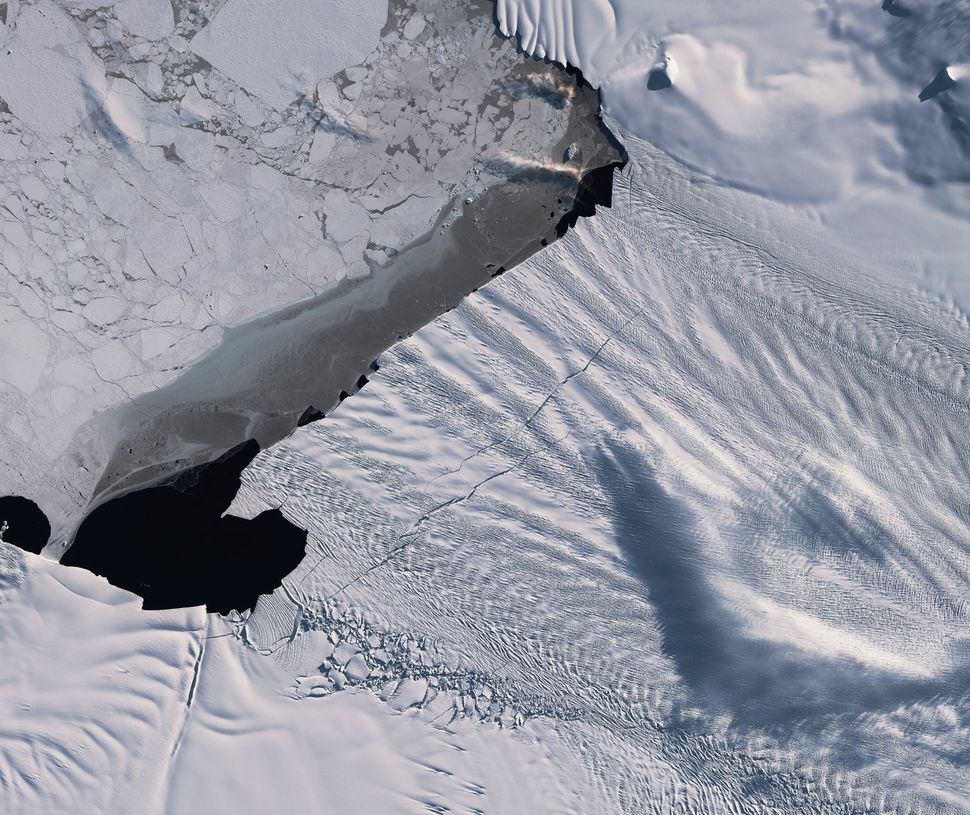
As climate change raises global sea levels, parts of the West Antarctica Ice Sheet, such as the Thwaites and Pine Island Glaciers, are particularly vulnerable to collapse. At the end of the last ice age, parts of West Antarctica thinned by an average of 1.5 to 3 feet (0.5 - 1 meters) per year. Today with GPS, satellite and airborne measurements, scientists are seeing parts of West Antarctica thin by 3 to 20 feet (1 to 6 meters) per year.

We also know from the geological record that this ice sheet is capable of rapid collapses, and has sometimes thinned at rates in excess of 30 feet (10 meters) per year. Recent models show sea level could rise by 1 meter by 2100 and 15 meters by 2500 if greenhouse gas emissions continue to rise at current rates and the ice sheet experiences a rapid collapse, as it has in the past.

This image shows the two cracks captured by the Copernicus Sentinel-2 satellite on Sept. 14, 2019. (Image credit: ESA, CC BY-SA 3.0 IGO)


Finding inspiration in scientific diplomacy


Despite the potential for environmental disaster in Antarctica, the continent also offers evidence that nations can collaborate to find solutions. The Antarctic Treaty System is the world's premier example of peaceful and scientific international cooperation.


This landmark accord, signed in 1961, sets aside Antarctica for peaceful and scientific purposes and recognizes no land claims on the continent. It also was the first non-nuclear accord ever signed, barring use of Antarctica for nuclear weapons testing or disposal of radioactive waste.


The great Antarctic explorer Sir Ernest Shackleton said that "optimism is true moral courage," and the authors of the Antarctic Treaty were certainly courageous optimists. They were encouraged by the success of the 1957-1958 International Geophysical Year, a worldwide program of scientific research during which 12 countries built over 50 bases in Antarctica, including McMurdo Station and the Amundsen-Scott South Pole Station.


Under the treaty, scientists from North Korea, Russia and China can freely visit U.S. research stations in Antarctica. Researchers from India and Pakistan willingly share their data about Antarctic glaciers.


Thanks to the Antarctic Treaty, 10% of Earth's land surface is protected as a wildlife and wilderness refuge. I have set foot in places in Antarctica where I know no one has ever been before, and the treaty sets areas aside that no one will ever visit. Antarctica's landscapes are unlike anywhere else on Earth. The best comparison may be the Moon.

Yet in these stark environments, life finds a way to persist — showing that there are solutions to even the most daunting challenges. If Antarctica has taught us anything in 200 years, it's that we can cooperate and collaborate to overcome problems. As Ernest Shackleton once said, "Difficulties are just things to overcome, after all."

50 Amazing Facts About Antarctica
In Photos: Antarctica's Larsen C Ice Shelf Through Time
Icy Images: Antarctica Will Amaze You in Incredible Aerial Views

This article was originally published at The Conversation. The publication contributed the article to Live Science's Expert Voices: Op-Ed & Insights.
Bubbling carbon dioxide vent discovered on the seafloor off the Philippines

By Yasemin Saplakoglu - Staff Writer 

A scientist collects gas samples at the newly discovered Soda Springs in the Philippines.
(Image: © University of Texas Jackson School of Geosciences)

Diving hundreds of feet below the surface of the ocean off the coast of the Philippines, scientists came across a bubbling hotspot of carbon dioxide. And this newly discovered vent might help us predict how coral reefs will deal with climate change, according to a new study.

Bayani Cardenas, a professor in the Department of Geological Sciences at The University of Texas at Austin, accidentally discovered this carbon dioxide fountain while researching the effect of groundwater runoff into the ocean environment in the Philippines's Verde Island Passage.

This strait that runs between the Luzon and Mindoro islands, connecting the South China Sea with the Tayabas Bay, is busy on its surface, serving as a prominent shipping route. It's also busy below the surface, where it harbors one of the most diverse marine ecosystems in the world. And the reefs in this passage, unlike bleached reefs elsewhere, are thriving, according to a statement from The University of Texas.

The researchers named the new hotspot Soda Springs and said that it could have been releasing these bubbles for decades or even millennia.

Related: Photos: Hawaii's New Underwater Volcano

Soda Springs is a result of an underwater volcano, which vents gas and acidic water through cracks in the ocean floor. The researchers found carbon dioxide concentrations as high as 95,000 parts per million (ppm) near the springs, which is over 200 times the concentration present in the atmosphere, according to the statement.

The levels quickly fell as the gas flowed into the massive ocean, but the seafloor released enough gas to create elevated levels (400 to 600 ppm) and enough acidic water to lower the pH for the nearby coastline. This might thus be an ideal spot for studying how other coral reefs around the world may cope with climate change as it brings more carbon dioxide into their environments, Cardenes said in the statement.

What's more, by tracing levels of radon-222, a naturally occurring radioactive isotope found in groundwater local to the area, the team discovered hotspots on the seafloor where groundwater was being discharged into the ocean. "Groundwater flow from land to sea could have important coastal impacts, but it is usually unrecognized," the authors wrote in the study. "Delicate reefs may be particularly sensitive to groundwater inputs."

The researchers found that groundwater and seawater appeared in different relative amounts in different areas of Soda Springs. This variable mixing means that "the groundwater flow could be contributing to the evolution and functioning of the ecosystem," the authors wrote.

However, the presence of these passageways might also mean that there is a way for pollutants from the island to make it into the coral reefs, Cardenes said in the statement. In the Philippines, where coastal development has surged, people are using septic tanks instead of modern sewage systems, which can easily pump waste into the reefs, Cardenes said.

It's not clear how these reefs thrive in a carbon-dioxide-rich environment, but then again, not much is known about this area. "It's really a big part of the ocean that is left unexplored," Cardenes said in the statement. "It's too shallow for remotely operated vehicles and is too deep for regular divers."

The findings were published on Jan. 3 in the journal Geophysical Research Letters.
'Ghost' population of humans discovered in ancient Africa

By Laura Geggel - Associate Editor 


This is the first time researchers have done an in-depth analysis of ancient DNA from western Central Africa.

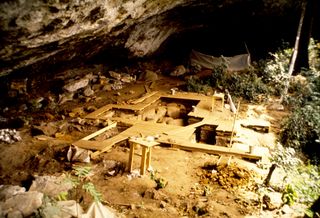
The rock shelter at Shum Laka in Cameroon. Surprisingly, the ancient people who lived at this rock shelter are not related to the people in the region today.
(Image: © Photo by Pierre de Maret, January 1994)

During the Stone Age in what is now western Cameroon, four children who perished before their prime were buried in a natural rock shelter. Now, thousands of years later, an analysis of the ancient DNA found in their bones has revealed secrets about the people who lived there many millennia ago, according to a new study.

Perhaps the most surprising finding is that these children are not related to the modern-day Bantu-speaking cultures that reside in the region today, the researchers said. Rather, the Stone Age youngsters are genetically closer to the present-day hunter-gatherer groups of Central Africa, which are not closely related to Bantu speaking groups, the researchers found.

This realization and others, including that a previously unknown "ghost" population contributed genetically to the people who live in Africa today, is shedding light on what is still the most genetically diverse region for humans in the world today, the researchers said.

Related: Photos: Looking for Extinct Humans in Ancient Cave Mud

Ancient rock shelter

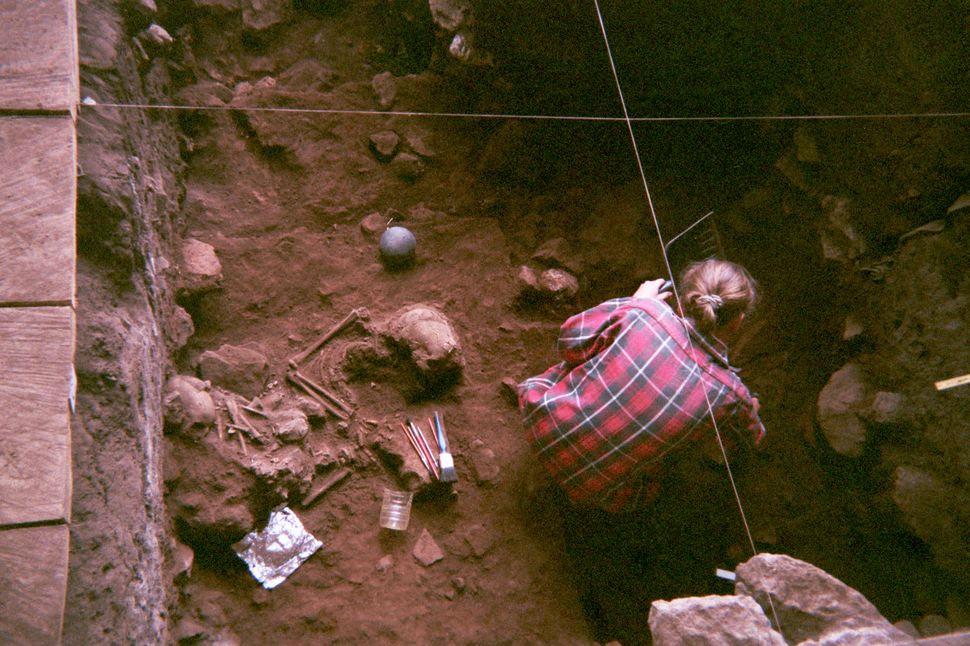
Researchers have found countless artifacts and 18 human burials at the Shum Laka rock shelter, which people have used for at least 30,000 years. But the new study focused on the burials of four children, who lived as the Stone Age transitioned into the Metal Age (also called the Stone-to-Metal Age) in western Central Africa.

This included the remains of a 4-year-old boy and a 15-year-old boy found in a double-burial dating to about 8,000 years ago. The researchers also analyzed the DNA of a 4-year-old girl and an 8-year-old boy found in neighboring burials dating to about 3,000 years ago, during the late Stone-to-Metal Age.

Although they lived thousands of years apart, these children were distant cousins, the researchers found. About one-third of their DNA came from ancestors who were more closely related to hunter and gatherers in western Central Africa. The other two-thirds came from an ancient source in West Africa, including a "long lost ghost population of modern humans that we didn't know about before," study senior researcher David Reich, a population geneticist at Harvard University, told Science magazine.

The DNA of these cousins upended a previously held idea. Until now, researchers thought that the Bantu-speaking peoples, which includes several hundred indigenous groups in sub-Saharan Africa, originated in this area of Central Africa, before radiating out across the lower half of Africa, which includes central, western central, eastern and southern Africa. This idea was thought to explain why most of the people from these regions are closely related to each other.

But the new genetic analyses show that's not the case. The inhabitants of Shum Laka were not the ancestors of Bantu-speaking people at least according to the DNA of these four children.

"The finding that the Shum Laka individuals are most related to present day rainforest hunter-gatherers and not ancestors of Bantu-speakers is surprising given that Shum Laka was long considered by archeologist[s] as the site where Bantu-speaker culture [was] developing in situ," Carina Schlebusch, an evolutionary biologist at the University of Uppsala in Sweden, who wasn't involved with the study, told Live Science in an email.

"However, as the authors mentioned in the article, it might be that multiple groups used the site," Schlebusch said. This means that the Bantu's ancestors might have used the site, but it's not shown in these particular burials.

Related: In Photos: Oldest Homo Sapiens Fossils Ever Found


A researcher excavates the ancient bones at the Shum Laka rock shelter, which holds the remains of children who lived about 8,000 and 3,000 years ago. (Image credit: Photo by Isabelle Ribot, January 1994)
Ancient genetics

The genetic analyses revealed a handful of other findings about the ancient people of Cameroon. For instance, one of the boy's genomes revealed that he had the oldest branch of the Y chromosome, which shows that the oldest lineage of human males was present in Cameroon for at least 8,000 years, and possibly much longer, the researchers said.

The children's genomes also showed signs of admixture, suggesting that the children's ancestors mated with people from different populations, the researchers found.

In addition, the analysis suggests that there are at least four major human lineages, which date to between 200,000 and 300,000 years ago. This realization is unique to this dataset, and hasn't been found from previous genetic studies, the researchers said.

The scientists also found another set of four sub-branches of human lineages that date to between 60,000 and 80,000 years ago. This includes the lineage that gave rise to all modern non-Africans, the researchers said.

"It is a nice paper and it is a welcome addition to the growing aDNA [ancient DNA] database of Africa," Schlebusch said. "It is especially valuable to get aDNA from West Africa, where it is well know[n] that the preservation of human remains [is] very bad due to the acidic soils."

That said, the researchers could have done even more with their unique dataset, she said. For instance, they could have visualized effective population sizes over time, Schlebusch said. She added that "the findings regarding the deep African population structure are interesting, but we definitely need more testing of possible models and most probably more aDNA results before we will be able to disentangle signals."

The study, led by scientists at Harvard Medical School, was published online today (Jan. 22) in the journal Nature


Search Results

Web results

6 days ago - Central Africa is too hot and humid for ancient DNA to survive—or so ... DNA to other genetic data from Africa and found hints that the Baka, Aka, and ... including some from a “long lost ghost population of modern humans that ...
Oct 10, 2018 - Traces of mystery ancient humans found lurking in our genomes ... Denisovans are nearly ghosts: we have that one finger bone and a few ... “So the idea is that 700,000 years ago, there's a population in Africa that splits off ...
6 days ago - Ancient DNA from West Africa Adds to Picture of Humans' RiseAncient DNA ... Now researchers have found the first genetic material from West Africa. ... Today some people in Sierra Leone have a tiny trace of Ghost Modern ...
6 days ago - But another Y is a rare version that's only found in a few modern populations in Africa and seems to have been introduced into modern humans ...
6 days ago - Comparison of the ancient DNA to modern groups across Africa revealed ... least 2.8 million years to the oldest fossil of our genus, Homo, yet found. ... Another branch represents a “ghost” population of modern humans whose ...
6 days ago - Scientists have produced the first genome-wide ancient human DNA ... The work also illuminates previously unknown "ghostpopulations that ... Y chromosome type, found almost nowhere outside western Cameroon today.