Tuesday, August 29, 2023

UK
Barclay family launch bid to buy back Telegraph


James Warrington
Sat, 26 August 2023 

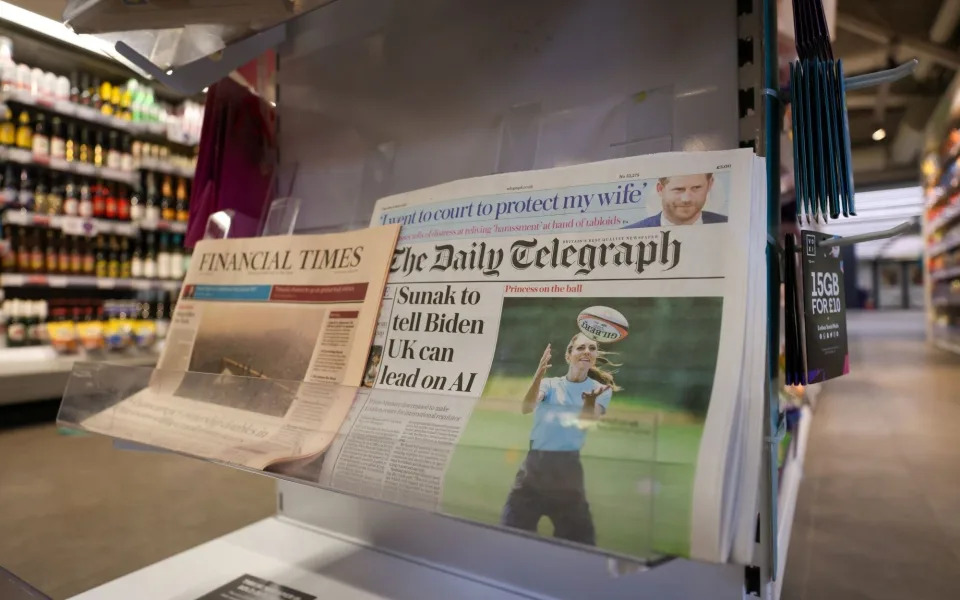
Copies of The Daily Telegraph newspaper on a newsstand

The Barclay family have tabled a bid to regain control of Telegraph Media Group from Lloyds Banking Group.

The former owners of the newspaper group, comprising the Daily Telegraph, Sunday Telegraph and Telegraph.co.uk, have secured backing from Middle Eastern investors to buy back roughly half the debt it owes Lloyds, Sky News reported.

The unnamed backers are said to be based in Abu Dhabi, while the offer is believed to be in the region of £500m to £600m.
This would mark a significant writeback for Lloyds, which wrote down the value of its loans to the family several years ago.

The Barclays lost control when the newspaper’s parent company was placed into receivership in June.

A formal sale process run by Goldman Sachs is due to begin in September. The Wall Street bank will also auction The Spectator magazine, which was also owned by the Barclay family.

Potential bidders for The Telegraph include Lord Rothermere, the owner of the Daily Mail, who is reportedly courting investors.

Any bid by his company Daily Mail and General Trust (DMGT), however, would be at risk of a lengthy review of its impact on media plurality that might reduce its attractiveness to Lloyds.

National World, a local newspaper group led by veteran executive David Montgomery, is to date the only party to publicly declare an interest in making a bid.

However, the Barclay family may hope a deal with them would be viewed as preferential by receivers at specialist consultancy AlixPartners, given it would avoid the risk of any protracted regulatory review.

Charlie Nunn, chief executive of Lloyds Banking Group, last month said there was “no need to have a rushed sales process”.

He added: “We’ve set up an independent receivership and this is all being managed totally independently from executives at Lloyds Banking Group.

“You can imagine why that’s important for us and for me personally so we aren’t involved in the decision making around how the process is being run.

“We’ve given the receivers the complete freedom to run a process with the right diligence and, from our perspective, to ensure the process is run well from a UK perspective and maximise the returns for our shareholders.”

A spokesman for the Barclay family declined to comment.
Germany plans three-year rent freeze for tenants

Tim Wallace
Mon, 28 August 2023 

Aerial view of Berlin skyline with famous TV tower and Spree river

Olaf Scholz is considering imposing a three-year rent freeze on Germany’s landlords as his ruling Social Democratic party attempts to ease the strain of the cost of living crisis on tenants.

Landlords could be forced to repay rents deemed “usurious”, if the rate charged is more than 20pc above the typical local level, in areas with limited supplies of homes.

Rules already in place to limit rent rises will also be tightened, under the plans, as furnished apartments and homes let for temporary use are not always covered by the restrictions.

Verena Hubertz, a senior SDP politician, told the German national Bild am Sonntag: “We need a breather for tenants – we need a rent freeze for the next three years”.

The party’s parliamentarians are meeting on Monday to hammer out new policies to cut living costs, with rents on the agenda.

The measure is on the table “in view of the enormous rent increases in recent years and the drastically increasing ancillary and heating costs caused by the war,” Ms Hubertz said.

Of Germany’s 41 million households, almost half live in rented accommodation, according to the Organisation for Economic Co-Operation and Development (OECD).

Just over a fifth own their own home, the OECD found.

Official statistics show that the average tenant household spent almost 28pc of their income on rents last year.


The IFO Institute, an influential economic think tank, estimates that rents in Germany will rise by an average of 7.2pc per year over the next decade.

In 2020 a five-year rent freeze came into force in Berlin, locking most payments at their 2019 level and even reducing the monthly payments of tenants deemed to be overpaying for their accommodation.


But the Federal Constitutional Court, the highest court in the land, ultimately struck the measure down in 2021, ruling that the local authority did not have the power to impose the cap.

Economists typically reject rent controls on the basis that the policy undermines the supply and quality of rental properties available for tenants as landlords cut investment.

In the UK, Labour’s shadow housing secretary criticised rent control policies this summer.

Lisa Nandy said: “When house building is falling off a cliff and buy to let landlords are leaving the market, rent controls that cut rents for some, will almost certainly leave others homeless.”

UK
Families to fund record £8.1bn toward first-time buyer purchases

Eir Nolsoe
Sun, 27 August 2023

A couple view properties for sale in an estate agents window

Parents and grandparents are facing a retirement cash crunch as they prepare to contribute a record £8.1bn towards younger buyers’ house purchases this year, a report has warned.

Money from relatives will help fund close to half of all purchases by under-55s in 2023, according to research by Legal & General and the Centre for Economics and Business Research (Cebr).

It is a significant jump from 35pc in 2020, when the research was last carried out. For under-35s, the share is expected to jump from just under half in 2020 to 57pc this year as rising interest rates push up mortgage payments.

The Bank of England has raised interest rates 14 consecutive times since December 2021 to 5.25pc, wiping tens of thousands of pounds off what the average borrower can afford.

The average amount of financial support from relatives is expected to hit £25,600 this year, L&G’s research found.

Bernie Hickman, chief executive of Legal & General Retail, which has 12 million policyholders, warned the record sums put many older people at risk of running out of money later in life.

He said: “Our research clearly shows that gifting or lending money to loved ones to get on the property ladder has noticeably impacted [the givers’] finances.

“There’s clearly a risk of depleting their own financial resources to the extent that it could impact on their own ability to live comfortably.”

Collectively, gifted funds towards home deposits are predicted to reach £10bn by 2025, nearly twice as much as in 2016.

Many of L&G’s customers have released equity from their property through lifetime mortgages to help their children or grandchildren get on the property ladder, Mr Hickman said.

He added that Britain’s housing market was not only perpetuating inequalities but was also creating “risks for the older generations”.

Research by L&G found that seven in ten people who had given money towards a family member’s home said it had left them in a worse financial position.

Steve Webb, a former pensions minister, said: “The big risk for parents on a tighter budget is that they might under-estimate their own retirement needs.

“It is important to have both regular income and a certain amount of capital. You might think that you can live comfortably enough from week to week, but what happens when the car needs replacing or the boiler breaks?”

Even among buyers aged 45 to 54, one in four relied on funds gifted by family to afford their purchase, L&G found.

Aneisha Beveridge at Hamptons, an estate agent, said rapidly rising borrowing costs would pile more pressure on family members to provide financial support towards deposits.

She said: “They are going to increasingly be calling for help from older households, whether that’s grandparents or parents.”

Ms Beveridge warned that despite growing pleas from younger buyers, demographic changes meant fewer parents were in a position to help out.

She said: “As homeownership rates have declined through the last 50-60 years, that has limited parents’ ability to actually help their children.

“I think we’re starting to see some of that play out now. That has big consequences for saving pots for healthcare and general day-to-day living.”

Separate research conducted by Hamptons found that financial help from siblings now makes up 11pc of gifted money towards home purchases, nearly twice as much as six years earlier.

Meanwhile, UK Finance data showed almost one in ten people climbing the property ladder are signing mortgage deals that will leave them paying off debts well into their 70s.

The trade body said a record 9pc of all home movers took out loans of 35 years or more in June, up from less than 1pc a decade ago.

Homeowners spend an average of eight years in their first property before moving, according to Zoopla.

This suggests home movers in their early 40s are signing up for mortgages that will leave them stuck in a debt trap until their late 70s.

The data also showed a record one in five first-time buyers are also signing up to mortgages of more than 35 years as interest rates soar.

A UK Finance spokesman said there had been a “rapid increase in the proportion of mortgage customers borrowing over a longer term in order to stretch their affordability” over the past year, though this was starting to plateau.

They added: “If the mortgage runs its full term this does mean the customer ends up paying more overall than they would over a shorter term, although the majority of first-time buyers redeem their mortgage well before this, usually when they move house.”
UK
Homeless families evicted as landlords quit London emergency housing sector


Sammy Gecsoyler
Tue, 29 August 2023 at 10:00 am GMT-6·4-min rea


Homeless families are being evicted from emergency accommodation to be replaced by private tenants as the number of landlords quitting the temporary housing sector in London more than doubled in eight months.

A survey by London Councils, the cross-party organisation representing the capital’s local authorities, found that between September 2022 and April 2023, 15 boroughs reported receiving a notice to quit, a legal document requesting the return of a property, from landlords for 3,531 properties in use as temporary accommodation.

This is a 120% increase on the 1,601 notices received over the same period in 2021-22 and is equivalent to a loss of 6% of London’s total temporary accommodation stock. All 32 London boroughs were asked to contribute to the voluntary survey but 17 did not respond to London Councils’ request to provide data for each month.

Temporary accommodation is used by local authorities to provide homeless families and individuals with a place to live short-term while a suitable permanent home is found locally.

Related: Number of households in temporary accommodation in England at highest level

Many of these properties are now either being sold or rented out on the more lucrative private market. Housing campaigners say landlords and letting agencies who lease temporary accommodation are trying to evict their tenants, sometimes in intimidating ways.

The Guardian spoke to the mother of a family living in temporary accommodation in north London. She said they were first served a notice to quit in person last July and soon received repeated letters and knocks at the door from their letting agent telling them to leave the property. She said the agency told her they wanted them evicted “because the landlord wanted more rent money”.

The letting agent also repeatedly called the house where the only person who could speak English was her 12-year-old daughter. Her mother said: “They would ask her to tell her parents that they need to leave the property right now. It was so aggressive.”

The family approached a local campaign group, Housing Action Southwark and Lambeth (HASL), which put them in contact with legal aid lawyers. After the letting agency was taken to court, eviction proceedings were halted and the harassment ended.

Elizabeth Wyatt, a member of HASL, said the group had “supported a number of members who have been given eviction notices from the private landlords of their temporary accommodation. It has been an extremely stressful experience for them.”

The loss of temporary accommodation stock in London is worsening an already dire situation in the capital. Research commissioned by London Councils and carried out by the London School of Economics and Savills shows there has been a 41% reduction in the number of London properties available for private rent since 2020.

Their research also estimates that one in 50 Londoners are now homeless, including one in 23 children, and that councils in the capital are spending £60m a month on temporary accommodation.

This has been driven by a sharp increase in people declaring themselves homeless to local authorities, in large part due to a swift rise in no-fault eviction notices being issued, and a reliance on expensive hotels and B&Bs as the availability of other forms of temporary accommodation dries up. In the past year, there has been a 781% increase in families being housed in hotels and B&Bs in London beyond the six-week legal limit.

Sue Edmonds, the chief executive of Capital Letters, a not-for-profit company that works with councils and landlords to provide homeless families with permanent homes, said there were “a lot of drivers leading to what is happening”.

“Many landlords are themselves struggling with the cost of living crisis, especially with the mortgage interest rates going up. In some cases, the rental income they get from being a temporary accommodation provider is insufficient to cover their costs,” she said.

“We know that smaller buy-to-let landlords are tending to think about selling up. Some landlords, in fairness, can see that they can get more money on the private rental market. There’s a bidding war out there.”

Edmonds said most of these properties were probably being sold for home ownership or “disappear” in deals done privately, the outcome of which is hard to determine. “They’ve been taken out of the private rented sector which further reduces the number of properties available for people who need them.”

She added that frontline council staff were finding the situation difficult.

“It’s not just a financial cost, there’s an emotional cost as well to those made homeless and also the staff trying to sort it out when there is nowhere to put them.”

Darren Rodwell, London Councils’ executive member for regeneration, housing and planning, said: “Across London we see landlords withdrawing their properties from use as temporary accommodation, meaning that boroughs run out of alternatives and place families with children in unsuitable B&Bs. The homelessness situation in London is becoming unmanageable. We need the government to work with us in reversing the numbers relying on temporary accommodation.”

Polly Neate, the chief excutive of Shelter, said: “A cramped emergency hotel or grim B&B is no home. Councils cannot keep picking up the pieces of this national crisis. It’s now beyond urgent the government fixes this mess by immediately unfreezing housing benefit and investing in truly affordable, good quality social homes.”

White House laughs off report Biden wants to limit Americans beer consumption

The Independent

Aug 29, 2023

White House Press Secretary Karine Jean-Pierre laughed off a report that the White House wants to limit Americans to having two beers per week.

Fox News’s Peter Doocy asked the press secretary the question after George Koob, the Director of the National Institute on Alcohol Abuse and Alcoholism, toldThe Daily Mail that the United States Department of Agriculture could revise its alcohol advice to match Canada’s.

But the press secretary brushed off the question. 

AUSTRALIA
Too hot to handle: climate crisis report so secret Albanese government won’t even reveal date it was completed

Daniel Hurst
Tue, 29 August 2023 

Photograph: Lukas Coch/AAP

The Australian government is not only refusing to release its secret report on how the climate crisis will fuel national security threats – it won’t even say when it was completed.

The government insists the date, too, is classified. The approach has sparked claims of a “cult of secrecy in Canberra”.

Anthony Albanese ordered the Office of National Intelligence (ONI) last year to investigate national security threats posed by global heating, in line with an election promise.


Related: Former ADF chief calls for release of secret report into security threat posed by climate crisis

When it notified the United Nations of Australia’s stronger 2030 emissions reduction target, the government trumpeted its commitment to “an urgent climate risk assessment of the implications of climate change for national security”.

So far, however, the government has rebuffed calls to release the assessment – or even a sanitised public version, as it did with the defence strategic review.

In a new response to Senate questions on notice, the prime minister confirmed the ONI’s climate assessment was finalised “within the last 12 months”. But Albanese added: “The specific timing of the assessment board is classified.”

Five other questions from the Greens’ defence spokesperson, David Shoebridge, were answered with an identical response: “The content and judgments of the assessment are classified.”

Sign up for Guardian Australia’s free morning and afternoon email newsletters for your daily news roundup

Shoebridge also asked the direct question: “Will the government make a declassified version of the assessment public? If not, why not?”

Albanese responded that the report “contains classified material” but the government continued to consider the issue.

“Along with the government’s climate statement, tabled in parliament on 1 December 2022, there is already considerable material available in the public domain discussing national security threats from climate change,” he said.

A single page of that 80-page climate statement was devoted to national security, saying global heating would “increasingly exacerbate risks” as “geopolitical tensions mount about how to respond”.

The same statement mentioned the ONI’s work in future tense, saying it “will inform how the government considers climate risk”.

Shoebridge said it was “bizarre that the government won’t even reveal the date the climate risk assessment was completed”.

“When you can’t even get the date of a high-profile, publicly acknowledged report then you know that something’s gone wrong with the cult of secrecy in Canberra,” the NSW senator said.

Related: The intergenerational report says climate is a ‘profound’ risk to Australia. But the full picture may be even worse

Shoebridge said transparency was less of a risk to national security than “not dealing with the threat of climate change in the first place”.

The independent ACT senator, David Pocock, said providing a declassified version of reports, including a climate risk assessment, was “not an unreasonable ask” and that some of our closest allies, including the US, had already done so.

“This is something I will continue to pursue.”

Both Pocock and Shoebridge proposed Senate motions to order the government to produce key documents, but the major parties combined to defeat them on 10 August.

Albanese has described the climate crisis as “a direct threat to global security” but has also defended the secrecy.

“We make no apologies for not releasing national security advice, which, appropriately, goes to the national security committee,” he told parliament this month.

“That is a position that we have had for a long period of time, and that will remain the position.”

In 2021, the US intelligence community released a report that warned: “Intensifying physical effects will exacerbate geopolitical flashpoints, particularly after 2030, and key countries and regions will face increasing risks of instability and need for humanitarian assistance.”
UK
Train strikes 2023: List of London rail services to be hit by September ASLEF and RMT action

Ben Lynch
Tue, 29 August 2023 

A RMT flag flies at a picket line outside Euston Station. Credit: Hollie Adams/Getty Images.

Londoners are set for more days of travel disruption in September due to two days of planned industrial action.

The ASLEF and RMT unions have announced they will be taking action due to ongoing disputes with the government and Rail Delivery Group over pay.

ASLEF has announced a strike on September 1 and an overtime ban on 16 train companies across the country on September 2, while 20,000 RMT members will also be striking on September 2.


ASLEF members will also be taking part in September action. Credit: Justin Tallis/AFP via Getty Images.


The combined action is expected to cause widespread disruption across the UK’s services.
Which train companies are going to be affected?

Most of the train companies due to be impacted by the action run services in and out of London. According to Network Rail, all of them will be affected on both days, September 1 and 2.

They are: Greater Anglia, Stansted Express, c2c, Great Western Railway, Chiltern Railways, Southeastern, Gatwick Express, Southern, Thameslink, Heathrow Express, Avanti West Coast, East Midlands Railway, South Western Railway, LNER and London Northwestern Railway.
What have the unions said?

Mick Whelan, ASLEF’s general secretary, said: “We don’t want to take this action but the train companies, and the government which stands behind them, have forced us into this place because they refuse to sit down and talk to us and have not made a fair and sensible pay offer to train drivers who have not had one for four years – since 2019 – while prices have soared in that time by more than 12%.

Mr Whelan accused the government of being “happy to let this drift on and on. But we are determined to get a fair pay rise for men and women who haven’t had one for four years while inflation has reached double figures. Our members, perfectly reasonably, want to be able to buy now what they could buy back in 2019.”

RMT general secretary Mick Lynch said: "The mood among our members remains solid and determined in our national dispute over pay, job security and working conditions.

“We have had to call further strike action as we have received no improved or revised offer from the Rail Delivery Group.

“The reason for this is the government has not allowed them a fresh mandate on which discussions could be held.

“Our members and our union will continue fighting until we can reach a negotiated and just settlement.”
What have the train companies said?

A Rail Delivery Group spokesperson previously told LondonWorld staff were offered a 13% pay rise which was “blocked without a convincing explanation” by the RMT executive.

“With further strike action the RMT are once again targeting customers looking to enjoy various sporting events, festivals, and the end of the summer holidays, disrupting their plans and forcing more cars onto the road,” the spokesperson said.

“We have now made three offers, the latest of which would have given staff pay rises of up to 13% as well as job security guarantees and the RMT executive have blocked this without a convincing explanation.

“We remain open to talks and we have said repeatedly that we want to give our people a pay rise, but until the union leadership and executive is united in what it wants and engages in good faith with the 30% shortfall in revenue the industry is continuing to grapple with post-Covid, it is difficult to move forward.

“Unfortunately, the repercussion of this impasse affects our staff, customers, and the communities across the country that rely on the railway.”
What has the government said?

A Department for Transport spokesperson said the government has facilitated “fair and reasonable pay offers.

“However, union bosses are opting to prolong this dispute by blocking their members from having a vote on these offers. We continue to urge that members are given their say and disruption is brought to an end.”
ABOLISH LESE MAJESTI
Saudi retired teacher sentenced to death for criticizing ruling family on social media


Edmund Bower
Tue, 29 August 2023 

Mohammed al-Ghamdi, a retired Saudi teacher, has been sentenced to death for his social media posts

A Saudi court has sentenced a retired teacher to death for criticising the ruling family in messages to his nine social media followers.

According to Human Rights Watch, 54-year-old Mohammed al-Ghamdi was sentenced to death on July 10 for various offences related to his activity on YouTube and X, formerly known as Twitter. The ruling may be the first death sentence for social media posts.

The charges reportedly levied against the retired teacher include “describing the King or the Crown Prince in a way that undermines religion or justice”, “supporting a terrorist ideology”, and disseminating fake news “with the intention of executing a terrorist crime”.


On Thursday, Mohammed’s brother, Saeed al-Ghamdi, tweeted that his brother’s sentencing may be an attempt “to spite me personally after failed attempts to return me to the country”. Saeed, an Islamic scholar, lives in self-imposed exile in London and is wanted by the Saudi authorities.

“I appeal to anybody who can help to save my brother from this unfair and unjust ruling,” he said.

Saudi Arabia has long faced criticism for its frequent use of the death penalty. In 2022, the kingdom performed 196 confirmed executions, according to Amnesty International, making it the third-most prolific executioner after China and Iran.
‘Silence its critics’

Saudi Arabia has also handed down numerous decades-long sentences for crimes related to social media posts.

Last August, a Leeds University doctoral student was sentenced to 34 years in prison when she returned home to Saudi Arabia for the summer holidays. Salma al-Shehab, a 34-year-old mother of two, was accused of “assisting those who seek to cause public unrest and destabilise civil and national security by following their Twitter accounts”.

Mohammed al-Ghamdi has been held by Saudi security forces since last June when he was arrested outside his house in Mecca. Following his arrest, Human Rights Watch reports that he spent four months in solitary confinement and was denied access to a lawyer for over a year.

His trial was conducted in Saudi Arabia’s controversial Specialized Criminal Court (SCC) that was established in 2008 to deal with a backlog of terrorism cases but has since become notorious for handing heavy sentences to political prisoners.

In 2020, Heba Morayef, Amnesty International’s Middle East and North Africa director, said: “The Saudi Arabian government exploits the SCC to create a false aura of legality around its abuse of the counter-terror law to silence its critics. Every stage of the SCC’s judicial process is tainted with human rights abuses.”
UK
Taxpayers to foot bill for green schemes as Michael Gove rips up EU rules on new housing


Emma Gatten
Tue, 29 August 2023 

Ministers will give Natural England millions of pounds to reduce run-off from agriculture and to upgrade waste-water treatment works to protect rivers - Natural England/Environment Agency/SWNS

Taxpayers will foot the bill for green schemes to reduce water pollution from new homes, the Telegraph understands.

Michael Gove, the Levelling-Up Secretary, announced on Tuesday he will scrap rules imposed by Brussels which had forced housebuilders to pay for projects to reduce river pollution before homes could be built.

The rules are designed to limit the amount of harmful chemicals coming from new homes that make their way into rivers, affecting wildlife.

The government blames them for blocking the provision of new housing, even where planning permission is granted, and by scrapping them hopes to enable 100,000 more homes to be built by 2030.

To protect rivers, ministers will instead give the quango Natural England millions of pounds to reduce run-off from agriculture and upgrade waste-water treatment works.

Taxpayers will be expected to foot the bill for the extra £140 million funding, although the Government hopes to eventually claw it back from housebuilders.

A Government source said it would be “talking to developers about their contribution” but was not yet sure how much housebuilders would contribute.
Backtracking on its green pledges

The announcement was met with anger from environmental campaigners, who accused the Government of backtracking on its green pledges.

But the Government says the contribution made by new homes to the problem is very small compared to that from agriculture and existing sewage infrastructure.

Housebuilders are resisting calls for them to pay into the scheme, saying it would be yet another tax raid on big developers, following the £300 million fund to resolve the cladding crisis and the recent tax on residential property developers.

“The industry is not going to be happy about yet another tax bill from Gove,” one source said. “But at least now there is a solution to the nutrients problem.”

Mr Gove defended the plans to get rid of the so-called ‘nutrient neutrality’ rules on Tuesday following anger from green groups. He told the BBC: “After all the measures we’ve announced today have been enacted there will be fewer nutrients going into British rivers.”

He added: “The way in which we’ve been dealing with it, as a result of some sort of clunky EU laws, has meant that we haven’t secured the investment that we needed to improve our environment and we’ve also got a total block on housing in large parts of the country.”

Ministers hope the new plans will deliver an estimated £18 billion boost to the economy, with the construction of new homes, which would otherwise have been blocked in a matter of months.

New environmental measures

The move comes alongside new environmental measures designed to tackle pollution at source and restore habitats.

But nature groups said scrapping the rules would only increase harm to the country’s rivers, which are under significant pressure from sewage and agriculture.

Craig Bennett, chief executive of The Wildlife Trusts, said: “In May, June and July, the Government made promises to the British people and to Parliament that they would not lower environmental protections or standards

“But just a few weeks later they are planning to do precisely the opposite. They lied – this is a disgraceful move which undermines public trust in this Government.

“Make no mistake – this is a licence from the Government for the commercial housebuilding lobby to profit from the pollution of our rivers.”

Gabriel Connor-Streich, the chief executive of Greenshank Environmental, which develops river improvement projects for housebuilders to invest in, said many were likely to be cancelled in the wake of the announcement.

“They’re not going to continue now until they have certainty that there is actually going to be a market sell into,” he said.

Stewart Baseley, the executive chairman of the Home Builders Federation, said: “Today’s very welcome announcement has the potential to unlock housing delivery across the country, from Cornwall to the Tees Valley, where housebuilding has been blocked despite wide acknowledgement that occupants of new homes are responsible for only a tiny fraction of the wastewater finding its ways into rivers and streams.

“The industry is eager to play its part in delivering mitigation and protecting our waterways. We look forward to engaging with Government on the right way to do so, now that ministers are acting upon the arguments that builders both large and small have been making for so long.”
Opinion
Biden is turning away from free trade – and that’s a great thing


Robert Reich
Tue, 29 August 2023 

Photograph: Carolyn Kaster/AP

President Joe Biden is making a break with decades of free trade deals and embarking on an industrial policy designed to revive American manufacturing.

This has caused consternation among free-traders, including some of my former colleagues from the Clinton and Obama administrations.

For example, Lawrence Summers, the former treasury secretary, last month called the president’s thinking “increasingly dangerous” and expressed concern about what he termed “manufacturing-centered economic nationalism that is increasingly being put forth as a general principle to guide policy”.

Well, this veteran of the Clinton administration – me – is delighted by what Biden is doing.

Clinton and Obama thought globalization inevitable and bought into the textbook view that trade benefits all parties. “Globalization is not something we can hold off or turn off,” Clinton explained in 2000. “It is the economic equivalent of a force of nature, like wind or water.”

But “globalization” is not a force of nature. How it works and whom it benefits or harms depends on specific, negotiated rules about which assets will be protected and which will not.

In most trade deals, the assets of US corporations (including intellectual property) have been protected. If another nation adopts strict climate regulations that reduce the value of US energy assets in that country, the country must compensate the US firms. Wall Street has been granted free rein to move financial assets into and out of our trading partners.

But the jobs and wages of US workers have not been protected. Why shouldn’t US corporations that profit from trade be required to compensate US workers for job losses due to trade?

Why shouldn’t US corporations that profit from trade be required to compensate US workers for job losses due to trade?

The age-old economic doctrine of “comparative advantage” assumes that more trade is good for all nations because each trading partner specializes in what it does best. But what if a country’s comparative advantage comes in allowing its workers to labor under dangerous or exploitative conditions?

Why shouldn’t the US’s trading partners be required to have the same level of worker safety as that of the United States or give their own workers the same rights to organize unions?

Globalization doesn’t answer these sorts of questions. Instead, the rules that emerge from trade negotiations reflect domestic politics and power.

The Clinton administration lobbied hard for the North American Free Trade Agreement (Nafta). In the end, Congress ratified it, with more Republican than Democratic votes. Additional trade agreements followed, along with the creation of the World Trade Organization (WTO) and the opening of trade relations with China, which joined the WTO in 2001.

Trade rose from 19% of the US economy in 1989 to 31% in 2011, according to the World Bank. By 2021, following the pandemic and Trump’s trade war with China, trade’s share of the US economy had drifted down to 25%.

These trade deals have benefited corporations, big investors, executives, Wall Street traders and other professionals.

The pharmaceutical industry has gotten extended drug patents in Mexico, China and elsewhere. Wall Street banks and investment firms have made sure they can move capital into and out of these countries despite local banking laws. US oil companies can seek compensation if a country adopts new environmental standards that hurt their bottom lines.

The stock market has responded favorably to free trade policies. In 1993, when Clinton took office, the Dow Jones industrial average peaked at 3,799 points. By the time he left office in 2001, it had topped 11,000.

Middle- and working-class Americans have benefited from these deals as consumers – gaining access to lower-priced goods from China, Mexico and other countries where wages are lower than those in the US.

But the trade deals also have caused millions of US jobs to be lost, and the wages of millions of Americans to stagnate or decline.

Between 2000 and 2017, a total of 5.5m manufacturing jobs vanished. Automation accounted for about half of the loss, and imports, mostly from China, the other half.

You can trace a direct line from these trade deals and the subsequent job losses to the rise of Donald Trump in 2016.

Economists have estimated that, if the US had imported half of what China exported to us during these years, four key states – Michigan, Wisconsin, Pennsylvania and North Carolina – would have swung Democratic, delivering the presidency to Hillary Clinton.

Whether globalization is good or bad depends on who gets most of its benefits and who pays most of its costs. For too long, US workers have paid disproportionately.

The Biden administration is changing this. I say, it’s about time.

Robert Reich, a former US secretary of labor, is a professor of public policy at the University of California, Berkeley, and the author of Saving Capitalism: For the Many, Not the Few and The Common Good. His newest book, The System: Who Rigged It, How We Fix It, is out now. He is a Guardian US columnist. His newsletter is at robertreich.substack.com.