Tuesday, August 29, 2023

New Mexico's top prosecutor vows to move ahead with Native education litigation


ALBUQUERQUE, N.M. (AP) — It's been five years since a New Mexico judge issued a landmark ruling finding that the state was falling short in providing an adequate education to Native American students and many others, and the pace of progress since has been frustratingly slow for tribal leaders.

New Mexico Attorney General Raúl Torrez said he intends to take over the ongoing litigation that led to the ruling from Gov. Michelle Lujan Grisham’s administration to ensure that the state complies with court-ordered mandates.

The announcement was made public Tuesday, just days after Torrez met with Pueblo governors. The leaders welcomed Torrez's move, saying that many students who have graduated over the last five years were unable to reap the benefits of any changes.

"Now, my hope is that policies will finally be put in place and education programs will be developed, along with recurring funding, so that our children get the education they richly deserve both now and in the future,” said Randall Vicente, the governor of Acoma Pueblo and a member of the All Pueblo Council of Governors.

Torrez, a Democrat, told the tribal leaders during their monthly meeting that the litigation — known as the Yazzie v. Martinez case — identified systemic issues within the state’s education system and was monumental in setting a precedent for Native American and other minority students.

New Mexico historically has been at the bottom of the list when it comes to educational outcomes nationwide. Struggles to address lagging test scores and low graduation rates predated the coronavirus pandemic, and lawmakers have been pouring millions of dollars into efforts to boost access to broadband across the rural state as a way to get more students connected to the services they need.

The attorney general's office confirmed Tuesday that Torrez and members of his civil rights team already have met with lawyers representing the plaintiffs, including the New Mexico Center on Law and Poverty, and the advocates and experts who helped draft a plan for meeting the needs of Native students.

Preliminary discussions also included Lujan Grisham, a Democrat who initially sought to have the case dismissed in 2020. Lujan Grisham has since defended her administration, saying progress has been made. That includes adding more classroom time to the school year, paying teachers more, providing free school lunches and creating an office dedicated to special education.

Caroline Sweeney, a spokeswoman for the governor, said in an email Tuesday that the Lujan Grisham administration inherited the case and that Lujan Grisham has enacted “all the right policies” and has funneled more money to public schools.

The governor's office placed the onus on local school officials.

“The bottom line is this: We need to find a way to more directly hold school boards and school districts accountable for fully implementing the critical investments this administration has made over the last four years,” Sweeney said. “The attorney general’s office has the power to do just that. We have raised this issue with sovereign nations, and they agree.”

Native American leaders have complained that legislative efforts and funding allocations to address the public education system’s deficiencies have been piecemeal. The state Public Education Department also has yet to finalize its own plan to address the ongoing education lawsuit after soliciting public comment in the summer of 2022.

It's too early to say what effects the attorney general's intervention might have, but advocates said they are willing to work with anyone from the state to get results for students.

Other plaintiffs include low-income students and those learning English as a second language.

Advocates have been talking with students, parents and teachers from different New Mexico communities and hearing similar stories about teacher shortages, scarce resources, limited technology and internet access, and not enough culturally relevant instructional materials.

“For years the state has wasted resources on a legal defense that’s protecting the current system, instead of deeply examining and getting to the root of the problems to fix things,” Melissa Candelaria, an attorney and the education director at the New Mexico Center on Law and Poverty, said in a statement.

Susan Montoya Bryan, The Associated Press
Supermoon could team up with Hurricane Idalia to raise tides higher just as the storm makes landfall


Supermoon could team up with Hurricane Idalia to raise tides higher just as the storm makes landfall© Provided by The Canadian Press

Arare blue supermoon could raise tides above normal just as Hurricane Idalia takes aim at Florida’s west coast, exacerbating flooding from the storm.

The moon will be closest to the Earth on Wednesday, the same day Idalia is expected to make landfall in Florida. While a supermoon can make for a spectacular backdrop in photos of landmarks around the world, its intensified gravitational pull also makes tides higher.

“I would say the timing is pretty bad for this one,” said Brian Haines, the meteorologist in charge at the National Weather Service office in Charleston, South Carolina.

It’s expected to make tidal flooding worse not only in Florida, but in states such as Georgia and South Carolina, where Haines’ office has been warning residents that parts of Charleston could be under water by Wednesday night.

When the moon is full, the sun and the moon are pulling in the same direction, which has the effect of increasing tides above normal ranges, said Kerry Emanuel, professor emeritus of atmospheric science at the Massachusetts Institute of Technology.

The moon's gravitational pulls are even stronger when it's closer to Earth, so the tides are even higher.

The storm surge is often the greatest killer when hurricanes strike. The ocean water pouring onto land could be up to 15 feet (4.6 meters) along parts of Florida’s west coast, the National Hurricane Center projected in its latest briefings Tuesday. Farther south, up to 7 feet (2.1 meters) of storm surge is expected in the Tampa Bay area.

Storm surge that can be taller than a person is a concern with any major hurricane. The tides and the influence of a supermoon can increase that somewhat.

"There’s a saying that you hide from the wind and run from the water, and hopefully people are heeding that advice,” said Brian Tang, associate professor of atmospheric science at University at Albany in New York.

The part of northwest Florida that could be hit by Idalia is especially vulnerable to storm surge because of the region's geography. The continental shelf extends so far out from the coast and has a gradual slope, allowing the ocean to grow higher as hurricane winds drive the water onto land, Tang said. The shape of the coast in that region – known as Florida’s Big Bend area – is also curved inward, which can focus the storm surge to make it even more dangerous, he said.

In South Carolina, there’s concern that Idalia’s path will take it near the historic city of Charleston and the surrounding area known as the Low Country. That would add water to the high tide that’s in the forecast, Haines said.

“Wednesday evening looks really nasty for coastal flooding here,” he said.

The weather service is forecasting an 8.2-foot (2.5 meter) tide in Charleston Wednesday evening, which could produce widespread flooding in downtown Charleston, Haines said. Even with a 7.5 foot tide (2.3 meters), some roads in the city flood and become impassible, he said.

Jeff Martin, The Associated Press
Tribal ranger draws weapon on climate activists blocking road to Burning Man; conduct under review


NIXON, Nev. (AP) — A tribal ranger's conduct is under review after he pointed a weapon Sunday at environmental activists and plowed his patrol vehicle through their blockade on the road leading to the annual Burning Man counter-culture festival in the Nevada desert.

The incident unfolded on a rural stretch of highway on the Pyramid Lake Paiute Tribe reservation in northwestern Nevada. The protest calling attention to climate change stopped traffic as attendees were headed to the Black Rock Desert north of the reservation for opening day of Burning Man.

A news release from the tribe's chairman, James J. Phoenix, described the incident as a ranger using his patrol vehicle to clear “debris” out of the roadway after climate activists refused to leave.

Videos on social media, however, showed the ranger had slammed his vehicle into the blockade — a metal travel trailer frame that some of the protesters had chained themselves to — then drove back toward the activists while announcing on a bullhorn, “I'm going to take you all out!”

Phoenix declined to answer questions Tuesday from The Associated Press, including which agency is conducting the review into the ranger's conduct and whether the weapon pointed at the activists was a handgun or a Taser.

“Bottom line up front, we are on it,” Phoenix said.

The ranger, whose name has not been released, then exited his vehicle, drew the weapon and yelled for the protesters to get down on the ground, according to videos taken from multiple angles. The ranger approached a woman as she lowered herself to the ground and grabbed her arm, pulling her down and kneeling on her back.

Related video: Chaotic footage shows police breaking up Burning Man climate protest (FOX News) Duration 5:30   View on Watch

Other protesters can be heard in the videos repeatedly announcing they were unarmed and “nonviolent.”

“We have no weapons,” yells Emily Collins, one of the activists who had chained herself to the blockade.

Seven Circles, the coalition that organized the demonstration, called the ranger's actions excessive in a statement released Tuesday.

“The excessive response is a snapshot of the institutional violence and police brutality that is being shown to anyone who is actively working to bring about systemic change within the United States, including the climate movement,” the statement said.

According to the tribe’s chairman, rangers cited five of the demonstrators, who had traveled to Nevada from New York, Washington, California and the European country of Malta. The chairman did not say what they were cited for.

Collins and her partner, Tom Diacono, traveled from Italy to participate in the protest, opting to skip Burning Man this year after attending the festival for many years.

“The planet is burning,” Diacono said. “It's a bit absurd to continue with the festival while the planet is begging for a change.”

Diacono said they parked the travel trailer across the two-lane highway, placing signs around their blockade that included a call for a ban on private jets. Diacono had expected to make some festival attendees angry by causing traffic jams, but the demonstration's outcome took him by complete surprise, he said.

“If you asked me to imagine 100 scenarios," Diacono said, "police ramming us with their truck was not one of them."

Associated Press, The Associated Press

Chaotic video shows police breaking up Burning Man climate protest blocking road and causing traffic jam

Greg Norman
Mon, August 28, 2023 

A video captured the chaotic moments when tribal police in Nevada dispersed at gunpoint a group of climate protesters who were blocking a road and causing a massive traffic jam for those looking to get to the Burning Man festival.

The footage taken Sunday at the beginning of the annual gathering in northern Nevada’s Black Rock Desert shows a law enforcement vehicle smashing into a sign that reads, "Burners of the World Unite," and a trailer that had been set up across the road behind it.

"We are not violent! Please... we have no weapons at all, we are environmental protesters!" a woman is heard yelling as police handcuff one of the demonstrators.

In the buildup to the police response, the same woman appears to have chained herself to the trailer, which members of the public are seen trying to move so traffic can start flowing again.

"People are getting hurt because of climate change. Look at what happened in Maui, look at what is happening right now in Canada," she said as tensions were escalating.

"Get out of the way!" a woman responded.

The video, taken by FreedomNewsTV, begins with people arguing with the demonstrators over the trailer in the road. Leaning up against the trailer are signs that say, "General Strike for Climate" and, "Abolish Capitalism."

"We got to get through, help us, we got s--- to do!" a man in a cowboy hat is heard saying as he starts trying to dismantle the trailer.

"You’re going to hurt someone," a male protester tells him.

"I don’t care... there are people with medical problems here and you are causing them to be in the f------ hot sun," he responds.

As the two sides continue to argue, the male protester then says, "This is a democracy, we have a right to protest! Get the cops! F------ unbelievable," before adding, "This is how we are trying to wake up the community."

A person then asks him, "How are we going to change the world doing this, man?" pointing to the scene in the road.

"Every change in society came from civil disobedience, all of them!" he says.

Police then finally show up with their sirens blaring.

"Get out now! On the ground! All of you on the ground now!" an officer says as he exits his Rangers truck with his weapon drawn.

"Stop resisting!" a voice then yells as police handcuff a woman.

The video footage ends with police picking up the climate protesters’ signs and tossing them on the side of the road while making more arrests.

A timelapse video of the traffic jam showed at least 150 vehicles, including several tour buses, backed up as a result of the protest.

LA REVUE GAUCHE - Left Comment: Search results for BURNING MAN 

Criminal hackers 'very likely' to pose threat to national security, economy in near term: report

Story by Peter Zimonjic 
CBC

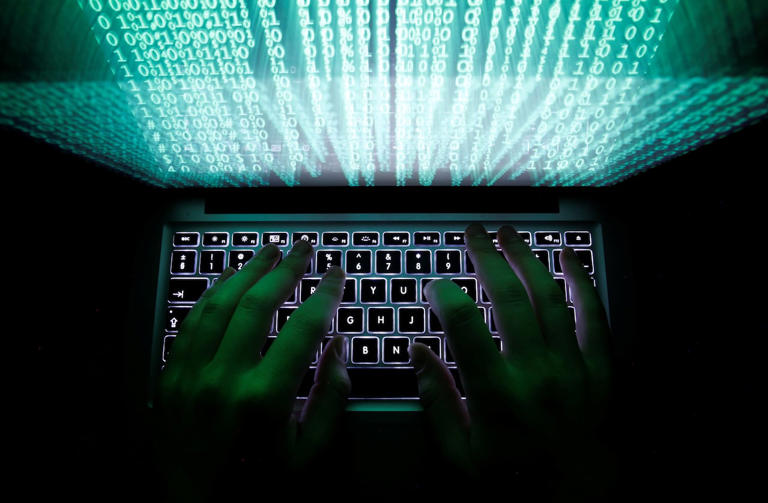
A new report from the Canadian Centre for Cyber Security is warning that cybercrime will pose a threat to national security and the economy in the near term.
© Kacper Pempel/Reuters

Organized cybercrime groups are likely to pose a threat to the nation's security and economy over the next two years, and ransomware attacks now constitute the most disruptive form of cyberattack facing Canada, a new report warns.

The report from the Canadian Centre for Cyber Security (CCCS), released Monday, warns that Russia and, to a lesser extent, Iran are acting as safe havens for cybercriminals hitting Western targets.

During a media briefing on the report Monday, government officials said criminal hackers are targeting education, energy, utility and health-care facilities that are critical to the economy.

The report said that fraud and online scams remain the most common forms of cybercrime. Canadians reported more than 70,000 instances of fraud last year, linked to more than $530 million allegedly stolen from companies and individuals.

Officials said only about 10 per cent of victims report such attacks and that $530 million figure could be an underestimate.

The report says ransomware attacks — which involve hackers threatening to publish sensitive data or block access to it unless a ransom is paid — are targeting organizations and industries with no discernable pattern.

The sectors most affected were manufacturing — which saw 18 per cent of attacks in 2022 — and business and professional services, which saw 14 per cent of attacks.

Other areas of the economy that suffered significant ransomware attacks in 2022 were the health care and pharmaceutical sector (7 per cent of total attacks), information technology and the retail sector (8 per cent each) and the non-governmental organization and education sectors (7 per cent of all incidents).
Hospitals targeted

Related video: Cyber criminals targeting Canadians with 'near impunity,' agency warns (cbc.ca)   Duration 1:56   View on Watch


The report says cyberattacks undermined hospitals' efforts to care for patients, leading to longer hospital stays, delayed tests and procedures, complications from medical procedures and even increased death rates in some cases.

In October 2021, for example, the health care system in Newfoundland and Labrador was hit with a ransomware attack that caused an IT outage affecting 10 per cent of patients in the province and costing the system $16 million.

Separately, the Canada Revenue Agency told CBC News that a hack against the file-sharing platform MOVEit earlier this year did involve CRA-related files, but most of the information was either publicly available or password-encrypted.

"Thanks to these additional safeguards being in place, the CRA has no reason to believe that any CRA information has been compromised," the CRA said.

The MOVEit platform is used internationally by public and private sector organizations to share personal information related to fields such as health care, finance and government services.

Russia and ransomware


The report says that ransomware victims who obey hackers' demands have no guarantee that their systems will be restored.

"One survey of Canadian businesses found that only 42 per cent of organizations who paid the ransom had their data completely restored," the report said.

"Some ransomware operators retain backdoor access to victim networks following ransom payment."

The report also says that in some cases, false evidence is planted to convince victims that their sensitive personal data has been deleted from the attacker's computers.

The CCCS says that "Russian intelligence services and law enforcement almost certainly maintain relationships with cybercriminals and allow them to operate with near impunity."

A government official said intelligence and security sources indicate that many cybercriminal groups operate in Russia and are permitted to carry out those activities so long as they do not target Russian interests.

The report says the relationship between cybercriminal groups in Iran is less clear, with groups targeting institutions and individuals in the United States, Israel and some of the Gulf States.
China is using Canadian think tank to fund and bolster its green image, critics say

Story by Tom Blackwell •

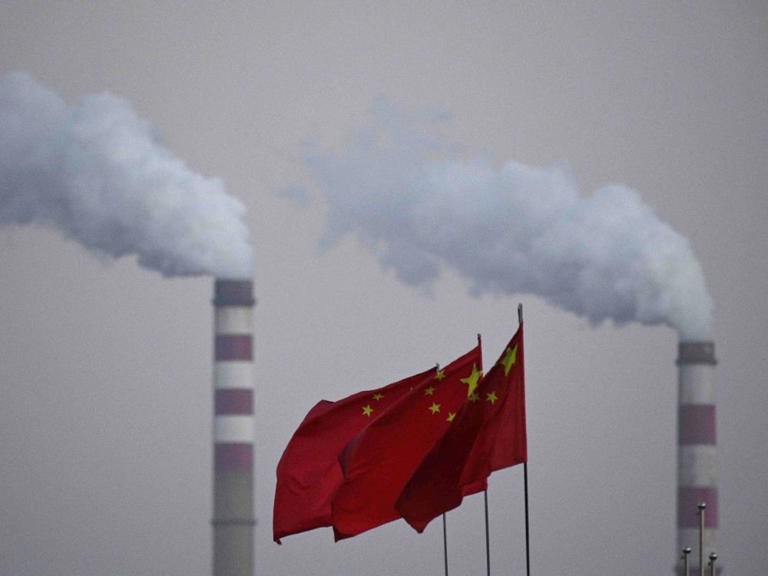
A coal-burning power station in China's Shanxi province. China continues to build coal-fired generating plants, though they are the biggest emitters of climate-altering carbon.© Provided by National Post

Funded by the federal government, a Canadian think tank has for four years been acting as the international secretariat for a Chinese environmental agency headed by one of Beijing’s most powerful Communist Party leaders.

Its little-known role adds to an unusual, longstanding and controversial collaboration between Canada and the Chinese government-founded agency. Touted as an advisory body for policy makers in Beijing, the council is accused by critics of being part of China’s vast global influence machine.

Winnipeg-based International Institute for Sustainable Development helps carry out Canadian-led projects for the China Council for International Cooperation on Environment and Development (CCICED), manages its international donations and appoints advisers, according to the council’s website.

The institute started doing the work in 2019, months after China detained two Canadians in apparent retaliation for the arrest of a Huawei executive in Vancouver, plunging relations between the nations into a prolonged deep freeze.

Guatemalan president calls for transition of power to anti-corruption crusader Arévalo


GUATEMALA CITY (AP) — Guatemalan President Alejandro Giammattei called Tuesday for a democratic transition of power to anti-corruption campaigner and president-elect Bernardo Arévalo and his Seed Movement party, which have faced waves of legal attacks in attempts to block his rise to power.

The president's statement came after a night of political chaos in the Central American nation following one of its most tumultuous elections in recent history.

Hours before the country’s Supreme Electoral Tribunal certified late Monday that Arévalo won this month’s presidential election, another government body — the electoral registry — suspended his party from all political activities. The Seed Movement asked the country's top electoral authority to lift the suspension.

Arévalo called the suspension illegal at a news conference Monday and said that now the vote has been certified “no one can impede me from taking office on Jan. 14.” Arévalo and his party, posing a threat to those keen on holding onto power, have faced a slew of legal challenges, allegations of irregularities and assassination plots, according to international observers.

U.S. Secretary of State Antony Blinken on Tuesday congratulated Arévalo on his election as the next president of Guatemala, saying in a statement that the United States remains “concerned with continued actions by those who seek to undermine Guatemala's democracy.”

“We stand with our partners in the international community and with the Guatemalan people against these unacceptable efforts, including the use of prosecutorial powers against those who seek transparency and accountability,” the statement said.

Arévalo already appeared certain to take office as president in January, after easily beating conservative former first lady Sandra Torres in that runoff. He got 60.9% of the votes, while she had 37.2%.

In a brief message to Guatemalans on Tuesday, Giammattei said he was satisfied for having put all the resources into making the electoral process peaceful. Despite accusations of voter fraud by Torres, the president said there were no “significant” incidents in the voting process.

“Now the doors are open to an orderly, transparent and efficient government transition,” Giammattei said.

Still, the suspension throws into doubt whether Seed Movement lawmakers can take their 23 seats in Congress, and also underscores the uphill battle faced by Arévalo, who campaigned on a progressive and anti-corruption platform.

The Seed Movement requested that the suspension be nullified, basing its request on a June ruling by Guatemala's constitutional court holding that no political force can be suspended during an electoral period. It will be up to the the Supreme Electoral Tribunal to rule on the party's standing.

“We’re basically entering really unexplored legal terrain," said Tiziano Breda, a Central America expert at Italy’s Instituto Affari Internazionali. "But Arévalo's victory is very hard to overrule. I’m not sure they want to risk great international concern, a diplomatic crisis, or what it could imply socially, the unrest it could provoke.”

He said he expects Arévalo’s opponents to continue trying to hamstring other parts of his administration so as to make it as hard as possible for him to govern.

Torres had appeared to have a clear shot at the presidency earlier this year after various other competitors were eliminated from the race, sparking concerns among some critics about the country's democracy.

In the first round of voting, the little-known Arévalo emerged from a crowded presidential field as a surprise presidential contender, winning the right to go into the runoff with Torres, who came to represent the country's elite at a time that Guatemalans are hungry for change amid discontent over endemic corruption.

His win has been the source of a legal back-and-forth between various governmental entities and courts, some staffed with officials who have been sanctioned by the United States on charges of corruption.

Torres, who hasn't conceded defeat, has alleged voter fraud. Raids by prosecutors on his party’s headquarters have caused concern in the international community and among Guatemalans. Earlier this week, the Organization of American States’ human rights commission asked that Guatemala provide protection for Arévalo after reports emerged of possible plots to kill him.

Following the election in August, thousands of people spontaneously took to the streets to celebrate his victory in the capital, Guatemala City. Amid attempts to invalidate the vote, smaller peaceful protests have cropped up in front of the Attorney General’s Office, with demonstrators waving blue and white Guatemalan flags to demand respect for the vote.

Breda said the existing establishment has tried hard to overturn the results. “Even if they don’t manage to, this will have an implication of hindering a transition to Arévalo’s presidency," he said.

___

Janetsky reported from Mexico City.

Sonia Pérez D. And Megan Janetsky, The Associated Press
Climate protester throws paint on Tom Thomson art at Canadian gallery

Story by David Baxter •7h


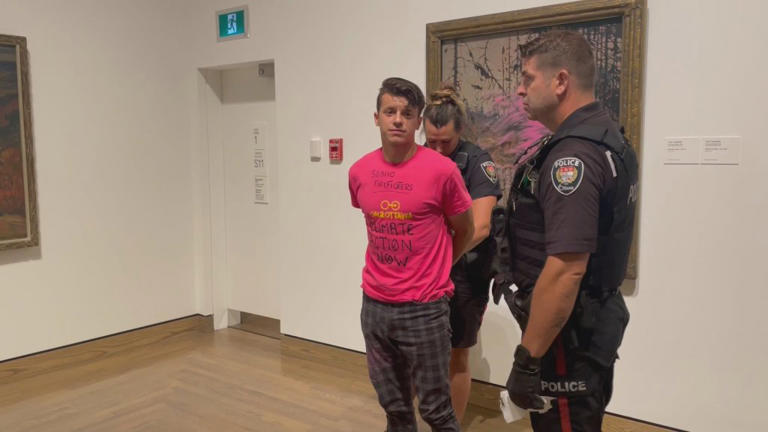
Kaleb Suedfeld is arrested after throwing paint on a work at the National Art Gallery in Ottawa on August, 29.© Mackenzie Gray / Global News

Aman has been arrested at the National Gallery of Canada in Ottawa after throwing paint on a painting in a self-described climate protest.

Kaleb Suedfeld is with the group On2Ottawa, and threw pink paint on a work titled Northern River by landscape painter Tom Thomson.

On2Ottawa says this is to draw attention to their calls that Canada implement a national firefighting agency that employs 50,000 firefighters by 2024.

The group says it's washable paint.

Video: ‘Art or life?’ Anti-oil activists throw tomato soup over Van Gogh painting in London

After throwing the paint, Suedfeld sat in front of the painting until he was arrested. He says he did it because experts and activists aren’t being heard when they call for more action to be taken to address climate change.

“The only power that we the people is to engage in non-violent, direct action to put pressure on governments and just wake up people. If I was yelling on the sidewalk, you wouldn’t care,” he said.

The National Gallery says the painting was not harmed. In a statement on their website, the gallery said that Northern River is displayed behind a protective glazed panel, and the gallery expects the painting to be rehung shortly.

In its press release, On2Ottawa says further disruption in the nation’s capital can be expected for the next week and a half.

Last week, On2Ottawa protesters briefly sat on both Wellington Street and Laurier Avenue – two artery roads that lead into Ottawa’s downtown – during the morning commute, calling for more action to be taken against climate change.

Ottawa Police say they were called to the gallery at noon, and arrested a man for mischief. They add the investigation is ongoing and further charges may be laid.

Thomson is associated with the Group of Seven, a collection of famed Canadian landscape painters who were active in the early 20th century. Thompson died prior to the formation of the group, but his work was an influence among the members.

Ottawa School of Art executive director Andrew Fay feels this is a "wrongheaded approach" for an environmental protest.

"Tom Thompson and the Group of Seven did so many beautiful paintings that are really sort of pro environmental. People see the beauty of the natural pristine landscape," he said.

"I understand the passion that people have, especially as half the country seems to be on fire at the moment. But it's not the way to go about it."

Similar acts of protest have happened at several major art galleries around the world.

— with files from Global News' Mackenzie Gray.
Canadian universities don’t want a cap on international students. Here’s why

Story by Uday Rana •

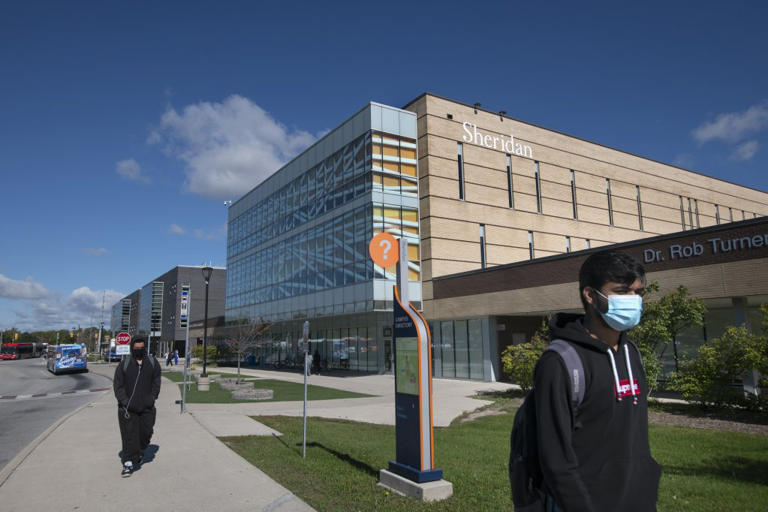
Students outside Sheridan Collegeís Davis Campus in Brampton,Ont., are photographed on Sept 29, 2021. Fred Lum/The Globe and Mail.© Provided by Global News

Amid talk of a cap on international students due to the housing crisis, Universities Canada says there's no need for any such limit.

Canada currently has 800,000 student permit holders and several federal ministers have hinted that the number be capped in the future to ease housing demand.

At the same time, universities and colleges are pushing back as experts say the fees they can charge international students "fill the gap" in funding for their operations.

“Recent comments conflating international students and the housing crisis are deeply concerning to Universities Canada and our members," said Lisa Wallace, a spokesperson for Universities Canada, in a statement last week.

"International students bring important knowledge, diversity and skills to our campuses, communities and workforce. We must continue to welcome them to study at Canadian universities."

Universities Canada in its statement said housing is a “complex and systemic issue."

The statement called on the federal government to expand access to low-cost financing to build housing, to broaden eligibility for housing programs through the National Housing Strategy and to support affordable housing projects in communities across the country.

Experts say, however, that it is not surprising that Universities Canada is opposing limits on the intake of international students.

Video: Halifax post-secondary students struggle to find housing ahead of school year

Fay Faraday, a law professor at Osgoode Hall Law School and immigration law expert, said Canadian universities depend on international students for a large chunk of their revenue

“The international student population is critical to the functioning of the university because the fees that they pay, which are significantly above domestic fees, fill the gap in the underfunding for the public education system and secondary public education system,” she said.

And she said the dependence has grown over the last few decades.

The number of international students in Canada has quadrupled since the year 2000.

According to Statistics Canada, the gulf between domestic and international fees is significant. In the 2022-2023 academic year, the average domestic student in Canada paid $6,834 in tuition. By contrast, the average international student paid nearly six times that amount at $36,123.

A Global Affairs Canada report said international students in Canada spend $22.3 billion on tuition, accommodation, and discretionary spending every year. This is in addition to international students being a major source of labour for Canada, which has faced a severe worker shortage in recent years.

Video: Canadians must be ‘very careful’ not to blame international students for housing crisis: Trudeau

Speaking after the cabinet retreat last week, Prime Minister Justin Trudeau said it would be wrong to single out international students as the cause of Canada's housing crisis.

“We have to be very careful. Over the past years, we’ve seen a lot of different people and a lot of different groups blamed for the housing crisis. At one point it was foreign homebuyers. At another point it was developers being super aggressive. Another point, it was under-investments by various orders of government. Now it’s people saying, ‘Oh, it’s international students,’” Trudeau said.

“Yes, there’s a lot of different factors that go into this housing crisis. But it’s something that has been brewing and developing over the past number of decades.”

A number of Trudeau’s cabinet colleagues have echoed this sentiment recently, but have also spurred questions about whether the government’s immigration targets need to be reviewed as the country struggles to cope with a housing crisis.

Immigration Minister Marc Miller, Housing Minister Sean Fraser and Public Safety Minister Dominic LeBlanc have all indicated that Ottawa is considering a cap on student intake.

Immigration, Refugees and Citizenship Canada (IRCC), however, told Global News it “does not establish levels/caps for study permits in the way we do for permanent residence programs through the multi-year levels plan.”

The statement from the department said the federal government was “undertaking a review” of the international students program after Miller told The Canadian Press in an interview that he is open to reconsidering international student enrollments, particularly amid fraud concerns.

Faraday said it would take provincial intervention to break the economic model that universities operate on.

"There's no way for the university to wean themselves off that economic model without government funding," she said. "But it's a government choice to starve the public institutions, and that's the problem."
Global Affairs Canada issues LGBTQ+ travel advisory for United States

Story by The Canadian Press •


OTTAWA — Canada has updated its international travel advisories to warn members of the LGBTQ+ community that they may face discrimination if they travel to some places in the United States.

The move comes after at least 18 U.S. states passed laws that limit or ban certain things relevant to the community, including gender-affirming medical care for minors and teaching about sexual orientation in schools.

The U.S. Department of Homeland Security also warned in May that threats of violence against the LGBTQ+ community were becoming more frequent and intense.

Mid-morning Tuesday, Global Affairs Canada changed its U.S. travel advice to include a caveat for LGBTQ+ travellers because "some states have enacted laws and policies" that may affect them.

Unlike similar warnings for several other countries, such as Tanzania or Egypt, Canada's U.S. warning doesn't specify which states, or which of their laws or customs, are of concern. It only says travellers should check the local laws for their destination before travelling.

On a more general page about advice to international LGBTQ+ travellers, the government provides some links to resources to look up relevant laws around the world.

"Carefully consider whether you are comfortable visiting a destination where the laws and social customs affecting (LGBTQ+) people differ from those in Canada," the government warns.

In May, the NAACP and the Human Rights Campaign, a U.S.-based LGBTQ+ advocacy group, were among several civil rights groups issuing their own travel advisories specifically for Florida. That came after Gov. Ron DeSantis, who is running for the Republican presidential nomination, signed into law restrictions on drag shows, the use of bathrooms and the use of preferred pronouns in schools.

Florida teachers are also now required to teach that sex is "an immutable biological trait," and that students must only use the pronoun of the sex on a person's birth certificate. They also cannot teach anything about gender identity or sexual orientation until high school, a law critics have dubbed the "Don't Say Gay" bill.

The groups said their advice wasn't to avoid Florida at all costs. But they said if people still chose to travel there, they should use the opportunity to speak out against the laws, and if they chose not to, they should be clear about the reason why.

Canada's general page for LGBTQ+ travellers warns that if they elected to use an X on their passport where it identifies gender, they may face discrimination in some places.

When asked about the change, Deputy Prime Minister Chrystia Freeland said Tuesday that the travel advisories issued by Global Affairs Canada are based on advice from professionals in the department whose job it is to monitor for particular dangers.

She would not say if the Liberals had discussed the matter with U.S. President Biden, but said the relationship with the U.S. is one of the most important for the government.

"We are able to manage that relationship regardless of the choice that the people of the United States make," said Freeland.

"Even as we work hard on that government-to-government relationship, every Canadian government, very much including our government, needs to put at the centre of everything we do the interests and the safety of every single Canadian and every single group of Canadians."

In a written statement, U.S. Ambassador David Cohen did not directly address the new travel warning but said his country "stands for equality and equal treatment for all."

"The United States is committed to promoting tolerance, inclusion, justice and dignity while helping to advance equality for the LGBTQI+ community," he wrote.

"We all must continue to do this work with our like-minded partners not only in the United States, not only in Canada, but throughout the world.”

This report by The Canadian Press was first published Aug. 29, 2023.

Mia Rabson, The Canadian Press


Canada advises LGBTQ2 travellers to be aware of U.S. state laws

Story by Sean Previl •

Canadian and U.S. flags fly atop the Peace Arch monument at the Douglas-Peace Arch border crossing in Surrey, B.C., on Monday, November 8, 2021. Fully vaccinated Canadians were once again paying long-awaited visits to loved ones, vacation properties and tourist destinations in the United States on Monday as southbound travel restrictions finally began to ease along the world's longest unmilitarized land border.
© THE CANADIAN PRESS/Darryl Dyck

Amid a wave of legislation in some U.S. states targeting the LGBTQ2 community, Canada has updated its travel advisory for the country specifically advising people to check state and local laws before visiting.

While overall travel advice around risk levels or health concerns has not changed for the U.S. by Global Affairs Canada (GAC), the department updated its "laws and culture" section specifically to add a section on considerations for the LGBTQ2 community.

"Some states have enacted laws and policies that may affect 2SLGBTQI+ persons," the advisory states, using the expanded term that includes reference to two-spirit, intersex and other sexualities.

The advice includes a link to the Canadian government's webpage for travel safety and advice for Canadians who are LGBTQ2.

"Not all countries have the same values and legal system that we have in Canada. As a result, it is important for you to be informed about the legal framework and social customs governing sexual orientation, gender identity, gender expression and sex characteristics in your destination country," that page notes.

The change marks a shift from just four months ago when several pieces of legislation in Florida prompted organizations including Equality Florida and the Human Rights Campaign to issue travel advisories of their own against coming to the state.

Video: Canadian Civil Liberties Association says anti-LGBTQ sentiment on the rise

When asked by Global News at the time if Canada intended on changing its own travel advisories or advising caution for the United States, GAC said it had issued advice specifically around threats to members of the community before, such as in Uganda.

However, in May, the department did not say whether officials were weighing a similar warning to make note of laws in states like Florida or Tennessee in the travel advice it issues for the U.S.

“Foreign laws and customs related to sexual orientation, gender identity, gender expression and sex characteristics can be very different from those in Canada,” the department had said to Global News.

“As a result, LGTBQ2 travellers could face certain barriers and risks when travelling outside Canada.”

Deputy Prime Minister Chrystia Freeland said travel advisories are done "professionally" by those in government whose job is to look "carefully around the world" and monitor if there are dangers to certain groups of Canadians.

She added the relationship with the U.S. is a priority for the federal government and it works to "manage that relationship regardless of the choices that the people of the United States make," and that they are focused on protecting Canadians.

"Even as we work hard on that government-to-government relationship, every Canadian government very much, including our government, needs to put at the centre of everything we do the interests and the safety of every single Canadian and of every single group of Canadians," she said. "That’s what we’re doing now, that’s what we’re always going to do.”

The response also cited the webpage on travel and Canadians' sexual orientation, gender identity, gender expression and sex characteristics.

That page advises those who plan to visit other countries to be aware of potential restrictions they could face such as if they have an "X" on their gender marker in a passport, and potential difficulties in receiving certain services such as health care due to their sexual orientation or gender identity.

"Research the laws, safety recommendations and social customs related to sexual orientation, gender identity, gender expression and sex characteristics in your destination country," it states.

While no part of the U.S. has criminalized homosexuality, some Republican-led states have put in place laws restricting or banning gender-affirming treatment, limiting drag artists from performing in public spaces, and prohibiting classroom instruction by school personnel or third parties on sexual orientation or gender identity.

The Federal Bureau of Investigation earlier this year noted a 35 per cent jump in hate crimes in its most recent 2021 data, led by a rise in attacks that targeted sexual orientation.


Trans Mountain facing intense deadline pressure to finish pipeline on time: Documents

Story by The Canadian Press •


CALGARY — New documents suggest the Crown corporation behind the Trans Mountain pipeline expansion is facing an uphill battle to finish the project on schedule in spite of mounting internal and external pressure to do so.

The Trans Mountain pipeline is Canada's only pipeline system transporting oil from Alberta to the West Coast. Its expansion, which is currently underway, will boost the pipeline's capacity to 890,000 barrels per day (bpd) from 300,000 bpd currently.

Trans Mountain Corp. has long stated its target date for the mechanical completion of the project is sometime during the third quarter of this year (which ends Sept. 30), with the pipeline's in-service date expected in early 2024.

But last week, the corporation filed for regulatory approval to modify the route of one of the remaining stretches of pipe yet to be completed, saying it has run into a construction-related hurdle that could delay the project's progress.

Now, new regulatory filings by a First Nation in B.C. reveal the extent of the deadline pressure facing the pipeline company.

In a letter to the Canada Energy Regulator dated Aug. 28, a lawyer for the Stk'emlupsemc te Secwepemc details a meeting the First Nation's leadership had with Trans Mountain executives about the proposed route change.

According to the First Nation's filing, Trans Mountain CEO Dawn Farrell said engineering difficulties related to the drilling of a tunnel in B.C. mean the corporation can no longer complete the pipeline section in question using a trenchless construction method as promised.

"I know that it’s not your concern that this is taking longer and that it’s causing problems with the schedule and all the rest of it but it is," the First Nation quotes Farrell as saying in the meeting. "Significantly.

"We are constrained to options that are economic and feasible within the remaining time frame."

The Stk'emlupsemc te Secwepemc's letter also says Trans Mountain never said its originally proposed construction method was impossible, only that it couldn't be done in time to meet a Jan. 1, 2024, in-service date for the pipeline.

"We’ve come to a conclusion that we aren’t going to be successful in completing that tunnel in time to meet the requirements and bring this project online," the First Nation quotes Trans Mountain as telling them.

"And, at this point in time, bringing the project online is something that we need to do. The executive made that clear, the board of directors made that clear. It’s an expectation of … the contracts we have in place."

The section of pipe in contention is a proposed 1.3-kilometre stretch yet to be built in the Jacko Lake area, near Kamloops.

The Stk'emlupsemc te Secwepemc state in their regulatory filing that the area has "profound spiritual and cultural significance" to their people, and that they only consented to the pipeline's construction with the understanding that Trans Mountain would minimize surface disturbances by implementing specific trenchless construction methods.

"Trans Mountain has failed to demonstrate that the trenchless construction methods within the Pipsell (Jacko Lake) Corridor approved under the Previous Deviation Application are no longer a viable method of construction," the First Nation states.

"Trans Mountain has made it clear that financial considerations ... and Trans Mountain’s preference for a Jan. 1, 2024 in-service date are the rationale for submitting the Deviation Application."

The Trans Mountain pipeline project has been plagued by difficulties. The pipeline was bought by the federal government for $4.5 billion in 2018 after previous owner Kinder Morgan Canada Inc. threatened to scrap the pipeline's planned expansion project in the face of environmentalist opposition and regulatory hurdles.

Its projected price tag has since spiralled, first to $12.6 billion, then to $21.4 billion and most recently to $30.9 billion (the most recent capital cost estimate, as of March of this year).

The federal government has already approved a total of $13 billion in loan guarantees to help Trans Mountain secure the financing to cover the cost overruns.

Trans Mountain Corp. has blamed its budget problems on a variety of factors, including inflation, COVID-19, labour and supply chain challenges, flooding in B.C. and unexpected major archeological discoveries along the route.

This most recent construction hurdle does not bode well for the corporation's schedule or budget, said Richard Masson, executive fellow with the University of Calgary's School of Public Policy.

"It sounds to me quite bad," Masson said in an interview on Tuesday.

"It’s unlikely, in my opinion, (that) you’re going to get a quick deviation approval on something you made a commitment to a First Nation on."

He added that while Trans Mountain waits for the regulator to make a decision on its request to move the pipeline route, its labour costs will continue to rise.

And the federal government, which is seeking to divest the pipeline and has entered negotiations with several interested Indigenous-led buyers, will be unable to sell until a final construction cost and in-service date is determined.

In the meantime, Trans Mountain has filed for regulatory approval for thetolls it wishes to charge oil shippers when the pipeline begins operations. But oil companies, frustrated by the higher tolls Trans Mountain says are necessary due to the pipeline's ballooning price tag, are pushing back.

The Canada Energy Regulator has yet to make a decision on the tolling issue, and has agreed to give shippers until Aug. 30 to file written statements. But shippers also need the pipeline to be completed on schedule to meet their obligations to customers.

"They've got a commitment to ship the oil, they've got to be ready to execute on that. So a delay complicates that," Masson said.

"And of course the federal government will need to put in more loan guarantees to keep this thing afloat until the tolls start coming. It all adds up to bad news for everybody."

This report by The Canadian Press was first published Aug. 29, 2023.

Amanda Stephenson, The Canadian Press

Trans Mountain oil pipeline expansion may face new delays -filing

Story by By Rod Nickel •

A pipe yard servicing government-owned oil pipeline operator Trans Mountain is seen in Kamloops© Thomson Reuters

WINNIPEG, Manitoba (Reuters) - Trans Mountain Corp fears that the expansion of its Canadian oil pipeline may be delayed further unless a regulator allows it to change its route in British Columbia, according to a First Nation that opposes the route adjustment.

Cost overruns and delays have dogged efforts to triple the capacity of the government-owned pipeline that runs from Edmonton, Alberta to Burnaby, British Columbia (B.C.).

Costs of construction have more than quadrupled to C$30.9 billion ($22.80 billion). Further delay would limit options to move Canadian oil to refineries in the United States or Asia.

The Canada Energy Regulator (CER) is weighing whether to allow Trans Mountain to deviate from its approved route on a 1.3-kilometre (0.8 mile) section just south of Kamloops, B.C.

Trans Mountain has requested to use a conventional open trench because it says it has encountered "significant technical challenges" micro-tunnelling through hard rock formations.

In a Monday filing to the CER, Stk’emlúpsemc te Secwépemc Nation (SSN) said Trans Mountain CEO Dawn Farrell raised the urgency of the route change at a meeting on July 6.

"I know that it's not your concern that this is taking longer and that it's causing problems with the schedule and all the rest of it, but it is, significantly," SSN quoted Farrell as saying. "We are constrained to options that are economic and feasible within the remaining time frame."

Trans Mountain did not respond immediately to a request for comment.

The route change would harm an area that holds spiritual and cultural significance, SSN said.

SSN said it supports the pipeline expansion, but not the route deviation, which it said Trans Mountain has not shown is necessary. It said Trans Mountain has instead indicated that it is seeking the change because of cost factors and its goal to put the pipeline into service on Jan. 1, 2024.

($1 = 1.3555 Canadian dollars)

(Reporting by Rod Nickel in Winnipeg, Manitoba; Editing by Andy Sullivan)