Friday, November 17, 2023

SAM SPADE MEETS AI
Private Eye Gets Almost 7 Years for Hedge Fund Hacking Ring

Chris Dolmetsch
Thu, November 16, 2023 


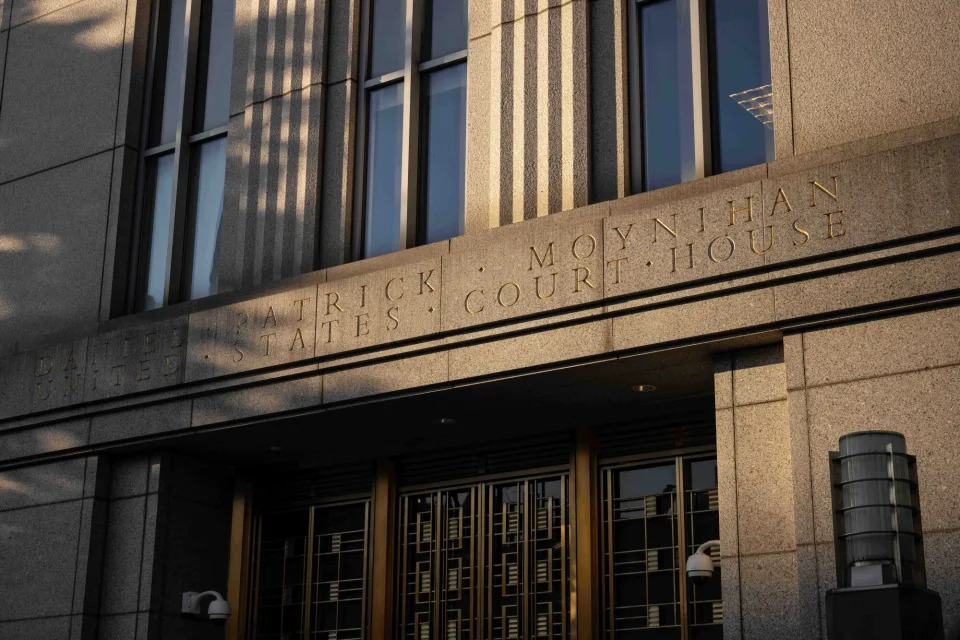
(Bloomberg) -- A private investigator was sentenced in New York to 80 months in prison after he admitted to his role in a massive hacking ring that targeted hedge funds, short sellers and journalists.

Aviram Azari’s punishment was pronounced on Thursday by US District Judge John Koeltl in Manhattan. The 52-year-old Israeli had pleaded guilty in April 2022 to fraud and conspiracy to commit computer hacking, as part of a deal with US prosecutors.

Through an interpreter he expressed in Hebrew his “deep regret,” while noting he is worried for his relatives and friends in Israel, including his daughter, who is an officer in the Israeli Defense Force. Israel has been at war with Hamas forces in Gaza for more than a month.

“I take responsibility, full responsibility, for my actions,” Azari, dressed in tan prison garb, told the judge before his sentence was pronounced. He said he regretted it “with all my heart.”

Read More: Private Eye Pleads Guilty in Probe of Vast Hedge Fund Hack

Azari had admitted to hiring hackers who targeted victims with phishing emails. Prosecutors said he played a “critical role” in the scheme and was paid more than $4.8 million over almost five years to manage intelligence-gathering campaigns and attacks that can compromise entire networks. They said his clients included the now defunct German technology firm Wirecard AG.

His case was part of an investigation into a vast hacking-for-hire campaign that targeted thousands of entities including hedge funds Coatue Management LLC and Blue Ridge Capital LLC, as well as nonprofit groups fighting telecommunications companies over control of the internet and journalists from multiple news organizations.

He was arrested after landing at John F. Kennedy International Airport in September 2019 and has been in custody ever since.

Fought Hezbollah

Azar, who lives in Kiryat Yam, Israel, served as a paratrooper in the Israel Defense Forces, fought in the 2006 Lebanon War with Hezbollah and later worked as an undercover officer for the Israeli police. His lawyers said in a sentencing memo that his firm was at first a lawful business that allowed him to use his skills, before he turned down the wrong path.

“Mr. Azari was successful at growing his business,” they wrote. “He should have stopped there.”

The US had asked the judge to give Azari 94 to 111 months behind bars, saying the scheme was “incredibly sophisticated” and “wreaked financial, professional, emotional and physical devastation” on his victims. Prosecutors said in their own sentencing memo that his apprehension was a “difficult achievement” in international cybercriminal investigations and that his sentence should serve as a deterrent to would-be hackers.

They said he ran a firm known as Aviram Hawk, or Aviram Netz, that hired groups of hackers, including one based in India, to steal credentials through emails that appeared to be from trusted sources. Wirecard used his company to gather intelligence on people and financial firms that had been critical of it, they said.

“Mr. Azari was an essential link in the chain of what was a sophisticated and long-running hacking scheme,” Assistant US Attorney Juliana Newcomb Murray told the court. “The true scale of this crime is exponentially larger than the government has been able to confirm.”

Exxon Probe

Azari’s firm also targeted people and organizations fighting climate change, and stole documents that were leaked to the press, prosecutors said. That resulted in news articles about probes by New York and Massachusetts into Exxon Mobil Corp.’s knowledge of the risks of climate change that “appeared designed to undermine the integrity” of the investigations, the government said.

Prosecutors identified more than 100 victims successfully hacked by Azari, and about 200 other targets of projects managed by his firm. The number of hackers hired in the schemes numbered “in the thousands” and spanned the globe, the government said.

Three of Azari’s victims addressed him directly Thursday, including Peter Frumhoff, a Harvard University professor of environmental science and public policy, and Lee Wasserman, director of the Rockefeller Family Fund.

Frumhoff said the attacks targeting groups fighting climate change were “unnerving.” He said, “it forced me at a critical moment to become extremely wary about what emails were legitimate and which were not. I had no idea about what information had been compromised.”

Wasserman said he was “appalled and shaken” by the hack of his private emails. “It felt like Big Brother had arrived,” he said. “I found myself whispering in my own home.”

All of the victims urged Azari to give up the names of those who hired him.

“We have a right to know who the clients are,” Frumhoff said. “The public has a right to know who was paying Azari to carry out these attacks.”

Azari asked Koeltl to sentence him to five years in prison, saying he had endured a “simply unimaginable punishment” since his arrest. He said he had been held in “utterly inhumane conditions” at jails in Manhattan and Brooklyn, including a one-year lockdown in a “mold-infested, windowless cell” for more than 23 hours a day without showers, hot meals or exercise.

The case is US v. Azari, 19-cr-00610, US District Court, Southern District of New York (Manhattan).

(Updates with comments from victims.)

Most Read from Bloomberg Businessweek
2 environmentalists who were targeted by a hacking network say the public is the real victim

Thu, November 16, 2023 

NEW YORK (AP) — Two environmentalists told a federal judge Thursday that the public was the real victim of a global computer hacking campaign that targeted those fighting big oil companies to get the truth out about global warming.

A climate scientist and the director of a fund that creates initiatives to address climate change spoke at the sentencing of an Israeli man who prosecutors said enabled the hacking of thousands of individuals and entities worldwide.

Aviram Azari, 52, of Kiryat Yam, Israel, was sentenced to six years and eight months in prison for his role in a global computer-hacking network that authorities say targeted environmentalists, companies and individuals.

“I was the target, but the public at large was the intended victim,” said Peter Frumhoff, director of science and policy and chief scientist at the Union of Concerned Scientists in Cambridge, Massachusetts.

“It is our job to tell the world the truth about a world on fire” and who “lit the flame,” said Lee Wasserman, director of the Rockefeller Family Fund.

In a release, prosecutors said Azari owned an Israeli intelligence firm from November 2014 to September 2019, earning $4.8 million after clients hired him to manage “projects” that were really hacking campaigns targeting climate change activists, individuals and financial firms, among others.

Some hacked documents were leaked to journalists, resulting in articles related to investigations by attorneys general in New York and Massachusetts over what Exxon Mobile Corp. knew about climate change and potential misstatements the company made regarding what it knew about the threat, prosecutors said.

Prosecutors said the theft of identities and personal data from victims resulted in some of them describing a “psychological assault” that left them with “anxiety, paranoia, depression, sleeplessness and fear” and the sense that their personal safety was in jeopardy.

Wasserman said he was “appalled and shaken” by the invasion into his personal and professional life.

“I found myself whispering in my own home,” he said.

“It was unnerving,” said Frumhoff, who also teaches at Harvard University.

He said the online invasion had a “completely detrimental, chilling effect on our work.”

Azari was sentenced after pleading guilty to conspiracy to commit computer hacking, wire fraud and aggravated identity theft. He has been detained since his September 2019 arrest when he traveled to the U.S. from abroad.

Assistant U.S. Attorney Juliana Murray told the judge that Azari's victims, including those working for public interest groups and climate change advocates, were “carefully chosen” to interrupt their work.

When he spoke, Azari apologized to his victims, saying he was accepting full responsibility for his crimes and promising not to “repeat this ever again.”

Frumhoff said he hoped the investigation continues so that prosecutors can expose who paid Azari “to carry out these attacks.”

After he was sentenced, Azari was given a chance to speak again and said that he listened as victims spoke at the proceeding.

He predicted “there will come a day” when he would be able to speak more about his crimes. Until then, he added, he asked for the forgiveness of his victims.

“You don't know everything,” he said.

Larry Neumeister, The Associated Press
RIP
Ken Mattingly, astronaut who helped Apollo 13 crew return safely home, dies at age 87


ROBERT JABLON
 

This photo released by NASA shows astronaut Ken Mattingly. Mattingly, who is best remembered for his efforts on the ground that helped bring the damaged Apollo 13 spacecraft safely back to Earth, has died Tuesday, Oct. 31, 2023, NASA announced. 
(NASA via AP) (ASSOCIATED PRESS)

LOS ANGELES (AP) — Ken Mattingly, an astronaut who is best remembered for his efforts on the ground that helped bring the damaged Apollo 13 spacecraft safely back to Earth, has died, NASA announced. He was 87.

“We lost one of our country’s heroes on Oct. 31," NASA Administrator Bill Nelson said in a Thursday statement.

Thomas Kenneth Mattingly II “was key to the success of our Apollo Program, and his shining personality will ensure he is remembered throughout history,” Nelson said.

NASA didn't mention where or how Mattingly died. However, The New York Times reported that Mattingly died in Arlington, Virginia.

A former Navy pilot, Mattingly joined NASA in 1966. He helped with development of the spacesuit and backpack for the Apollo moon missions, NASA said.

However, his own first spaceflight only came in 1972 when he orbited the moon as pilot of the Apollo 16 command module, while two other crew members landed on the moon's surface.

On the trip back to Earth, Mattingly spacewalked to collect film cannisters with photographs he had snapped of the moon's surface.

In later years, Mattingly commanded two space shuttle missions and retired from the agency and the Navy as a rear admiral.

But his most dramatic mission was one that he never flew.

In 1970, Mattingly was supposed to have joined the crew of Apollo 13, piloting the command module. But he was removed from the mission a few days before launch after being exposed to German measles.

He didn't contract the illness but was replaced aboard the mission by John Swigert Jr.

Several days into the mission, an oxygen tank on the spacecraft's service module exploded, knocking out most of the power and oxygen to the command module. The lunar landing was scrapped and NASA began frantic efforts to save Swigert, James Lovell and Fred Haise.

Mattingly, who knew the spacecraft intimately, worked with engineers and others as they analyzed the situation and scrambled to find solutions and pass on instructions to the crew.

The trio of astronauts eventually crowded into the lander, which was designed for only two, and used it as a lifeboat for four days as Apollo 13 swung around the moon and then landed safely on Earth.

Mattingly “stayed behind and provided key real-time decisions to successfully bring home the wounded spacecraft and the crew,” NASA's Nelson said.

“One of the many lessons out of all this is starting on day one it was from the very first moment, assume you’re going to succeed and don’t do anything that gets in the way," Mattingly recalled in an oral history interview for NASA in 2001.

Apollo 13's story was told in the 1994 book “Lost Moon: The Perilous Voyage of Apollo 13,” co-authored by Lovell, and in the 1995 movie “Apollo 13,” where Gary Sinise played Mattingly.

UPDATES
Indian rescuers still 40 metres away from workers trapped in collapsed tunnel

Thu, November 16, 2023 

Police officers stand guard next to a barricade past the entrance of a tunnel where 40 road workers are trapped after a portion of the tunnel collapsed in Uttarkashi


By Saurabh Sharma

SILKYARA, India (Reuters) - Rescuers drilled about one-third of the way into the debris of a collapsed highway tunnel in India by Friday morning to reach 40 workers trapped inside for five days, officials said.

Drilling had penetrated through about 21 metres (70 feet) of debris, Devendra Singh Patwal, a disaster management officer, told Reuters.

They have to cover a total distance of nearly 60 meters.

Another officer with the rescue team inside the tunnel said the trapped men were doing fine.

The workers have been supplied with food, water and oxygen through a pipe and authorities have been in contact with them via walkie-talkies.

The 4.5 km (3 mile) tunnel in the northern state of Uttarakhand is part of the Char Dham highway, one of the most ambitious projects of Prime Minister Narendra Modi's government.

Authorities have not said what caused the tunnel to cave in on Sunday morning, but the region is prone to landslides, earthquakes and floods.

(Reporting by Saurabh Sharma, writing by Tanvi Mehta and Raju Gopalakrishnan)

New drill bores deeper into tunnel rubble in India to create an escape pipe for 40 trapped workers


BISWAJEET BANERJEE
November 16, 2023 


LUCKNOW, India (AP) — Rescuers drilled deeper into the rubble of a collapsed road tunnel in northern India on Friday to fix wide pipes for 40 workers trapped underground for a sixth day to crawl to their freedom.

Drilling with a new machine started on Thursday and has covered a stretch of 24 meters (78 feet) so far, Devendra Patwal, a disaster management official, said.

It may require up to 60 meters (195 feet) to enable the trapped workers' escape, Patwal told The Associated Press on Friday.

Patwal said the rescuers hoped to complete the drilling by Friday night and create an escape tunnel of pipes welded together.

Some of the workers felt fever and body aches Wednesday, but there has been no deterioration in their condition, he said. Nuts, roasted chickpeas, popcorn and medicine are being sent to them via a pipe every two hours.

The construction workers have been trapped since Sunday, when a landslide caused a portion of the 4.5-kilometer (2.7-mile) tunnel they were building to collapse about 200 meters (500 feet) from the entrance. The hilly area is prone to landslide and subsidence.

The site is in Uttarakhand, a mountainous state dotted with Hindu temples that attract many pilgrims and tourists. Highway and building construction has been constant to accommodate the influx.

The tunnel is part of the busy Chardham all-weather road, a flagship federal project connecting various Hindu pilgrimage sites.

About 200 disaster relief personnel have been at the site using drilling equipment and excavators in the rescue operation, with the plan to push 80-centimeter-wide (2.6-foot-wide) steel pipes through an opening of excavated debris.

A machine used earlier in the week was slow in pushing the pipes through the debris, a state government statement said.

The new American Auger machine has a drilling capacity of up to 5 meters (16 feet) per hour and is equipped with a 990 centimeters (2.9 feet) diameter pipe to clear debris. At times, it is slowed down by the pile of rubble.

State officials have contacted Thai experts who helped rescue a youth soccer team trapped in a cave in Thailand in 2018, state government administrator Gaurav Singh said. They also have approached the Norwegian Geotechnical Institute for possible help.
A cannabis worker died on the job from an asthma attack. It’s the first reported case in US


Thu, November 16, 2023 


The U.S. cannabis production industry’s first reported occupational asthma death took the life of a worker in Massachusetts, federal health and safety officials said.

The woman, 27, was working in a cannabis cultivation and processing facility when she experienced worsening work-related respiratory symptoms that ended in a fatal asthma attack in January 2022, officials said in a federal report published Thursday. The report states that allergic diseases such as asthma are a growing concern in the U.S. cannabis industry, which has grown rapidly in recent years thanks to a wave of state-level legalizations.

The report said the worker's death “illustrates missed opportunities for prevention, including workplace exposures, medical surveillance, and treatment according to the current asthma guidelines.”

The report also states that evaluation of workers with new-onset or worsening asthma is essential in cannabis facilities. That approach could help prevent workplace deaths when paired “with prompt diagnosis and medical management,” the report states.

The U.S. Centers for Disease Control and Prevention published the report, which it said represented findings of a federal Occupational Safety and Health Administration inspection that included a worksite exposure assessment, coworker and next-of-kin interviews, medical record reviews, and collaboration with the Massachusetts Department of Public Health.

The report does not name the worker or the Massachusetts facility. However, the federal Occupational Safety and Health Administration reported in filings last year that an employee at the Holyoke location of cannabis company Trulieve who was packaging ground cannabis into pre-rolls suffered an asthma attack and later died in the hospital. Trulieve identified the worker as Lorna McMurrey, 27, last year.

Representatives for Trulieve did not respond to requests for comment from The Associated Press.

The report cites studies that identify respiratory hazards in the cannabis cultivation and production industry, such as microbial and plant allergens. The report also states that chemicals such as pesticides and allergens specific to the cannabis plant itself can be a hazard.

The finding comes as legalization of recreational marijuana, and the resultant growth of the cannabis industry, is spreading. Almost half the states allow adult recreational use of marijuana. Legalizations began in 2012 with Washington and Colorado and have only accelerated.

Advocates for safety in the marijuana industry have called for more safeguards to make sure the cannabis business doesn’t put workers or the public at risk.

The death of the Massachusetts worker “should be a big red flag to lawmakers that we need to put way more guardrails around that industry,” said Scott Gagnon, a cannabis industry watchdog who advocates for the prevention of substance abuse in Maine, where marijuana has been legal for several years.

The industry wants to be as safe as possible, said Paul Armentano, deputy director of NORML, the marijuana law reform group, adding that “likelihood of such incidences is greatly reduced in environments where cannabis businesses are licensed, regulated, and required to adhere to the same sort of workplace safety regulations and standards as others."

“Furthermore, when such incidences do occur, the regulated marketplace ensures that they are properly investigated and that corrective actions are taken to prevent future incidents,” Armentano said.

Patrick Whittle, The Associated Press
Oil Majors’ Carbon Capture Plans Dubbed a ‘Dangerous Delusion’
SOMEBODY TELL ALBERTA & FEDS

Alastair Marsh
Thu, November 16, 2023


(Bloomberg) -- Oil executives betting they’ll be able to meet net zero emissions goals by relying on carbon-capture technology are deluding themselves, according to an influential group of corporate bosses, bankers and academics.

The Energy Transitions Commission, whose members include senior representatives from BP Plc and Bank of America Corp., says the role of carbon capture, utilization and storage (CCUS) in slashing emissions will be “vital but limited.” However, any carbon-intensive company assuming that CCUS is a license to continue expanding production, while holding on to net zero goals, is basing its business model on “a dangerous delusion,” the ETC said in a report published Thursday.

The findings come just two weeks before COP28 climate talks get underway in Dubai. The summit will be presided over by the head of the state-backed Abu Dhabi National Oil Co., which has said it can raise production and cut emissions at the same time by investing in carbon capture technology. Exxon Mobil Corp., the largest US oil company, has said it won’t reduce oil and gas production and instead intends to invest in low-carbon technologies that complement fossil fuels such as carbon capture and hydrogen.

“The big debate at COP is going to be whether you get rid of fossil fuel use, or if you keep using fossil fuels at the current level and you just add CCUS” and direct air capture, according to Adair Turner, the former City of London finance regulator who now chairs the ETC.

Representatives from oil-producing nations may say that “of course we can go on producing a hundred million barrels of oil a day for the next 50 years and we’ll do enough direct air capture to offset it,” he said. “And on the other hand, you’ll have a lot NGOs and renewable energy companies saying this whole CCUS and DAC thing is a bit of a con trick, and it’s a deliberate device by the fossil fuel companies to explain why they can go on producing fossil fuels forever.”

According to the ETC’s calculations, the cost of developing CCUS isn’t declining, and projects aren’t being developed at the expected pace. At the same time, progress made toward getting the necessary financing for such projects has been “very disappointing” over the past 18 months, the ETC said.

Turner says the appropriate mix is 85% real emissions reductions, with CCUS and DAC taking care of the rest.

With fossil fuel production, processing and combustion responsible for 90% of global CO2 emissions and 35% of methane emissions, COP28 talks need to secure an agreement around a phase-down of all fossil fuels, the ETC said.

The ETC estimated last year that roughly 150 gigatons of carbon removals “could be delivered” by 2050, by tapping a portfolio of nature-based and technological solutions. Reaching that goal requires that “adequate finance” be mobilized, the commission said on Thursday.

Are you planning to do more green investing or put more money into fossil fuels next year? Share your views in Bloomberg's latest MLIV Pulse survey.


 Bloomberg Businessweek
U$A
Thousands of Starbucks workers go on a one-day strike on one of the chain's busiest days of year


Thu, November 16, 2023 at 


NEW YORK (AP) — Workers at more than 200 U.S. Starbucks locations walked off the job Thursday in what organizers said was the largest strike yet in the 2-year-old effort to unionize the company’s stores.

The Workers United union chose Starbucks' annual Red Cup Day to stage the walkout since it’s usually one of the busiest days of the year. Starbucks expects to give away thousands of reusable cups Thursday to customers who order holiday drinks.

The union said it was expecting more than 5,000 workers to take part in its “Red Cup Rebellion.” Workers were expected to picket for part of the day and visit non-union stores the rest of the day, the union said. Around 30 stores also staged walkouts on Wednesday.

Juniper Schweitzer, who has worked for Starbucks for 16 years, said she loves the company and its ideals but believes it's not living up to them.

“They have promised the world to us and they have not delivered,” said Schweitzer, who was picketing outside her Chicago store on Thursday.

Frequent promotions like Red Cup Day or buy-one-get-one-free offers put added stress on workers, who she said have no ability to switch off mobile orders or otherwise control the workflow.

“I mean, you can imagine the Starbucks orders. Decaf grande non-fat, three-and-a-half Splenda mocha with no whip. Multiply that by 100 and you have just drink, drink, drink, drink, drink, drink, drink,” she said. "We just have basically an infinite amount of drinks and we’re understaffed and we’re underpaid and we’re sick of it.”

Edwin Palmasolis, a Starbucks employee for more than two years, joined the picket line Thursday in front of his New York store. His store voted to unionize last year, but so far Starbucks and the union haven't started bargaining. He thinks a contract would help improve working conditions at his busy Manhattan store.

“It’s been more of a downgrade than an uphill for us. It’s been exhausting trying to deal with their retaliation and not much of a change has been made in the past year,” he said.

Thursday’s strike was the fifth major labor action by Starbucks workers since a store in Buffalo, New York, became the first to unionize in late 2021. Workers at 110 stores walked out last year on Red Cup Day; most recently, a strike in June protested reports that Starbucks had removed Pride displays from its stores.

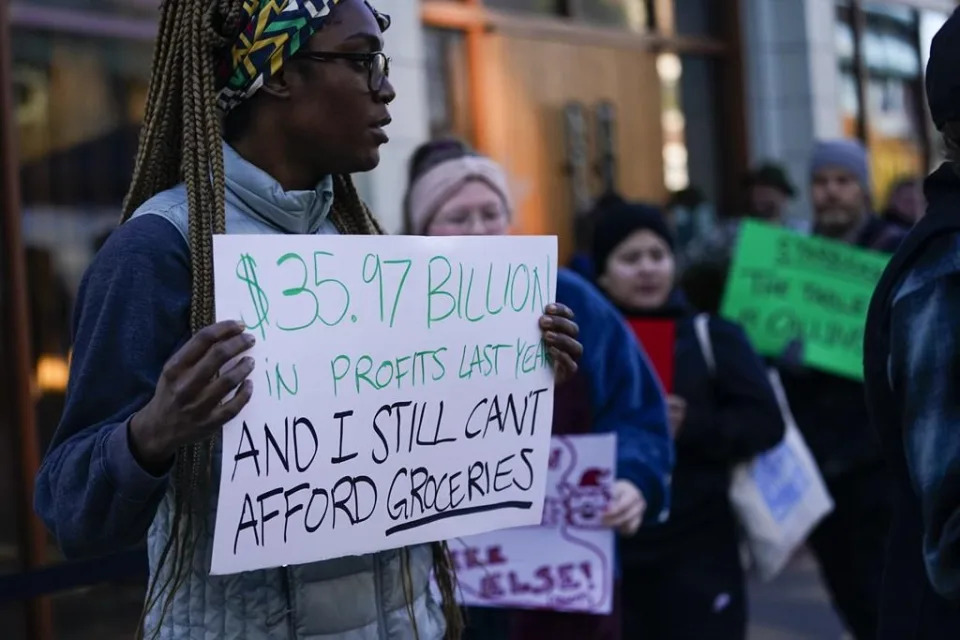
But the strikes have had little impact on Starbucks’ sales. For its 2023 fiscal year, which ended Oct. 1, Starbucks reported its revenue rose 12% to a record $36.0 billion.

Starbucks said Thursday that many of the stores with striking workers remained open, staffed by supervisors, managers and employees who chose not to strike or visited from nearby stores to pick up additional hours.

“We have nearly 10,000 stores open right now delighting our customers with the joy of Red Cup Day,” the company said.

At least 363 company-operated Starbucks stores in 41 states have voted to unionize since late 2021. The Starbucks effort was at the leading edge of a period of labor activism that has also seen strikes by Amazon workers, auto workers and Hollywood writers and actors. At least 457,000 workers have participated in 315 strikes in the U.S. just this year, according to Johnnie Kallas, a Ph.D. candidate and the project director of Cornell University’s Labor Action Tracker.

Starbucks opposes the unionization effort and has yet to reach a labor agreement with any of the stores that have voted to unionize. The process has been contentious; regional offices with the National Labor Relations Board have issued 111 complaints against Starbucks for unfair labor practices, including refusal to bargain. Starbucks says Workers United is refusing to schedule bargaining sessions.

Starbucks noted that it has started bargaining with the Teamsters union, which organized a Starbucks store outside of Pittsburgh in June 2022. But the two sides have not reached a labor agreement. An employee answering the phone at the store Thursday said it wasn't participating in the strike.

Relations between Starbucks and Workers United have grown increasingly tense. Last month, Starbucks sued Workers United, saying a pro-Palestinian post on a union account damaged its reputation and demanding that the union stop using the name Starbucks Workers United. Workers United responded with its own lawsuit, saying Starbucks defamed the union by suggesting it supports terrorism and violence.

But on Thursday, most strikers were focused on work issues and pay. Moonie Atchley, who works as a mixologist at a Starbucks store in the company's hometown of Seattle, was picketing outside a non-union store near Pike Place Market, where the first Starbucks opened in 1971.

Atchley said she often struggles to pay her rent and buy food on her Starbucks paycheck, even though she lives outside the city.

"The union is fighting for a better Starbucks. We want the best for this company,” she said.

__

AP Video Journalists Manuel Valdes in Seattle, Melissa Perez Winder in Chicago and Robert Bumsted in New York contributed. Durbin reported from Detroit.

Dee-ann Durbin, The Associated Press

Starbucks workers hold largest strike in company history on Red Cup Day

JOSEPH LAMOUR
November 16, 2023 

Starbucks workers hold largest strike in company history on Red Cup Day

Starbucks workers have organized the largest strike in the company’s history on a typically high-traffic day for its locations.

On Nov. 16, unionized workers at multiple Starbucks locations nationwide walked out in protest on Red Cup Day, a promotion where customers can purchase reusable red holiday cups that give them discounts on future uses and other benefits.

Starbucks Workers United said the walkout involved thousands of workers at more than 200 stores, but Starbucks said workers were taking part in the protest at fewer than 100 stores.

The union, which organized what it coined the “Red Cup Rebellion,” says workers are protesting understaffing at the company’s locations, which includes promotional days like Red Cup Day, Double Star Days, ThursYays and more. Workers are demanding that Starbucks also turn off mobile ordering on these days when foot traffic is up.


Starbucks Workers United union members and supporters on a picket line outside a Starbucks (Victor J. Blue / Getty Images)

Mobile ordering, which was first introduced to stores in 2015, has become an integral part of Starbucks employees’ workday as the capability has grown over time. Mobile order and delivery totalled a third of Starbucks’ sales in its latest quarter, according to CNBC, and some baristas say mobile orders have inundated and overwhelmed staff, particularly on days when the company offers deals and freebies.

For its part, Starbucks says its retail leaders have the flexibility to adjust staffing schedules — which are created three weeks in advance — as needed, and stores are often provided additional labor hours to increase staffing for planned promotional days like Red Cup Day.

Steph Kronos, a pro-Union activist, joins Starbucks workers, former employees, and supporters in holding signs in support of a strike, outside of a Starbucks store (Saul Loeb / Getty Images)

At least 360 of Starbucks’ roughly 9,000 company-owned locations in 41 states have voted to unionize, according to National Labor Relations Board data, since the end of 2021, when the union first won an election.

Meanwhile, Starbucks workers just filed 32 more complaints with New York City, bringing the total to nearly 90 complaints since February. Workers allege that Starbucks violated New York’s Fair Workweek Law, which says businesses must give employees regular schedules that stay the same week-to-week, set work schedules 14 days in advance and extra pay for shift changes and more.

“We make every effort and have invested significant resources to ensure partner scheduling practices are in alignment with New York City’s Fair Workweek Law,” Starbucks said in a statement to CNBC.

This article was originally published on TODAY.com
Analysis-What China's Xi gained from his Biden meeting

MICHAEL MARTINA AND GREG TORODE
November 16, 2023


By Michael Martina and Greg Torode

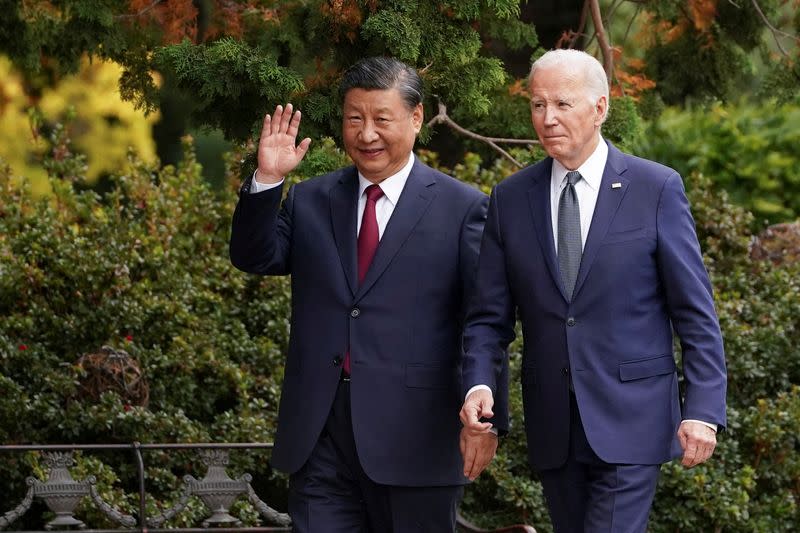
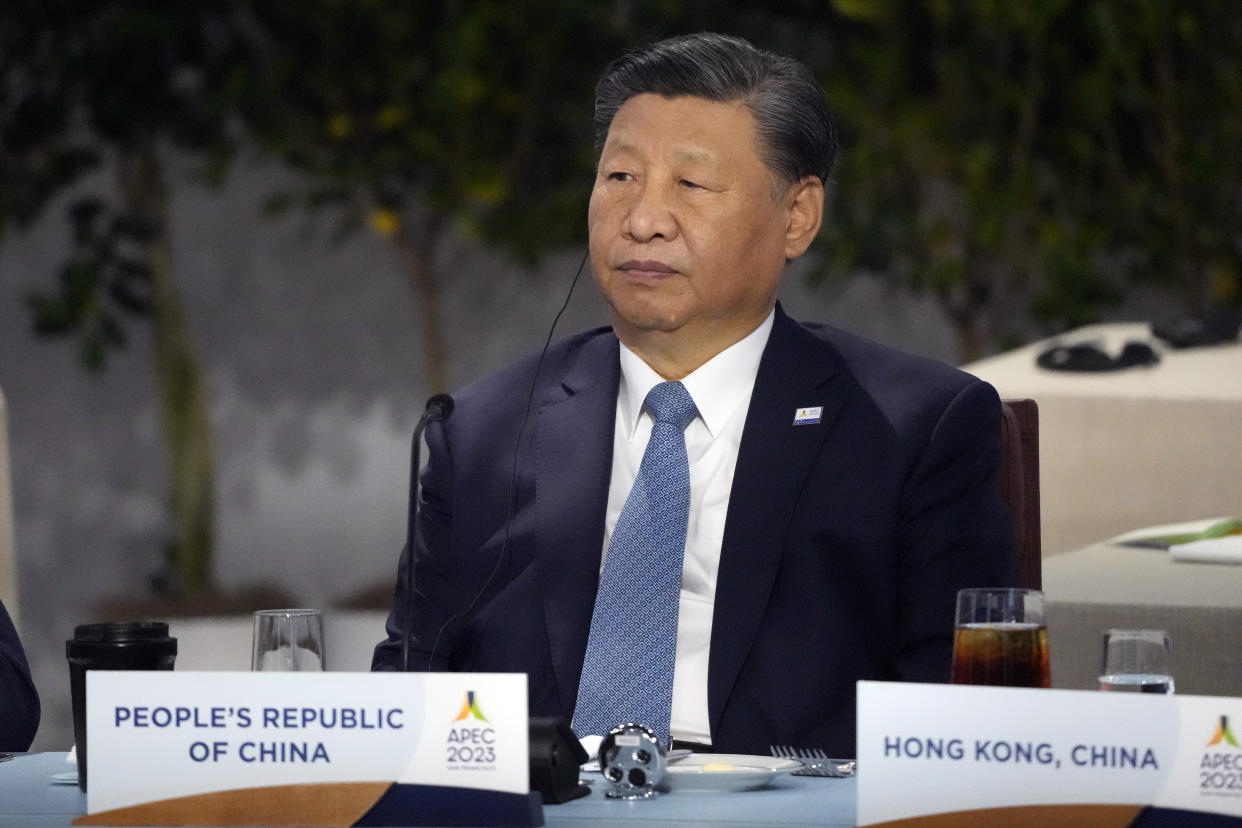
SAN FRANCISCO/HONG KONG (Reuters) - When Chinese President Xi Jinping met executives for dinner on Wednesday night in San Francisco, he was greeted with not one, but three standing ovations from the U.S. business community.

It was one of several public relations wins for the Chinese leader on his first trip in six years to the United States, where he and President Joe Biden reached agreements covering fentanyl, military communications and artificial intelligence on the sidelines of the Asia-Pacific Economic Cooperation summit.

All three were outcomes the United States had sought from China rather than the other way around, said two people briefed on the trip.

But Xi appeared to have achieved his own aims: earning U.S. policy concessions in exchange for promises of cooperation, an easing of bilateral tensions that will allow more focus on economic growth, and a chance to appeal to foreign investors who increasingly shun China.

China's economy is slowing and earlier this month it reported its first quarterly deficit in foreign direct investment. And the ruling Communist Party has battled political intrigues that have raised questions about Xi's decision-making, including the sudden and unexplained removals of his foreign minister and defense minister.

"If the U.S. and China can manage their differences ... it will mean that Xi Jinping doesn't have to divert all of his attention to that (bilateral relations)," said Alexander Neill, an adjunct fellow at Hawaii's Pacific Forum think-tank.

"He needs to focus on his domestic agenda which is incredibly pressing."

DROPPING SANCTIONS FOR COOPERATION

Securing Xi's promise of Chinese cooperation on stemming the flow of fentanyl to the United States was high on Biden's to-do list for the summit. A senior U.S. official said the agreement under which China would go after specific companies that produce fentanyl precursors was made on a "trust but verify" basis.

In return, the U.S. government on Thursday removed a Chinese public security forensic institute from a Commerce Department trade sanction list, where it was placed in 2020 over alleged abuses against Uyghurs, a long-sought diplomatic aim for China.

Critics warned removing sanctions against the institute signals to Beijing that U.S. entity listings are negotiable, and have questioned the Biden administration's commitment to pressuring China over what it says is the Chinese government's genocide of Uyghurs.

"This undermines the credibility of our entity list and our moral authority," said a spokesperson for the Republican-led House of Representative's select committee on China.

On top of that, Biden's Republican opponents argue the U.S. is missing an opportunity by not leveraging China's flagging economic momentum for more diplomatic gains.

Biden also touted as a success an agreement to resume military dialogues cut by China following then-U.S. House Speaker Nancy Pelosi's 2022 trip to Chinese-claimed Taiwan.


But while Beijing would welcome lower tensions, this is unlikely to change Chinese military behavior the U.S. sees as dangerous, such as intercepts of U.S. ships and aircraft in international waters that have led to a number of near-misses.

"China fears hotlines could be used as a potential pretext for a U.S. presence in areas it claims as its own," said Craig Singleton, a China expert at the Foundation for Defense of Democracies in Washington.

Biden administration officials have acknowledged that creating functional military relations won't be as easy as semi-regular meetings between defense officials.

"This is a long, hard, slow slog and the Chinese have to see value in that mil-mil before they'll do it. That's not going to be a favor to us," one senior Biden administration told Reuters in October in the run-up to the Xi-Biden meeting.

PARTNER AND FRIEND?

In his public remarks to Biden, Xi suggested China sought peaceful coexistence with the United States, and he told business leaders China was ready to be a "partner and friend" to the U.S., words partially aimed at a business community alarmed by China's crackdown on various industries and the use of exit bans and detentions against some executives.

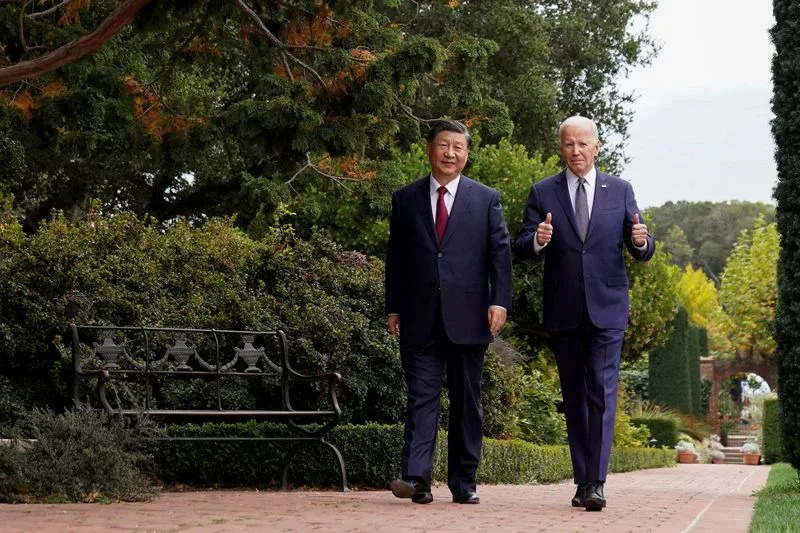
Similarly, Xi's televised garden walk with Biden, and the largely respectful reception given to Xi by his American hosts, was highlighted in China's tightly controlled media to show a domestic audience that their president is managing the country's most important economic and political relationship.

"Xi Jinping may have made the calculation that overhyping the American threat does China and his standing in the party and the party itself more harm than good," said Drew Thompson, a former Pentagon official who is now a scholar at the National University of Singapore.

"The fact that we are debating whether China is investible is a real problem for China."

At the same time, Xi reiterated to Biden points that he made earlier this year to Russian President Vladimir Putin, urging the U.S. president to view U.S.-China relations through "accelerating global transformations unseen in a century."

Analysts say that is code for the belief that China - and Russia - are remolding the U.S.-led international system.

Still, this time pragmatism may have outweighed ideology.

China recognizes it's still necessary for its economic progress to have somewhat normal relations with the U.S. and Western countries, said Li Mingjiang, a professor at the Rajaratnam School of International Studies in Singapore.

"It's the fundamental driving force behind the meeting."

(Reporting by Michael Martina and Greg Torode; Additional reporting by Trevor Hunnicutt in Washington, and Antoni Slodkowski and Laurie Chen in Beijing; Editing by Don Durfee and Tom Hogue)
China's Xi is courting Indo-Pacific leaders in a flurry of talks at a summit in San Francisco


DIDI TANG
November 16, 2023 


SAN FRANCISCO (AP) — Chinese President Xi Jinping, fresh off his meeting with President Joe Biden, courted Indo-Pacific leaders in a flurry of meetings Thursday at a time of intensifying competition with the United States.

Xi held individual talks with the leaders of Mexico, Peru, Fiji, Japan and Brunei, all on the sidelines of a summit of Asia-Pacific Economic Cooperation economies.

In a meeting with Peruvian President Dina Boluarte, Xi said the two countries should strengthen economic and trade cooperation and pledged China’s support for Peru as host of next year’s summit of APEC leaders.

In particular, Xi said, China will be willing to import more “premium” agricultural products from the South American country and will encourage Chinese businesses to participate in major projects in Peru.

Earlier, Xi held talks with Andrés Manuel López Obrador, praising the Mexican president for his leadership and reform efforts and pledging to bring the China-Mexico relationship to a new level. It was believed to be the first face-to-face meeting between the two men.

During the meeting, the two sides agreed to deepen cooperation on counternarcotics efforts. China and the United States on Wednesday said the two would work together to stem the flow of fentanyl precursors to countries such as Mexico before the drug is finished and gets smuggled into the U.S.

Xi said the two countries should collaborate in industries such as infrastructure, finance and electric vehicles, while López Obrador said Mexico would smooth the way for Chinese businesses investing in Mexico. The Mexican leader also said his country would be willing to work with China on multilateral affairs and help promote relations between China and Latin America, according to China's state media.


In recent years, many Chinese businesses — faced with tariffs and other restrictions from the U.S. government — have moved some production to Mexico. Xi expressed his sympathy for those affected by Hurricane Otis and said China made emergency arrangements for Mexico to procure relief supplies.

The Mexican president posted on X shortly after his meeting with Xi that the two leaders “reiterated the commitment to continue maintaining good relations to the benefit of our people and our nations.”

Xi met Fiji's Prime Minister Sitiveni Rabuka. Xi said Beijing is treating Fiji as “a good friend and a good partner” in the Global South, roughly referring to developing countries.

The Chinese leader also met with Japanese Prime Minister Fumio Kishida and the sultan of Brunei.

In an opening statement, Kishida said China and Japan "share a mutual responsibility to contribute to the peace and prosperity of the world.”

China said Xi told Kishida that it is in the interest of the two peoples for the two countries to coexist peacefully, cooperate and grow together. Xi said the two sides should handle differences properly and focus on common interests.

Xi called Hassanal Bolkiah, Brunei’s sultan, an “old friend” and said China would work with Brunei to bring benefits to both people.

Xi spent four hours with Biden on Wednesday, their first face-to-face meeting in a year.

Hear from the Iowa woman who's been friends with Xi Jinping for 25 years 

Biden removes sanctions from Chinese institute in push for fentanyl help

Thu, November 16, 2023 


By Alexandra Alper and Michael Martina

WASHINGTON (Reuters) -The Biden administration on Thursday removed the Chinese Ministry of Public Security's Institute of Forensic Science from a trade sanction list, part of a bid to convince Beijing to do more to halt the flow of the synthetic opioid fentanyl into the United States.

Washington put the institute on the list in 2020 over alleged abuses against Uyghurs and other minority groups, effectively barring it from receiving most goods from U.S. suppliers.

Former Chinese ambassador to the U.S. Qin Gang last year described it as "shocking" that the U.S., which had expressed frustration over Beijing's lack of cooperation on fentanyl, would sanction an institute he described as essential to controlling the drug.

The Chinese embassy in Washington did not immediately respond to a request for comment.

Reuters had previously reported the institute would be removed as Biden sought more cooperation from Beijing on fentanyl in a meeting with China's President Xi Jinping on Wednesday in San Francisco at the Asia-Pacific Economic Cooperation (APEC) forum.

As part of the meeting, the men agreed to create a working group on counter-narcotics cooperation. The White House's National Security Council did not respond to a request for comment on what, beyond creating the working group, China pledged to do to stem shipments of the deadly narcotic.

The move was criticized by human rights activists and Republicans, who accused the Biden administration of going soft on Beijing over its treatment of Uyghurs.

Rayhan Asat, a human rights lawyer of Uyghur heritage, said she recognized the pressing issue posed by fentanyl, but that the U.S. decision raised questions about U.S. commitment to addressing China's rights abuses.

"The United States has a legal obligation, under federal law, to address atrocity crimes once they have been determined as such. The question then arises: should addressing one issue take precedence over addressing the genocide? Can't we address both?" she said.

Blocking fentanyl "precursor" chemicals has been a priority for Washington as the rate of overdose deaths involving the drug more than tripled from 2016 through 2021, according to the U.S. Centers for Disease Control and Prevention (CDC).

The removal, according to a notice posted in the Federal Register, came after a "removal proposal" was received and reviewed, the department said in the posting, by a committee composed of representatives of the departments of Commerce, State, Defense, Energy, and sometimes, the Treasury.

(Reporting by Alexandra Alper, Michael Martina and Paul Grant; Editing by Doina Chiacu, Chizu Nomiyama and Josie Kao)


A TYRANT MAYBE

Watch: Blinken winces as Biden brands Xi a ‘dictator’


Rozina Sabur
Thu, November 16, 2023


Antony Blinken appeared uneasy as Joe Biden described Xi Jinping as a “dictator” and briefed the press that a deal to free Israeli hostages could be imminent.

During a press conference following his meeting with the Chinese leader in California, Mr Biden apologised to his secretary of state for revealing too much on the state of Hamas-Israel hostage negotiations.

The US President said: “I don’t want to get ahead of myself here... but we have gotten great cooperation from the Qataris”, a key intermediary between Israel and Hamas.
‘I know Mr Secretary, I’m going to stop’

Mr Biden remarked about a “pause the Israelis have agreed to” as he described progress toward a deal, before cutting himself off as the US secretary of state sat stony-faced.

The president went on to say: “I’m giving too much detail. I know Mr Secretary, I’m going to stop. But I am mildly hopeful.”

Mr Biden made the comments during a solo press conference in northern California following a four-hour summit with Chinese president Xi Jinping.

At the end of the news conference, he was asked whether he still held the view that Mr Xi was a dictator, something he said in June.

“Look, he is. He’s a dictator in the sense that he’s a guy who runs a country that is a communist country that’s based on a form of government totally different than ours,” Mr Biden responded.

Mr Blinken appeared to wince and wring his hands when the US President made the remark.

ICYMI RACIST HEALTHCARE
US fails again in report on preterm birth, a leading cause of infant mortality


EDUARDO CUEVAS, USA TODAY
November 16, 2023 

The U.S. has landed another poor grade when it comes to preterm births, with festering disparities in outcomes for Black and Native women that are life-threatening, according to a new annual report.

Preterm birth, when babies are born before 37 weeks gestation, is among the leading causes of infant death in the U.S., according to the March of Dimes. Outcomes across the country improved only slightly this year. In 2021, just over one in 10 babies were born preterm, and that was true again in 2022. Because of this, the March of Dimes, a decades-old health nonprofit for mothers and babies, gave the U.S. a D+ grade, the same as the previous year, in its “State of Maternal and Infant Health for American Families” report card published Thursday.

Ashley Stoneburner, a data scientist with March of Dimes, who was a report author, told USA TODAY it's hard to make sense of why mothers and babies are so at risk.

“We live in one of the wealthiest nations, and our health of moms and families is getting worse year after year,” Stoneburner said.
'Preterm birth is just the tip of the iceberg'

The report comes amid spikes in national infant and maternal mortality rates that have a disparate impact on communities, across race, class and geographical boundaries.

An 'unacceptable American crisis:' Cases of babies with syphilis reach staggering numbers

Premature Baby in Incubator [Via MerlinFTP Drop]

“All these indicators are connected,” Stoneburner said. “And preterm birth is just the tip of the iceberg.”

Factors that exacerbate preterm birth include pre-pregnancy hypertension and diabetes, as well as smoking, unhealthy weight and a previous preterm birth, the report said.

The report showed gaps in women's and infants’ health along these faultlines. Black and Native women were 54% more likely to have preterm deliveries than white women. Babies born to Black and Indigenous mothers had death rates 2.3 times higher than those born to white and Hispanic mothers. The infant mortality rate also increased overall, as data from the National Center for Health Statistics recently showed an uptick for the first time in two decades. Maternal deaths doubled from 2018 to 2021, with greater increases among Black and Native women.


Amid the slight drop in preterm births, 14 states saw increases in preterm births. Preterm births have steadily risen in the last decade, according to the March of Dimes, which has published its annual report since 2008.

The March of Dimes’ index showed mothers giving birth in states in the Southeast, Appalachia and Midwest had higher levels of vulnerability and poorer outcomes. In its ratings, the March of Dimes gave eight states, mostly in the South, along with West Virginia and the territory of Puerto Rico, an F grade. No states earned an A, although just eight states – in New England, the West Coast and Idaho – earned B grades.

Mental health: Anxiety is everywhere. Experts double down on a solution that may surprise you.

The report cited 100 cities with the most live births, one-third of which earned F grades. These included Birmingham, Alabama, which had the nation’s highest birth rate, and Rochester, New York, and El Paso, Texas.

“The fact is, we are not prioritizing the health of moms and babies in this country,” Dr. Elizabeth Cherot, the president and CEO of March of Dimes, said in a statement.

The report called for an array of policy actions to improve health outcomes, such as increased federal funding to perinatal efforts to improve health outcomes across states, and efforts to extend Medicaid maternity coverage to one year after childbirth. The coverage currently ends 60 days after a pregnant person delivers a baby.

These problems are not new, but improving maternal and infant care is imperative, the report says. As the American College of Obstetricians and Gynecologists recently put it, "The maternal access crisis in the United States is nothing short of catastrophic."

Eduardo Cuevas covers health and breaking news for USA TODAY. He can be reached at EMCuevas1@usatoday.com.

This article originally appeared on USA TODAY: On preterm labor, U.S. gets failing grade (again) in new report


SEE

A Ghana reparations summit agrees on a global fund to compensate Africans for the slave trade

Associated Press
FRANCIS KOKUTSE
November 16, 2023 

ACCRA, Ghana (AP) — Delegates at a reparations summit in Ghana agreed Thursday to establish a Global Reparation Fund to push for overdue compensation for millions of Africans enslaved centuries ago during the trans-Atlantic slave trade.

The Accra Reparation Conference adds to the growing demands for reparations after about 12 million Africans were forcefully taken by European nations from the 16th to the 19th century and enslaved on plantations that built wealth at the price of misery.

Centuries after the end of the slave trade, people of African descent around the world continue “to be victims of systemic racial discrimination and racialized attacks,” concluded a recent report by a special U.N. forum which supported reparations as “a cornerstone of justice in the 21st century.”

“It is time for Africa — whose sons and daughters had their freedoms controlled and sold into slavery — to also receive reparations,” said Ghana’s President Nana Addo Akufo-Addo at the conference, attended by senior government officials from across Africa as well as the diaspora community.

Slave reparations have become an issue the world “must confront and can no longer ignore,” said Akufo-Addo, calling out the British and other European nations who enriched themselves during the slave trade while “enslaved Africans themselves did not receive a penny.”

Delegates to the conference in Accra did not say how such a reparation fund would operate. But Gnaka Lagoke, an assistant professor of history and pan-African studies, said it should be used to “correct the problems” that the continent is facing in all sectors of its economy.


Compensations are based on “moral and legal rights and dignity of the people,” said Ambassador Amr Aljowailey, strategic adviser to the deputy chairman of the African Union Commission, who read out the resolution titled The Accra Proclamation.

In addition to the Global Reparation Fund, which will be championed by a committee of experts set up by the A.U. Commission in collaboration with African nations, “a special envoy will engage in campaigns as well as litigation and judicial efforts,” said Aljowailey.

Activists have said reparations should go beyond direct financial payments to also include developmental aid for countries, the return of colonized resources and the systemic correction of oppressive policies and laws.

The required amount for compensation will be decided through a “negotiated settlement (that will) benefit the masses,” said Nkechi Taifa, director of the U.S.-based Reparation Education Project.

____

Follow AP’s Africa coverage at: https://apnews.com/hub/africa