Tuesday, January 14, 2025

UK MP’s second jobs are institutionalised bribery. They should be banned.

'Preventing MPs from selling their souls to the highest bidder is a necessary step in democratising parliament.'


10 January, 2025 

Many of our social problems are caused by the disconnection between the people and parliament. People are shunning the ballot-box and feel that MPs don’t represent them. In the July 2024 UK general election only 59.7% of the registered voters actually voted.

The prime duty of MPs, and all legislators, is to serve the people but for many it is a route to riches through second jobs in the form of lucrative corporate directorships and advisory roles. Second jobs are just another name for institutionalised bribery and must be banned.

MPs taking second jobs serve their paymasters by asking questions and securing information for their paymasters, arrange meetings with ministers, providing access to policymakers, thwart threatening legislation and keep unwelcome issues off the political agenda. Conflict of interests is inevitable. Normal people can’t compete in the auction for influence. Citizens writing to MPs are frequently told that they cannot help them because they don’t reside within the MP’s constituency boundary. The same MPs have no qualms about representing corporations and the rich not residing in their constituency, because they pay

The Labour Party’s 2024 election manifesto said that “The absence of rules on second jobs also means some constituents end up with MPs who spend more time on their second job, or lobbying for outside interests, than on representing them”..

An MP’s job is full-time and a demanding one. Compared to median annual wage of £29,664 for workers, MPs receive an annual salary of £91,346 plus the costs of running an office, employing support staff, having somewhere to live in London or their constituency, and travelling between Parliament and their constituency. One in ten MPs also work as local councillors and increase their pay. Too many don’t regard MPs position as a full-time job and chase personal riches.

The register for members’ financial interests after the July 2024 election is still emerging but the past provides some guidance. An analysis by The Economist showed that between 2010 and 2024 MPs spent a collective total of 50,000 hours on second jobs and collected £27m in fees. In addition to the £27m, they also earned £38m from practising law, medicine or consulting. Senior MPs demand premium prices. For example, former Chancellor Kwasi Kwarteng and Health Secretary Matt Hancock demanded £10,000 a day to further the interests of a fake South Korean company.

In the last parliament, around 90 out of 360 Conservative MPs had second jobs, compared to five out of 199 Labour MPs, and two each from the Scottish National Party and Liberal Democrats. The proportions may well change now that Labour is in government.

In general, MPs are required to disclose earnings from outside employment in the Register of Members’ Financial Interests. However, the disclosure requirements are weak. For example, those operating through Limited Liability Partnerships (LLPs) are not required to disclose their share of profits, and shareholdings of less than 15% are not disclosed. In any case, the disclosures do not eliminate conflicts, corporate capture or degradation of democracy.

MPs do not need permission from their constituents to take second jobs and there are no legally enforceable restrictions. The Code of Conduct requires that they “must not provide, or agree to provide, paid parliamentary advice, including undertaking, or agreeing to undertake services as a Parliamentary strategist, adviser or consultant”. The rulebook exempted advice on public policy and current affairs; and advice in general terms about how Parliament works. In July 2024, MPs agreed to remove these exemptions, with effect from October 2024. However, it is all open to interpretation.

There is no ban on second jobs and consultancies are easily replaced by paid media work, books, guest appearances at corporate events, lectures and speeches, all intended to enrol MPs to serve corporate interests.

This is especially lucrative for senior MPs. For example, former Prime Minister Boris Johnson collected £4.3m from speeches in the nine months between being ousted from office and standing down as an MP. Ideological enrolment also results in TV shows and columns in newspapers. Nigel Farage, leader of Reform UK, received £189,300 for four hours work from Direct Bullion for a brand ambassador role in which he praises the role of gold as a tax free investment. His non-MP work generated income of £547,583 in 2024. Former Health Secretary disappeared for weeks from parliament to take part in a TV reality show and collected a fee of £320,000. Another Conservative MP, later a Minister, appeared on a TV reality show and refused to register fee in the Register of Members’ Interests. Lee Anderson, another Reform UK MP, hosts a TV show for payment of £100,000.

Would an MP with a regular newspaper column speak against his/her paymaster for hacking into innocent person’s email or phone? Should they be promoting tax avoidance vehicles or corporate interests? Should they be promoting corporate interests at the expense of their constituents’ welfare?

In line with its election manifesto promise the government has created the Modernisation Committee and on 12 September, it said that it will look at the “tightening of the rules on second jobs for members of the Commons”.

A total ban on second jobs is needed but unlikely as MPs will make exceptions to protect their incomes, which will undermine the spirit of any reforms. Some say that a total ban would encourage high calibre MPs to quit parliament. Well, if they can’t live on £91,346 and represent people then they need a dose of reality and see how normal folks make ends meet. There are plenty of other good people available do that job.

Some argue that it is desirable for MPs to have some experience of business life, and that this improves quality of debates and legislative scrutiny. The evidence for this is scarce. Interestingly, they rarely volunteer to work for charities, hospices, food banks, trade unions and housing associations, possibly because there is no money in it. Even if a small number take-up second jobs, that still undermines confidence in parliament. The argument about business experience is being merely used to camouflage the ride on the gravy train.

Some would like the MPs to continue with second jobs but within “reasonable limits”. Inevitably, there would be haggling over the limits. Some have suggested 10–20 hours a week is a reasonable limit. There is no mechanism for enforcing this limit as the Commons relies upon self-reporting. An hours-based approach takes no account of money, favours, cognitive capture of MPs or the scale of political sales. Such limits will be ineffective in curbing the sale of legislators to the highest bidders.

Some argue that the tenure of an MP is short and after leaving parliament they may return to their professional career. Therefore they should be permitted to continue to practice as a lawyer, architect, surveyor or an accountant. Such arguments may have some validity but are also a fig-leaf for pursuit for private interests.

Allowing MPs to continue with professional careers need not lead to financial enrichment and subservience to corporations and the rich. They should not benefit from such second jobs. All payments received should go to a newly established Foundation for Democracy. This should apply to all income from any second job.

At set intervals, the accumulated funds should be distributed to political parties in accordance with a formula based upon their share of the vote and party membership. This way, MPs can continue with professional careers, broadcasting and other hobbies but won’t receive financial benefits. To prevent any underhanded deals, MPs should be prevented in their post-legislative career from working for these employers for five years after leaving parliament or reeving any financial benefit.

No matter how it is dressed-up, second jobs are about the sale of MPs and political influence. They are nothing to do with serving the people or democracy. Second jobs have normalized corporate capture and corrupt practices and must be banned. Of course those who have got used to self-enrichment will oppose such proposals, but wiser souls know that confidence in parliament can’t be restored with empty gestures. Preventing MPs from selling their souls to the highest bidder is a necessary step in democratising parliament.


Prem Sikka is an Emeritus Professor of Accounting at the University of Essex and the University of Sheffield, a Labour member of the House of Lords, and Contributing Editor at Left Foot Forward.


Image credit: Diliff -Creative Commons


Tory and Reform MPs rake in money from jobs at GB News and other right-wing media outlets


Right-wing MPs are making £££ from media appearances


Reform leader Nigel Farage and fellow Reform MP Lee Anderson made six figure sums as presenters and contributors on the right-wing news channel GB News.

Between July and November last year, Farage made a staggering £219,504 as a presenter on GB News, on top of his £91,346 MP salary.

Farage also earned around £4,000 a month, or £48,000 a year, writing articles for The Telegraph.

But that’s not all. In the last six months, Farage has made a total of £571,585 from outside jobs, including £189,000 for 24 hours’ work as an ambassador for a gold bullion company.

He also made over £8,000 as a ‘social media influencer’ across Youtube, Facebook and X.

GB News paid Anderson £100,000 between March 2023 and March 2024.

Former home secretary Suella Braverman made £25,500 writing articles for The Telegraph between April and December last year. This was in addition to her earning £63,260 for various speaking engagements.

In November and December 2024, the Daily Express paid Tory MP Esther McVey £3690 for writing articles.

Conservative MP Nick Timothy is paid £145,000 a year for just three hours of work per week as a Telegraph columnist.

Olivia Barber is a reporter at Left Foot Forward


A full list of Nigel Farage’s 9 jobs and how much he earns from each one

So much for being a ‘man of the people’.


Yesterday

It’s been revealed that self-proclaimed man of the people, Nigel Farage, who is the UK’s highest-earning MP, now has nine jobs, meaning that he earns more than any other MP from outside earnings.

On top of his MPs salary of £91,346, Farage is also raking in £571,585 from outside jobs, in less than six months.

Last week, the Guardian reported that Farage made £189,000 last year as a brand ambassador for a gold bullion company.

With the Mirror revealing that the Reform UK leader now has nine jobs, here’s a full list of them and how much the arch Brexiteer is making from each one.Reform UK MP for Clacton – £91,346
Gold Bullion ambassador for Direct Bullion-£189,300 from 24 hours work
TV presenter on GB News-£219,506
Influencer on Facebook/Meta-£2,795
Influencer on X-£5,482
Personalised videos on Cameo-£54,006
Public speaker-£65,379
Journalist at Telegraph-£24,000
Influencer on Youtube/Google-£11,117

So much for being a ‘man of the people’.

Basit Mahmood is editor of Left Foot Forward


GERMANY

Signa Prime Administrator Blames Board for €1 Billion of Damages

By Libby Cherry
January 09, 2025 

Hoardings with the Signa logo around the closed Galeria Karstadt Kaufhof shopping center, a Signa Prime Selection AG project, near the main railway station in Munich, Germany, on Friday, March 8, 2024. 
(Michaela Stache/Photographer: Michaela Stache/Bl)

(Bloomberg) -- The administrator of Rene Benko’s bankrupt luxury property unit is asking former supervisory board members to acknowledge their role in causing at least €1 billion ($1.03 billion) of alleged damages by failing to practice proper oversight.

Law firm Abel Rechtsanwälte GmbH claims board members of Signa Prime Selection AG, including former Austrian Chancellor Alfred Gusenbauer, had ignored that the group was materially insolvent by March 2022 — if not earlier, according to a letter seen by Bloomberg. They also signed off on improper loans between Signa companies, the bankruptcy advisors say.

One such transaction related to managers lending on €463 million of proceeds from a capital increase intended to fund the purchase of London’s Selfridges department store.

A legal representative for former Supervisory Board Chair Gusenbauer said the administrator’s request lacked justification. A spokesman for Abel declined to comment. The News magazine first reported the letter.

Signa Prime filed for insolvency at the end of 2023 due to a cash crunch spurred by tumbling valuations and rising interest rates. It held stakes in some of Europe’s most prominent landmarks, including Berlin’s KaDeWe and the Hotel Bauer in Venice.


Creditors, prosecutors and the insolvency administrator have sought legal options to recoup money and clarify one of the largest insolvencies in Austria’s history. Benko, who denies wrongdoing, has been interrogated by officials as part of a separate fraud probe.

There “was clearly no suitable controlling and no suitable financial planning,” the administrators wrote in the letter dated Dec. 20. The deteriorating financial condition and billions of euros of internal loans should have been a “a warning signal for any prudent Supervisory Board member.”

Abel alleges Signa’s financial planning took the form of rudimentary Excel models, which “in no way” met the requirements for a large company.

The transfer of funds between units of the sprawling real estate empire, of which Signa Prime was just one, has been a major point of contention, and may have helped mask the extent of financial difficulties.

Bondholders of another unit, Signa Development Selection, filed a complaint to the public prosecutor’s office in Vienna last year, arguing that hundreds of millions of funds transferred to other Signa units had damaged them and the company, Bloomberg previously reported.

Another transfer between Signa entities included a total of €252 million in loans by Signa Prime to a subsidiary of its largest shareholder Signa Holding in 2023, according to the letter.

Signa Holding’s insolvency administrator is reviewing several transactions and has previously disputed intercompany loans, a spokesman for that unit said by email.

Abel asked supervisory board members to respond by Jan. 20.

©2025 Bloomberg L.P.
In Hottest Year Ever, US Homes Used a Record Amount of Power to Keep Cool

By Naureen S Malik
January 10, 2025


(Bloomberg) -- While data centers’ energy needs are a growing concern for the grid, the biggest user is more prosaic. Homes use far more energy to keep cool than servers. And amidst the world’s hottest year, residential use hit a record as well in 2024, reflecting the need to get a grip on the sector and keep climate targets within reach.

American household electricity consumption grew at an accelerated clip over the past five years amid hotter and longer summers, data going back to the late 1990s from the US Energy Information Administration show. Cooling season demand spikes are getting bigger and helping homes outpace the growth in the commercial sector, which includes data centers.

Total electricity sales to residential consumers rose to an all-time high of 700.7 billion kilowatt-hours this summer, edging out the previous record of 700.2 billion set in 2022, according to the EIA data.

While the data doesn’t parse out air conditioning use, it’s clear that higher temperatures are a key driver. Typically hot states like Arizona, California and Florida sizzled through their warmest summer on record in 2024. Even typical pleasant places are becoming uncomfortable without air conditioning; Maine and New Hampshire also saw record heat last summer.

“I just got an AC and Mill Valley never needed air conditioning,” said Patty Cook of her home in a redwood-ringed town north of San Francisco. “Now people in my neighborhood are all getting heat pumps. It’s happening in these climates where we haven’t traditionally had to have air conditioning,” the senior vice president focused on flexible power resources at advisory firm ICF International added.


At the same time, people are moving to hotter places. Arizona, Texas and Florida are among the states that experienced double-digit population growth from 2010 to 2020, according to the Census Bureau. In 2020 — the last year with records available — more than two-thirds of US homes had central AC, up from 27% in 1980.

Increasingly hot weather in more places is boosting household energy demand and may ensure it stays ahead of the commercial sector, even as data centers expand their footprint. That race will continue as city-sized data centers come online and compete for energy with households increasingly electrifying everything from cooling systems to vehicles.

While the planet reached record warmth, the most intense heat in the US was in cities. The May-to-September cooling season was the third hottest on record, said Matt Rogers, president of private forecaster Commodity Weather Group.

The covid-19 pandemic sent residential energy use into overdrive in 2020 when much of the American economy shut down and people worked from home at an unprecedented scale. That year, residential electricity sales from May through September totaled a then-record 691 billion kilowatt-hours, outstripping commercial demand by a whopping 22%.

Residential electricity usage continued to grow faster during air conditioning season than the rest of the year. Sales for the cooling season were 6% higher for the past five years versus 2015-2019, higher than the 4% growth in total for all five years, EIA data show. Conversely, electricity sales to the commercial sector rose just 0.2% in both the hot weather months and annually over the last five years.

“Ultimately weather is certainly driving things, but it’s not driving it completely,” said Jon Wellinghoff, a long-time energy regulator and founder of GridPolicy Consulting. For households switching from gas-powered furnaces and cars to heat pumps and EVs, energy demand will actually increase most in the winter. That will strain grid operators, particularly those heavily reliant on solar, because the sun isn’t up as long, Wellinghoff said. He added that more efficient cooling systems could help slow summer growth, though.

"There's going to be tremendous growth in the residential and AI data center sector, but that doesn't mean that it cannot be managed appropriately with the right technology and the right intelligence," Wellinghoff said.

Households and utilities also have more options to meet summer needs, including incentivizing the use of more efficient appliances, rooftop solar, batteries and more distributed supplies located closer to communities.

“It's going to get a lot more chaotic,” Cook said.

©2025 Bloomberg L.P.

BlackRock launches IBIT spot bitcoin ETF in Canada

By Ivonne Flores Kauffman
January 14, 2025 a


Robert Mitchnick, head of digital assets at BlackRock, talks about the investment company's new Bitcoin ETF on the CBOE Canada platform.

After launching a spot Bitcoin ETF on U.S. markets last year, BlackRock has launched a similar product for the Canadian market.

The iShares Bitcoin ETF, which launched Monday on the CBOE Canada Exchange, trades under the ticker symbol IBIT, and simply invests in its U.S. counterpart but is priced in Canadian dollars and trades on a Canadian exchange.

BlackRock’s Head of Digital Assets Robert Mitchnick says that’s because Canada is a distinct market for investors who want to invest here instead of abroad.
The information you need to know, sent directly to you: Download the BNN Bloomberg App

“It’s about bringing access… to Canadian investors,” Mitchnick said in an interview with BNN Bloomberg Tuesday. “Canada is a market where we feel like there is a significant opportunity.”

BlackRock’s product was one of a dozen that launched in the U.S. last year, but the fund drew $50 billion in assets, far more than most other new entrants, because of its liquidity and the “value proposition” of the product.


“The expertise and track record of the world’s largest ETF manager, combined with the investments made over the years on BlackRock’s digital asset capabilities is a very compelling value proposition,” he noted, adding that the fund has an annual management fee of 0.32 per cent.

With Bitcoin being one of the best performing asset classes in 2024 and poised for more gains in 2025 under the crypto-friendly Trump administration, more and more investors are investing in the digital asset directly.

But Mitchnick says the ETF product still appeals to a broad number of investors.

“We’ve seen this resonate with all manner of investor types,” he said. “It has the potential to be a unique diversifier.”
Unifor members vote to back strike mandate at CPKC if new contract not reached

By The Canadian Press
January 14, 2025

Trains sit idle at a Canadian Pacific Kansas City (CPKC) railyard in Smiths Falls, Ont., on Thursday, Aug. 22, 2024. 
THE CANADIAN PRESS/Sean Kilpatrick

CALGARY — Workers represented by Unifor at Canadian Pacific Kansas City Railway have voted in favour of strike action if their union cannot reach a new deal with the company.

The union says members voted 99 per cent in support of the strike mandate.

Unifor national president Lana Payne says members are united in their demands for job security and work ownership, fair wages, and improved working conditions.

Unifor Local 101R represents more than 1,200 members who work in mechanical shops, inspecting and maintaining locomotives and freight cars.

Negotiations between the union and the railway are set to resume in Calgary on Jan. 24.

The vote authorizes the union to initiate strike action if a deal is not reached by 12:01 a.m. ET on Jan. 29.

This report by The Canadian Press was first published Jan. 14, 2025.
Oil Embargo on the U.S. Could Blow Up in Canada's Face

By Andrew Topf - Jan 14, 2025

Alberta Premier Danielle Smith opposes federal threats to impose an oil embargo on the U.S.

Amid federal subsidies for clean energy, Smith has doubled Alberta's oil and gas production capacity in partnership with Enbridge.

Alberta Premier Danielle Smith has continued to lobby for Alberta’s interests while disparaging federal policies seen as detrimental to the province.


Alberta Premier Danielle Smith is no shrinking violet when it comes to disagreements with the Canadian government over energy policy.

Smith has previously clashed with Ottawa over its carbon tax, and following a weekend visit to President-elect Trump, she did not mince words over Foreign Affairs Minister Melanie Joly’s threat to impose an oil embargo on the US if Trump carries through with 25 percent tariffs on Canadian imports.

“Oil and gas is owned by the provinces, principally Alberta, and we won’t stand for that,” Smith told reporters at an online news conference Monday.

Alberta is Canada’s largest oil-producing province, in 2023 producing 84 percent of the country’s crude.

No country is more important than Canada when it comes to US oil imports. In 2023 the nation imported 4.4 million barrels a day, which was around 97 percent of Canada’s total crude oil exports, making it America’s top supplier.


Trump, who takes office on Jan. 20, has said he will slap 25% tariffs on imports coming from Canada and Mexico unless they take measures to control illegal drugs and migrants from crossing their borders.

Joly won’t rule out cutting off the supply of energy to the United States in a tariff war, telling CTV’s Question Period on Sunday that “everything is on the table”. The country is reportedly preparing a list of products against which surtaxes could be levied, should Trump make good on his tariff threat.

Ottawa made similar moves in 2019 during Trump’s first term, the National Post reported, adding more than $16 billion in surtaxes to American imports including steel, aluminum, yogurt, toilet paper and dishwashers.

But Smith said Canada shouldn’t be making empty threats and “it’s not Joly’s call to make,” she said via Global News. According to the Canadian Constitution’s section 92, provinces have exclusive jurisdiction over the exploration, development, conservation, and management of non-renewable natural resources within their borders.

Smith suggested that an oil embargo could blow up in Canada’s face, given that cutting off pipeline supplies through Michigan could choke off key supply to Ontario and Quebec.

Moreover, she said that, if Ottawa moves to cut exports, “they will have a national unity crisis on their on their hands at the same time as having a crisis with our U.S. trade partners.”

More positively, Smith told CTV News “I think oil and gas is going to be key to being able to get a breakthrough once tariffs do come in, getting them off. We maintain a strong partnership on energy. We make the case about how much the Americans benefit from that energy relationship, we demonstrate that we are a good trade partner, that we buy more goods and services from America than any other nation.”

“The bedrock of that tariff-free relationship is energy,” she added, noting that Canada exports heavily discounted Canadian oil to the US, which is then upgraded and sold as a value-added product for a price up to three times higher than the raw crude.

“I just feel like the more we make those arguments, slowly but surely we'll be able to make the case that we should continue to enjoy a tariff-free relationship,” Smith told reporters on the conference call.

Smith said she’s “very concerned” about a leadership vacuum affecting talks with the United States over tariffs. Prime Minister Justin Trudeau has resigned and prorogued parliament until March. The Liberal Party of Canada has said that a new leader will be announced on March 9.

Alberta and Ottawa frequently clash over energy policy and this is just the latest spat. Older readers will remember when then-Prime Minister Pierre Trudeau asked the Western provinces to agree to a voluntary freeze on oil prices amid the 1973 Arab oil embargo. With the embargo driving international oil prices to record highs, and nine days after asking for the price freeze, Trudeau’s government imposed a 40-cent tax on every barrel of oil exported to the United States. Revenues were used to subsidize oil imports for Eastern Canadian refiners. Then-Alberta Premier Lougheed called the decision “the most discriminatory action taken by a federal government against a particular province in the entire history of Confederation.”

The same Liberal government in 1980 introduced the National Energy Program, or NEP. The NEP aimed to reduce the role of foreign companies in the Canadian oil patch, including increasing Canadian ownership of the industry, sharing revenue between the federal and provincial governments, and developing non-conventional sources.

However, it was deeply unpopular in the Western provinces especially Alberta, where it was felt that it interfered with provincial jurisdiction and unfairly deprived Alberta of oil revenue. The program was dismantled in 1985 by the federal Conservative government.


LA REVUE GAUCHE - Left Comment: Search results for NEP ALBERTA


Fast-forwarding to present day, Alberta Premier Danielle Smith has continued to lobby for Alberta’s interests while disparaging federal policies seen as detrimental to the province.

To wit, Alberta has been battling Ottawa over the carbon tax since it was introduced in 2019. Meant to tax carbon emissions, the levy is applied to homeowners’ natural gas bills, to fossil fuel producers and distributers, and to large industrial emitters through an output-based pricing system. The tax has more than tripled from $20 per tonne of carbon dioxide in 2019 to $65/t in 2023.

Although the Supreme Court of Canada ruled in favor of the carbon tax in 2021, the Alberta government continues to challenge it on the grounds that it adds to already high home heating costs, and that it is unconstitutional.

In October 2024, Premier Smith announced the province has applied for a judicial review to be exempted from the carbon tax, with the greater goal of forcing Ottawa to cancel it.

Smith argues the tax places an unfair burden on Albertans, most of whom heat their homes with natural gas. Making matters worse, in 2023 Prime Minister Trudeau announced a three-year carbon tax reprieve on deliveries of heating oil. Smith says this only benefits people living in Atlantic Canada and Quebec, whose populations use heating oil, not natural gas.

Amid the controversy, Smith has doubled down on oil and gas production despite a federal government that has phased out fossil fuel subsidies — with the notable exception of the Kinder Morgan Trans Mountain pipeline, bought by Ottawa in 2018 for $4.5 billion but whose costs ballooned to $34 billion — and pivoted towards clean energy including billions in subsidies to EV battery production facilities.

Earlier this month Smith appeared on a video with Enbridge CEO Greg Abel to announce a doubling of oil and gas production.

“Today we've signed a letter of intent with Enbridge to accelerate these growth opportunities and ensure more capacity for oil and gas is available across more than 29,000 kilometers of pipelines in the Enbridge network,” Smith said on the Cable Public Affairs Channel (CPAC).

“This added capacity objective is critical to Alberta and our most important trading partner, the United States. Alberta's oil directly supports more than 50 US-based refineries with direct investment in more than 20 US states and is essential to affordability, growth, economic prosperity and energy security in the United States and globally. Alberta oil and natural gas is also a reliable and important feedstock for essential products produced in the United States especially in the Midwest states of Ohio, Illinois, Indiana, Michigan and Wisconsin.”

By Andrew Topf for Oilprice.com
ONTARIO

Doug Ford says he’s strengthening border to ‘send a message’ to Trump

By Jordan Fleguel
BNNBLOOMBERG
January 14, 2025 


Ontario Premier Doug Ford announced increased border measures in an attempt to diverge Trump's plans to hike tariffs on Canadian imports.

Ontario Premier Doug Ford says he intends to strengthen the province’s border with the U.S. in an effort to “send a message” to Donald Trump that he shares the U.S. president-elect’s security concerns.

“Even well before Trump was elected, all the premiers, myself included, for years have been saying we have to tighten up the border, so that’s exactly what we’re doing,” Ford told BNN Bloomberg in a Tuesday interview.

“We’ll have 200 OPP (Ontario Provincial Police) officers out there working collaboratively with CBSA (Canada Border Services Agency), RCMP (Royal Canadian Mounted Police), U.S. border patrol and DEA (Drug Enforcement Administration).”
The information you need to know, sent directly to you: Download the BNN Bloomberg App

Ford said the planned increase to the police presence at the border is intended to stem the flow of drugs, illegal immigrants and guns between the U.S. and Canada, an issue Trump cited when he first threatened to impose 25 per cent tariffs on Canadian goods on his first day in office.

Ford said that while Ontario is doing its part, he’s urging the federal government to do more to strengthen the border nationwide.


Although the federal Liberals announced last month a commitment to allocate $1.3 billion to bolstering border security, Ford said he’s yet to see a detailed plan for how and where the money will be used.

Ford also said he believes Canada should be meeting its North Atlantic Treaty Organization (NATO) defence spending obligations of two per cent of annual gross domestic product (GDP) – a threshold it’s hasn’t met since signing a pledge to do so in 2014.

“We can’t continuously just rely on the U.S. to protect our country. We’re part of NATO, we have to fulfil the commitment of two per cent – minimum,” he said.
Trump ‘should be happy’

Ford said Trump “should be happy” that Canada’s provincial leaders are committed to improving safety and security on both side of the Canada-U.S. border and added that he hopes both nations can “work together” on the issue.

In another apparent effort to appease Trump’s trade concerns, Ford said he believes the federal government should match any tariffs the incoming U.S. administration imposes on China in order to protect the Canada-U.S. supply chain, which he said is inextricably linked.

Ford also reiterated the beneficial nature of the U.S.-Canada trade relationship, which remains strained as Trump’s tariff threats could materialize as soon as next week when he officially takes office.

“Eighty-seven per cent of the potash in Saskatchewan goes down to the U.S. to keep their agricultural sector moving. Uranium comes from Saskatchewan and gets processed in Port Hope in Ontario here, it keeps their military moving forward,” he said.

“We have the finest nickel in the entire world, high-grade nickel that people want. Who do we want to give it to? Well, 47 per cent goes down to the U.S…. aluminum coming from Quebec is essential for their manufacturing, so there’s a whole host of products.”

Retaliatory tariffs a last resort


Ford said that as his government prepares for all possibilities if Trump follows through on his tariff threats, the “last thing” he wants to do is levy retaliatory tariffs on U.S. goods, but he didn’t rule it out.

“I want to ship them more critical minerals, more energy, more of everything, but that’s a tool in our toolbox, and we’ll see what the U.S. does,” he said.

Ford added that while Trump has doubled down on his tariff threats in recent weeks, he hasn’t heard the same enthusiasm for imposing them by other U.S. officials or business leaders.

“I just haven’t heard it from CEOs, to the contrary, some of the largest companies in the world that are based in the U.S. are sending letters to president-elect Trump saying this is not good for either economy,” he said.

“Along with elected officials. I’ve talked to endless Republicans and Democrats – they aren’t saying the same thing. So, let’s see how this rolls out on Jan. 20 and 21.”

Northern Sea Route cargo set new record in 2024


Friday, 10 January 2025

Rosatom has reported nearly 37.8 million tonnes of cargo traffic on the Northern Sea Route in 2024, breaking the previous high by 1.6 million tonnes. 

Northern Sea Route cargo set new record in 2024
(Image: Rosatom)

The recently ended year also saw a record number of transit voyages - 92 - which helped set a record of 3 million tonnes of transit cargo.

The nuclear icebreakers fleet provided 976 icebreaker escorts and "also provided information and navigation support services to 72 vessels".

Rosatom Director General Alexey Likhachev said: "The year of the 65th anniversary of the nuclear icebreaker fleet was not only a year of new records in cargo transportation. In January, we laid down the icebreaker Leningrad, and in November, we launched the Chukotka ... another important result of 2024 for us is that the concept of the Great Northern Sea Route received the support of the country's leadership, this concept will determine all our further work in the Arctic for the coming decades. We have to create a new transport corridor - from Kaliningrad to Vladivostok with all the accompanying infrastructure and connections with river ports and rail transport."

The 5600-kilometre route runs from St Petersburg and Kaliningrad to Vladivostock. Russia says the distance from Murmansk to Japanese ports is halved by using the Northern Sea Route rather than the Suez Canal, with the duration cut from about 37 to 18 days. Global warming has made large scale navigation along the route more feasible, and it is being facilitated by a large-scale 'Project 22220' construction programme of nuclear-powered icebreakers.

The fifth Project 22220 icebreaker, the Chukotka, is 173 metres long, 34 metres wide, with a height from the waterline to the mainmast of 57 metres. The height of its side is 15.2 metres and it is designed to break through ice up to three metres thick and has a speed of 22 knots in clear water. It will be powered by two RITM-200 reactors which each have a thermal capacity of 175 MW. It already has the reactors on board and has a target completion date of 2026.

Russia has held discussions with both India and China during the year over the potential of the route, with the first meeting of the Russian-Chinese Subcommission on Cooperation on the Northern Sea Route taking place in November. That followed an agreement of intent in June by Chinese businesses and Rosatom to create a joint venture for the construction of ships and a year-round container line between Chinese and Russian ports.

World Nuclear News


Lawsuit challenges NRC on SMR regulation


Friday, 10 January 2025

The States of Texas and Utah and microreactor developer Last Energy Inc are challenging the US regulator over its application of a rule it adopted in 1956 to small modular reactors and research and test reactors.

Lawsuit challenges NRC on SMR regulation
A rendering of the Llynfi Clean Energy Project in Wales, one of Last Energy's proposed projects outside the USA (Image: Last Energy)

Under the US Nuclear Regulatory Commission (NRC) Utilization Facility Rule, all US reactors are required to obtain NRC construction and operating licences regardless of their size, the amount of nuclear material they use or the risks associated with their operation. The plaintiffs say this imposes "complicated, costly, and time-intensive requirements that even the smallest and safest SMRs and microreactors - down to those not strong enough to power an LED lightbulb" must satisfy to secure the necessary licences. This does not only affect microreactors: existing research and test reactors such as those at the universities in both Texas and Utah face "significant costs" to maintain their NRC operating licences, the plaintiffs say.

In the filing, Last Energy - developer of the PWR-20 microreactor - says it has invested "tens of millions of dollars" in developing small nuclear reactor technology, including USD2 million on manufacturing efforts in Texas alone, and has agreements to develop more than 50 nuclear reactor facilities across Europe. But although it has a "preference" to build in the USA, "Last Energy nonetheless has concluded it is only feasible to develop its projects abroad in order to access alternative regulatory frameworks that incorporate a de minimis standard for nuclear power permitting".

Noting that only three new commercial reactors have been built in the USA over the past 28 years, the plaintiffs say building a new commercial reactor of any size in the country has become "virtually impossible" due to the rule, which it says is a "misreading" of the NRC's own scope of authority.

They are asking the court to set aside the rule, "at least as applied to certain small, non-hazardous reactors", and exempt their research reactors and Last Energy’s small modular reactors (SMRs) from the commission's licensing requirements.

Turning point
 

Houston, Texas-based law firm King & Spalding said the lawsuit, if it is successful, would "mark a turning point" in the US nuclear regulatory framework - but warns that it could also create greater uncertainty as advanced nuclear technologies get closer to commercial readiness.

"Regardless the outcome, the Plaintiffs’ lawsuit highlights the challenges in applying the Utilization Facility Rule to the advanced nuclear reactors now under development in the US," the company said in in analysis released on 9 January.

But the NRC is already addressing the issue: in 2023, it began the rulemaking process to establish an optional technology-inclusive regulatory framework for new commercial advanced nuclear reactors, which would include risk-informed and performance-based methods "flexible and practicable for application to a variety of advanced reactor technologies". SECY-23-0021: Proposed Rule: Risk-Informed, Technology-Inclusive Regulatory Framework for Advanced Reactors is currently open for public comment until 28 February, and the NRC has said it expects to issue a final rule "no later than the end of 2027".

The lawsuit has been filed with the US District Court in the Eastern District of Texas.

World Nuclear News


Viewpoint: Joint EDF-CNNC book is new chapter in bilateral links


Friday, 10 January 2025

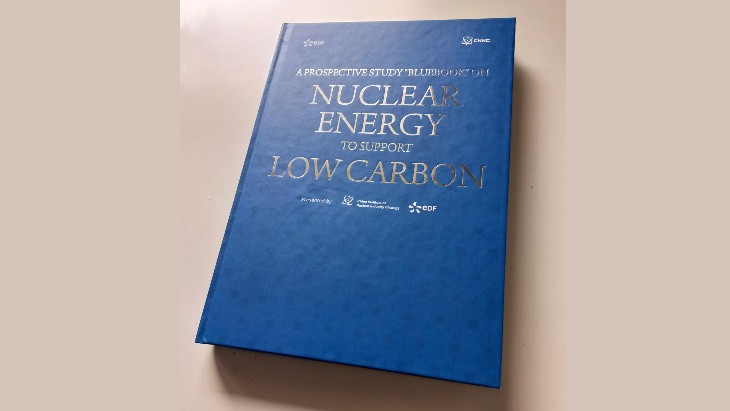
The Blue Book Nuclear Energy To Support Low Carbon is a unique collaborative work by China National Nuclear Corporation (CNNC) and France’s EDF, sharing their experience to highlight nuclear’s role in the energy transition, explains the editorial committee leader of the Blue Book at EDF, Antoine Herzog, in this Q&A.

Viewpoint: Joint EDF-CNNC book is new chapter in bilateral links
(Image:: EDF and CNNC)

Firstly, what is the book?
 

The Blue Book is a collaborative work between the Chinese nuclear company CNNC and the French company EDF. It is intended to be the first fruit of a new era of collaboration between these two players on a wide range of subjects. Indeed, it is the first time in the nuclear energy sector that a Chinese and a French energy group have jointly written a book of this kind.

How did it come about?
 

EDF and CNNC have a long-standing relationship. Today, as the Chinese industry achieves unprecedented growth and innovation, and as France experiences a new impetus of nuclear energy, this Blue Book is a pioneering initiative. Supported by the nuclear industries of the two countries, it aims to highlight the properties of nuclear technologies for a successful energy transition, while underlying the overriding imperative of safety.

To seal this new era of cooperation, the decision to write a Blue Book was taken in 2022 and confirmed on 6 April 2023 when the Presidents of China and France, Xi Jinping and Emmanuel Macron, met in China to sign a number of agreements.

What was the process of writing the book?
 

It took around 18 months of work in English and Chinese to achieve this result. With the help of dozens of experts on each side, many sections were written jointly, starting with the Executive Summary, and numerous paragraphs on current cooperation. This work then had to be enriched by the specific contributions of each of the players.

EDF and CNNC agreed that addressing nuclear from a climate change perspective, as well as in terms of security of supply and economics, was key. In terms of sharing experiences, it was also enriching for each of the players to learn more about each other's approaches.

In a large number of chapters, a Chinese part and a French part follow one another, which meant that the substance of the contributions of each player was retained, while at the same time succeeding in creating a common thread. The work was then refined jointly to produce a coherent result. The two missions, one to France and the other to China, were major steps in bringing the work together.

What about the content itself?
 

After an overview of nuclear energy around the world, including in France and China, EDF and CNNC examined the three major contributions of nuclear power: to the climate, to the economy and to security of supply. The aim was then to focus on the comparative nuclear dynamic between the two countries, with the main themes including safety, public acceptance, the industrial supply chain, construction methods, fuel resources, decommissioning and waste, and the adaptation of plants to climate change. Last but not least, the Blue Book places great emphasis on innovation and international cooperation.

How similar, or different, were the perspectives?
 

The Blue Book revealed very similar approaches between the two players, while at the same time highlighting the particularities of each player so that each can benefit from the experience of the other.

CNNC has a large number of power plants under construction, and this can benefit EDF in the areas of construction methods, factory production and site optimisation. Many of EDF’s reactors are located on riversides, and the operation of its fleet is flexible, since it has long been able to adapt to variations in electricity demand. With more than 2000 reactor-years of its fleet operating successfully, EDF has a wealth of experience to draw on. All these features mean that each player can benefit from the experience of the other, which is a source of mutual enrichment.

What are the hopes for the Blue Book's impact?
 

This Blue Book creates a new era for China-France nuclear energy cooperation and could serve as a reference for other countries that envisage developing nuclear energy and promoting low-carbon development.

Both China and France have ambitious nuclear plans. Above all, they both have a strong record of ensuring safety and reliability in nuclear operations. Having a low-carbon, large-scale dispatchable technology such as nuclear power is crucial, and in looking to the future in this way, drawing up a Blue Book made sense.

What are its main recommendations?
 

The main recommendations include to: build a robust nuclear safety regulatory system, enhance the competitiveness of nuclear energy, improve public communication, build strong and resilient supply chains, build a safe, cost-effective and sufficient system for securing uranium resources, implement a closed fuel cycle and minimise radioactive waste, develop the multipurpose use of nuclear energy, optimise the research and development, design and engineering construction, enhance the research and development of advanced fuels, and strengthen international cooperation under the framework of international organisations such as the International Atomic Energy Agency.

Where can the Blue Book be read? And what's next?
 

The Blue Book can be downloaded free of charge from the IAEA website.  

As to what’s next, the exchanges of ideas and practical experience have enabled China-France cooperation to reach a new stage. EDF and CNNC will undoubtedly work together in the fight against climate change, and by sharing experience and strengthening their cooperation, aim to continue to pave the way for a greener and more sustainable future.

World Nuclear News