Tuesday, January 14, 2025


Lessons from the LA Wildfires


 January 14, 2025
FacebookTwitter
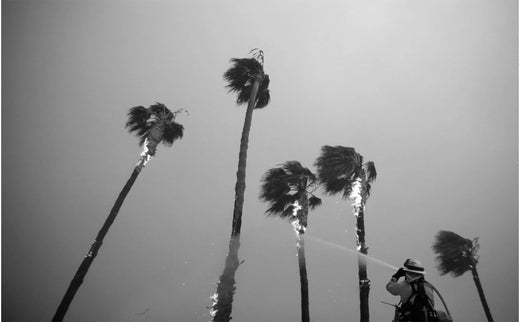
Wind-blown embers leap ahead of the fire front to start new “spot” fires. Under these conditions, it is impossible to stop or control a blaze. Photo George Wuerthner

The fires in Los Angeles are still burning as I write this. The loss of property, the disruption and loss of lives, and the trauma these fires created are horrendous.

Nevertheless, there are lessons we can learn to change fire policies to mitigate (not prevent) such tragedies in the future.

Wildfires are a natural part of many Western landscapes. Extreme weather and climate are responsible for all large blazes. In 2024, I wrote a piece called “It’s the Wind Stupid,” emphasizing how critical wind is to the creation of large, unstoppable wildfires. In LA, Santa Ana winds up to 100 miles per hour, fanned the flames, and cast embers miles ahead of the fire front. In just 24 hours, the Palisades Fire grew more than 15,000 acres. That’s several football fields a minute!

This graph shows the difference in fire spread caused by wind speed.

It’s important to note that increases in wind speed are not linear in how they affect fires. They are exponential. A 20-mph wind gust doesn’t double a 10-mph wind; it quadruples it.

Santa Ana winds have been stoking fires for millions of years. The difference is that we now have sprawl and entire cities on the fire pathway. These are urban fires ignited by wildfire. Once enough homes are ignited, traditional fire-fighting capacities are overwhelmed.

LESSONS FROM THE FIRES

An important lesson from the LA fires and others is that extreme weather conditions negate fuel reductions. State and federal agencies’ mantra about “reducing fuels” fails to recognize that high winds invalidate the effectiveness of logging, thinning, or prescribed burns. The wind blows embers over, around, and through such “fuel reductions.”

Chaparral is the most widespread vegetation type in California. The majority of the landscape burning in the LA fires consists of chaparral. Photo George Wuerthner

Some of the misguided folks that think fuels are always the problem continue to suggest that if only California had done more ‘prescribed burning” like they assert the Indians did and this could have prevented these blazes. First, tribal burns were fairly localized and did not influence vegetation at the landscape scale. However, the majority of the landscape burning in LA is chaparrel. Burning chaparral is not necessary or effective.

Chaparral is a shrub vegetation type that dominates southern California, and it infrequently burns but at high severity when it does. Fire suppression has had little effect on chaparral communities. Photo George Wuerthner

The natural fire regime in chaparral is typically 30-100 years between blazes. Burning it more frequently eradicates chaparrel species from the landscape, and replaces it with even more flammable grasses.

If you have vulnerable structures on the landscape, they will ignite. Embers land in gutters, roofs, and wooden decks or are pushed by high winds through unscreened vents to ignite homes.

Wind-driven fires are impossible to stop. Highway 101 did not stop the Thomas Fire, which charred the Santa Barbara area in 2017-2018. The only firebreak that held was the Pacific Ocean.

The Pacific Ocean was the only “fuel reduction” that prevented the Pacific Palisades’ blaze from continuing westward.

Furthermore, like those in Los Angeles, most acreage charred annually is in non-forested landscapes. The LA fires are burning through chaparral. Over the past few decades, many larger fires have been in grasslands or shrubs, not forests. Indeed, approximately 80% of destroyed buildings in the West were lost in grassland and shrubland fires.

Nearly 80% of the structures destroyed in the West occur in grassland-shrub ecosystems, not forests. Yet, federal agencies continue to emphasize forest logging and thinning projects as the solution for wildfire prevention. Wallowa Whitman NF, Oregon. Photo George Wuerthner

Yet federal and state agencies have continued to emphasize logging forests as if this will safeguard communities, which is delusional under extreme weather conditions but also doesn’t apply to many western landscapes.

This was a typical scene at Paradise, California, where the Camp Fire destroyed 19,000 structures, while green trees surrounding the buildings survived. Photo George Wuerthner

In the aftermath of the LA fires, like others, such as the Camp Fire that overran Paradise, California, you frequently see green trees surrounding the foundations of homes that were annihilated. This indicates that the fire front did not move through the area; instead, ember showers ignited homes.

This home burnt to the ground during the 2007 Grass Valley Fire near Lake Arrowhead. The presence of green trees surrounding this burnt out foundation demonstrates that the fire front never touched the home. Rather a wind-driven embers ignited the fire that destroyed this structure. Photo George Wuerthner

There is an explanation. Most homes are built of wood, drywall, and plastics that are more flammable and burn at lower temperatures than trees. These materials can burn completely, whereas most of a tree, even if burnt, remains as a snag because the boles have higher water content and resist combustion.

Wildfires generate a lot of radiant heat that can ignite a home even if a flame never touches it. Wooden walls can ignite, and materials like vinyl, common in windows, can melt and provide entry for embers into the home.

Due to the heavy metals, plastics, and other materials used in the construction of urban structures, in the aftermath of a blaze, the site is considered a toxic waste site that must be cleaned up before any reconstruction occurs. This adds significantly to rebuilding costs. Photo George Wuerthner

Once ignited, a burning building generates far more heat than the thermal pulse from wildfire. When you have homes nearby, there is a domino effect whereby one burning structure generates enough heat to ignite adjacent homes. This is why entire blocks can be turned to ashes.

Given that traditional measures like thinning the forest or prescribed burns are ineffective during extreme fire weather (and all large blazes only occur during extreme weather), how can communities protect themselves?

Humans are responsible for the majority of igntitions in California and much of the West. Rural sprawl has increased the likelihood of wildfire. Roads are pathways for flammable weeds and human ignitions. Powerlines strung through the landscape can also be a source of ignition if they are knocked over. Zoning to preclude such “human disasters” is one means of reducing wildfire. Photo George Wuerthner

First, land use zoning can limit construction in fire-prone areas where geographical features like canyons and ridges enhance fire spread. As homes spread into the hinterland, power lines knocked down by falling trees or wind events become a major ignition source. Hence, the less sprawl, the less chance there is for such ignitions.

A new logging road was created to “thin” or “log” the forest ostensively to reduce wildfire, even though roads are a major area for wildfire ignitions. Photo George Wuerthner

Second, most human ignitions (the majority of all fire starts) occur near roads. Road closures and not building roads into the hinterlands are potential defenses against fire starts.

Third, it’s critical to reduce flammable materials near homes. A wood pile adjacent to a house, a wooden fence, shrubs planted adjacent to the structure are all potential ignition points.

Annual clearance of debris like these pine needles is necessary to reduce the flammability of the home. Photo George Wuerthner

Fourth, working from the home outward reduce the flammability of the home itself. A metal roof or one made of a non-flammable material can withstand burning embers. Windows with vinyl frames easily melt from radiant heat and fall apart, allowing embers to enter the home. Construction with metal, brick, adobe, or other non-flammable materials can sometimes help a home to survive a blaze.

Additional measures, such as installing a rooftop sprinkler system, can save a house. A wet structure won’t burn.

However, even if you take all the right precautions to reduce your home’s flammability, if your neighbor does not, the heat from their burning home can ignite your structures. So, community-wide hazard reduction programs, such as restrictions on burning yard waste or periodic checks to make sure flammable materials are moved away from house foundations.

Here is a home that is highly flammable. Pine needles are on the roof, brush is growing right to the fence and building foundation, and tree branches overhang the roof. Modification of this home would be relatively inexpensive, and could significantly increase its ability to resist a wildfire. Photo George Wuerthner

The wake-up call of the LA fires is the recent announcement that 2024 was the warmest temperature across the planet in thousands of years. With increasing heat, drought, and high winds, we can expect more fires like those southern Californians are experiencing.


George Wuerthner has published 36 books including Wildfire: A Century of Failed Forest Policy

How the City of Dreams became a city of flames

LA-based socialist Clare Fester say the fires are not a ‘natural disaster', but are fuelled by climate change—and cuts mean fire departments can't respond properly


LA wildfires have destroyed homes and killed 24 people

By Camilla Royle
Monday 13 January 2025     
SOCIALIST WORKER Issue 2938

As Donald Trump prepares for his inauguration as United States president, wildfires are ripping through Los Angeles. They are among the worst disasters the city has seen.

The fires have killed at least 24 people and many more have been seriously injured. There are multiple ­uncontrollable fires that have burned more than 40,000 acres in total. More than 12,000 homes and other buildings have been engulfed by flames and tens of thousands of people ordered to evacuate.

LA-based socialist Clare Fester, said, “This unfolding catastrophe is anything but a ‘natural’ disaster.

“Not only have climate scientists warned for decades about exactly this kind of destruction, the people in power have systematically ­undermined the social services necessary to get the fires like these under control.”


Many of the dead are older and disabled people who were not able to leave their homes. Victor Shaw, who was 66 years old, was found dead with a hose in his hand after telling his sister he wanted to try to save his home of 55 years.

“When I went back in and yelled out his name, he didn’t reply back, and I had to get out because the embers were so big and flying like a firestorm—I had to save myself,” his sister Shari said.

LA is known for property developments for the mega rich—­alongside one of the highest rates of ­homelessness anywhere in the US. People living outside are especially at risk from choking on smoke caused by the wildfires.

Clare explained that the city’s mayor, Democrat Karen Bass, had made nearly £15 million worth of cuts to the LA Fire Department. The fire department warned that this would affect helicopter ­coordination and pilot training.

At the same time, funding for the Los Angeles Police Department has gone up—they need more money to support their violence. Much of the increase in their ­funding is for liability payouts, such as £15 million spent compensating the family of a disabled man ­murdered by an off duty cop.

The LAPD paid £10 million to a man left with a brain injury after a car crash—caused by a police ­detective running a red light. And nearly a third of those sent out to fight the fires are ­incarcerated people. Prison labour helps compensate for the shortage of funding in the fire service.

They do dangerous work on the frontlines with minimal training and for the equivalent of £2.40 a day.

The fires have been whipped up by the strong Santa Ana winds, which blow dry air from the desert towards California. But high temperatures due to climate change are also making fires like these a regular occurrence.

Clare said, “Mutual aid networks are doing stellar jobs taking care of evacuated people and providing essential services.

“But we need more than ­distribution systems for aid, we need a society run for the planet and the people who live on it, not the wealthy few who are hellbent on destroying it.”
The wealthy buy protection and leave neighbours to burn

The Marxist writer Mike Davis showed in his 1998 book Ecology of Fear how the mega-rich of the City of Dreams had built their properties higher and higher into the mountains. The property development boom provided more fuel for the fires.

This time fires have reached the glamorous residents of the Pacific Palisades neighbourhood. Millionaire Keith Wasserman provoked outrage by offering in a post on X to pay “any amount” for private firefighters to protect his home.

Real estate developer Rick Caruso hired a fire engine and a dozen private firefighters as a preventative measure—while the state fire department struggled to contain the blaze.

One of them told the LA Times that he had a full time job for the Los Alamitos Fire Department but had contracted his services to Caruso while off duty. Some private firms are contracted by insurance companies. They increase class divisions by letting the rich hang on to their assets.


Fire Weather


The apocalyptic wildfires that have erupted in the boreal forest in Siberia, the Russian Far East and Canada, climate scientists repeatedly warned, would inevitably move southwards as rising global temperatures created hotter, more fire-prone landscapes. Now they have. The failures in California, where Los Angeles has had no significant rainfall in eight months, are not only failures of preparedness – the mayor of Los Angeles, Karen Bass, decreased funds for the fire department by $17-million – but a failure globally to halt the extraction of fossil fuel. The only surprise is that we are surprised. Welcome to the age of the “Pyrocene” where cities burn and water does not come out of the hydrants.

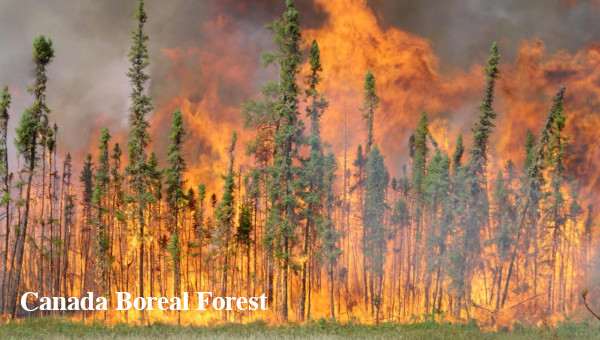
The boreal forest is the largest forest system on earth. It circumnavigates the Northern Hemisphere. It stretches across Canada and Alaska. It travels through Russia where it is known as “the taiga.” It reaches into Scandinavia, picks up again in Iceland and Newfoundland, and moves westward across Canada, completing the circle. The boreal forest has more sources of freshwater than any other biome, including the Amazon Rainforest. It is the lungs of the earth, able to store 208 billion tons of carbon, or 11 percent of the world’s total. Yet it has been steadily degraded, assaulted by deforestation and the extraction of the tar sands in Alberta, Canada – which produces 58 percent of Canada’s oil and is the US’s largest source of imported oil – man-made drought and rising temperatures from carbon emissions.

Two Million Acres of Boreal Forest Destroyed

Almost two million acres of boreal forest have been destroyed by extraction industries and timber companies. They have scraped away the topsoil and left behind poisoned wastelands. The production and consumption of one barrel of tar sands crude oil releases between 17 and 21 percent more carbon dioxide than the production and consumption of a standard barrel of oil. The oil is transported thousands of miles to refineries as far away as Houston, through pipelines and in tractor-trailer trucks or railroad cars.

This vast assault, perhaps the largest such project in the world, has accelerated the release of carbon emissions that, unchecked, will render the planet uninhabitable for humans and most other species. There is a direct line from the destruction of the boreal forest and the raging wildfires in California.

The boreal forest system has, for over a decade, seen some of the planet’s worst wildfires, including the 2016 Wood Buffalo (aka Fort McMurray) wildfire, which consumed nearly 1.5 million acres and which was not fully extinguished for 15 months. The monster wildfire, which was, according to journalist John Vaillant, about 950 degrees Fahrenheit – hotter than Venus – destroyed thousands of homes and forced the evacuation of 88,000 people. The fire ripped into Fort McMurray with such ferocity and speed that residents barely escaped in their cars as buildings and houses were instantly vaporized. Flames shot 300 feet into the air. Fireballs rolled up into the smoke column for another 1,000 feet. It was a harbinger of the new normal.

More than 100 climate scientists have called for a moratorium on the extraction of tar sands oil. Former NASA scientist James Hansen warned over a decade ago that if the tar sands oil is fully exploited, it will be “game over” for the planet. He has also called for the CEOs of fossil fuel companies to be tried for “high crimes against humanity and nature.”

Alberta Tar Sands

It is hard to get a sense of the scale of the destruction unless you visit, as I did in 2019, the Alberta tar sands. I spent time with the 500 inhabitants of Beaver Lake, the Cree reserve, most of whom are impoverished and live in small, boxy prefabricated houses. They are victims of the latest iteration of colonial exploitation, one centered on the extraction of oil that is poisoning the water, soil and air around them.

Beaver Lake, as I wrote at the time, is surrounded by over 35,000 oil and natural gas wells and thousands of miles of pipelines, access roads and seismic lines. The area also contains the Cold Lake Air Weapons Range, which has appropriated huge tracts of traditional territory from the native inhabitants to test weapons. Giant processing plants, along with gargantuan extraction machines, including bucket wheelers that are over half a mile long and draglines that are several stories high, ravage hundreds of thousands of acres.

“These stygian centers of death belch sulfurous fumes, nonstop, and send fiery flares into the murky sky,” I wrote. “The air has a metallic taste. Outside the processing centers, there are vast toxic lakes known as tailings ponds, filled with billions of gallons of water and chemicals related to the oil extraction, including mercury and other heavy metals, carcinogenic hydrocarbons, arsenic and strychnine. The sludge from the tailings ponds is leaching into the Athabasca River, which flows into the Mackenzie, the largest river system in Canada.”

Nothing in this moonscape, by the end, will support life. “The migrating birds that alight at the tailings ponds die in huge numbers,” I noted. “So many birds have been killed that the Canadian government has ordered extraction companies to use noise cannons at some of the sites to scare away arriving flocks. Around these hellish lakes, there is a steady boom-boom-boom from the explosive devices.”

The water in much of northern Alberta is no longer safe for human consumption. Drinking water has to be trucked in for the Beaver Lake reserve. Cancer and respiratory diseases are rampant.

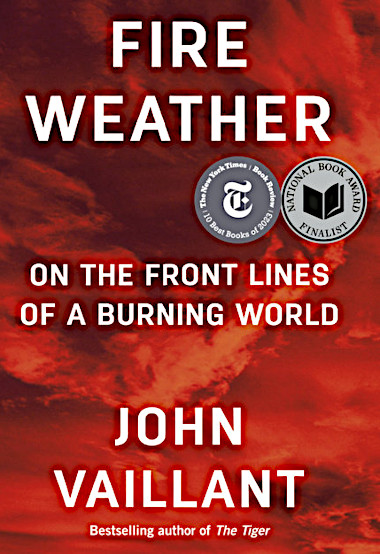
John Vaillant, author of Fire Weather: On the Front Lines of a Burning World describes the tars sands landscape:

“…mile upon mile of black and ransacked earth pocked with stadium-swallowing pits and dead, discolored lakes guarded by scarecrows in cast-off rain gear and overseen by flaming stacks and fuming refineries, the whole laced together by circuit board mazes of dirt roads and piping, patrolled by building-sized machines that, enormous as they are, appear dwarfed by the wastelands they have made. The tailings ponds alone cover well over a hundred square miles and contain more than a quarter of a trillion gallons of contaminated water and effluent from the bitumen upgrading process. There is no place for this toxic sludge to go except into the soil, or the air, or, if one of the massive earthen dams should fail, into the Athabasca River. For decades, cancer rates have been abnormally high in the downstream community.”

The out-of-control fire storms and blizzard of swirling embers, he chronicles, are what we are witnessing in California, a state which normally experiences wildfires during June, July, and August. Neighborhoods burn “to their foundations beneath a towering pyrocumulus cloud typically found over erupting volcanoes” and fires generate “hurricane-force winds and lightning that ignites fires miles away.”

These cyclone-like fires resemble the firebombing of Hamburg or Dresden during World War Two, rather than forest fires of the past. They are almost impossible to control.

You can see an interview I did with Vaillant here.

“Fire wants to climb,” Vaillant told me. “[W]e all know heat rises. It’s rising up into the treetops and it’s sucking in wind from underneath because it needs oxygen all the time. So the fire, it’s helpful to think of it as a breathing entity. It’s pulling oxygen in from all around and rising into the architecture of the trees and so there’s this rushing chimney-like effect. Where the fire is in a way happiest, most energetic, most charismatic, and dynamic is up in the treetops, and then it’s pulling in wind from down below. As that heat builds, as the whole tree is engaged, you have this increasing heat and increasing wind which then builds on itself so it becomes almost a self-perpetuation machine. If you have hot enough, dry enough, [and] windy enough conditions, those flames will then begin to leap from treetop to treetop.”

The heat releases vapor, hydrocarbons from the fuels around it, which is why we see “explosive fireballs and massive surges of flame coming out of big boreal fires because that’s the superheated vapor rising up and then ignited. Imagine an empty gas can – even though there might not be a lot of liquid in it, it will still explode in a spectacular fashion. Well, that’s really what the fire is enabling in the forest, for all those hydrocarbons to release in this gaseous cloud that then ignites. That’s when you see, especially a boreal fire, in full run. It’s called a Rank 6. It’s comparable to a Category 5 hurricane.”

When houses and buildings become very hot they, like trees, release hydrocarbons. Vaillant calls modern buildings “incendiary devices.” They are packed with petrochemicals and often sheathed with petroleum products like vinyl siding and tar shingles. When fires push temperatures to over 1,400 degrees the vinyl siding, tar shingles, glues and laminates in the plywood vaporize.

The Petroleum Age

“The modern home is in fact more flammable than a log cabin or a 19th-century home that’s made mostly out of wood, mostly furnished with cotton-stuffed furniture or horse hair stuffed furniture, things that we think of as antiques now,” Vaillant said. “But the modern home is really in a way a giant gas can and we don’t think of that when it’s 75 degrees. But when it’s 300 degrees because of the radiant heat coming off a fire, or 1,000 degrees because of the radiant heat coming off a boreal wildfire, it turns into something completely different.”

“All of us alive today have grown up in the petroleum age,” Vaillant said. “It feels normal to us the way I think people smoking on airplanes and in doctors’ waiting rooms felt normal to people in the 1950s. We’re completely habituated to it, to the point that it’s invisible to us. But if you really stop and think about how petroleum is rendered and what it in fact is, it’s literally toxic at every stage of its life. From the moment it’s drawn from the ground through the incredibly polluting refining process, into our cars and where it’s burned … Petroleum will kill you in every form, whether as a liquid, as a toxic spill, as a gas, as an emission. It’s strange to think that we have surrounded ourselves and persuaded ourselves that this profoundly toxic substance is an ally to us and an enabler of this wonderful lifestyle that we live that is now being compromised in measurable and visible ways by that very energy source.”

We have harnessed the concentrated energy of 300 million years and set it alight. We are addicted to fossil fuels. But it is a suicide pact. We ignore the freakish weather patterns and disintegration of the planet, retreating into our electronic hallucinations, pretending the inevitable is not inevitable. This vast cognitive dissonance, fed to us by mass culture, makes us the most self-deluded population in human history. The cost of this self-delusion will be mass death. The devastation in California is the harbinger of the apocalypse. •

This article first published on the Chris Hedges Substack website.

Chris Hedges is a Pulitzer Prize-winning author and journalist who was a foreign correspondent for fifteen years for The New York Times.

The Fire Boom | Mike Davis

Mike Davis’s essay on LA as a locus of ecological destruction, taken from his classic work Ecology of Fear: Los Angeles and the Imagination of Disaster.


Mike Davis14 January 2025
VERSO
Blog post


In this excerpt from Mike Davis's classic book Ecology of Fear (originally published in 1998), he explores the tinderbox of the wealthy "Los Angeles frontiers" and the massive public resources dedicated to keep it from igniting.

"I have this sense of impending doom…"- Fire historian Stephen Pyne (1993)

In 1981, in one of his last articles, Los Angeles's best-known environ­mental writer, Richard Lillard, challenged Frederick Jackson Turner's famous thesis that the American frontier-and with it, the frontiers­man-disappeared in 1890. As a matter of fact, Lillard asserted, the frontier was alive and well in the Edenic canyons above Malibu and Hollywood. The unique challenge of the wild mountains so near the big city brought out the true grit in the self-selected population of hill dwellers. "The whole hillside and canyon ambiance, almost always fresh and wildsmelling, both attracts and holds the kind of individual that Frederick Turner and many a traveller, Tocqueville included, knew in the backwoods districts. “The neighborly and self-reliant hill folk, moreover, were tempered to heroic mettle by the implacable constancy of the fire danger, “keeping an outlook for arsonists or chil­dren playing with matches, as their forefathers once kept alert for hostile aborigines.”

At the same time, however, Lillard warned harshly against the creeping threat of mountain society's nemesis: sloping suburbia.


It is not habitation amid wilderness. Mankind has conquered nature instead of adjusting to it. Often the new instant enclaves have a supermarket, a cleaning and dyeing establishment, and a laundromat. The immigrating mini-city populace consists of country club types rather than hillsiders.

Although Lillard was writing only a decade and a half ago, his moun­tain frontier is now extinct. "Country club types" have everywhere conquered and now monopolize the picturesque seacoasts and foothills. Despite brave but belated attempts at open space conser­vation, like those of the Santa Monica Mountains Conservancy, Southern California's remnant natural landscape continues to be destroyed or privatized. As we saw earlier, fire itself accelerates gen­trification and the replacement of bohemian lifestyles by snobbery and exclusiveness. The real impetus of this movement to the hills is no longer love of the great outdoors or frontier rusticity, but, as critic Reyner Banham recognized in the 1960s, the search for absolute "thickets of privacy" outside the dense fabric of common citizenship and urban life.

Hillside homebuilding, moreover, has despoiled the natural her­itage of the majority for the sake of an affluent few. Instead of pro­tecting "significant ecological areas" as required by law, county planning commissions have historically been the malleable tools of hillside developers. Much of the beautiful coastal sage and canyon riparian ecosystems of the Santa Monica Mountains have been sup­planted by castles and "guard-gate prestige." Elsewhere in Southern California-in the Verdugo, Puente, San Jose, San Joaquin, and San Raphael Hills, as well as the Santa Susana, Santa Ana, and San Gabriel Mountains-tens of thousands of acres of oak and walnut woodland have been destroyed by bulldozers to make room for simi­lar posh developments.

And the "flatland" majority-including the poor taxpayers of the Westlake district, most of whom have never seen a Malibu sunset­will continue to subsidize the ever increasing expense of maintaining and, when necessary, rebuilding sloping suburbia. As Richard Min­nich points out, hillside homeowners, unlike tenement dwellers, have access to almost unlimited fire protection.


The money flows to the Santa Monica Mountains instead of poor areas of Los Angeles because fighting firestorms is an emergency action. In fact, all wildland fires, even one acre spots, are treated as emergencies. The Forest Service and other land management agencies have no a priori budget. After the fire is suppressed, they just send a bill to the government. Budgeting is a posteriori, which means there are no strings. They can spend as recklessly as possible. Urban fires aren't treated this way.

Meanwhile, the suburbanization of Southern California's remain­ing wild landscapes has only accelerated in the face of a perceived deterioration of the metropolitan core. As middle- and upper-class families flee Los Angeles (especially its older, "urbanized suburbs" like the San Fernando Valley), they seek sanctuaries ever deeper in the rugged contours of the chaparral firebelt. The population, for example, of the Thousand Oaks-Agoura Hills corridor-the crucible of almost all Malibu firestorms-has tripled since 1970 (to nearly 60,000), with hundreds of new homes scattered like so much kindling across isolated hilltops and ridges.

Ignoring every lesson of the recent fires and earthquakes, two new megadevelopments, Newhall Ranch and Ritter Ranch, totaling 42,000 homes, are under construction in the environmentally sensitive, fire­prone Santa Clarita and Leona Valley areas of northern Los Angeles County. Statewide, some seven million inhabitants-the whitest and wealthiest segment of the population-now live in the suburban-chaparral border zone where wildfire is king. Excluding national parks and military bases, California suffered an incredible 10,000 wildfires per year during the 1980s.

At the same time, suburban firestorms are becoming ever more apocalyptic. The social cost of fire has increased in almost geometric relation to the linear growth of firebelt suburb populations. Two-­thirds of all the homes and dwellings destroyed by wildfire since statewide record keeping began in 1923 have been burnt since 1980. If, as Stephen Pyne has suggested, the 1956 Malibu fire inaugurated a new fire regime, then the 1991 Oakland fire ($1.7 billion insured damage) and the 1993 Southern California fire complex ($1 billion) marked the emergence of a new, "postsuburban" fire regime.

The increased dangers of this "fire boom" are most obvious to those who risk their lives every year fighting mountain firestorms. As Interior Secretary Bruce Babbitt complained while visiting the Malibu fire scene in 1993: "Fire-fighting is getting more expensive, more haz­ardous." To use a military analogy, the new density of hillside housing has transformed the battle against wildfire from a wide-ranging war of maneuver into the equivalent of street fighting. Firefighters' ener­gies are now dispersed into house-by-house defenses, while tradi­tional wildfire techniques, like the use of backfires, are vitiated by the threat to nearby homes. As a result, there is a dramatically increased risk of firefighters' being trapped by erratic and rapidly moving fire fronts.

This is exactly what happened to four engines from the Glendale and Los Angeles city fire departments on the second day of the 1996 Malibu fire. Although the fire did little property damage, it came close to wiping out an entire fire line of defenders. The firefighters had been dispatched to save some ridge-top homes perched above Malibu Bowl in Corral Canyon, when shifting winds suddenly fanned flames up a steep south-facing hillside. The captain in charge of the Glendale fire crew, who would normally have watched for such flare-ups, was preoccupied with laying line to protect the homes. As the fire unexpectedly erupted across the eucalyptus­planted ridge, "Engine 24's captain felt a blast of heat followed by a rain of embers. He ordered his personnel to abandon their hose line and run." One firefighter, 53-year-old William Jensen, held his posi­tion with almost suicidal courage in order to cover his fleeing com­rades with spray from his hose. He was hideously burned over 70 percent of his body and, although he lived, required 16 separate skin-graft operations before he left the hospital four months later.

Meanwhile, nearby units from Los Angeles were desperately trying to escape from the closing circle of flames. The heavy smoke, how­ever, stalled Engine 10, and "the four men on board were only able to open one of the aluminized blankets each carried as protection. Three crawled under it; the fourth-the captain-was only able to get his upper body under the shield." He was seriously burned. Two other Los Angeles crews suffered smoke inhalation after they were forced to drive through the red wall of flame. A subsequent internal review by the two fire departments narrowly, and probably unfairly, focused on the role of "inexperienced leadership" in the near catas­trophe, while ignoring the larger issue of house-by-house deployment under dangerous firestorm conditions.

Indeed, a growing risk of entrapment and death is inevitable as long as property values are allowed to dictate firefighting tactics. The expo­nential growth of housing in foothill firebelts, moreover, increases the likelihood of several simultaneous conflagrations and stretches regional manpower reserves to their limit, or beyond. As one national forest official observed: "These fires in Malibu prove that you could throw in every firefighter in the world and still can't stop it.”

Most experts agree that the most effective way to curb the rising fire danger is regular "prescriptive burning" every five to seven years to reduce fuel accumulation. This return to Tong-va practice, how­ever, has proved almost impossible to implement in Southern Cali­fornia, outside of unpopulated national forest jurisdictions. All controlled burns entail some small risk of runaway fire, and local fire departments are understandably intimidated by their potential lia­bility. Hillside homeowners' associations, moreover, vehemently oppose prescriptive burning because of the belief that "blackened hillsides and ash in the swimming pools reduce property values." In a typical case, the Los Angeles County Fire Department was recently sued by a Topanga Canyon resident who claimed that controlled burns would make it impossible to sell his home.

Mountain homeowners also continue to reject any special fiscal responsibility for the defense of their precarious habitats. Penny­pinching Malibuites, for example, have resisted every effort to force them to update their notoriously inefficient water system or widen their narrow, winding streets. Yet thanks to their disproportionate political clout, they continue to expect that the general public will bear the exploding costs of a scientifically discredited strategy of total fire suppression. As Alan Kishbaugh, the president of the powerful Federation of Hillside and Canyon Associations of Los Angeles (which includes Malibu affiliates), recently put it: "We're sitting here in our homes, doing our part, and expecting the best protection avail­able .... When it comes to fire protection, Californians are entitled to the best that exists."

As in the aftermath of each previous fire tragedy, homeowners have invariably been seduced by the idea of a technological fix to the problem of wildfire ecology. The latest fetish is the CL-415 "Super Scooper": a gigantic amphibious aircraft capable of skim­ming the surface of the ocean and loading up to 14,000 gallons of water per fire drop. For years the Federation of Hillside and Canyon Associations has been fiercely lobbying state and local offi­cials to purchase a fleet of these Canadian-built planes at $17 mil­lion each. Since the 1993 evacuation of Malibu, moreover, the federation has enjoyed the support of the powerful West L.A. Democratic machine as well as most of the regional media, includ­ing the Los Angeles Times. In 1996 the state introduced the big planes on an experimental basis.

Once again, politicians and the media have allowed the essential landuse issue-the rampant, uncontrolled proliferation of firebelt suburbs-to be camouflaged in a neutral discourse about natural hazards and public safety. But "safety" for the Malibu and Laguna coasts as well as hundreds of other luxury enclaves and gated hilltop suburbs is becoming one of the state's major social expenditures, although-unlike welfare or immigration-it is almost never debated in terms of trade-offs or alternatives. The $100 million cost of mobilizing 15,000 firefighters during Halloween week 1993 may be an increasingly common entry in the public ledger. Needless to say, there is no comparable investment in the fire, toxic, or earthquake safety of inner-city communities. Instead, as in so many things, we tolerate two systems of hazard prevention, separate and unequal.

- Read more in Ecology of Fear: Los Angeles and the Imagination of Disaster by Mike Davis. See all our publishing by Mike Davis here, and our wider reading on building an anti-capitalist movement against climate disaster.
Low-income households in UK worse off due to ‘sky-high’ housing costs

The Resolution Foundation has found that ‘sky-high housing costs’ outweigh the relatively low cost of food


Yesterday

Low and middle-income families in the UK are worse off than families in other Western European countries due to ‘sky-high housing costs’, according to a new report by the Resolution Foundation.

The think tank said that while food costs in the UK are 12% cheaper than the average in other developed countries, less well-off Britons were more affected by the cost of housing, which is 44% higher in the UK than the OECD average.

The report found that, after adjusting for the cost of living and housing, poor German families are £2,300 a year, or 21%, better off than poor families in the UK.

The income gap with poor Dutch families is even wider at 39%, while the gap with poor French families is 8%.

The foundation’s report showed that families in the bottom half of income distribution spend 22% of their budget on housing and 17% on food. In contrast, wealthier families spend 13% on housing and 13% on food.

Simon Pittaway, Senior Economist at the Resolution Foundation, said: “Britain’s recent toxic history of low growth and high inequality has left low-to-middle income families far poorer than their counterparts in Western Europe.

“These damaging income gaps are even worse once we factor in the prices of goods and services that matter most to these families.

“While food and clothing are relatively cheap, the sky-high cost of housing – which accounts for almost a quarter of all spending by lower-income households – makes Britain a particularly pricey country for poorer families.

“Britain’s housing costs crisis is a major driver of child poverty, and contributes to poor families being £2,300 worse off than their German counterparts. The crisis needs to be tackled urgently – from building more affordable homes to providing better support for low-income renters.”

Olivia Barber is a reporter at Left Foot Forward
Liverpool FC fans reject rumoured Musk takeover – ‘he’ll ruin us’

What would Bill Shankly do?


11 January, 2025 
Left Foot Forward

Liverpool FC supporters aren’t mincing their words about Elon Musk – the world’s richest man – potentially taking over their club.

As Liverpool is widely considered one of the world’s most left-wing football clubs, it’s not surprising that fury is being vented over the prospect of a “hyper-capitalist clown” – as Nigerian-American political strategist Akin Olla described him – buying the club.

What would Bill Shankly do?

The club’s socialist core goes back to Bill Shankly, Liverpool’s legendary manager from 1959 to 1974. Shankly believed in collective effort, fairness, and humanity. As his famous quote summed up:

“The socialism I believe in isn’t really politics. It is a way of living. It is humanity. I believe the only way to live and to be truly successful is by collective effort, with everyone working for each other, everyone helping each other, and everyone having a share of the rewards at the end of the day. That might be asking a lot, but it’s the way I see football and the way I see life.”

In an interview with the Spanish newspaper El Pais in 2019, the club’s then chief executive Peter Moore said that when the club discusses business, they ask: “What would Shankly have done? What would Bill have said in this situation?”’

A mural in Anfield exemplifies the club’s socialist values and working-class roots.

“I’m just a normal working lad from Liverpool whose dream has come true,” it reads, alongside an image of Trent Alexander-Arnold, who is actively involved with foodbanks and supporting the struggles of the working-class community.

It stands to reason therefore that Liverpool FC supporters weren’t going to let this one lie – the prospect of Elon Musk buying the club.

MAGA (Make America Great Again) mania in Britain reached new heights when the father of the world’s richest man claimed his son is considering a Liverpool FC takeover.

Errol Musk triggered the panic when revealing his family’s apparent long history with the city.

Talking to Times Radio, he said his son is “obviously” keen on buying Liverpool from Fenway Sports Group (FSG), the US multinational which has owned the club since 2010.

“His grandmother was born in Liverpool, and we have relatives in Liverpool, and we were fortunate to know quite a few of the Beatles because they grew up with some of my family. So, we are attached to Liverpool you know.”

Liverpool fans have different thoughts about it.

Reacting to Erroy’s comments, Liverpool Echo readers didn’t hold back. One reader wrote:

“We don’t need Elon Musk to buy Liverpool FC, he’ll ruin us. He’s got too much baggage and it’s all about him. The club will be in his shadow, I’d rather have FSG, and I don’t like them. We’ll lose our integrity and go downhill, he’s not well-liked.”

Another remarked: “I wouldn’t want him anywhere near our club, people talk about FSG not spending money, but you can’t spend money you haven’t got, or you’ll end up like City.”

Another wrote: “Walk on and on and on and on, and don’t stop till you’re as far away from Anfield as possible!”

Writer and presenter James Martin made its views clear on Liverpool.com, arguing that Musk would be a “nightmare at Anfield.”

“Quite simply, Musk and Liverpool are a fundamental clash of ideologies. FSG are clearly ultra-capitalists, so there’s no point pretending they have always been perfectly aligned with the club and the city, but the South African billionaire would be on another level entirely,” he wrote.

Martin also acknowledged that FSG does well in hiring experts.

“From Jurgen Klopp to Michael Edwards, the Americans have picked the best people and broadly let them get on with their jobs.”

But he warned how Musk loves to take control, noting how one of his first actions when he bought Twitter was to slash the workforce by 80 percent and introduce a “verification” system that allows users to pay to amplify themselves, noting how engagements with Musk’s own tweets have more than doubled over the past year.

“Before you know it, Musk would be managing the team himself. If there’s one thing the UK has been reminded of in the last few weeks, it’s that the billionaire loves to talk about things he doesn’t understand, which would not bode well in the slightest,” Martin added.

Sham Jivani, a Liverpool FC fan for over 50 years, was blunt about a Musk takeover:

“I’d stop supporting them,” he told LFF.

Image credit: Liverpool Zone – X screen grab
Multi-millionaire ReformUK MP Rupert Lowe advocates for dismantling NHS and ‘buying own healthcare’

‘I’d like some form of scheme where we buy our own healthcare’, said the multi-millionaire


Today


Reform MP Rupert Lowe has argued that the public should pay for their own healthcare and advocated for the NHS to be dismantled.

The former Southampton FC chair and multi-millionaire has said he thinks “we should be able to opt out of the NHS” and “have some form of scheme where we buy our own healthcare”.

Speaking on TalkTV, where presenter Jeremy Kyle referred to him as a “my friend” and said, “I could damn well talk to you forever”, Lowe described the NHS as “an animal on the back of productive Britain and it’s killing us”.

Lowe said that “there are a lot of ways you can solve the NHS” and claimed that disassembling and reassembling it was the answer.

Furthermore, the Reform MP argued that pressures on the NHS mean people who can afford private healthcare end up paying twice, once through national insurance and again through private insurance. He once again blamed these pressures on migration.

This is despite the fact that one in five NHS workers are from overseas and are helping to relieve NHS pressures.

Taj Ali, former editor at Tribune, said in a post on X: “Multi-millionaire public schoolboy Rupert Lowe wants to dismantle our NHS. This is what Reform MPs represent.

“Wealthy elites wedded to extreme Thatcherite ideology posing as anti-establishment heroes. They offer you scapegoats not credible solutions.”

Lowe is a non-executive director and has shares in pharmaceutical company, Biopharma Process Systems Ltd.

During the covid-19 pandemic, the firm, which made a £7.9million pre-tax profit in 2021, received £141,741 in furlough money from the government.

On X this morning, Lowe posted a bizarre rant claiming that the NHS should not write letters in languages other than English. He said: “Why is the NHS sending out communication with this leading the letter?

“Funding this foreign translation is NOT the taxpayer’s problem. It should be scrapped.”

Olivia Barber is a reporter at Left Foot Forward