Thursday, January 16, 2025


Exposure to air pollution before pregnancy linked to higher child body mass index, study finds


An international research team co-led by the Keck School of Medicine of USC found that greater air pollution exposure in the three months before conception was associated with higher childhood obesity risk up to two years after birth.


Keck School of Medicine of USC


In a study of more than 5,000 mothers and their children, exposure to air pollution during the three months before pregnancy predicted higher child body mass index (BMI) and related obesity risk factors up to two years of age. Findings from the study, which was supported by the National Institute of Environmental Health Sciences, were published in the journal Environmental Research.

Past research has linked air pollution exposure during pregnancy to a broad range of health problems in children, including respiratory issues and a higher risk for chronic diseases such as obesity and heart problems. But few studies have focused on the preconception period, typically defined as the three months before a pregnancy begins. Environmental exposures during this timeframe can affect the health of sperm and eggs, which are in their final stages of growth.

In one of the largest studies to date of preconception environmental exposures, researchers from the Keck School of Medicine of USC, Duke University and Fudan University in Shanghai, China studied 5,834 mother-child pairs recruited from maternity clinics in Shanghai. They found that greater exposure to PM2.5, PM10 and NO2 before pregnancy was linked to increases in BMI or BMIZ, a standardized score that shows how a child’s BMI compares to others of the same age and sex.

“These findings imply that the three months before conception are important, and that people who plan to bear children should consider taking measures to lower their air pollution exposure to reduce their children’s risk for obesity,” said Jiawen Liao, PhD, a postdoctoral research associate in population and public health sciences at the Keck School of Medicine and first author of the study.

Small but substantial changes

For the study, the field team, led by Weili Yan, PhD, and Guoying Huang, PhD, of the Children’s Hospital of Fudan University, recruited and enrolled 5,834 women who visited 28 maternity clinics across Shanghai. This provided a rare opportunity: the ability to start collecting data before pregnancy even began.

To calculate air pollution exposure during the preconception period, the researchers developed state-of-the-art machine learning models. Led by Jim Zhang, PhD, of Duke University, they used a combination of satellite data, pollutant simulations and meteorological factors to estimate daily pollution exposure at each participant’s home address. They calculated levels of PM2.5 and PM10, two types of fine particulate matter, and NO2, which is mostly emitted by automobiles.

After birth, researchers also collected electronic medical records data of children’s weight and height at three-month intervals until age two. They used this data to calculate growth rate of weight, BMI, and BMIZ.=

They then compared participants with a relatively low exposure level (the 25th percentile of the cohort) to those with a relatively high exposure level (the 75th percentile of the cohort) to quantify how air pollution exposure was linked to different child outcomes.

A higher level of exposure to PM2.5 during the preconception period was associated with a 0.078 increase in child BMIZ at age two. A higher level of exposure to PM10 was associated with a 0.093 kg/m2 increase in BMI at age two. From six months onward, children with higher preconception exposure to all three pollutants had higher weight, BMI and BMIZ growth rates.

“The magnitude is small, but because air pollution is widespread and everybody is exposed, the risk of air pollution exposure on children’s obesity risk may be substantial and may start before their mothers’ pregnancy,” said Zhanghua Chen, PhD, an assistant professor of population and public health sciences at the Keck School of Medicine and the study’s senior author.

Precautions for the public

The study is observational, so more research is needed to determine whether air pollution exposure before pregnancy directly affects childhood obesity risk. But the findings suggest that people can take action now to minimize potential harm to themselves and their children, the researchers said.

Measures include wearing a mask or staying inside as much as possible when outdoor air quality is poor, as well as using an air purified indoors. While the study focused on mothers, men who plan to conceive may benefit from taking similar precautions.

At the Keck School of Medicine, Liao, Chen and their colleagues are planning a new study to monitor preconception air pollution exposure in Southern California. They are also testing an intervention that uses indoor air purifiers to reduce the risk of heart and metabolic problems among the general population.


About this research

In addition to Liao, Zhang and Chen, the study’s other authors are Wu Chen, Zhenchun Yang, Chenyu Qiu and Frank D. Gilliland from the Department of Population and Public Health Sciences, Keck School of Medicine of USC, University of Southern California; Yi Zhang from Children’s Hospital of Fudan University, Shanghai, China; Kiros Berhane from Columbia University, New York, New York; Yihui Ge from Duke University, Durham, North Carolina; Zhipeng Bai, Bin Han and Jia Xu from the Chinese Research Academy of Environmental Sciences, Beijing, China; and Yong-hui Jiang from Yale University School of Medicine, New Haven, Connecticut.

This work was supported by the National Institute of Environmental Health Sciences [R01ES029945, P30ES007048].

Insurance access for US homeowners with higher climate risks declines


By  AFP
January 16, 2025


The report, providing a view of the homeowners insurance market, comes as a climate-related crisis unfolds in Los Angeles - Copyright AFP JOSH EDELSON

Homeowners in areas of the United States with the highest climate-related risks saw declining access to insurance, a Treasury Department report released Thursday said.

Average insurance non-renewal rates were about 80 percent higher for consumers in high-climate-risk areas than for those in the lowest-risk ones, the report found.

It showed that “homeowners insurance is becoming more costly and harder to procure for millions of Americans as the costs of climate-related events pose growing challenges,” the department said.

The report, providing a view of the homeowners insurance market, comes as a climate-related crisis unfolds in Los Angeles, and with millions across the country rebuilding from the effects of hurricanes and other disasters last year.

Los Angeles has been battling deadly wildfires that have killed at least 24, destroyed thousands of buildings, and forced tens of thousands to flee their homes.

The “analysis comes at a time of devastating tragedy, loss of life, and destruction from the wildfires in the Los Angeles area,” said Treasury Secretary Janet Yellen in a statement.

“While it’s far from clear what the exact financial costs of this disaster will be, it is a stark reminder of the impacts of the growing magnitude of natural disasters on the US economy,” she added.

The report, released by the Treasury Department’s Federal Insurance Office, is based on data covering more than 330 insurers on over 246 million homeowners insurance policies, running from 2018 to 2022.

Homeowners living in communities hit by “substantial weather events are paying far more than those elsewhere,” the Treasury said.

Across the country, homeowners insurance costs have been rising — with average premiums per policy growing 8.7 percent faster than the rate of inflation in the 2018-2022 period.

“Data and analysis, like those in this report, are critical for helping policymakers understand how substantial climate-related property losses are being spread across homeowners, insurers, and governments,” said Under Secretary of Domestic Finance Nellie Liang.
5
Opinion

Notice, no one is rescuing the Ten Commandments from a burning synagogue

(RNS) — For Jews, the Ten Commandments are just the appetizer. They do not belong in public school classrooms.


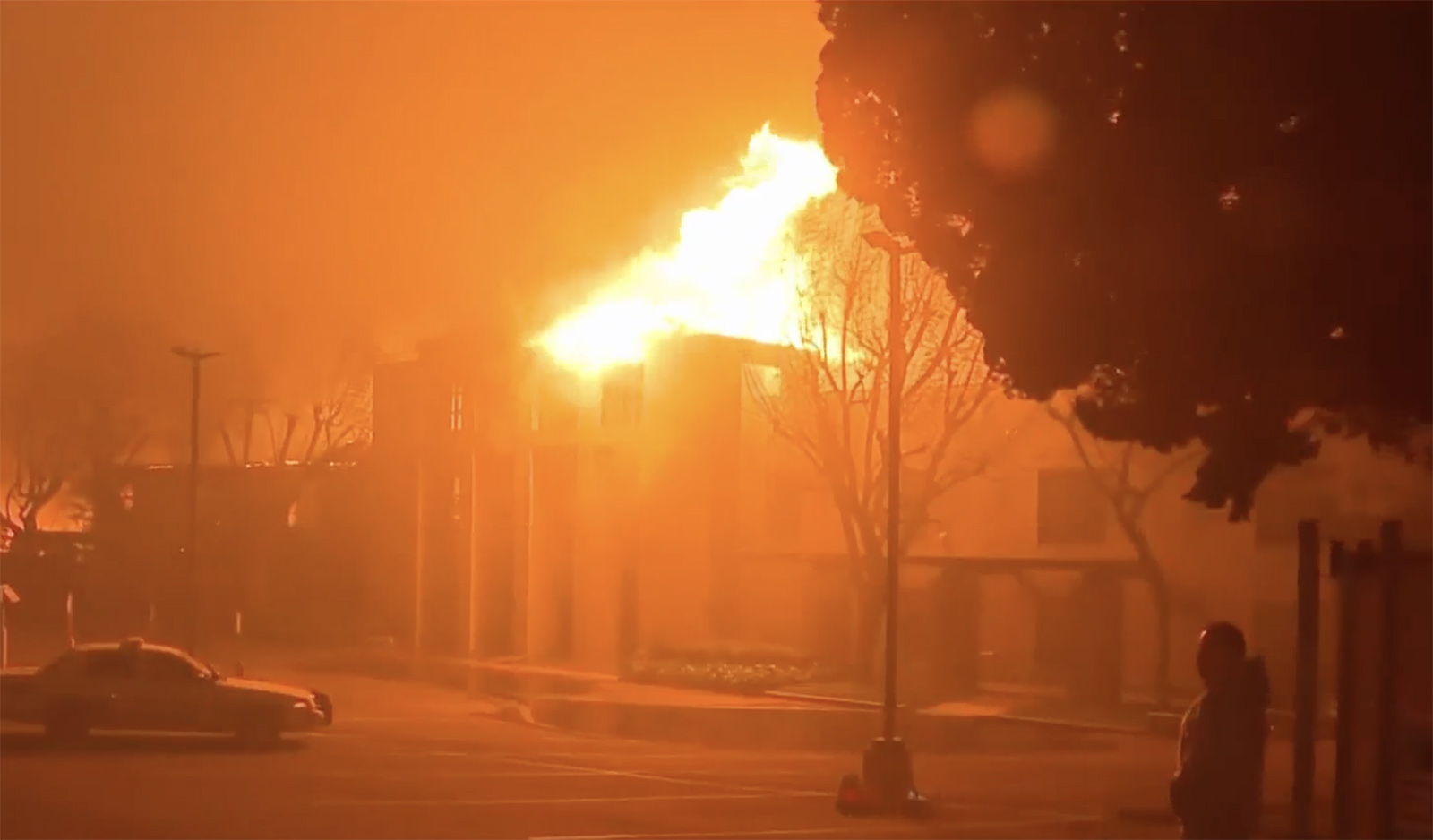
The Pasadena Jewish Temple & Center burns during wildfires in Pasadena, Calif.
 (Video screen grab)

Joshua Hammerman
January 15, 2025


(RNS) — Last week, as the flames engulfed the hills and valleys of Los Angeles, I heard the awful news of the complete destruction of the Pasadena Jewish Temple & Center, a synagogue with a hundred years of history and a vibrant congregation of 430 families.

I have an acquaintance who is active there and wanted to reach out to him. It’s such a helpless feeling to be a continent away from this kind of disaster, and the sight of a burning synagogue triggers deep anguish in the heart of any Jew. So, I dashed off a note.

He replied within a few hours with a very Jewish response.

Thanks so much for reaching out, your kind words and support are greatly appreciated. Fortunately, no one was injured at the synagogue and all the Torah scrolls were saved. At the same time, many in the community have been displaced and more than a few have lost homes.

The two most important bits of information imparted were given in order of their significance:No one was injured in the building.
The Torah scrolls were saved.

The rescue of those Torahs was a dramatic scene, described by Binyamin Cohen of the Forward.

For a Jew, even one with a very limited Jewish education, there is something visceral about the sanctity of a Torah scroll that hits us at the deepest, gut level. The Torah is treated similarly to a human being. We kiss it, hug it, dance with it, and bury it when it is no longer viable. We never burn one.

Just Google “saving Torah scrolls from fire” and you’ll see an endless parade of stories of heroism from all over the world, people risking their lives to save an inanimate object that is really much more. Sadly, Torah rescues from burning synagogues are not uncommon.

OK, that was a long windup. So, here’s my question:

Have you ever seen a single photo of the Ten Commandments being rescued from the burning flames from a synagogue — or any building? In LA? Anywhere? Ever?

Of course not.

It’s not as if the Ten Commandments are meaningless to Jews. But they are just a small part of a larger whole — the Torah — which is equal to far more than the sum of its parts.


Which brings me to what’s taking place in Louisiana.


Last week, while the flames encircled Los Angeles, an amicus brief filed in the Court of Appeals for the 5th Circuit by the National Council of Jewish Women and about 20 other faith-based groups, mostly Jewish, asserted that the Louisiana law mandating a poster or framed copy of the Ten Commandments be permanently hung in every public school classroom violates religious freedom.

The law is in litigation and remains paused after a preliminary injunction blocked officials from enforcing it. However, Kentucky and 17 other states are backing Louisiana in its appeal of the ruling by a U.S. district judge that declared the law unconstitutional.

The amicus brief asserts that the law’s goal is to impose “majoritarian religious values.” Rarely have progressive Jews taken on Christian nationalism so directly.

Here’s an excerpt:

Contrary to the Founders’ intent, H.B. 71 would put the government in the position of favoring certain religious traditions over others. Although the Ten Commandments have historical significance, they are, at heart, a religious text with different meanings, interpretations, and significance across different faiths, including within and among faiths within the Jewish and Christian traditions.

The brief adds that H.B. 71’s legislative history makes clear that its proponents intended to use it as a vehicle to establish what its proponents viewed as a “Judeo-Christian” worldview. Jeff Landry, the governor of Louisiana, sent a fundraising email urging supporters to help “the Judeo-Christian values that this nation was built upon.”

I have nothing against the Ten Commandments, but not a single Jew — and I would venture to guess not a single Christian — would run into a burning building to save a framed poster of a couple of mass-produced fake tablets. It’s an insult to my religion to force us to act as if anything other than our Torah is being presented as the paradigm for sanctity — all the more in the name of “Judeo-Christian values.”

The fetishization of the image of the Ten Commandments is, ironically, a form of idolatry, which is explicitly prohibited in those very commandments. It is a distortion of “Judeo” values to elevate to sanctity an object that is, at most, a nice temple decoration or the backdrop for a Charlton Heston film festival.

For Jews, the Big Ten are just the appetizers. Our tradition has many more commandments that are of equal or even greater significance than them. Would Louisiana like to display all 613 (according to Maimonides’ count) in their classrooms, including the one that allows for leniency on abortion?

I would be totally on board if they decided to use this legislation as a springboard for the promotion of religious pluralism. Why not display versions of the commandments found in different faiths?

No one ever claimed the Bible’s list is unique; there are lots of different versions.

Did you know that for Hindus, the “tenfold law” as they call it, includes self-control, forgiveness, wisdom and abstention from anger?

Buddhists include not merely coveting wives, killing and stealing, but also refraining from “divisive, harsh and senseless speech.” Imagine planting two tablets containing that on a courtroom lawn!

For the Sikhs it is a sin to argue with your parent.

An African proverb states, “If a parent takes care of you up to the time you cut your teeth, you need to take care of them when they lose theirs.”
Islam vociferously condemns the murder of innocents.

And Confucianism states, “No crime is greater than having too many desires.”

Contrast and compare the Bible’s Big Ten with all the others.

And then let’s post them all, side by side.

Just not in public school classrooms.

(Rabbi Joshua Hammerman is the author of “Mensch-Marks: Life Lessons of a Human Rabbi” and “Embracing Auschwitz: Forging a Vibrant, Life-Affirming Judaism That Takes the Holocaust Seriously.” See more of his writing at his Substack page, “In This Moment.” The views expressed in this commentary do not necessarily reflect those of RNS.)
OUTLAW PRISON LABOR

Inmates battling LA wildfires see chance for redemption

GET SMOKE INHALATION, HEAT STROKE INSTEAD


Agence France-Presse
January 16, 2025

More than 900 inmates are working alongside firefighters in the battle to tame wildfires in Los Angeles. (Photo credit: Paula RAMON / © Agence France-Presse)

Inmate Jacob Castro cuts firebreaks in the hills around Los Angeles. It's hard work, but having been in prison for 29 years, it is a chance for redemption.

"It's the first thing I've done in my life that I'm proud of," Castro told AFP during a short break from work.

He is one of more than 900 inmates working alongside firefighters on containment or operational support in the complicated battle against fires that have ripped through Los Angeles, killing at least two dozen people and destroying homes.

Firefighters say the teams are invaluable -- but not everyone is happy they are there.

Billionaire reality star Kim Kardashian last week lashed out at the scant wages they earn, in a practice some have likened to slavery.

"There are hundreds of incarcerated firefighters, risking their lives to save us," the "Keeping Up with the Kardashians" star wrote on social media."They are on the Palisades fire and Eaton fire in Pasadena working 24 hour shifts. They get paid almost nothing, risk their lives... I see them as heroes."

Inmates who work in firefighting earn between $5.80 and $10.24 per day, plus an additional $1 per hour when dealing with emergencies, according to the California Department of Corrections and Rehabilitation (CDCR).

The pay is set by legislation that allows prisoners to receive wages well below state minimums.

Liberal California had the opportunity to change this rule in a referendum in November, but voters rejected the proposal.


- 'Second chance' -

The practice is popular with inmates, who told AFP they see it as a chance to help society -- as well as to shave time off their sentences.

"I love doing this, helping the community by making up for the bad decisions I made in life," said Castro, who has a coveted spot in one of the fire training camps operated by the CDCR.

"It's a chance to redeem myself."

The inmate crews are distinguished only by their orange uniforms.

Deployed to perform manual labor, they can work shifts of up to 24 hours, just like firefighters.

They clear vegetation with axes, chainsaws and shovels, climbing up and down steep hills, removing dry fuels that spread the flames.


"This is definitely some of the hardest work I've done," said Maurice Griffin, who has already been in the service for three seasons.

"It really has made a difference in my life.

"I really appreciate the opportunity to not be in prison and be out changing lives and saving lives."

For Santana Felix Nolasco, 28, the skills and the discipline he has learned have been invaluable.

"It's a big opportunity for every single one of us here," he said. "They give us a second chance for those that actually really want to change," he said, his voice cracking with emotion.
- 'Huge contribution' -
The inmates are among thousands of firefighters from all over the United States, as well as from Mexico, who have been fighting the flames that forced tens of thousands of people from their homes and scorched 40,000 acres (16,000 hectares).

"These guys put a lot of hard work in," said Captain Joseph Cruz, who oversees a team working in the Palisades fire zone. "It's a huge contribution."

Firefighters and prisoners talk, laugh, eat and work together.


It's a "life-changing experience for me," said Nolasco, who wants to change his orange prisoner's uniform for the yellow uniform of the California firefighters when he gets out.

Cruz says seeing the positive effect on the men in his charge is "very rewarding."

"The goal is to get a change of behavior, change of lifestyle, change of previous habits that unfortunately landed in them there in the first place," he said.


"If I retired today, and I knew that I had a couple of guys that were able to get career paths after it, after leaving here... I would be happy.

"It's a great thing, and that's what I do it for."
Critics Warn Media Outlets Failing to Explain Climate Cause Behind Los Angeles Fires

"Too much of the coverage has simply ignored the climate crisis altogether, an inexcusable failure when the scientific link between such megafires and a hotter, dryer planet is unequivocal," wrote the founders of Covering Climate Now.


An aerial view of repair vehicles at sunset passing near beachfront homes that burned in the Palisades Fire on January 15, 2025 in Malibu, California.
(Photo: Mario Tama/Getty Images)

Eloise Goldsmith
Jan 16, 2025
COMMON DREAMS

Covering the who, what, when, where, and why is journalism 101. So why are too few media outlets explaining the role that the climate crisis plays in the "why" behind the fires ravaging the Los Angeles region?

That's the central question posed in an opinion piece published in The Guardian and elsewhere on Thursday authored by Mark Hertsgaard and Kyle Pope, the founders of Covering Climate Now, a global collaboration of over 500 news outlets aimed at improving climate coverage, of which Common Dreams is a part.

Hertsgaard and Pope wrote that "too much of the coverage has simply ignored the climate crisis altogether, an inexcusable failure when the scientific link between such megafires and a hotter, dryer planet is unequivocal."

They added: "Too many stories have framed the fires as a political spat between U.S. President-elect Donald Trump and California elected officials instead of a horrifying preview of what lies ahead if humans don't rapidly phase out fossil fuels. Too often, bad-faith disinformation has been repeated instead of debunked."

Misinformation, in many instances stemming from right-leaning sources, have proliferated since the blazes broke out last week. Trump in a social media post appeared to point the finger at California's statewide water management plans for fire hydrants running dry as firefighters fought the blazes last week. Southern California does have plenty water stored, but the city's infrastructure was not designed to respond to a fire as the large as the ones that broke out, experts toldPBS. Another user on the platform X falsely claimed that California turned away fire trucks from Oregon because of their emission levels, according to KQED.

Hertsgaard and Pope also called for outlets to name names. "Rarely have stories named the ultimate authors of this disaster: ExxonMobil, Chevron, and other fossil fuel companies that have made gargantuan amounts of money even as they knowingly lied about their products dangerously overheating the planet," they wrote.

While the fires are still burning, researchers are already drawing the links between climate change and the blazes. In a thread on Bluesky, the climate scientist Daniel Swain explained the concept of climate "hydroclimate whiplash"—which southern California experienced in 2024—and how this can create ideal conditions for fires to spread.

The authors of the opinion piece noted that there have been bright spots when it comes to covering the fires with an eye toward the climate emergency and debunking false and misleading claims about the fires. The duo highlight a Timestory that is titled "The LA fires show the reality of living in a world with 1.5C of warming" and a column written by the Los Angeles Times' Sammy Roth, which began: "Los Angeles is burning. Fossil fuel companies laid the kindling."

Hertsgaard and Pope wrote, "When a house is on fire, by all means let journalism show us the flames."

"But tell us why the house is burning, too," they added.


How Big Oil Lobbied Its Way Out of Accountability for the LA Fires

"Accountability is an existential threat to their business model, and their business model is an existential threat to all of us, and that’s the bottom line," said Meghan Sahli-Wells, the former mayor of Culver City.


The death toll has risen to 25, according to the Los Angeles medical examiners in Los Angeles, California, United States on January 14, 2025. The latest victim, the 25th, died in the Eaton Fire, which has already claimed 17 lives.
(Photo: Lokman Vural Elibol/Anadolu via Getty Images)


Eloise Goldsmith
Jan 15, 2025
COMMON DREAMS

As devastating wildfires continue to burn in the Los Angeles region on Wednesday—placing tens of thousand of Californians under evacuation orders and causing over $250 billion in economic damages by one estimate—a pair of new reports highlight how fossil fuel companies have dodged responsibility for their role in the destruction and hampered the state's ability to fight back by depriving it of funds.

Two new reports highlight how fossil fuel companies hampered the state's ability to fight back by depriving it of funds.

California's fossil fuel industry deployed lobbying muscle to kill legislation that would compel polluters to pay into a fund that would help prevent disasters and aid cleanup efforts, and has taken advantage of a tax loophole to deprives the state of corporate tax revenue, thereby "putting climate and social programs in peril." In the case of the former, California's biggest fossil fuel trade group, the Western States Petroleum Association, recently launched a digital campaign that appears aimed at throwing cold water on any such legislative efforts.

According to The Guardian, the Polluters Pay Climate Cost Recovery Act of 2024 appeared on 76% of the 74 lobby filings submitted in 2024 by the oil company Chevron and the Western States Petroleum Association.

The legislation—which didn't make it out of the state senate in 2024—would, if enacted, create a recovery program forcing fossil fuel polluters to pay their "fair share of the damage caused by the sale of their products" during the period of 2000 to 2020, according to the nonprofit newsroom CalMatters.

According to The Guardian, the filings from those two firms that included this specific bill totaled over $30 million—though lobbying laws do not require a breakdown that would make clear how much was spent specifically on the "polluter pay" law.

With Los Angeles burning, there's renewed interest in passing the bill, The Guardian reports, citing supporters of the legislation. But Western States Petroleum Association isn't sitting idly by. On January 8, the group launched ads that suggest measures like the "polluter pay" bill would force them to increase oil prices. The ads, which appear to have been taken down, do "not specifically mention the polluter pay bill, it echoes the 2024 campaign that did," wrote The Guardian.

"Accountability is an existential threat to their business model, and their business model is an existential threat to all of us, and that’s the bottom line," said Meghan Sahli-Wells, the former mayor of Culver City who currently works for the environmental advocacy group Elected Officials To Protect America, told the paper.

Meanwhile, another report from The Climate Center—a think tank and "do-tank" focused on curbing pollution—has thrust a tax loophole long used by multinational oil and gas companies, into the spotlight.

The report released last week details how "years of litigation and lobbying by oil and gas majors like ExxonMobil, Chevron, and Shell Oil" are responsible for a large corporate tax avoidance policy that is known as the "Water's Edge election" that became law in 1986.

The law allows multinational corporations to "elect" avoid taxes on earnings they designate as beyond the "water's edge" of the borders of states in which they operate, according to The Climate Center.

"Closing the loophole as it applies to the oil and gas industry could put anywhere between $75 to $146 million per year back into the state’s budget," the report states.

For context, California closed a $46 billion budget shortfall last year, including by enacting cuts to climate and clean air programs.

"The water's edge tax loophole allows multinational fossil fuel corporations to dodge paying their fair share of taxes that can help fund vital environmental projects, which could include wildfire preparedness," California Assemblymember Damon Connolly (D-12) told the progressive outlet The Lever, the first outlet to report on the findings.

California lawmakers last year passed a bill that took aim at some aspects of the loophole, but an advocacy group whose board of directors includes representative from the oil and gas industry has filed lawsuit challenging the constitutionality of the reform, according to the The Climate Center.
Survivors count the mental cost of Los Angeles fires


By AFP
January 15, 2025


Fires around Los Angeles created fear and anxiety for tens of thousands of people - Copyright AFP ETIENNE LAURENT

Romain FONSEGRIVES

When the Pacific Palisades neighborhood of Los Angeles went up in smoke, Alexander Swedelson lost his apartment, but also a bit of his identity: the flames ravaged the businesses he loved, the trails he ran, and even the place he fished.

“It’s just been the most heartbreaking thing I’ve ever seen in my life. Man, it’s just like a war zone,” the 39-year-old photographer told AFP, standing in the ruins of what was once one of the most desirable bits of real estate in the country.

The awful sight of a place where familiar landmarks have been erased has re-opened old wounds for Swedelson.

“I’m probably gonna restart therapy,” sighed the recovering alcoholic, who has been sober for six years.

For the past week, the former volunteer firefighter has been doing his part to help his community.

Armed with a water pump and a chainsaw, he first tried — in vain — to save his parents’ house, before fighting the spread of embers in the neighborhood.

Then, he delivered food and air filters to the elderly who had not evacuated.

Sleep has been a rarity.

“I think I hit my limit,” he said, his eyes misty, sitting in a pickup truck covered in pink retardant dropped by the firefighting planes.

As a one-time drug rehab counselor who has seen first responders grapple with trauma in the aftermath of a tragedy, he knows enough to see that he is at risk now.

“I just kind of stirred up a dormant beast in me, and I’m just gonna have to be really careful.”

– Get treatment early –

With at least 24 people dead and tens of thousands displaced by fires that continue to smoulder, the last eight days will leave a lasting mark on America’s second biggest city.

From the initial panicked evacuation to the terrible firefight that saw hydrants run dry, the opening day of the disaster was just the beginning.

Thousands of people have seen their homes reduced to ashes. And even those whose homes were spared have been heartbroken by the ruin of their neighborhoods.

Psychotherapist Sonnet Daymont said the mental health impacts will also extend to teenagers in the city who have been glued to rolling imagery of the unfolding carnage, or to people who live outside the diaster zone but who have watched their city burn.

“There is such a thing as survivor’s guilt and vicarious trauma,” she told AFP in her Pasadena office, where she offers free sessions to those affected.

“The sooner you get treatment, the better, so that you can learn the skills you need to bring your body down, cope and calm, and get strategic about your next steps as you rebuild,” she said.

A study by Canada’s Laval University followed survivors of a fire that afflicted Alberta in 2016.

A year after the disaster, a third of them suffered from depression, anxiety, drug addiction or post-traumatic stress.

– Eco-anxiety –

“The impact of wildfire unfolds over time,” said Kathryn Andrews, a 51-year-old artist who lost her mobile home in the flames that wrecked Pacific Palisades.

Tragically, this is not the first time she has been through the devastation.

In 2020, her house was razed by a fire in Juniper Hills, an hour and a half drive northeast of Los Angeles.

“I developed a creative block for about a year and a half,” she said.

“When I make art, I feel very vulnerable, and I couldn’t take on feeling any more vulnerable. It was just an overwhelming experience, and I sort of shut down.”

Andrews said she also experienced a kind of eco-anxiety, the effect of living in a part of the world that has been raked by increasingly destructive wildfires over the last 15 years.

“I began to think of, really, the entire American West as a potential fire zone,” she said.

“It made me just have a better understanding of global warming.”

Wildfire survivors “bring up climate change all of the time,” said Daymont.

In her practice, she encourages them to think of themselves as “survivors,” rather than “victims,” and she works with them to develop strategies to soothe the body and mind.

“It is an opportunity to work towards post traumatic growth,” she said.

“If we have something hard happen and we deal with it well, we can take those lessons and that strategy and use it for other things.”

Music industry girds for looming US TikTok ban


By AFP
January 16, 2025


For years TikTok has been an integral tool for most musicians, a jump-off point for artists looking to break out and an essential promotional platform for already-established musicians - Copyright AFP STR

Maggy DONALDSON

TikTok has dramatically changed music discovery and marketing — a reliance the looming US ban on the popular app has underscored as the music world braces for an unknown future.

That the short-form video-sharing app might shut down in the United States starting Sunday has fostered a sense of “marketing apocalypse” across the industry, says Tatiana Cirisano, a music industry analyst at MIDiA Research.

For years TikTok has been an integral tool for most musicians, a jump-off point for artists looking to break out and an essential promotional platform for established musicians.

In an increasingly fragmented musical landscape, Cirisano says “Tik Tok served as sort of the one lightning rod where popularity could actually coalesce into a hit, and there actually could be these more mainstream cultural moments.”

Now, digital marketing companies say artists are scrambling to download and archive their TikTok content before the app goes dark — the “worst-case scenario,” said Cassie Petrey, founder of the digital marketing company Crowd Surf.

“We’ve helped a lot of talent build great audiences” on TikTok, Petrey said. “It is unfortunate.”

– Life post-TikTok –


What platform could fill a potential void is a question front of industry minds; obvious near-parallels include YouTube Shorts and Instagram Reels.

Both features were created in TikTok’s image — but neither have enjoyed comparable prominence.

“It’s one thing to measure the user base or the weekly active users of those platforms,” said Cirisano, numbers she said are on par with TikTok.

But in terms of “cultural heft,” she said, “they haven’t really had the same impact.”

Jahan Karimaghayi, co-founder of marketing firm Benchmob, has urged clients to consider “changing their approach specifically to Instagram.”

“Instagram is a little bit more of an art gallery — it’s about showing content to your followers — where Tiktok it’s almost like you make content for people who don’t follow you,” he said.

Sarah Flanagan, an influencer marketing expert in the music industry, echoed that view, saying that on TikTok “discovery is coming from a viral sound point of view” versus image.

“That’s huge in terms of why Tiktok has worked so well for music,” she said.

It’s one advantage YouTube — which Karimaghayi pointed out many people already use “as a jukebox”– could have.

“If people migrate to Shorts, there’s a real opportunity for artists to connect even more music,” Flanagan said.

And Americans are already trying new alternatives, like China’s popular viral video app RedNote.

It’s surged to top Apple’s free app downloads, though experts say that could be a short-term trend.

– ‘Pressure to go viral’ –

As earth-shaking as a TikTok ban stateside could be for music, “I think there’s definitely artists who will breathe a sigh of relief for their mental state if Tiktok goes away, because of just the pressure to create content, the pressure to go viral,” Cirisano said.

In contrast to putting out a high-production music video, the explosion of short-form video has meant “suddenly artists were burdened with having to create their own format” rather than work with a full team, Flanagan said.

“Nobody was telling them what to do and how to look cool.”

But experts agree any respite could be brief: losing US TikTok won’t spell the end of content creation beyond the music.

“There’s very few artists these days that can put up music and do very little,” Karimaghayi said.

For Cirisano, fear of a TikTok ban is a stark reminder that “social is what is driving music and culture, and that trickles down to streaming — when it used to be the opposite.”

– Global impact –


Of course, TikTok will remain core to music marketing strategies outside US borders — most stars already have teams working on global promotion, and that won’t stop even if American or US-based artists can’t use their accounts domestically.

The change might even benefit already-huge markets in places like Latin America and Africa, which could grow increasingly dominant.

But it could also negatively impact those seeking to break through in the US, which remains the largest recorded music market in the world, where many career-makers are based.

“TikTok was sort of that crucial bridge between global regions,” Cirisano said.

For at least an interim period, taking away TikTok would give “power and sway back to the traditional power players in music,” Flanagan said.

But, “sometime change is good,” she added: “it was limiting in terms of how creative you could be when everybody always wanted to just push songs on Tiktok.”

And ultimately, the music industry is no stranger to evolving consumption habits or new media: “we’ve always kind of been at the forefront of technology,” Karimaghayi said.

“There will be a little bit of a bumpy road — but people are still going to use the internet.”


Chinese apps including TikTok hit by privacy complaints in Europe


By AFP
January 16, 2025


TikTok and several other prominent Chinese apps face complaints they don't respect EU data protection rules - Copyright AFP STR

Online privacy campaigners said Thursday they had filed complaints in several European countries against six Chinese companies including TikTok, accusing them of “unlawfully” sending Europeans’ personal data to China.

Prominent Austria-based privacy campaign group NOYB (None of Your Business) said it has lodged six complaints against TikTok, AliExpress, SHEIN, Temu, WeChat and Xiaomi — in its first such action against Chinese companies.

The complaints were filed in Austria, Belgium, Greece, Italy and the Netherlands.

Noyb has launched several legal cases against US technology giants such as Meta and Google, often prompting action from regulatory authorities over violations of the EU’s landmark General Data Protection Regulation (GDPR).

The GDPR aims to make it easier for people to control how companies use their personal information.

“Given that China is an authoritarian surveillance state, it is crystal clear that China doesn’t offer the same level of data protection as the EU,” said NOYB data protection lawyer Kleanthi Sardeli.

“Transferring Europeans’ personal data is clearly unlawful –- and must be terminated immediately,” Sardeli said according to a statement.

According to the privacy group, AliExpress, SHEIN, TikTok and Xiaomi “transfer data to China”, while Temu and WeChat mention transfers to “third countries”.

“As none of the companies responded adequately to the complainants’ access requests, we have to assume that this includes China,” the statement added.

Noyb believes that “the rise of Chinese apps opens (up) a new front” for EU data protection law.

TikTok declined to comment when contacted by AFP.

Noyb said it is seeking administrative fines of up to four percent of the companies’ global sales, which could amount to 1.35 billion euros ($1.39 billion) for Temu.

The group began working in 2018 with the advent of the GDPR.
French researchers aim to ease X refugees’ path with ‘HelloQuitX’

IS IT BILINGUAL?!

By AFP
January 16, 2025


Many observers argue X has shifted rightwards since Elon Musk's 2022 takeover - Copyright AFP/File Lionel BONAVENTURE


Ulrike KOLTERMANN

French researchers have developed an application to help users migrate their whole online community from Elon Musk’s X to rival social platforms such as Bluesky or Mastodon.

The developers are betting on a campaign urging users to dump X on January 20, the day of Musk ally Donald Trump’s inauguration as US president, to drive usage of the service — dubbed “HelloQuitX” in a play on the name of Japanese cartoon cat Hello Kitty.

Institutions, politicians and celebrities from around the world have left X in dribs and drabs in the weeks since Trump was re-elected in November.

They include the horror novelist Stephen King, British left-wing newspaper The Guardian and, as of Thursday, French infectious disease centre the Institut Pasteur.

But “many users are trapped on X by their audience,” said David Chavalarias, a mathematician at France’s CNRS public research body.

“Some can’t bring themselves to leave for fear of losing their sources or their following.”

He and a team of around 30 people decided to develop HelloQuitX to offer a way for people to bring large chunks of their networks with them when they leave, cushioning the blow of starting afresh elsewhere.

– Transfer –

Users are invited to transfer the lists of people they follow and their followers from X to Bluesky or Mastodon.

The two newer social networks are seen as “more compatible with privacy and freedom of speech”, according to the HelloQuitX developers.

Even with help from the app, users must go through a multi-step process that begins with requesting their personal data from X — which the platform can take up to two days to deliver — before uploading it to HelloQuitX.

The CNRS promises to delete everyone’s personal information once it has been migrated.

Chavalarias said that more than 5,000 people and organisations had signed up in the first week of the service going live.

“There’s always effort involved in switching platforms,” said Jakob Juenger, a communication researcher at Muenster University in Germany.

“You always run the risk that you won’t find the same content” on the new network, he pointed out — making the French initiative a “very interesting” attempt to palliate this effect.

“X is dangerous because the online service is endangering democracy,” said Juenger.

– ‘Factory for divisions’ –

Chavalarias, author of “Toxic Data: How social networks manipulate our opinions”, argued that far-right and other “toxic” content has significantly increased on X since Musk took ownership in 2022.

The network “has become a factory for divisions”, he said, echoing the findings of several recent studies finding right-wing content’s visibility has surged on the platforms, while the reach of left-leaning posts has declined.

“HelloQuitX” is not the first attempt to organise a mass exodus from the platform.

Several waves of people have already left, including after Musk’s takeover and following Trump’s reelection.

The HelloQuitX team picked the date of the Republican’s inauguration to highlight the link between the two billionaires.

Musk has been named to head a “Department of Government Efficiency” in the incoming administration.

Since the US poll, Musk has devoted dozens of messages to attacking European leaders including German Chancellor Olaf Scholz and British Prime Minister Keir Starmer.

The South Africa-born tycoon has thrown his weight behind far-right individuals and movements, especially the Alternative for Germany (AfD) running second in opinion polls in the run-up to elections on February 23.

Musk has batted away allegations that he is spreading false information and failing to adequately moderate content.

Instead, he portrays himself as a radical free speech supporter rejecting all forms of censorship.

Musk’s model appears to have inspired Meta boss Mark Zuckerberg, who last week made far-reaching changes to moderation and fact-checking policies.

Critics have warned the update marks a backwards step for efforts to counter hate speech or protect minorities from harassment.

Chavalarias speculated that the Facebook owner’s shift could lead to a new digital mass migration.

“Facebook would be a next step if its ideological turn continues,” he said.
Survivors arrested

S.Africa rescuers say clearance of clandestine miners now over

By AFP
January 16, 2025


Illegal miners occupied the shaft -- once part of S. Africa's vast mining industry - Copyright AFP ANDREW CABALLERO-REYNOLDS

Linda GIVETASH

Rescuers retrieving illegal miners from a disused South African gold shaft said on Thursday a final sweep appeared to show nobody was left underground, after 78 bodies and more than 200 miners were lifted out this week.

Many of those rescued looked frail, their legs just skin and bone. Nine people are in hospital under police supervision, a spokeswoman for the force said.

Illegal miners, most of them foreign nationals, had occupied the shaft — once part of South Africa’s vast mining industry.

The move spurred a months-long police crackdown to remove the miners, some of whom had been underground for weeks, if not months.

At least 246 people have resurfaced since a specialised machine installed on Monday sent a cage down the 2.6-kilometre (1.6-mile) shaft near Stilfontein, about 140 kilometres southwest of Johannesburg.

Investigators face “a mammoth task” in identifying the dead as some of the bodies were already decomposing, and in some cases just bones, police spokeswoman Athlenda Mathe told journalists at the site on Thursday.

Since the police operation began in August, a total of 87 bodies have been retrieved and 1,907 miners have resurfaced.

The vast majority of the clandestine miners are foreign nationals, with 1,125 from Mozambique and 465 Zimbabweans, police said.

Only 26 are South Africans.

Rescuers determined late on Wednesday there was no-one left in the shaft, the head of Mines Rescue Services, Mannas Fourie, told reporters at the site.

– ‘Those who try’ –


The cage was sent down again with cameras on Thursday for a final sweep.

“We couldn’t see any person still left behind and we couldn’t hear any voices on the recording,” Fourie said.

The miners had been located at a level some 1,280 metres (around 4,200 feet) below ground but the cage was sent down further until it hit water to confirm there were no other people, he added.

No longer viable for commercial extraction, the mine was entered illicitly by the men trying to eke out a living.

Locally known as “zama zamas” — “those who try” in the Zulu language — illegal miners frustrate mining companies and are often accused of criminality by residents.

All those who resurfaced from the derelict Stilfontein site have been arrested by police and charged with illegal mining and related offences.

Among the dead, only two have been identified so far, Mathe said.

Identification will be a lengthy process given the condition of the remains and the fact many miners were undocumented migrants, she said.

The causes of death will also need to be determined.

Community leader Johannes Qankase told AFP Thursday that he believed most of the men starved to death.

– ‘Mass grave’ –

To force the miners out, police had restricted supplies of food and water that the surrounding community had been dropping down the shaft.

In November, a court ordered police to end all such restrictions.

The site had been turned into “a mass grave by the government, killing our people like this because people are hungry”, Qankase said.

On Thursday, the acting provincial police commissioner defended officers’ actions.

Speaking at the site, Patrick Asaneng said that if they had allowed local people access to the shaft, they would have been “in a way aiding and abetting crime and criminality — and we’re not supposed to do that”.

Police said they were investigating the broader criminal networks that orchestrate the mining activity, recruit miners and traffic the illicit gold.

“Those ringleaders who are controlling what happens underground… some of them have been retrieved, some already in police custody, but we are looking for the real kingpins,” Mathe said.

University of Limpopo criminologist Witness Maluleke told AFP illegal mining was organised by international “elite individuals” across borders that posed to law enforcement “a mountainous web to curtail”.

“If left unattended, more South Africans will learn this criminal behaviour and become elusive experts, to add more numbers to this practice,” he said.

Police suggested the mine shaft would eventually be sealed off but community leader Qankase said he believed that would not stop illegal gold extraction.

The miners “come to this risky, dangerous situation because of poverty, because of hunger”, he said.

“They will reopen it.”


Death toll rises as more bodies pulled from disused South African gold mine

Johannesburg (Reuters) – South African authorities have recovered at least 60 bodies from an abandoned gold mine more than two kilometres underground. Hundreds more men are feared trapped following a deadly siege during a crackdown on illegal mining.


Issued on: 15/01/2025 - RFI

Rescued miners are processed by police after being pulled from the Stilfontein mine in South Africa on 14 January 2025. 
REUTERS - Ihsaan Haffejee

The siege, which began in August at the mine in the town of Stilfontein, about 150km from Johannesburg, cut off food and water supplies for months in an attempt to force the miners to the surface so that they could be arrested.

On Monday, authorities used a metal cage to begin recovering men and bodies from the shaft, in an operation expected to run for days.

"We don't know exactly how many people are remaining there," South African Police Minister Senzo Mchunu told broadcaster eNCA. "We are focusing on getting them, assisting them out."

It was difficult to say when all the miners would be brought up, he said, adding: "When each one of the miners who are underground went there, no one was counting."

In a statement, police said 51 bodies had been retrieved by Tuesday night, following nine the previous day.

Bodies recovered in operation to rescue hundreds trapped in South African mine

Survivors arrested


The 106 survivors pulled from the mine on Tuesday were arrested for illegal mining, swelling the figure of 26 a day earlier, they added.

For decades, South Africa's precious metals industry has battled illegal mining, which costs the government and industry hundreds of millions of dollars a year in lost sales, taxes and royalties, a mining industry body estimates.

Typically, it is centred on mines abandoned by companies as they are no longer commercially viable on a large scale. Unlicensed miners, known locally for taking a chance, go in to extract whatever may be left.

The South African government has said the siege of the Stilfontein mine was necessary to fight illegal mining, which Mining Minister Gwede Mantashe called "a war on the economy".

But residents and rights groups have criticised the crackdown, part of an operation called "Close the Hole".
Impossible’ to protect all undersea infrastructure: NATO commander

By AFP
January 16, 2025


Investigators suspect one act of sabotage was carried out by the Eagle S
 - Copyright AFP Omar AL-QATTAA

NATO members face an “impossible task” trying to protect their vast network of critical undersea cables and pipelines from sabotage, the head of the alliance’s centre for securing the infrastructure said Thursday.

Nations around the Baltic Sea are scrambling to bolster their defences after the suspected sabotage of undersea cables in recent months.

After several telecom and power cables were severed, experts and politicians accused Russia of orchestrating a hybrid war against the West as the two sides square off over Ukraine.

NATO this week announced it was launching a new monitoring mission in the Baltic Sea involving patrol ships and aircraft, aimed at deterring any attempts to target undersea infrastructure in the region.

Danish Navy Captain Niels Markussen, director of NATO’s Maritime Centre for Security of Critical Undersea Infrastructure warned that it was not possible to stop every act of sabotage.

“You can’t put a ship over every nautical mile of pipeline or cable — it’s an impossible task,” Markussen told AFP.

“There are approximately 50,000 big ships out there worldwide and they can drop anchors and drag them over infrastructure.”

Markussen said that while the Baltic mission would not be able to stop all incidents it “will bring much more focus on it, monitoring, and a better picture of what and who is operating out there.”

“It will have a deterrence.”

– ‘Grave concern’ –

Tensions have mounted around the Baltic Sea since Russia’s invasion of Ukraine in February 2022.

In October 2023, an undersea gas pipeline between Finland and Estonia was shut down after it was damaged by the anchor of a Chinese cargo ship.

Two telecom cables in Swedish waters were severed on November 17-18 last year.

Just weeks later, on December 25, the Estlink 2 electricity cable and four telecom cables linking Finland and Estonia were damaged.

Investigators suspect the cables were damaged by the anchor of the Eagle S, a Cook Island-flagged oil tanker believed to be part of a so-called “shadow fleet” used to export Russian oil.

Investigations are ongoing into these incidents, but NATO says the spate of cases is a cause for “grave concern” and suspicions have pointed at Moscow.

Protecting underwater infrastructure has often been seen as the job of the private firms operating it, or individual countries.

But Markussen said NATO members were rapidly ramping up coordination and cooperation to try to protect their vital energy and communication links.

NATO countries are also increasingly turning to technology including artificial intelligence and underwater drones to try to tackle the threat, he said.

One first issue however has been to get a clear sense of where exactly NATO members’ undersea infrastructure lies: countries and companies have often been reluctant to share the location of strategic assets.

“We need to understand the total system of our infrastructure — what is out there and what it’s doing,” Markussen said.