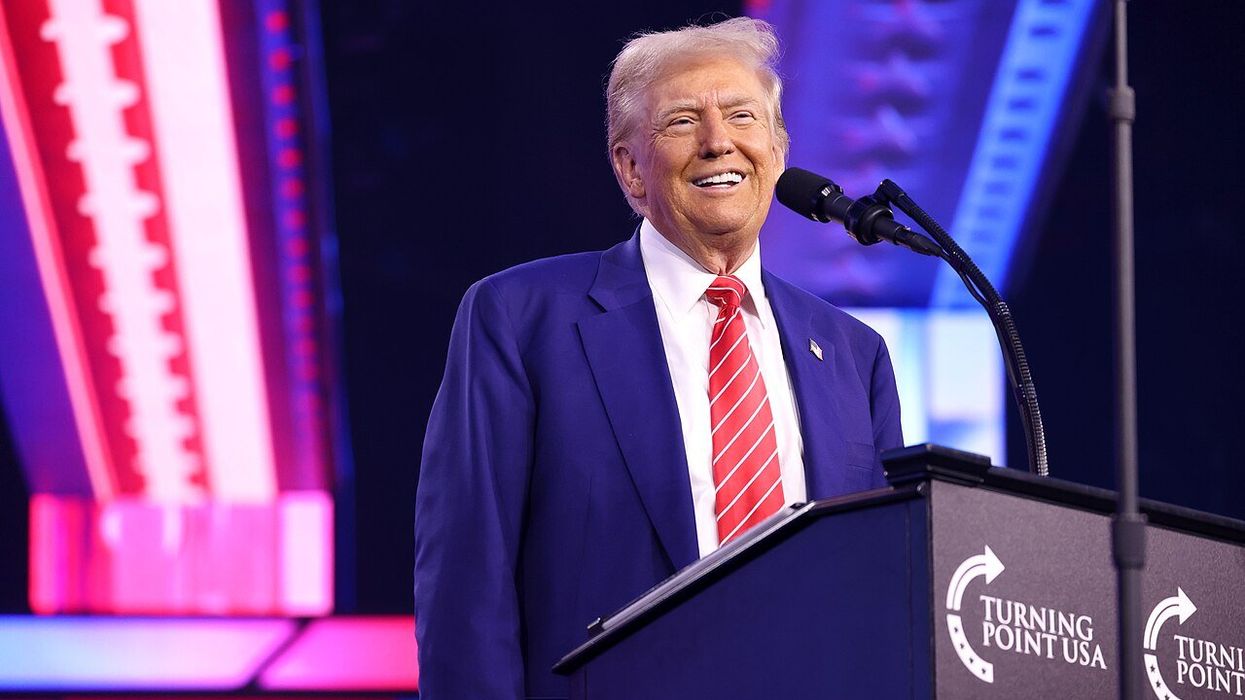
TRUMPVILLE
Trump says wants to declare national emergency, use military at Mexico border
By AFP
January 20, 2025

Donald Trump repeatedly criticized the number of people crossing the US-Mexico border during his presidential campaign - Copyright AFP/File ERNESTO BENAVIDES
Donald Trump will issue a raft of executive orders aimed at reshaping how the United States deals with citizenship and immigration, he said on Monday minutes after his inauguration.
The 47th president will set to work almost immediately with a series of presidential decrees intended to drastically reduce the number of migrants entering the country.
“First, I will declare a national emergency at our southern border,” Trump said.
“All illegal entry will immediately be halted, and we will begin the process of returning millions and millions of criminal aliens back to the places from which they came.
“I will send troops to the southern border to repel the disastrous invasion of our country,” he said.
Trump, who campaigned on a platform of clamping down on migration and whose policies are popular with people who fret over changing demographics, also intends to put an end to the centuries-old practice of granting citizenship automatically to anyone born in the United States.
“We’re going to end asylum,” White House deputy press secretary Anna Kelly told reporters, and create “an immediate removal process without possibility of asylum. We are then going to end birthright citizenship.”
The notion of birthright citizenship is enshrined in the US Constitution, which grants anyone born on US soil the right to an American passport.
Kelly said the actions Trump takes would “clarify” the 14th Amendment — the clause that addresses birthright citizenship.
“Federal government will not recognize automatic birthright citizenship for children of illegal aliens born in the United States,” she said.
Kelly said the administration would also reinstate the “Remain in Mexico” policy that prevailed under the last Trump administration.
Under that rule, people who apply to enter the United States at the Mexican border were not allowed to enter the country until their application had been decided.
“We’re going to… reinstate Remain in Mexico and build the wall,” she said.
Kelly said Trump would also seek to use the death penalty against non-citizens who commit capital crimes, such as murder.
“This is about national security. This is about public safety, and this is about the victims of some of the most violent, abusive criminals we’ve seen enter our country in our lifetime, and it ends today,” she said.
– Court challenges –
Many of Trump’s executive actions taken during his first term were rescinded under Joe Biden, including one using so-called Title 42, which was implemented during the Covid-19 pandemic preventing almost all entry to the country on public health grounds.
The changes under Biden led to an influx of people crossing into the United States, and images of thousands of people packing the border area.
Trump and his allies characterized this as Biden’s “open border” policy, and spoke regularly of an “invasion.”
The incoming president frequently invoked dark imagery about how illegal migration was “poisoning the blood” of the nation, words that were seized upon by opponents as reminiscent of Nazi Germany.
While US presidents enjoy a range of powers, they are not unlimited.
Analysts say any effort to alter birthright citizenship will be fraught.
Aaron Reichlin-Melnick, a Senior Fellow American Immigration Council, said the 14th Amendment was “crystal clear” in granting citizenship to anyone born in the United States, with the exception of children of foreign diplomats.
“We have had birthright citizenship for centuries, and a president cannot take it away with an executive order,” he told AFP.
“We expect rapid court challenges.”
Reichlin-Malik said all sides of the immigration debate recognized that the laws needed reform, but presidential orders were unlikely to achieve lasting change.
“Instituting new travel bans will make the US legal immigration system even more complex and expensive and difficult to navigate than ever,” he said.
“Our immigration system is badly out of date, and executive actions aiming to restrict it even further will harm the United States.”
By AFP
January 20, 2025
Donald Trump repeatedly criticized the number of people crossing the US-Mexico border during his presidential campaign - Copyright AFP/File ERNESTO BENAVIDES
Donald Trump will issue a raft of executive orders aimed at reshaping how the United States deals with citizenship and immigration, he said on Monday minutes after his inauguration.
The 47th president will set to work almost immediately with a series of presidential decrees intended to drastically reduce the number of migrants entering the country.
“First, I will declare a national emergency at our southern border,” Trump said.
“All illegal entry will immediately be halted, and we will begin the process of returning millions and millions of criminal aliens back to the places from which they came.
“I will send troops to the southern border to repel the disastrous invasion of our country,” he said.
Trump, who campaigned on a platform of clamping down on migration and whose policies are popular with people who fret over changing demographics, also intends to put an end to the centuries-old practice of granting citizenship automatically to anyone born in the United States.
“We’re going to end asylum,” White House deputy press secretary Anna Kelly told reporters, and create “an immediate removal process without possibility of asylum. We are then going to end birthright citizenship.”
The notion of birthright citizenship is enshrined in the US Constitution, which grants anyone born on US soil the right to an American passport.
Kelly said the actions Trump takes would “clarify” the 14th Amendment — the clause that addresses birthright citizenship.
“Federal government will not recognize automatic birthright citizenship for children of illegal aliens born in the United States,” she said.
Kelly said the administration would also reinstate the “Remain in Mexico” policy that prevailed under the last Trump administration.
Under that rule, people who apply to enter the United States at the Mexican border were not allowed to enter the country until their application had been decided.
“We’re going to… reinstate Remain in Mexico and build the wall,” she said.
Kelly said Trump would also seek to use the death penalty against non-citizens who commit capital crimes, such as murder.
“This is about national security. This is about public safety, and this is about the victims of some of the most violent, abusive criminals we’ve seen enter our country in our lifetime, and it ends today,” she said.
– Court challenges –
Many of Trump’s executive actions taken during his first term were rescinded under Joe Biden, including one using so-called Title 42, which was implemented during the Covid-19 pandemic preventing almost all entry to the country on public health grounds.
The changes under Biden led to an influx of people crossing into the United States, and images of thousands of people packing the border area.
Trump and his allies characterized this as Biden’s “open border” policy, and spoke regularly of an “invasion.”
The incoming president frequently invoked dark imagery about how illegal migration was “poisoning the blood” of the nation, words that were seized upon by opponents as reminiscent of Nazi Germany.
While US presidents enjoy a range of powers, they are not unlimited.
Analysts say any effort to alter birthright citizenship will be fraught.
Aaron Reichlin-Melnick, a Senior Fellow American Immigration Council, said the 14th Amendment was “crystal clear” in granting citizenship to anyone born in the United States, with the exception of children of foreign diplomats.
“We have had birthright citizenship for centuries, and a president cannot take it away with an executive order,” he told AFP.
“We expect rapid court challenges.”
Reichlin-Malik said all sides of the immigration debate recognized that the laws needed reform, but presidential orders were unlikely to achieve lasting change.
“Instituting new travel bans will make the US legal immigration system even more complex and expensive and difficult to navigate than ever,” he said.
“Our immigration system is badly out of date, and executive actions aiming to restrict it even further will harm the United States.”
Emergency Powers Are About to Be Tested
Elizabeth Goitein
Sat 18 January 2025

The nation is bracing itself for what President-Elect Donald Trump has promised will be the largest deportation effort in American history. Trump has vowed to use the military to assist with deportations, relying on emergency and wartime powers such as the Insurrection Act, the National Emergencies Act, and the Alien Enemies Act. In addition to worrying about the impact on immigrant families, wider communities, and the economy, many Americans are wondering—is this legal?
The deportation of undocumented individuals who are ineligible for asylum or other legal protection is, of course, well within the government’s authority under current immigration law. (As a policy matter, President Joe Biden has chosen to focus on those who have committed serious crimes—a policy that Trump is set to undo, presumably to facilitate broader deportation efforts.) But deploying the military raises an entirely different set of legal questions. Even under the potent authorities Trump has cited, the actions he proposes to take would be, at a minimum, an abuse of power, and they might well be illegal to boot.
Some degree of military involvement in immigration enforcement is already permitted—and has occurred under multiple administrations—without recourse to emergency powers. This may be surprising to many Americans. Anglo-American law has a long tradition of military noninterference in civilian affairs, for the simple reason that an army turned inward can quickly become an instrument of tyranny. In the United States, this tradition finds expression in an 1878 statute, the Posse Comitatus Act, that prohibits federal armed forces from participating in law-enforcement activities unless expressly authorized by law. Although not every American is familiar with the act, the principle it enshrines is deeply embedded in the public consciousness.
Less well known is the fact that the Posse Comitatus Act is riddled with exceptions and loopholes. For one thing, courts have construed the law to bar only direct participation in core law-enforcement activities, such as arrests or seizures. Federal forces may still provide indirect support to law-enforcement agencies in a number of ways, including conducting reconnaissance, sharing intelligence, and furnishing and operating equipment. In the 1980s, Congress passed several laws authorizing active-duty armed forces to provide these types of assistance.
In addition, the act applies only to federal armed forces. It does not apply to the National Guard—military units within the states that usually operate under state authority—unless the president has called Guard forces into federal service, at which point they become part of the federal military. Congress has passed a law authorizing Guard forces to perform federal missions at the request of the president or secretary of defense even when they haven’t been called into federal service. (Governors have the right to refuse such missions.) The Posse Comitatus Act does not apply to these operations, because the Guard forces remain, at least nominally, under state command and control.
These gaps in the act’s coverage have enabled military involvement in the enforcement of immigration and customs laws at the U.S.-Mexico border for decades, beginning in the 1980s and ramping up after 9/11. Presidents George W. Bush, Barack Obama, and Trump sent thousands of National Guard forces to the border, where they provided support to the Department of Homeland Security in the form of surveillance, transportation, equipment, and the erection of barriers. Trump also deployed active-duty armed forces, as did President Biden. In the summer of 2023, 2,500 National Guard forces and 1,500 active-duty armed forces were stationed at the border.
The seemingly permanent militarization of the U.S.-Mexico border may not violate the Posse Comitatus Act, but it has led to a variety of harms. When thousands of soldiers are routinely arrayed at the border, Americans receive the message that migrants are a threat to national security and public safety—a baseless notion that underlies and fuels support for Trump’s anti-immigration platform. Prolonged deployments at the border are also bad for the military, as they undermine service members’ morale and divert resources and personnel from core military functions.
Trump now reportedly seeks to double down on the militarization of immigration enforcement by invoking a trio of emergency authorities, beginning with the Insurrection Act of 1807—the primary statutory exception to the Posse Comitatus Act. The Insurrection Act gives the president broad powers to deploy federal armed forces (including the federalized National Guard) to quell civil unrest or enforce the law. The criteria for deployment are written in vague, archaic terms that provide few clear constraints. To make matters worse, the Supreme Court held in 1827 that the president is the sole judge of whether the criteria for deployment have been met. In other words, courts generally cannot review a president’s decision to invoke the law.
ADVERTISEMENT
Although a top aide has said that Trump will invoke the Insurrection Act, the Trump team has provided scant detail on how he plans to use federal forces once deployed. Given that nonemergency authorities already authorize substantial military support to civilian law enforcement, it’s conceivable that Trump’s purpose in invoking the Insurrection Act is purely symbolic—a performative act of “shock and awe.” (The very name of the law suggests that immigrants are attacking from within and must be defeated through force.) At least in theory, though, the law could allow federal forces to perform core law-enforcement functions, such as apprehending and detaining immigrants, in any state in the country and against any governor’s wishes.
Such a use of the Insurrection Act would go beyond a mere expansion of existing military activities. Soldiers rolling into American towns in armored vehicles, knocking on doors, and carting people off to military detention facilities would create risks and harms that current border operations do not. For one thing, direct interactions between military personnel and civilians in fraught circumstances carry a significant potential for violence. After all, soldiers are trained to fight; few receive training in how to peaceably enforce civilian laws while respecting civil liberties. Furthermore, the visible presence of soldiers deployed in the streets would be both alarming and chilling for many Americans. Some would undoubtedly feel less comfortable engaging in protests against Trump’s policies or other basic acts of personal expression.
Heavy involvement of the military in immigration enforcement would also require a massive infusion of resources, both financial and human. That’s where Trump’s plan to declare a national emergency might come in. Under the National Emergencies Act, presidential declarations of national emergency unlock enhanced powers contained in 150 provisions of law spanning almost every area of governance, including military deployment, commerce, transportation, communications, agriculture, and public health. These provisions can supply both additional authority and additional resources for presidential action in a crisis.
Trump has used these powers before. In 2019, Trump declared that unlawful migration at the southern border constituted a national emergency. He invoked an emergency power that frees up funding for “military construction” projects, which he used to secure funds Congress had refused to allocate for the border wall. He might well reprise this effort, and he could attempt to use the same provision to fund the construction of military bases that would serve as immigrant-detention facilities. He could also use emergency powers to call up reservists, amplifying the manpower available to detain and deport immigrants. Indeed, Biden did exactly that in 2023 to supplement forces at the southern border.
Finally, Trump has pledged to invoke the Alien Enemies Act—the last remaining vestige of the notorious 1798 Alien and Sedition Acts. A president may invoke this law when Congress has declared war or when the president proclaims an “invasion” by a foreign government. It allows the president to detain and deport immigrants, including green-card holders and others lawfully in the country, who are not U.S. citizens and who were born in the enemy nation. Immigrants targeted under the act are not entitled to the hearings and other procedural protections afforded by immigration law.
The act was last used in World War II to implement the internment of more than 31,000 noncitizens of Japanese, German, and Italian descent. (U.S. citizens of Japanese descent were detained under a separate authority.) Congress and the U.S. government have since apologized for much of this shameful episode in our nation’s history.
According to reporting in Rolling Stone, Trump may claim that migration from Mexico and other countries south of the border constitutes an “invasion” perpetrated by drug cartels that are operating as de facto governments in those regions. The Alien Enemies Act does not itself authorize military deployment, but it could be combined with the Insurrection Act and other authorities to significantly expand the military’s remit. Most notably, if Trump were successful in invoking these laws, they could allow troops to detain and deport not just undocumented individuals but people who are lawfully present in the United States.
There is no question that the authorities Trump has cited grant the president sweeping powers. The Brennan Center, where I work, has called attention to the dangers posed by each of them. My colleagues and I have urged Congress to reform the laws in order to incorporate safeguards against presidential overreach (or, in the case of the Alien Enemies Act, to repeal it).
But there is also no question that Trump’s proposed actions, as he and his allies have framed them, would be a staggering abuse of these authorities—and quite possibly illegal. Despite the permissive language of the Insurrection Act, it was clearly intended for crises that could not be solved by civilian government actors. That is why it has been invoked only 30 times in the nation’s history and has lain dormant for the past 33 years. In keeping with tradition and constitutional principles, the Justice Department has interpreted the law narrowly, asserting that it should be used only as a “last resort”—specifically, when state and local authorities request military assistance, are obstructing federal law, or have “completely broken down.”
There are many ways to address unlawful immigration short of deploying federal troops. Last spring, for instance, the Senate voted twice on a bipartisan bill that would have dramatically tightened border security. Republicans blocked the measure—reportedly at Trump’s behest, so that he could continue to make the porous border a central focus of his campaign. Having actively obstructed an effort to ramp up civilian enforcement of immigration laws, Trump can hardly argue that military deployment is a “last resort.”
His cynical behavior could open the door to a legal challenge. Although the Supreme Court has generally barred judicial review of Insurrection Act invocations, it has suggested on various occasions that there might be an exception for deployments undertaken in bad faith. That’s because all of the president’s actions, even those committed to his discretion under Article II of the Constitution, must be consistent with the express constitutional obligation to faithfully execute the law.
In addition, the Supreme Court has distinguished between a president’s decision to invoke the Insurrection Act (which is usually not subject to judicial review) and any actions taken by the military after deployment (which are squarely within the courts’ purview). Soldiers deployed under the act must comply with the Constitution and other applicable federal law. If people’s legal rights were violated under a Trump-ordered deployment—for instance, if military detention conditions failed to meet basic human needs—courts would be able to intervene.
Just as invoking the Insurrection Act would be inconsistent with the law’s intent, declaring a national emergency would be a misuse of emergency powers. To be sure, America’s broken immigration system has led to unprecedented numbers of unlawful border crossings. Emergency powers, however, are designed to address sudden, unexpected crises that can’t be handled by Congress through ordinary legislation. There is nothing sudden or unexpected about the problems at the southern border, and Congress can—and should—address those problems through reform of the immigration system.
As a legal matter, courts will be reluctant to second-guess Trump’s decision to declare an emergency. But they will be less deferential in reviewing whether his administration’s actions are authorized under the specific powers he invokes. Although Trump has not identified which powers he plans to use, none of the 150 provisions available during a national emergency is designed to facilitate deportation. Trump will likely be stretching some of these laws beyond their permissible limits. (During his first administration, some courts struck down his use of the military-construction authority to build the border wall.) Courts will also review whether the actions Trump takes pursuant to a national-emergency declaration comport with other federal laws and constitutional rights.
Perhaps the most glaring abuse would be invoking the Alien Enemies Act. The history and design of the law make clear that it is a wartime authority only. It was intended to address armed attacks by foreign nations, not people fleeing political persecution, drug- and gang-related violence, or economic hardship. Even if a significant portion of migrants were criminals—a myth contradicted by all available evidence—that would not render their border crossing an act of war.
Moreover, whether in wartime or peacetime, the Alien Enemies Act suffers from grave constitutional flaws. It permits the targeting of individuals based solely on their ancestry, rather than their conduct, and it allows those individuals to be detained and deported without a hearing. As a recent Brennan Center report argues, these powers are fundamentally inconsistent with modern understandings of constitutional equal-rights and due-process protections.
Whether the Supreme Court would uphold the actions Trump has threatened is impossible to say with any certainty. In recent years, the Supreme Court has occasionally taken positions previously thought inconceivable, and overturned numerous long-standing precedents. But regardless of how the Supreme Court may rule, these actions should rightly be understood as an abuse of power, an abuse of the public trust, and an abuse of the law. And as soon as there is an opportunity, Congress must reform the emergency authorities in question so that no president can ever commit such abuses in the future.
In addition, the act applies only to federal armed forces. It does not apply to the National Guard—military units within the states that usually operate under state authority—unless the president has called Guard forces into federal service, at which point they become part of the federal military. Congress has passed a law authorizing Guard forces to perform federal missions at the request of the president or secretary of defense even when they haven’t been called into federal service. (Governors have the right to refuse such missions.) The Posse Comitatus Act does not apply to these operations, because the Guard forces remain, at least nominally, under state command and control.
These gaps in the act’s coverage have enabled military involvement in the enforcement of immigration and customs laws at the U.S.-Mexico border for decades, beginning in the 1980s and ramping up after 9/11. Presidents George W. Bush, Barack Obama, and Trump sent thousands of National Guard forces to the border, where they provided support to the Department of Homeland Security in the form of surveillance, transportation, equipment, and the erection of barriers. Trump also deployed active-duty armed forces, as did President Biden. In the summer of 2023, 2,500 National Guard forces and 1,500 active-duty armed forces were stationed at the border.
The seemingly permanent militarization of the U.S.-Mexico border may not violate the Posse Comitatus Act, but it has led to a variety of harms. When thousands of soldiers are routinely arrayed at the border, Americans receive the message that migrants are a threat to national security and public safety—a baseless notion that underlies and fuels support for Trump’s anti-immigration platform. Prolonged deployments at the border are also bad for the military, as they undermine service members’ morale and divert resources and personnel from core military functions.
Trump now reportedly seeks to double down on the militarization of immigration enforcement by invoking a trio of emergency authorities, beginning with the Insurrection Act of 1807—the primary statutory exception to the Posse Comitatus Act. The Insurrection Act gives the president broad powers to deploy federal armed forces (including the federalized National Guard) to quell civil unrest or enforce the law. The criteria for deployment are written in vague, archaic terms that provide few clear constraints. To make matters worse, the Supreme Court held in 1827 that the president is the sole judge of whether the criteria for deployment have been met. In other words, courts generally cannot review a president’s decision to invoke the law.
ADVERTISEMENT
Although a top aide has said that Trump will invoke the Insurrection Act, the Trump team has provided scant detail on how he plans to use federal forces once deployed. Given that nonemergency authorities already authorize substantial military support to civilian law enforcement, it’s conceivable that Trump’s purpose in invoking the Insurrection Act is purely symbolic—a performative act of “shock and awe.” (The very name of the law suggests that immigrants are attacking from within and must be defeated through force.) At least in theory, though, the law could allow federal forces to perform core law-enforcement functions, such as apprehending and detaining immigrants, in any state in the country and against any governor’s wishes.
Such a use of the Insurrection Act would go beyond a mere expansion of existing military activities. Soldiers rolling into American towns in armored vehicles, knocking on doors, and carting people off to military detention facilities would create risks and harms that current border operations do not. For one thing, direct interactions between military personnel and civilians in fraught circumstances carry a significant potential for violence. After all, soldiers are trained to fight; few receive training in how to peaceably enforce civilian laws while respecting civil liberties. Furthermore, the visible presence of soldiers deployed in the streets would be both alarming and chilling for many Americans. Some would undoubtedly feel less comfortable engaging in protests against Trump’s policies or other basic acts of personal expression.
Heavy involvement of the military in immigration enforcement would also require a massive infusion of resources, both financial and human. That’s where Trump’s plan to declare a national emergency might come in. Under the National Emergencies Act, presidential declarations of national emergency unlock enhanced powers contained in 150 provisions of law spanning almost every area of governance, including military deployment, commerce, transportation, communications, agriculture, and public health. These provisions can supply both additional authority and additional resources for presidential action in a crisis.
Trump has used these powers before. In 2019, Trump declared that unlawful migration at the southern border constituted a national emergency. He invoked an emergency power that frees up funding for “military construction” projects, which he used to secure funds Congress had refused to allocate for the border wall. He might well reprise this effort, and he could attempt to use the same provision to fund the construction of military bases that would serve as immigrant-detention facilities. He could also use emergency powers to call up reservists, amplifying the manpower available to detain and deport immigrants. Indeed, Biden did exactly that in 2023 to supplement forces at the southern border.
Finally, Trump has pledged to invoke the Alien Enemies Act—the last remaining vestige of the notorious 1798 Alien and Sedition Acts. A president may invoke this law when Congress has declared war or when the president proclaims an “invasion” by a foreign government. It allows the president to detain and deport immigrants, including green-card holders and others lawfully in the country, who are not U.S. citizens and who were born in the enemy nation. Immigrants targeted under the act are not entitled to the hearings and other procedural protections afforded by immigration law.
The act was last used in World War II to implement the internment of more than 31,000 noncitizens of Japanese, German, and Italian descent. (U.S. citizens of Japanese descent were detained under a separate authority.) Congress and the U.S. government have since apologized for much of this shameful episode in our nation’s history.
According to reporting in Rolling Stone, Trump may claim that migration from Mexico and other countries south of the border constitutes an “invasion” perpetrated by drug cartels that are operating as de facto governments in those regions. The Alien Enemies Act does not itself authorize military deployment, but it could be combined with the Insurrection Act and other authorities to significantly expand the military’s remit. Most notably, if Trump were successful in invoking these laws, they could allow troops to detain and deport not just undocumented individuals but people who are lawfully present in the United States.
There is no question that the authorities Trump has cited grant the president sweeping powers. The Brennan Center, where I work, has called attention to the dangers posed by each of them. My colleagues and I have urged Congress to reform the laws in order to incorporate safeguards against presidential overreach (or, in the case of the Alien Enemies Act, to repeal it).
But there is also no question that Trump’s proposed actions, as he and his allies have framed them, would be a staggering abuse of these authorities—and quite possibly illegal. Despite the permissive language of the Insurrection Act, it was clearly intended for crises that could not be solved by civilian government actors. That is why it has been invoked only 30 times in the nation’s history and has lain dormant for the past 33 years. In keeping with tradition and constitutional principles, the Justice Department has interpreted the law narrowly, asserting that it should be used only as a “last resort”—specifically, when state and local authorities request military assistance, are obstructing federal law, or have “completely broken down.”
There are many ways to address unlawful immigration short of deploying federal troops. Last spring, for instance, the Senate voted twice on a bipartisan bill that would have dramatically tightened border security. Republicans blocked the measure—reportedly at Trump’s behest, so that he could continue to make the porous border a central focus of his campaign. Having actively obstructed an effort to ramp up civilian enforcement of immigration laws, Trump can hardly argue that military deployment is a “last resort.”
His cynical behavior could open the door to a legal challenge. Although the Supreme Court has generally barred judicial review of Insurrection Act invocations, it has suggested on various occasions that there might be an exception for deployments undertaken in bad faith. That’s because all of the president’s actions, even those committed to his discretion under Article II of the Constitution, must be consistent with the express constitutional obligation to faithfully execute the law.
In addition, the Supreme Court has distinguished between a president’s decision to invoke the Insurrection Act (which is usually not subject to judicial review) and any actions taken by the military after deployment (which are squarely within the courts’ purview). Soldiers deployed under the act must comply with the Constitution and other applicable federal law. If people’s legal rights were violated under a Trump-ordered deployment—for instance, if military detention conditions failed to meet basic human needs—courts would be able to intervene.
Just as invoking the Insurrection Act would be inconsistent with the law’s intent, declaring a national emergency would be a misuse of emergency powers. To be sure, America’s broken immigration system has led to unprecedented numbers of unlawful border crossings. Emergency powers, however, are designed to address sudden, unexpected crises that can’t be handled by Congress through ordinary legislation. There is nothing sudden or unexpected about the problems at the southern border, and Congress can—and should—address those problems through reform of the immigration system.
As a legal matter, courts will be reluctant to second-guess Trump’s decision to declare an emergency. But they will be less deferential in reviewing whether his administration’s actions are authorized under the specific powers he invokes. Although Trump has not identified which powers he plans to use, none of the 150 provisions available during a national emergency is designed to facilitate deportation. Trump will likely be stretching some of these laws beyond their permissible limits. (During his first administration, some courts struck down his use of the military-construction authority to build the border wall.) Courts will also review whether the actions Trump takes pursuant to a national-emergency declaration comport with other federal laws and constitutional rights.
Perhaps the most glaring abuse would be invoking the Alien Enemies Act. The history and design of the law make clear that it is a wartime authority only. It was intended to address armed attacks by foreign nations, not people fleeing political persecution, drug- and gang-related violence, or economic hardship. Even if a significant portion of migrants were criminals—a myth contradicted by all available evidence—that would not render their border crossing an act of war.
Moreover, whether in wartime or peacetime, the Alien Enemies Act suffers from grave constitutional flaws. It permits the targeting of individuals based solely on their ancestry, rather than their conduct, and it allows those individuals to be detained and deported without a hearing. As a recent Brennan Center report argues, these powers are fundamentally inconsistent with modern understandings of constitutional equal-rights and due-process protections.
Whether the Supreme Court would uphold the actions Trump has threatened is impossible to say with any certainty. In recent years, the Supreme Court has occasionally taken positions previously thought inconceivable, and overturned numerous long-standing precedents. But regardless of how the Supreme Court may rule, these actions should rightly be understood as an abuse of power, an abuse of the public trust, and an abuse of the law. And as soon as there is an opportunity, Congress must reform the emergency authorities in question so that no president can ever commit such abuses in the future.
Antoine BOYER and Aurélia END
Sun 19 January 2025

US President-elect Donald Trump and his wife Melania at a candlelight dinner at the National Building Museum in Washington, DC, on the eve of his inauguration
(Jim WATSON) (Jim WATSON/AFP/AFP)
A sweeping deportation program, "drill, baby, drill," and peace for Ukraine: President-elect Donald Trump has vowed to move big and fast when he returns to the White House on Monday.
Here is a look at his sensational but frequently vague promises for a second term -- much of them likely to be enacted through executive orders.
- Immigration -
Trump has promised a hardline stance against an estimated 11 million undocumented migrants in the United States.
According to The Wall Street Journal, the Republican billionaire will declare a state of emergency on the border with Mexico, which would unlock additional Department of Defense funding and assets.
He also vowed on the campaign trail to end birthright citizenship, calling it "ridiculous."
Analysts also expect him to issue executive orders on other aspects of immigration policy, including possibly to terminate an app used by migrants hoping to petition for asylum.
However, birthright citizenship is guaranteed by the US Constitution, and any deportation program will face legal challenges as well as potential refusals by some countries to accept deportees.
- Trade wars -
Trump has vowed to slap a 25 percent tariff on goods imported from Mexico and Canada -- top US trading partners -- as punishment for what he says is their failure to stem the flow of drugs and undocumented migrants into the United States.
But is Trump really ready to unleash a trade war with US neighbors, rupturing a North American free trade agreement? Some see this -- and an even more provocative suggestion that Canada should be absorbed into the United States -- as pre-negotiation bluster.
Beijing should also buckle up.
Trump has threatened to impose a 10 percent tariff on Chinese products, adding to existing tariffs that date back to his first term. Trump accuses China of failing to crack down on the production of chemical components used to make fentanyl.
- January 6 pardons -
The president-elect has suggested he might pardon some or all of the people involved in the January 6, 2021 riot at the US Capitol, when his supporters tried to overthrow the 2020 election in which he lost to Democrat Joe Biden.
Trump has described them as "hostages" and "political prisoners."
He told a pre-inauguration rally that his supporters would be "very happy" with the decision he plans to make on the matter on his first day in office.
More than 1,500 people have been charged with federal crimes in the deadly assault, and more than 1,100 of them have been sentenced.
- Wars and diplomacy -
Trump warned that "all hell will break out in the Middle East" if Hamas does not release Israeli hostages before his inauguration -- and promptly took credit when a ceasefire and hostage release deal negotiated by the Biden Administration was announced Wednesday.
Trump also says he intends to quickly end Russia's war against Ukraine, though it is unclear when or how he plans to do that.
After promising over the summer to end the nearly three-year conflict "in 24 hours," Trump more recently suggested a timeline of several months.
- Climate -
Climate skeptic Trump has promised to "drill, baby, drill" for oil and gas.
He plans to repeal some of Biden's key climate policies, such as tax credits for electric vehicles, which are meant to encourage a transition to a green economy.
Trump also wants to boost offshore drilling, though he might need to secure congressional support to do that. Biden has selected swaths of ocean as protected no-drill areas.
- Transgender rights and race -
"With the stroke of my pen on day one, we're going to stop the transgender lunacy," Trump said in December, vowing to "end child sexual mutilation, get transgender out of the military and out of our elementary schools and middle schools and high schools."
He added the US government would recognize only two genders, male and female.
Also among his plans is cutting federal funding to schools that have adopted "critical race theory," an approach that looks at US history through the lens of racism.
- TikTok lifeline -
Trump has vowed to save the popular Chinese video-sharing app TikTok from a law banning it on national security grounds.
TikTok briefly shut down in the United States as a deadline loomed for its Chinese owners ByteDance to sell its US subsidiary to non-Chinese buyers.
However, it went back online after Trump, who has credited the app with connecting him to younger voters, promised to issue an executive order delaying the ban to allow time to "make a deal."
He said on his Truth Social platform that he "would like the United States to have a 50% ownership position in a joint venture."
abo-ft/bjt/tc/fox
A sweeping deportation program, "drill, baby, drill," and peace for Ukraine: President-elect Donald Trump has vowed to move big and fast when he returns to the White House on Monday.
Here is a look at his sensational but frequently vague promises for a second term -- much of them likely to be enacted through executive orders.
- Immigration -
Trump has promised a hardline stance against an estimated 11 million undocumented migrants in the United States.
According to The Wall Street Journal, the Republican billionaire will declare a state of emergency on the border with Mexico, which would unlock additional Department of Defense funding and assets.
He also vowed on the campaign trail to end birthright citizenship, calling it "ridiculous."
Analysts also expect him to issue executive orders on other aspects of immigration policy, including possibly to terminate an app used by migrants hoping to petition for asylum.
However, birthright citizenship is guaranteed by the US Constitution, and any deportation program will face legal challenges as well as potential refusals by some countries to accept deportees.
- Trade wars -
Trump has vowed to slap a 25 percent tariff on goods imported from Mexico and Canada -- top US trading partners -- as punishment for what he says is their failure to stem the flow of drugs and undocumented migrants into the United States.
But is Trump really ready to unleash a trade war with US neighbors, rupturing a North American free trade agreement? Some see this -- and an even more provocative suggestion that Canada should be absorbed into the United States -- as pre-negotiation bluster.
Beijing should also buckle up.
Trump has threatened to impose a 10 percent tariff on Chinese products, adding to existing tariffs that date back to his first term. Trump accuses China of failing to crack down on the production of chemical components used to make fentanyl.
- January 6 pardons -
The president-elect has suggested he might pardon some or all of the people involved in the January 6, 2021 riot at the US Capitol, when his supporters tried to overthrow the 2020 election in which he lost to Democrat Joe Biden.
Trump has described them as "hostages" and "political prisoners."
He told a pre-inauguration rally that his supporters would be "very happy" with the decision he plans to make on the matter on his first day in office.
More than 1,500 people have been charged with federal crimes in the deadly assault, and more than 1,100 of them have been sentenced.
- Wars and diplomacy -
Trump warned that "all hell will break out in the Middle East" if Hamas does not release Israeli hostages before his inauguration -- and promptly took credit when a ceasefire and hostage release deal negotiated by the Biden Administration was announced Wednesday.
Trump also says he intends to quickly end Russia's war against Ukraine, though it is unclear when or how he plans to do that.
After promising over the summer to end the nearly three-year conflict "in 24 hours," Trump more recently suggested a timeline of several months.
- Climate -
Climate skeptic Trump has promised to "drill, baby, drill" for oil and gas.
He plans to repeal some of Biden's key climate policies, such as tax credits for electric vehicles, which are meant to encourage a transition to a green economy.
Trump also wants to boost offshore drilling, though he might need to secure congressional support to do that. Biden has selected swaths of ocean as protected no-drill areas.
- Transgender rights and race -
"With the stroke of my pen on day one, we're going to stop the transgender lunacy," Trump said in December, vowing to "end child sexual mutilation, get transgender out of the military and out of our elementary schools and middle schools and high schools."
He added the US government would recognize only two genders, male and female.
Also among his plans is cutting federal funding to schools that have adopted "critical race theory," an approach that looks at US history through the lens of racism.
- TikTok lifeline -
Trump has vowed to save the popular Chinese video-sharing app TikTok from a law banning it on national security grounds.
TikTok briefly shut down in the United States as a deadline loomed for its Chinese owners ByteDance to sell its US subsidiary to non-Chinese buyers.
However, it went back online after Trump, who has credited the app with connecting him to younger voters, promised to issue an executive order delaying the ban to allow time to "make a deal."
He said on his Truth Social platform that he "would like the United States to have a 50% ownership position in a joint venture."
abo-ft/bjt/tc/fox
As Trump returns to office, what he's promised to do on Day 1
MEREDITH DELISO
Sun 19 January 2025

President-elect Donald Trump is on the cusp of returning to the White House, with his inauguration ceremony on Monday.
During his third campaign for the presidency, he laid out what he would do on his first day back in office, even referring to himself as a "dictator" but only on "Day 1."
"We're closing the border and we're drilling, drilling, drilling," he said during a 2023 town hall in Iowa with Fox News host Sean Hannity. "After that, I'm not a dictator."
One task on his apparent to-do list has already become irrelevant. Trump vowed to fire Jack Smith, the special counsel who brought two federal cases against him, "within two seconds" of returning to the White House. Though Smith resigned as special counsel on Jan. 10 after submitting his final report on the probes into allegations of interfering with the 2020 election and unlawfully retaining classified documents after leaving the White House.
Here's what else Trump has said he would do on Day 1:

PHOTO: President-elect Donald Trump speaks to members of the media during a press conference at the Mar-a-Lago Club, Jan. 7, 2025, in Palm Beach, Florida. (Scott Olson/Getty Images)
Mass deportations and closing the border
With immigration a top issue for voters, Trump has said he's determined to round up and deport millions of migrants living in the U.S. without legal permission.
"On Day 1, I will launch the largest deportation program in American history to get the criminals out," he said during a rally at Madison Square Garden in the closing days of the presidential race. "I will rescue every city and town that has been invaded and conquered, and we will put these vicious and bloodthirsty criminals in jail, then kick them the hell out of our country as fast as possible."
Incoming "border czar" Tom Homan has promised to execute "the biggest deportation operation this country has ever seen."
To do so, Trump has indicated he will seek help from the U.S. military by declaring a national emergency.
Trump has also vowed to close the southern border on his first day in office.
"We're going to close the border. Day 1, the border gets closed," he said during the 2023 town hall with Hannity.
Stephen Miller, Trump's deputy chief of staff of policy, told Fox News following the election that the president-elect would immediately sign executive orders regarding mass deportations and a border closure.
"It is going to be at light speed," Miller said. "The moment that President Trump puts his hand on that Bible and takes the oath of office, as he has said, the occupation ends, liberation day begins. He will immediately sign executive orders sealing the border shut, beginning the largest deportation operation in American history."
Trump has railed against the Biden administration's immigration policies, in part claiming they have made America less safe, though statistics show that U.S.-born citizens are more than twice as likely to be arrested for violent crimes than undocumented immigrants, according to a 2020 Justice Department study cited in the Proceedings of the National Academy of Sciences.
There are an estimated 11 million unauthorized migrants living in the U.S. without legal immigration status. Removing them could cost billions of dollars per year, according to estimates from the American Immigration Council.
End birthright citizenship
Among other immigration policies, Trump has pledged to sign an executive order on the first day of his new term to end birthright citizenship.
In a 2023 campaign video, Trump said that under the new executive order, at least one parent will have to be a "citizen or a legal resident" for their children to qualify for birthright citizenship.
Such a move, though, is expected to face significant legal hurdles. Under the 14th Amendment to the United States Constitution, any person born within the territory of the U.S. is a U.S. citizen.
Free some convicted Jan. 6 rioters
Trump has said one of his first acts if elected to a second term would be to "free" some people convicted for their roles in the Jan. 6 attack on the U.S. Capitol, whom he continues to claim are "wrongfully imprisoned."
"I am inclined to pardon many of them. I can't say for every single one, because a couple of them, probably they got out of control," he said on his social media platform last March when announcing the promise.
Trump has repeatedly downplayed the violence that ensued that day, referring to the defendants as "J6 hostages," calling for their release.
As of early January, more than 1,580 individuals have been charged criminally in federal court in connection with Jan. 6, with over 1,000 pleading guilty, according to the Department of Justice.

PHOTO: A general view shows the West Front of the U.S. Capitol building as preparations are underway for the upcoming presidential inauguration of U.S. President-elect Donald Trump, in Washington, Jan. 15, 2025. (Fabrizio Bensch/Reuters)
Tariffs on Canada and Mexico
Trump posted on his Truth Social platform following the election that one of the first executive orders he will sign when he takes office will be to charge Mexico and Canada with a 25% tariff on all products coming into the United States.
"This Tariff will remain in effect until such time as Drugs, in particular Fentanyl, and all Illegal Aliens stop this Invasion of our Country!" he posted. "Both Mexico and Canada have the absolute right and power to easily solve this long simmering problem. We hereby demand that they use this power, and until such time that they do, it is time for them to pay a very big price!"
In response, Mexico's president, Claudia Sheinbaum, warned that any tariff will be met with another and disputed his claims about migration and drugs while blaming the U.S. for Mexico's drug war -- pointing to U.S. consumption and American guns.
Canadian officials said the country "places the highest priority on border security and the integrity of our shared border."
End the Russia-Ukraine war 'within 24 hours'
Trump claimed during a 2023 CNN town hall that if he were president, he could end the war between Russia and Ukraine in 24 hours. Though he did not detail what he wanted an end to look like, dodging on whether he wanted Ukraine or Russia to win.
Asked during an ABC News debate in September if he wants Ukraine to win against Russia, Trump did not directly answer but said that he wants the war to stop.
"I'll get the war with Ukraine and Russia ended. If I'm president-elect, I'll get it done before even becoming president," he said.
Though more recently, retired Lt. Gen. Keith Kellogg, Trump's pick to serve as the special envoy to Ukraine and Russia, said on Fox News this month that he'd personally like to see the war end within 100 days.
MORE: After charm offensive, Ukraine braces for Trump's return
End 'Green New Deal atrocities'
Trump said in a campaign video last year he would end the "Green New Deal atrocities on Day 1" if reelected.
The Green New Deal -- a public policy initiative to address climate change pitched by Democrats Rep. Alexandria Ocasio-Cortez and Sen. Ed Markey -- was never signed into law, though Trump has used the term to generally refer to the Biden administration's climate and energy policies, like the landmark Inflation Reduction Act.
"To further defeat inflation, my plan will terminate the Green New Deal, which I call the Green New Scam. Greatest scam in history, probably," Trump said during remarks at the Economic Club of New York in September. "[We will] rescind all unspent funds under the misnamed Inflation Reduction Act."
Trump also said during his Republican National Convention address that he will "end the electric vehicle mandate on Day 1." There is no such federal mandate, though recent Environmental Protection Agency regulations are aimed to accelerate the adoption of cleaner vehicle technologies.
Green cards for college graduates
Trump deviated from his usual anti-immigrant rhetoric when he advocated for "automatically" giving noncitizens in the U.S. green cards when they graduate from college -- not just people who go through the vetting process -- during an episode of the "All In" podcast released in June.
"[What] I want to do, and what I will do, is you graduate from a college, I think you should get, automatically as part of your diploma, a green card to be able to stay in this country. That includes junior colleges, too," Trump said in the episode.
"Anybody graduates from a college, you go in there for two years or four years, if you graduate, or you get a doctorate degree from a college, you should be able to stay in this country," he continued.
Asked on the podcast if he would expand H-1B work visas for tech workers after fixing the border, Trump said "yes."
"Somebody graduates at the top of the class, they can't even make a deal with the company because they don't think they're going to be able to stay in the country. That is going to end on Day 1," Trump said.
Elon Musk and Vivek Ramaswamy, the leaders of Trump's new Department of Government Efficiency, have also voiced their support for H-1B visas, which allow foreign skilled professionals to work in America, saying they are essential because American culture doesn't prioritize success in science and engineering careers compared to other countries.
Some of Trump's far-right supporters have pushed back against support for the visas, arguing they are a way for business leaders to have cheap labor rather than provide job opportunities for Americans.
Reinstate ban on transgender military service
Trump has vowed to reinstate a ban on transgender military service enacted during his first term in 2017, which President Joe Biden repealed in 2021, among other measures that would impact trans people.
"With the stroke of my pen, on day one, we're going to stop the transgender lunacy," Trump said at a Turning Point USA rally in December. "And I will sign executive orders to end child sexual mutilation, get transgender out of the military and out of our elementary schools and middle schools and high school. And we will keep men out of women's sports."
"And that will likewise be done on Day 1," he continued.
Estimates on the number of active transgender service members vary. In 2021, the Department of Defense said there were approximately 2,200 people in the military services who were diagnosed with gender dysphoria and seeking medical care, while noting that was a subset of the transgender population.
If a ban on transgender service members were to be reinstated, the Human Rights Campaign said it "will take swift action to push back against this dangerous and discriminatory ban."
As Trump returns to office, what he's promised to do on Day 1 originally appeared on abcnews.go.com
Trump promises to disrupt immigration. These charts show how that could shake up the US economy.
Adriana Belmonte
·Senior Distribution Editor
Sun 19 January 2025
During the 2024 presidential campaign, Donald Trump said he would carry out "the largest deportation in the history of our country." Prior to Monday's inauguration, the New York Times reported that Immigration and Customs Enforcement plans to conduct immigration raids in the days after Trump takes office again.
Deportation at scale could have significant effects on the US economy and labor market.
"A very direct impact of the policies of Trump is: How is that really going to affect the labor markets?" Dany Bahar, a senior fellow at the Center for Global Development, told Yahoo Finance. "Because a lot of the people are coming to actually fill a lot of the positions that are open. And whether we like the term ‘illegal immigration’ or not, if these people are actually filling jobs that are needed for the US economy, that is good for the US economy.”
As of 2023, according to estimates by the nonpartisan Economic Policy Institute (EPI), foreign-born labor accounted for record-high 18.6% of the US workforce. That same year, according to EPI, the US labor force grew by 12.6% — a number that drops to just 0.5% when removing immigrants.
Currently, the US has about 8.1 million job openings and roughly 7 million unemployed Americans.
As Trump begins a second term, here's a detailed look at the relationship between immigration and the US economy.
'The US doesn’t have a border crisis — it has a labor market crisis'
Immigrants to the US include naturalized citizens, lawful permanent residents, temporary lawful residents, and undocumented immigrants. There were 47.8 million immigrants in the US as of 2023, roughly half of which were naturalized citizens and an estimated 11 million of which were undocumented.
People moving to America have varying degrees of education: While advanced degrees are represented at a higher rate among immigrants than native-born citizens in the US, there is also a higher percentage of immigrants without a high school degree.
The latter aspect is why many end up in jobs that American citizens see as "less desirable."
"We have always taken the jobs that nobody else wanted, to be very honest,” Ramiro Cavazos, president and CEO for the US Hispanic Chamber of Commerce, told Yahoo Finance. “Right now, no one in this nation is raising their child to be a person that works in the fields or to be a farm worker or to be someone that is doing landscaping work. We have high-tech all the way to low-tech jobs in this country where immigrants are filling those positions, whether they’re documented or not.”
Most undocumented immigrants in the US come through ports of entry, such as airports and shipping locations, or are people who overstayed expired tourism or work visas.
This was especially evident during the COVID pandemic when the job market saw a record number of openings while migrant crossings surged at the southwest border.
In June 2024, President Biden issued an executive order suspending entry for migrants who crossed the border illegally. The order can be discontinued if fewer than an average of 1,500 people per day cross the border in a week but go back into effect if it reaches a specific threshold.
“To understand the impact of the policies that are ultimately going to try to enforce what’s happening at the border and going even one step further and trying to deport people, it’s important to understand the diagnosis of what the problem is,” Bahar said. “The border is a symptom of something, and my research shows that it’s a symptom of something very specific that the US is going through now, which is a very odd labor market. Essentially, what I’m trying to say is the US doesn’t have a border crisis — it has a labor market crisis.”
Research by Bahar found a significant correlation between the strength of the US labor market and the number of migrants trying to enter the US at the southwest border from 2000 to 2023. Essentially, migration goes up when the labor market is strong and down when it weakens.
Bahar noted that during the Biden administration years of 2022 and 2023, over 12 million people crossed the border while something else significant was also happening in the US economy: “The labor markets were as hot as they’ve ever been for at least 25 years.”
If that flow is stopped, Bahar continued, "then your immediate effects are that you’re going to be deepening the problem of labor shortages, which were very lively during COVID. If you remember walking anywhere in this country, everywhere you would see on the street in every single store or establishment was a ‘help wanted’ sign. So that, to me, is the main channel through which migration, or the Trump policies on immigration, will impact the economy."
The magnitude of H-1B
Undocumented immigrants aren't the only ones at risk under Trump's immigration policies. Highly educated immigrants also face some uncertainty in the new Trump administration.
During his 2016 campaign, Trump described the H-1B visa program — which grants highly skilled immigrants the authority to work legally in the US — as "very bad for workers" and called for an end to the program.
Recently, however, he appeared to support his adviser and Tesla CEO Elon Musk's stance on expanding the program. (The South African-born Musk, who became a US citizen in 2002, previously held a H-1B visa and relies on the program for employees at companies he oversees.)
Elon Musk speaks with US President-elect Donald Trump at a viewing of the launch of the sixth test flight of the SpaceX Starship rocket in Brownsville, Texas, on Nov. 19, 2024 Brandon Bell/Pool via REUTERS/File Photo
“I’ve always liked the visas, I have always been in favor of the visas — that’s why we have them," Trump told the New York Post. “I have many H-1B visas on my properties. I’ve been a believer in H-1B. I have used it many times. It’s a great program."
The cap on new H-1B visas issued per year — 65,000 plus an additional 20,000 for foreign professionals with a master's degree — has remained unchanged since 2006, even as immigration numbers have skyrocketed. In 2023, the number of H-1B applications hit a new high at more than 780,000.
Morgan Bailey, attorney at the law firm Mayer Brown and a former senior official at the Department of Homeland Security, explained to Yahoo Finance that the system is "very controlled in terms of the number of employment-based cases that can be approved each year. And there could be more flexibility in terms of the types of workers that the United States wants to attract, as well as those numbers being able to be increased or decreased depending upon the needs of the country."
Tech companies typically account for most H-1B visa holders, though this may be due to the sheer number of applicants in the specific field.
“It’s basically a lottery, so it doesn’t have any consideration really in terms of the occupation that the individual is working in,” Bailey added, “whereas there could be some aspects of changing that system so that there’s a priority for STEM fields, medical fields, whatever the country feels like there’s a priority for at the moment — and that it wouldn’t be stagnant in terms of every year being that same group that has the priority, but maybe changing that depending upon what the needs are at a given time.”
In any case, there is high demand for H-1B visas within American companies driving global innovation.
Between 2022 and 2024, some of the largest companies in the US — including Apple (AAPL), Microsoft (MSFT), Amazon (AMZN), Tesla (TSLA), Meta (META), and Google (GOOG) — sponsored a relatively high number of approved H-1B visas.
In 2024, 46% of all Fortune 500 companies — including all 10 of the most valuable public companies in the US — were either founded by immigrants or the children of immigrants or employed an immigrant CEO.
'We're going to have to do something with them'
The legal status of roughly 530,000 DACA recipients, otherwise known as "Dreamers," has become a case study when it comes to Trump's immigration policies.
President Barack Obama put the DACA — Deferred Action for Childhood Arrivals — immigration policy into place in 2012. DACA shields undocumented individuals who were brought into the country as children from deportation while allowing them to obtain work authorization (and subsequently pay income taxes).
On his first day in office in 2017, Trump ended the program. A federal judge ruled to keep the program in place in 2018 — but a different judge ruled against the program in 2023, deeming it "unlawful" but keeping protections in place for current recipients. The matter is still being litigated and is expected to make its way to the Supreme Court.
There have been some political developments in recent years as well. In a December 2024 "Meet the Press" interview, Trump appeared to soften his stance on creating a pathway to citizenship.
"The Dreamers, we’re talking many years ago they were brought into this country," Trump said. "Many years ago. Some of them are no longer young people. And in many cases, they’ve become successful. They have great jobs. In some cases, they have small businesses. Some cases, they might have large businesses. And we’re going to have to do something with them. ... I think we can work with the Democrats and work something out.
Data from FWD.us, a bipartisan organization that advocates for immigration reform, found that DACA recipients contribute roughly $11.7 billion to the US economy each year. This includes roughly $566.9 million in mortgage payments, $2.3 billion in rental payments, and $3.1 billion in state and local taxes on an annual basis, according to the Center for American Progress.
In a way, the case of the Dreamers shows how immigration fuels the growing US economy — and how immigration policies can affect those dynamics.
“The bottom line is this: The workforce needs of this nation, they keep growing with the economy that we have, which is booming,” Cavazos said. “25% of the global economy is the US economy. We have about 60% of the Fortune 500 global companies located here. We need to make sure that we don’t become another Germany, another Japan — great economies but basically stagnant economies because they don’t have a strong immigration program.”
—
FOR CHARTS AND GRAPHS GO HERE
Adriana Belmonte is a reporter and editor covering politics and healthcare policy for Yahoo Finance. You can follow her on X @adrianambells and reach her at adriana@yahoofinance.com.
Adriana Belmonte is a reporter and editor covering politics and healthcare policy for Yahoo Finance. You can follow her on X @adrianambells and reach her at adriana@yahoofinance.com.