Thursday, May 29, 2025

Pan’s Labyrinth and the Horror of Flesh Eating


May 29, 2025

Still from Pan’s Labyrinth.

I’ve been meaning to watch Pan’s Labyrinth, Guillermo del Toro’s dark fairy tale set in fascist Spain, since the film was released to critical acclaim in 2006. I finally got around to the winner of three Academy Awards, which more than met my expectations. It‘s deservedly called a masterpiece. As an animal activist, I found a sequence which employs flesh eating as a source of horror to be particularly interesting.

Ivana Baquero stars as a young girl named Ofelia, in 1944, living with her sick, pregnant mother and a domineering stepfather, who, as a captain in the Civil Guard, hunts down resisters to Francisco Franco’s authoritarian regime. In the midst of this grim setting, Ofelia discovers the titular labyrinth, an ancient structure which leads to a magical place, perhaps more terrifying than the war-torn world she knows.

Del Toro, who, in addition to directing, also wrote the movie’s screenplay, envisioned the magical realm as real, however, he deliberately left this element up to viewers’ interpretation. Unaware of the filmmaker’s comments on the matter, in my initial watch, I leaned toward understanding the fantastical storyline as imagined, a product of Ofelia’s fears about her mother, stepfather and country.

In this magical realm, real or imagined, the scariest creature might be the Pale Man, a humanoid being with eyes in the palms of his hands. Doug Jones plays the role with the help of various practical and digital effects. Del Toro apparently wanted the creature to look like an old, obese man who had since starved — hence the stretched, loose skin we see hanging off the monster’s body in the final film.

What makes the creature most unnerving, though, is his taste for human flesh, specifically that of children. In terms of ways of dying, being eaten seems to be one which especially scares us, as humans. It seems unnatural, like a violation of the order of things. Perhaps we can only understand or acknowledge the violence of consuming another when we’re those under threat of being consumed.

When Ofelia enters the Pale Man’s lair, she notices gruesome paintings of the creature eating a number of children, as well as piles of shoes, presumably from prior victims, which can’t help but evoke the Holocaust. Despite being warned not to take anything from the monster’s table, the young girl gives into temptation, and eats two grapes from the lavish feast laid out before the Pale Man.

This awakens the creature, who pursues Ofelia as she scrambles for the exit. She barely makes it out of his lair alive. Two of her fairy guides, however, are not so lucky. The Pale Man bites off their heads in a disturbing moment inspired by Saturn Devouring His Son, a famous painting from the 1820s by Francisco Goya. The scene manages to capture some of the depravity inherent to flesh-eating.

Again, Pan’s Labyrinth is a great film, which provides a unique mix of historical drama and richly-detailed fantasy. The design of creatures like the Pale Man is impressive, but the movie also deftly explores weighty subjects, like the complicity of religion with right-wing totalitarianism. I’m somewhat embarrassed by the nearly two decades it took me to see the film, but better late than never, right?

Jon Hochschartner is the author of a number of books about animal-rights history, including The Animals’ Freedom FighterIngrid Newkirk, and Puppy Killer, Leave Town. He blogs at SlaughterFreeAmerica.Substack.com.

Catholics see a familiar political divide in Pope Leo XIV and his eldest brother

(RNS) — Catholic leaders hope the pope’s relationship with his brother will help Catholics in the US learn to better love each other in spite of political differences.


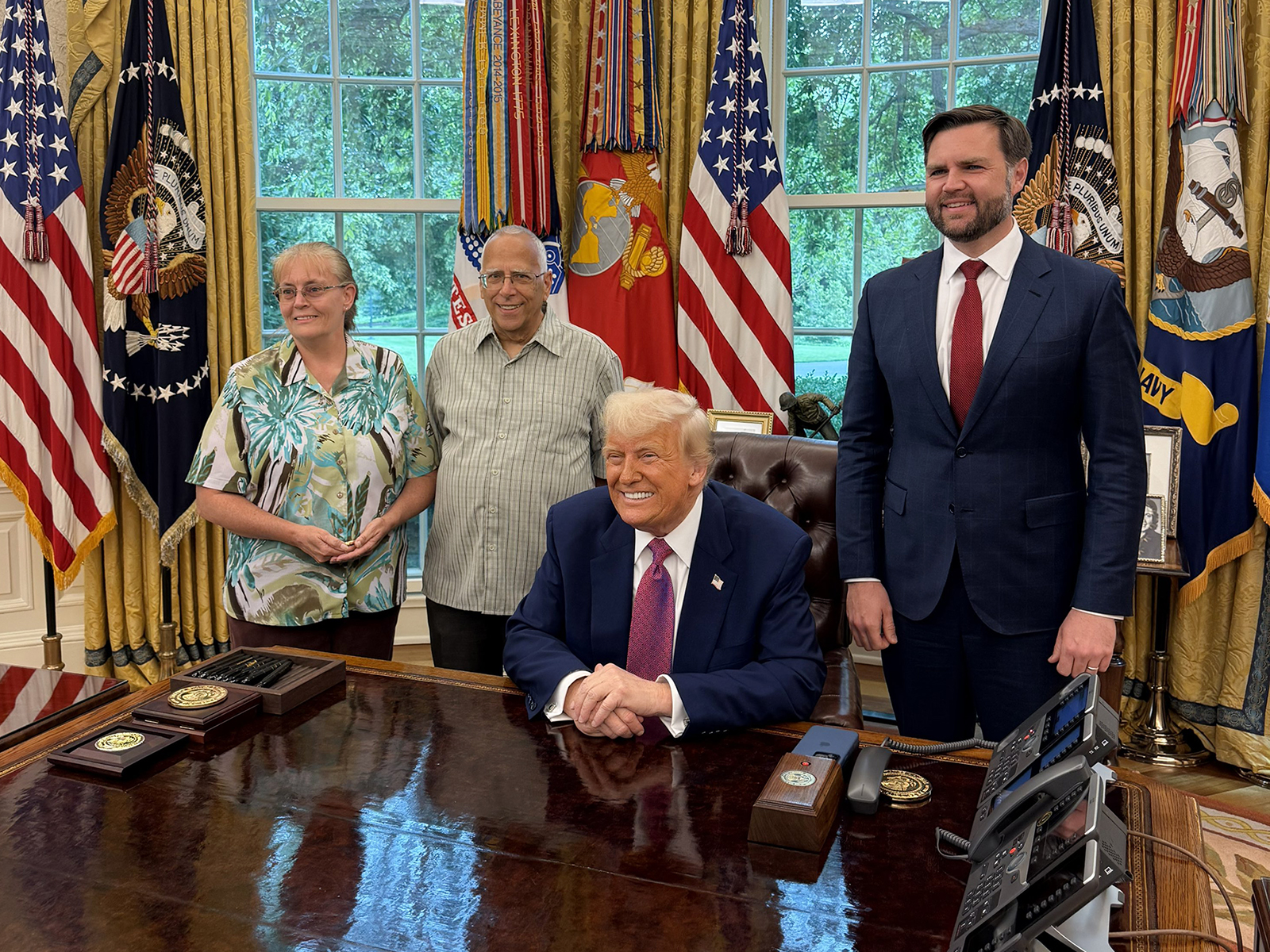
Deborah, left, and Louis Prevost meet President Donald Trump and Vice President JD Vance in the Oval Office of the White House, May 20, 2025.
 (Photo by Margo Martin/White House)

Aleja Hertzler-McCain
May 23, 2025


(RNS) — Just hours after Pope Leo XIV was announced from the loggia, his two brothers began making headlines. John Prevost, the middle brother, took an agonizingly long time to answer Leo’s first papal call, as documented by The Associated Press. Then the eldest brother, Louis Prevost, appeared on Piers Morgan’s show to discuss his incendiary Facebook posts.

And on Wednesday (May 21), Louis Prevost again got social media chattering after Margo Martin, U.S. President Donald Trump’s special assistant and communications adviser, posted a photo of Louis Prevost and his wife meeting with President Trump and Vice President JD Vance.

In the days after Leo’s election, his eldest brother’s past posts supporting Trump got media attention, not only for Louis Prevost’s allegiance to MAGA, but also for content that included slurs and conspiracy theories. And, while neither the pope’s nor his older brother’s social media posts are now publicly accessible, Leo’s social media revealed that in his last posts before becoming pope he reposted sharp criticisms of the Trump administration’s immigration policy.

This glimpse into a potentially divided family has stirred speculation and sympathy from the wider watching world.

“ I do think God gave us a little bit of a gift in just showing us this normal family on the global stage,” said Kathryn Jean Lopez, religion editor at the National Review. “ I don’t care what your politics are. The two brothers humanize (Leo) in ways that you could not script.”

While Catholic experts told RNS that Louis’ connections with Trump are unlikely to make a significant political impact in the church or the government, they expressed hope that the pope’s relationship with his brother may help U.S. Catholics learn to better love each other despite political differences.

Lopez said recent popes have been treated like a “public enemy” or a “savior-like figure” and wondered if his brothers might help Leo escape either portrayal.

RELATED: What we can learn about Leo XIV from his digital footprint

When a young Robert Prevost was becoming ordained to be a priest, his brother Louis was serving in the Navy. The elder Prevost has said he was always more conflict-oriented than his little brother.

Nichole Flores, associate professor of religious studies at the University of Virginia, said that having “profoundly different” siblings is a relatable experience and echoed that Leo’s brothers make him seem “normal.”

But also, said Jason King, director of the Center for Catholic Studies at St. Mary’s University in San Antonio, within the pope’s family, “ you’ve got this division really in the home that we’re facing as a country, lots of other countries are facing, that sometimes the church is facing.”

Vanessa Corcoran, a historian and advising dean at Georgetown University, believes that for Leo, who may be shaping up to release major teaching on artificial intelligence, “ it’s fitting that he is someone that, like many of us, is learning how to build bridges with people whose political opinions, social media presence is different from our own.”

Corcoran highlighted that the focus on the pope’s siblings is “unusual” for the modern papacy because many recent popes have been older than the 69-year-old Leo and have not had many living siblings. They also have not been on social media.


Pope Leo XIV meets members of the international media in the Paul VI Hall at the Vatican, Monday, May 12, 2025. (AP Photo/Andrew Medichini)

Neither are there good historical comparisons for the pope’s siblings meeting heads of state.

The Medici and the Borgia families, prominent during the Italian Renaissance, produced four and two popes, respectively. But those families had “political influence from the larger family really through bankrolling the Vatican,” said Corcoran of the wealthy patrons, famous for supporting artists like Leonardo da Vinci, Michelangelo and Raphael.

“ We’re not seeing financial influence like that,” said Corcoran. “We don’t have these family dynasties that influence papal politics in the same way.”

While Flores said it was possible some conservative Catholics found affirmation in Louis Prevost’s meeting with Trump, and King, of St. Mary’s University, speculated the Trump camp might be using the moment to portray a closeness to the pope, all of the experts dismissed the idea his oldest brother might shape Leo’s relationship with Trump.
RELATED: Pope Leo XIV’s first US bishop appointment is a former refugee

For King, Leo’s relationship with his brother is a good place to watch for the pope’s unity agenda.

“ If the pope is able to find a way to both say that kind of language and that kind of attacks on other humans’ dignity, that’s not allowable, but then find some way to stay in relationship with Louis,” said King, “that would be a constructive sign.”

He’s also hoping Leo will push the U.S. bishops to unify their country’s church and speak against the Trump administration’s divisive attitude toward “ vulnerable human beings.”

Flores, an expert on democracy and theology, said this is a moment where many different camps of Catholics have aspirations for Leo. Some are hoping he will push the U.S. church toward a more robust embrace of social teaching and away from the idea that immigration policy is a question of “prudential judgment.” Others hope he will unify the church around “the dignity of life” and allow Latin liturgies to flourish.

How Leo will meet or disappoint those expectations is yet to be seen, but Flores said she hoped watching Leo interact with his brothers will help the church “ continue to reflect on the broader social significance of families.” The scholar explained, “ Families aren’t socially isolated units that function in the private sphere.”

And Lopez, from the National Review, added, “ We’ve had such a hard time in the United States in recent years when it comes to politics and personal relationships, and I just hope the Prevosts make us be human again and just love one another in the midst of political differences.”
An interfaith group’s 1950s MLK comic book remains a prominent nonviolence teaching tool

(RNS) — ‘You have done a marvelous job of grasping the underlying truth and philosophy of the movement,’ the Rev. Martin Luther King Jr. wrote to the creator of a comic book about civil rights.


Cover and excerpts of “Martin Luther King and the Montgomery Story."
 (Images courtesy Fellowship of Reconciliation)

Adelle M. Banks
May 29, 2025

(RNS) — At cross-cultural gatherings in Bethlehem, West Bank, groups of children and adults turn to a 67-year-old, colorful comic book with the Rev. Martin Luther King Jr.’s image on its cover, his tie and shirt collar visible beneath his clerical robe.

As they read from “Martin Luther King and the Montgomery Story,” the group leader is prepared to discuss questions about achieving peace through nonviolent behavior.

“What are the teachings we have from Martin Luther King?” asks Zoughbi Zoughbi, a Palestinian Christian who is the international president of the Fellowship of Reconciliation and founder of Wi’am: The Palestinian Conflict Transformation Center. “How can we benefit from it, and how do we deal with issues like that in the Palestinian area under the Israeli occupation? How to send a message of love, agape with assertiveness, not aggressive?”

Zoughbi told RNS in a phone interview that the comic book, published in 1958, remains a staple in his work, which includes both English and Arabic versions. (It is available in six languages.) Over the decades, it was used in Arabic in the anti-government Arab Spring uprisings, in English in anti-apartheid activism in South Africa and in Spanish in Latin American ecclesial base communities, or small Catholic groups that meet for social justice activities and Bible study.

It continues to be a teaching tool and an influential historical account in the United States as well. The book was distributed in January at New York’s Riverside Church and has been listed as a curriculum resource for Muslim schools. And it remains a popular item, available online and in print for $2, at the bookstore at Atlanta’s Martin Luther King Jr. Center for Nonviolent Social Change. Store director Patricia Sampson called it “one of our best sellers.”

Copies of “Martin Luther King and the Montgomery Story” are used in teaching at the Palestinian Conflict Transformation Center in Feb. 2025, in Bethlehem, West Bank. (Photo courtesy Zoughbi Zoughbi)

The 16-page book was created by the Fellowship of Reconciliation, a Christian-turned-interfaith anti-war organization. It was written by Alfred Hassler, then FOR-USA’s executive secretary, in collaboration with the comic industry’s Benton Resnik. A gift of $5,000 from the Ford Foundation’s Fund for the Republic, a nonprofit advocating for free speech and religious liberty, helped support it.

“We are a pacifist organization, and we believe deeply in the transformative power of nonviolence,” said Ariel Gold, executive director of FOR-USA, based in Stony Point, New York. “And where this comic really fits into that is that we know that nonviolence is more than a catchphrase, and it’s really something that comes out of a deep philosophy of love and an intensive strategy for political change.”

The comic book bears out that philosophy, in part by telling the story of King’s time in Montgomery, Alabama, where he was chosen to lead the Montgomery Improvement Association as Black riders of the city’s buses strove to no longer have to move to let white people sit down. Their nonviolent actions, catalyzed by Rosa Parks’ refusing to give up her seat in 1955, eventually led to a Supreme Court decision that segregated public busing was unconstitutional.

The comic book ends with a breakdown of “how the Montgomery method works,” with tips for how to foster nonviolence that include “decide what special thing you are going to work on” and “see your enemy as a human being … a child of God.”

Ahead of publishing, Hassler received “adulation and a few corrections” from King, to whom he sent a draft, said Andrew Aydin, who wrote his master’s thesis on the comic book and titled it “The Comic Book that Changed the World.” The name of the comic book’s artist, long unknown, was revealed in 2018 to be Sy Barry, known for his artwork in “The Phantom” comic strip, by the blog comicsbeat.com.


Different translations of “Martin Luther King and the Montgomery Story.” 
(Images courtesy Fellowship of Reconciliation)

In an edition of FOR’s Fellowship magazine, King wrote in a letter about his appreciation for the comic book: “You have done a marvelous job of grasping the underlying truth and philosophy of the movement.”

The book quickly gained traction. The Jan. 1, 1958, edition of Fellowship noted the organization had received advance orders for 75,000 copies from local FOR groups, the National Council of Churches and the NAACP. An ad on its back page noted single copies cost 10 cents, and 5,000 could be ordered for $250.

By 2018, the magazine said some 250,000 copies had been distributed, “especially throughout the Deep South.”

The comic book has led to other series in the same genre that also seek to highlight civil rights efforts, using vivid images that synopsize historical accounts of the 1960s. “March,” a popular graphic novel trilogy (2013-2016), was created by U.S. Rep. John Lewis, along with Aydin, his then-congressional staffer, and artist Nate Powell, about Lewis’ work in the Civil Rights Movement. A follow-up volume, “Run,” was published in 2021.

“It was part of learning the way of peace, the way of love, of nonviolence. Reading the Martin Luther King story, that little comic book, set me on the path that I’m on today,” said Lewis, quoted in the online curriculum guide on FOR’s website.

More recently, a new grant-funded webcomic series, “Bad Catholics, Good Trouble,” was inspired by both the King comic book and “March,” said creator Matthew Cressler. Described as a “series about antiracism and struggles for justice across American Catholic history,” it chronicles the stories of Sister Angelica Schultz, a white Catholic nun who sought to improve housing access for African American residents in Chicago, and retired judge Arthur McFarland, who as a teenager worked to desegregate his Catholic high school in Charleston, South Carolina, and later encouraged the hiring of Black staff at the University of Notre Dame in Indiana.


Exceprts from Chapter 2 of “An Exception to the Rule,” a “Bad Catholics, Good Trouble” webcomic story by Matthew J. Cressler, Jennifer Daubenmier and Judith Daubenmier, illustrated by Marcus Jimenez.
(© Cressler, Daubenmier & Daubenmier)

Cressler said the King comic book’s continued distribution and use in diverse educational settings “make it one of the most significant comics in the history of comics — which is something that might seem wild to say, given how when most people think about comic books, they think of superheroes like Superman or Batman.”

Though different in topic and artistic style, Cressler said, the MLK comic book can be compared to “Maus” by Art Spiegelman and “On Tyranny” by Timothy Snyder — more recent graphic novels about a Jewish Holocaust survivor and threats to democracy, respectively — “as a medium through which to teach, to educate and specifically to politically mobilize.”

Anthony Nicotera, director of advancement for FOR-USA and an assistant professor at Seton Hall University, a Catholic school in South Orange, New Jersey, uses the King comic book in his peace and justice studies classes.

“People are using it in small ways or local ways or maybe even in larger ways,” he said, “and we don’t find out until after it’s happened.”

Gold, a progressive Jew who is the first non-Christian to lead FOR-USA, said future versions are planned beyond the six current languages to further share the message of King, the boycott and nonviolence. She said this year, her organization is aiming to translate it into French and Hebrew, for use in joint Israeli-Palestinian studies and trainings on nonviolence, as well as for Jewish religious schools.

“Especially in this political moment, I think we really need sources of hope, and we need reminders of the work and the strategy and the sacrifice that is required to successfully meet such an intense moment as this,” she said.

RELATED: John Lewis’ co-author talks faith, voting rights and their new graphic novel, ‘Run’
Islam Beyond Phobia

Leqaa Kordia: The forgotten prisoner

(RNS) — Kordia’s case is a warning: Speak out, and we will find you. Protest, and we will lock you away.


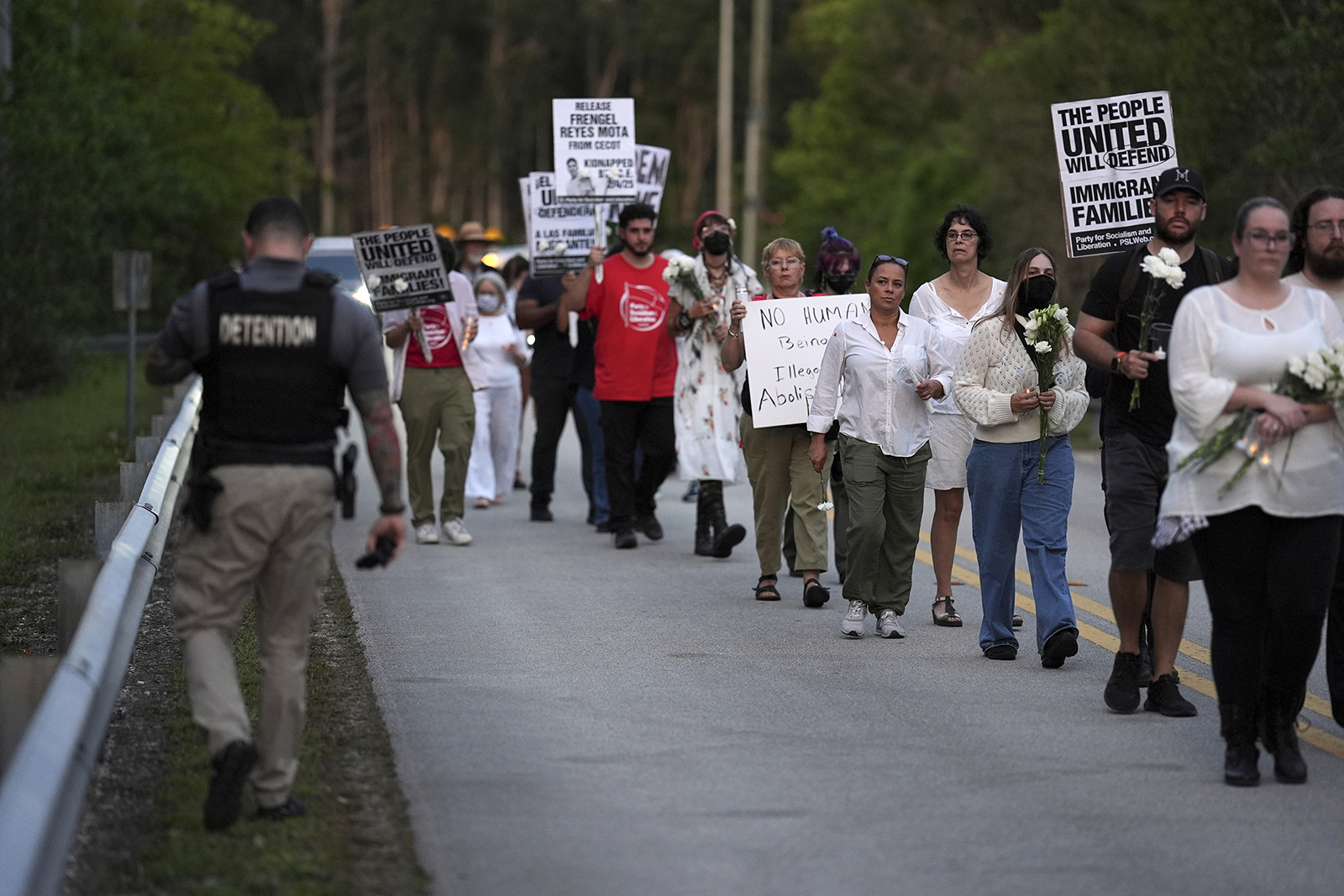
A Krome Detention Center officer patrols, left, as people march during a vigil to recognize those who have died in U.S. Immigration and Customs Enforcement custody as well as those affected by mass deportations, May 24, 2025, outside Krome Detention Center in Miami. (AP Photo/Rebecca Blackwell)
Omar Suleiman
May 28, 2025

(RNS) — I was familiar with the cold, concrete visitation room: The walls were bare, the lighting too bright, the silence unsettling. In the same room I had first met Badar Khan Suri — the Georgetown University professor and father of young children who was one of many swept into ICE detention for daring to speak out against genocide.

Thankfully, Badar was released. The government has shamefully filed an appeal, but for now, he is where he belongs: at home in Virginia, surrounded by his wife and children. I had the blessing of greeting him at the detention center door on the very day he was released. It was May 14, at 1:30 p.m.

RELATED: What we have to learn from students leading the charge for justice

By 2 p.m., I was back in the same visitation room, not to celebrate a release, but to see a forgotten prisoner. No one outside of a handful of attorneys and a few organizers even knows her name.

She is Leqaa Kordia, a young Palestinian who had been taken from her life and thrown into Prairie Land Detention Center in Texas. Someone who had protested the murder of more than 100 of her family members in Gaza and, in response, had been abducted by U.S. Immigration and Customs Enforcement.

I only learned about her when Badar’s legal team mentioned a fellow detainee.

My immediate request to visit her was denied. I tried again for the next day and was denied again. Finally given permission to visit May 14 at 2 p.m., which turned out to be a half hour after Badar was released. That was God’s plan. I got to see Badar step into the sunlight as a free man, and then I walked back into the prison to meet someone still buried in its shadows.

Leqaa told me her story with quiet resolve. She spoke of being held in overcrowded cells for several weeks. Sleeping on concrete. Being denied halal food and basic hijab and clothing accommodations. No respect for modesty when male guards entered the cell. Denied accommodations to fast during Ramadan. Months of this. Alone.


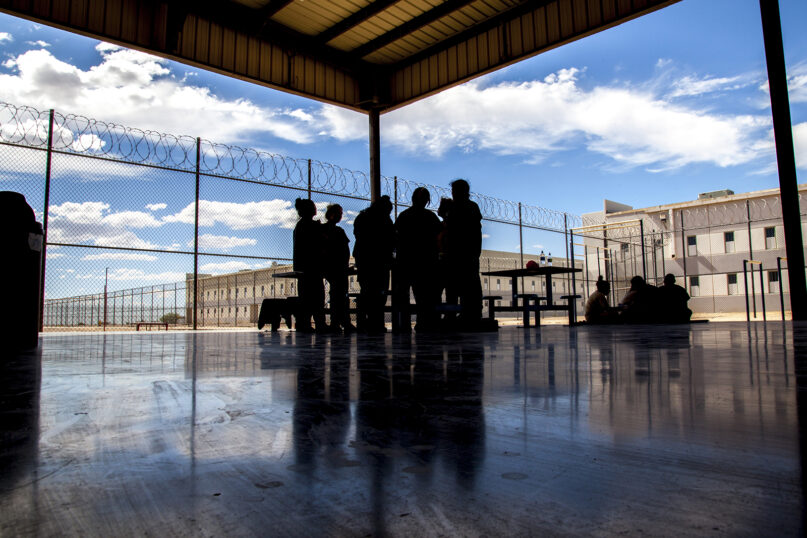
Detainees at U.S. Immigration and Customs Enforcement’s Eloy Detention Facility in Eloy, Ariz. (Photo by Charles Reed/U.S. Immigration and Customs Enforcement)

And what had she done? She raised her voice for Gaza, among hundreds of other students at Columbia University, and made herself vulnerable by letting a student visa lapse, an offense that would never have resulted in detention halfway across the country from her home.

Little media coverage. No photograph. No protest. Just a name, slowly fading in an indifferent system. An immigration judge granted her bond in early April. To further punish Leqaa, the government invoked a rarely used provision, as it has done for a few other students recently, to automatically prevent her release while it appealed that decision.

After meeting Leqaa, I traveled to Paterson, New Jersey, to meet her mother. Leqaa’s absence hangs like a fog in that home. There is no closure in this house. Just waiting. Just grief.

On May 22, I joined a protest at a detention center in Jena, Louisiana, to demand the release of Mahmoud Khalil — the best known of those currently detained in this crackdown on students and others who have spoken out in defense of Palestinians. Mahmoud has become a symbol of resistance and dignity, but as he himself has reminded us, others share his fate, whose names are not in headlines.

Leqaa is one of them. And she must not be forgotten. Next week, on June 5, a court in Dallas will hear her request to be released. That day will mark exactly 11 weeks since Leqaa has been separated from her family, friends and community.

In this moment of global helplessness as Gaza is erased before our eyes, we ask ourselves what we can do. We donate. We pray. We weep. But we must also fight for those who have raised their voices for Gaza and are now paying the price.

There is no policy justification for what is being done. This is punishment, plain and simple. It is a warning: Speak out, and we will find you. Protest, and we will lock you away.

It is our moral duty to prove that we are not so easily silenced. That those who fight for the oppressed will never be abandoned.

So let us not just raise her name. Leqaa Kordia. Let us also make sure she knows she is not forgotten, and that her mother does not wait in vain.

Let us remind this country that we are watching — and that our prayers and our protests are louder than their prisons.
90 days after judge's order, Trump administration has failed to restart refugee program

(RNS) — Faith groups say thousands remain locked in limbo as the administration drags its feet.


Afghan refugees hold placards during a meeting to discuss their situation after President Donald Trump paused U.S. refugee programs, in Islamabad, Jan. 24, 2025. 
(AP Photo/Anjum Naveed)

Jack Jenkins
May 29, 2025


(RNS) — In late February, U.S. District Judge Jamal Whitehead ordered the Trump administration to resume accepting refugees cleared under the federal refugee admissions program, which President Donald Trump froze by executive order on the first day of his second term.

In a lengthy ruling siding with the plaintiffs, which included a trio of faith-based groups that help resettle refugees, the judge spelled out his reasons for granting a preliminary injunction, arguing “the record shows concrete and severe harms to the individual and organizational plaintiffs flowing directly from” the administration’s decision to freeze the program.

“These harms are mostly irreversible and warrant immediate intervention to stop more harm from befalling Plaintiffs,” Whitehead added.

Three months later, the administration has not begun to admit the estimated 128,000 refugees already approved to enter the U.S., roughly 12,000 of whom had travel plans booked before Jan. 20, when Trump issued his order.

The faith groups involved in the case say the harm to refugees has only worsened. The refugees — many who fled religious persecution, brutal war and relentless violence around the globe — remain locked in limbo, the groups say, some in refugee camps where they wait to hear whether they will again be approved to enter America.

“As if they haven’t been through enough already,” said Mark Hetfield, head of HIAS, a Jewish agency that resettles refugees and one of the religious organizations suing the Trump administration. Hetfield said the ongoing pause of the program, which he called “cruel,” has been “completely devastating” for the refugees he serves.


Mark Hetfield discusses the U.S. Refugee Admissions Program during a panel at the Religion News Association conference, April 3, 2025, in Arlington, Va. (RNS photo/Kit Doyle)

The faith groups say the administration has claimed in court it cannot resettle refugees, but the groups point out that 59 white Afrikaners from South Africa, who had not previously been approved, were fast-tracked to refugee status in mere months and resettled in May.

After Whitehead’s initial ruling, attorneys for the Trump administration quickly filed an appeal and abruptly terminated agreements with faith-based refugee resettlement agencies that had joined the suit, which the plaintiffs called a “blatant violation” of the court’s order.

“The government has certainly been using delay tactics thus far, and the district court has been having none of it,” said Mevlüde Akay Alp, part of the litigation team with the International Refugee Assistance Project. The group is working with plaintiffs in the case, such as HIAS, Church World Service and Lutheran Community Services Northwest.

She was seconded by Hetfield, who accused the government of “clearly trying to do everything they can to delay the implementation or to narrow the implementation of this.”

Last week, the 9th U.S. Circuit Court of Appeals ruled that Whitehead’s initial injunction applies to individuals who had travel booked on or before Jan. 20 and who had “special reliance interests” in coming to the United States. Whitehead has appointed a special neutral master to adjudicate which refugees meet that description.


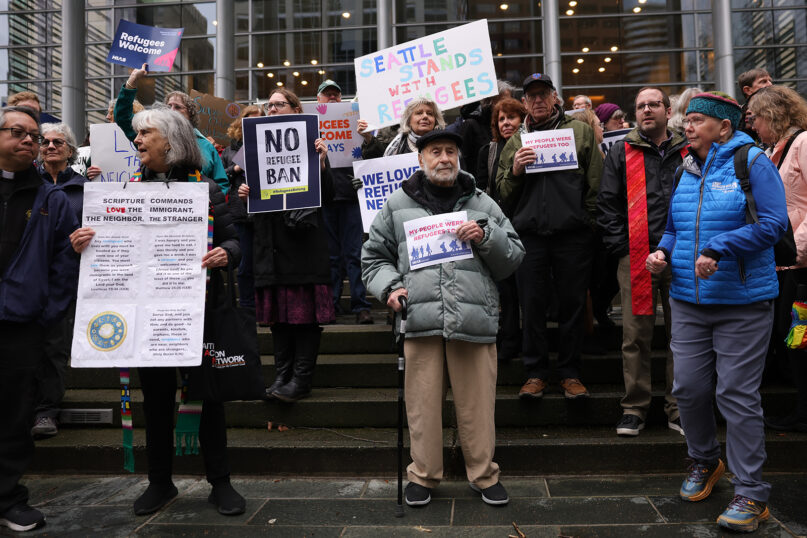
Martin Bernstein, 95, at center, whose parents were refugees, holds a sign as people gather outside the U.S. District Court after a federal judge blocked President Donald Trump’s effort to halt the nation’s refugee admissions system, Feb. 25, 2025, in Seattle. (AP Photo/Ryan Sun)

In response to questions, the White House referred Religion News Service to the Department of Homeland Security, which sent a statement made by Assistant Secretary Tricia McLaughlin in a CNN interview, claiming the administration has “granted asylum to 8,666 individuals since January 20, regardless of color or creed.”

McLaughlin’s statement appears to conflate two different forms of immigration: asylum-seekers, who have already come to the U.S. and are processed through a separate system, and refugees, who apply from abroad and submit to substantial vetting before being allowed into the U.S.

A representative for the U.S. State Department did not reply to questions about the case.

Akay Alp said the government has suggested it cannot restart the program because of severe cuts at the resettlement agencies, which were forced to lay off staff and radically reduce their operations when the government abruptly halted their services and in at least one case refused to pay for work performed before Trump assumed office.

“One of the things that the government is saying is that the U.S. refugee admissions program infrastructure has been destroyed by the suspension of funding to the organizations that carry out this work, and that’s one of the reasons why they didn’t move to admit refugees more quickly after the Court issued its injunction,” Akay Alp said. “Of course, that’s entirely a problem of the government’s own making.”

Hetfield said, however, that his agency still had the capacity to receive refugees. “If they continue to starve the system and to tear it, rip it to shreds, we will not have that capacity — but as of right now, we still do.”

In April, the U.S. Conference of Catholic Bishops announced it would end its refugee resettlement work because of the administration’s instransigence. Earlier this month, Episcopal Migration Ministries did the same, citing moral concerns with resettling the South Africans ahead of other approved refugees.

Republicans who have championed the cause of refugees in the past, including Sen. James Lankford and former Sen. Marco Rubio, who is now secretary of state, have done little to draw attention to the case. But Hetfield also expressed frustration that Democrats who have rallied against the Trump administration’s wrongful deportation of Kilmar Abrego Garcia to El Salvador have paid less attention to the plight of refugees.

“It’s amazing how individuals who have been wrongfully removed from this country have been getting a lot of attention, but here we’re talking about 128,000 people, all of whom have faced life-threatening situations and been put in a position of being rescued and resettled by the United States government, and then had that offer taken away from them,” Hetfield said.

Last week at a hearing of the Senate Committee on Foreign Relations, Sen. Tim Kaine, a Virginia Democrat, brought up the freezing of the program while noting the administration’s recent decision to admit 59 Afrikaners from South Africa, asking Rubio, “Do you think Afrikaner farmers are the most persecuted group in the world?”

Rubio responded by insisting Afrikaners face persecution in South Africa and argued the refugee program suffers from a “volume problem” of not being able to admit all persecuted people. He also said the program would “prioritize people coming into the country on the basis of the interests of this country.”

White South Africans demonstrate in support of U.S. President Donald Trump in front of the U.S. Embassy in Pretoria, South Africa, Feb. 15, 2025. 
(AP Photo/Jerome Delay, File)

The response was an about-face for Rubio, who was one of 18 senators from both parties who sent a letter in 2019 to officials in Trump’s first administration speaking out against rumored plans to zero out refugee admissions.

“At a time when we are facing the ‘highest levels of displacement on record,’ according to the United Nations Refugee Agency, we urge you to increase the refugee resettlement cap and to admit as many refugees as possible within that cap,” read the letter, which was spearheaded by Lankford and Chris Coons, a Delaware Democrat, and signed by Sen. John Thune, a South Dakota Republican who is now Senate majority leader.

None of the Republican senators responded to requests for comment on the refugee program’s status. Coons’ office responded in a statement, noting Americans’ “marrow deep” support for accepting refugees and saying that freezing the program “does nothing to make us safer or reduce costs; it’s cruelty for cruelty’s sake, and Senator Coons will continue doing all he can to end it.”

Several groups filed amicus briefs in support of the plaintiffs this week, including attorneys general from 20 states as well as faith groups such as Lutheran Services Carolinas, Jesuit Refugee Service, JustFaith Ministries, the Council on American-Islamic Relations California and Bet Tzedek Legal Services.

“Despite their differences, the faiths to which amici, their staffs, and their volunteers adhere place service to the stranger — refugees, immigrants, neighbors — at the core of their practices and systems of belief,” read part of a brief filed by a group of religious organizations, which outlined a variety of theological arguments from different faith traditions in support of refugees.

But as the legal battle drags on, Akay Alp said, refugees who cannot enter the country continue to languish. One of the individual plaintiffs in the case, identified as Pacito, who fled Congo when he was 13 years old, refused to believe his flight to the U.S. had been canceled two days before he was supposed to leave, according to the lawyer. Instead, he slept outside the travel booking facility with his wife and infant child, hoping there had been a mistake.

“He literally did not believe, could not believe, that it could be true,” said Akay Alp.

How Bad Does It Have to Get Before the DNC Declares an Emergency?


 May 29, 2025

Photograph Source: G. Edward Johnson – CC BY 4.0

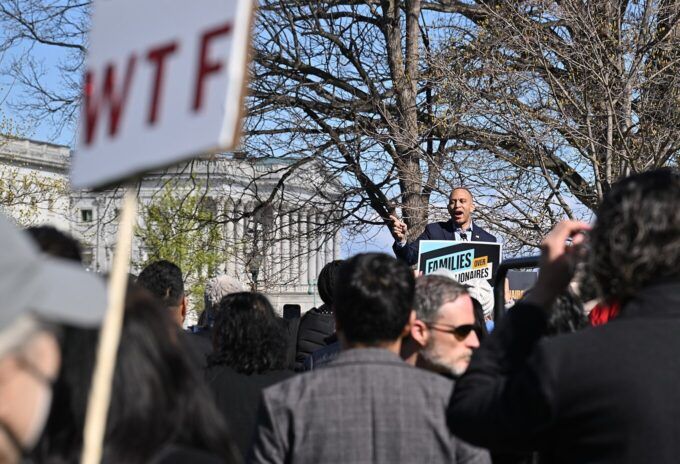
Midway through this month, Democratic Representative Hakeem Jeffries sent out a fundraising text saying that he “recently announced a 10-point plan to take on Trump and the Republicans.” But the plan was no more recent than early February, just two weeks after President Trump’s inauguration. It’s hardly reassuring that the House minority leader cited a 100-day-old memo as his strategy for countering the administration’s countless moves since then to dismantle entire government agencies, destroy life-saving programs and assault a wide range of civil liberties.

Meanwhile, Senate Minority Leader Chuck Schumer is so unpopular with the Democratic base that a speaking tour for his new book – abruptly “postponed” just before it was set to begin more than two months ago – still hasn’t been rescheduled. The eruption of anger at his support for Trump’s spending bill in mid-March made Schumer realize that being confronted by irate Democrats in deep-blue states wouldn’t make for good photo ops.

Last month, a Gallup poll measured public confidence in the Democratic congressional leadership at just 25 percent, a steep drop of nine points since 2023 and now at an all-time low. Much of the disaffection comes from habitual Democratic voters who see the party’s leaders as slow-moving and timid while the Trump administration continues with its rampage against democratic structures.

Away from the Capitol, the party’s governing body – the Democratic National Committee – is far from dynamic or nimble. Maintaining its twice-a-year timetable, the 448-member DNC isn’t scheduled to meet until late August.

In the meantime, the DNC’s executive committee is set to gather in Little Rock, Arkansas on Friday for its first meeting since December. That meeting is scheduled to last three hours.

The DNC’s bylaws say that the executive committee “shall be responsible for the conduct of the affairs of the Democratic Party in the interim between the meetings of the full (Democratic National) Committee.” But the pace of being “responsible” is unhurried to the point of political malpractice.

The extraordinary national crisis is made even more severe to the extent that top Democrats do not acknowledge its magnitude. Four months into his job as the DNC’s chair, Ken Martin has yet to show that the DNC is truly operating in real time while the country faces an unprecedented threat to what’s left of democracy. His power to call an emergency meeting of the full DNC remains unused.

This week, Martin received a petition co-sponsored by Progressive Democrats of America and RootsAction, urging the DNC to “convene an emergency meeting of all its members – fully open to the public – as soon as possible.” The petition adds that “the predatory, extreme and dictatorial actions of the Trump administration call for an all-out commensurate response, which so far has been terribly lacking from the Democratic Party.” Among the 7,000 signers were more than 1,500 people who wrote individual comments (often angrily) imploring the DNC to finally swing into suitable action.

As several dozen top DNC officials fly into Little Rock’s Bill and Hillary Clinton National Airport, they will bring with them the power to begin shifting the direction of the Democratic Party, but the chances of a positive course correction look meager. The DNC’s current executive committee is a bastion of the party establishment, unlikely to signal to grassroots Democrats and the general public that the party is no longer locked into automatic pilot.

The pattern is a sort of repetition compulsion, afflicting Democratic movers and shakers along with the party as an institution. While many journalists focus on the ages of congressional leaders, the lopsided power held by Democrats in their 70s and 80s is merely a marker for a deeper problem. Their approaches are rooted in the past and are now withering on the political vine.

Even with the rare meeting of the DNC’s executive committee just a couple of days away, the official Democratic Party website was still offering no information about it. The apparent preference is to keep us in the dark.

But anyone can sign up to watch livestream coverage from Progressive Hub, during a four-hour feed that will begin at 12:30 pm Eastern time on Friday. Along with excerpts from the executive committee meeting as it happens, the coverage will include analysis from my RootsAction colleagues Sam Rosenthal, who’ll be inside the meeting room in Little Rock, and former Democratic nominee for Buffalo mayor India Walton. The livestream will also feature an interview with Congressman Ro Khanna, who has endorsed the call for an emergency meeting of the full DNC.

Right now, the Democratic Party appears to be stuck between Little Rock and a hard place. The only real possibilities for major improvement will come from progressives who make demands and organize to back them up with grassroots power.

Norman Solomon is the national director of RootsAction.org and executive director of the Institute for Public Accuracy. His latest book, War Made Invisible: How America Hides the Human Toll of Its Military Machine, is published by The New Press.