Thursday, May 29, 2025

International Law and Israel’s Reign of Terror in Gaza


 May 28, 2025
FacebookTwitter

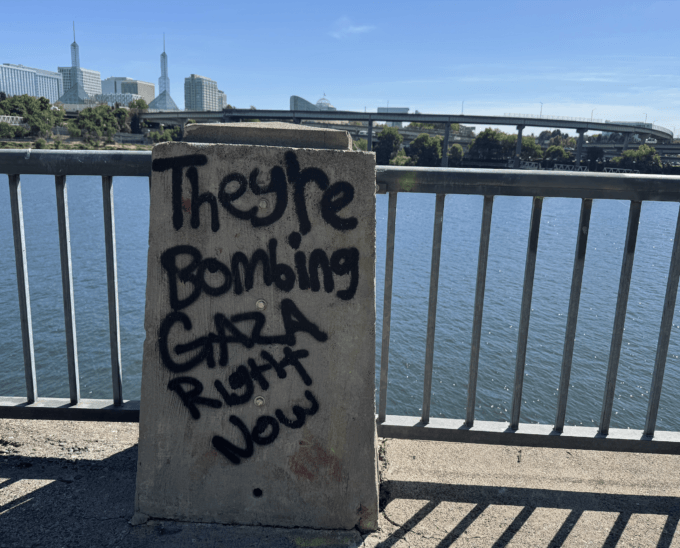
Photograph by Nathaniel St. Clair

As the world watches, one of history’s greatest crimes has taken form.  Inaction, complicity and silence in the face of genocide have caused profound suffering to the Palestinian people.  No final reckoning or redress would be equivalent to the scale and magnitude of Israel’s depraved criminality.

Inevitably there will be a final accounting for those who advanced an environment in which a member of the Israeli parliament felt emboldened enough to boast:  Everyone got used to the idea that you can kill 100 Gazans in one night … And nobody in the world cares.”

The time is past due to state unequivocally that Israel has, since it declared statehood in 1948, been terrorizing the Palestinian people and that the U.S. and its Western allies have, because of their overwhelming support for Israel, been active participants in that terror.

Israeli violence clearly fits America’s own definition of “domestic terrorism.”

Washington’s leading law enforcement agency, the Federal Bureau of Investigation, defines it as: “Violent, criminal acts committed by individuals and/or groups [regimes] to further ideological goals stemming from domestic influences such as political, religious, social, racial, or environmental nature.”

Palestinians have suffered incomprehensible horrors because U.S. politicians, political influencers, public and corporate media have failed to provide the historical context that gave rise to the insurrection of 7 October 2023.  Absent that history and discussion of Palestinian resistance grounded in international law, they have made Israel’s indefensible response appear warranted.

The failure to inform has essentially given Israel license to commit genocide and all manner of atrocities in Gaza and has enabled U.S. authorities to suppress opposition to the war on American college campuses.

The media, for example, has accepted without question, the government’s illegitimate designation of Palestinian resistance against Israeli occupation as “terrorism” and national liberation groups like Islamic Resistance Movement (Hamas) as terrorist organizations.

In so doing, by equating Palestinian resistance with terrorism, they have eased the way for authorities to use the “support for terrorism” accusation to crush dissent and to arrest pro-Palestinian demonstrators.

Scholars and activists, like Columbia student Mahmoud Khalil, held without due process for over two months in a Louisiana detention center, have been arrested on grounds that they pose a threat to U.S. foreign policy and security.  In reality, Khalil’s “crime” was standing up for truth and Palestine.

With some basic fact-finding, the media would have learned that resistance to occupation is legally reinforced under international law.   And that the 1949 Fourth Geneva Convention and Additional Protocol I explicitly affirm the legitimate right of the occupied to resist occupation as part of the right to self-determination.  Resistance includes armed struggle in situations of colonial domination, foreign occupation and against racial regimes.   The 1977 Additional Protocols to the Convention also gave legal legitimacy to the resort to arms by national liberation movements.”

In addition, they would have discovered that the U.N. General Assembly has passed numerous resolutions recognizing the legitimacy of armed resistance as a means of oppressed peoples to achieve self-determination and independence.

Israel is a colonial foreign and racial regime that has brutally dominated Palestinian lives for eight decades and according to international law, resistance to it is justified.

The Palestinian rebellion could also have been understood differently if the media had presented comparable cases, like the Warsaw Ghetto Uprising in 1943—an historical act of Jewish resistance against their Nazi occupiers during World War II.  We would be hard pressed today to find anyone who would question the righteousness or legitimacy of that rebellion, as they have regarding the uprising of 7 October.

During the Nazi occupation of Poland in 1939, for instance, German authorities began to concentrate Poland’s Jews, estimated at three million, into a number of crowded ghettos located in cities throughout the country.  The sealed-up Warsaw ghetto warehoused approximately 350,000 people in a densely packed two-mile area of the city.

Jews who had not died of disease, starvation or deportation to extermination camps fought back against Nazi Germany’s final effort to transport them to death camps.  Although they recognized that victory and survival were unlikely, they refused to surrender.  After 29 days of fighting, 13,000 Warsaw Jews and 17 German soldiers were killed.  After the Nazi occupiers destroyed the entire ghetto, their final act was to blow up the historical 1878 Warsaw Synagogue.

The Jewish fighters knew full well the outcome of their defiance.  They chose, however, to determine how they would die—Treblinka or resistance.

After years of degradation, Palestinian resistance forces also made a choice to break out of the dehumanizing ghetto in which they had been held hostage for 58 years.  Although they, too, knew they were up against a powerful brutal army, they chose a “Gaza Ghetto Uprising” over unending oppressive confinement.

As Israel moves closer each day to completing its long-cherished goal of killing as many Palestinians as the “civilized world” will permit, it is critical to magnify the fact that according to international law, people under colonial or foreign occupation have a legitimate right to armed struggle to obtain their freedom and sovereignty.

Had the October insurrection been placed within the context of international law, perceptions may have been different and the violence of the last 19 months might not have happened.  Most importantly, 68,000 Palestinians would not have been massacred and ancient Gaza would not now be an environmentally devastated wasteland.

It is essential to recognize that Palestine is one of the few countries in the world remaining under direct military occupation and colonial rule.  Using the auspices of the newly established United Nations, the British officially handed off their colonial mandate in Palestine to the Tel Aviv regime in 1948.  Since then, Israel’s plan to seize and control all of historic Palestine and forcibly remove the indigenous population, has never ceased.

In addition, attention should be focused on the 19 July 2024 International Court of Justice  Advisory Opinion ruling that Israel is unlawfully occupying and is not entitled to sovereignty over any of the the Palestinian territories (West Bank, East Jerusalem and Gaza).  The Court also mandated that Israel end its occupation, desist from creating new settlements, evacuate existing ones and provide full reparations to Palestinian victims; and once again affirmed the Palestinians’ right to self-determination.

Israel has, however, only intensified its violence since the ICJ ruled and after the U.N. General Assembly overwhelmingly voted in favor of a resolution that gave effect to the Court’s Advisory Opinion.

In Resolution ES-10/24, the General Assembly demanded that within 12 months from the adoption (18 September 2024) of the resolution that Israel end without delay its unlawful presence in the Occupied Palestinian Territory and meet its obligations under international law.

The United States and its European allies have joined Israel in giving the ICJ and the U.N. General Assembly the “digitus impudicus,” as they ignore the Court’s mandate that all states must recognize the unlawfulness of the occupation and refrain from aiding Tel Aviv in maintaining the occupation.

International law is unmistakably on the side of Palestine.  Until now, it has been primarily textual representation, not action.  Legalities have not stopped Israel from murdering Palestinian resistance leaders, dropping thousand-pound bombs on non-combatants to kill one man.

Resistance is a right of the oppressed.  Mahmoud Khalil, in a letter to his newborn son, has eloquently given voice to that right and to the Palestinians who were, who are and who will be:

“The struggle for Palestinian liberation is not a burden; it is a duty and an honor we carry with pride.  So at every turning point in my life, you will find me choosing Palestine.  Palestine over ease.  Palestine over comfort. Palestine over self.  This struggle is sweeter than a life without dignity.  The tyrants want us to submit, to obey, to be perfect victims.  But we are free, and we will remain free.”


Connecting the Dots on Trumps Budget


 May 29, 2025

Photo by Jonathan Cooper

Trump’s budget clearly favors certain supporters over others. It reallocates funds from health care intended for his low-income populist base to sustain tax subsidies for his wealthiest backers. As Trump’s populist base learns the details of his “Big Beautiful Budget,” Republican members of Congress will face consequences. This is especially true for Senate Republicans, who do not benefit from gerrymandered districts; their constituents cover the entire state.

As long as House Republicans are led by their Freedom Caucus (see The Far-Right Freedom Caucus), they will continue to focus on reducing health care protections for Trump’s largest demographic, which consists of low-income families with children and seniors. They believe these individuals must make this sacrifice to balance the budget. Whatever the House passes must be approved by the Senate, and some Republican senators are concerned about being forced to vote on a budget that openly cuts essential services like Medicaid.

Before discussing how lower-income MAGA supporters will be affected by these cuts, it is crucial to recognize that Republicans in both chambers support a budget that maintains a tax structure favoring wealthier Americans. One of the best examples is their budget proposal, which extends the individual alternative minimum tax (AMT) repeal. This line item benefits higher-income individuals by ensuring they pay a minimum level of tax, even if they use various deductions and credits that could significantly reduce their regular income tax liability.

Before Trump’s last significant budget tax-cutting package, the TCJA, from his first term, over 5 million taxpayers had to file an AMT return. Just after the TCJA passed, only 200,000 had to pay the AMT. The current House budget continues the repeal. According to the Bipartisan Policy Center, this repeal would reduce revenues by nearly $1.4 trillion over the next decade, accounting for 42% of the total federal deficit.

As a result, the percentage of wealthier citizens paying the AMT tax with this subsidy remains around 0.1%, instead of the 4% of the population subject to the normal tax rate that everyone else pays. This is not what making America great again was supposed to be promoting.

If one connects the dots from Trump’s budget (now the Republican Party’s) to the effects on his voter base and the most vulnerable Republican senators, it outlines a critical path leading to a Democratic-controlled Senate. Some senators risk losing their seats if they vote for a House version that cuts services for their baseline lower-income supporters in rural counties across each state.

The Republican budget claims to cut waste, but it actually makes the government more inefficient, directly harming seniors.

Republicans in Congress argue that their budget will save taxpayers money by reducing waste. It sounds appealing, but every organization and every human invention has some inefficiency. For example, most road-legal cars achieve only about 20% to 40% efficiency. Cost-conscious corporations typically operate auto manufacturing plants within an efficiency range of 60% to 70%. In other words, a degree of waste can be found in all human activities.

To be more efficient is good, but Trump’s Republican administration is exploiting a naturally occurring element of inefficiency to enact a political policy. No matter how small one might be, they are amplifying their importance to cut basic public services with little attention to those being denied, many of whom are Trump supporters.

Judd Legum of Popular Information writes about a memo from Trump-appointed Acting Deputy Social Security Administration Commissioner Doris Diaz that illustrates how this strategic practice unfolds. Elon Musk identified some minor inefficiencies within the Social Security Administration, suggesting that 10% of all federal expenditures were related to Social Security fraud. The “fraud” was mainly improper payments resulting from beneficiaries or the SSA failing to update records. This amounts to less than 1% of total Social Security benefits paid and 0.1% of the federal budget.

Due to this faulty logic, Diaz’s memo suggested requiring a social security recipient to visit a field office to provide in-person identity documentation if they cannot correctly use the “internet identity proofing” instructions. How often are internet instructions unclear that users need to make a phone call to understand them?

If seniors encounter difficulties, they must go to an SSA office and wait in line to speak with a service representative. Additionally, there may be fewer staff available. Trump’s DOGE announced plans to cut Social Security staff by 7,000 workers, 12% of their workforce.

Republican congressional representatives will be held accountable for this issue since they control the federal government. They should remember that, according to the Census Bureau, 72 percent of voters aged 65 and older cast their ballots in 2020, and Trump won them over Kamala Harris by just one percent.

Cutting health services to Medicaid, SNAP, and the Affordable Care Act (Obamacare) will threaten Republican support of low-income whites in rural areas.

In the 2020 election, most lower-income households—defined as those earning less than $50,000 a year—voted for Trump. Studies also show that lower-income whites supported Trump at higher rates than their higher-income counterparts.

That pattern may change significantly next year, as estimates from the nonpartisan Congressional Budget Office predict that 7.6 million lower-income voters will lose their health insurance and 3 million will be denied SNAP benefits (aka food stamps). Over the next decade, this would cut more than $1 trillion from healthcare and food assistance programs.

When we think about people living in poverty, the media often emphasizes a racial portrayal of poverty, which the Feds define as having incomes at or below $50,000. However, little attention is given to the fact that poor white voters make up 73% of all voting-age adults living in poverty. And they vote: Thirty-eight million cast their ballots in 2020, representing an 80% turnout. In comparison, the corresponding Black population of 6 million had a turnout of 68%.

Most rural white poor voters supported Republicans, and they did so even more in 2024 than in 2020. According to a preliminary analysis by the New York Times, over 90 percent of counties shifted in favor of President-elect Trump in the 2024 presidential election, increasing his vote margin from 2020 in more than 2,300 counties. Vice President Kamala Harris carried only 427 counties, losing nearly a quarter of the counties with small urban areas.

The Democratic Party is rooted in these urban counties, so it is natural to expect that much of its attention focuses on minorities who are more concentrated in those areas. However, the current proposed Republican budgets will deprive outer core urban and rural communities of essential health services that previous Democratic administrations provided.

Congressional Republicans are overstretching their position by eliminating some long-standing and essential health services for rural areas in their pursuit to balance a budget burdened by tax benefits for high-income earners. Fortunately for them, Democrats are only making shallow forays into these regions to explain how the Republican budget will cut health care services for the rural poor, who are primarily Republican voters.

PLEASE SHARE THIS PIECE – through my Substack account –  https://nlicata.substack.com, Or just forward this email to friends and others.

The Republican budget will significantly impact rural Americans by reducing federal health programs. 

The impact will be felt in blue states, such as Washington, and red ones, like Missouri. Seattle Times columnist, “Nine of the 10 Washington counties that use Obamacare and Medicaid the most, per capita, are red-voting.” Fifty percent of the working-age population in the top seven counties is on subsidized health care. In Missouri, where there are two Republican Senators, nearly 47% of children living in rural areas relied on Medicaid and the Children’s Health Insurance Program (CHIP) for coverage.

Missouri Senator Josh Hawley warned his fellow Republican Senators that allowing the budget to cut funding for federal health programs would benefit corporate giveaways at the expense of slashing health insurance for the working poor. According to the latest analysis from the nonpartisan Congressional Budget Office, Republicans would strip almost 9 million low-income Americans of their health insurance, primarily by trimming Medicaid.

The House budget subtly reduces Medicaid without Republicans needing to label it as a cut.

It achieves these reductions by tightening eligibility, complicating enrollment and retention processes, and shifting Medicaid costs from the federal government to the states.

It shifts Medicaid costs to states by limiting their ability to tax health care providers (aka a “provider tax”), impacting hospitals and other health service providers that rely on Medicaid. Provider tax is essential for maintaining health coverage for low-income Americans in 49 states. Due to this provision, the Congressional Budget Office predicts that states will lose nearly $90 billion in the next decade if the Senate approves the House budget.

Along with freezing or limiting state provider taxes and facing reduced federal funding, states will be required to dedicate more time and resources to implementing the stringent new work and eligibility rules mandated by the budget for utilizing Medicaid.

The Republican senators face a choice of approving the House budget or keeping their jobs.

House Republicans narrowly passed their budget, but a few Republican senators may face backlash from populist voters if they support it and cut health coverage.

These senators face reelection in six states where Medicaid covers one-fifth of non-elderly adults living in small towns and rural areas. They are Louisiana’s Bill Cassidy, West Virginia’s Shelley Moore Capito, Montana’s Steve Daines, Arkansas’s Tom Cotton, and Alaska’s Dan Sullivan. Kentucky’s Mitch McConnell is retiring, so his seat will be an open race.

Furthermore, there are three states with Republican senators up for reelection where at least half of the children living in small towns and rural areas are covered by Medicaid/CHIP, which are on the chopping block. The Children’s Health Insurance Program (CHIP) is a joint federal and state program that provides health coverage to children in families who earn too much to qualify for Medicaid but cannot afford private insurance. Those senators and states are Bill Cassidy of Louisiana, Senator Lindsey Graham of South Carolina, and Senator Tom Cotton of Arkansas.

As the Brookings Institution reported, the Republican budget “plan saves money mainly by removing millions of people from coverage, while offering no alternative means to insure them.” Republican efforts tweak obscure state taxes and revamp income verification schedules for both Medicaid and the Affordable Care Act’s subsidies.

One such unpublicized change could limit or potentially eliminate funding for Obamacare Medicaid recipients, which has long been a Republican objective. Three Republican senators facing reelection represent states that extended Obamacare federal funds to include Medicaid recipients. Additionally, they have “trigger laws” that require their state legislature to end expansion if the Obamacare funding match to the state falls below 90 percent of the expansion cost.

If they support the House budget, the three senators—Steve Daines from Montana, Thom Tillis from North Carolina, and Tom Cotton from Arkansas—will be accountable for bringing this issue to their state legislators.

The situations described expose these seven senators to a potentially angry base of lower-income white voters in strongly conservative states. If these voters experience cuts to their health benefits and financial security, their loyalty to these senators and the Republican Party will diminish. Democrats should focus on illustrating how the Republican budget plan and the sacrifices faced by their supporters are interconnected.

However, in doing so, Democrats must pivot away from blaming billionaires for voters’ problems, regardless of how true that may be. Instead, they need to present clear and specific measures they are committed to implementing. Those efforts should begin today and not wait until after they are elected.

Nick Licata is author of Becoming A Citizen Activist, and has served 5 terms on the Seattle City Council, named progressive municipal official of the year by The Nation, and is founding board chair of Local Progress, a national network of 1,000 progressive municipal officials.