Monday, June 30, 2025

PAKISTAN

Could early warnings have prevented River Swat tragedy?

After 13 lives were lost in a flash flood, officials and experts weigh what could — and should — have been done to prevent the disaster.


Published June 30, 2025
 DAWN

THEY came for breakfast and a few photographs, perhaps to capture a happy moment beside the River Swat. But within minutes, the calm waters turned violent, sweeping away an entire family in front of helpless onlookers.

As the surging brown torrents of the swollen river pounded the rocks beneath their feet, 14 tourists — men, women and children — stood huddled together, teetering between fading hope and overwhelming despair.

The family, belonging to Daska tehsil in Sialkot, had stopped for breakfast at Relax Hotel, located at the Fizagat picnic point on the outskirts of Mingora.

After their meal, they ventured onto the riverbed to take photographs. As they snapped selfies and recorded videos, the waters suddenly swelled, trapping them on a raised mound of stones and sand, left behind by quarrying work in the riverbed.

The river’s rapids quickly eroded the small, fragile piece of land beneath them. As bystanders captured the unfolding tragedy on their phones under a grey sky, members of the group began to fall into the torrent, one by one. Within minutes, all were swept away.


After 13 lives were lost in a flash flood, officials and experts weigh what could — and should — have been done to prevent the disaster

The short distance to safety — barely 100 metres — proved unreachable.

The incident has ignited public anger and raised serious questions about the provincial government’s emergency response, early warning systems and disaster preparedness.

Dawn spoke with officials and experts to piece together what really happened in Swat and evaluate the government’s role, the effectiveness of the emergency response, preparedness, and early warning systems.

What happened

Eyewitnesses said the group was stranded for over two hours and no one turned up to rescue them. But officials dispute this claim.

Shah Fahad, director general of Rescue 1122, told Dawn that CCTV footage from the hotel shows the tourists entering the riverbed around 9:37am. “The river was dry then, but within minutes, the water surged. By 9:45am, the river had risen dramatically,” he said.

Mr Fahad said the first call for help was received at 9:49am. However, a fatal miscommunication occurred. The operator misunderstood the nature of the emergency, treating it as a medical issue instead of a rescue operation.

An ambulance was dispatched and arrived at 9:56am. When responders realised they were faced with a river rescue, they requested a different vehicle. A disaster rescue vehicle, carrying generators, inflatable boats and other paraphernalia, was dispatched to the scene, but arrived too late.

He said an investigation was underway to find out whether the delay could have been due to operator error, or the caller’s failure to properly convey the nature of the emergency.

But there are slight variations, even in official records. According to information seen by Dawn, the Swat district administration received its first alert at 9:55am, and a Rescue 1122 ambulance arrived at the scene around 10:07am. Rescue efforts began in earnest at 10:15am with a locally made raft using inflated tubes.

By 10:36am, the eroding riverbed gave way and the stranded tourists were swept into the rapids. Video footage shows a raft, locally called a jaalai, approaching four people clinging to each other in knee-deep water. Official accounts claim three of them were rescued.

Several officials and rescue experts told Dawn the River Swat’s rocky, shallow, fast-flowing nature makes it unsuitable for divers or motorboats. Rescue 1122 has a rope gun capable of launching lines up to 100 metres, but it couldn’t be used as there was no anchor point across the river.

Why no helicopter?

A KP government official said a helicopter rescue was considered, but ultimately ruled out due to bad weather.

An emergency response expert told Dawn that 95 per cent of crisis management is preparedness, and only 5pc is the response. “You don’t send divers unless there’s a high chance of survival — and in this case, there wasn’t.”

He regretted that Swat has seen multiple floods since the 2010 floods, but little has been done in terms of community-based disaster risk management (CBDRM). In contrast, the Kalash valleys in Chitral have such systems in place.

“In 2015, the Bumburet valley faced severe flooding, but no lives were lost because villagers upstream warned those downstream. That’s what CBDRM looks like,” he said.

Early warning systems

Swat district spans over 5,000 square kilometres and has a population of 2.6 million. The Meteorological Department maintains three weather observatories here — in Saidu Sharif, Malam Jabba and Kalam.

On June 23, the KP Provincial Disaster Management Authority issued a weather advisory warning of a westerly wave approaching by June 25. It said the wave was likely to intensify on June 25 and directed authorities to take precautionary measures.

Data from the Met Department shows rainfall on June 27 measured 46mm in Saidu Sharif, 42mm in Malam Jabba and 4mm in Kalam. River gauges installed by the Irrigation Department in Khwazakhela recorded a morning discharge of 6,738 cusecs.

A senior Irrigation Department official told Dawn that Kalam valley was outside of the monsoon zone, which extends across Bahrain, Khwazakhela and Matta tehsils.

Another Irrigation Department official said the flash flood likely originated in Khwazakhela and Matta tehsils, fed by tributaries like Chaprial, Ningolay, Baryam and Shawar. Streams from Manglawar and Malam Jabba also contributed.

A telemetry system at Charbagh was reportedly non-functional, though Swat Executive Engineer Inamullah Khan denied its existence there, stressing that only Khwazakhela has such a system.

Former Swat deputy commissioner Shahzad Mehboob, who was transferred on Saturday, said the flood came too quickly for officials to respond. “Small tributaries of the River Swat swelled, and it reached the site within a very short span of time,” he said.

Yet questions remain: did officials in upstream tehsils — Khwazakhela, Matta, Charbagh and Babuzai — warn Mingora authorities in time? Could such a warning have triggered preventative action, avoiding the loss of lives?

On the evening of the tragedy, the KP government suspended the assistant commissioners of Babuzai and Khwazakhela for a delayed response and failure to issue an early warning. The Additional Deputy Commissioner (Relief) was also suspended for failing to make arrangements.

Some officials questioned why life jackets were not dropped near the stranded tourists. Others criticised the lack of on-ground enforcement, stressing that while alerts were issued, field action was lacking.

Published in Dawn, June 30th, 2025

Header image: Army officials participate in rescue operations, Swat, June 27. — Rescue 1122/File


PAKISTAN


Malformation, pests and water shortage: 
The mango meltdown in Sindh

In the last five years, the acreage of mango orchards across Sindh has dwindled, shrinking from 59,100 hectares in 2019-20 to 58,900 hectares in 2023-24.


Published June 25, 2025
PRISM/DAWN

It was a sultry summer morning. Mir Shah Mohammad Talpur was visiting his sprawling mango orchards, located on the outskirts of Hyderabad, to inspect the year’s produce. However, the ruthless sun glaring on his back and mercury rising to 43.2 degrees Celsius were making things difficult for Mir.

For the mangoes, though, these climatic conditions were in tandem with their harvest.

Mir’s orchard is spread across 450 acres of land. “I have been looking after the bagh for six years … many trees here are around 50 years old,” he told Dawn.com. The 49-year-old wore a black sun cap along with a neck flap to avoid exposure to the intense heat.

Like many in the area, Mir too sublets his mango orchard — a practice in vogue, by and large, in Sindh. Only a few growers, including those who believe in progressive farming, manage their own orchards. The province is known for its Sindhri mangoes, harvested in the first week of June.


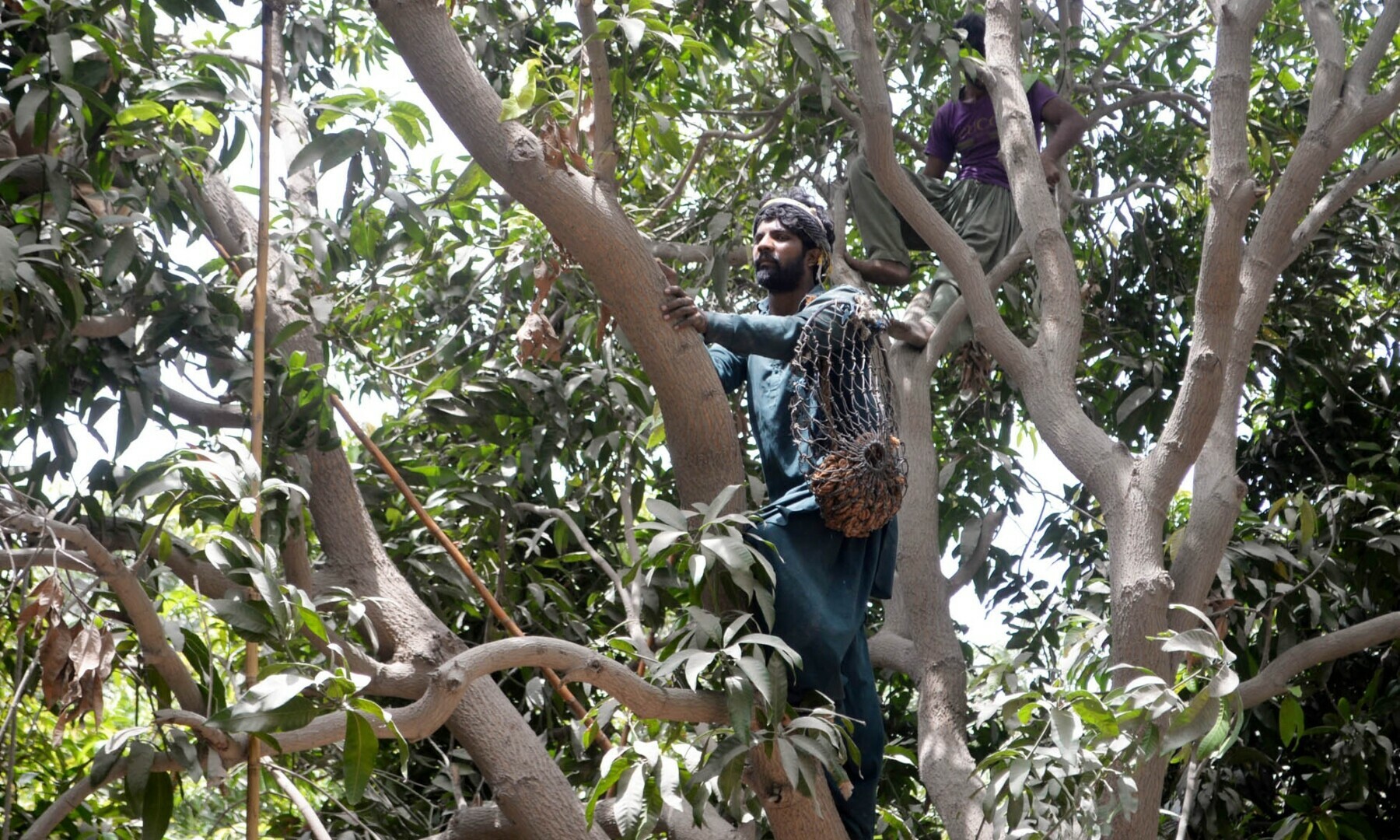
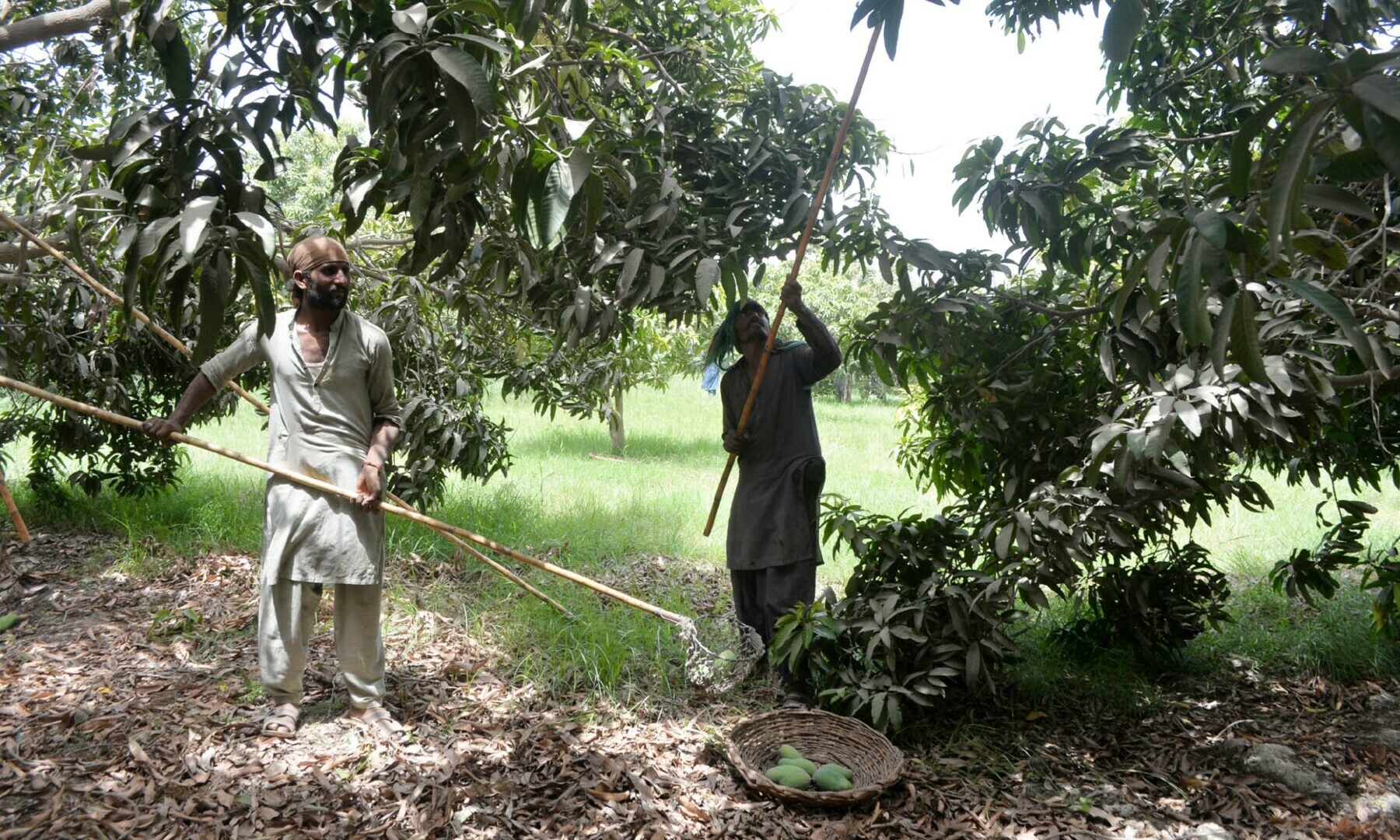
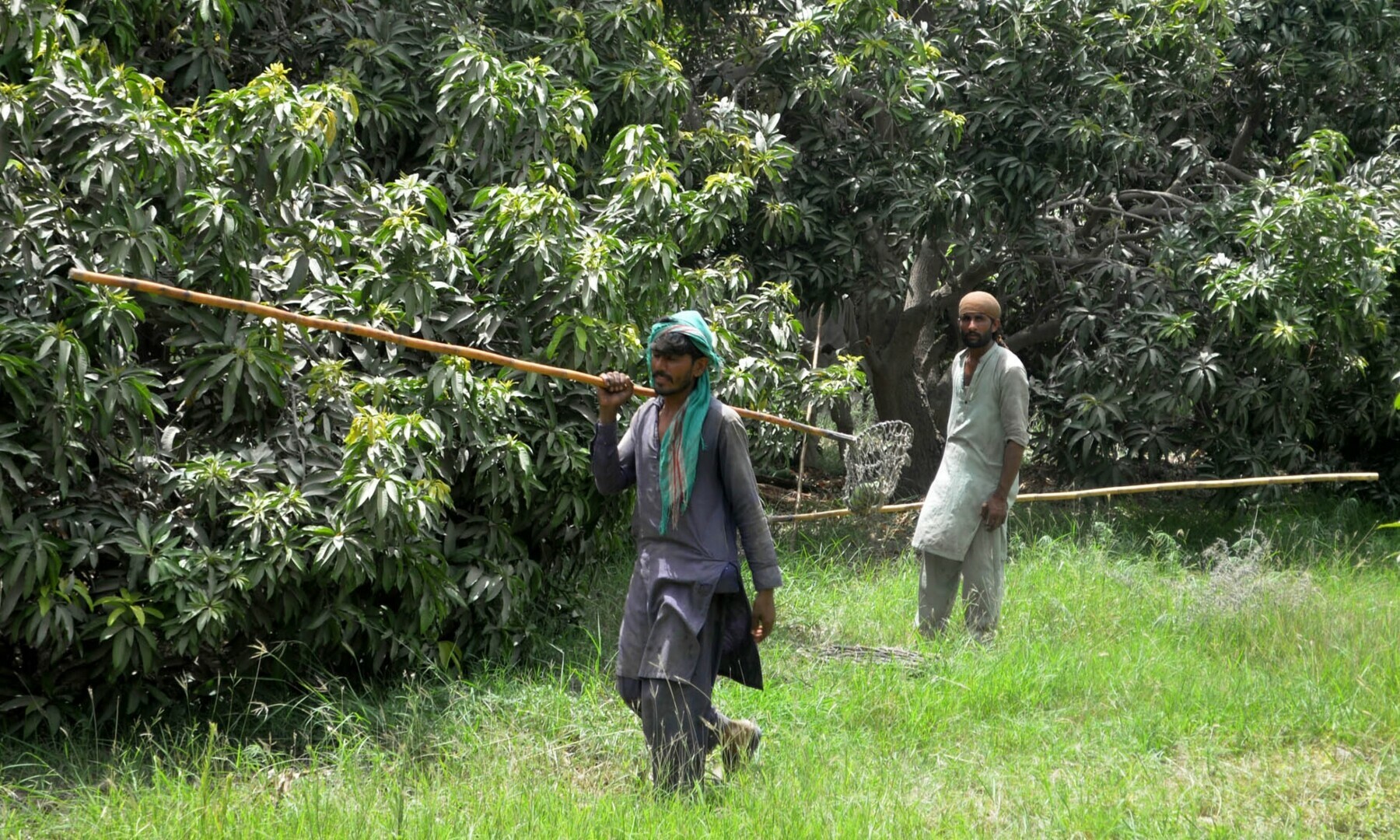
Two workers moving from one part of the orchard to other for picking of fruit.

Despite other varieties such as Saroli, Dasehri and Langra, which are harvested as early as mid-May, Sindhri remains the most preferred choice of mango lovers. It is not just an export favourite, but also used as a ‘seasonal gift’ by politicians and top-level government functionaries.

“This time, Sindhri is being picked quite early thanks to the market dynamics,” said Mir. “The falling of the fruit from trees indicates that it is now ripe and ready for harvest.” For this year’s harvest, he signed an agreement with Haji Ramazan Siyal, a contractor from Multan.

From trees to plates

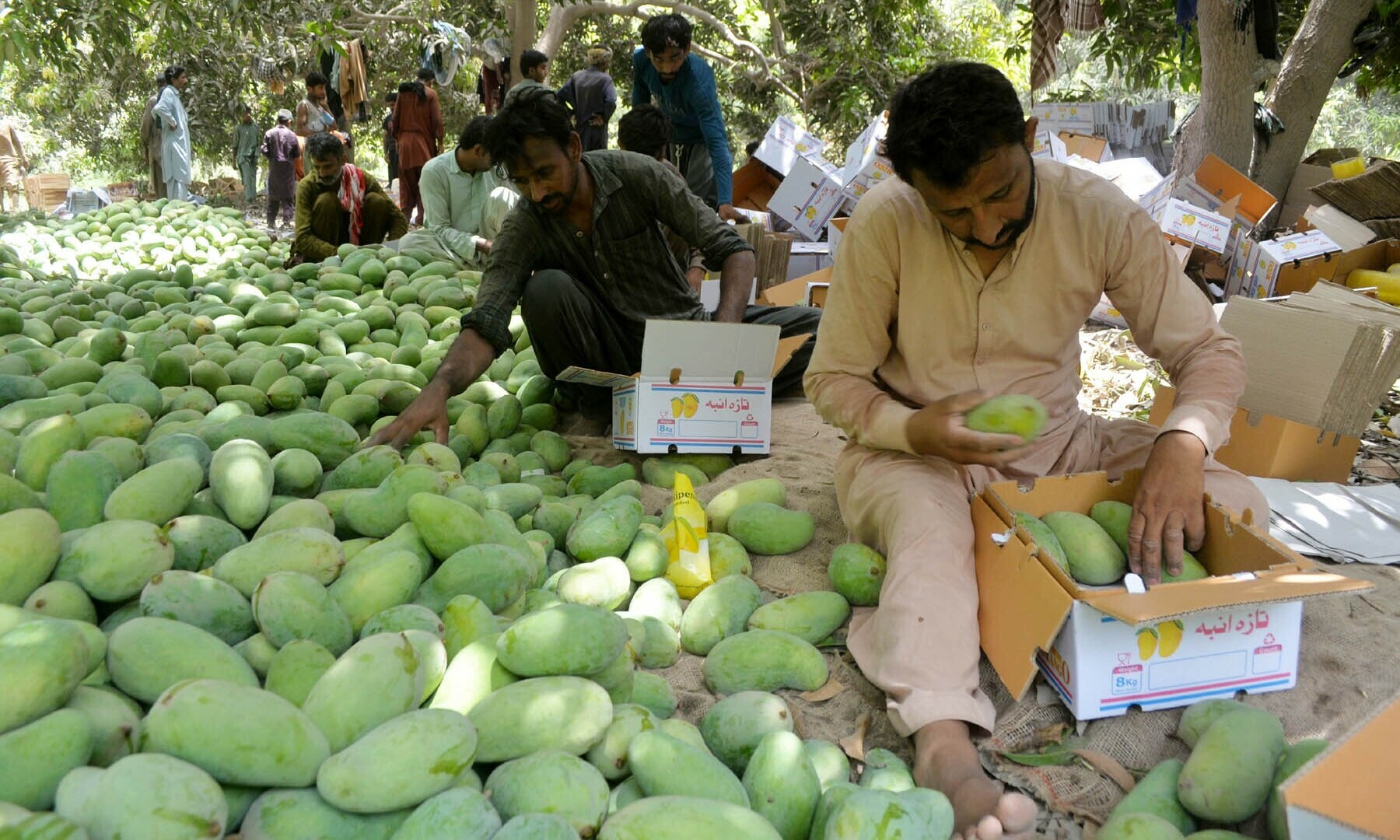
At Mir’s orchard, labourers from Punjab, who routinely cross over to this side of the provincial border during the season, are busy with various chores — climbing trees to pluck mangoes, sorting the fruits for export consignments and local market consumption, and cooking food.

These labourers — many of them hailing from southern Punjab’s districts of Muzaffargarh, Layyah, Dera Ghazi Khan and Multan — stay in the orchards for over a month until the end of the harvesting season and the subsequent marketing.


A couple of workers busy plucking mangoes.


They then leave for Punjab, where harvesting begins relatively late. These workers have expertise in preparing bardana (wooden boxes), bharawa (filling of mangoes in boxes), thukawa (packing of mangoes) and turawa (plucking). Their dexterity is on show as they swiftly move through the orchards.

Picking of mangoes is conventionally known as ‘pattaee’ in the Sindhi language. A few farm workers climb the trees, while others stand underneath with polypropylene bags in their hands. These specific bags are used to ensure that not a single mango touches the earth below, which can damage the shape and quality of the king of fruits.


Two workers picking mangoes from the a tree.


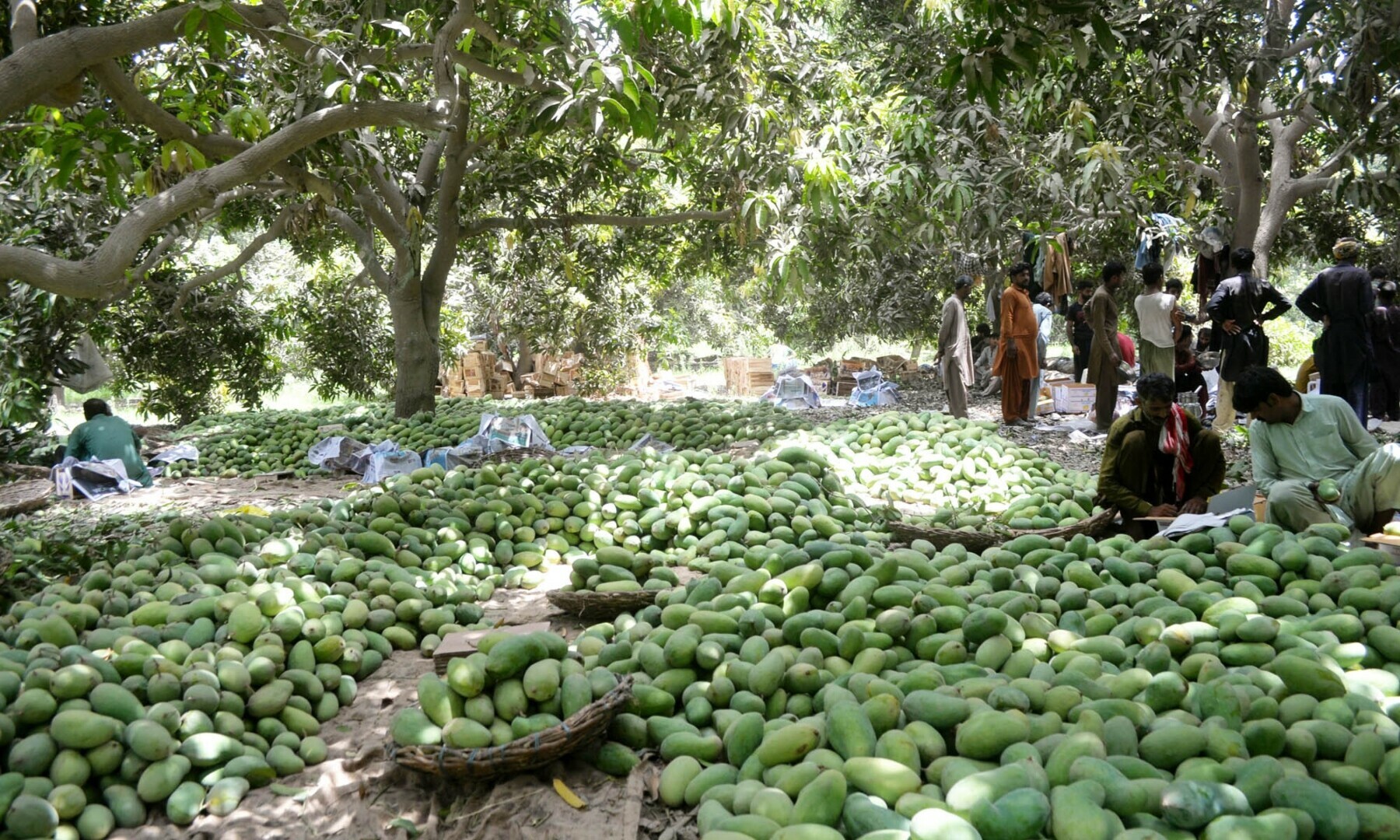
The mangoes plucked thus far are collected at a separate location to make a mound of them before they are graded. The ubiquitous sweet smell of unripe mangoes pervades this part of the orchard.

Shift from conventional to modern ways

At Mir’s farm, however, Siyal’s labourers, including his young son, Mudassir Siyal, have shifted away from conventional harvesting or pattaee. Instead, they pick every mango in a small bag, whose edge is fixed with a sharp cutter. This process reduces the labour, because the fruit is collected in a basket and then shifted for manual sorting and grading.

“I feel the fruit suffers shock inside in the pattaee way of harvesting,” says Mir, seated under the canopy shade of an old mango tree. “This year, labourers are clearing trees in quite an efficient way to avoid losses.” Soon, Siyal’s men bring out servings of mangoes.


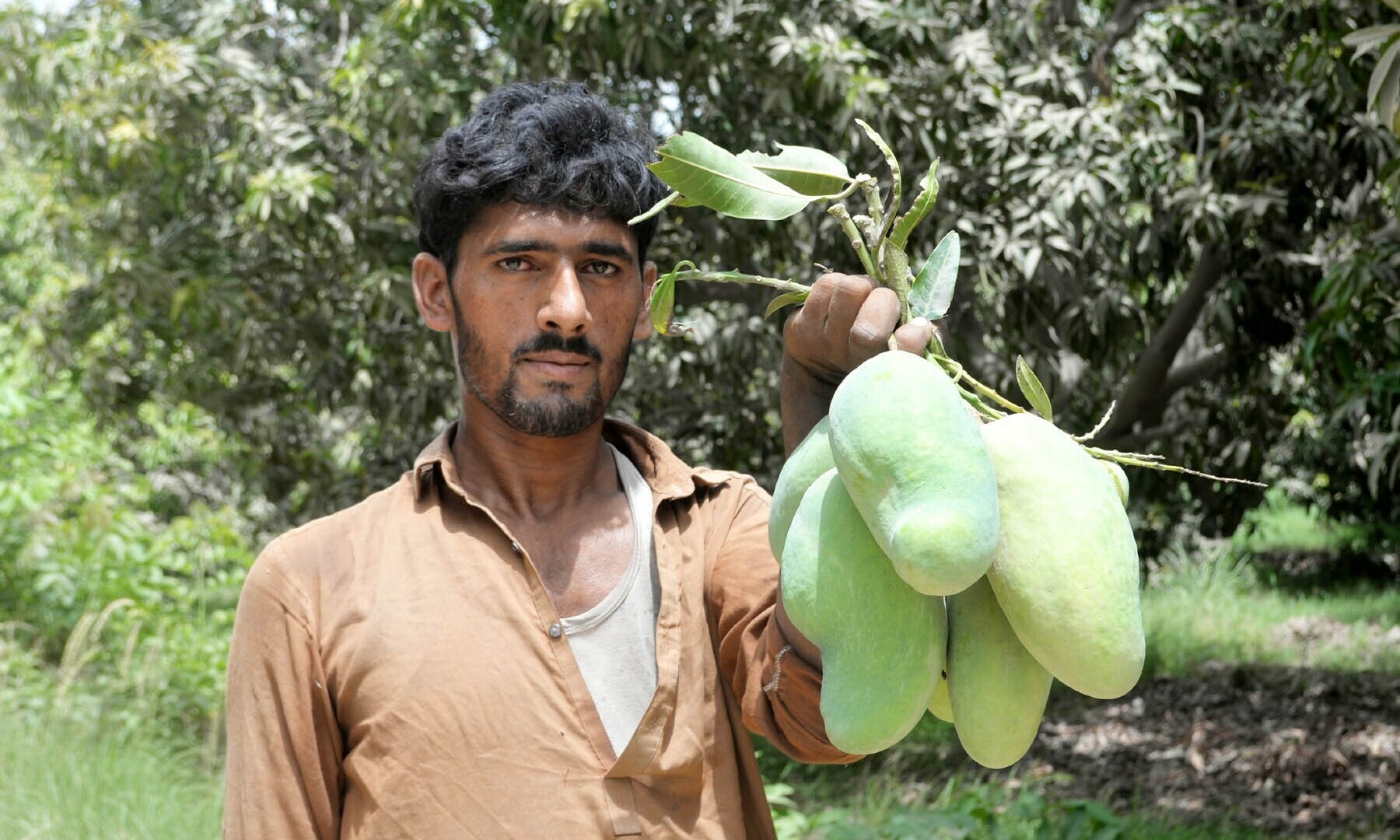
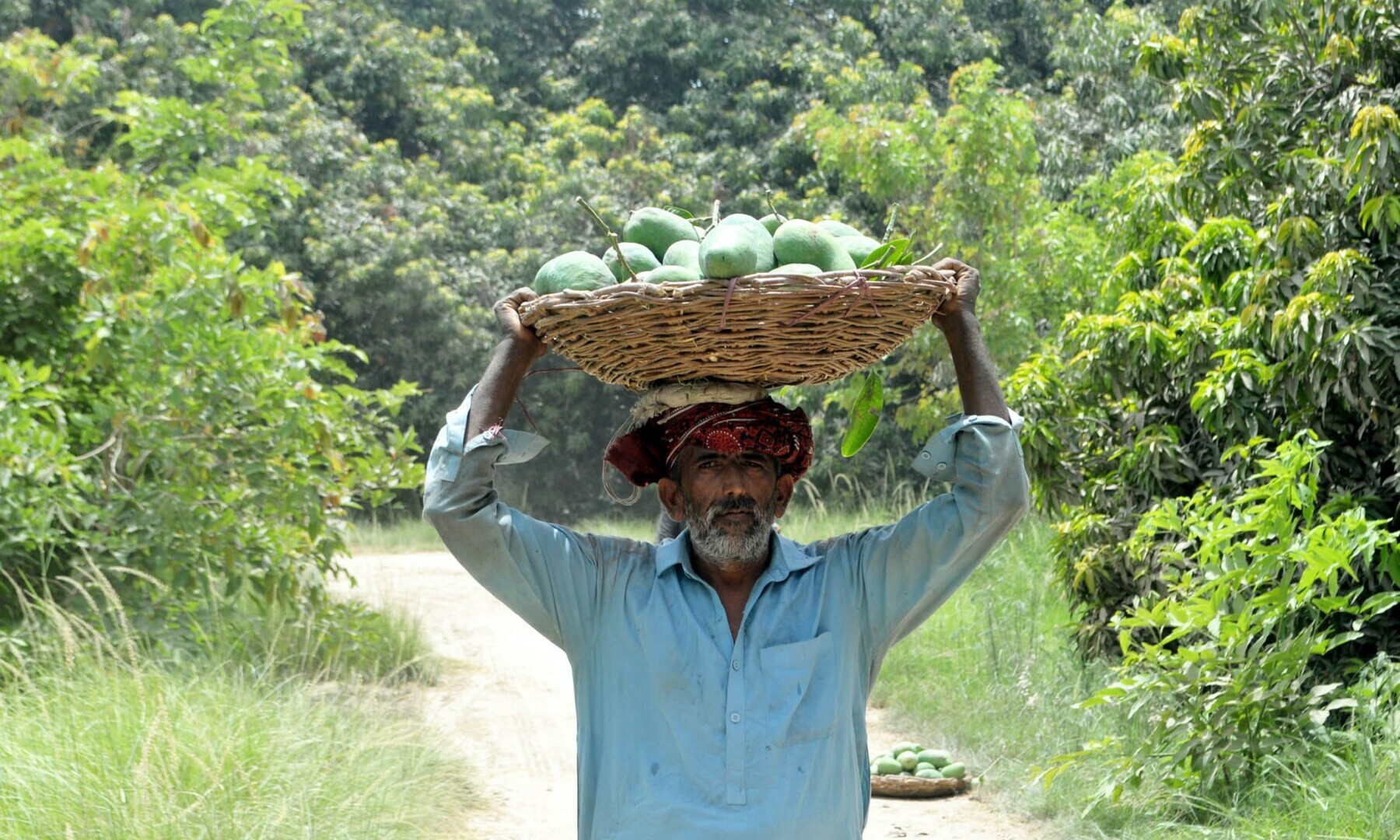
A contractual worker carries a bunch of unripe sindhri mangoes.


According to Siyal, Mir’s orchard needs massive pruning of stems to let sunlight and air pass through easily. “I have given some advice to Mir saheb on how to cut large branches of trees that are at present entangled considerably. It should be done across the orchard,” he says.

“I started working as a labourer to climb trees for picking mangoes, and then went on to become a contractor. I bought my first bagh in the early 1970s for Rs30,000 and now my son works with me,” he adds.


Mound of sindhri mangoes collected in the orchard before packing.

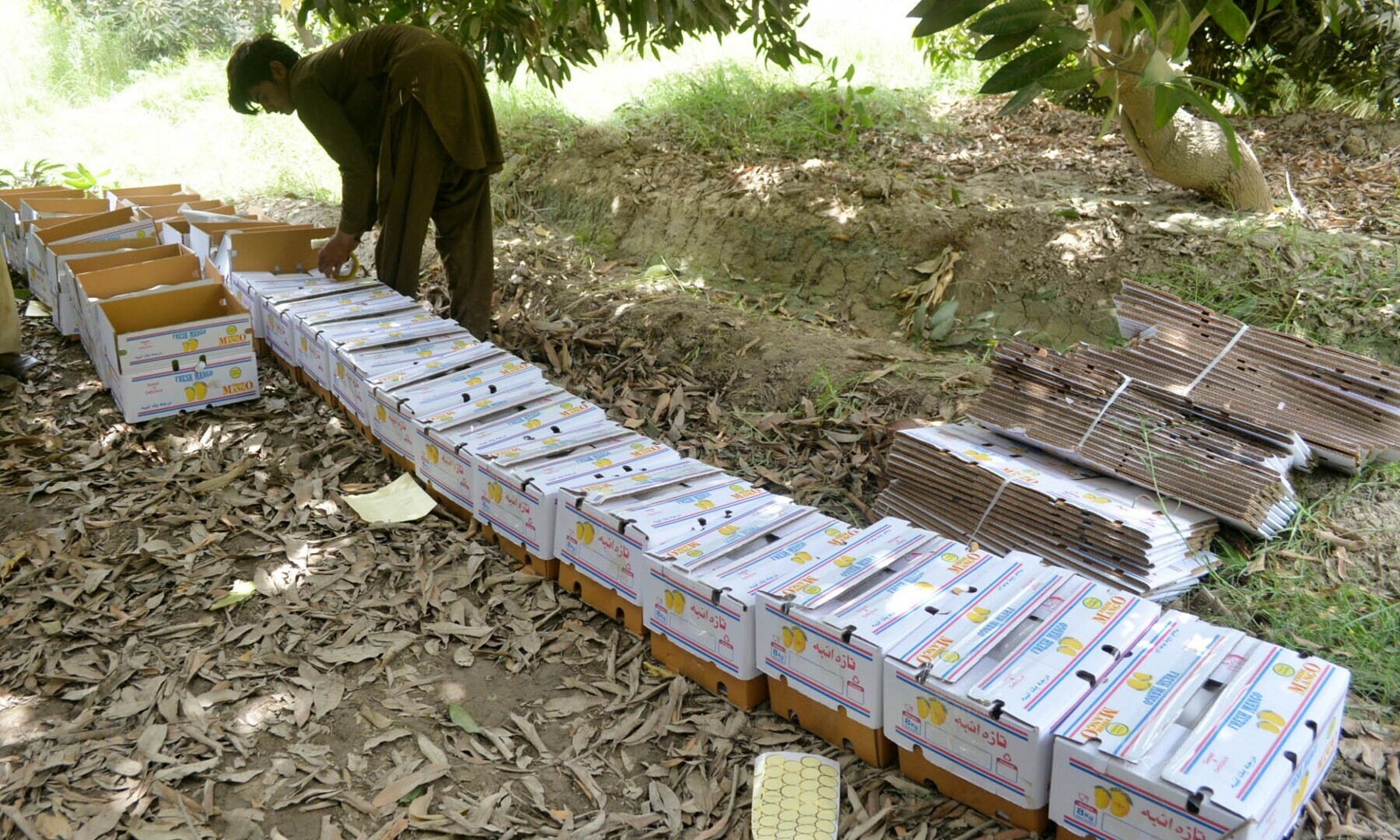
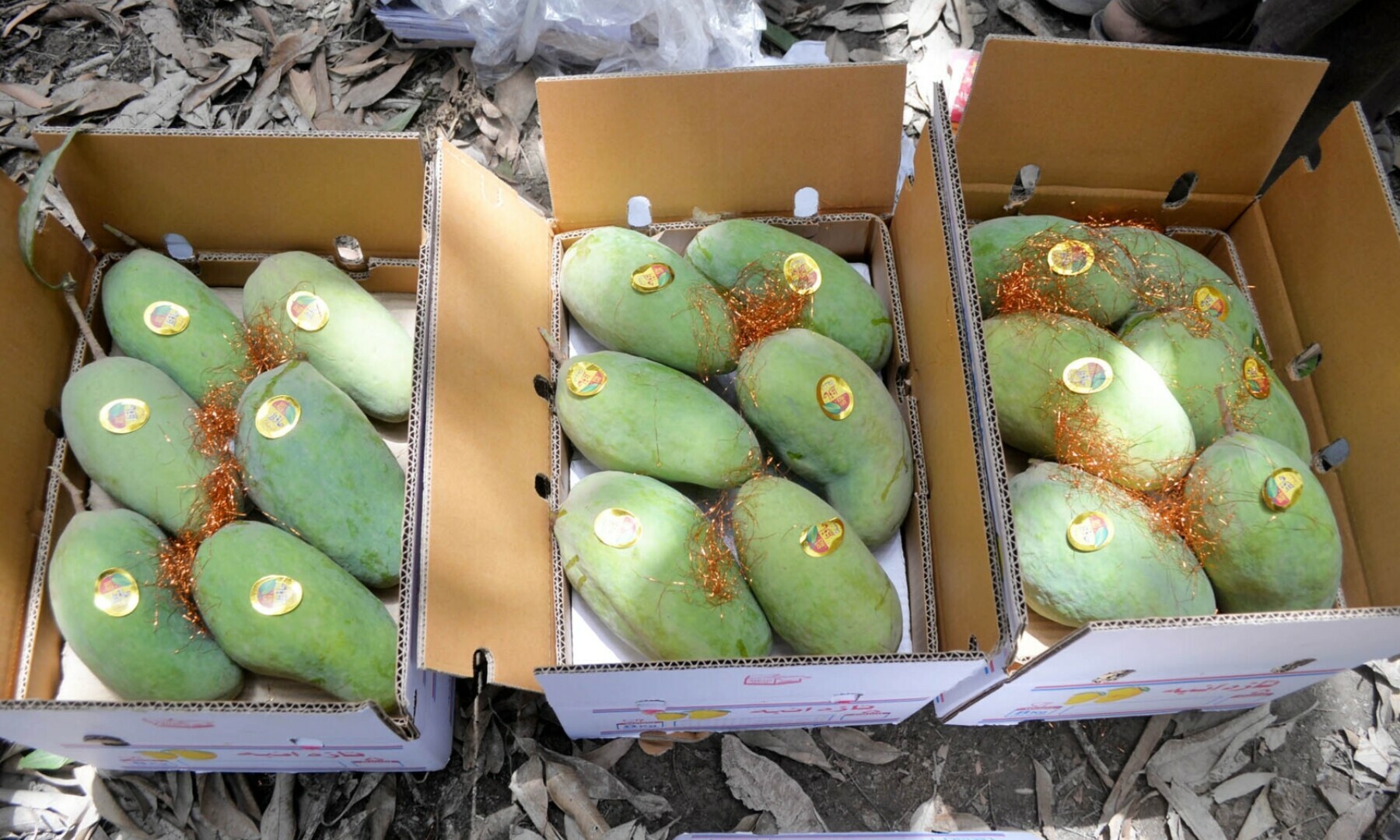
The contractor provides high-quality mangoes to exporters, besides selling them in domestic wholesale markets across Sindh, under a business deal for export to Iran. Each carton invariably carries eight to nine kilogrammes of mangoes. Exporters usually arrive in orchards after contacting contractors, while some are now working as orchard contractors themselves.

However, many growers avoid managing orchards themselves. “Handling a mango orchard and then marketing the fruit is not everyone’s cup of tea,” said Nadeem Shah, who owns an orchard in Matiari. “I tried managing it sometime back, but then backed out. It’s a tricky business that I find difficult to deal with.”
Threat to mangoes

The acreage of mango orchards has dwindled in the last five years, from 59,100 hectares in 2019-20 to 58,900 hectares in 2023-24. Mango production, however, showed a slight increase from 329,300 tonnes in 2019-20 and 387,200 tonnes in 2023-24. These figures, however, present a dismal picture when compared to a decade ago, when the acreage stood at 63,144 hectares with production of 402,514 tonnes, according to data from the Sindh agriculture department.


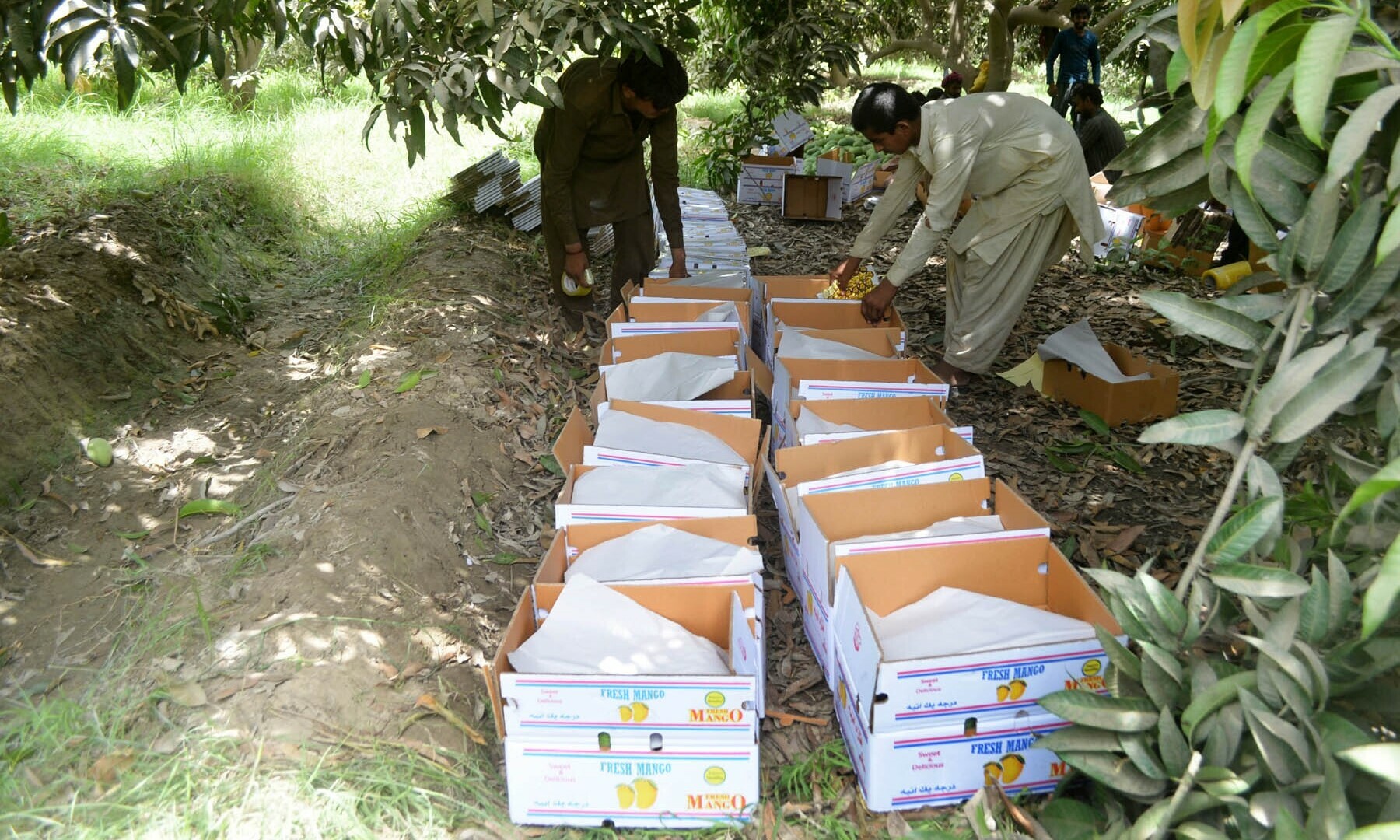
Workers filling cartons large size export quality sindhri mangoes.

Mango producers fear that the fruit’s production will drop considerably this year due to various factors. Earlier this year, mangoes suffered shocks apparently due to climate change-driven weather patterns. Severe water shortage at critical stages of flowering and fruiting in February and March was another major factor that affected the mango crop.

The water shortage has also affected Mir’s mango orchards. “Look at the size of the mango … it’s 970 grams, but this could have been more than 1,000 grams or even closer to 1,100 grams if we provided water to the orchard before harvesting,” he lamented. Watering trees before plucking makes the land underneath marshy, thus restricting the mobility of workers.


A worker arranges empty cartons before packing of fruit.

If this was not enough, a disease called malformation and a pest known as hopper damaged the crop. It was again followed by substantial damages due to powerful wind storms that visited Hyderabad, Tando Allahyar and Mirpurkhas — hub of mango production — causing massive dropping of unripe mangoes. Some signs of malformed flowers were still present in the trees.

Malformation is a disease, and growers can only control it by removing the malformed flowers as soon as they appear in the trees. According to Mahmood Nawaz Shah, a progressive grower and Sindh Abadgar Board (SAB) president, hopper is most lethal at the time of flowering.

“For the last few years, hopper attacks have become quite common. We don’t get research-oriented and evidence-based advice from the agriculture department on how to deal with it,” he regrets.

‘Axe to grind’

Zulfiqar Ali Kachelo has inherited a hefty legacy of the mango farming business in the lower Sindh region. He is a member of the fifth-generation Kachelo family, running the mango orchard trade and diversifying it from conventional trade to e-commerce. Ali’s family cumulatively owns a couple of thousand acres of mango farms in Mirpurkhas.

“I primarily stand for managing orchards myself, as it helps grow the local area’s economy,” he told Dawn.com. “We need to train local farm workers instead of relying on their counterparts from parts of the country.” He also sublets his farm, but on an alternative basis. “If I let out some part of the orchard to a contractor some year, the next year I handle it myself, which helps me learn the trade dynamics and trends.”


Workers are busy filling cartons with harvested export quality mangoes.

The issues of malformation and pests are affecting farms regularly, he said. “And we find no solution for it at the government level. The only activity the government is associated with is an annual mango festival with no productive discourse being seen there except for routine mango season’s celebrations,” he criticises.

So, he lamented, the growers depend on their own wisdom or the private sector. “But then the private sector has its axe to grind,” he said, adding that the government’s support for mango orchards, by and large, is almost zero.

SAB’s Nawaz concurred that the government’s support for farmers when it came to tackling diseases was missing. For the past three years, consistent pest attacks along with malformation have been witnessed, making farmers following progressive farm protocols extraordinarily cautious.


Export quality mangoes kept in cartons.

“They regularly used sprays to control these issues,” he says, recalling that when malformation was reported in 2023, it caused substantial losses — 20pc to 25pc in the overall mango production.

“Learning from the past, these farmers had somewhat better control in 2024,” Nawaz says. “This year again, malformation was quite massive. Growers having some knowledge applied the required sprays, but those lacking awareness lagged and suffered losses.”

This is the reason why mangoes remain undersized. The incidence of pest attack was also quite evident on the fruit in terms of its quality.

For now, however, Sindh’s mangoes continue their journey — from branches to plates and gift boxes — bringing a touch of sweetness that makes the sweltering summer heat a little more bearable. Across the board, there’s agreement: mangoes, in all their forms, sizes, and flavours, are the season’s greatest joy. But if the pressing issues plaguing mango production are not urgently addressed, we may soon risk losing the king of fruits.

Header image: A worker carries mangoes in a basket after plucking them from trees. — All photos by Umair Ali


\


‘Sweet but sinister’

The Labubu doll is the worst face of overconsumption.
Published June 29, 2025 
DAWN


The writer is an instructor of journalism


WE were living in Beijing in 1983 when our family visited us from San Francisco bearing Cabbage Patch dolls as gifts. We hadn’t heard about these soft big-eyed dolls — it’s hard to explain just how cut off from the world we were back then — but I have a clear memory of my chacha explaining the craze for them in the US.

In the 2023 documentary about these dolls, I learned that parents drove miles to buy them for their children, stood in long queues and even fought with other customers. The New York government issued a complaint against the brand that made the dolls for making too few to meet the demand. The toys set new sales records for three years and probably set in motion a frenzy for the latest toys, video games, make-up, clothes — remember the lines for lawn jora exhibitions in the early 2000s?

Perhaps we were witnessing the beginning of the scarcity mindset with the Cabbage Patch dolls — the less the product, the more the desire for it. We’ve all experienced a desire for something in our childhood and heard our parents say ‘you can’t have it’, or getting it as a reward for good grades. Today, I see the desire has been replaced with a sense of entitlement; ie, ‘I deserve the hottest thing being sold on the internet’. Everything is about instant gratification. And then instant discarding.

I wrote about the craze for certain water bottles reaching Pakistan. When you juxtapose this against us being forced to buy water, it becomes all rather absurd.


The Labubu doll is the worst face of overconsumption.

The absurdity brings me to the Labubu doll, an odd-looking small plush toy with a snaggle tooth smile. It has become a global sensation. I saw them dangling off designer bags at a mall in Dubai last week, and then went down a rabbit hole to understand why people wanted these “sweet but sinister” dolls. South China Morning Post described the frenzy as part of a trend of toys for the “kidult” sector, which is rising as buyers are “driven by nostalgia, comfort-seeking and collectability”. It also “represents a growing intersection between play and finance” and there is a resale market for them. Their scarcity creates value, the paper wrote. “Their emotional resonance creates demand.”

The doll, which was first created in 2015, retails for $20, but due to its popularity, can sell for 10 times more. It gained popularity in 2019, when toy retailer Pop Mart began releasing them as blind-box collectables; you did not know what you were getting, adding, I suppose, to an insatiable desire for more.

The Labubu doll is the worst face of overconsumption. It will likely end up in a landfill where all trends go to die. Or rather, it will kill the planet in the process of its decay. The Cabbage Patch dolls represented a new era of economic prosperity — parents had more money to spend on their children. Toys represented a new kind of social currency.

The Labubu doll certainly represents a good moment for China, which, as CNN wrote, “is a glimpse of how [its] long-awaited soft power is beginning to take shape in unexpected ways”. The unexpected came in the form of TikTok influencers and celebrity endorsements for Labubu. While reading up on this strange-looking doll, I found myself in an equally bizarre world of beauty influencers who showcase thousands of dollars of spending on make-up and skincare. I’m talking about buying dozens of blushes in one go, and shelves and cupboards filled with products to bathe an army with.

When does an obsession go too far?


China may be pushing a ‘cool product’ but when did we become such mindless consumers, ie, ‘sheeple’? Do we need to look the same? In Dubai, I saw women in baggy jeans and black cropped tops everywhere. On my flight home, almost all women were in floral coordinated sets.

Who benefits from this herd mentality? Popularity, as I always teach in class, does not mean good. I’m usually referring to TV ratings, but I’ll now extend it to leadership, which enjoys mass following and rarely allows for questioning.

I’m worried about this moment — the economic crisis which widens the disparity between the haves and have-nots, the constant anxiety around war and conflict, the water crisis in Karachi, etc. It’s easy to lose yourself to online shopping or social media, which are selling you products. It is the only place you find your dopamine rush, because the outdoors is not pleasant.

Once upon a time, you were cool if you didn’t fit in. That is not the case today. Capitalism “with a fuzzy face” wants your hard-earned rupees, and maybe we should pause and find other ways to get our dopamine rush.

The writer is an instructor of journalism.

Published in Dawn, June 29th, 2025
Bangladesh’s biggest port resumes operations as strike ends

AFP 
Published June 30, 2025 
DAWN

Bangladesh’s biggest port resumed operations on Monday after customs officials called off a strike that had disrupted the export and import of goods for around 48 hours.

Sehela Siddiqa, joint tax commissioner and secretary of the National Board of Revenue (NBR) Reform Unity Council — a platform of protesting workers — confirmed the resumption of activities at Chittagong and all other ports.

“The ports are now fully functional and operating across the country,” Siddiqa told AFP. “All employees have returned to work.”

A section of employees at the NBR, the country’s tax collection authority, has been protesting for over a month against a move by the interim government to reform the agency.

The government’s proposal includes abolishing the NBR and establishing two separate bodies to handle tax policy formulation and tax collection.

Over the weekend, some NBR staff launched what they called a “complete shutdown”, stopping work in a range of departments, including customs.

The workers resumed duties after the government threatened tough action.


The deadlock ended late Sunday night after hours of intensive negotiations between NBR staff and the Ministry of Finance, mediated by business groups.

Senior NBR official Hasan Muhammad Tarek Rikabdar said they called off the strike after positive pledges from the government.

“We welcome the government’s decision to form an advisory committee for reforms in revenue management, and we hope to contribute to the process by actively participating in it,” he told reporters on Sunday night.

Meanwhile, the Anti-Corruption Commission (ACC) has launched a probe against six NBR officials, including Rikabdar, for allegedly amassing illicit wealth.

They were accused of facilitating tax evaders in exchange for bribes.

“Based on verified allegations, the ACC initiated the investigation,” ACC Director General Md Akhter Hossain said.Follow Dawn Business on X, LinkedIn, Instagram and Facebook for insights on business, finance and tech from Pakistan and across the world.


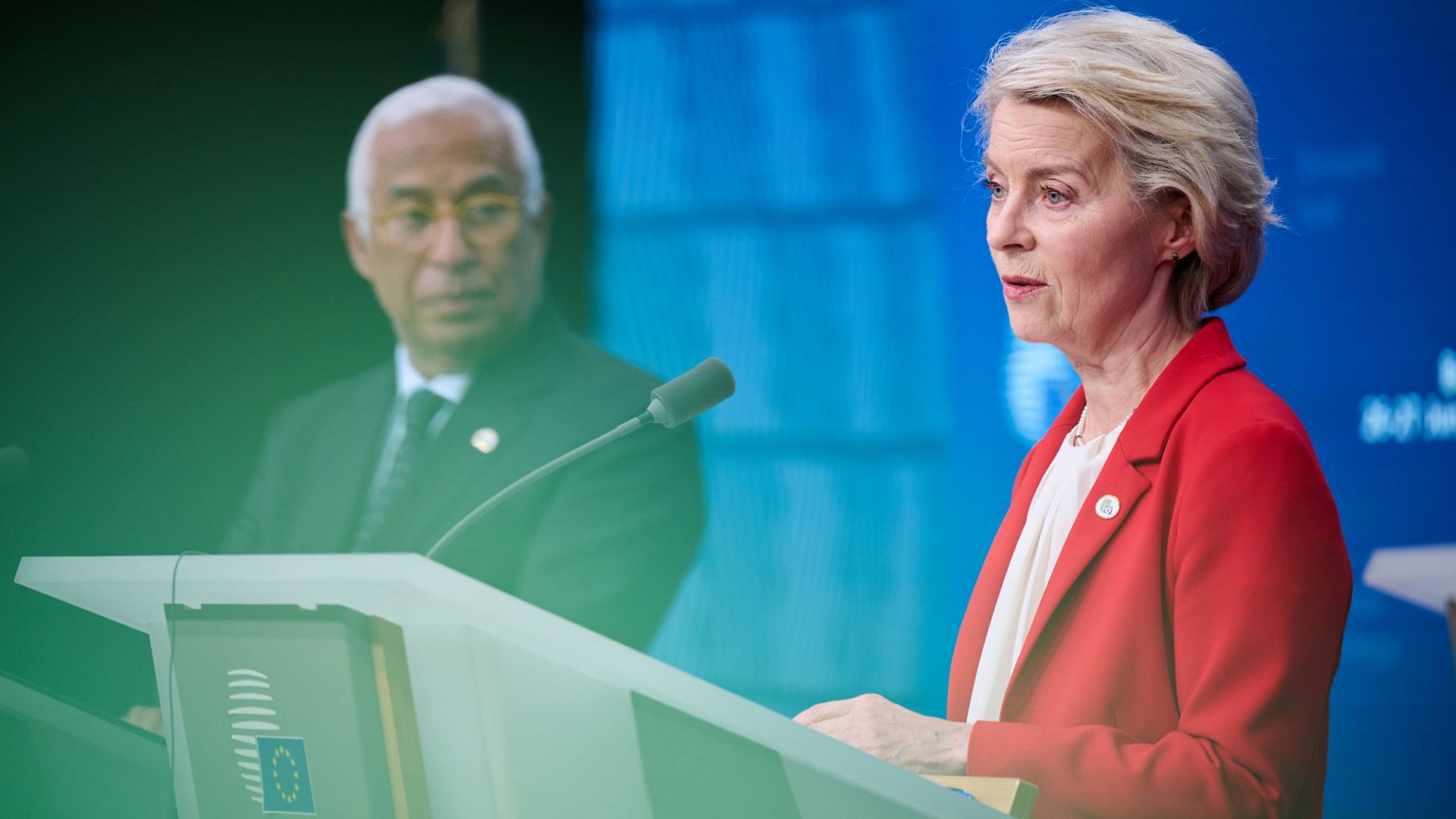
Let's create a new World Trade Organization - Von der Leyen

At the June's EU summit, Ursula von der Leyen introduced an initiative as a potential first step toward reshaping the global trade order.
Copyright European Union - Dati Bendo


By Gerardo Fortuna
Published on 

European Commission chief Ursula von der Leyen has proposed to EU leaders the launch of a Europe-led initiative to establish a structured trade cooperation with Asian countries, potentially laying the groundwork for an alternative to the gridlocked World Trade Organisation (WTO).

At Thursday’s EU summit in Brussels, European leaders discussed the possibility of overhauling the WTO’s institutional framework, including its stalled dispute resolution mechanisms, to better reflect the current global trade landscape.

“The WTO hasn’t worked for years,” German Chancellor Friedrich Merz said in a press conference following the summit, referencing persistent dysfunction under both the Trump and Biden administrations.

Commission President Ursula von der Leyen presented leaders with different options of trade deals, labelling as the most attractive a closer cooperation between the EU and members of the Comprehensive and Progressive Agreement for Trans-Pacific Partnership (CPTPP), a regional trade pact of 11 Pacific Rim countries and the UK.

She introduced the initiative as a potential first step toward reshaping the global trade order.

“I said that we can think about this as the beginning of redesigning the WTO—of course, understanding what should be reformed positively within it,” von der Leyen told reporters after the summit.

She stressed the importance of learning from the WTO’s shortcomings and showing the world that “free trade based on rules” remains achievable with a wide group of willing partners.

“This is a project we should truly engage in. CPTPP and the European Union—that’s my team,” she said, adding that the EU must take the lead in managing this initiative.

Asked whether the United States should be involved, von der Leyen replied: “As far as I understand, the Americans left the CPTPP at a certain point.”

This is not the first attempt to circumvent the WTO’s paralysis. As a stopgap measure, 57 WTO members, including the UK, Paraguay, and Malaysia, have joined the Multi-Party Interim Appeal Arbitration Arrangement (MPIA), a mechanism that replicates the WTO Appellate Body’s functions for participating members.

However, the MPIA covers only 57.6% of global trade and does not address the broader institutional crisis.

The WTO has been effectively paralysed since December 2019, when the US began blocking appointments to the Appellate Body, rendering the two-tier dispute settlement system non-functional.

Major trade negotiations—such as those on eliminating harmful fisheries subsidies and reforming agricultural rules—remain stalled due to entrenched positions from key members, including the US, China, Japan, and the EU itself.

With few signs of resolution, the WTO’s future relevance is increasingly being called into question.

Glastonbury controversy explained: Police investigate Kneecap and Bob Vylan setsFREE GAZA! FUCK KEIR STARMER!Copyright AP PhotoBy  David Mouriquand - EURONEWSPublished on 30/06/2025 - 

Musicians making headlines for their politics isn't new, but this year’s Glastonbury featured two sets by Kneecap and Bob Vylan that riled politicians – including UK Prime Minister Keir Starmer. Police are investigating both concerts.

This year’s Glastonbury, Britain's biggest summer music festival which draws some 200,000 music fans each year to Worthy Farm in southwest England, has come to an end. And it’s been one of the most controversial editions in recent memory.  

Controversial Belfast rappers Kneecap and their weekend slot made headlines in the lead-up to the festival, after several MPs, including Prime Minister Keir Starmer, called on Glastonbury to pull the band from the line-up, due to their defiant pro-Palestinian remarks and band member Mo Chara being charged with a terror offence.  

Still, the band played and were supported by Glastonbury co-organiser Emily Eavis, who said that “everyone is welcome.” 

Her father, festival founder Michael Eavis, added: “People that don’t agree with the politics of the event can go somewhere else!” 

Still, controversy was inevitable...  

Kneecap cause a ruckus

Kneecap perform during Glastonbury Festival in Worthy Farm
Kneecap perform during Glastonbury Festival in Worthy FarmAP Photo

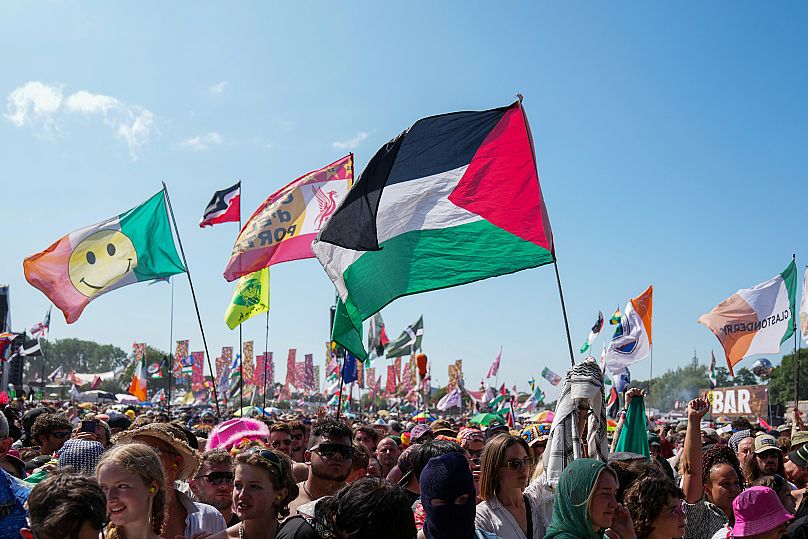
As predicted, Kneecap delivered an incendiary set at Glastonbury, on the West Holts stage, to a huge crowd waving countless Palestinian flags. 

Many Palestinian flags were waved during Kneecap's performance
Many Palestinian flags were waved during Kneecap's performance AP Photo

The BBC, the festival’s broadcaster partner, said in a statement just hours before the band took to the stage that their set wouldn’t be streamed live and would instead be made available as an on-demand version after the end of the gig.  

Previously, Conservative Party leader Kemi Badenoch said she thought the BBC "should not be showing" Kneecap's performance at the festival: "The BBC should not be showing Kneecap propaganda. One Kneecap band member is currently on bail, charged under the Terrorism Act. As a publicly funded platform, the BBC should not be rewarding extremism. 

Kneecap at Glastonbury
Kneecap at GlastonburyAP Photo

The trio, DJ Próvaí, Mo Chara and Móglaí Bap, came on stage with screens showing their usual message: “Israel is committing genocide against the Palestinian people, aided by the UK government. Free Palestine.” This message was galvanized during the set when the band said: “There’s no f*cking hiding it, Israel are war criminals.” 

“Glastonbury, I’m a free man,” also declared Chara, referring to being given unconditional bail from his appearance on his terror charge.

“Mo Chara was in court this month,” said Bap. “Was anyone there? Mo Chara’s in court for a trumped up terrorism charge. It’s not the first time there was a miscarriage of justice for an Irish person in the British justice system”. 

Chara then mentioned Keir Starmer – who argued that it was “not appropriate” for the band to be playing at Glastonbury: “The Prime Minister of your country said he didn’t want us to play, so f*ck Keir Starmer.” 

They echoed this sentiment when introducing their fan favourite song ‘Get Your Brits Out’, with Chara telling the crowd: “We f*cking love the English people, it’s the English government we can’t stand. F*ck Keir Starmer.” 

The band ended their set by thanking Glastonbury festival for their support of the band and for Palestine, with Bap stating: “One day it will be controversial for the people that didn’t speak about Palestine,” with Chara agreeing: “Remember those c*nts, we will remember them.” 

However, their set was not the only controversial moment of this year’s highly politicised edition... In fact, their lightning may have been stolen by an earlier act.  

Bob Vylan: Controversy before Kneecap’s set

Bob Vylan perform on the West Holts Stage during Glastonbury Festival
Bob Vylan perform on the West Holts Stage during Glastonbury Festival AP Photo

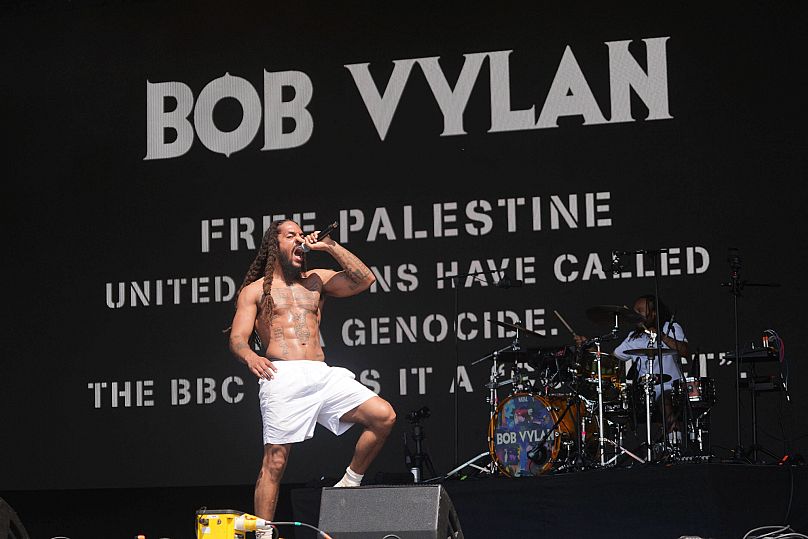
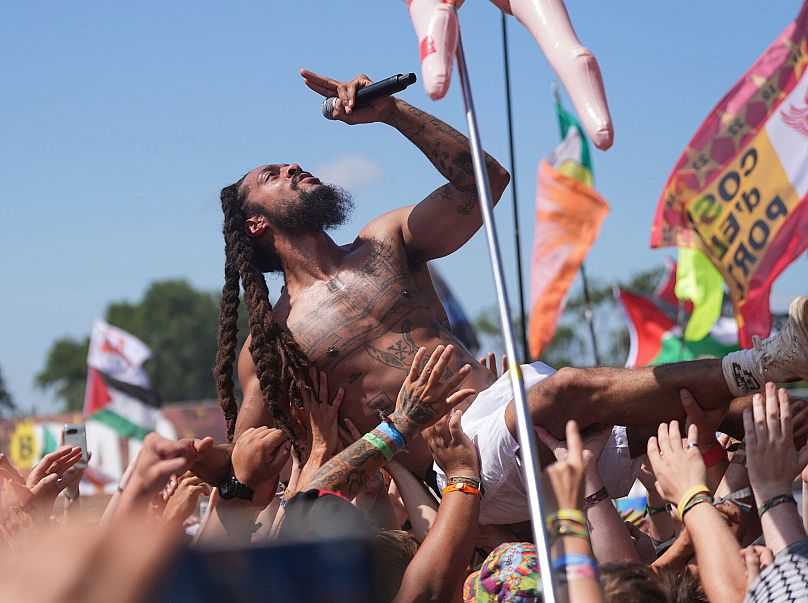
Before the Kneecap set, rap-punk duo Bob Vylan also caused controversy by leading the crowd in chants of: "Free, free Palestine" and "Death, death to the IDF (Israel Defence Forces)." 

The BBC said it issued a warning on screen about “very strong and discriminatory language” during the live stream. 

Still, that wasn’t the end of it.  

The Israeli Embassy to the UK said on social media that it was “deeply disturbed by the inflammatory and hateful rhetoric expressed on stage at the Glastonbury Festival," while the Campaign Against Antisemitism (CAA) said it will be formally complaining to the BBC over its "outrageous decision" to broadcast the performance.

In a statement, Prime Minister Keir Starmer said: "There is no excuse for this kind of appalling hate speech." The Prime Minister also reiterated his previous argument that Kneecap should have been removed from the line-up: "I said that Kneecap should not be given a platform and that goes for any other performers making threats or inciting violence. The BBC needs to explain how these scenes came to be broadcast." 

Bob Vylan performs on the West Holts Stage during the Glastonbury Festival
Bob Vylan performs on the West Holts Stage during the Glastonbury FestivalAP Photo

Even Emily Eavis posted a response to Bob Vylan's performance. 

"Their chants very much crossed a line and we are urgently reminding everyone involved in the production of the Festival that there is no place at Glastonbury for antisemitism, hate speech or incitement to violence," she wrote. 

She added that while "as a festival, we stand against all forms of war and terrorism - we will always believe in - and actively campaign for - hope, unity, peace and love", adding a performer's comments "should never be seen as a tacit endorsement of their opinions and beliefs". 

Eavis added: "With almost 4,000 performances at Glastonbury 2025, there will inevitably be artists and speakers appearing on our stages whose views we do not share." 

British Police said that they were assessing footage of the performance to decide whether any offences may have been committed

Who are Bob Vylan?

Bob Vylan perform on the West Holts Stage
Bob Vylan perform on the West Holts StageAP Photo

Bob Vylan are a punk-rap duo known for their politically charged lyrics which tackle racism, homophobia, police brutality and far-right politics.  

The two members keep their real names secret and are known as Bobby Vylan and Bobbie Vylan.

Formed in Ipswich in 2017, the band has released five albums – 'Vylan' (2017), 'Dread' (2019), 'We Live Here' (2020), 'Bob Vylan Presents The Price Of Life' (2022), and last year's 'Humble As The Sun'.  

They have won several awards, including Best Alternative Act at the MOBOs in 2022.  

Like Kneecap, the duo has been outspoken on the war in Gaza. 

A UN report has found that Israel’s military actions are consistent with genocide, and at least 56,000 Palestinians have been killed, according to the Gaza Health Ministry. 

Israel has continually denied that their actions in Palestine can be equated to genocide and argued that it has not partaken in any war crimes.

Europe swelters in summer's first heatwave as climate change intensifies

Southern Europe sizzled Saturday in the season's first heatwave, as climate change continues to drive temperatures higher on the world's fastest-warming continent. Rome braced for 37°C (99°F), sending tourists and Catholic pilgrims scrambling towards the capital's 2,5000 public fountains to cool off.


Issued on: 28/06/2025 -
By:
FRANCE 24
Video by:
FRANCE 24

01:32
Scientists warn that humanity's burning of fossil fuels is causing ever-hotter summers. © Stefano Rellandini, AFP


Southern Europeans braced Saturday for their first heatwave of the northern hemisphere summer, as climate change pushes thermometers on the world's fastest-warming continent increasingly into the red.

Scientists have long warned that humanity's burning of fossil fuels is heating up the world with disastrous consequences for the environment. Europe's ever-hotter and increasingly common blistering summer heatwaves are a direct result of that warming, they argue.

In Italy, 17 cities -- from Milan in the north to Palermo in the south -- were put on red alert for high temperature, with peaks recorded of 39 degrees Celsius (12 Fahrenheit).

In Rome, the high temperatures drove the Eternal City's many tourists and pilgrims towards its 2,500 public fountains for refreshment.


And in Venice, visitors to -- and protesters against -- Amazon tycoon Jeff Bezos's Friday wedding in Venice sweltered in the extreme heat.

"There is no wind, a lot of humidity, we are sweating, and I'm suffocating at night," Alejandra Echeverria, a 40-year-old Mexican tourist to the city, told AFP on Saturday.
A man in Venice uses an umbrella to protect himself from the heat. 
© Marco Bertorello, AFP

Sunday forecast hotter


In France, as temperatures in the southern port city of Marseille flirted with 40C, the city's authorities ordered public swimming pools be free of charge to help residents beat the Mediterranean heat.

Two-thirds of Portugal will be on high alert on Sunday for extreme heat and forest fires, with 42C (108F) expected in the capital Lisbon.

The heatwave is forecast to become even more intense on Sunday.

Spain, which has in past years seen a series of deadly summer blazes, is expecting peak temperatures in excess of 40C (104F) across most of the country.

According to AEMET, Spain's meteorological agency, El Granado in the southwest Huelva region recorded 46 Celsius (114F), which if confirmed would be the hottest temperature ever recorded in Spain during June.

The past three years have been the hottest in Spain's history.


Tourists by the Bridge of Sighs in Venice walking in the heat. 
© Marco Bertorello, AFP

Precautionary measures


With peaks of 39C (102F) expected in Palermo, Sicily has ordered a ban on outdoor work in the hottest hours of the day, as has the Liguria region in northern Italy.

The country's trade unions are campaigning to extend the measure to other parts of the country.

And in France, where heatwave alerts were extended Saturday across the country, the central city of Tours ordered schools there closed on Monday and Tuesday in the afternoon.

The nearby city of Orleans had already made access to some air-conditioned museums free and announced it was keeping parks and gardens open late.

In the French Mediterranean city of Nice, where the mercury hit 33 Celsius at midday (91F), residents and tourists were seeking refuge in misted parks and museums.

"We're not going to stay cooped up all day," said one retiree resting in the shaded Promenade du Paillon, a central greenway.

Watch moreClimate change and Europe's ‘suffocatingly’ hot heatwaves

Families with young children flocked to water jets and cooling sprays.

"We live in a city-centre flat without a pool, and the sea is tricky with a two-year-old," said Florence Oleari, a 35-year-old GP.

At the Albert I garden, organisers of a triathlon to be held on Sunday briefed 4,000 competitors on emergency measures, including ice stations and electrolyte stations.

"If I feel unwell, I'll stop," said Frederic Devroye, a participant who travelled from Brussels for the triathlon, which includes a 3.8 km swim, a 180 km cycle with 2,600 m of elevation, and -- to top it off -- a marathon. Local authorities have distributed nearly 250 fans to schools over the past fortnight, while tourists like Jean-Luc Idczak opted to explore Nice's air-conditioned museums to keep cool.

"With this weather, it's perfect," he said as he entered the city's photography museum.

In Seville, where forecasts suggested temperatures could reach up to 43 degrees Celcius, locals and tourists used handheld fans and caps to shield themselves from heat.

"Lots of cream, sun protection, on the face, everywhere, and very light clothing," said Marta Corona, a 60-year-old tourist holding a fan.

"People come asking for water and drinks, that's what sells, because with this heat you have to cope somehow," said Fernando Serrano, a 69-year-old kiosk owner at his stand.

The heatwave comes hot on the heels of a series of tumbling records, including Europe's hottest March ever, according to the EU's Copernicus climate monitor.

According to Copernicus and the World Meteorological Organization (WMO), Europe has been warming at roughly twice the global average since the 1980s.

As a result of the planet's warming, extreme weather events including hurricanes, droughts, floods and heatwaves like this weekend's have become more frequent and intense, scientists warn.

By some estimates 2024, the hottest year in recorded history so far, saw worldwide disasters that cost more than $300 billion.

(FRANCE 24 with AFP)

FASCIST EUROPE

Bulgarian anti-euro campaigners set up protest camp in Sofia

SLAVIC ARYANISM

Bulgarian anti-euro campaigners set up protest camp in Sofia


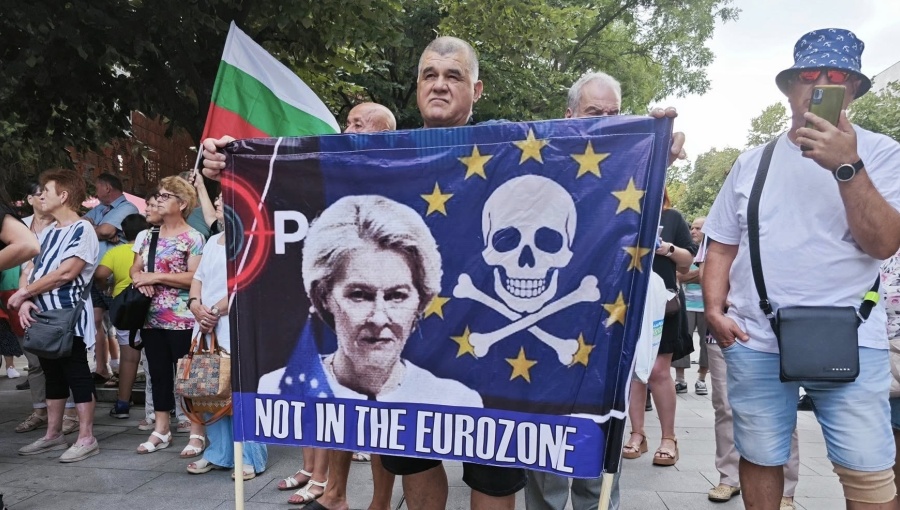
Protesters against euro adoption in central Sofia. / Vazrazhdane via Facebook


By Denitsa Koseva in Sofia June 29, 2025

Bulgarian anti-euro campaigners have set up a protest camp in the centre of Sofia dubbed the ‘City of the Lev’. 

The 10-day protest was launched after Bulgaria was given a green light for eurozone entry by the European Central Bank and the European Commission, which issued positive convergence reports at the beginning of June. Bulgaria is expected to join the eurozone on January 1, 2026. 

However, Bulgaria’s adoption of the euro has faced strong opposition by the far-right pro-Russian Vazrazhdane party and President Rumen Radev. 

The Civil Committee for Protection of the Lev, in which Vazrazhdane is involved, launched the 10-day protest on June 28. Campaigners plan to block the centre of the Bulgarian capital Sofia until July 8, when the final decision on the country’s accession to the eurozone should be taken by the ECOFIN committee.

Vazrazhdane claimed in a statement on its website that Bulgarians are being forced to enter the eurozone by Brussels, and has launched a campaign under the slogan ‘The fight for the lev is the last fight for Bulgaria”.

Subsequently, the party’s leader Kostadin Kostadinov, dubbed Kostya Kopeikin because of his open pro-Russian orientation, said during a plenary parliament session that the party will destroy the eurozone from the inside.

While the protests are not expected to gather strong support, citizens of Sofia launched a petition urging the local authorities to ban the blockade of the centre, calling it a civil harassment.

Those signing the petition demand that Sofia city municipality annul its permission for the blockade and explain why it has allowed “occupation of the city by a specific political party”.

Meanwhile, Vazrazhdane initiated  a fresh no-confidence motion against the government of Prime Minister Rossen Zhelyazkov because of its eurozone entry activities and alleged failure in financial policy. As the Gerb-led ruling coalition has a comfortable majority, the vote is expected to fail.

Thousands block roads in another night of Serbian anti-graft protests

Thousands of demonstrators blocked the streets in Serbian cities on Sunday in the second consecutive night of anti-graft protests. President Aleksandar Vucic dismissed protestors demand to call snap elections.


Issued on:  30/06/2025 
By: FRANCE 24


Protesters light up mobile phones as they demonstrate in front of the prosecutors offices calling for the release of their peers who were detained in protests the previous night. © Oliver Bunic, AFP


Thousands of protesters blocked major roads in Belgrade and other Serbian cities on Sunday, as demonstrations calling for snap elections continued into a second night following Saturday's huge rally in the capital.

On Saturday, around 140,000 people rallied in central Belgrade, the latest gathering in over half a year of demonstrations triggered by the collapse of a train station roof in the city of Novi Sad in November, killing 16 people in a disaster widely blamed on shoddy construction resulting from entrenched corruption.

Anti-graft activists, responding to the arrest of a "large number of citizens" in the wake of the protest, called for more action - with thousands responding to set up dozens of blockades around the capital.

At the key Autokomanda junction, protesters were setting up tents preparing to stay overnight, according to an AFP photographer.


Protesters posted images of similar blockades from several other cities, including Novi Sad, and published plans for dozens of similar protests around the country.

Local media and videos posted by protesters showed large crowds streaming onto major bridges, and students forming barriers from bins and fences.

Serbian Interior Minister Ivica Dacic told local station Pink TV that authorities were monitoring the situation.

Earlier on Sunday, President Aleksandar Vucic remained defiant against protesters' demands for early elections, accusing the student-led movement of causing "terror"

One monitor said 140,000 protesters marched in Belgrade on Saturday. © Djordje Kostic, AFP

"Serbia has won, and you cannot defeat Serbia by violence as some wanted," Vucic said in a televised speech.
'Not a moment for withdrawal'

Clashes with police after Saturday's rally ended with dozens of arrests, as riot officers used tear gas and batons to attempt to disperse a crowd that also threw bottles and flares.

Authorities said 48 officers had been injured, one seriously, and put the crowd size at 36,000 -- well below an independent estimate by the Archive of Public Gatherings of around 140,000.

Dacic said 22 people had sought medical help, of whom two were seriously injured.

Ahead of Sunday's blockades, eight people were arrested on accusations including planning to block roads and attack state institutions "in order to violently change the state order", the Higher Prosecutor's Office said in a statement.

Police said they had detained 77 people, with 38 still in custody following Saturday's rally.

"This is not a moment for withdrawal," protest organisers said on Instagram, encouraging people to gather outside the prosecutors' office and demand their release.

But Vucic insisted "there will be many more arrested for attacking police. This is not the end."

He said there would be "no negotiations with terrorists and those who want to destroy the state".
'Take freedom'

Ahead of Saturday's protest, organisers had issued an "ultimatum" for Vucic to call elections -- a demand he had dismissed well before the rally began.

On Sunday, he reiterated there would not be any national vote before the end of 2026.

The outcry over the Novi Sad disaster has already led to the resignation of the country's prime minister and a cabinet reshuffle.

Vucic has repeatedly alleged the protests are part of a foreign plot to destroy his government.

More than a dozen people have been arrested in recent weeks, a crackdown that has now become routine ahead of large demonstrations.

After the rally, organisers played a statement to the crowd calling for Serbians to "take freedom into your own hands".

"The authorities had all the time to meet the demands and prevent an escalation," the organisers said in a statement.

(FRANCE 24 with AFP)