It’s possible that I shall make an ass of myself. But in that case one can always get out of it with a little dialectic. I have, of course, so worded my proposition as to be right either way (K.Marx, Letter to F.Engels on the Indian Mutiny)
Monday, August 18, 2025
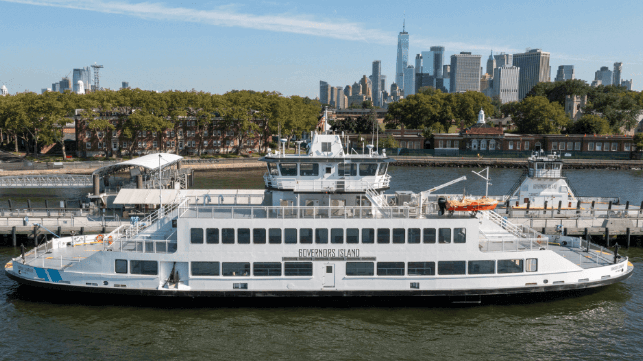
New York Welcomes Hybrid-Electric Ferry for Governors' Island
Photo by Timothy Schenck, courtesy of Trust for Governors Island
New York City is celebrating its first hybrid-electric public ferry, christened Harbor Charger, which is being praised for ushering in a new era of sustainable maritime transportation in the state. The state announced that the new $33 million vessel entered service on August 13, transporting tourists and locals from Lower Manhattan to Governors Island.
The commissioning of the vessel is being hailed as a major milestone in New York’s quest to chart a course toward a cleaner and more sustainable future. Built by Conrad Shipyard in Morgan City, Louisiana, Harbor Charger is the state’s first hybrid-electric public ferry, and will have a capacity to carry up to 1,200 passengers and 30 vehicles cruising at a speed of 10-12 knots. This means she has the ability to travel at speeds up to 66 percent faster than current ferries, paving the way for passengers to reach Governors Island quickly.
The vessel's name came following a citywide competition that drew more than 800 submissions, with the winning name being submitted by David Kurnov.
The Harbor Charger is equipped with Siemens Energy’s BlueDrive Eco diesel-electric propulsion system, BlueVault battery solution, and EcoMAIN monitoring technology, effectively making the craft among the most environmentally-friendly. The hybrid propulsion system has the capability to reduce carbon dioxide emissions by nearly 600 tonnes annually, helping towards net-zero goals.
The ferry’s efficiency is expected to be boosted once the state completes the construction of shoreside charging facilities, which will reduce emissions by an additional 800 tonnes annually. The Trust for Governors Island Trust has already secured $7.5 million in federal funding from the US Federal Transit Administration to finance the project, which is designed to make the Harbor Charger fully electric.
Designed by Elliot Bay Design Group, the vessel features modern amenities including a lower-level ADA-accessible lounge, and restrooms on each level that are expected to enhance passenger experience. Notably, her launch coincides with the 20-year anniversary of Governors Island opening to the public.
“Twenty years ago, Governors Island opened to the public for the first time, creating a green, clean, sustainable space for New Yorkers to enjoy. Today, we are doubling down on that legacy with the launch of this first-of-its-kind electric ferry,” said Eric Adams, New York City Mayor.
The commissioning of the Harbor Charger now paves the way for the state to decommission the diesel-powered Lt. Samuel S. Coursen, a passenger ro/ro ferry that has been in service for seven decades, having been commissioned by the U.S. Army in 1956. Coursen is slated for retirement from service later this year.
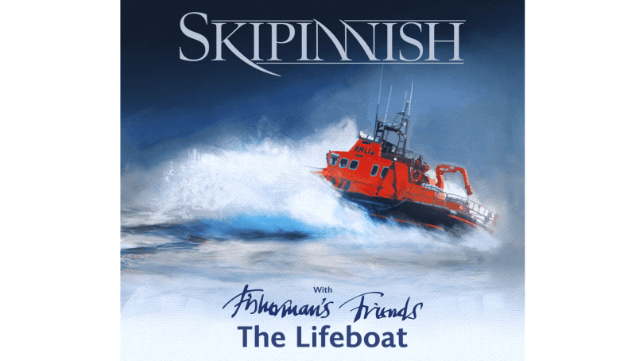
Sunderland Marine Champions Lifeboat Heroes in New Skipinnish Single
Internationally renowned Fisherman’s Friends join Skipinnish on the track. ‘The Lifeboat’ available to download on Friday 15 August 2025 - Proceeds go to Royal National Lifeboat Institute (RNLI)
Sunderland Marine, part of global marine insurer NorthStandard, has announced its contribution to the release of "The Lifeboat," a stirring new single by Celtic music icons Skipinnish featuring renowned sea shanty group The Fisherman’s Friends. The song is a tribute to two centuries of bravery by Royal National Lifeboat Institute (RNLI) volunteers, honouring their courageous service saving lives at sea under the most challenging conditions – including the North East shores.
Written by Skipinnish co-founder, lifelong fisherman and Sunderland Marine member, Angus MacPhail, "The Lifeboat" reflects the selfless dedication of RNLI crews who are ready to respond to emergencies at a moment’s notice. Sunderland Marine’s sponsorship has been instrumental in supporting the production and promotion of this tribute, which will donate all proceeds to the RNLI.
The connection is personal for Sunderland Marine, which has deep roots in the North East’s maritime community. Sunderland’s own RNLI Lifeboat Station is the oldest operational station in Great Britain, and has protected seafarers for over 200 years.
Angus MacPhail said: “Having lived my life around the sea, I know firsthand the extraordinary dedication of lifeboat volunteers. Sunderland Marine’s support has been invaluable in bringing this tribute to life, helping us share the story of the selfless bravery that saves lives every day.”
Craig McBurnie, Head of Sunderland Marine, added: “At Sunderland Marine, we are proud to support a project that celebrates the life-saving work of the RNLI and the spirit of the maritime community. This single reflects values we share, including courage, commitment, and a deep connection to the sea.
“This sponsorship is part of an ongoing commitment to supporting the maritime and fishing industries, and the communities we serve.”
The North East’s insurer is committed to supporting sustainability and safety in the sector, as demonstrated by its previous initiatives such as backing the Whitby Lobster Hatchery and funding coastal fishing line recycling schemes, reinforcing its role as a responsible partner in regional maritime heritage.
"The Lifeboat" will be officially released on Thursday, 14th August, accompanied by a music video launch. The single will be performed live by Skipinnish and The Fisherman’s Friends at Skipinnish’s headline concert at Glasgow’s OVO Hydro on 27th September 2025.
The products and services herein described in this press release are not endorsed by The Maritime Executive.
Maritime Industry Must Act if it is to Achieve a Sustainable Blue Economy
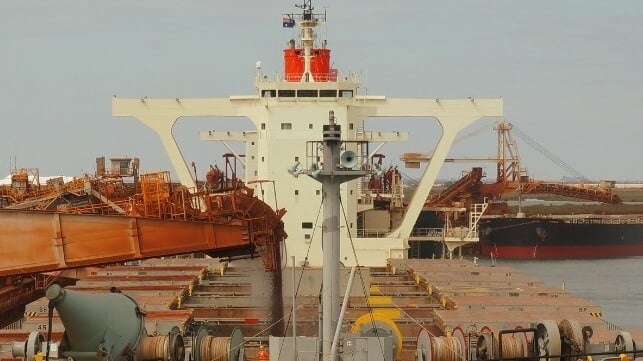
Bulker loading iron ore at Port Hedland, where BV, Fortescue, K Line and partners are exploring a green ammonia-powered shipping corridor (iStock / Ngataring)
Bureau Veritas Marine & Offshore’s Executive Vice President, Matthieu de Tugny, addresses what is required of class societies if the maritime industry is to achieve a sustainable blue economy.
The maritime industry is currently experiencing a sustained period of growth, with shipping and port industries representing 40% of the ocean economy’s total worth, which today stands at $2.2 trillion. This growth is reflected in the current global orderbook, which – according to the Clarksons newbuilding price index – has seen a 45% increase in newbuild orders since 2021. However, this economic strength is tempered by mounting challenges that cannot be ignored.
Geopolitical instability continues to disrupt maritime operations on a day-to-day basis, whilst elevating the safety risks for seafarers operating within the affected regions. Simultaneously, an unpredictable policy environment is reshaping global trade routes, while shipowners and operators face significant regulatory demands in an effort to cut carbon emissions, pressures that are only expected to increase over the coming years.
Following the outcomes of MEPC 83, the maritime industry awaits the likely introduction of the IMO’s Net Zero Framework (NZF) in October. If enacted, these measures will establish mandatory marine fuel standards and GHG emissions pricing for shipping. The NZF will join a complex regulatory environment such as FuelEU Maritime and the EU Emissions Trading System (EU ETS), creating escalating compliance costs for shipowners. Recent reports highlight the scale of this requirement, stating that the EU ETS alone will cost the industry approximately $6 billion in 2025, rising to an estimated $51 billion by 2030. Furthermore, it is clear that shipowners are struggling to manage the evolving complexity of the newly introduced regulations. According to recent reports, less than 40% of shipping companies met the deadline for their first year of verified emissions reporting under EU ETS.
In response to this dynamic yet uncertain environment, it is understandable that owners may be choosing a “wait-and-see” approach when it comes to engaging with emerging clean technologies. Although first movers may gain a reputational advantage that may attract end customers that are committed to specifying zero-carbon fuel in their tender requirements, for the majority of vessels, the safest financial option is to wait for greater certainty within the current landscape.
However, if the maritime industry is to meet the IMO’s net-zero GHG target by 2050 – not to mention the 20% GHG emissions reduction checkpoints in 2030 – systemic transformation is required in terms of how we finance, fuel and operate the global fleet. Financial institutions that underpin the shipping industry must embrace green financing models that link capital with climate performance. Furthermore, if the current alternative fuels deadlock is to be overcome, the industry must focus on continuing to establish more green corridors as a viable means of synchronizing the development of ships, ports, fuels, and regulatory policies to support zero-emission trade.
As a leading classification society, Bureau Veritas Marine & Offshore (BV) has been working in a risk capacity alongside industry partners, including Fortescue, K Line, and the Australian Renewable Energy Agency, to support the development of the Australia–Japan iron ore corridor. This route is centered around the development of green ammonia, with fuel production in Pilbara, bunkering facilities in Port Hedland, and end-use in Kobe.
This fundamental change also involves the need to address the historic inefficiencies that the industry has operated under for centuries. Practices such as “sail fast, then wait” (SFTW), which denotes the practice of vessels speeding to their destination and then idling at anchor whilst they wait for an available berth at port. However, new initiatives such as the Blue Visby Solution seek to address this ineffective practice. Developed by the Blue Visby Consortium, this multilateral platform utilizes a unique algorithm to provide participating vessels with optimized arrival times that allow them to slow steam. This can reduce shipping emissions by approximately 15% and, based on 2019 figures, has the potential to remove approximately 45 million tonnes of CO2 across the tanker and bulker fleets.
The role of classification societies is central to the success of the industry’s transition. However, whilst maintaining the traditional role of class as custodians of change within the industry, BV is increasingly acting as an enabler of enhanced collaboration throughout the maritime value chain. By utilizing its extensive industry expertise, BV represents a trusted and impartial advisor that facilitates the integration of energy-saving devices and operational measures to cut fuel consumption, whilst providing modeling scenarios and detailed data insight to support evolving financing schemes that will accelerate the development of advanced zero-carbon fueled vessels.
The industry has certainly made crucial progress in its pursuit of Net Zero, but this momentum must be sustained. This can only be achieved through pragmatic, decisive action that works in tandem with global supply chain partners. Only through this consolidated effort will we unlock the potential of a truly sustainable blue economy.
To learn more about what is required to achieve and sustain the ocean economy you can now read Towards a Sustainable Blue Economy, written by Bureau Veritas Marine & Offshore’s Executive Vice President, Matthieu de Tugny.
The opinions expressed herein are the author's and not necessarily those of The Maritime Executive.
Samskip Joins DCSA+ to Champion Standardization
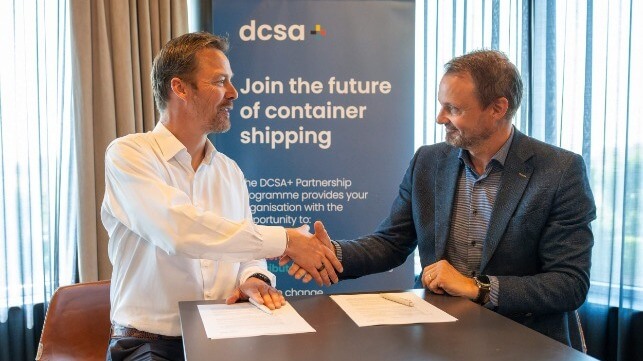
Thomas Bagge, CEO at Digital Container Shipping Association (DCSA) (left) and Ragnar Ragnarsson, CIO at Samskip (right)
Samskip, one of Europe’s leading logistics service providers, has officially joined the DCSA+ partnership program, reinforcing its commitment to digital innovation, interoperability, and the evolution of global logistics standards.
By becoming part of this influential network, Samskip takes a leading role in shaping the digital frameworks that will power tomorrow’s logistics, frameworks built on openness, collaboration, and efficiency.
“We believe the future of logistics relies not just on smart systems, but on a shared digital language,” said Ragnar Thor Ragnarsson, Chief Information Officer at Samskip. “By joining the DCSA+ Partner Program, we have the opportunity to help shape future industry standards that enhance not only our own multimodal operations but also the entire logistics ecosystem. Stronger standards lead to greater reliability, efficiency, and service quality for everyone.”
As a multimodal pioneer operating across shortsea, rail, road, and inland waterways, Samskip brings a unique perspective to the DCSA+ community. Its participation bridges the gap between ocean container carriers and inland transport operators, contributing critical insight into aligning systems, reducing fragmentation, and streamlining data flow across complex supply chains.
The DCSA+ program was launched to accelerate the adoption of open digital standards by including all key logistics stakeholders from ports and tech providers to shortsea operators and forwarders. It aims to:
Connect industry partners with proven standards,
Accelerate real-world implementation,
and Contribute to the evolution of new, practical solutions.
Samskip’s involvement ensures that multimodal inland transport, often overlooked in ocean-focused frameworks, has a seat at the table in shaping a truly end-to-end digital transformation. Through the collaboration, Samskip gains early access to API (application programming interface) and messaging standards, increased interoperability with customers and partners, and the opportunity to streamline internal processes while helping push the entire industry forward. This initiative complements Samskip’s ongoing collaboration with SMDG, further reinforcing its dedication to modernizing digital communication through both traditional EDIFACT formats and cutting-edge APIs.
“Through DCSA+ and SMDG, we are doubling down on our commitment to reliable, visible, and simplified transport while showing what’s possible when we listen, align, and innovate together,” added Ragnarsson.
The products and services herein described in this press release are not endorsed by The Maritime Executive.
Report: India's Top Bank Pulls Back From Russian-Supplied Refinery
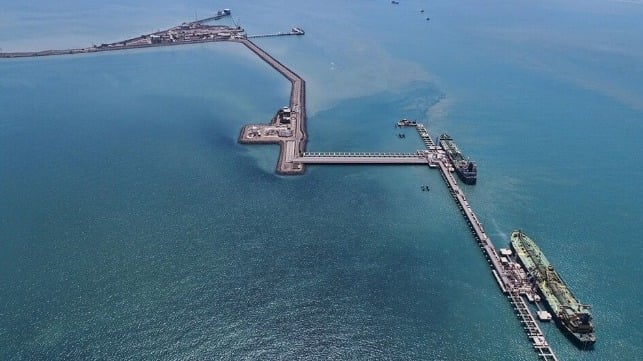
The pier for the Vadinar refinery (Nayara Energy / CC BY SA 4.0)
After the EU imposed sanctions on the Russian-owned, India-based refiner Nayara Energy, the State Bank of India has decided to stop handling international transactions on Nayara's behalf. The decision also follows President Donald Trump's announcement of an extra tariff penalty on India for its continued importation of Russian oil.
Nayara operates the Vadinar refinery, the second-largest in India, capable of processing about 400,000 barrels per day. Russian state energy giant Rosneft is the largest shareholder with 49 percent of Nayara; another 49 percent stake is owned by joint venture Kesani Enterprises, itself half-owned by Russian investment fund United Capital Partners, based in Moscow.
The Vadinar refinery receives about 70-90 percent of its crude oil supply from Russia, and exports a large share of its refined products to foreign countries - including, until recently, nations in Europe. The company also has its own retail distribution network throughout India, and has the option of redirecting its sales efforts towards domestic markets.
Now that the EU has sanctioned Nayara in connection with the ongoing Russian invasion of Ukraine, the refiner has come under pressure and its production rates have reportedly fallen. In a statement to the Times of India last week, Nayara insisted that it is "operating at a healthy run rate" despite "unjust sanctions." It has also had difficulty securing tanker tonnage for crude oil deliveries and clean product exports; multiple ships have changed course before or after a call at the refiner's dock, causing logistics problems for export sales.
"We are actively engaging with governmental authorities and all our partners to facilitate seamless transactions and continue to maintain operational stability," the firm said in its statement last week.
One additional area in which it may need support is in the execution of international financial transactions. The State Bank of India (SBI) has reportedly stopped handling Nayara's overseas financial transactions because of the risk of EU sanctions - and the risk of attracting more American tariffs on India as a whole, an insider told Economic Times.
The Untold Plight Of North Korean Seafood Workers in China
Footage from Donggang Jinhui’s annual meeting in February 2023, posted on social media, showed the influence of North Korea on the company (Douyin / Outlaw Ocean Project)
In February 2023, Donggang Jinhui Foodstuff, a seafood-processing company in China, threw a party. It had been a successful year: a new plant had opened, and the company had doubled the amount of squid that it exported to the United States. The party, according to videos posted on Douyin, the Chinese version of TikTok, featured singers, instrumentalists, dancers, fireworks, and strobe lights.
One aspect of the company’s success seems to have been its use of North Korean workers, who are sent by their government to work in Chinese factories, in conditions of captivity, to earn money for the state. A seafood trader who does business with Jinhui recently estimated that it employed between fifty and seventy North Koreans. When videos of the party were posted online, a commenter asked, “Aren’t you prohibited from filming this?”
The video was part of hundreds of hours of footage and other documents that proved that the Chinese government was using North Korean workers to process seafood, in violation of UN sanctions. Much of the seafood processed in these plants was destined for consumers in the U.S., which breaks federal law.
These revelations, which are part of the final episode of the newly released second season of the Outlaw Ocean podcast, sent shockwaves through the global seafood market as companies scrambled to discern whether their supply chains were compromised by a similar dependence on state-sponsored forced labor. At the risk of espionage charges and execution, two dozen North Korean workers, most of them women, also agreed to talk to the reporters about working in Chinese seafood plants. These workers recounted rampant sexual assault, violence, constant monitoring and zero access to the outside world.
Global attention on the illegal use of North Korean labor has spiked recently because of Russia’s deployment of thousands of soldiers from the Hermit Kingdom to fight in the war in Ukraine. The US state department has estimated that there are over 100,000 North Korean workers currently in China.
China officially denies that North Korean workers are in the country, but the investigation identified at least fifteen seafood processing plants that, collectively, have employed more than a thousand North Korean workers since 2017. Investigators dispatched to seafood plants in China filmed North Koreans processing seafood. After mining social media for footage of North Korean workers in Chinese seafood processing plants, investigators then used export data to tie those plants to Western buyers.
Some of the social media footage pulled from China featured people openly discussing the presence of these workers. “They are easy to distinguish,” a Dandong native wrote in a comment on Bilibili, a video-sharing site. “They all wear uniform clothes, have a leader, and follow orders.” In a video at a plant called Dandong Yuanyi Refined Seafoods, fifteen women perform a synchronized dance in front of a mural commemorating “Youth Day,” a North Korean holiday. The video features a North Korean flag and the caption, “North Korea in Donggang cold storage [with] little beautiful women.” (The company did not respond to requests for comment.)
The impact of the investigation was deep and wide. Several seafood companies severed ties with plants connected to the North Korean workers. The Congressional and Executive Committee on China held a hearing where they called for the governments of South Korea, Japan and the U.S. to work together to stop seafood products processed in China by forced North Korean labor from being imported. Members of the European Parliament sent letters to the European Commission questioning about imports of seafood tainted by state-sponsored forced labor.
While these revelations have spurred meaningful action and disrupted some supply chains, the pervasive and clandestine nature of North Korean forced labor means that, for now, the struggle against this exploitation continues.
Marcella Boehler is global publishing editor at The Outlaw Ocean Project, a non-profit journalism organization based in Washington D.C. that produces investigative stories about human rights, environment and labor concerns on the two thirds of the planet covered by water. Season Two of The Outlaw Ocean Project's podcast series may be found here.
The opinions expressed herein are the author's and not necessarily those of The Maritime Executive.
Maersk Reports Crew Stopped Spread of Container Fire on Vessel Off Africa
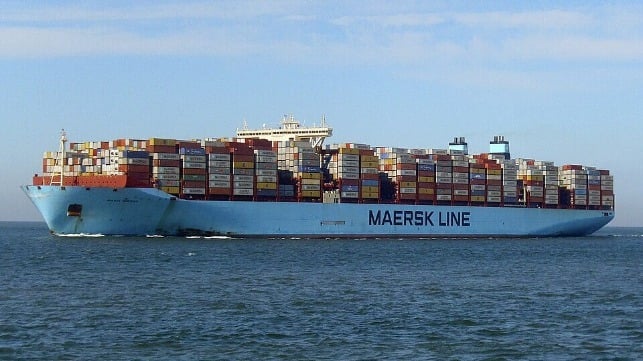
Marie Maersk remains off the coast of Africa as teams battle the container fire (Tvabutzku1234 - CC0 1.0)
The container fire, which began last week on one of Maersk’s lager boxships, Marie Maersk, is believed to have stopped spreading, as firefighting efforts are expected to intensify. The 19,000 TEU vessel remains off the coast of Africa while the company is considering a port of refuge as the first step toward determining the full extent of the damage.
“This was also achieved thanks to the assistance of four assets, three tugboats and a Platform Supply Vessel,” said Maersk in its update. The company said the vessels had brought firefighting equipment to the Marie Maersk over the past days, and AIS signals show they remain in proximity to the ship. “We expect firefighting efforts to intensify further once the external firefighters can board Marie Maersk.”
The crew reported smoke coming from containers on the vessel early on August 13 while they were bound from Rotterdam to Malaysia and China. Maersk has said the crew remains safe with all machinery, steering, and navigational equipment fully operational. The Marie Maersk was diverted towards the West African coast to get landside support as fast as possible, and because of the large number of vessels diverting around Africa, additional Maersk vessels and others have also been in the vicinity.
“Due to the prevailing conditions in the respective cargo bays, we still cannot confirm the exact impact of the fire on the cargo yet,” Maersk stated. The goal is to get the vessel into a port of refuge where they can offload damaged containers and complete an inspection to determine the extent of the spread of the fire, smoke, and heat. The company has not said how many containers are aboard currently, but because they are outbound from Europe, it is possible the vessel is not fully loaded or is carrying empties.
Maersk reports the vessel will be diverted to a port of refuge, which is under contemplation. The goal is to get landside support as fast as possible.
The challenge is also finding a port that is willing to accept the vessel and has the capabilities to handle a container fire. In the case of the Maersk Frankfurt, which caught fire off India in July 2024, after the fire was brought under control, the vessel diverted to the Middle East. Another operator, X-Press Feeders, is again highlighting that ports in Qatar, India, and Sri Lanka refused permission when its vessel X-Press Pearl was desperately seeking refuge with a leaking container that ultimately caught fire and contributed to the total loss of the vessel.
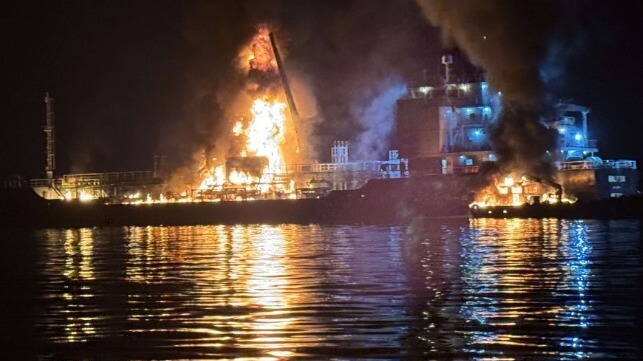
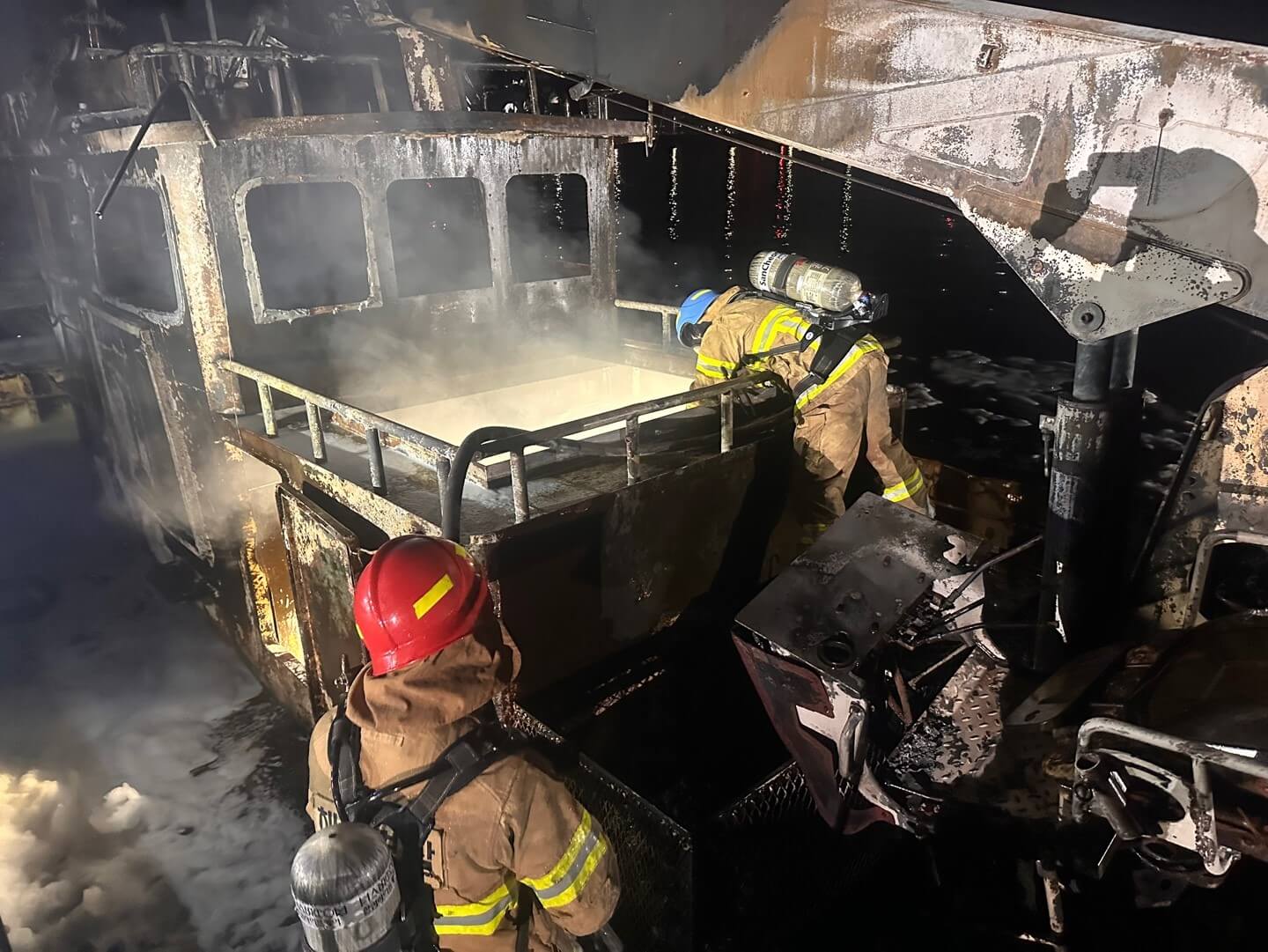
A fire started early on Saturday, August 16, spreading from one ship to another in the anchorage off Yeosu, South Korea. The local fire department in the city in southeastern Korea worked with the Coast Guard due to the risk of explosion as the two ships burned.
The fire broke out on a 2,692-dwt chemical tanker that was at anchor. The police declined to name the ship during the investigation. The fire spread to a neighboring vessel, which is being described as a 24-ton delivery ship. It is unclear if there was a transfer of chemicals was taking place.
The tanker was loaded with 2,500 tons of hazardous chemicals as well as 100 tons of fuel. The Coast Guard reports because of the high risk of an explosion, 15 vessels were mobilized.
Fire crews boarded the two vessels (Korea Coast Guard)
All 18 crewmembers, including 14 from the tanker and four from the smaller vessel, were evacuated. The fire department reports the captain of the smaller vessel, a man in his 50s, was confirmed deceased. Two Myanmar crewmembers from the tanker were also injured. One is in critical condition, and the second is only slightly injured.
Firefighting crews reported that the fire began around 0100 local time and by 0317 was extinguished on the smaller vessel. It took till 0745 to completely extinguish the fire on the tanker.
Both vessels were being inspected to confirm that the fire was out. The investigation will determine the cause of the fire.
Fincantieri Sues Citing $100M in Damages from Fraudulent Fire Insulation
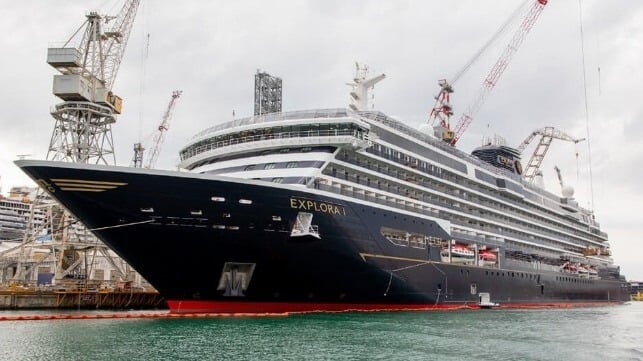
Explora I fitting out in Italy was delayed for 21 days to address the problems of the fire insulation panels (Fincantieri)
Italian shipbuilder Fincantieri is suing the manufacturer of fire insulation panels it used in the construction of three cruise ships and eight military ships, alleging fraud and misrepresentation that it says caused over $100 million in economic damages as well as reputational harm. The shipbuilder is alleging that Paroc Group, which is owned by Owens Corning, obtained safety certificates under “false pretenses by submitting altered materials for testing,” and conspired to maintain the fraud and sell a defective product which endangered safety.
Paroc Group, which was acquired by Owens Corning in 2018, launched a new line of stonewool insulation products sold as fire safety panels for marine applications. The Navis line was promoted as a lighter-weight, fire-safe marine insulation for use in steel decks and bulkheads. Fincantieri reports that it and its subcontractors selected and began using the product in 2019 for both cruise ships and military vessels that required materials meeting the Class A-60 fire integrity standard.
A-60 is the highest-rated fire insulation material under the SOLAS regs and is designed to prevent the transfer of heat for a minimum of 60 minutes. It is typically used for steel bulkheads, such as with galleys or casings, to provide protection from the potential to transfer heat and fire aboard a vessel.
Fincantieri reports that it relied on the certification and the repeated assurances of the supplier for the integrity of the material. In 2023, a competitor of Owens Corning Paroc reported that it tested certain of the Navis products and found that they “did not in fact meet the fire integrity standards for Class A-60 products.” The competitor lodged a complaint, and independent testing by the Danish Institute of Fire and Security Technology in April 2023 confirmed the products were not compliant.
They allege in the suit that it required a deliberate effort to undermine the initial testing process leading to the certification. They further state that the fraud required manipulation of testing materials and repeated and coordinated falsification.
The product was recalled in May 2023, but Fincantieri writes in the lawsuit complaint that it “did not advise or instruct that any remedial actions be taken for completed vessels in service.” The Navis line was discontinued as of May 31, 2024.
Fincantieri identified that it used the product on a total of 11 ships, including the already delivered Discovery Princess, which went into service for Carnival Corporation’s Princess Cruises in March 2022, as well as two luxury cruise ships, Explora I and Explora II, under construction for MSC’s Explora Journeys. The other eight vessels, including two under construction, are military vessels.
Delivery of MSC’s Explora I was postponed for 21 days due to the need to replace the defective products. Fincantieri says it also delayed the delivery of Explora II in 2024 and Carnival Corporation’s Sun Princess being built for Princess Cruises.
Fincantieri says that it is incurring over $100 million in harm. It says the direct costs include to investigate, repair, and remediate affected vessels, as well as increasing construction costs. It also incurred liquidated damages and other costs resulting from delayed deliveries.
The suit was filed in U.S. District Court in Ohio, where Owens Corning is headquartered. The corporation, a leader in building materials, was involved in more than 20 years of litigation related to the use of asbestos in shipbuilding materials before filing for bankruptcy and settling those suits in 2000.
Lost and Found: Navy Yard Logbook From the Pearl Harbor Attack
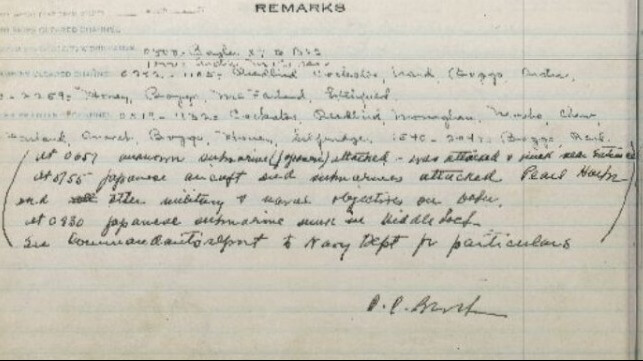
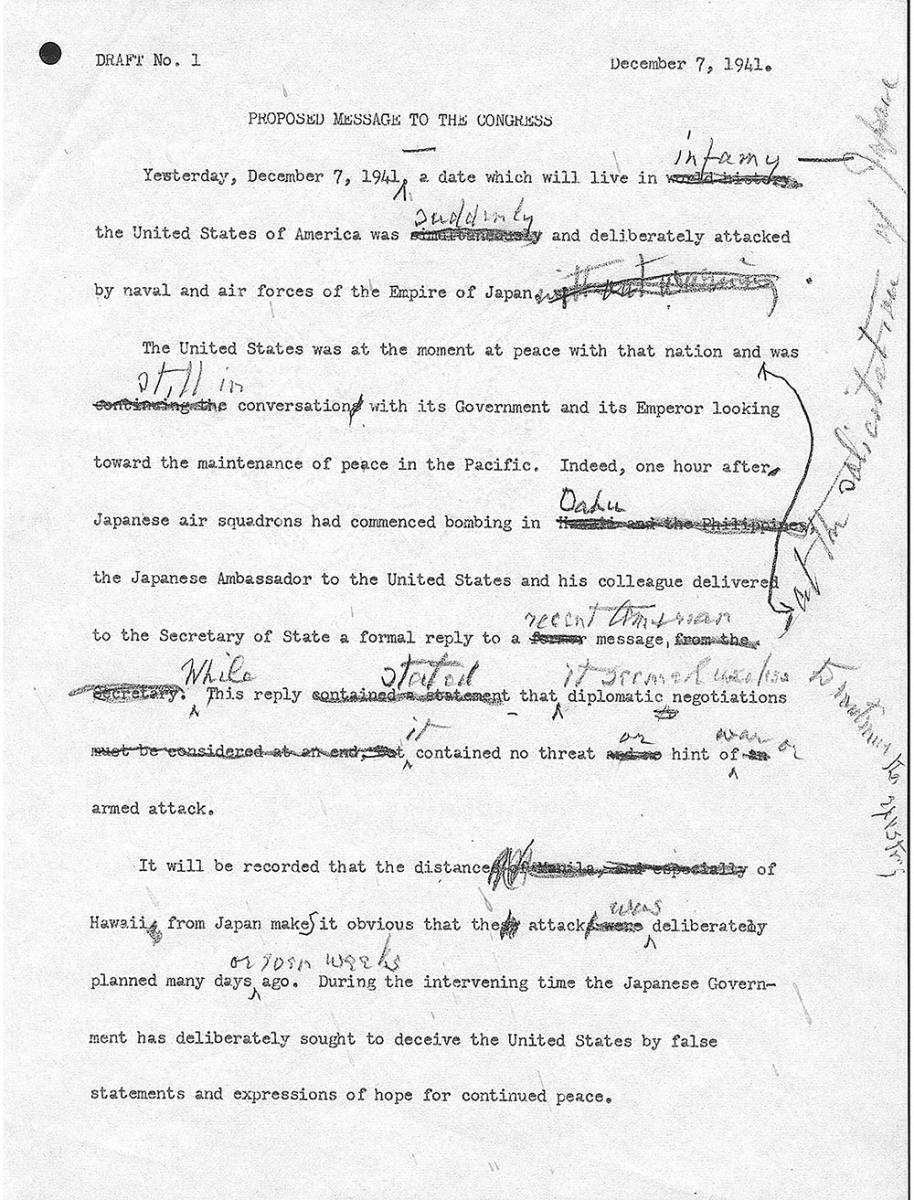
Entry detailing the timing of the Japanese attack, Dec. 7, 1941 (National Archives / USN)
By miraculous coincidence, conservators at the U.S. National Archives have recovered the logbook for Pearl Harbor Naval Base for the period before and after the Japanese attack on December 7, 1941. It is the only record of its kind from the "date which will live infamy," and it was nearly lost to a trash bin before finding its way into private hands, according to the previous owners.
The logbook covers the status of vessels in the yard during the period from March 1941 to June 1942, a period of extremely rapid and momentous events. During the time period when the first entries, the U.S. was on a peacetime footing and was in diplomatic talks with Japan; nine months later, Japanese forces attacked Pearl Harbor and the U.S. entered the war; and by the end of the logbook, just seven months further on, the U.S. Navy won strategic victories at the Battle of the Coral Sea and the Battle of Midway, and was gearing up to retake the Solomon Islands.
The log nearly didn't make it. According to Michael William Bonds, who inherited it from his mother Oretta Kanady, the recordbook somehow ended up at Norton Air Force Base in California, where Kanady worked as a civilian employee in the 1970s. Bonds told the Washington Post that Kanady found the logbook in a trash bin and asked if she could take it home. It wasn't classified, and she received permission. Bonds took possession of it when she passed in 2000, and has had it in storage ever since. Only recently did he realize what it was, and its exceptional historical value.
The record documents moments of tragedy and triumph for Pacific Fleet. It notes the untimely arrival of USS Oklahoma and USS Arizona on December 5, just in time for their destruction at the hands of Japanese pilots two days later. On the page for December 7, it details the time of arrival of the first Japanese aircraft, and the time of arrival and departure of Navy warships in response to the strike (top). On the morning of December 8, as salvors dealt with the aftermath of the attack, the log noted that the capsized hull of the battleship USS Utah "appears to be drifting out into channel," recommending a tug to be sent to secure the wreck.
It also shows the Pearl Harbor yard's essential work in repairing Navy warships after the Japanese attack, putting cruisers and destroyers back in the fight after severe damage. Within six months, the yard had taken in and redelivered the damaged battleships Pennsylvania, Maryland, and Tennessee; cruisers Honolulu, Helena, and Raleigh; destroyers Helm and Shaw; and three auxiliaries, all fully repaired or patched up for transit for permanent repairs.
Wan Hai 503 Remains at Sea 10 Weeks Seeking Port of Refuge
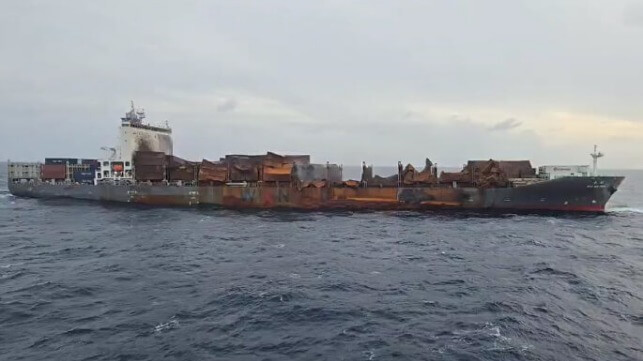
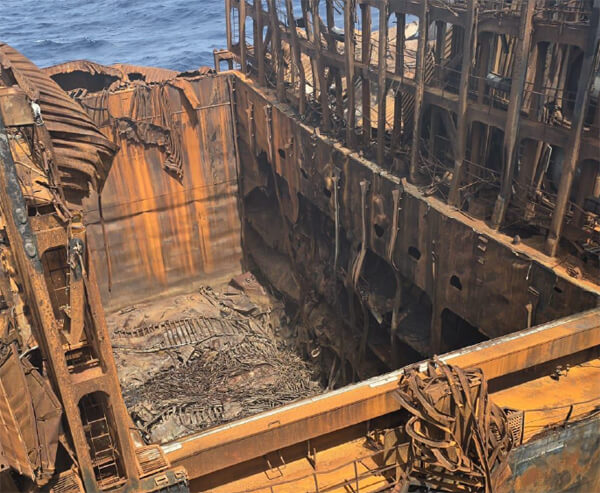
Picture from mid-July showing the condition of the hulk after the fire (India DGS)
Ten weeks after the fire was reported aboard the containership Wan Hai 503, the vessel remains at sea in search of a port of refuge. It has turned into the vessel no one wants, as India almost immediately said it would not permit its ports to receive the ship, and more recently, Sri Lanka declined the application made for the vessel’s refuge.
Owner/operator Wan Hai Lines issued its most recent update at the end of last week, reporting the vessel is stable and being monitored.
“We, in close coordination with our appointed experts and the salvage team, are in the process of liaising with potential ports of refuge,” reported Wan Hai. “Decisions on the final port of refuge will take into account the overall suitability for the vessel as well as the handling of fire-damaged cargo.”
The fire began on June 9 while the vessel was in India’s EEZ as it was sailing from Colombo, Sri Lanka, to Nhava Sheva, India. The Indian Coast Guard responded, assisting in the evacuation of the crew and an extensive firefighting effort. After salvage teams got secure tow lines, India, however, ordered the ship taken further out to sea, fearing a repeat of incidents such as the loss of X-Press Pearl and the ongoing problems after the MSC Elsa 3 sank weeks before the Wan Hai fire. As of July 24, India reported the vessel was outside its zone and that it was relinquishing involvement to the Maritime & Ports Authority of Singapore as the vessel’s flag state.
Conditions aboard the vessel had dramatically improved with no more flames and only residual smoke in bays 29 to 35. Twenty salvers were reported aboard the ship, continuing cooling efforts and undertaking dewatering efforts.
Conditions aboard as of mid-July (DGS)
Wan Hai has continually reported since the end of July that the fire is extinguished and that teams continue to improve the onboard situation. However, Hapag-Lloyd, which shared cargo aboard the ship, confirmed on August 13, “The request for a port of refuge in Sri Lanka has been declined by the authorities.”
They said the ship was 130 nautical miles from the Indian coast (Cape Comorin). The plan was to move it further out to sea while discussions continued on a port of refuge. This has continued, although the area is subjected to monsoons at this time of year.
There is no clear determination for the direction of the ship and a potential resolution. It has been suggested it might be towed to the Middle East. Last year, the Maersk Frankfurt, which suffered a container fire off the Indian coast, ended up gaining refuge at Khor Fakkan, in the UAE, in September 2024, about seven weeks after its fire started. That vessel, also, was not a constructive loss and returned to service.
Similar salvage efforts to what are required for the Wan Hai 503 were recently completed in the Port of Aberdeen, Scotland, after the Solong was towed there after the collision and fire in the North Sea. The hulk was cleared of its debris in Scotland and arrived last week at a recycling facility in Belgium.
Although a lot has been incinerated during the fire on the Wan Hai 503, the concerns raised continue to be about potential pollutants and the danger of the ship sinking.
Hudson Bay's Port of Churchill Could Host Transatlantic Container Service
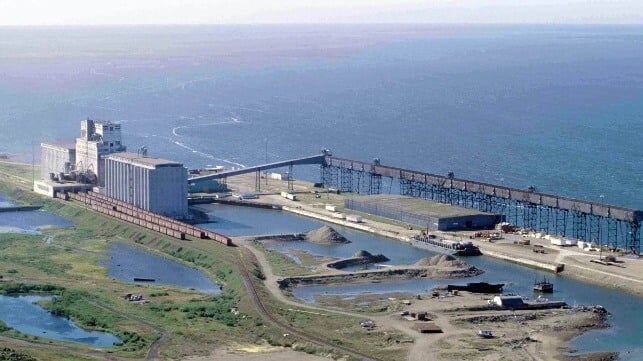
Grain terminal at Port of Churchill (Ansgar Walk / CC BY SA 2.5)
Plans are underway to develop the Port of Churchill on Hudson Bay to serve container ships and to upgrade the railway line into Western Canada. Such a development has potential to develop competition between Churchill and Port of Duluth on Lake Superior.
Introduction
Plans to develop the Port of Churchill on Hudson Bay date back to 1923, and it opened in 1931 following completion of the Hudson Bay Railway line. The port was intended to export Western Canadian agricultural products such as wheat, barley and oats to England and Europe. At the time, the Canadian navigation canal from Montreal to Lake Ontario could only transit small vessels, some of which had ocean sailing capability. However, much larger vessels could sail into the Port of Churchill, which offered a low-tide water depth of just over 37 feet.
The Port of Churchill remained competitive until the completion of the St. Lawrence Seaway during the late 1950s, when the largest ocean freight carriers of that era were able to sail inland to the Upper Great Lakes and the grain terminal at Port of Thunder Bay. Compared to Hudson Bay, the St. Lawrence Seaway offered an extended shipping season for ships of equal size, enhancing the competitiveness of the Port of Thunder Bay for transferring grain between railway and ship transport. Traffic through Port of Churchill subsequently decreased until its closure and sale during the late 1990s.
Potential Future
The railway line that extends southwest from Port of Churchill indirectly connects to a population of over 25 million spread across Western Canada and the Northwestern United States. While sailing vessels between the U.S. West Coast and Europe via the Panama Canal occurs regularly, recent drought across the watershed of that canal restricted shipping. Some container traffic between Europe and the northwestern United States may be diverted via Port of Duluth on Lake Superior, using Seawaymax-sized container ships, while other traffic moves to and from East Coast container ports along railway lines approaching peak operational capacity.
An examination of water depths around the Port of Churchill indicates potential to deep-dredge the dock area. Boulders would need to be relocated westward from the sea floor, with some needing to be broken apart using dynamite. Dredging the dock water draft to 52 feet at low tide would allow container ships of 12,000 to 14,000-TEU capacity and a 14-meter draft to berth at the dock. Future occasional dredging may be needed due to silt build up. Future weather conditions would likely allow port operations between early June and early December, coinciding with peak container traffic season.
Railway Connection
A large section of the railway line that extends south and southwest of the Port of Churchill crosses over tundra/muskeg, restricting maximum axle weights for locomotives and wagons/carriages. Container cars would likely have to operate in single stack configuration. The combination of speed and weight restrictions would require for operation of ballast-reduced locomotives each coupled to a ballast reduced railway slug unit to which they supply electric power, to drive additional axles and increase low-speed traction. Operation of extended length container trains would require multiple mid-train locomotives (DPU or Distribution Power Units) spread throughout each train.
Such operation would require additional sidings at Port of Churchill. At a point southwest of Port of Churchill where geology allows for operation of higher axle loads, locomotives would be exchanged and containers re-arranged to double stack configuration. While such operation would increase railway operating costs, the operation of much larger container ships at Port of Churchill would reduce transoceanic per container transportation cost compared to multiple Seawaymax container ships calling at Port of Duluth. Cost competitiveness of shipping containers via Port of Churchill depends on reducing railway transportation costs between the port and Western Canada, as well as the northwestern United States.
Economic Factors
The volume of future container-based trade between Europe and the combination of Western Canada and northwestern United States will determine the viability of container transfers at Port of Churchill. While moving containers via the Panama Canal between Europe and northwestern USA and Western Canada incurs competitive transportation costs, sending containers via Port of Churchill incurs greatly reduced time-in-transit, allowing for faster delivery schedules and more transatlantic return trips per ship. Railway lines extending to U.S. East Coast and Gulf Coast ports now operate near capacity, raising per container transportation costs along those lines in response to increasing demand for service.
Port of Churchill’s competitive edge involves a portion of customers and shippers being willing to pay higher per container transportation costs in exchange for faster container delivery schedules. While Port of Duluth would be restricted to serving container ships of 1,000-TEU capacity, Port of Churchill following dredging would be able to berth ships of up to 14,000 TEU. The annual cyclical peak of container traffic volumes occurs between July and November, when Port of Churchill would be fully operation. Innovation that assures competitive railway transportation costs to and from Port of Churchill container terminal is essential.

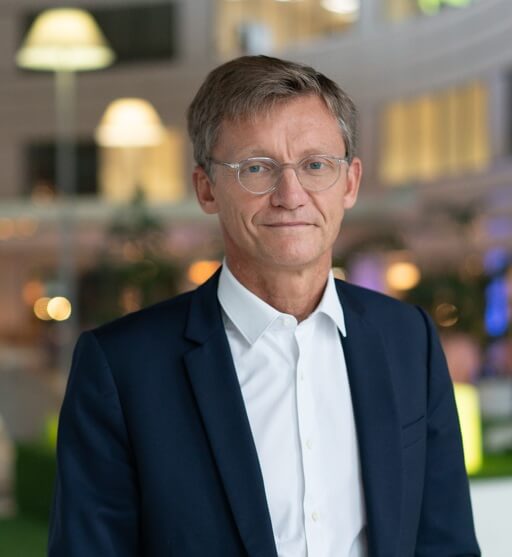 Bureau Veritas Marine & Offshore’s Executive Vice President, Matthieu de Tugny, addresses what is required of class societies if the maritime industry is to achieve a sustainable blue economy.