Wednesday, November 12, 2025


Britain Has Refused To Provide Intelligence To US For Blowing Up Boats – OpEd

LIBERTARIAN ANTI-IMPERIALISM


Screenshot of video released by the White House of an 
alleged boat carrying drugs in the Caribbean. Credit: The White House

November 12, 2025 
By Adam Dick

Great Britain, over a month ago, bowed out of helping the United States blow up boats and kill their occupants in the Caribbean. Natasha Bertrand reported in a Tuesday article at CNN that Britain had then suspended its providing of intelligence to the US that would help the US in carrying out a series of fatal attacks on boats.

Bertrand wrote that Britain, “which controls a number of territories in the Caribbean where it bases intelligence assets,” has suspended intelligence sharing it has supplied the US for years that “has helped the US locate vessels suspected of carrying drugs so that the US Coast Guard could interdict them, the sources said. That meant the ships would be stopped, boarded, its crew detained, and drugs seized.”

Using the intelligence for this “law enforcement” style of action was one thing. Using it to facilitate a murder spree is another.

Bertrand explained in the first two paragraphs of her article:

The United Kingdom is no longer sharing intelligence with the US about suspected drug trafficking vessels in the Caribbean because it does not want to be complicit in US military strikes and believes the attacks are illegal, sources familiar with the matter told CNN.

The UK’s decision marks a significant break from its closest ally and intelligence sharing partner and underscores the growing skepticism over the legality of the US military’s campaign around Latin America.

Canada has also bowed out of providing help to the US in blowing up the boats. Wrote Bertrand:

Canada, another key US ally which has helped the US Coast Guard interdict suspected drug traffickers in the Caribbean for nearly two decades, has also distanced itself from the US military strikes. The sources told CNN that Canada intends to continue its partnership with the Coast Guard, called Operation Caribbean. But the country has made clear to the US that it does not want its intelligence being used to help target boats for deadly strikes, the sources told CNN.


The US military’s boat destroying campaign in the Caribbean and Pacific has since it began in early September struck 17 boats and killed at least 70 people according to a Thursday The Hill article by Filip Timotija reporting on the latest attack.

At the beginning of this US campaign to destroy boats and kill their occupants, Jacob G. Hornberger of the Future of Freedom Foundation described clearly how it violated legal principles intended to protect people from government run amuck. “In my opinion, that’s just murder, pure and simple,” concluded Hornberger in his September 3 article “Trump’s Drug-War Murders in the Caribbean.” Key people in the British and Canadian governments likely found this same conclusion unavoidable before those governments decided to deny support for the campaign.


This article was published by Ron Paul Institute



Adam Dick

Adam Dick is a Senior Fellow at Ron Paul Institute for Peace and Prosperity. Adam worked from 2003 through 2013 as a legislative aide for Rep. Ron Paul. Previously, he was a member of the Wisconsin State Board of Elections, a co-manager of Ed Thompson's 2002 Wisconsin governor campaign, and a lawyer in New York and Connecticut.


Venezuela: Tensions rise as US sends world's largest aircraft carrier


Issued on: 12/11/2025 - FRANCE24


A US aircraft carrier strike group arrived in Latin America Tuesday, escalating a military buildup Venezuela has warned could trigger a full-blown conflict as it announced its own "massive" deployment. The USS Gerald R. Ford, the world's largest aircraft carrier, entered an area under control of the US Naval Forces Southern Command, which encompasses Latin America and the Caribbean. The vessel's deployment was ordered nearly three weeks ago, with the stated goal of helping to counter drug trafficking in the region.


Video by Ava LUQUET


France condemns US military buildup in Caribbean as G7 talks open in Canada

France’s foreign minister has criticised ongoing US-led “military operations” in the Caribbean, warning they risk fuelling regional instability, as G7 foreign ministers convened in southern Ontario on Tuesday amid rising tensions over defence, trade and global security crises.


Issued on: 12/11/2025 
By: FRANCE 24

France's outgoing Minister of Foreign Affairs Jean-Noel Barrot speaks to the media after Mideast talks with his counterparts from European and Arab countries and French President Emmanuel Macron. © Christophe Petit Tesson, AP
01:57


France's foreign minister criticised “military operations” in the Caribbean at a G7 meeting on Tuesday, as the deployment of a US aircraft carrier strike group escalated an arms buildup in the region.

Speaking to reporters at the start of the Group of Seven gathering in Canada, top French diplomat Jean-Noel Barrot said it was crucial to avoid “instability caused by potential escalations", after Venezuela warned the US deployments could trigger a full-blown conflict.

“We have observed, with concern, military operations in the Caribbean region because they disregard international law,” Barrot said, without citing specific US actions.

The comments at the meet near Niagara Falls came after the USS Gerald R. Ford, the world’s largest aircraft carrier, entered an area under the control of the US Naval Forces Southern Command, which encompasses Latin America and the Caribbean.


President Donald Trump’s administration is conducting a military campaign in the Caribbean and eastern Pacific, deploying naval and air forces for an anti-drugs offensive.

Venezuelan President Nicolas Maduro has accused the Trump administration of “fabricating a war” while pursuing a regime change plot in disguise.

Barrot said it was essential for the G7 club of industrialised democracies to “work in concert” to confront the global narcotics trade, noting that more than a million French citizens live in the Caribbean and could be impacted by any potential unrest.

Ukraine, Sudan


Canadian Foreign Minister Anita Anand, the meeting host, said bolstering Ukraine would feature prominently at the talks but stopped short of promising concrete G7 action to support Kyiv’s efforts against the Russian invasion.

As the meeting began, the UK announced £13 million ($17.1 million) in funding to help repair Ukraine’s energy sector, which has suffered massive Russian attacks in recent days. Britain also announced a maritime services ban on Russian liquefied natural gas.

Foreign Secretary Yvette Cooper said Russian President Vladimir Putin “is trying to plunge Ukraine into darkness and the cold as winter approaches".

At the G7, Cooper plans “to galvanise (Britain’s) closest partners to continue to stand up for Ukraine in the face of Putin’s mindless aggression", the Foreign Office said.

Anand told reporters that Sudan’s escalating crisis would be addressed Tuesday at a working dinner on global security.

She said Canada was “absolutely horrified” by the conflict that has triggered one of the world’s worst humanitarian crises and that the G7 would work “to support those who are suffering and dying needlessly in Sudan".

Anand is set for a bilateral meeting with US Secretary of State Marco Rubio before the G7 meeting closes on Wednesday.

However, she said she did not expect to press the issue of Trump’s trade war, which has caused Canadian job losses and slowed economic growth.

“We will have a meeting and have many topics to discuss concerning global affairs,” Anand told AFP. “The trade issue is being dealt with by other ministers.”

Trump abruptly ended trade talks with Canada last month – just after an apparently cordial White House meeting with Prime Minister Mark Carney.

The president has voiced fury over an advertisement, produced by Ontario’s provincial government, that quoted former US president Ronald Reagan on the harm caused by tariffs.

(FRANCE 24 with AFP)


On Thin ICE: What’s Behind Trump’s Reported Removal Of USARC Commissioner? – OpEd

Wayback Machine: USARC Profile for Elizabeth Qaulluq Cravalho (6/11/2025)
By Michael Walsh


Earlier this week, the U.S. Arctic Research Commission (USARC) deleted one of the USARC Commissioners profiles from its website. That commissioner, Elizabeth Qaulluq Cravalho, was then relisted under the section of the website for Former Commissioners.

This is a very curious development for the U.S. Arctic research community.

The USARC website previously indicated that Cravalho’s term was not set to expire until February 26, 2028.

Meanwhile, there are two other commissioners whose terms have already expired: David Kennedy and Deborah Vo. They have yet to be replaced though.

That undercuts the most obvious hypothesis for why the Trump Administration may have removed Cravalho.

If the Trump Administration was seeking to remake the board of Commissioners in its image, why would it not have started with the Commissioners whose terms have already expired?


U.S. Arctic Research Commission Website (11/11/2025)

There may be a simple answer to that question.

Per its website, the USARC has eight Commissioners. Seven are appointed by the President of the United States. They include two from private industry, four from academia, and one from Indigenous residents of the Arctic. The eighth is the Director of the National Science Foundation (NSF).

It is possible that the Trump Administration recently identified someone from private industry that it wants to appoint as a Commissioner, and it now needs to remove a current Commissioner to make that happen.

However, there is another hypothesis floating around the U.S. think tank community that merits consideration.

Cravalho is the Vice President of Lands for the NANA Regional Corporation, which is owned by 15,000 Iñupiat shareholders that have roots in Northwest Alaska.

Earlier this year, NANA Regional Corporation made headlines when an investigative journalist surfaced accusations of civil rights abuses at immigration detention facilities linked to NANA Regional Corporation.

A few weeks ago, NANA Regional Corporation again made headlines when some shareholders of NANA Regional Corporation publicly criticized existing immigration detention facilities contracts with the United States Immigration and Customs Enforcement (ICE).

As any professor will tell you, correlation is not causation.

However, this correlation certainly begs the question of whether the reported removal of Cravalho was retaliation for NANA Regional Corporation shareholders publicly criticizing the ICE detention facilities.

Either way, it will be interesting to see what happens now that Cravalho has been reportedly removed as a USARC Commissioner.

At the USARC, the Trump Administration could assign a new USARC Chair. It could immediately replace Cravalho with their own pick. It could replace the other commissioners whose terms have expired. It could terminate other Commissioners whose terms have not unexpired.

Beyond the USARC, the Trump Administration could retaliate against Akima and NANA Regional Corporation for its shareholders’ criticism of ICE. For example, they could push to take away their current immigration detention facilities contracts or freeze them out of bids for future immigration detention facilities contracts.

In the background, there may be bigger structural changes on the horizon.

Some left-wing policy wonks are concerned that Trump Administration intends to overhaul, or even eliminate, the 8(a) Business Development Program.

This development will not assuage those concerns.


Michael Walsh

Michael Walsh (@FPCommentary) is an academic researcher at the University of the Witwatersrand. He is a former member of the Communications Committee of the Arctic Research Consortium of the United States (ARCUS) and a former member of the Experts Working Group on Emerging Security Challenges co-chaired by the North Atlantic Treaty Organization (NATO) and the Partnership for Peace Consortium (PfPC).
Trump is not going to COP30 in Brazil, but America is
DW 
November 11, 2025

The Trump administration has trivialized COP30, and is not sending anyone to the climate talks in Belem. But local and regional leaders from across the US want the world to know they're not giving up.

In this photo projection, protesters reference the COP30 climate talks in Brazil. Hosted by the nation's President Luiz Inacio Lula da Silva (left), they are going ahead without Donald Trump, who believes climate change is a hoax
Image: Fabio Teixeira/Anadolu/picture alliance

Washington is not sending a top-level team to this year's COP climate summit in Belem, Brazil.

The global community expected as much from a president who has pulled the United States out of the Paris Agreement for the second time, slashed funding for renewable energy, championed fossil fuel projects and told world leaders at the UN in September that climate change is the "greatest con job ever perpetrated on the world."

But delegates from Washington state, along with governors, mayors and other representatives from states and cities across the US, are determined to pick up the slack. Together, they represent about two-thirds of the US population and produce nearly three-quarters of the country's economic output.

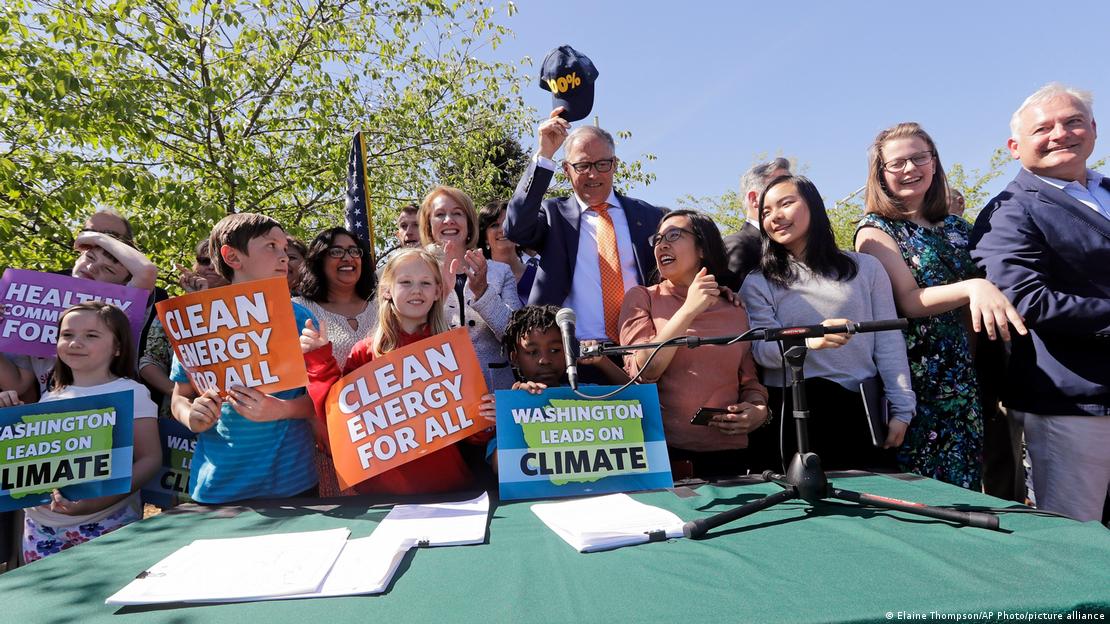
"It's a long way to come from Seattle to Rio, but I made the trip, and others made the trip, because it's important for the rest of the world not to give up on the United States," said Jay Inslee, the former Democratic governor of Washington. Inslee was speaking to DW from Rio de Janeiro, where he was taking part in pre-COP events last week ahead of the main climate talks.

US is giving up on climate — others are cashing in  09:53

"The United States have not pulled out of Paris. One part of the United States has, and that's the federal government," said Inslee, a founding member of the US Climate Alliance, a bipartisan coalition of governors that includes 23 states and one territory. The group was spurred into action during the first Trump presidency in 2017.

"It's very important that we not allow a misperception to exist that somehow progress has stopped because we have a bloviating, anti-wind turbine, climate-denying narcissist in the White House. That's a very important message, I think, for the world to give them confidence to move forward."

Speaking in Belem, California's Governor Gavin Newsom told AFP any future Democratic president would rejoin the Paris Agreement "without hesitation," adding that it's both a "moral commitment" and an "economic imperative."

"It's an abomination that he has twice, not once, pulled away from the accords," Newsom said. "Donald Trump is doubling down on stupid."

Will Trump's tariff diplomacy derail COP?

While Trump's team is not expected in Belem, some observers are concerned the president could disrupt the negotiations from afar.

"The signal sent to countries around the world is that the US may penalize in trade terms countries that take stronger climate action," said Maha Rafi Atal, an associate professor in political economy at the University of Glasgow in Scotland.

She told DW in an email that Trump's hostility to climate action could see other countries "less willing to prioritize emissions reductions over economic growth" and funding the energy transition.


"Yes, the [US] federal government may continue to be disruptive," said Gina McCarthy, co-chair of America Is All In (AIAI), a climate action coalition, in an email. "Our delegation is focused on what we know for sure: local leaders and businesses across the United States are pressing forward on clean energy and are eager to collaborate with international partners to strengthen the Paris Agreement."
Local efforts add up

More than 100 subnational leaders from the US Climate Alliance, Climate Mayors and AIAI — representing state and city officials as well as tribal nations, businesses, schools and other institutions — are taking part in the high-stakes negotiations in the Amazon, which run from November 10 to 21.

While many of the decisions at COP shape how nations tackle climate change at the federal level, the local leaders believe the US, the world's second-biggest polluter after China, can still meet the goals of the 2015 Paris accord and reach net-zero emissions by mid-century. Even with Trump boosting oil and gas projects, which contribute significantly to global warming.

"[Trump] often talks and makes a lot of noise, but he cannot stop us moving forward," said Inslee. "Yes, he has reduced some of our federal efforts, but we retain the ability to control our own destiny in these states and cities."


As governor of Washington, Jay Inslee (center, seen here in May 2019) made climate action a central focus
Image: Elaine Thompson/AP Photo/picture alliance

In fact, an analysis released by AIAI last month shows that expanded climate action on the local level, along with renewed support from Washington after 2028 — when Trump is due to leave office — could see the US reduce its greenhouse gas emissions 56% below 2005 levels by 2035. Under the Biden administration, the US 2035 pledge was to cut net emissions by up to 66%.

Many of those reductions in the coming years would come from local policy changes in three key areas: electricity, transportation and reducing methane emissions from leaky gas infrastructure and organic waste.

"Our findings show that innovative local policies and market-driven clean technology investments can keep the US on a path toward significant emissions reductions, even in challenging times," said Nate Hultman, director at the Center for Global Sustainability at the University of Maryland, which led the study.

'Change happens from the bottom up'


Speaking at the COP30 Local Leaders Forum last week, McCarthy — a climate adviser for the Biden administration and former head of the Environmental Protection Agency — told attendees that "change happens from the bottom up."

She said local efforts were "leading the charge on clean energy," pointing out that the 24 states in the US Climate Alliance had already managed to collectively reduce greenhouse gas emission by 24% below 2005 levels, while increasing their GDP by 34%.

"They're supported by the majority of Americans that want their leaders to lower energy costs, protect public health and create jobs," McCarthy told DW.

Inslee, whose policies on clean energy, energy-efficient building and low-emission transportation as governor of Washington from 2013 to 2025 helped shape Joe Biden's approach to climate change, said job creation and economic growth could go hand-in-hand with reducing emissions.

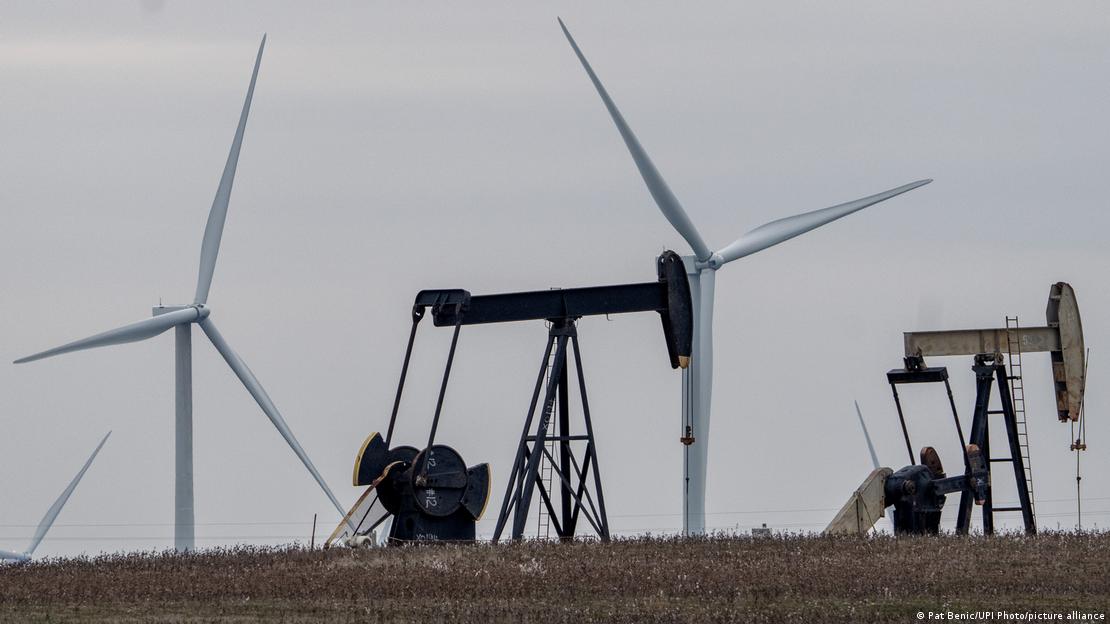
The southern US state of Texas, known for its oil fields, 
has seen a boom in solar and wind energy
Image: Pat Benic/UPI Photo/picture alliance

Even in states like Texas, which is not a part of the US Climate Alliance, renewable energy is taking off because, as Inslee put it, Americans "want cheaper sources of energy." Texas, where voters backed Trump in the last three elections, leads the US when it comes to the development of renewable energy generation and battery capacity. Average electricity prices in the southern state are among the lowest in the country, according to August data from the US Energy Information Administration, a government agency.

Through their participation at COP, McCarthy told attendees in Rio that local leaders were looking to build partnerships and inform negotiations in Belem.

"We have power, we have agency, we have authority, and damn it, we are going to use it!" she said to applause.

Edited by: Tamsin Walker

Martin Kuebler Senior editor and reporter living in Brussels, with a focus on environmental issues

California's Newsom takes US climate stage as White House sits out COP30

American voices took the stage on day two of the COP30 climate conference, but none represented the federal government. California Governor Gavin Newsom, a Democrat, spoke at the UN climate summit in the Brazilian Amazon after the Trump administration opted not to send a delegation.


Issued on: 12/11/2025 -  RFI

California Gov. Gavin Newsom speaks during a rally to push for a redistricting measure on Thursday, Aug. 14, 2025, in Los Angeles. AP - Marcio Jose Sanchez

Newsom said a Democratic administration would rejoin the Paris Agreement "without hesitation."

"It's a moral commitment, it's an economic imperative, it's both -- and it's an abomination that he has twice, not once, pulled away from the accords," Newsom said in response to a question by French press agency AFP in Belem, the Brazilian Amazon city hosting the COP30 climate summit.

Newsom appeared alongside Helder Barbalho, the governor of Para state, of which Belem is the capital, at an event on the city's docks.

Meanwhile, US President Donald Trump's absence from COP30 marked a departure from traditional climate diplomacy, in which the White House typically leads US delegations at annual UN climate negotiations. State officials filled the void left by Washington's decision to stay away.

Since taking power, Trump has strongly criticised international climate efforts, including the UN-sponsored Conference of Parties, or COP30, and has chosen not to send any top-level US officials to the climate gathering in Brazil, which takes place in the city of Belém from 10–21 November.

White House spokesperson Tyler Rogers said that Trump "will not jeopardise our country's economic and national security to pursue vague climate goals that are killing other countries", asserting that climate policies such as the Paris Agreement would have "killed America" had it not been for Trump's intervention.

Trump frequently refers to climate change as "the greatest con job ever perpetrated on the world", and his administration has rolled back numerous climate policies in favour of "common-sense energy" – including signing an executive order on 20 January to withdraw from the Paris Agreement.

Showcase California


Dubbed the "anti-Trump" by Politico Newsom is showcasing how California's clean energy transition is driving economic growth, creating jobs and reducing pollution, positioning climate action as a defining opportunity of the 21st century.

"We are doubling down on stupid in the United States of America – not in my state of California," Newsom told an audience at the Global Investors Symposium at the Milken Institute in São Paulo on Monday, drawing a sharp contrast between his state's green economic growth and federal retreat.

"What the hell is going on here? This is the country we should be engaging with instead of giving the middle finger with 50 per cent tariffs," he said, referencing the Trump administration's trade approach to Brazil.

In Belém, Newsom's high-profile delegation – including leaders in resources, agriculture and energy – will hold meetings with Brazilian officials, climate investors and Indigenous leaders. He promoted California's track record: a 21 per cent reduction in greenhouse gas emissions since 2000, a surging green economy and a $50 billion climate investment programme he says is producing "jobs, clean air and lower costs".

California now counts seven times as many green jobs as fossil fuel positions, even as its economy has become the world's fourth largest.

2026 US Midterms

Newsom's trip comes as COP30 gathers world leaders and civil society ten years after the Paris Agreement, amid speculation about Democratic strategies for the 2026 midterms and the 2028 presidential race.

Newsom’s efforts at COP30 are intertwined with his recent domestic initiatives.

Last week, he celebrated a redistricting win in California that added five Democratic congressional seats, urging other blue-state governors to follow suit ahead of the midterms.

“We cannot rest until we take back the House,” he told supporters after his party's win.​

For the Democratic Party, Newsom’s strategy is clear: recast climate action as the engine of economic opportunity, deepen partnerships across the Americas, and use galvanising events like COP30 to project American leadership—even when Washington steps back.

Polls now suggest Democrats could net twelve seats in the 2026 midterms, and Newsom’s name is increasingly floated as a contender for the White House in 2028.​
Indigenous activists in Brazil clash with security at COP30
November 12, 2025 
DW, AFP, AP, dpa, Reuters

Dozens of Indigenous protesters briefly forced their way into the COP30 climate summit venue in Brazil.

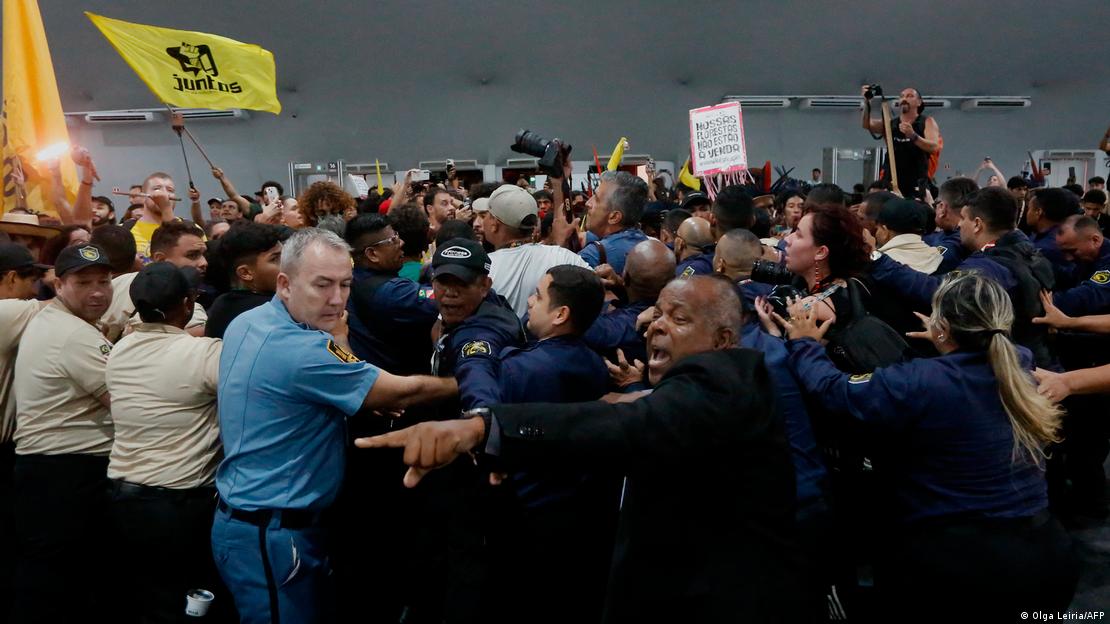
Indigenous protesters clashed with security personnel at the COP30 climate conference in Belem, BrazilImage: Mauro Pimentel/AFP

Dozens of Indigenous protesters and other climate activists on Tuesday evening forced their way into the main venue of the UN climate summit being held in Brazil.

They then scuffled with security officers inside the compound where thousands of delegates from countries around the world are attending this year's COP30 climate summit in the Amazon city of Belem.

Some of the protesters waved flags and chanted, while others held slogans calling for land rights or carried signs saying, "Our land is not for sale."

"We can't eat money," said Gilmar, an Indigenous leader from the Tupinamba community near the lower reaches of the Tapajos River in Brazil, told Reuters news agency.

"We want our lands free from agribusiness, oil exploration, illegal miners and illegal loggers," said Gilmar, who only uses one name.

Agustin Ocana, mobilization coordinator for youth with the Global Youth Coalition, told The Associated Press news agency that some of the group were chanting, "They cannot decide for us without us."

That is a reference to tensions over participation of Indigenous people in the conference.


Indigenous protesters stormed the COP30 venue
Image: Olga Leiria/AFP


Security staff suffered minor injuries in the clash

Journalists at the scene reported seeing a police officer being evacuated in a wheelchair.

Another guard with a fresh cut above his eye told Reuters he had been hit in the head by a heavy drumstick thrown from the crowd.

Ocanasaid he saw protesters and security hitting each other with small plastic bins. One guard was bleeding from being hit in the head, he said.

Security confiscated several long, heavy sticks.

The incident caused minor injuries to two security staff and minor damage to the venue, a UN Climate Change spokesperson said.

The confrontation came late in the day as people were filtering out of the venue for COP30.

UN police officers were asking those still inside the venue to evacuate the vast site of giant air-conditioned tents.

Security within the conference grounds lies with UN police, while local authorities take charge of the surrounding area.

Access points to the venue were closed and heavily guarded by security forces.

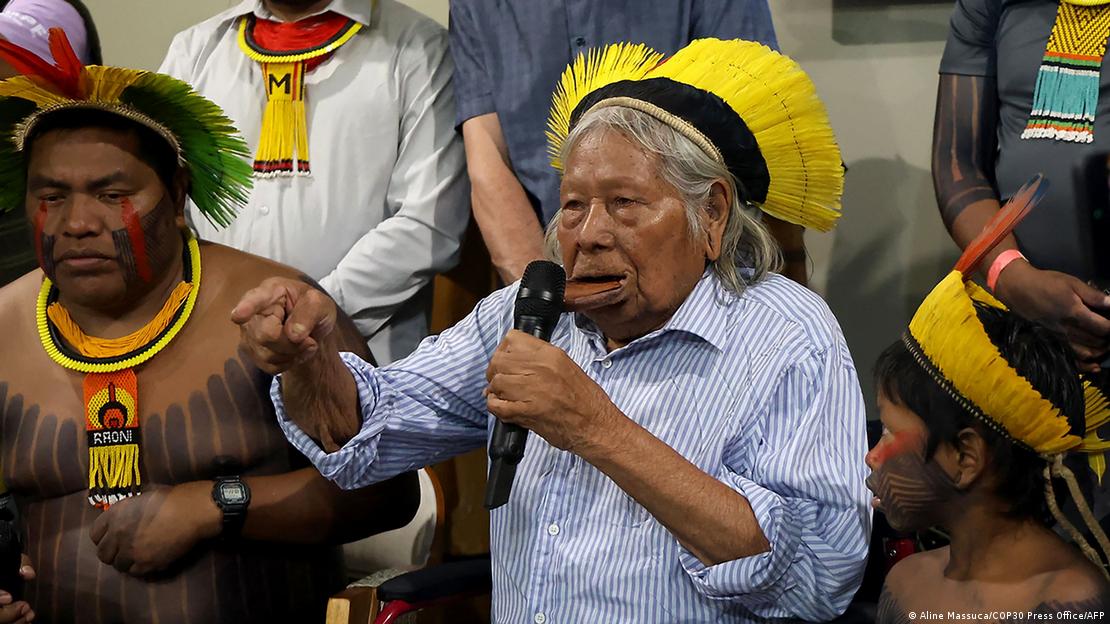
Raoni Metuktire leads the Kayapo people, who are indigenous to parts of the states of Mato Grosso and Para in the Brazilian Amazon
Image: Aline Massuca/COP30 Press Office/AFP


Indigenous communities demanding more say in forest management

Earlier on Tuesday, prominent Indigenous leader Raoni Metuktire told Reuters that many from the Indigenous communities were upset with infrastructure projects in the forest.

The leader of Brazil's Indigenous Kayapo people, Raoni Metuktire has been fighting to protect his homeland in the Amazon for decades.

He warned that proposed highways, rail projects and oil wells would harm people across the world.

"These projects destroy rivers and lands and they are continuing to do it. …. It will be very bad for us. And for you too. You are bringing the consequences upon yourselves," he said

Edited by: Saim Dušan Inayatullah

COP30: African youth push for climate justice

Tainã Mansani in Belem, Brazil
DW
November 11, 2025

Young African activists at COP30 in Brazil are calling for climate funding, political inclusion, and justice for communities hit hardest by the climate crisis.

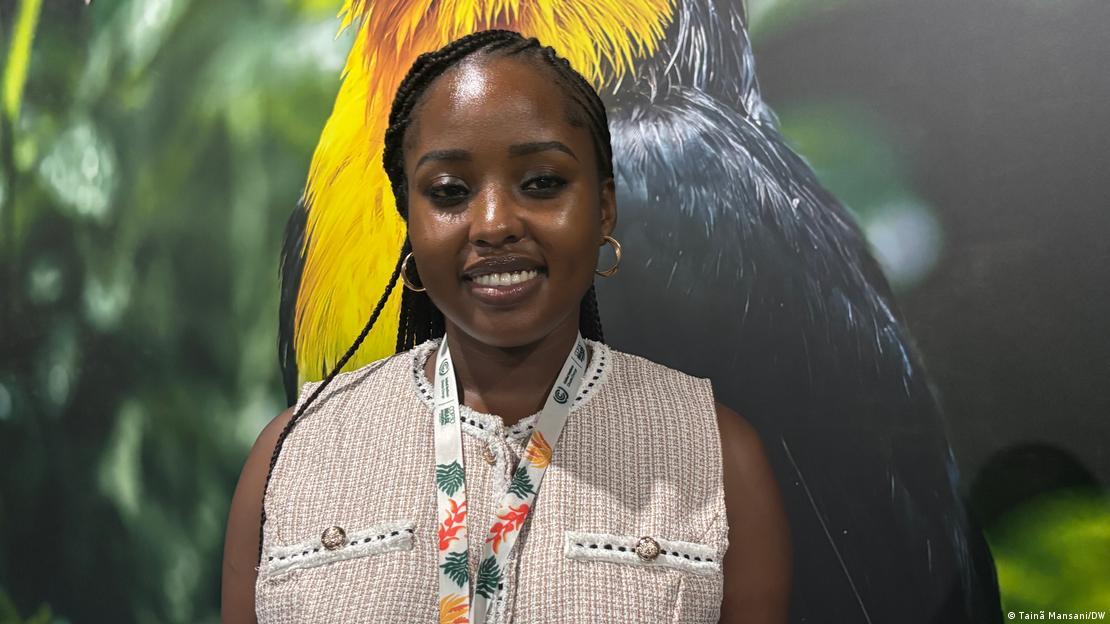
Hilda Nakabuye told DW that she expects leaders at COP30 to put people's voices at the center of their decisions
Image: Tainã Mansani/DW


Anita Soina is a climate activist from Kenya with over 100,000 Instagram followers. She is widely seen as one of Africa's most promising voices in the environmental movement.

The 26-year-old, who is a member of Kenya's Maasai community, traveled to the city of Belem in northern Brazil for COP30, the UN climate conference.

Soina said she has witnessed how deforestation fuels drought, hunger, and water scarcity in her native Kenya. For her, COP30 carries special meaning.

"I think this event will be one of the biggest wins for the Global South," she told DW. "When we are here, listening to the COP president or Brazil's president, you can feel that something truly promising is happening."

But Soina's optimism is cautious.

"We have had many promises before, and at the end of the day, the crisis continues getting worse," she said. "The biggest barrier in Africa is the lack of political will. That is why most resources are not used for the purposes they were intended."
Demands for transparency and action

Representing Zambia, Maurice K. Nyambe, executive director of the graft monitor Transparency International, also traveled to the Amazon for COP30. He hopes this year's summit will deliver not only new pledges but mechanisms to ensure accountability.

"Whether we talk about climate finance or carbon trading, it is important to include transparency [and] accountability in all those discussions," he told DW. "We have high expectations for COP30."

Anita Soina founded a Kenyan group to raise awareness of climate change, organizing tree planting and cleanup campaigns
Image: Tainã Mansani/DW


What's at stake at COP30?


The annual climate change conference is known as COP, which stands for the "Conference of the Parties" that signed the 1992 UN climate treaty. The agreement, called the UN Framework on Climate Change Convention (UNFCCC), committed nations to work together to fight climate change.

This year's conference, COP30 Brazil, is expected to be historic: for the first time, the global gathering is being held on the edge of the Amazon rainforest.

It will serve as a review of the 2015 Paris Agreement to curb climate change, assessing progress on emission targets and climate finance for Global South countries — commitments that remain largely unfulfilled, especially in Africa.

The continent is among the most vulnerable to climate change. Droughts, floods and the loss of farmland already threaten millions of livelihoods and food security.

This is why, in recent years, young African activists have become increasingly vocal in international climate debates, demanding climate justice and tangible actions from wealthy nations.

The Paris Agreement united nearly 200 countries in a pledge to limit global warming to well below 2 degrees Celsius (3.6 degrees Fahrenheit), and to pursue efforts to cap the rise at 1.5 C.

Voices from the frontlines

The opening session of this year's COP30 saw Brazilian President Luiz Inacio Lula da Silva call for a firm stand against climate change deniers.

"Climate change is no longer a threat looming in the future — it is a tragedy unfolding in the present," he said, as ministers discussed how the crisis is already devastating the world's most vulnerable populations.
Maurice K. Nyambe hopes this year's COP30 will deliver not only new pledges but mechanisms to ensure accountability
Image: Tainã Mansani/DW

Helping her community is what drives Hilda Nakabuye, a prominent Ugandan activist and member of Fridays for Future Uganda, now attending her fifth COP. "To me, COP30 is a special moment because it marks 10 years of the Paris Agreement," she said.

Her work focuses on youth and women in Uganda, and on opposing the controversial East African Crude Oil Pipeline (EACOP), a planned 1,400-kilometer (870-mile) heated pipeline backed by TotalEnergies and China National Offshore Oil Corporation.

It cuts through sensitive areas like Murchison Falls National Park and skirts Lake Victoria, Africa's largest freshwater lake. Environmentalists have warned of irreversible damage to biodiversity and water sources relied on by over 40 million people.

"As a young … woman from Africa, I am here to raise my voice and represent the communities affected by a crisis they did not create," she said.

"We ask for a fair and just energy transition. I expect leaders here at COP30 to put people's voices — especially those of marginalized communities — at the center of their decisions."

Engaging communities

Both Soina and Nakabuye agree that empowering local communities to understand their rights is essential. There is so much more to be done to involve communities. The best strategy is to engage them not only in addressing climate change but also in community development, Soina explained.

Simon Peter Longoli says thousands of herders have been devastated by recurring droughts
Image: Tainã Mansani/DW

Simon Peter Longoli, who traveled from Uganda, took part in an event on the opening day of COP30 focused on how local communities can engage more effectively in the UNFCCC process.

For him, COP30 brings high expectations, as pastoralists are now formally recognized within the UN framework as part of the so-called "local communities."

For the first time, he believes that recognition may come.

"What we have achieved here today is another milestone," Longoli said. "We expect that tomorrow it can be formalized — that indigenous people called 'caucus', as their local communities, can participate in the process related to climate change in the UNFCCC."

"Time is running out on climate change. For pastoralists, we may be able to adapt. But COP needs to deliver results that can be implemented," he added.
Global South solidarity

African youth say they hope to see real climate finance commitments and genuine participation in decision-making at COP30. A common message echoes through their voices: Climate justice must move beyond rhetoric and translate into resources for those living on the frontlines.

They also call for deeper cooperation among Global South nations — from the Amazon to Africa — to confront the global crisis together.

These young activists consider their presence in Belem as more than symbolic. It's a demand for action.

Uganda's activists defy crackdown on oil pipeline protests  05:59

Edited by: Keith Walker
COP30: 'Climate conference of truth' in Brazil?

Tim Schauenberg
DW
November 10, 2025

At the COP30 climate summit, nations will again try to agree on targets to limit catastrophic global temperature rise. But many barriers remain before steep greenhouse gas cuts are realized.

With the world having breached the 1.5C global warming limit set in Paris, can the Brazil COP30 agree on greater climate ambition?
Image: Eraldo Peres/AP Photo/picture alliance

Two cruise ships are bobbing quietly in the specially expanded port near the city of Belem in northern Brazil on the edge of the Amazon. They will serve as alternative accommodation for more than 10,000 participants at this year's climate conference.

Between 40,000 and 50,000 people, including heads of state and government from almost 200 countries, are expected to attend the 30th UN Climate Change Conference, COP30, to discuss measures for greater climate protection.

From converted strip clubs to multi-story steamboats, Belem had to get creative with accommodation due to a lack of available rooms and high prices.

Belem is a symbolic choice of location for the summit due to its proximity to the Amazon, a region that is vital for both the regional and global climate — even as forest fires, droughts, and changing rainy seasons take their toll — and where local communities are on the frontline of a deforestation crisis.

The region is also one of the poorest in Brazil. Extreme weather events, which are becoming more frequent and severe due to rising temperatures associated with the burning of oil, gas and coal, have bigger impacts on low-income communities in the country, but also worldwide.

Implementing climate mitigation and emission reductions

Speaking ahead of the negotiations, Brazil's President Lula has labeled the event a "conference of truth," referencing the need to face the reality of climate change and need for action. Similarly, the host nation has called it a "conference of implementation."

This has definitely been lacking in recent years, with no single country currently doing enough to limit global warming to 1.5 degrees Celsius (2.7 degrees Fahrenheit) — the limit the world agreed to strive for under the Paris Agreement of 2015.

Climate change adaptation is set to be a key theme in Belem. As economies, ecosystems and communities begin to endure more frequent and severe climate impacts, there is a pressing need to mitigate these consequences.

Poorer and developing countries, many of which are very vulnerable to the consequences of increasing temperatures, are demanding significantly more financial support from rich countries that have contributed more to heating the planet.

The 1.5 C target for climate protection does not yet extend to adaptation, and vulnerable countries want to agree on indicators that will rate the success of adaptation measures.

There is also the key question of country commitments to reducing planet-heating emissions. All Parties to the Paris Agreement should have submitted new climate targets in September. But by November, according to COP President Andre Correa do Lago, fewer than 70 countries had submitted new targets.

"We are frustrated," said Do Lago. "Two deadlines have already passed without countries fulfilling their commitments. That is annoying."


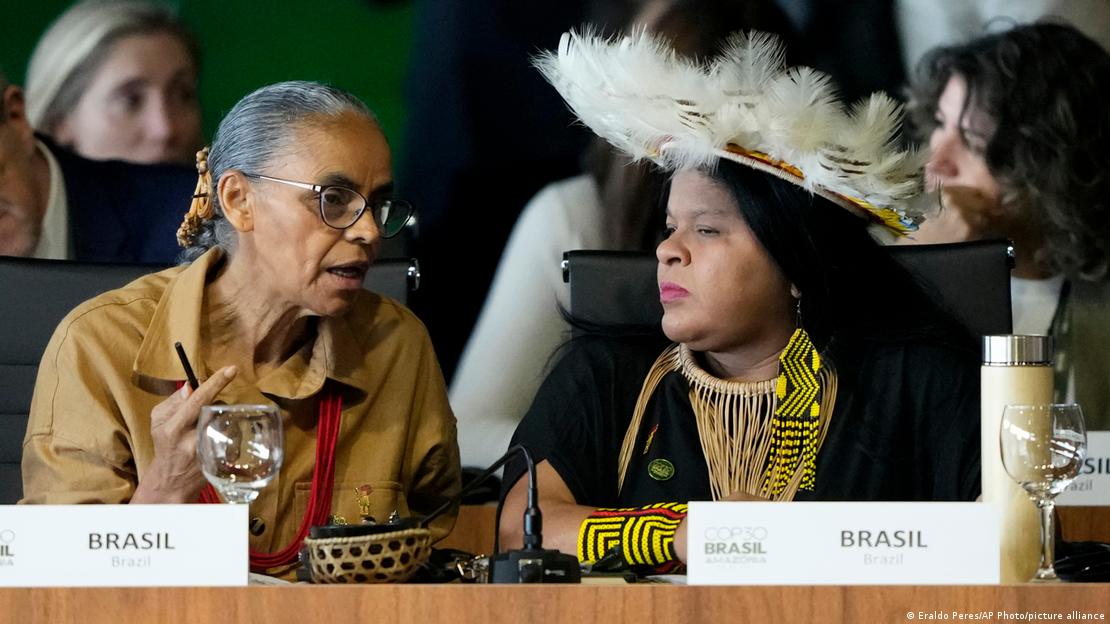
Brazilian Environment Minister Marina Silva, left, addressed climate impacts with Brazilian Indigenous Peoples Minister Sonia Guajajara ahead of COP30
Image: Eraldo Peres/AP Photo/picture alliance


Brazil's chance to lead amid uncertainty

For Brazil under President Lula, the conference is a top priority as it showcases the nation's ability to couple sustainable development with economic progress and take a leading role on the world stage.

Global uncertainty related to increasing trade conflicts, the war in Ukraine, and the situation in Gaza has unduly impacted multilateral climate policy. Meanwhile, the US, the world's second-largest greenhouse gas emitter, withdrew from the Paris climate agreement when Donald Trump took office and has since rolled back climate protections.

Observers view upcoming negotiations with concern


"It is important to have a host for the negotiations who inspires confidence in all countries," says Niklas Höhne of Climate Action Tracker — a consortium of German and international think tanks that examine how national climate targets are being implemented.

At the start of the conference, Brazil will present an initiative to protect tropical forests, which are particularly important for climate regulation and biodiversity: the Tropical Forest Forever Facility.


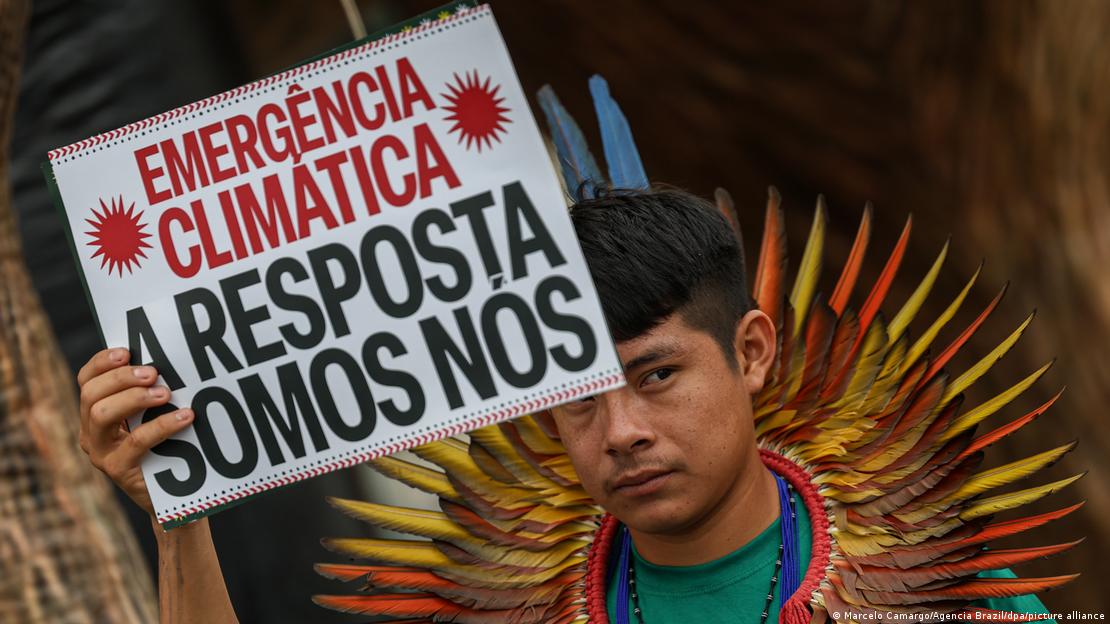
An Indigenous man holds up a sign reading "Climate Emergency: We Are the Answer," during a pre-COP meeting in the Brazilian capital Brasilia in October
Image: Marcelo Camargo/Agencia Brazil/dpa/picture alliance

This involves a new fund that will be established with government money and topped up by private investors. Countries that take special measures to protect their forests will be rewarded with profits from the fund. At least 20% of the payments are earmarked for Indigenous communities. The goal is to raise a total of US$125 billion (€108 billion) for the fund.

The initiative is a prestige project for host Brazil, though it remains to be seen how much of this total can be raised during the negotiations in Belem.
Why Germany is slowing its ambition

Germany will miss its target to become climate neutral by 2045 based on current projections. The government wants to further expand fossil gas infrastructure and is weakening its commitment to renewable energies.

This is not only worrying for Germany, but also for the EU, Niklas Höhne explained. "Germany is an extremely important player in the EU and is also working to relax climate protection measures in the EU," he said. "That in turn has an impact on a global level. If the EU doesn't take the lead, who will?"

As major economies like Germany lose climate ambition, China is increasingly taking on a pioneering role, according to Jan Kowalzig, climate expert at the global NGO Oxfam. However, he doubts that China will make an effort to encourage others to be more ambitious.

"In the past, China has been more concerned with protecting its national interests than with advancing collective progress on climate protection," Kowalzig said.

Mohamed Adow of the non-governmental organization, Power Shift Africa, says what is needed most from Belem is "concrete ambitions, concrete technology transfer, not the usual platitudes."

This article was originally written in German.


Tim Schauenberg One of DW's climate reporters, Tim Schauenberg is based in Brussels and Münster.twitter handle: tim_schauen

Cop30 opens in Brazil, exposing global rifts on fossil fuels and finance


The 30th UN climate summit opens in the Brazilian Amazon on Monday as nations fall short on emissions pledges and the world edges closer to dangerous warming. Fewer than half of all countries have updated their climate plans, while political rifts cloud hopes of progress on phasing out fossil fuels.


Issued on: 10/11/2025 - RFI

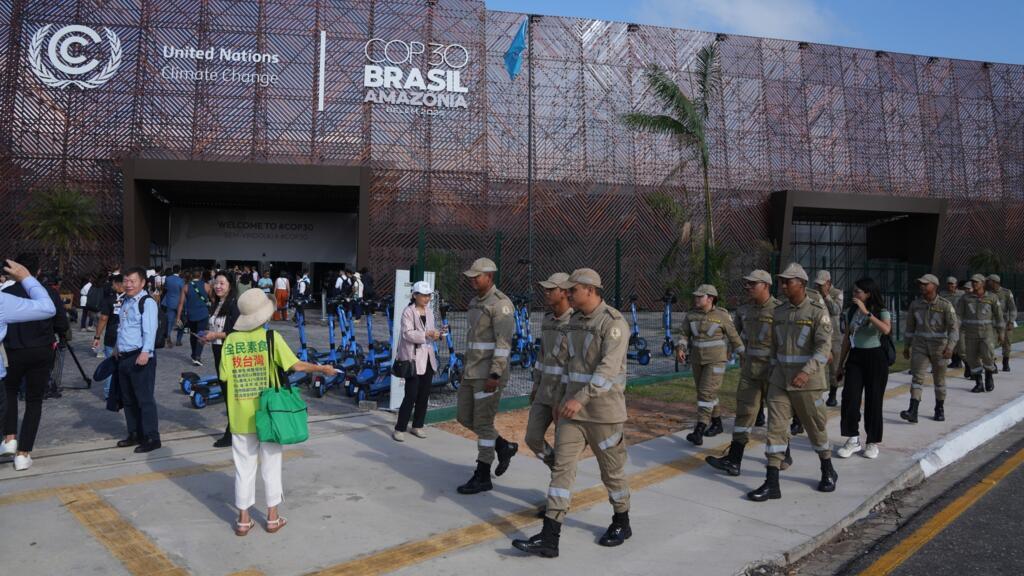
Brazilian firefighters and conference-goers outside the Cop30 venue in Belem on Monday, 10 November 2025. AP - Fernando Llano

By:Amanda Morrow

The conference is being held in Belém, at the gateway to the Amazon rainforest, bringing together nearly 190 national delegations and up to 50,000 participants.

Brazil’s presidency has called it the “Cop of the people, Cop of truth, Cop of action”, but the summit faces an unclear agenda and sharp disagreements over how – or even whether – a final declaration can be reached.

Just over a month ago, countries were due to publish their new climate plans. Barely more than half have done so, and their combined ambition falls short. The world is still heading for 2.4C of warming by the end of the century – which scientists warn is a catastrophe for humanity and the planet.

To avoid another failure, the Brazilian presidency is not attempting a grand final declaration. It wants instead to launch more concrete commitments with a group of willing states, in a bid to save what can be saved of global climate cooperation.


Fossil fuel fight


At a summit of heads of state three days earlier, several leaders – including Brazilian President Luiz Inacio Lula da Silva – said it was necessary to prepare for the end of fossil fuels. But beyond that political signal, there is almost no chance of finding consensus, as oil-producing countries remain firmly opposed.

“How are we going to do this? Is there going to be consensus about how we are going to do it? This is one of the great mysteries of Cop30,” conference president André Corrêa do Lago said.

“My preference is not to need a Cop decision. If countries have an overwhelming desire for a Cop decision, we will certainly think about it and deal with it.”

Do Lago said emerging countries were appearing at this Cop with a different role. He noted the rise of China’s importance in the talks as the US seeks to exit the Paris Agreement in January and the European Union struggles to maintain its level of ambition amid worries over energy security.

“Emerging countries are appearing in this Cop with a different role. China is coming with solutions for everyone,” Do Lago added, pointing to inexpensive green technologies from China now leading the energy transition worldwide.

Indigenous voices

Civil society is making its return after three Cops in authoritarian countries, and it intends to be heard. Indigenous leaders in particular are demanding a real say in decisions that affect their lands and future.

Brazilian groups are joined by visiting delegations who arrived on Sunday evening by boat after travelling 3,000 kilometres from the Andes to the Brazilian coast.

They want stronger control over how their territories are managed as climate change worsens and industries such as mining, logging and oil drilling push deeper into forests.

“We want to make sure that they don’t keep promising, that they will start protecting, because we as indigenous people are the ones who suffer from these impacts of climate change,” said Pablo Inuma Flores, an indigenous leader from Peru, who also criticised oil spills and illegal mining along the river.

Money gap


Adaptation to natural disasters that are already hitting is another key issue for Southern countries, especially in Africa.

Negotiators are tasked with defining 100 indicators to measure how prepared countries are. But what vulnerable states say they mainly need to adapt is money.

Money is the final major challenge at this Cop. Last year’s summit ended in failure, with rich countries promising $300 billion per year within 10 years to help the poorest countries, when at least four times more would be needed.

Brazil wants to propose reaching $1.3 trillion, but the question of where to find the money is expected to cause tension.

Countries also want to address financial and action targets for adapting to a warmer world, with hopes that development banks can reform enough to ensure more money – including from the private sector – goes to these goals.

Ahead of the summit, scientists at dozens of universities and institutions from Asia, Africa and Europe sounded an alarm over the world’s thawing glaciers, ice sheets and other frozen areas.

“The cryosphere is destabilising at an alarming pace,” they said in an open letter to Cop30 published on Monday.

“Geopolitical tensions or short-term national interests must not overshadow Cop30. Climate change is the defining security and stability challenge of our time.”

The first point of order for Cop30 is to vote on an agenda.

Do Lago said countries had been wrangling for months over what to include, describing this as a healthy exchange of priorities.

By Monday morning, 106 governments had submitted new climate plans, with more expected this week.


UN says climate crisis is intensifying typhoons impacting the Philippines


UN says climate crisis is intensifying typhoons impacting the Philippines
/ Damon Lam - Unsplash
By bno - Jakarta Office November 12, 2025

The United Nations cautioned that intense storms such as Typhoon Fung wong, locally called Uwan, are likely to increase as rising sea temperatures around the Philippines fuel extreme weather, Philstar Global reports. On November 10, UN Secretary General deputy spokesman Farhan Haq said in a briefing that higher sea temperatures linked to the climate crisis make joint preparedness crucial.

The Philippines sits in the path of some of the world’s strongest storms. Its capacity to act quickly and protect communities affects not only its own people but also sets a benchmark for disaster readiness across the region.

The UN humanitarian coordination office noted that the Philippine government is overseeing relief and early recovery operations after carrying out one of its largest recorded pre-emptive evacuations. Before landfall, more than 1.3mn people in 13 of the country’s 18 regions were moved to safety. About 480,000 individuals remained displaced and over 6,000 evacuation centres were operating as of November 10. UN Resident and Humanitarian Coordinator Arnaud Peral praised the country’s planning, saying timely actions saved lives.

On November 11, rescue teams began clearing debris as widespread flooding receded. Fung wong, which displaced 1.4mn people, weakened into a severe tropical storm while bringing rain to Taiwan ahead of an expected landfall on November 12.

It was the second strong storm to hit the Philippines within days. Typhoon Kalmaegi, locally named Tino, struck the previous week, leaving 232 fatalities. In Isabela province, a coastal town of 6,000 remained unreachable, while neighbouring Nueva Vizcaya faced similar isolation due to landslides.

National civil defence deputy administrator Rafaelito Alejandro said restoring roads, electricity and communications is the current priority. A resident on Catanduanes Island described losing her home after relocating from an earlier storm, saying she is exhausted by repeated disasters.

Scientists warn that warmer oceans and a more humid atmosphere are intensifying typhoons and increasing rainfall.

Melting Glaciers, Moving People: Nepal’s Climate-Induced Migration – Analysis


November 12, 2025 

Observer Research Foundation
By Anasua Basu Ray Chaudhury and Sreedipta Roy

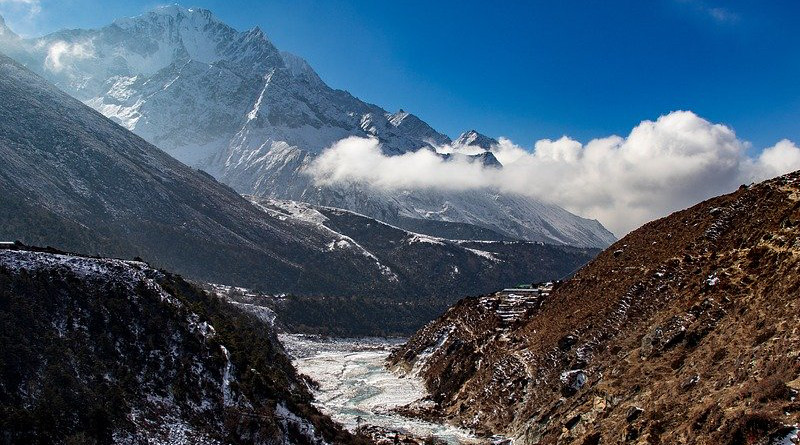
Recent protests in Nepal reflected youth anger over political stagnation, soaring living costs, and deepening mistrust in governance, with corruption at the core. Yet, an even graver threat looms large: climate change, already evident through erratic weather, melting glaciers, and rising natural disasters that endanger the fragile Himalayan ecosystem and the livelihoods it supports.

For a country that is among the ones to contribute least towards global emissions, Nepal faces a disproportionate burden of climate change as Himalayan glaciers face the imminent threat of disappearing, and an increase in natural calamities plagues the nation’s fragile ecosystem and vulnerable communities. Almost 80 percent of the Himalayan glacial reserve faces a risk of extinction by 2100 if global emissions continue to increase. Even with efforts to keep the global temperature increase to 1.5°C, up to 30 percent of glaciers would still be lost. In the last twelve years, 44,000 reported incidents of floods, landslides, and storms have taken place in Nepal, claiming the lives of 5,667 individuals and resulting in US$367 million in losses.

With a fragile and unpredictable environment at play, many people turn to migration as the only pathway to a stable and secure life. For instance, indigenous communities continue to shrink in the village of Dhye, as several members out-migrated when water became too scarce. Between 2001 and 2021, the Panchakanya village in Terhathum district witnessed a 40 percent reduction in its population, while the Thoklung village lost 42 percent of its population. It is estimated that the loss of glaciers in the future can lead to severe water shortages for the 250 million people living in the Hindu Kush Himalaya region, affecting another 1.6 billion people downstream. This doesn’t just impact the trajectory of Nepal but also of South Asia, especially as densely populated countries like India and Bangladesh face the imminent threat of mass migration and a threat to the livelihoods of billions who depend on the glacial system for several reasons.

In this context, this essay seeks to examine how climate change influences migration patterns in Nepal, and to analyse better how climate change in the Himalayas impacts indigenous communities. By situating it within the broader discourse on climate-induced displacement, this essay emphasises the urgent need for collaboration at the regional level to protect at-risk communities and to enhance the climate resistance of the Himalayas.
Factors Driving Migration

It is important to understand the ways in which climate change disrupts the everyday lives of ordinary people, forcing them to relocate. Over 60 percent of the population in Nepal depends on agriculture as their means of income, with the Terai region being the most agriculturally productive. Due to the late arrival of monsoons, droughts have become more frequent, particularly in the winter months and in the western Terai plains. The average annual rainfall has decreased by 3.7 mm per month every decade since 1960.

In the coming years, the number of rainy days will likely decline along with an increase in the intensity of rainfall. This, in turn, will impact water, agriculture, health, livelihood, energy, biodiversity, disaster management, and urban planning. An estimation in 2015 suggested that due to the impact of climate change on agriculture, Nepal’s GDP will drop by 0.8 percent each year by 2050. The study also associated changes in crop production with changes in precipitation patterns during the period, affecting Nepal’s water resources availability and variation. Too little rainfall will reduce rice and maize cultivation, which are the main food crops for much of the country’s population, while high-intensity rainfall will destroy crops and increase topsoil erosion.

In Nepal, there is a direct link between climate change, farming, and migration. The indigenous Tibetans of the upper Himalayas, who have long adapted to one of the world’s harshest environments, are now being compelled to migrate. The people of Upper Mustang remain among the few preserving the remnants of traditional Tibetan spiritual culture. Upper Mustang’s economy has collapsed as grazing lands erode and rivers dry, with a 4.3 percent loss of plant cover over 30 years, causing severe soil erosion. In villages like Samdzong, once fertile lands now face drought, erratic water, and migration. Despite emission cuts, glacial retreat persists, threatening Nepal’s high-altitude communities with displacement and loss.
The Effect of Out-Migration

This migration often takes place to urban cities, which means a tougher life for many. The absence of social networks and marketable skills funnels individuals into low-paying, unstable jobs, making them susceptible to repeated cycles of exploitation and poverty. Overseas labour migration is increasing, especially among the youth. Although remittances help strengthen rural economies, migrants often face hazardous working conditions, long periods of family separation, and inadequate protection. Even greater challenges are faced by women and indigenous peoples alike, and these groups represent sections of society that are often ignored in decision-making, while they also bear the burden of waiting for food and water security to be restored in their homes. The resultant impacts clearly indicate that the impacts of climate-related migration must be managed not only from an environmental perspective but from a social one as well. If affected families do not receive proper support and investment for climate adaptation, they will continue to suffer. Creating sustainable livelihoods and helping displaced families is essential. Without these efforts, migrants from the Nepali Himalayas will gradually lose their dignity and sense of identity as they struggle to survive away from their mountain homes.
Addressing Policy Gaps and the Need for Regional Coordination

Even as Nepal has begun to recognise and include climate-induced mobility in its national framework, its integrated mobility response still faces significant policy implementation gaps. These gaps are compounded by the absence of cohesive cross-border cooperation in the South Asian region. While Nepal’s National Adaptation Plan draws attention to climate-induced migration, loss of livelihoods, and the need for adaptation tracking data systems, issues pertaining to funding, fractured mandates across tiers of government, and the absence of migration-specific legislations (such as social protection and planned relocation frameworks) render the implementation of such proposals ineffective.

Gacial systems, climate change, and human mobility are transboundary issues and thus should be addressed at the regional level. However, South Asian Association for Regional Cooperation (SAARC) collaboration is sporadic; experts cite stalled projects, insufficiently funded joint projects, and a tendency to “securitise” climate challenges, which hinders productive collaboration on shared river basins, climate services, and early warning systems.

At the eighth edition of the Global Platform for Disaster Risk Reduction held in June 2025, a high-level event was organised by the United Nations Office for Disaster Risk Reduction (UNDRR) and the Bay of Bengal Initiative for Multi-Sectoral Technical and Economic Cooperation (BIMSTEC). Nepal’s Home Secretary Gokarna Mani Duwadee called for the establishment of a cohesive BIMSTEC disaster mechanism that would synchronise risk evaluations, supervise Sendai Framework enforcement and the formation of a specific regional Disaster Risk Reduction fund. Climate action takes priority for BIMSTEC as it hosts a workshop in Kathmandu, thereby highlighting the necessity of climate policies rooted in principles of gender equality and social inclusion.

Because of the direct effect on water security and cross-border displacement, changes in glacial flow and snow will require coordinated action in the Hindu Kush Himalayan region. The Glacier and Snowassessments of the Hindu Kush Himalaya mandate cooperation across the entire Hindu Kush region through open data, harmonised risk monitoring, and planning across entire basins. Recent reports highlight the urgency in dealing with floods and infrastructure breakdowns that are hampering trade and energy networks in a manner that no single country can combat.

To address these issues, climate-induced displacement should be incorporated into both national and local budgets, as well as social protection strategies, aligning actions in the NAP with earmarked funding and voluntary, rights-based relocation guidelines. Planning should be based on policy-relevant, open climate risk and migration data, and regional platforms should be reinvigorated with periodic data exchange agreements and shared drought management, early warning, and GLOF (glacial lake outburst floods) risk reduction funds. With international agreements still non-binding, a regional soft-law instrument (or protocol) to protect cross-border environmental migrants by clarifying their rights to assistance, employment, and admission should be put in place. If these steps are ignored, the forecasted climate displacement in Nepal will trigger a sequence of crises affecting the South Asian labour markets, waterways, and urban centres, resulting in irreparable damage to the region’s economy and livelihood.

About the authors:Anasua Basu Ray Chaudhury is a Senior Fellow with the Neighbourhood Initiative at the Observer Research Foundation.

Sreedipta Roy is an Intern at the Observer Research Foundation.

Source: This article was published by the Observer Research Foundation.


Observer Research Foundation

ORF was established on 5 September 1990 as a private, not for profit, ’think tank’ to influence public policy formulation. The Foundation brought together, for the first time, leading Indian economists and policymakers to present An Agenda for Economic Reforms in India. The idea was to help develop a consensus in favour of economic reforms.


4.3 The Multitude against Empire. 393. Notes. 415. Index. 473. Page 11. PREFACE. Empire is materializing before our very eyes. Over the past several decades, as ...