Sunday, November 23, 2025

The rise of masculinism: Violence and misogyny online (1/3)

ANALYSIS


For the International Day for the Elimination of Violence against Women, FRANCE 24 examines a sharp rise in masculinist discourse that seeks to normalise and legitimise misogyny. This first article of a three-part series looks at the increase in violent rhetoric online and asks what can be done to protect the victims.


Issued on: 23/11/2025 - 
FRANCE24
By: Pauline ROUQUETTE
Over the past decade, digital violence against women has increased dramatically. © Studio graphique FMM

Deepfakes, trolling, doxing and more: New terms have been coined to describe online violence and how victims are targeted in the virtual world – much of the abuse directed against women. According to the UN, digital attacks have become one of the main vectors of gender-based violence worldwide.

A 2021 study conducted by the Economist Intelligence Unit in 45 countries revealed that 85 percent of women have been victims of, or witnesses to, online violence – or violence facilitated by technology – including 74 percent of women in Europe, 91 percent in Latin America and the Caribbean and 90 percent in Africa. Cyberviolence also affects nine out of 10 women who are already victims of domestic violence, according to a study by the Hubertine Auclert Centre, a French group that works to promote gender equality and combat violence against women.

This explosion of cyberviolence goes hand in hand with advances in digital technologies. With the spread of generative AI, attacks are now more extreme, more coordinated and more sexualised – including a proliferation of deepfakes used to violate women's privacy.


But the dramatic increase in online abuse cannot be explained solely by new technologies. It also follows a rise of masculinist – a reaction to feminism, advocating male interests – narratives that have redefined digital culture and led to uninhibited aggression towards women.

Forums for incels (“involuntary celibates”), videos by misogynistic influencers and anti-feminist or “anti-woke” communities pervade online platforms. According to a report by the French think tank Iris, it takes “less than 30 minutes” for algorithms to recommend such content to young male internet users.

As a result, masculinist discourse is reaching a wider audience and spawning digital aggression that is also politicised – and increasingly socially accepted. This further fuels the types of digital abuse that have long targeted women and gender minorities.
From sexism to a structured ideology

“Cyberviolence is not a private issue but an integral part of the continuum of violence against women and girls,” the European Institute for Gender Equality (EIGE) said in a 2022 report documenting the extent of gender-based digital violence.

The type of violence that already exists offline is amplified in the digital space.

Masculinist propaganda then gives fresh meaning and direction to this entrenched violence, transforming it into a structured mobilisation against women.

The tens of thousands of men who have shared real or fake pornographic images of women – sometimes members of their own families – on Facebook groups, WhatsApp or Telegram are taking part in “systemic violence against women”, says Alice Apostoly, co-director of the Gender in Geopolitics Institute in Paris.

Apostoly says the “explosion of masculinist discourse” spreads misleading information based on misogynist and sexist stereotypes, “which gives weight to sexist and sexual violence targeting feminist activists, female politicians, journalists and artists”.

It is precisely this ideological dimension – the transformation of impulsive male anger into a political narrative – that distinguishes “traditional” digital violence from its more recent manifestation: the mobilisation of radicalised groups of men seeking to punish, intimidate or silence women who are in the public sphere.

This phenomenon, widespread on digital platforms, goes far beyond the idea of lone “incels” spouting vitriol from behind the safety of their screens.

While media coverage of the once obscure masculinist movement has focused in recent years on incels – highlighted in the Netflix series “Adolescence” and implicated in terrorist attacks that have left dozens dead since 2014 – it often overlooks many other openly misogynistic groups.

These groups share the same fixations: hatred of feminism, nostalgia for a patriarchal order and the belief that men are now victims.

Their huge online presence plays a central role in spreading and normalising digital violence.


Organised violence

The attention given to British influencer Andrew Tate, a leading light in the masculinist movement, obscures the collective dimension of masculinism, which Stéphanie Lamy, researcher and author of La Terreur masculiniste (Masculinist Terror), prefers to refer to in the plural.

“'Masculinisms' are an ideological offering developed in radical milieus, characterised by a diversity of ideologies, the collectivisation of resources and the glorification of violence in all its forms,” she says. What differentiates masculinist discourse from misogyny and sexism is therefore this “collective and organised dimension”.

The only known killing in France motivated by a masculinist ideology, the murder of Mélanie Ghione by Mickaël Philétas in 2020 – was not legally classified as an ideological attack.

But Lamy notes that “there was indeed collaboration with other members of the same anti-feminist circle” that Philétas claimed he belonged to, the MGTOW group, for Men Going Their Own Way. “So it was indeed organised,” she says.

In Saint-Etienne, Bordeaux and Annecy, three men were arrested between 2021 and 2023 while planning attacks against women and gathering weapons for this purpose.

In the case of Timothy G., suspected of planning to attack women in Saint-Étienne, witnesses said he had been encouraged to take action within the incel forums he frequented. “There are no lone wolves,” Lamy says.

“Propaganda, whatever form it takes, shapes perceptions and reflexes. When we see hateful comments under a feminist post, it may have been posted in a forum with a call to carry out an attack,” notes Lamy, or a targeted harassment campaign against women. “But it may also be that some men act on their own initiative, because they have already been conditioned to react in this way.”
Normalisation of misogyny, a ‘major blind spot’ in legislation

Masculinism provides a common language, with its own justifications and targets. And the more this framework becomes normalised, the more digital violence proliferates.

If cyberviolence against women and gender minorities – otherwise known as “technology facilitated gender-based violence" (TFGBV) – has exploded in recent years, it is indeed “because digital technology is becoming increasingly politicised”, says Lamy. "The more visible women are in the public sphere, the more they become targets."

And if they are increasingly targeted, it is because there are increasingly motivated groups of men who are organising themselves to attack them.

Lamy says such misogynistic attacks offer “rituals” that allow individuals “to unite, take joint action to feel part of a group and rally”.

READ MOREFour men convicted of cyberbullying French DJ Olympics performer

For Apostoly, these are acts of political violence, which have “a very clear objective: to make women invisible and silence them in the digital public sphere and in the public sphere in general”.

The normalisation of this type of violence is all the more problematic as it thrives in the absence of almost any legal sanctions.

In its 2022 report, the Group of Experts on Action against Violence against Women and Domestic Violence (Grevio) noted: “While many countries have adopted new laws to criminalise certain forms of technology-facilitated online abuse, many provisions are limited in scope, as is their practical implementation.”

“The moderation of hate speech is linked to a complex web of European and national legislation and regulations that stem from the fight against terrorism,” explains Lamy. "The first European standards were driven by this, focusing on racial hatred and completely overlooking misogyny. It's a huge blind spot.”

Yet the same mechanisms of radicalisation, expression of hatred and “hierarchisation of humans” are at work, she says.

As a result, various online community platforms are becoming the main incubators for misogynistic and masculinist violence, with no real regulation, while generative AI is multiplying the tools used for harassment.

“At the European level, we are fortunate to have a Digital Services Act (DSA) and a General Data Protection Regulation, but it is essential that these two bodies of law be strengthened and that American platforms have no say in what they want to do or not do within the EU,” says Apostoly.

She laments that the AI Act, adopted in 2023, makes no mention of gender issues, despite calls from associations to regulate image-generating AI so that it does not reproduce gender stereotypes and encourage gender-based and sexual violence.

"We have gone so far beyond the point of no return in terms of platform regulation that we now need drastic measures that no longer even concern digital technology,” says Lamy. “This is a political issue, and we are not going to solve it with technology.”

Lamy stresses the importance of funding, “putting money on the table” to sustain the work of associations that fight violence against women that remain underfunded despite being on the front line.

The budget for France’s programme 137, seeking Equality between women and men in 2024, increased from €36.5 million to €101.1 million (up 176 percent compared to 2020). Last July, a report by the French Senate Finance Committee highlighted the gap between these appropriations and the estimated real cost of gender-based and sexual violence – estimated at between €2.5 billion and €70 billion per year – calling for stronger leadership and greater mobilisation of local authorities and European funds.

For her part, Apostoly emphasises the importance of prevention: education about human sexual and emotional life to “foster gender equality from an early age”, support for feminist and digital rights associations, and awareness campaigns about misinformation and online harassment.

Lamy warns that “focusing solely on digital technology is pointless if we don't take a holistic approach”.

Indeed, while digital violence targeting women flourished well before the advent of masculinist propaganda, the latter has given it coherence – a rationale and new targets, including shared narratives and tools for mobilisation.

Masculinism today is structured, transnational and deeply political. It is not confined to online platforms, but has become part of the public debate, shaping perceptions and paving the way for very real attacks on women and their rights.

This article has been translated from the original in French.
How Germany's Nuremberg trial for Nazi crimes transformed international law

Eighty years ago, on 20 November, 1945, the historic trials of many leaders of the Nazi Third Reich began in Nuremberg, Germany, just months after the end of WWII. The exceptional procedure laid the foundations of a new international legal model to prosecute crimes against humanity.


Issued on: 22/11/2025 - RFI


The international judges at the Nuremberg Palace of Justice, Germany, during the trial of the main Nazi leaders for war crimes before the International Military Tribunal (IMT), Germany, 1945. © Raymond D'Addario, Public domain, via Wikimedia Commons

The four victorious Allied powers of World War II did not opt ​​for summary justice, but instead created an International Military Tribunal (IMT) to judge Nazi criminals.

New concepts, such as war crimes, crimes against humanity and crimes against peace were introduced on the orders of US Attorney General Robert Jackson and laid the foundations of contemporary international criminal law.

For 10 months in courtroom 600 of the Nuremberg tribunal, in front of more than 400 journalists and nearly a hundred witnesses, the world would see the extent of Nazi crimes carried out under the leadership of Adolf Hitler.


German leader Adolf Hitler (L) and his Nazi commanders Hermann Goering (2nd L) and Joseph Goebbels (C) THE NATIONAL ARCHIVES/AFP

Hiding behind orders

When the trial opened on 20 November, 21 of the 24 high-ranking officials of the Nazi regime appeared in court.

Key defendants were the regime's second in command Hermann Goring, Hitler's right-hand man Rudolf Hess, Alfred Rosenberg, the regime's ideologue, and Hitler's architect, Albert Speer.

Defendants also included some of the highest-ranking officers of the German armed forces: Wilhelm Keitel and Alfred Jodl of the Wehrmacht High Command, and naval commanders Erich Raeder and Alfred Dönitz.

In this Nov. 21, 1945 file photo, Reichsmarshal Hermann Goering stands in the prisoner's dock at the Nuremberg War Crimes Trial in Germany. He is entering a plea of not guilty to the International Military Tribunal Indictment. AP

Seven institutions were also accused: the Reich Cabinet (government), Nazi Party dignitaries, the SS, the Gestapo, the SA, the General Staff, and the High Command of the German Armed Forces.

All the defendants pleaded not guilty, claiming they were acting on orders and had not been aware of the atrocities committed by the Nazi regime.

Their lawyers knew that their clients' guilt was beyond doubt, given the irrefutable evidence. A film depicting the horrors of the extermination camps, footage still little known at the time, was shown during the trial.


Chilling testimony of survivors


Marie-Claude Vaillant-Couturier, a survivor of Auschwitz and Ravensbruck, delivered detailed testimony on 18 January, 1946, that stunned the assembly.

"One night, we were awakened by terrifying cries. We learned the next morning, from the men who worked at the Sonderkommando, the gas commando, that the day before, not having enough gas, they had thrown the children alive into the furnaces," she recalled.

Her testimony helped other victims to come forward, though it would take several decades before they were heard outside the courts, which for a long time were the only places they were willing to be heard.

"Through my eyes, thousands and thousands of eyes [were watching them], and through my voice, thousands of voices [were accusing them]" Vaillant-Couturier said later.

Photograph of Marie-Claude Vaillant-Couturier published on the front page of the communist magazine Regards, on 8 February, 1946. © Regards, Public domain, via Wikimedia Commons

When the verdicts were handed down on 1 October, 1946, three of the defendants were acquitted, twelve were sentenced to death and executed by hanging two weeks later. While Goring was sentenced to death, he managed to hasten his execution by swallowing a cyanide capsule.

The others served prison sentences.

Only Speer admitted a share of responsibility, a tactical choice that allowed him to narrowly escape a death sentence.

Twelve further trials were held in the same courtroom over the following years, although they were largely overshadowed by the Cold War and the reconstruction of Germany.


Ideological capital

Choosing Nuremberg as the setting for the trial had strong symbolic significance.

In the autumn of 1945, Berlin and Nuremberg were in ruins. But the vast courthouse in the centre of Nuremberg was miraculously still standing despite years of war.

Situated in Bavaria's second-largest city, steeped in its imperial past, Hitler designated it the regime's "ideological capital".

A view of Nuremberg from the castle looking southeast in 1945. © Ray D'Addario, Public domain, via Wikimedia Commons

Speer built a vast architectural complex – the Reichsparteitagsgelände ("Reich Party Congress Grounds") – in the southeast of the city, where the Nazi Party, the NSDAP, held its congresses from 1933 to 1938.

It was there that the so-called Nuremberg Laws, in 1935, cemented Nazi antisemitism into the Reich's legal system.

For the past fifteen years, a memorial in the building has informed the public and attracts 160,000 visitors a year, mostly from abroad.

Nina Lutz, the memorial's director, says she is impressed by how well informed the visitors are.

"Everything has changed. Today we are aware of the importance of this trial for historical work on the crimes of the Third Reich. I'm always surprised by the interest and knowledge of our visitors," she told RFI.


Resonance with Ukraine war


Among a group of young German visitors, some are keen to see how the legal model set up in Nuremberg could still have an influence 80 years on.

"On the one hand, we see that the trial was fair, but also that criminals were acquitted. Let’s hope it will be different in the future; we’re thinking of Ukraine, for example," one man told RFI.

"I wasn’t aware of the importance of the trial for international criminal law," another visitor admitted, while a third said it "shows that we can do something about these crimes, but the world has to work together".


The Nuremberg trials are not only a crucial historical chapter after the fall of the Third Reich. They marked a turning point in international law that remains relevant today.

"The Nuremberg Principles are of central importance to international criminal law," says Gurgen Petrossian of the Nuremberg Principles Academy. "States have incorporated these rules into their national laws. We see this in trials today where these same principles are applied."

The trial that began this week in Koblenz, against five men accused of war crimes and crimes against humanity under the Bashar al-Assad regime in Syria, is just one example of how relevant the Nuremberg trials still are.

This article was adapted from RFI content in French: this piece by Pascal Thibaut and this piece by Olivier Favier.


THE ONE THAT GOT AWAY

earlier, she had still been an ardent disciple of the German. Zionist ... In describing Eichmann as the banality of evil, Arendt had invented a phrase ...


Photography

Hicham Benohoud's 'The Classroom' awarded PhotoBook of the Year

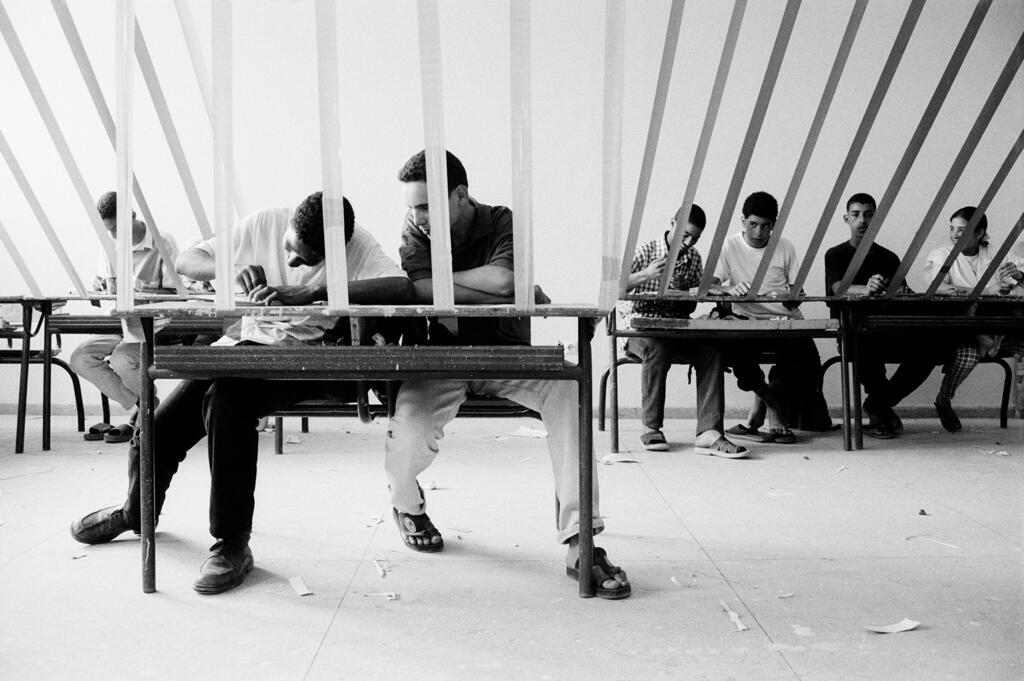
Paris – Moroccan photographer Hicham Benohoud’s book The Classroom was been awarded PhotoBook of the year at Paris Photo, the world’s largest photography fair. The book presents a striking collection of black-and-white images created while he was working as an art teacher in Marrakesh in the early 1990s.


Issued on: 23/11/2025 -

From 'The Classroom' photobook by Hicham Benohoud.
 © Hicham Benohoud 2025 courtesy Loose Joints


By: Isabelle Martinetti


The Paris Photo-Aperture Book Prize has been awarded since 2012 to highlight the crucial role photo books play in the evolution of photography.

This year, the prize went to Hicham Benohoud for his book The Classroom published in March 2025 by Loose Joints and was announced during the recent 28th edition of the annual Paris Photo fair.

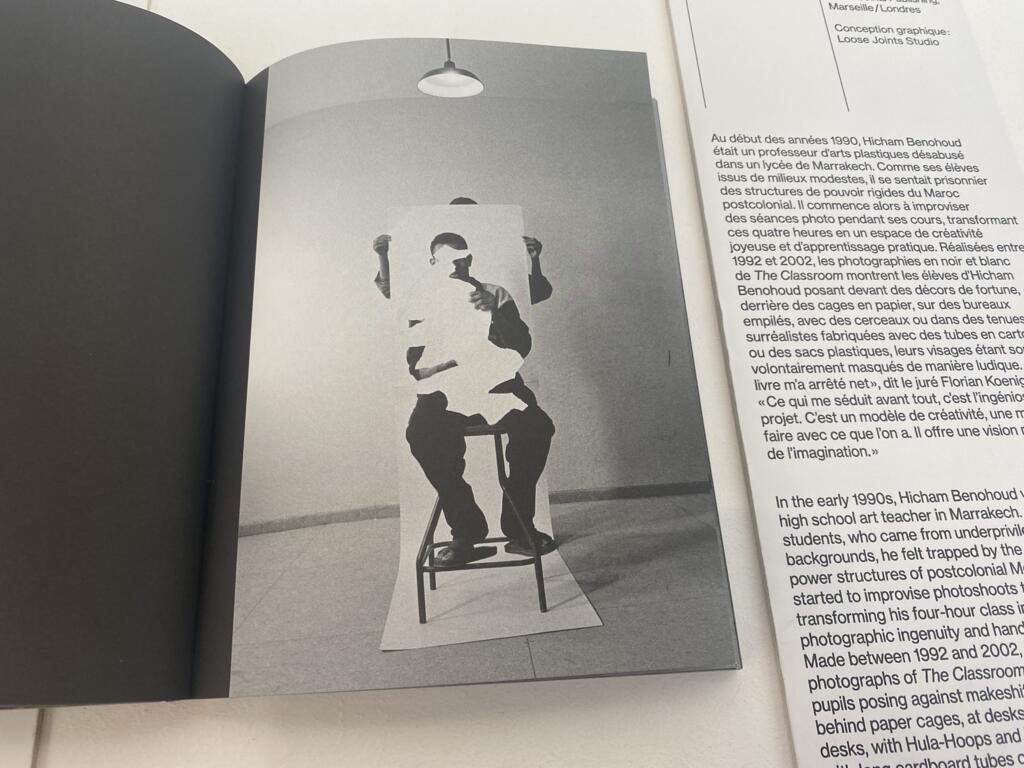
Photographer Hicham Benohoud’s book 'The Classroom'
 on display at Paris Photo fair, on 16 November, 2025. © RFI/I. Martinetti


Benohoud, 57, is a Moroccan visual artist who graduated at the École Supérieure des Arts Décoratifs in Strasbourg. The photos of The Classroom were taken between 1994 and 2002 when he was then an art teacher at a secondary school in his hometown of Marrakesh.

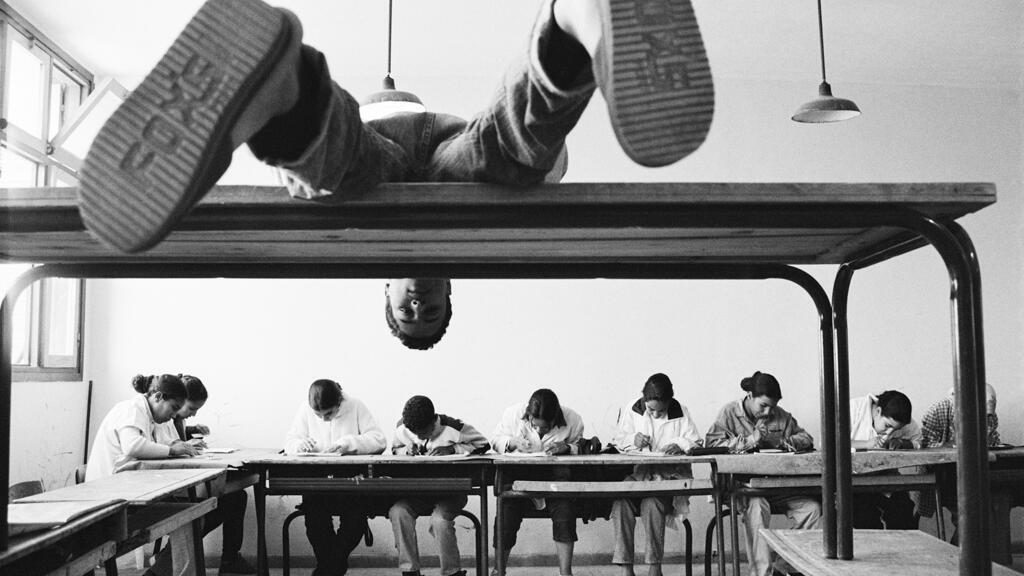
The "models" seen in the black and white images were his own students whom he staged during class.


RFI asked him some questions shortly after the Paris Photo fair earlier this month.

RFI: What was your reaction when you heard you had won the PhotoBook of the Year award?

Hicham Benohoud: I don't normally enter photography competitions. I've been on the judging panel for several photography competitions myself and I find it complicated and tricky to award a prize to one candidate when every artist has a different sensibility. I believe it was the publishing house Loose Joints that submitted my work. It's important to remember that this award is not given to a photographer but to a photography book.

I had just gone to Paris Photo for the signing of my book The Classroom, and it was at that precise moment that the publisher announced the award to me, visibly moved. Seeing my impassive reaction, she explained that this prize is to photography what the Oscar is to cinema. It was at that moment that I realised the importance of this prize in the world of photography book publishing.

I am honoured to receive this distinction and would like to thank all the members of the jury for their courageous and, above all, unlikely choice. I also dedicate this award, posthumously, to Christian Caujolle, who recently passed away and who organised my first solo exhibition The Classroom, outside Morocco in 2001 when he was director of the Galerie VU and the agency of the same name.

Untitled image from 'The Classroom' photo series by Hicham Benohoud. © Hicham Benohoud 2025 courtesy Loose Joints


RFI: Why did you start this photo series The Classroom?

HB: At first, I didn't know that photography was an art form in itself, like painting or sculpture. And far be it from me to imagine that this work would be exhibited and acquired by prestigious institutions such as the Reina Sofia Museum or the Tate Modern.

I took photos because I was bored in class and to kill time, I had set up a makeshift studio in a corner of the classroom so I could photograph my students. I taught four hours a day, either in the morning or in the afternoon, six days a week. In addition, I repeated the same lesson four times a day for an hour at a time throughout the week. I had four classes of about twenty students per day, almost five hundred students per week.

As the hours were endless, I wanted to keep myself busy in some way to break the monotony. At first, I only took portraits of my students from the front, the side and from behind. It was only when I had taken thousands of portraits that I tried to develop this work by adopting staging as a genre.

From 'The Classroom' photobook. © Hicham Benohoud 2025 courtesy Loose Joints


RFI: How did you come up with the composition of these images?

HB: I couldn't improvise because the one-hour class was short and I couldn't afford to ask my students to try out several ideas, especially since everything was done during art class.

I prepared all the scenes a few days before the photo shoots. Once I had an idea, I wrote it down on a piece of paper. I made detailed sketches with the approximate framing of a 50 mm lens, the perspective, the lighting, etc.

I knew in advance how many models would be posing, and I sometimes changed the layout of the tables to organise my image before each shot.

Only once my sketch was precise would ask my pupils to pose for me, following the drawing as closely as possible.

I only started taking photos ten to fifteen minutes after the start of the art class, once the pupils were busy with their colouring or drawings and didn't need me to explain the lesson.

For all the scenographic devices, such as installing panels, unfurling rolls of paper, hanging string from the ceiling, etc., I did not ask any students for help. Generally, the props used came from the art storage room. I set everything up myself and once everything was in place, I brought my students into the scene before taking the photos and thanking them, asking them to return to their desks as if nothing had happened.

For the photo, I told them which posture or pose to take. I directed them like a director directs actors, but more gently.

As the process was quite restrictive, I only took photos a few days in a row each month.

From 'The Classroom' photo book. © Hicham Benohoud 2025 courtesy Loose Joints


RFI: How was this photo book created – the choice of photos, the layout and so on?

HB: Regarding the production of the book, I was contacted directly by the publishing house. I gave them carte blanche for the choice of photos, the number of pages, the dimensions of the book, the layout, the publication date, etc. I submitted two thousand negatives to the team and left it up to them to produce the book as they saw fit.

I admit that I was surprised by the editing of certain photos that I thought were weak, but which were selected and found their place in the book. The rhythm of the images also surprised me a lot, because I personally would have made a completely different book, smoother, in which I would have taken fewer risks.

It was in the hope of being surprised, even troubled, that I had the courage to give the publishing house complete freedom to design and produce this little book. I can see that I was rewarded for my blind trust in them, and the publishing house for the freedom and quality of this edition. To each their own profession.

From 'The Classroom' photo book. © Hicham Benohoud 2025 courtesy Loose Joints


RFI: What did you want to show with these photos?

HB: Through these photos, I talk about Morocco as I see it. I address the issue of the individual, who does not exist in my society because it is the family or the community that counts.

Religion and traditions are so deeply rooted that they cannot be questioned. Otherwise, you are breaking the law, especially since the constitution is directly inspired by the Koran.

I have nothing against my religion, but I don't have the right to criticise it. So I show individuals who are also self-portraits, bound, restrained, deprived of freedom of movement and therefore of expression.

'The Classroom' photo book. © Hicham Benohoud 2025 courtesy Loose Joints
Art

A stitch in time: the Ghanaian artist sewing trash into treasure


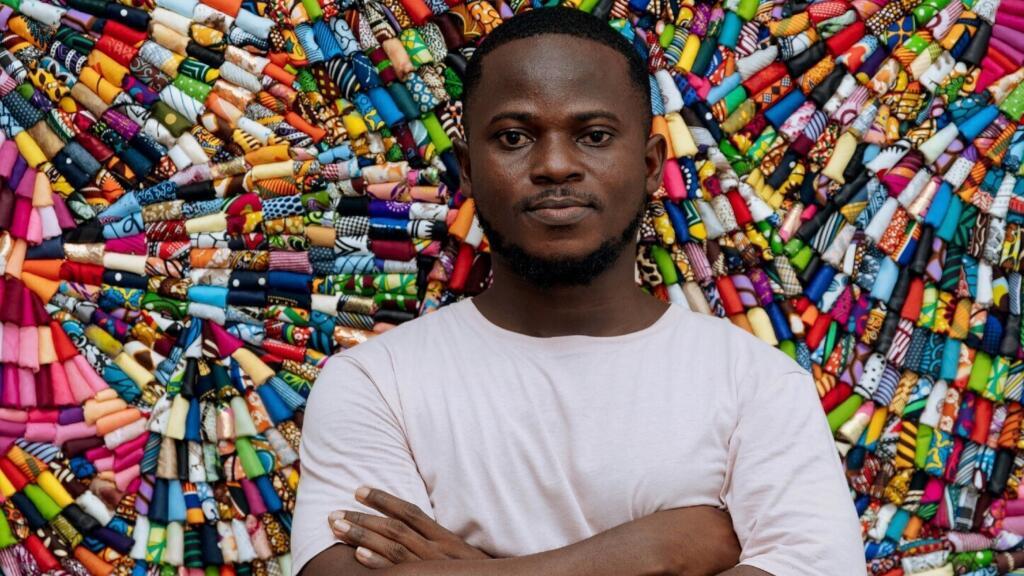
A civil engineer by trade and an artist at heart, Emmanuel Aggrey Tieku has found an innovative way to raise awareness about the problem of textile waste in his native Ghana. His ever-expanding installations are stitched together from hundreds of pieces of used clothing, collected from cities around the world as part of a decades-long project.


Issued on: 23/11/2025 - RFI


Emmanuel Aggrey Tieku, an artist from Ghana, with his textile project "How to Heal a Broken World". © desirepedia
02:35


By: Ollia Horton


Tieku credits his grandmother as one of his main sources of inspiration when it comes to his interest in textiles and their role in society as markers of cultural identity.

"She was a queen mother, and she loved textiles. She was an avid collector. We're talking about collections from the '50s, limited editions, particularly African fabric," Tieku tells RFI.

"She would talk to me about the essence of textiles and what it means for someone to have pride in what they wear."

While Tieku was exposed to his grandmother’s love of fashion from his childhood, it wasn’t until engineering school that he reconnected with fabrics and their hidden potential.

Working on a project investigating how textile waste could be transformed into building blocks for the construction industry, he began to think about its potential to become something useful, beautiful and meaningful.

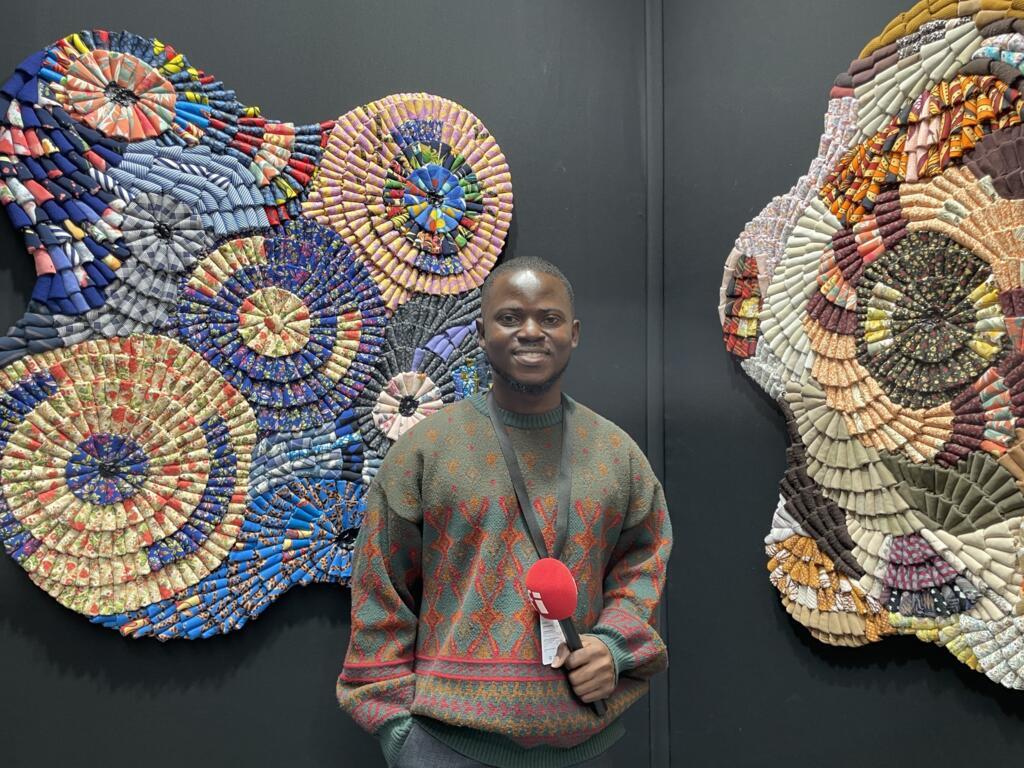
Ghanian artist Emmanuel Aggrey Tieku with his textile project "How to Heal a Broken World" at the Also Known as Africa (AKAA) contemporary art fair in Paris in October 2025. © RFI / Ollia Horton

Fast fashion, slow art

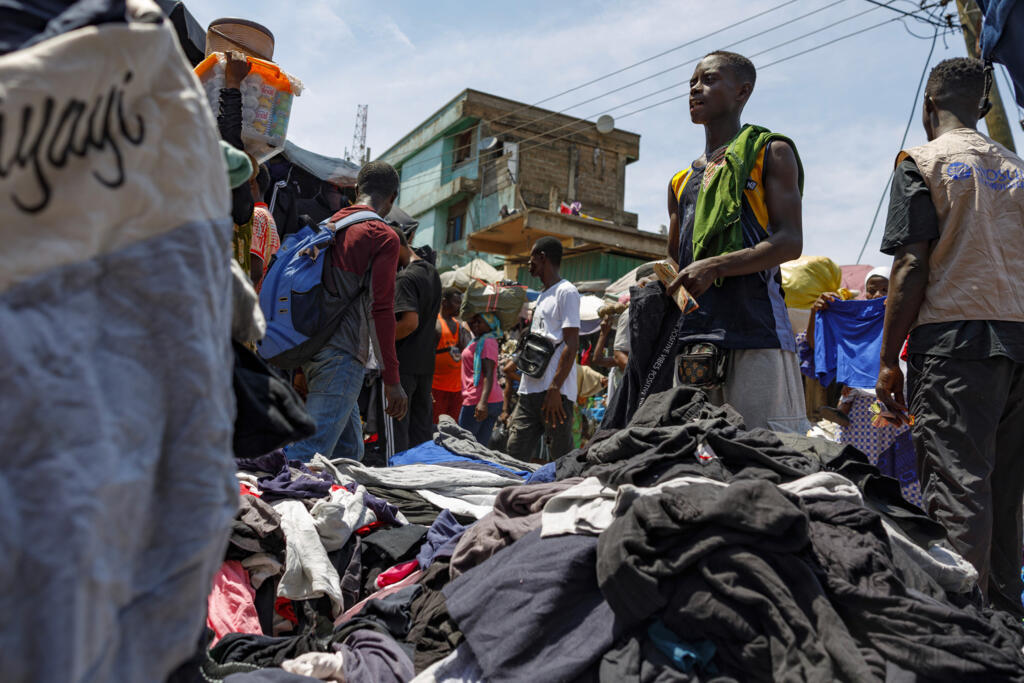
Tieku's native Ghana has become a dumping ground in recent years for clothes that people in other countries no longer want. Some 14 million items of clothing arrive each week, he says, be it unsold pieces from the "fast fashion" industry or secondhand items.

Although locals have made a living out of reselling some of the clothes, there are simply too many to handle.


Secondhand clothes at Kantamanto market, one of the world's largest used clothes markets in Accra, Ghana, on 31 October 2024. © AP / Misper Apawu

Reflecting on the mountain of discarded items and the stories they contained, Tieku began experimenting with large cloth installations in and around Accra. They became the foundation of his travelling project "How to Heal a Broken World – Fragile Origins, Futile Foundations".

It is a giant global patchwork which he says he will work on for the next 45 years, sewing textile installations in cities around the world.

Part of the project was created in Paris, where Tieku was invited to participate for the first time at the Also Known as Africa contemporary African art fair (AKAA) in October after winning this year's Ellipse Prize from French foundation Ellipse Art Projects.


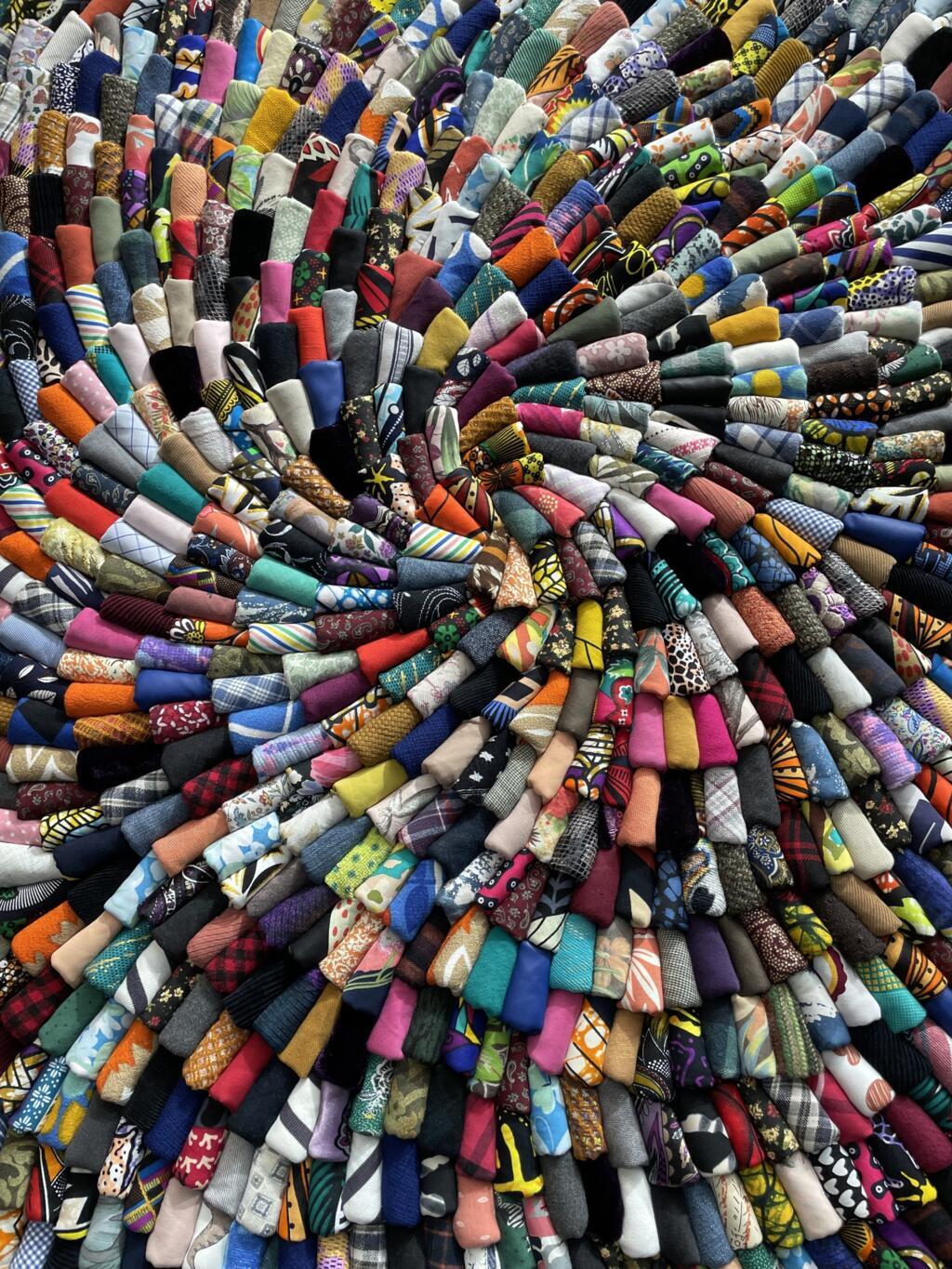
Close-up view of a piece by Emmanuel Aggrey Tieku at the 2025 Also Known as Africa (AKAA) contemporary art fair in Paris. © RFI / Ollia Horton


The dozen of his works on display drew from some 1,000 kg of secondhand clothes donated by French charity Emmaüs.

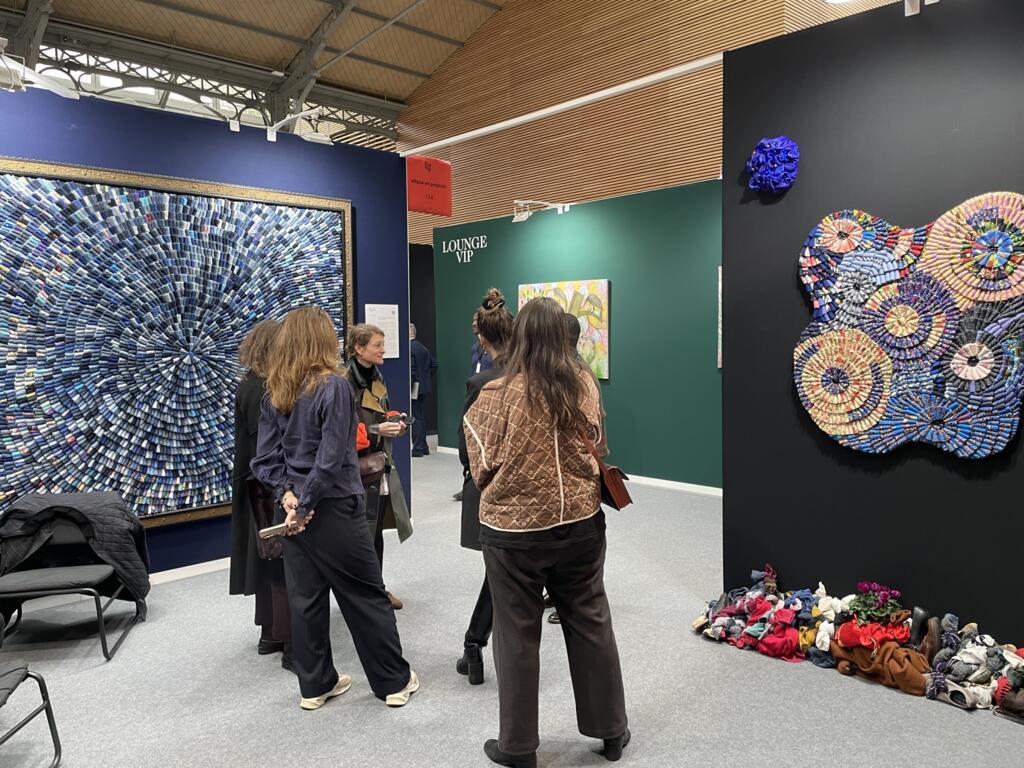
"I wanted to give the fabric a second life and also document the life of Paris in the moment, through what people wear and how people choose to be seen," Tieku says, pointing to an eye-catching circular motif called "The Sky Sings Over Paris".

Measuring around two square metres, the piece is made up of tiny, folded pieces of blue and grey denim, cut from old jeans and stitched together to form patterns that fan out in a spiral.


Visitors look at works by Emmanuel Aggrey Tieku at the AKAA art fair in Paris in October 2025. On the left is his piece "The Sky Sings Over Paris" made from recycled jeans.
 © RFI / Ollia Horton

Collecting stories, memories

Tieku says he has no control over the shape each piece takes; instead, it’s the fabric that speaks to him.

He does, however, emphasise the collective experience in each city where he takes his project. He encourages people to donate clothing that has a special significance and he collects stories about them along the way.

"As it travels from city to city, [the project] accumulates history, memories... People write messages on it, for other people to see from the other side of the globe."


A piece made from recycled clothes by Emmanuel Aggrey Tieku. 
© RFI / Ollia Horton

A floating garden

The Paris leg has taken the total project to 400 metres of stitched fabric, but Tieku hopes to reach 700 metres by the beginning of 2026.

The next stages will happen in Basel and Milan, where similar textile creations will be added to the larger project – the final size of which the artist hasn't yet decided.

Meanwhile, "How to Heal a Broken World" will return to its roots in Ghana with an installation called "Bridge over Troubled Water".


Tieku has chosen the Korle Lagoon in Accra, one of the most polluted water bodies on Earth, where he says attempts to dredge the basin of textile, plastic and electronic waste have so far failed.

"I want to convert the morbid, stagnant water into a temporary blooming field where a garden grows and a sense of hope arises," he says.

The 2.5 km-long discarded textile installation will cover a part of the lagoon between two bridges, where it spills into the Atlantic Ocean, and form a floating garden with more than 100 species of flowering plants.

Tieku hopes the project will spur viewers "to reimagine ways to bring life to what is dead and hopeless, to care for the planet and heal the world through our collective responsibility".
G20 summit ends with commitment to multilateralism, despite US boycott

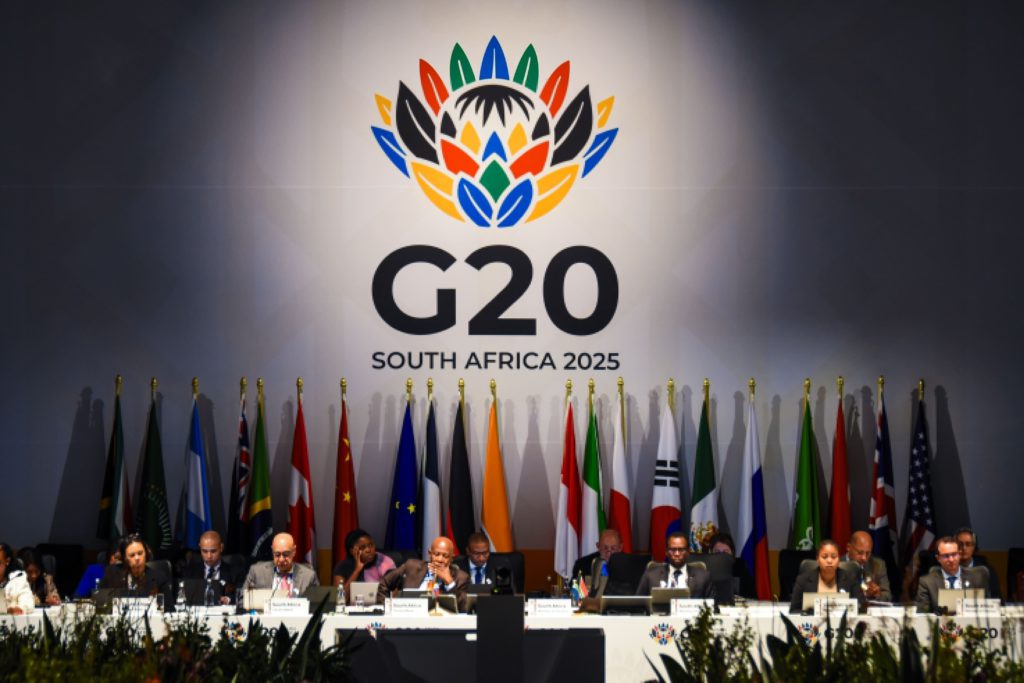
The G20 summit in Johannesburg closed on Sunday with South Africa claiming a diplomatic victory after securing agreement on a wide-ranging declaration – despite a boycott by the United States and warnings from several leaders that the forum is struggling to remain relevant in a fragmenting world.


Issued on: 23/11/2025 - RFI

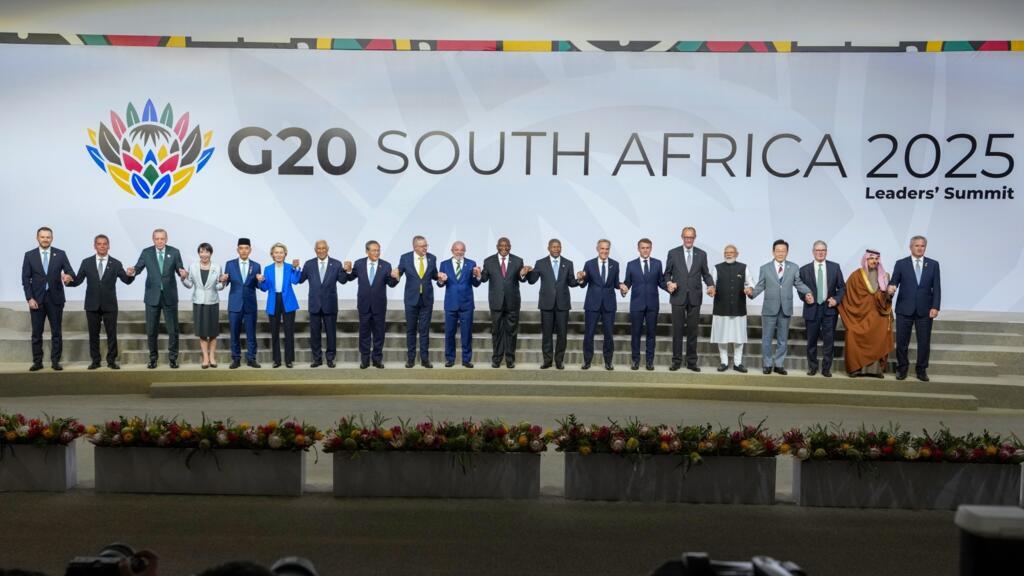
Heads of states pose for a family photo following the first plenary session of the G20 leaders' summit in Johannesburg, South Africa, on 22 November, 2025. © Misper Apawu / AP

South Africa's President Cyril Ramaphosa said on Sunday that the Leaders' Declaration from this weekend's Group of 20 summit reflected a "renewed commitment to multilateral cooperation".

As host of the Johannesburg summit, Ramaphosa pushed through the declaration addressing global challenges like the climate crisis, despite opposition from the US.

Addressing the summit's closing ceremony on Sunday, Ramaphosa said the declaration showed that world leaders' "shared goals outweight our differences".

The Trump administration boycotted the event because of allegations – widely debunked – that South Africa's black majority government persecutes its white minority. It also said South Africa's priorities – inculding cooperation on trade and climate – ran counter to its policies.

In an unprecedented move, Pretoria released the 122-point declaration at the start of the two-day meeting on Saturday – a decision that broke with G20 protocol and annoyed Washington.

Diplomatic tensions overshadowed the final hours of the summit as South Africa refused to stage the traditional handover of the rotating presidency, scheduled to pass to the United States for 2026. President Donald Trump plans to hold the summit at a Florida golf club he owns.

What was agreed?

The declaration called for more global attention on issues that specifically affect poor countries, such as the need for financial help to recover from climate-related disasters, debt relief and support for the transition to greener energy sources.

Leaders representing 19 countries, the EU and the African Union called for climate-related funding to increase “from billions to trillions globally”, echoing commitments made as Cop30 concluded in Brazil.

The text also emphasises the “imperative” of tackling global disparities in wealth and access to development, though it stops short of endorsing the international panel on inequality championed by South Africa.

On energy transition and resources, the declaration urged efforts to secure supply chains for critical minerals amid intensifying geopolitical tensions.

Regarding security, it said the organisation will work for a comprehensive and lasting peace in Sudan, the Democratic Republic of Congo, the occupied Palestinian territory and Ukraine.

The summit marked an important moment for African nations, more than 20 of which attended as guests.

Germany announced new investments through the pan-African insurer ATIDI, while the Compact with Africa programme – launched at the G20 in 2017 – received fresh commitments. The United Arab Emirates pledged US$1 billion to expand artificial intelligence infrastructure across Africa.

"South Africa has used this presidency to place the priorities of Africa and the Global South firmly at the heart of the G20 agenda," Ramaphosa said.

G20 outcomes are not binding so it's not clear whether the declaration will translate into concrete action.

Several of South Africa’s ambitions – including stronger language on taxing billionaires – were watered-down.

Geopolitical crises


The summit came at a time of heightened tensions between world powers over Russia's war in Ukraine, and fraught climate negotiations at Cop30 in Brazil.

The declaration made just one reference to Ukraine, calling for a “just, comprehensive and lasting peace” based on the UN Charter, despite gathering the vast majority of the world's leaders.

"Meeting for the first time on the African continent marks an important milestone," said French President Emmanuel Macron, but added the G20 bloc was "struggling to have a common standard on geopolitical crises” and "may be coming to the end of a cycle".

British Prime Minister Keir Starmer agreed, saying: “There’s no doubt, the road ahead is tough.”

China’s premier, Li Qiang – filling in for President Xi Jinping – said “unilateralism and protectionism are rampant”, and warned of mounting pressure on global solidarity.

Still, some praised the summit as a significant symbolic moment for the G20, which is actually a group of 21 members formed in 1999 as a bridge between rich and poor nations to confront global financial crises.

“This is the first ever meeting of world leaders in history where the inequality emergency was put at the centre of the agenda,” said Max Lawson of Oxfam – the international charity working to alleviate global poverty.

(with newswires)

G20 confronts fractured world order, growing US disengagement as South Africa summit ends


G20 leaders meeting in South Africa on Sunday hailed the virtues of multilateral cooperation even as they grappled with a splintering world order plagued by growing political rivalries and US disengagement. The final day of the weekend summit attended by leaders from the world's major economies began with talks on G20's future in a fragmented world.


Issued on: 23/11/2025 - 
By: FRANCE 24


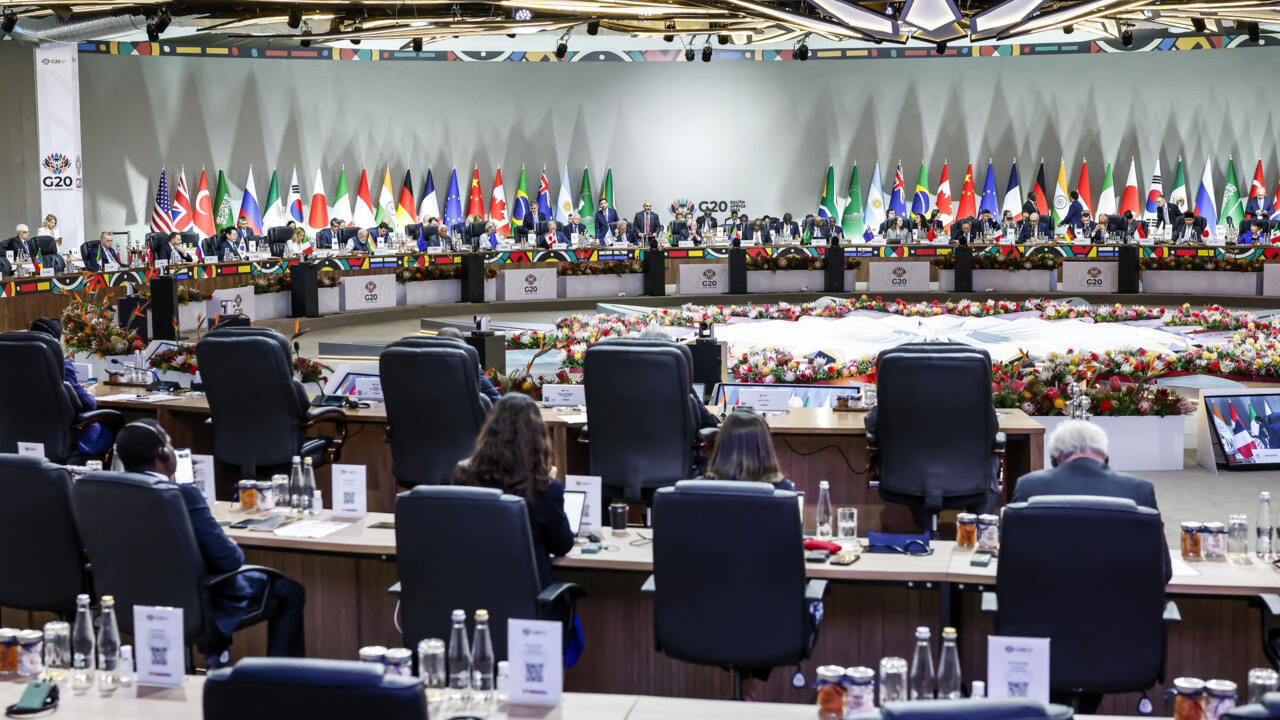
Leaders discussed how to keep the G20 relevant in a fragmenting world order. © Marco Longari, POOL/ AFP

G20 leaders gathered Sunday in South Africa hailed multilateralism – even as they struggled to adapt to a changing world order beset by go-it-alone US policies, wars and deepening geopolitical rivalries.

The final day of their weekend summit – boycotted by the United States – kicked off with a searching discussion on how the G20 can survive in a fragmenting world.

"We are not experiencing a transition, but a rupture," acknowledged Canadian Prime Minister Mark Carney to journalists just before the summit session.

"Too many countries are retreating into geopolitical blocs or the battlegrounds of protectionism," he said, but added: "In every rupture resides the responsibility to build – nostalgia is not a strategy."

'Nostalgia is not a strategy,' Canadian Prime Minister Mark Carney said. © Marco Longari, Pool, AFP
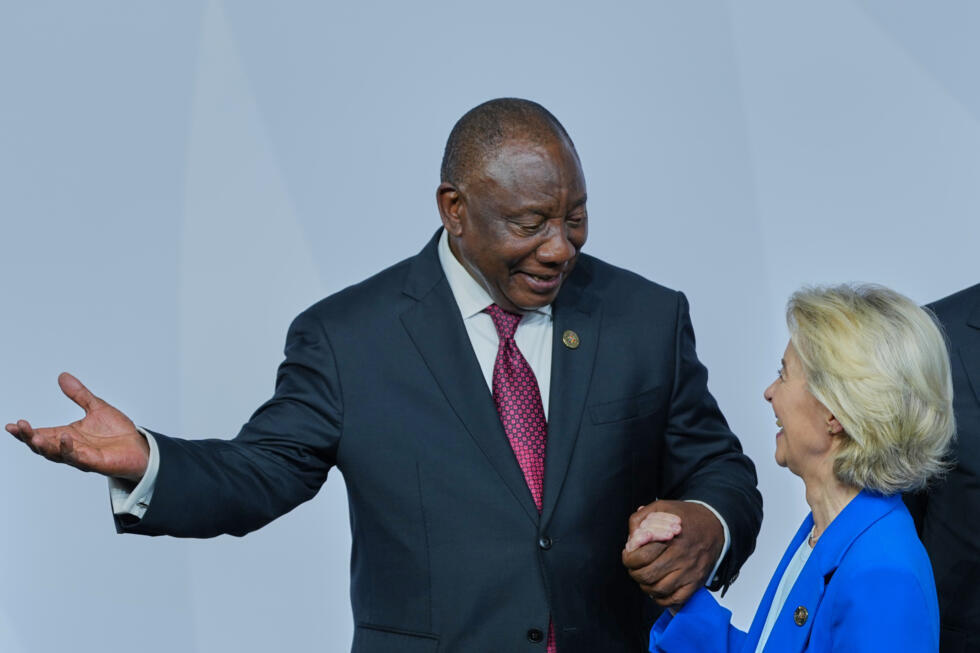
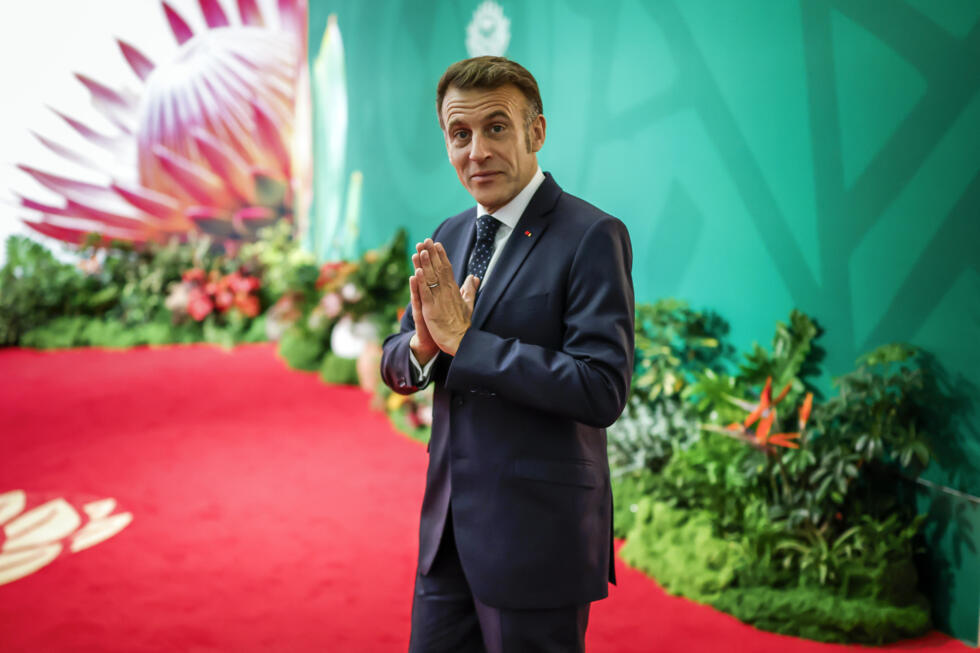
Dozens of leaders from key economies around the world – including EuropeChinaIndiaJapanTurkeyBrazil and Australia – attended the summit, the first to be held in Africa.

US President Donald Trump's government snubbed the event, saying South Africa's priorities – including cooperation on trade and climate – ran counter to its policies.

The United States is retreating from multilateral forums as it stokes trade volatility with sweeping tariffs and reverses commitments to fight global warming.

Trump's officials have also made unfounded accusations of a "white genocide" in South Africa.

'Fragmentation'


South African President Cyril Ramaphosa says the summit shows multilateralism is still alive, despite "challenges". © Misper Apawu, Pool, AFP


In a joint G20 statement issued Saturday, the leaders present said they were meeting "against the backdrop of rising geopolitical and geo-economic competition and instability, heightened conflicts and wars, deepening inequality, increasing global economic uncertainty and fragmentation".

South African President Cyril Ramaphosa admitted "challenges", but said: "The G20 underscores the value of the relevance of multilateralism."

The leaders' declaration was issued despite Washington objecting to the summit making any statement in the name of the G20.

The UK-based Oxfam charity said "South Africa has set an example to the world in ensuring the G20 stood firm and collectively agreed on a leader’s declaration – defending multilateralism – despite powerful opposition".

Nevertheless, French President Emmanuel Macron on Saturday said that "the G20 may be coming to the end of a cycle".

It needs to refocus its priorities on strategic economic issues going forward, he said, noting "difficulties" in the G20 finding common approaches to armed conflicts around the world.

That somewhat reflected a US intention to limit G20 discussions to just macroeconomic topics as it takes on hosting duties next year – when Trump plans to hold the summit at a Florida golf club he owns.

'Lifeline' to multilateralism


French President Emmanuel Macron is urging the G20 to refocus on economic priorities. 
© Marco Longari, Pool, AFP


The G20 – comprising 19 nations plus the European Union and the African Union – was founded in the wake of the 1997-1998 Asian financial crisis as a forum to boost global economic and financial stability.

Over time, its discussions have broadened to also cover climate change, sustainable development, global health and conflicts.

While those areas have economic implications, they are also political – often resulting in impasses or omissions in drafting summit declarations.

Divisions have only widened over Russia's war in Ukraine and the Israel-Hamas conflict in Gaza.

Carney – whose country this year holds the G7 presidency, to be taken up by France next year – also said that "the centre of gravity in the global economy is shifting", implying that the G20 needed to take greater note of emerging economies and the global South.

"Bringing emerging powers and developing countries was like creating a whole new world into the G20 and that actually helped to neutralise the Trump absence," he said.

"This summit has actually thrown a lifeline to multilateralism, breathing new life into it," he said.

(FRANCE 24 with AFP)

S.Africa G20 declaration highlights: minerals, debt, climate


ByAFP
November 22, 2025


South Africa's G20 summit endorsed a declaration the touched on issues of access to critical minerals and measures to cope with climate change - Copyright AFP EMMANUEL CROSET
Julie BOURDIN

Leaders from the G20 group of top economies endorsed Saturday a declaration at a summit in South Africa that highlights issues related to access to critical minerals and measures to cope with climate change.

South Africa chose “Solidarity, Equality, Sustainability” as the theme of its presidency of the G20, which comprises 19 countries and two regional bodies, the European Union and the African Union and accounts for 85 percent of global GDP.

Here are some highlights from the declaration from the first G20 summit on the African continent which was boycotted by the United States.

– Critical minerals –

Leaders said they would seek to protect the global value chain of critical minerals from “disruption”, whether due to geopolitical tensions, unilateral trade measures inconsistent with World Trade Organization (WTO) rules, pandemics, or natural disasters.

Many countries are intensifying efforts to secure access to these minerals, which are abundant in African and essential to the transition to green energy, used in electronics from phones to solar panels and electric cars.

China’s dominance of critical mineral supply chains has emerged as growing area of concern for the world’s industrialised democracies.

The declaration also supported “increased exploration of critical minerals, particularly in developing countries” for which they said the resource should be a driver of development and value-addition “rather than just raw material exports”.

– Just, lasting peace –


The declaration addressed major global conflicts underway by calling for a “just, comprehensive, and lasting peace” in Ukraine, Sudan, the Democratic Republic of Congo and the “Occupied Palestinian Territory” on the basis of the UN Charter.

It called on countries to “refrain from the threat or use of force … against the territorial integrity and sovereignty or political independence of any state”.

While Ukraine was only mentioned once in the 30-page document, Western leaders attending the summit also scrambled on the sidelines to respond to a unilateral plan pushed by US President Donald Trump to end the war in Ukraine on terms favouring Russia.

– Inequality –

South Africa placed the fight against inequality as one its main G20 priorities, with President Cyril Ramaphosa commissioning an expert report on the problem and supporting a call to establish an international panel on wealth disparities.

While the declaration did not specifically mention the report’s recommendation, it underlined the “imperative” to address “disparities in wealth and development both within and between countries”.

The leaders also called for efforts to reform international financial systems to help low-income countries cope with their debt, which was hindering development and eating into investments into infrastructure, disaster resilience, healthcare and education.

They called for more transparency from lenders, including in the private sector, and backed a review of the International Monetary Fund as well as work to establish global minimum taxes.

The declaration’s language on taxation of the super-rich was less robust than in the previous G20 declaration in Rio de Janeiro where leaders agreed to ensure the world’s billionaires “are effectively taxed”.

– Climate –


Endorsed on the same day that the COP30 UN climate talks concluded in Brazil, the declaration recognised the need to “rapidly and substantially” scale up climate finance “from billions to trillions globally from all sources”.

It highlighted inequalities in access to energy, particularly in Africa, and called for increasing, de-risking and diversifying investments for sustainable energy transitions.

The leaders said they would promote the development of early warning systems for people at risk of climate-linked disasters, recognising that some of those most impacted were from least developed countries.

The text, however, fell short of mentioning a phaseout from fossil fuels.

Africa G20 hosts bid to become mineral powerhouse

G20 South Africa Finance Ministers and Central Bank Governors meeting held earlier this year. Credit: UNDP

As global leaders land in Johannesburg for the first G20 summit on African soil, hundreds of climate protesters took to the streets to demand leaders give ordinary people more control over the continent’s coveted critical minerals.

Several mineral experts and African leaders agree with the protesters: the G20 global leaders summit is an opportunity to call for these minerals like lithium and cobalt to benefit the continent where they are found.

“It’s important to have a G20 that includes communities so proper conversations can be had about the development of Africa,” said Lazola Kati, campaign manager of Fossil Ad Ban, an initiative by climate group Fossil Free South Africa, on the sideline of the protest.

“We are so rich in resources. What this can look like is job creation, skills transfer… our own energy sector,” said Kati as protesters from Uganda to Zimbabwe sang and held up placards.

Africa is home to 30% of the world’s critical minerals needed for the transition away from fossil fuels to clean technology, as well as the digital infrastructure for AI data centres.

But for centuries Africa has endured what has become known as the “resource curse” – a paradox where abundant natural resources lead to conflict, corruption and slower economic growth.

The G20, which gathers leaders representing 80% of the world’s economy together, is being hosted in Africa for the first time. The African Union became a permanent member in 2023.

Policy experts believe that this gives African governments more leverage to call for global investment into local mineral processing to create jobs, as demand surges.

“Think of it this way: selling raw cobalt is like exporting flour when you could be exporting bread,” said Maxwell Gomera, United Nations Development Programme (UNDP) resident representative in South Africa during a speech at a Johannesburg event this month

“The world is in a new scramble for Africa’s minerals” he added. “We must make sure the new green order doesn’t become the old colonial order.”

Industrialization message

The continent needs to negotiate as a bloc to leverage its mineral bargaining power, said Deprose Muchena, program director at the Open Society Foundations (OSF), a human rights funding organization.

“The African Union is a member of the G20 now, which means even when South Africa is off the stage, the AU remains to continue the powerful industrialization message,” said Muchena.

The Africa Green Minerals Strategy, endorsed by the African Union in 2025, aims to promote mineral-related industrialization across the continent.

It outlines responsible mining practices, the needs for skills development and attracting investment for local mineral processing, or beneficiation.

More than a dozen African nations, including the Democratic Republic of Congo (DRC), Nigeria and Namibia, have restricted such exports intermittently, or banned them outright to promote beneficiation, according to World Bank research.

Zambia and the DRC are creating special economic zones to manufacture batteries using local minerals, the UN says.

One of the three main themes for the South African G20 summit is the future of critical minerals for Africans.

But the continent captures less than 5% of the value generated from energy technologies, according to The International Energy Agency, a global energy institution.

South African President Cyril Ramaphosa signed a critical minerals deal with the European Union on Thursday that he called “unprecedented”. He said South Africa intended to increase mineral processing to “move up the value chain”.

“Resources are finite”


But key political players will not be visiting South Africa for the G20, including US President Donald Trump and Chinese President Xi Jinping.

Both countries have key interests, capital and investments in global critical minerals.

“It is better when Trump and the like are not there,” said Kati from Fossil Free South Africa.

“This is the time where we can define development and investment, so when they come back we are ready with an African-defined program,” she said.

But mining is only one element of Africa’s development, said OSF’s Muchena.

Despite the G20 emphasis placed on critical minerals, it is important to remember that mining has a limited time span, he said.

“We know resources are finite and at some point the demand for critical minerals will go down due to potential technologies that could replace the need for these resources, the same way diamonds are being replaced by synthetics,” he said.

The financial benefit of these resources had to be used wisely during the mines’ lifespans.

Muchena estimates that between 2023 and 2024, Africa exported close to $250 billion worth of revenue from its critical minerals, with $1.6 trillion expected in the next 25 years.

“If these are the numbers, they should be finding their way back into the communities to transform them, to provide energy directly,” he said, referencing the 600 million Africans without reliable electricity.

At the mineral protest, Congolese bishop and activist Raphael Bahebwa from the Congolese Solidarity Campaign took the microphone to speak about mining abuses in his home country, where roughly 70% of the world’s cobalt is found.

“Everyone carrying a cellphone is carrying the blood of our people,” said Bahebwa, referring to the exploitative mining practices behind the cobalt found in most cellphones.

“When mining companies come with their contracts, the people must be honoured on their land so that they can benefit as well,” he said.

(By Kim Harrisberg; Editing by Jack Graham and Jon Hemming)


G-20 Tries to Box In Critical Mineral Disruption

The G-20 is tiptoeing around China with a sledgehammer. In a draft declaration seen by Bloomberg, leaders called for shielding the global critical-minerals value chain from “unilateral trade measures inconsistent with WTO rules”—a diplomatic way of saying: everyone noticed what China did this year. Beijing’s licensing chokehold on dysprosium, terbium, and other heavy rare earths rattled supply chains from missile makers to EV plants, and the repercussions are still rolling through the system.

Over the past six months, the U.S. and its allies have sprinted to stitch together mine-to-magnet supply chains outside Chinese control. Washington is taking minority stakes in North American rare-earth firms; MP Materials and Aclara are racing to commission heavy-rare-earth separation lines by 2026-2028; and Europe is now openly funding magnet plants to avoid being caught flat-footed again. Even so, the math is bleak—China refines over 90% of global rare earths and produces 94% of the permanent magnets that make missiles maneuver, turbines spin, and EVs accelerate without melting down.

That dominance is exactly what made China’s export curbs so effective. Earlier this year, U.S. defense contractors warned they were burning through “safety stock” of germanium, gallium, and heavy rare earths, with some inputs inflating five or sixty times in price. One supplier flat-out admitted it would miss deliveries if the squeeze continued.

So when the G-20 talks about making mineral supply chains more “resilient,” that’s because Beijing recently reminded everyone how asymmetric the playing field really is.

The draft declaration is non-binding, voluntary, and diplomatic to a fault. It will not unwind Chinese dominance. But it does show how much the strategic conversation has shifted. Critical minerals—once a niche topic for mining conferences—now sit next to Ukraine, Middle East conflicts, and global trade fights on the world’s main stage.

The G-20 isn’t calling China out by name, but everyone already knows who holds the cards—and who’s scrambling to redraw the deck.

By Julianne Geiger for Oilprice.com


ECOCIDE

Trump Administration Proposes Offshore Leasing In Almost All Alaska Waters

File photo of a young polar bear climbing atop some ice in the Chukchi Sea.
 (Photo by Petty Officer 2nd Class Christopher M. Yaw/U.S. Coast Guard)

November 23, 2025 
Alaska Beacon
By Yereth Rosen


(Alaska Beacon) — The Trump administration on Thursday released a plan for offshore oil and gas leasing that would open up almost all Alaska marine waters to development, along with the entire Pacific coast and the Gulf of Mexico.

The Alaska portion of the plan proposes 21 lease sales through 2031, five of them in Cook Inlet, two in the Beaufort Sea, two in the Chukchi Sea and the others in other marine areas. Those include a lease sale in a newly designated “High Arctic” area that lies beyond the 200-nautical-mile exclusive economic zone and where U.S. territorial rights are not yet clear.

The only federal Alaska offshore area without a proposed lease sale is the North Aleutian Basin, where oil leasing is under an indefinite ban to protect salmon-rich Bristol Bay.

The new plan, which also proposes six oil lease sales off the U.S. West Coast and seven in the Gulf of Mexico, is similar to an offshore leasing plan proposed by the Trump administration in 2017.

In a statement, the Department of the Interior called the plan “a major step to boosting United States energy independence.”

“Offshore oil and gas production does not happen overnight. It takes years of planning, investment, and hard work before barrels reach the market,” Interior Secretary Doug Burgum said in the statement. “The Biden administration slammed the brakes on offshore oil and gas leasing and crippled the long-term pipeline of America’s offshore production. By moving forward with the development of a robust, forward-thinking leasing plan, we are ensuring that America’s offshore industry stays strong, our workers stay employed, and our nation remains energy dominant for decades to come.”

Gov. Mike Dunleavy, a supporter of President Donald Trump, hailed the plan.

“Once again, the Trump Administration is leading the way to American energy dominance by restoring confidence in the federal government’s offshore leasing policies. Alaska has tremendous offshore oil and gas reserves that can power our economy for decades,” Dunleavy said in a post on the social media site X.

Another pro-drilling and pro-Trump Alaska public official, Sen. Dan Sullivan, R-Alaska, had a more muted response.

Sullivan, in a statement, said Burgum on Thursday “committed to me that DOI will continue to carefully listen to Alaskans throughout this process, particularly Alaska Native communities who live near the proposed leasing areas, including our whaling captains who bring generations of experience and deep knowledge of the Arctic Ocean.”

“It’s important for Alaskans to know that this draft proposal is not a final decision or a directive that any particular offshore lease sale will occur. Before any potential proposal is finalized, there will be multiple opportunities for public comment, environmental review, and additional analysis. As my office reviews the proposal, I will work to ensure that we are weighing in and amplifying Alaskan voices and views,” Sullivan continued.

Others expressed anger about the plan.

A map shows the locations of the 21 Alaska federal offshore oil and gas lease sales proposed by the Trump administration. (Map provided by the U.S. Bureau of Ocean Energy Management)


Rep. Jared Huffman, D-California, was among a group of mostly California Democrats in Congress who blasted it during a news conference Thursday.

“We are here because President Trump just put out what we believe is an asinine pro-polluter plan to open up our coast to offshore drilling,” Huffman said.

It is “not just a little bit of offshore drilling,” he said, but the entire California coast, the eastern Gulf of Mexico where residents have long opposed offshore drilling, and “every inch of Alaska.” Huffman is the ranking Democrat on the House Natural Resources Committee.

Environmentalists singled out the proposed Arctic lease sales in particular.

“Drilling anywhere in the Arctic Ocean is completely irresponsible. It is remote, ice-filled, stormy, home to irreplaceable wildlife and subsistence traditions. There is no way to clean up oil spills in this environment, and they are inevitable,” Erik Grafe, an attorney for the environmental law firm Earthjustice, said in an emailed statement.

Additionally, Grafe said, leasing in the Chukchi and Beaufort Seas is unlawful.

“Those areas have been withdrawn from future leasing by Presidents Obama and Biden, and though President Trump has purported to reverse these withdrawals, he lacks that authority. Only Congress can open them up again,” he said.

That finding was the result of an environmental lawsuit that Grafe represented. In 2019, Alaska-based U.S. District Court Judge Sharon Gleason ruled that Trump was barred from undoing Obama administration protections for Arctic and East Coast waters.

A new lawsuit filed in February by many of the same plaintiffs addresses that issue again. The new lawsuit, also with Grafe as one of the plaintiff attorneys, targets Trump’s Inauguration Day executive actions that aimed to open wide swaths of territory to drilling and other development, including the Arctic Ocean.

Another pending legal question concerns whether the federal government has the right to sell leases in the area designated as the High Arctic. That area, part of the North American extended outer continental shelf, lies beyond the 200-nautical-mile U.S. exclusive economic zone. The Biden administration made a territorial claim to the area, which is larger than California. But the claim has yet to be confirmed. The U.S. is not a party to the United National Convention on the Law of the Sea, and that international treaty is used to adjudicate nations’ territorial claims in the outer continental shelf.

The idea of leasing most of the non-Arctic areas off Alaska’s coastline also got a poor reception on Thursday.

Anticipating the new Trump administration plan, a coalition of Alaska Native tribal governments in June sent a letter to Burgum expressing longstanding opposition to Bering Sea oil leasing.

The letter asked Burgum to drop all plans for selling leasing in areas from the Aleutian Islands to the Bering Strait.

“We, the Central Yup’ik, St. Lawrence Island Yupik, and Inupiaq people, have been here since time immemorial. Because we spend so much time out on the Bering Sea fishing and hunting, the sea is just as important to us as the land. The Tribes that still rely on these waters to hunt and fish remain unified in protecting these waters. Our people have been clear: the planning areas in our region should not be made available for oil and gas leasing,” said the letter, which was from the Association of Village Council Presidents, Nome-based Kawerak, Inc. and the Bering Sea Elders Group.

Kawerak, Inc. referred to that June letter Thursday to express its reaction to the new leasing plan.

The tribal organizations have been the forces behind establishment of the Northern Bering Sea Climate Resilience Area during the Obama administration. The designation barred oil leasing and bottom trawling, addressed some shipping safety concerns and established a system for more tribal control.

The first Trump administration abolished the designation; President Joe Biden, in an Inauguration Day executive action, revived it. Trump, on the first day of his second term, abolished the protections again.

A spokesperson for the Department of the Interior said Friday that the Bureau of Ocean Energy Management, the agency that manages offshore energy activity, will do further evaluation before settling on a final leasing plan.

“The First Proposal is the first of three required steps before the Secretary can finalize the 11th Program. BOEM is including these areas now to meet legal requirements, conduct further analysis, gather public and industry input, and ensure the Secretary can fully evaluate all options before deciding what areas to include in the final program,” Alyse Sharpe, a senior public affairs specialist, said by email.

Huffman, at the Democrats’ news conference, said the public is likely to mobilize nationally against the plan and that his colleagues will work to prevent it from being implemented.

That includes the proposed Arctic and Bering Sea lease sales, which he called “incredibly reckless.”

“We know what the seafood economy means to the state of Alaska. And we know what happened with the Exxon Valdez,’ he said, referring to the 1989 oil spill disaster in Prince William Sound.

“I’m a Californian, but I will fight to protect Alaska’s coast and Alaska’s fisheries as well,” he added.

Eight years ago, when the first Trump administration released a similar plan for oil leasing in almost all areas of federal waters off Alaska, the idea was widely panned in the state.

While political leaders supported leasing in Cook Inlet and the Beaufort and the Chukchi Seas, they objected to the idea of leasing other areas.

Among the groups objecting was the North Pacific Fishery Management Council, which manages commercial seafood harvests in Alaska’s federal waters. The council, citing “the substantial risk to the sustainable management of Alaska’s fisheries,” asked then-Secretary of the Interior Ryan Zinke to drop all the Bering Sea, Aleutian and Gulf of Alaska lease sales from the plan.

Then-Gov. Bill Walker and the all-Republican congressional delegation made similar requests to Zinke, asking him to focus the plan on Cook Inlet and the Beaufort and Chukchi Seas, while retaining longstanding buffers to protect whales and other subsistence resources. The Alaska Legislature passed a resolution with a similar request.

The first Trump administration’s expansive leasing plan never went into effect.

Gleason’s 2019 decision froze action on that leasing plan, and the Bureau of Ocean Energy Management, the Interior agency that manages offshore oil and gas leasing, continued to work under the Obama administration’s 2017-2022 five-year plan. In 2023, the Biden administration released a five-year leasing plan for 2024 through 2029 that was limited to three Gulf of Mexico lease sales.

There has never been any oil produced from federal waters off Alaska except for a small portion of the Hilcorp-operated Northstar field in the Beaufort Sea, which lies mostly on state leases close to shore. The last federal offshore lease sale held in Alaska, a Cook Inlet sale held at the end of 2022, drew only one bid.

Alaska Beacon

Alaska Beacon is an independent, nonpartisan news organization focused on connecting Alaskans to their state government. Alaska, like many states, has seen a decline in the coverage of state news. We aim to reverse that.