Wednesday, December 03, 2025

EU Offshore Study: Average Wind Turbine Hits Only One Dozen Birds Per Year
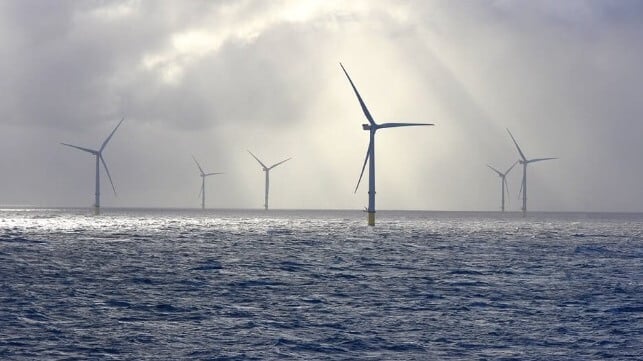
Wind turbine
iStock

Published Nov 30, 2025 4:57 PM by The Maritime Executive


A new industry-backed study aims to push back on claims that the offshore wind industry is a threat to migratory birds. The consultancy-performed study concludes that (at least in the EU) birds almost completely avoid wind turbines and that the risks of collisions are significantly lower than previously assumed.

The study commissioned by industry lobby group German Offshore Wind Energy Association (BWO) has now refuted assumptions that high migration intensity by birds in waters where offshore wind farms are being developed automatically lead to collisions. In its findings, the study contends that over 99.8 percent of migratory birds avoid wind turbines. In essence, it means that blanket shutdowns of turbines during periods of heavy bird migration is not a sensible approach.

Conducted by research and consulting firm BioConsult SH GmbH, the study sought to establish the risks of collisions between migratory birds and offshore wind farms in the North and the Baltic Sea, regions that are fast becoming hubs for offshore wind power.

With the study site being the Windtestfeld Nord wind farm near Husum, Germany, the researchers were able to analyze the movement patterns of over 4.2 million birds over a period of one and a half years. The wind farm spans approximately 150 hectares with five operating wind turbines of varying types and sizes being used for the study, where bird species like geese, ducks, gulls, waders and songbirds are common.

To understand the movements of the birds, camera systems were installed on two of the turbines and recorded all bird (and bat) passages through the rotor plane both during the day and at night. Nocturnal activity was captured using infrared cameras in combination with infrared emitters. To assess general migration intensity in the area, the team used a specialized bird radar that was operated continuously throughout the entire study period, and which was designed for real-time monitoring of bird movements.

BWO has described the combination of radar and the AI-based cameras as a methodological breakthrough that enabled unprecedented accuracy in recording bird flight movements in the rotor plane. In effect, this allowed the team to come to the conclusion that nocturnally migrating birds avoid collisions with wind farms and that the overall collision risk in relation to the total amount of birds passing a wind farm at night is very low.

This was based on the results of the fatality surveys, which indicated a relatively low number of collision victims of an estimated total of 99.7 fatalities of all bird species being recorded across the study period at the five monitored wind turbines. This corresponds to a mean of 12.9 collision fatalities per year and turbine.

“The new study shows that migratory birds avoid wind turbines. This confirms that the environmentally sound expansion of offshore wind energy works in harmony with these birds and not against them. With this research, we want to depoliticize the discussion, improve the data basis, and make decisions based on facts,” said Stefan Thimm, BWO Managing Director.

The study, which now provide a solid basis for the expansion of offshore wind energy, comes when Germany is pursuing growth in renewable energy. The country has set targets to increase offshore wind capacity to 30 GW by 2030, 40 GW by 2035 and 70 GW by 2045. By end of last year, a total of 1,639 turbines with a capacity of 9.2 GW were installed in the country.


Ocean Winds Secures Financing to Begin Offshore Wind Farm in Poland
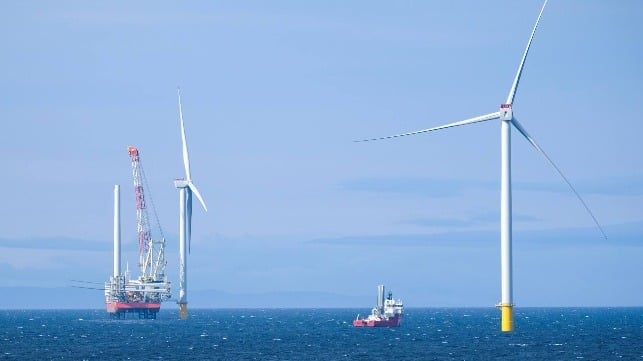
offshore wind farm
Ocean Wind completed the financing for its first Baltic offshore wind farm, which will be in Poland (Ocean Winds)

Published Dec 1, 2025 8:15 PM by The Maritime Executive


In another bit of positive news for the beleaguered offshore wind power industry, Ocean Winds reports it has secured financing and completed the financial close for one of the first offshore wind farms in Poland. The company, which is a 50-50 joint venture between EDP Renewables and ENGIE, highlights strong support from the European finance community that is making the project possible.

The company reports that as part of the financial close, it secured nearly €2 billion (US$2.3 billion) from a syndicate that includes the European Investment Bank. EIB contributed nearly a third of the total financing, along with Instituto de Credito Official EspaƱol and 13 commercial banks.

The company said work will begin on the wind farm in 2026 with the design and construction of the onshore substation and export cable route. It emphasizes that the project will be conducted in large part by Polish companies. The service base will be in Wladystawowo. 

“At Ocean Winds, we are convinced that Poland has the potential to become a regional leader in offshore wind – both in terms of clean energy production and industrial capability,” said Bautista Rodriguez, Chief Operating Officer, at Ocean Winds. “In Poland, offshore wind energy is a key driver of the country’s energy transition and a real opportunity for the development of a revitalized economic sector.”

Poland has substantial goals for offshore wind power, targeting 6 GW by 2030 and a total of 8–11 GW by 2040. Its first offshore wind farm, Baltic Power, is currently under construction and is expected to be operational in 2026.

Kacper Kostrzewa, Managing Director for Poland at Ocean Winds, said it marked a milestone for the project and for the company. It will be Ocean Wind’s first offshore wind farm in the Baltic. Critically, he said that the financial close for the project is also a milestone for the Polish offshore wind industry.

The project will also be the first to be fully delivered from Polish ports. Swinoujscie will serve as the marshaling harbor for foundations. Gdansk will be used for the wind turbines.

Known as BC-Wind, the project will be 23 kilometers (14 miles) north of the Polish coast, located entirely in the Polish EEZ. It will consist of 26 turbines rated at 14 MW, but with a power boost feature, the capacity can be increased to 15 MW. Total planned capacity is up to 390 MW.


Seatrium Seeks Arbitration Against Maersk Offshore Wind Over WTIV

wind turbine installation vessel
The nearly completed vessel has become the focus of an arbitration claim between Maersk Offshore Wind and builder Seatrium (Maersk Offshore Wind)

Published Dec 1, 2025 2:29 PM by The Maritime Executive


Singapore-based Seatrium has filed a counterclaim for arbitration against Maersk Offshore Wind in the ongoing dispute over the nearly completed newbuild wind turbine installation vessel ordered in 2023. The dispute emerged in October after Maersk Offshore Wind filed a surprise termination notice for the nearly completed vessel.

Seatrium rejected an arbitration claim made by Maersk Offshore Wind in October, which alleged problems with the construction project without supplying specific details. The claim that “disputes had arisen” during the project. Seatrium said it would “vigorously prosecute its position and defend any claims.”

On November 28, Seatrium filed its notice of arbitration seeking to commence a case against the buyer of the vessel. The builder continues to claim that the contract was wrongfully terminated in a notice dated October 9. It is seeking a declaration that the contract is “valid and subsisting” and that Maersk Offshore should be ordered to meet its obligations. Further, it seeks to have damages assessed.

Seatrium reported that when it received the cancellation notice, the vessel was 98 percent complete. Since then, it has said that the vessel would be delivered by January 30, 2026.

The contact, which is reportedly valued at approximately $475 million, was placed before the merger that created Seatrium. The company reports the order was not structured with progressive milestone payments, and as such, Maersk Offshore has only paid 20 percent of the contract price. It is seeking to compel the buyer to pay the remaining 80 percent.

The 475-foot-long ship was launched in May 2025 and was designed as part of a push by the then Maersk Supply Services to expand into the wind turbine installation space. It incorporates a unique locking system to receive feeder vessels from shore with the components for the wind farms. The plan was to use the vessel in the United States with the supply system providing a solution to meet the requirements of the Jones Act. Maersk Supply Services, which is owned by AP Moller Holdings, was renamed Maersk Offshore Wind to further emphasize its business focus.

The WTIV is under contract to Empire Wind for the installation of the project offshore from New York. Seatrium has said that it would also be exploring opportunities directly with Empire Wind for the vessel. 
 

Trump Administration Targets Another Offshore Wind Farm Project
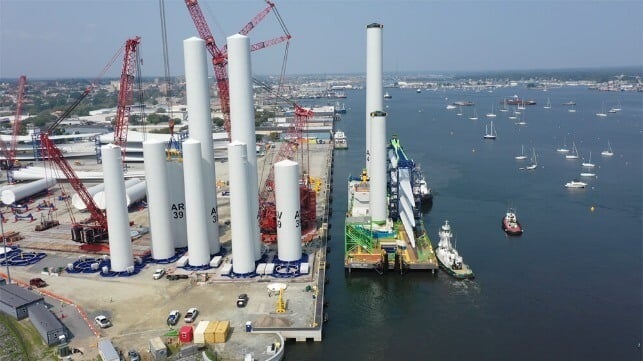
staging for wind farm
The new challenge also jepordizes the use of the terminals in New Bedford and Salem which would gain long-term work from the wind farms

Published Dec 2, 2025 8:20 PM by The Maritime Executive


Using a now familiar technique, the U.S. Department of Justice on Tuesday, December 2, made a filing in U.S. District Court targeting yet another offshore wind farm project. Speaking on behalf of the Bureau of Ocean Energy Management, the Department of Justice confirmed that the Bureau is reviewing the approval for the New England Wind project, which is to be developed by Iberdrola’s subsidiary Avangrid.

The filing asks the court for a voluntary remand of a case filed by a local environmental group, saying it is warranted to “promote judicial economy.” The Department of Commerce and Avangrid were sued in May 2025 by a group calling itself Ack For Whales, which is challenging the July 2024 approval of the wind farm by the federal government. The plaintiffs argue that the approval by BOEM failed to adequately ensure there would be less interference with other users, such as commercial fishing, sportfishing, recreation activities, boating/shipping, etc. The courts in the past have viewed these as nuisance suits and dismissed them on the grounds that the groups have time to make their cases during the permit approval process.

The original lease was awarded in April 2015 to a project then known as Park City Wind. It was amended on several occasions, splitting the project into two phases and renaming it New England Wind. It would be located southwest of Vineyard Wind, which is nearing construction completion in an area selected for a series of wind farms south of Martha’s Vineyard and Nantucket, Massachusetts. Phase 1 would be for between 41 and 62 wind turbines with a projected total generation capacity of 804 MW. The second phase, which has also been called Commonwealth Wind, would consist of up to 88 wind turbines and a total generation capacity of 1,232 MW.

The project gained its federal approval with the Record of Decision from the Department of the Interior in April 2024. BOEM approved the Construction and Operation Plan in July 2024. Since then, the developer has been seeking to complete its power agreements with the state’s power authority.

DOJ asks the court to stay the litigation by Ack, saying BOEM is “likely to make a new agency action, and that action may affect – or potentially moot” the claims. The Bureau is reviewing the construction plan, saying it believes the COP “understated impacts that were improperly weighed in reaching the determinations.” It points to Donald Trump’s executive order on the first day in office in January, calling for a review of the leases and leasing process. A group of states filed a separate case earlier this year challenging the open-ended review process.

It is a similar tactic that was also used with a suit by Nantucket against SouthCoast Wind, also in Massachusetts, and by activists against U.S. Wind in Maryland. The court sided with BOEM and DOJ, permitting the review for SouthCoast Wind to proceed while also saying timelines must be established as the reviews cannot drag on indefinitely. The court hearing the Massachusetts case ordered regular reviews and updates and set deadlines.

In the new filing, DOJ argues New England Wind is not under construction, and it is not imminent, and as such, the review does not cause harm. It neglects that the review sidelined negotiations for the power purchase agreements, which were placed in jeopardy. 

The New Bedford Light newspaper, reporting on the filing, also highlights that it jeopardizes planned large investments in the local community. New England Wind and SouthCoast Wind were to base operations at the New Bedford Foss Marine Terminal, where they plan to locate their operations and maintenance facilities. New England Wind was also participating in the planned redevelopment in Salem for a terminal that would be the staging for the construction of the project.

DOJ, in its filing, asks for an indefinite stay of the environmentalists' case. It does not propose a timeline for completing the review. 


Terrestrial biodiversity grows with tree cover in agricultural landscapes


University of Illinois College of Agricultural, Consumer and Environmental Sciences
Riparian buffers increase biodiversity 

image: 

New University of Illinois Urbana-Champaign research finds that for every 10% increase in riparian forest cover adjacent to agricultural fields, an additional terrestrial species is present.

view more 

Credit: Eric Larson, University of Illinois Urbana-Champaign


URBANA, Ill. — Farmers plant or preserve riparian buffers for various reasons, such as improving water quality, controlling erosion, or maintaining hunting habitat. Now, a new study from the University of Illinois Urbana-Champaign underscores the benefits of riparian buffers to terrestrial biodiversity, finding that for every 10% increase in forest cover, an additional species is present. 

“We found raccoon and common snapping turtle DNA all over the place,” said senior study author Eric Larson, associate professor in the Department of Natural Resources and Environmental Sciences (NRES), part of the College of Agricultural, Consumer and Environmental Sciences at Illinois. “But the fact that we found bobcats and big brown bats with our sampling method was exciting, and shows just how much is going on in those riparian buffers.”

The sampling method Larson is referring to — environmental DNA metabarcoding — is one he and fellow ecologists have leaned into in recent decades to detect rare or hard-to-capture species. By extracting DNA fragments from water, soil, snow, or even air, scientists can reconstruct the animals that have traipsed, swam, or flown nearby. 

When Larson and Olivia Reves, the study’s first author, decided to study biodiversity in riparian buffers, they already knew the benefits of tree cover for aquatic organisms. For example, shade from overhanging trees protects the water from thermal extremes and creates more favorable fish habitat. But less was known about the benefits of riparian buffers to terrestrial animals in agricultural areas.

To fill this gap, Reves and Larson used eDNA metabarcoding to identify terrestrial species from water adjacent to agricultural land across 47 sites in Central Illinois, varying in forest cover.     

“This monitoring tool has been overlooked to identify the benefits of agricultural conservation actions like riparian buffers for terrestrial biodiversity,” said Reves, who recently completed her master’s degree with Larson.

But why sample water to detect terrestrial species?

“If we looked for fish in these samples, we would certainly find fish DNA,” Larson said. “But water in a stream or river incorporates DNA from all of the animals using the surrounding landscape. You dip down to the stream for a drink, and you leave some of your DNA to be detectable downstream.”

After isolating and identifying all of the DNA fragments from the water, the researchers could then look at the relationships between terrestrial diversity and forest cover. Not only did they find an additional species for every 10% increase in forest cover, but sites with complete forest cover supported three times the terrestrial vertebrate species compared to those lacking tree cover. Also, community composition turned over in higher-cover locations.

“We saw a gradient in the animal communities linked with forest cover,” Reves said. “At one end, we saw grassland species — mice, ground squirrels, killdeer — that are adapted to more disturbed environments. In the high forest cover sites, it was a totally different set of species. The fact that we saw forest-dependent species, including southern two-lined salamanders, North American river otters, and ruby-throated hummingbirds, really drives home the idea that riparian buffers are beneficial in agricultural landscapes.”

Reves added that, despite the biodiversity benefits, not all agricultural landowners are sold on riparian buffers.

“Some landowners see them as unkempt or think they bring pests to their fields. But we found a lot of species, like bats, that actually draw pests away or prey on those pests. In addition, riparian buffers can help with soil erosion and water quality,” she said. “I hope our study informs the voluntary and regulatory implementation of forested riparian buffers across the Midwest.”

The study, "Environmental DNA quantifies the terrestrial biodiversity co-benefit of forested riparian buffers in agricultural landscapes," is published in the Journal of Applied Ecology [DOI: TBD]. Authors include Olivia Reves, Nick Iacaruso, Mark Davis, and Eric Larson.

Research in the College of ACES is made possible in part by Hatch funding from USDA’s National Institute of Food and Agriculture. This study was also supported by a project funded by USDA’s McIntire-Stennis program [grant no. 7004745].


Experts call for AED placement on every commercial aircraft to boost in-flight cardiac arrest survival rates from 6% to up to 70%


An article in the Canadian Journal of Cardiology outlines recommendations for improved safety standards at 30,000 feet


Elsevier

In-Flight Sudden Cardiac Arrest (IFCA) & Automated External Defibrillator (AED) Use 

image: 

A new comprehensive literature review in the Canadian Journal of Cardiology highlights systemic and policy shortcomings of current aviation safety standards, and recommends regulated and mandated automated external defibrillators (AEDs), standardized cardiopulmonary resuscitation (CPR) protocols, and integration of telemedicine.

view more 

Credit: Credit: Canadian Journal of Cardiology / Bassi et al.


December 3, 2025 – In-flight cardiac arrest is extremely rare, yet catastrophic, and responsible for up to 86% of all deaths in the air. A new comprehensive literature review highlights systemic and policy shortcomings of current aviation safety standards, calling for global alignment. Recommendations include regulated and mandated automated external defibrillators (AEDs) on board, standardized cardiopulmonary resuscitation (CPR) protocols training, and integration of telemedicine. The article in the Canadian Journal of Cardiology, published by Elsevier, aims to inform policy regulators, airlines, and international aviation bodies to improve in-flight medical emergency preparedness and response protocols.

In-flight medical emergencies are an expected challenge, given the global air travel passenger volume of nearly four billion passengers annually. The most prominent risk factors for in-flight cardiac arrest include male sex, age, pre-existing cardiac disease, and duration of flight time. With an aging global passenger population and increasing flight durations due to advancing aircraft technology, the risk and frequency of in-flight cardiac arrest are expected to rise.

“Improving survival rates following a flight passenger’s cardiac arrest hinges on several critical considerations,” states senior author Adrian Baranchuk, MD, Queens University, Canada. “The cabin environment poses a unique challenge, including the confined space of the fuselage, limitations to equipment accessibility, and inconsistent crew CPR and AED training. Currently, only the US legally mandates defibrillators on commercial flights, whereas Canada only federally recommends it and leaves it to the discretion of the airline itself to include them.”

Prompt defibrillation is crucial

AED utilization has a significant impact on survival outcomes in multiple environments. The likelihood of survival for shockable sudden cardiac arrest decreases by 7–10% per minute without defibrillation. Due to the narrow intervention window, diverting a plane for an emergency landing is often unattainable, as it often takes longer than 20 minutes from cruising altitude to a safe landing.

The disparities in AED implementation may hinder swift emergency responses. Without an onboard AED, only approximately 6% of in-flight cardiac arrest patients survive to hospital. Further projections suggest that equipping all commercial aircraft with AEDs could save 35–93 lives annually worldwide.

First author Mario D. Bassi, MD, University of Ottawa, Canada, points out, “Currently, the data show that AEDs are consistently reliable, sensitive to detecting and treating in-flight cardiac arrest, and cost-effective to airlines. AEDs are proven to be safe, with no evidence of detriment or reduced functionality emerging in the compromised environment of the aircraft cabin, such as turbulence. While prompt recognition of a cardiac arrest and CPR initiation are vital, the chances of survival jump from 6% to up to 70% when an AED is used. However, up to one third of EU aircraft were found to not have an AED available in-flight.”

Based on their comprehensive review of the existing literature, the authors recommend:

  • Universal implementation of easily accessible onboard AEDs to reduce time to defibrillation
  • Standardized airline-specific CPR training for crew
  • Integration of telemedicine for real-time guidance and triage (e.g., CPR coaching)

“The primary determinant impacting sudden cardiac arrest survival is the time to defibrillation,” concludes Dr. Baranchuk. “We believe our recommendations and appropriate measures must be strongly considered by policymakers and airlines alike to improve passenger safety and survival rates.”


Death may suggest we belong to a broader whole


AI could change our view of death, but its inevitability remains


Kyoto University

Death may suggest we belong to a broader whole 

image: 

Shisei Tei, a researcher at Kyoto University, stresses the importance of accepting death.

view more 

Credit: KyotoU / Shisei Tei


Kyoto, Japan -- Shisei Tei claims he is clumsy with technology and doesn't even own a smartphone, yet he has found himself thinking a lot about what we call generative AI.

Tei is cautiously optimistic about AI. As a researcher, he uses it to help with analyzing psychiatric data, and outside work it helps him plan personalized hikes. But Tei is concerned that AI will change how we think about death, which he discusses in a chapter he wrote for the book SecondDeath: Experiences of Death Across Technologies.

"Today, I often see how AI reframes grief and remembrance," says Tei. Though he thinks mental health chatbots have the potential to lower barriers to care, maladaptive use of chatbots that reconstruct deceased individuals can distort our perceptions of death and existence.

"AI-induced virtual continuations of the deceased can comfort the living and extend memory to some extent," says Tei, "but they can also blur presence and absence, potentially hindering our capacity to accept impermanence."

In our conversation, Tei explained that historically, many cultures and philosophical traditions have considered the mind and body to be separate entities, supporting the belief that the mind is eternal. This idea has penetrated modern society, which often treats death as something to overcome or delay rather than an essential part of life. It has also been reinforced by attempts to use AI to preserve the human mind.

Tei, who is from Taiwan and works at Kyoto University, has dedicated his research to bridging psychiatry, religious philosophy, and neurophenomenology, a framework proposed by biologist Francisco Varela. In this book chapter, the author explores death through the lens of selfless selves, a term introduced by Varela, who was influenced by Tibetan Buddhism. It describes how living systems sustain themselves through the mutual interdependence of their parts, like cells in a body.

"Selfless selves refers to being both altruistic and autonomous -- maintaining one's individuality while remaining in harmony with others and the wider world," says Tei. "In this sense, like cells in a larger body, people can be viewed as simultaneously distinct yet co-creating a collective life, with the self understood as fluid and shaped through interaction to serve biological and social needs."

Tei writes that this concept also describes characteristics of AI agents, as they present artificial identities while lacking a fixed selfhood, along with our interconnectedness and anonymity online. However, while traditional belief systems and modern mental health care emphasize the importance of accepting uncertainty, AI can make us reliant on quick, straightforward answers, most of which we will never obtain, thus flattening complex experiences and reinforcing cost-benefit reasoning.

"Outsourcing decision-making or emotional support to machines risks weakening the very wisdom we aim to cultivate," Tei says. For humans, empathy formed through face-to-face and nonverbal communication enhances a sense of belonging, showing how it feels and what it means to be alive, while loneliness and solitude can nurture hope. Perceptions of death arise from these interactions. Dying can evoke a sense of connection to something broader -- we may die, but part of ourselves may live on in our communities.

Tei stresses that incorporating these ideas into end-of-life care and engaging with these ideas ourselves and in our communities can help us to both treat the dying with dignity and accept death's inevitability.

"Death becomes certain once life begins," Tei writes in the book, "and denying its anticipation risks denying life itself."

###

The chapter "Death in the Cybernetic Era: AI, Virtual Agents, and Selfless Selves" appeared on 16 October 2025 in SecondDeath: Experiences of Death Across Technologies, with doi: 10.1007/978-3-031-98808-0_16

About Kyoto University

Kyoto University is one of Japan and Asia's premier research institutions, founded in 1897 and responsible for producing numerous Nobel laureates and winners of other prestigious international prizes. A broad curriculum across the arts and sciences at undergraduate and graduate levels complements several research centers, facilities, and offices around Japan and the world. For more information, please see: http://www.kyoto-u.ac.jp/en