Thursday, December 04, 2025

LONG READ: De-dollarisation gathering momentum, driven by geopolitics and ballooning debt fears

LONG READ: De-dollarisation gathering momentum, driven by geopolitics and ballooning debt fears
Dumping the dollar and switching to a basket of currencies to settle global trade deals is going at a glacial pace. But once glaciers start moving, they are impossible to stop. / bne IntelliNews
By Ben Aris in Berlin December 3, 2025

De-dollarisation is gathering momentum, but the process of switching to settling global trade in multiple currencies is going at a glacial pace. The problem is that once glaciers start moving, they are impossible to stop.

The Chinese yuan is the leading contender to replace the dollar. Globally the yuan still accounts for a small share of international trade, but there are growing pockets where it dominates. In Russia’s case, Beijing and Moscow settle almost all their trade in national currencies now, up from nothing pre-war. That makes a large patch of land in what was the Soviet Union that is now almost de-dollarized already.
Dollar sinking value

The slow exodus from the dollar is already starting to impact its value, which has declined by 10% year-to-date, marking its weakest annual performance in over two decades. While the US stock market continues to boom—particularly in the tech sector—foreign investors are shedding exposure to dollar-denominated assets, including Treasury bills, at what Deutsche Bank described as “an unprecedented pace.”

“The trend raises a critical question: if the world’s wealthiest nations keep accumulating debt without clear growth or reform strategies, what will back their obligations tomorrow?” Kate Martin asked, writing in the Financial Times.

US debt has now topped $37 trillion, or 137% of GDP, which is starting to spook investors. By contrast, Russia’s total debt is RUB26.5 trillion ($290bn), or 17-20% of GDP, which should make it one of the strongest currencies in the world. Russia can cover its entire debt more than two-times over with just its cash in the bank.

The dollar’s declining share in global reserves and the rise in currency-hedged equity inflows suggest that even as investors chase returns, they are increasingly protecting themselves from the risk of continued dollar weakness.

According to the FT, more than 80% of inflows into US stocks are now hedged against dollar depreciation, up from near zero at the beginning of the year. “It’s starting to look like a game of musical chairs,” Martin observed. “As long as the music is playing, investors are still chasing returns—but the music will eventually stop.”

Yuan waiting in the wings

An exporting powerhouse Beijing has followed a careful policy of ensuring its trade is largely balanced with most of its partners which makes setting deals in mutual national currencies easy. The US has taken its eye off the ball and allowed large imbalances to build up. Trump’s Liberation Day tariffs is a crude attempt to undo this problem.

Russia used to run a modest deficit with China for the first two decades of the Putin regime. But as soon as the West imposed its extreme sanctions regime and cut Moscow off from the lucrative EU markets, Russia has been forced to turn to China which threw it an economic lifeline. Now Russia runs a healthy trade surplus with China, which China pays for in yuan, giving Moscow access to a flow of yuan that it can use to replace the dollar.

In 2020, Russia imported from China goods worth about $54.91bn, which was about 23.7% of its total imports, and exports to China totalled about $49.15bn – a trade deficit of a mere $5.8bn. By 2023 the total trade turnover was about $240bn with Russia running a surplus of about $13.83bn in 2024 and $12.16bn in the first half of this year – still a relatively modest level compared to the overall volume of trade.

In the same way that the EU opened its market to Ukrainian goods by dropping all duties, but unlike in Russia’s case it ran a $20bn trade deficit with Europe that has ballooned to a $40bn deficit and it’s getting worse as those duties were reimposed in June.

Local de-dollarised regions emerge

“The dollar is currently unreliable, and Russia does not use it,” Russian Finance Minister Anton Siluanov at the Financial University's international forum "Russia: Vision of the Future" on November 25.

According to him, Moscow does not have the goal of de-dollarisation, but does have the goal of ensuring stable settlements.

While the dollar still dominates global trade settlements, in localised regions and especially amongst the Eurasian Economic Union (EUU) and BRICS members, its use has fallen drastically and largely replaced by the Chinese yuan. As part of the yuanisation of the Russian economy, its use has fallen to next to nothing.

However, the development of a cross-border settlement system within the group is "rather sticky," as not everyone is "ready to participate." Siluanov noted that many are satisfied with dollar settlements.

The yuan is still a long way from replacing the dollar. The Chinese currency’s share in international finance accounts for only 4% of global payments and just 2% of central-bank reserves. However, internal reforms have enabled China to double the yuan’s share in international payments since 2022.

The use of preferred currencies to settle trade bills is closely connected to what goods are being paid for. Since the start of the Ukraine war, Asia has completely replaced Europe as Russia’s best customer for oil. Russia has shifted 90–95% of its mutual trade settlements with India and China to national currencies, Deputy Prime Minister Alexander Novak said on October 20, Vedomosti reported.

Over 30%-50% of China’s trade is now conducted in yuan, up from 14% in 2019. More than half of all cross-border receipts are settled in the currency, compared with less than 1% in 2010. Cross-border trade settled in yuan has been growing at an average annual rate of 30-40% in past years. Chinese manufacturers invest overseas in yuan, or foreign companies or governments borrow yuan from Chinese banks.

"The market itself meets the needs for settlements in national currencies. For example, with our friends from China and India, 90–95% of our trade has already switched to national currencies. This is automatic, without any purpose, because they don't allow settlements in the respective currency, which was the hegemonic one," Novak stated, referring to restrictions on dollar-denominated transactions.

He added that the transition has not hindered bilateral trade. The move reflects broader efforts by Russia to reduce reliance on the dollar and other Western currencies in the face of sanctions and financial restrictions.

Earlier, on October 15, Novak said India had begun settling oil payments in Chinese yuan, though the share of such transactions remained limited. He noted that the majority of oil trade with India is still settled in rubles, without specifying the proportion.

FX decoupling

As the role of the dollar decreases its importance in portfolios falls and that is leading to a decoupling of exchange rates that used to move in lockstep.

“A regime change is happening in global FX. Currencies that used to be cyclical and volatile are becoming safe havens, as markets seek out countries with low debt. That's the Swedish Krona, which now has a higher correlation with gold than Swiss Franc,” economist Robin Brooks says.

Due to Russia’s problems now all the Global Emerging Markets (GEMs) are looking for a convenient way to dump the dollar – and many of them are turning to digital solutions. At the BRICS summit in Kazakh last year, Russian President Vladimir Putin showcased the BRICS Pay digital currency that could become an alternative to the dollar. It is not a genuine cryptocurrency, but rather an amalgam of the digital versions of the leading BRICS currencies that could be used to settle commodity payments, including the digital ruble.

In parallel, Beijing has expanded its non-dollar alternative infrastructure, including the Cross-Border Interbank Payment System (CIPS), which now counts over 1,700 member banks globally and handled CNY175 trillion ($24.7 trillion) in transactions last year. The CIPs platform has already eaten into the volume of yuan traded on SWIFT, the pre-eminent Western money transfer system.

China has also increased digital yuan trials, notably through the mBridge platform—a blockchain-based cross-border payment network co-developed with other central banks.

China also is deploying swap lines and local currency lending to build confidence in the yuan. It has signed CNY4.5 trillion ($630bn) in currency swap agreements with 32 central banks including yuan-denominated “panda bonds” in Hungary and Russia, as well as negotiations with Kenya and Brazil over new debt instruments.

Selling off T bills, buying gold

The use of the dollar in trade has been sticky as the system is well established and the pools of liquidity deep, but after CBR sanctions seized over $300bn of Russia’s foreign currency reserves at the start of the Ukraine war, central bankers around the world were freaked out and have rushed to reduce their exposure to the dollar. That meant nobody’s international reserves were safe anymore. The Trump administration’s aggressive Liberation Day tariff regime has only catalysed a process that was already underway.

Russia sold off all its dollar assets even before the war started and replaced it with yuan. In the meantime, it has also sold its euro holdings and increased gold to a third of a total – and earned a bonus $100bn from the inexorable rise in the value of gold in the last three years. Reserves now top $700bn, an all-time high, largely because of the revaluation of its 2,360 tonnes of monetary gold. Russia has by far the highest percentage of debt backed by gold among major economies at 65%. Next best is Switzerland with 38%, followed by Germany with 14%.

China is likewise selling off its US T bills and stocking up on gold for similar reasons. From a peak of over $1.3 trillion in 2013, China’s holdings fell to $778bn by September 2023 and have continued to decline into 2024 and 2025.

China’s Treasury holdings as a share of all foreign holdings is down to 7.6%, the lowest in 23 years. This percentage has declined by 20 points over the last 14 years. As a result, China now ranks as the world’s third-largest foreign Treasury holder, after previously being in the top spot for years.

By contrast, during the same period, the UK’s percentage has quadrupled, to 9.4%, near the highest on record. Japan is now the biggest holder of US debt, but it has also been pulling back. The share of US Treasuries in its reserves has declined 26 points over the last 21 years, to 12.9%, near the lowest this century. 

For decades, US Treasuries were the global safe haven, but that appears to be changing, as Central Banks worry about America’s growing indebtedness and seek to diversify their exposure away from the dollar -especially after it lost its AAA rating from all the main rating agencies between 2021 and 2025.  Today only 11 countries have a triple-A rating from all three ratings agencies, including Germany, Australia, Canada, Sweden, Norway, and Switzerland. France, the UK and Italy are noticeably  absent from this list. 

At the same time, China has significantly increased its physical gold reserves. The People’s Bank of China has been purchasing gold steadily since late 2022, adding more than 200 tonnes by the end of 2023. As of mid-2025, official gold holdings exceed 2,300 tonnes, though analysts believe actual reserves may be higher due to opaque off-market acquisitions. Pointedly, China recently returned its physical gold to Beijing and has offered to hold the gold of other countries.

Rank

Country

Gold Reserves (tonnes)

Current Value (USD bn)

Debt Backing (%)

1

USA

8,133

1,052

2.87

2

Germany

3,352

434

13.92

3

Italy

2,452

317

9.02

4

France

2,437

316

8.58

5

Russia

2,333

302

65.43

6

China

2,299

298

1.97

7

Switzerland

1,040

135

36.44

8

Japan

846

110

0.97

9

India

880

114

3.21

10

Netherlands

612

79

16.88

Source: Central bank data

And it’s not just China and Russia doing it: foreign central banks now own more gold than US Treasuries for the first time in 30 years, Bloomberg reports.

Between them, selling US assets and accumulating gold is the same policy as Russia has followed for years and effectively sanction-proof the economy.

As part of a broader de facto de-dollarisation policy, China is also actively promoting the use of the yuan in international trade and financial agreements, especially with countries like Russia, Iran, and members of the BRICS bloc. Beijing’s first push to boost yuan use began in 2009 but ended abruptly in 2015 with capital flight, The Economist reports. Now it is having another attempt.

Domestically, China is stamping out the use of the dollar for credits. In 2022, only 15% of loans were issued in yuan; by mid-2025, that figure has climbed to nearly 50%.

Dollar share of reserves falling

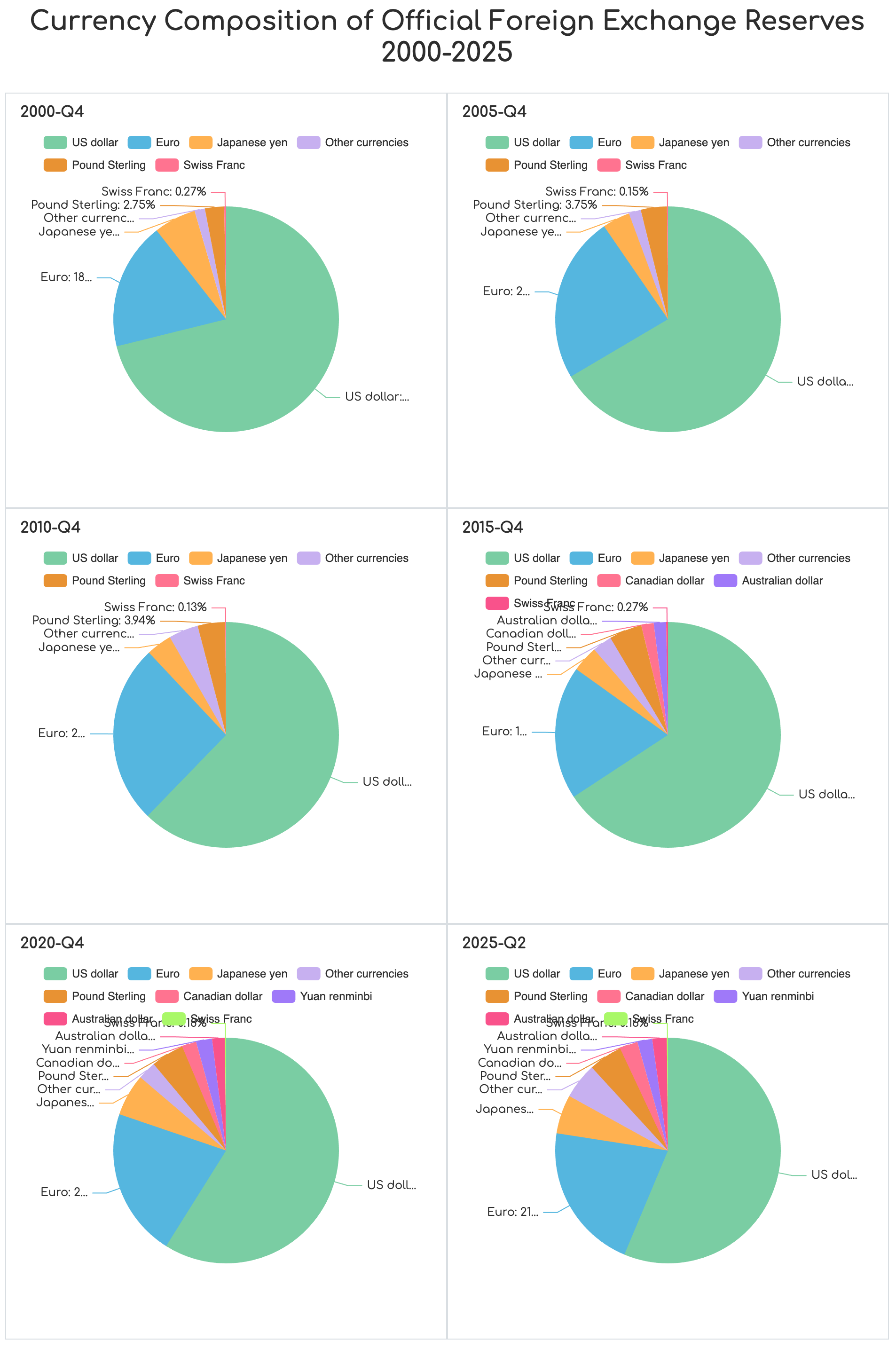
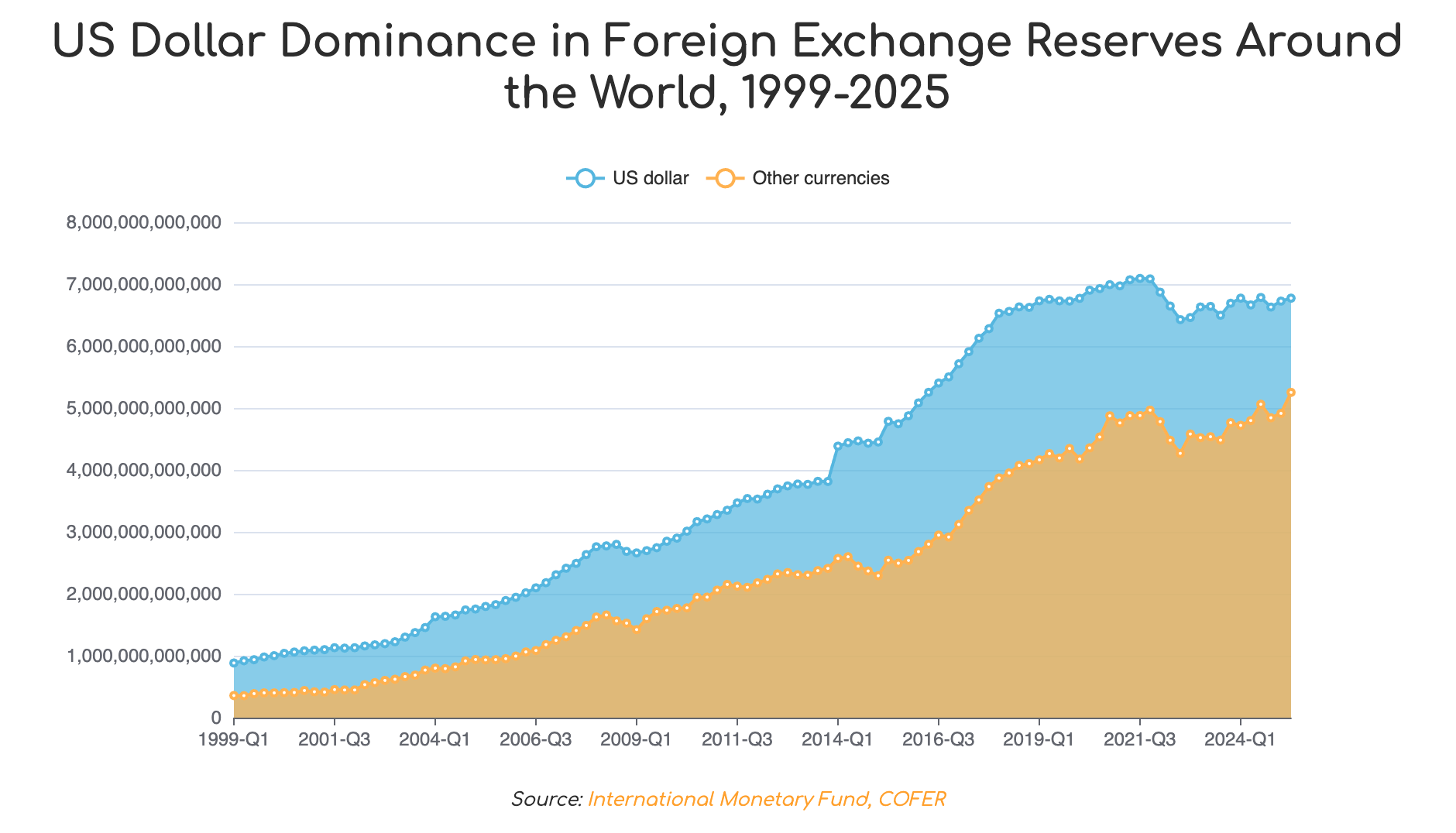
More generally, the share of dollars in countries’ international reserves have fallen to a multiyear low. Between 2000 and 2025, the US dollar's share of foreign exchange reserves around the world went from 71.2% to 56.3%, a difference of almost 15 percentage points over the course of 25 years.

The most recent figures show that global foreign exchange reserves reached approximately $12.94 trillion in the second quarter of 2025, up from $12.54 trillion in the previous quarter, according to BestBrokers. However, currently, the value of the allocated currency reserves held in dollars is $6.77 trillion, compared to a historic high of $7.1 trillion in the third quarter of 2021, and up from $2 trillion in 2020.

The euro has been a big winner from the decline of the dollar's popularity, with the share of Euro-denominated reserves increasing from around 18% to 21.1% between 2000 and 2025, but still less than the previous peak of 26% in the early 2010s.

“The US dollar has depreciated against major currencies this year - the DXY, which measures the greenback against six currencies, dropped more than 10% within the first six months of the year, the most significant in over 50 years,” BestBrokers said in a recent report. “At the same time, in 2025, the US dollar's share of global foreign exchange reserves dropped to a historic low of 56%.”

Drilling into the International Monetary Fund (IMF) Currency Composition of Official Foreign Exchange Reserves (COFER) data, the analysts  found that between the first and the second quarter of 2025, the euro-denominated global allocated reserves increased by 9.13% when measured in dollars.

“This is the greatest increase in nominal value among all major currencies. Euro-denominated reserves grew to $2.54 trillion at the end of Q2, reaching 21.13% of all reserves,” says BestBrokers.

Composition of Allocated Foreign Exchange Reserves at the End of Q2 2025

Currency

Value (Q2 2025)

Change from Q1 2025

US Dollar

$6.77 trillion

0.72%

Euro

$2.54 trillion

9.13%

Japanese Yen

$670bn

2.89%

Pound Sterling

$580bn

5.26%

Canadian Dollar

$314bn

2.50%

Yuan Renminbi

$255bn

3.30%

Australian Dollar

$251bn

6.75%

Swiss Franc

$19bn

–7.82%

Other Currencies

$622bn

8.61%

Source: BestBrokers. IMF


 However, the IMF itself points out that a lot of this change has more to do with the sinking value of the dollar than an increase in the fundamentals of the euro.

“The valuation effect effectively obscures the direction of change of the underlying movement in the currency. Similarly for the pound: the valuation effect obscures the direction of change: the share appears to have gone up when, holding exchange rates constant, the share would actually have gone down,” the IMF said in a recent blog, which tracks exchange rate adjusted central bank reserves using its “Currency Composition of Official Foreign Exchange Reserves (COFER)” metric.

Meanwhile, the share of non-dollar, non-euro currencies grew substantially. In 2000, these accounted for 10.6% of global reserves; by mid-2025, the figure had reached 22.6%, with smaller currencies—including the Canadian and Australian dollars, Swiss franc, and Korean won—increasing their combined share from 1.5% to 5.2%.

“The euro’s modest rise and the steady swelling of “other currencies,” which now account for 22.6% of reserves, underscore a broader reality: central banks aren’t abandoning the dollar, but they are quietly hedging against a world that no longer revolves around a single anchor,” says Paul Hoffman, lead data analyst at BestBrokers.

Emerging market debt soaring

The flip side of the same story is while the dollar’s appeal wanes, central bankers, hunting for an alternative, have been buying emerging markets bonds.

Investors are fleeing traditional quality markets in the face of soaring borrowing costs, mounting debt and flagging economies. Britain's 30-year borrowing costs rose to their highest levels since 1998 in September and sterling slid as the UK’s debt continues to mount. The Chancellor of the Exchequer, Rachel Reeves, was forced to hike taxes again this year, despite pledging not to when taking office. France’s government has already collapsed as parliament has failed to address the swelling budget deficit. And Germany is facing similar, if less acute, problems. Rising G7 debt is back at the centre of a bond market storm amongst some of the world's biggest economies that no one wants to admit to.

Investor appetite for emerging market debt has overtaken demand for sovereign bonds issued by the US and its peers in Europe as the situation continues to deteriorate. Europe can’t afford to take over the burden of supporting Ukraine since the US exit, as most EU countries are either in recession or approaching a crisis thanks to the boomerang effect of sanctions, according to Kate Martin writing in the Financial Times.

From 2010 to 2016, the government debt market of developed countries was roughly three times the size of that of emerging markets. Today, that dynamic has reversed.

“Persistent fiscal deficits, rising debt levels, and weakening economic prospects in G7 nations have eroded confidence. Meanwhile, many emerging economies offer higher yields, stronger growth potential, and improved macroeconomic stability,” Martin wrote.

Popular amongst the punters are the bonds of India, Indonesia, Brazil, and Mexico, while investors have become increasingly cautious of the increasingly unsuitable debt levels in the US, Japan, and much of Europe.

Washington’s Gamble On Ahmed Al-Sharaa Could Push Syria Toward A New Authoritarian Era – Analysis

Syria's interim president Ahmed al-Sharaa with US President Donald Trump. 
Photo Credit: SANA
By Halmat Palan

On September 22, 2025, Syrian President Ahmed al-Sharaa, a man once hunted by the United States and its allies, walked onto the stage of the Concordia Annual Summit in New York City. Waiting to interview him was retired US General David Petraeus, the same commander once tasked with pursuing him as the head of the Al Qaeda-affiliated Nusra Front during the height of the Iraq and Syria Jihadi insurgency. Petraeus, once CIA director, praised al-Sharaa’s vision and barely concealed the surreal nature of the moment.

Only weeks later, al-Sharaa sat in the White House with President Donald Trump, who suspended sanctions on Syria for 180 days and hailed him as a major advocate for peace. What was unimaginable a few years ago is now official US policy.

This rebranding of al-Sharaa is a dangerous gamble. He didn’t stumble into power through democratic reform or national consensus. He built his position through the Nusra Front, which later became the Hayat Tahrir al Sham (HTS). According to the United Nationsand Human Rights Watch, this group engaged in suicide bombing, massacres, torture, unlawful killings, war crimes and coercive rule during the Syrian Civil War. West Point’s Combating Terrorism Center has shown that HTS’s rebranding didn’t change either its core jihadist ideology or methods.

Washington once placed a $10 million bounty on al-Sharaa and put him on the terrorist list. Today, these designations have been removed and replaced by handshakes and photo ops with jihadists in suits.

Al-Sharaa’s impact on Syria’s diverse communities

Trump’s description of al-Sharaa as a stabilizing partner sends a troubling message to the communities that suffered most under jihadist and authoritarian violence. Syria’s Kurds, Druze and Alawites see an unelected leader with a hardline past consolidating power in Damascus with Western blessing as a dangerous threat to building a decentralized and democratic Syria that enshrines in its constitution and institutions guaranteed rights and freedoms for all.

They understand the danger a man like al-Sharaa poses because they have not only lived through the reign of leaders with similar ideological and authoritarian tendencies but have also paid many lives responding to such forces of intolerance and repression, as in the case of the Al-Assad Dynasty and the Islamic State of Iraq and Syria (ISIS). The signals of alarm sent by the Kurds and Druze about al-Sharaa and the HTS should be heeded because nothing in this man’s record suggests he has abandoned his desire for centralized rule and homogenization politics cloaked in Jihadism.

His government has already made it clear that, in its desire for national unity, it will stand against demands for power-sharing or decentralized structures of governance. The interim constitution rejects federalism and strips Kurdish cultural and linguistic recognition in line with Ba’athist homogenization of the Assad era, rather than a break from it.

According to the London School of Economics, Al Monitor and North Press, there has been an active rollback of Kurdish language curricula, cultural programs and even public holidays such as Newroz since al-Sharaa took the helm in Damascus. These are not symbolic moves but evidence of the governing philosophy for Syria’s future under al-Sharaa.

The ethnic and religious groups in Syria will not accept marginalization reminiscent of the Ba’athist era. They will reject and revolt against any authority that seeks to strip them of the freedoms and autonomy they have paid for with blood.


Rising tensions and marginalization of the Druze

Similar to the Kurds, the Druze in Sweida suffer from marginalization and threats to their security as a people. Reporting by the Middle East Institute and Syria Direct suggests that the central government has supported Sunni Bedouin tribes in recent clashes, exacerbating sectarian insecurity and eroding local defence structures.

This forms part of a concerning pattern that emboldens groups loyal to the HTS-run government and furthers ethnic and religious fault lines rather than calming them. This leads to a security and political climate where groups like the Druze and Kurds, who demand autonomy or self-defense, are treated as threats to national sovereignty rather than forces crucial to the security of their regions and the broader country.

Al-Sharaa presents this tightening grip on power as necessary for defending national unity and Syria’s sovereignty. In reality, it is the same centralization that led Syria to civil war and eventual collapse under Bashar al-Assad. Concentrating authority in Damascus without meaningful inclusion of the periphery does not create stability. Instead, it alienates communities like the Kurds and Druze that proved to be the most resilient against ISIS and the most willing to build pluralistic governance, while the central state resorted to massacres, detention and torture of the populace seeking their democratic rights and freedoms.

Why decentralization is essential for Syria’s future

The strategic flaw in Washington’s embrace of al-Sharaa is deeply concerning and should be viewed with great caution. True stability in deeply divided states comes from balancing power between the center and the periphery, not from labeling the periphery as a national security threat and the central power as justified in whatever it does. This is clear both from international relations theory and the lived experience of pluralistic and multicultural societies.

When the center knows the periphery can check its excesses, incentives shift from the use of force towards negotiation. When the periphery knows it cannot be dominated, incentives shift toward cooperation rather than revolt. Thus, decentralization is the ideal model of governance for Syria since it creates a balance of power, whereas centralization seeks to destroy it through the domination and supremacy of the central power.

In Syria, the communities most committed to shared governance are the same ones being sidelined today. Kurdish forces protected Arabs, Yazidis, Assyrians and Christians during the fight against ISIS and were decisive in the destruction of the ISIS caliphate. While they held the line, al-Sharaa was pledging allegiance to Al Qaeda, expanding HTS control and jihadist governance. It is hard to justify rewarding al-Sharaa’s HTS while undercutting the Kurds and others.

It is also important to highlight the influence of regional powers like Turkey in this push for centralization. According to the Atlantic Council and the Washington Institute, Ankara sees al-Sharaa as someone who could help neutralize Kurdish autonomy and reshape northern Syria in line with Turkish interests.

A US policy that strengthens the central government under al-Sharaa effectively aligns with Turkish objectives at the expense of the Kurds, who fought ISIS and pushed back against both jihadist and regime authoritarianism in Syria. Such a policy does not bode well for US allies or the objectives of stability and democracy in the region.

Given Syria’s demographic diversity, a federal or pluralistic system that provides real cultural, linguistic and administrative autonomy for Kurds, Druze and others is the only structure that can create stability and prosperity. Security arrangements might include local forces like the Syrian Democratic Forces (SDF) and community units made up of Druze, alongside, but not subordinate to, the Syrian army.

The details would have to be worked out, but the principle is paramount to the stability and harmony of all groups in a future Syria. Stability cannot be built on the pretense that Syria is a homogeneous Arab nation with one identity, one center, and one narrative.

Lastly, Al Shara is unelected. His authority rests on military power and foreign endorsement. No leader with that profile should be allowed to reshape Syria’s political future without major constitutional guarantees, independent elections and the full participation of the country’s diverse communities to check any moves towards authoritarian and discriminatory policies.

By backing al-Sharaa without strong conditions and checks on power, Washington and its allies risk empowering a force that could create a new authoritarian and Islamist system akin to the Islamic Republic built by former Supreme Leader Ruhollah Khomeini and his successors in Iran. Syria’s stability and prosperity begin with a stronger periphery, not a reinforced central authority led by a man whose record and ideology have yet to indicate any meaningful change.


The views expressed in this article are the author’s own and do not necessarily reflect Fair Observer’s editorial policy.

About the author: Halmat Palani is a Kurdish human rights activist, English teacher, and freelance writer based in Vancouver, Canada. Halmat was born as a refugee, and his personal journey has fueled his determination to make a difference. With a bachelor’s degree in political science and international studies from Simon Fraser University, he channels his expertise to shed light on pressing issues.

Source: This article was published by Fair Observer


Fair Observer

Fair Observer is an independent, nonprofit media organization that engages in citizen journalism and civic education. Fair Observer's digital media platform has 2,500 contributors from 90 countries, cutting across borders, backgrounds and beliefs. With fact-checking and a rigorous editorial process, Fair Observer provides diversity and quality in an era of echo chambers and fake news. Fair Observer's education arm runs training programs on subjects such as digital media, writing and more. In particular, Fair Observer inspires young people around the world to be more engaged citizens and to participate in a global discourse.
Trump administration orders enhanced vetting for applicants of H-1B visa


Reuters Published December 4, 2025 

The Trump administration on Wednesday announced increased vetting of applicants for H-1B visas for highly skilled workers, with an internal State Department memo saying that anyone involved in “censorship” of free speech be considered for rejection.

H-1B visas, which allow US employers to hire foreign workers in speciality fields, are crucial for US tech companies which recruit heavily from countries including India and China.

Many of those companies’ leaders threw their support behind Trump in the last presidential election.

The cable, sent to all US missions on December 2, orders US consular officers to review resumes or LinkedIn profiles of H-1B applicants – and family members who would be travelling with them – to see if they have worked in areas that include activities such as misinformation, disinformation, content moderation, fact-checking, compliance and online safety, among others.

“If you uncover evidence an applicant was responsible for, or complicit in, censorship or attempted censorship of protected expression in the United States, you should pursue a finding that the applicant is ineligible,” under a specific article of the Immigration and Nationality Act, the cable said.

Details on the enhanced vetting for H-1B visas, including the focus on censorship and free speech, have not been previously reported.

The cable said all visa applicants were subject to this policy, but sought a heightened review for the H-1B applicants given they frequently worked in the technology sector “including in social media or financial services companies involved in the suppression of protected expression”.

“You must thoroughly explore their employment histories to ensure no participation in such activities,” the cable said.

The new vetting requirements apply to both new and repeat applicants.

“We do not support aliens coming to the United States to work as censors muzzling Americans,” a State Department spokesperson said, but added that it does not comment on “allegedly leaked documents”.

“In the past, the president himself was the victim of this kind of abuse when social media companies locked his accounts.

He does not want other Americans to suffer this way. Allowing foreigners to lead this type of censorship would both insult and injure the American people,” the spokesperson said.

The Trump administration has made free speech, particularly what it sees as the stifling of conservative voices online, a focus of its foreign policy.

Officials have repeatedly weighed in on European politics to denounce what they say is suppression of right-wing politicians, including in Romania, Germany and France, accusing European authorities of censoring views like criticism of immigration in the name of countering disinformation.

In May, Rubio threatened visa bans for people who censor speech by Americans, including on social media, and suggested the policy could target foreign officials regulating US tech companies.

The Trump administration has already significantly tightened its vetting of applicants for student visas, ordering US consular officers to screen for any social media posts that may be hostile towards the United States.

As part of his wide-ranging crackdown on immigration, Trump in September imposed new fees on H-1B visas.

Trump and his Republican allies have repeatedly accused the administration of Democratic former president Joe Biden of encouraging suppression of free speech on online platforms, claims that have centred on efforts to stem false claims about vaccines and elections.


PANNIER: Who’s killing Chinese workers on the Afghan-Tajik frontier?

PANNIER: Who’s killing Chinese workers on the Afghan-Tajik frontier?
Sparsely populated, rugged mountainous border areas between Afghanistan and Tajikistan are often a blessing for smugglers and militants but a nightmare for security. / screengrab
By Bruce Pannier December 3, 2025

Someone in northern Afghanistan near the Tajik border is targeting Chinese workers just across the river inside Tajikistan.

On November 26, three Chinese miners were killed in an attack in which assailants used a drone equipped with firearms and grenades, while on November 30, two Chinese roadworkers were shot dead.

It is difficult to say who is behind the killings or pinpoint their motive, but the violence has led to the highest-level contact between authorities of Tajikistan and Afghanistan since the Taliban returned to power in Kabul in August 2021.

Suspects

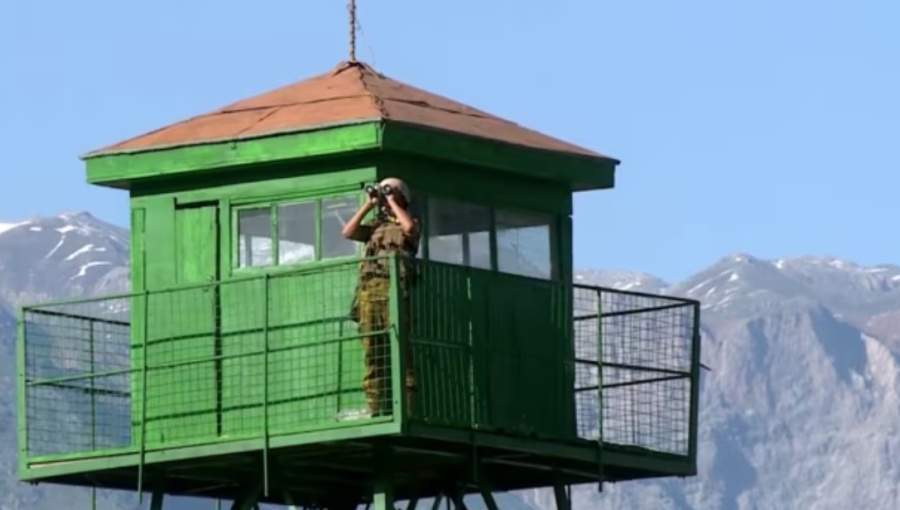
Right after the first attack, in Tajikistan’s southwestern Shamsiddin Shohin district, Tajik authorities blamed drug smugglers. The sparsely populated, rugged mountains along the Tajik-Afghan border are ideal territory for smuggling precious and semi-precious stones, weapons, cigarettes and narcotics.

Why smugglers would choose to kill Chinese workers at a gold extraction site was not explained, though there was some speculation the attack was made to revenge an incident that took place several days earlier.

During the night of November 20, Tajik border guards detected a group crossing from Afghanistan into Tajikistan. The guards then used an armed drone to attack the group, killing two of the intruders. Tajik border guards had never before used a drone in such a way. The day after the drone strike, the bodies and 116 packages of narcotics were found.

If revenging the deadly drone operation was the motive, it remains unclear why the perpetrators attacked a workers’ camp when a Tajik border station is not far away.

It was easier to believe the Chinese were not the intended target, but following the second attack, it became impossible to consider that the Chinese were simply collateral damage in a feud between Tajik border guards and smugglers.

In November 2024, there was an attack on a gold mining site, also in Shamsiddin Shohin district, which  left one Chinese worker dead, and four wounded. A Tajik worker was also injured. As with the November 26 attack, Tajik authorities pointed the finger at drug smugglers, without addressing how it was that such individuals, presumably trying to slip by undetected along routes known to them, ended up losing their way and firing on a gold mining camp when they were discovered.

If not them, then who?

However, if it is not drug smugglers who are behind the armed assaults, who is?

Some information emerged that two people were apprehended in Afghanistan’s Maymai district for the shooting of the two Chinese roadworkers, but details about those detained or their motives has not been provided.


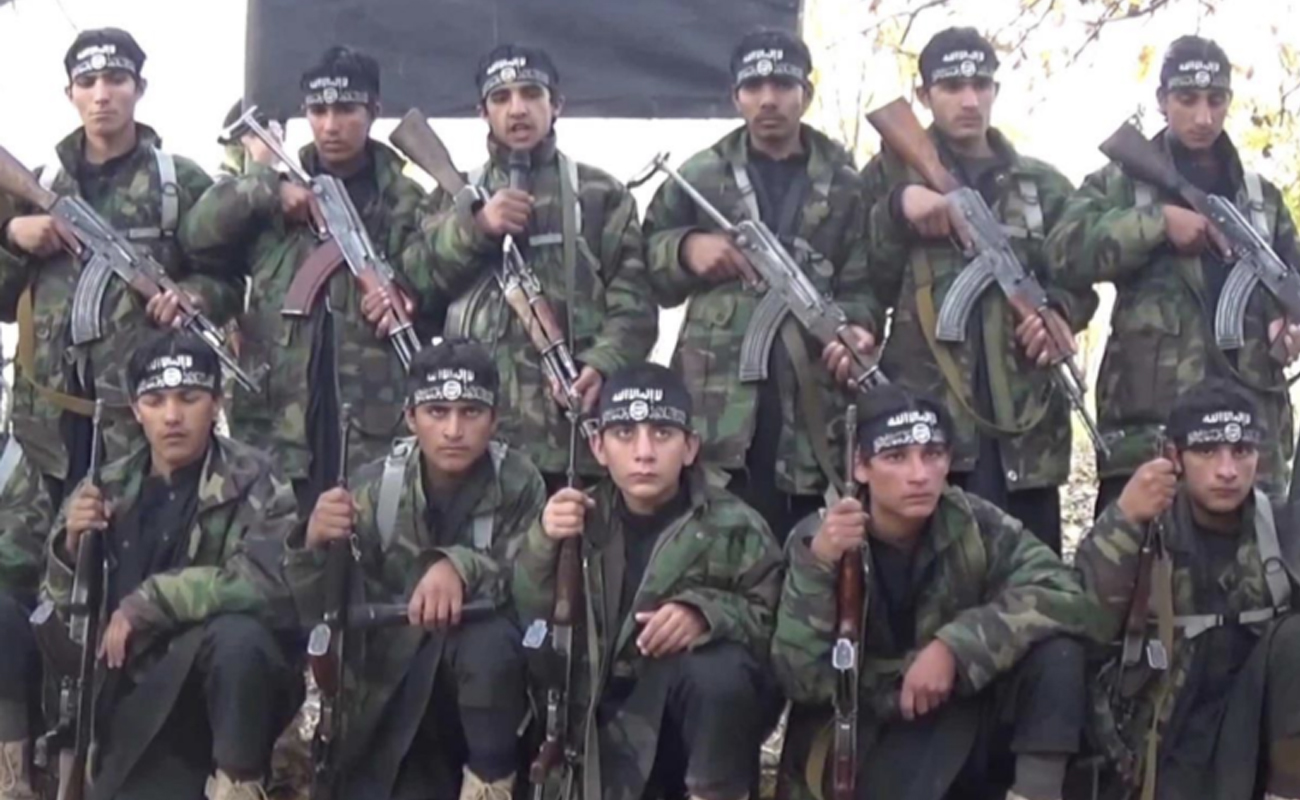
The ISKP would be expected to claim the attacks, if it was the perpetrator (Credit: Voice of Khorasan magazine).

The two most obvious suspects are militant-terrorist groups Islamic State of Khorasan Province (ISKP, or ISIS-K) and East Turkestan Islamic Movement (ETIM).

ISKP is based in Afghanistan. In its propaganda, it condemns China’s role in Afghanistan and Central Asia. The group has carried out attacks targeting Chinese nationals in Afghanistan, most notably a December 2022 attack on a Kabul hotel where Chinese diplomats and businessmen were known to regularly stay.

In May 2022, ISKP militants launched rockets from Afghanistan into Tajikistan, but there were no casualties or damage.

Notably, ISKP usually claims responsibility for its attacks. It would almost certainly have posted something on deadly attacks made on Chinese workers if it had carried them out.

ETIM is an Uyghur separatist group that was active in the chaos of Iraq and Syria 10 years ago. It showed up in Afghanistan shortly after US and allied forces entered the country. Many of its militants left for the Middle East. Some returned to Afghanistan after groups such as ISIS and others were beaten back in Iraq ad Syria. ETIM originated in China’s western Xinjiang Uyghur Autonomous Region (XUAR), which borders Central Asia. Its goal is the liberation of XUAR from China.

ETIM is an ally of the Taliban. But after the Taliban retook power just over four years ago, they promised all of Afghanistan’s immediate neighbours that they would not allow any militant groups present in the country to plan or carry out attacks on them. Taliban authorities have also given guarantees to Chinese officials that ETIM will not be allowed to carry out attacks on China, or on Chinese interests in Afghanistan.

In searching for the culprit behind the five Chinese workers’ deaths, there is another possibility. On December 2, Taliban Foreign Minister Amir Khan Muttaqi vaguely blamed groups trying to damage “positive relations” between Afghanistan and Tajikistan.

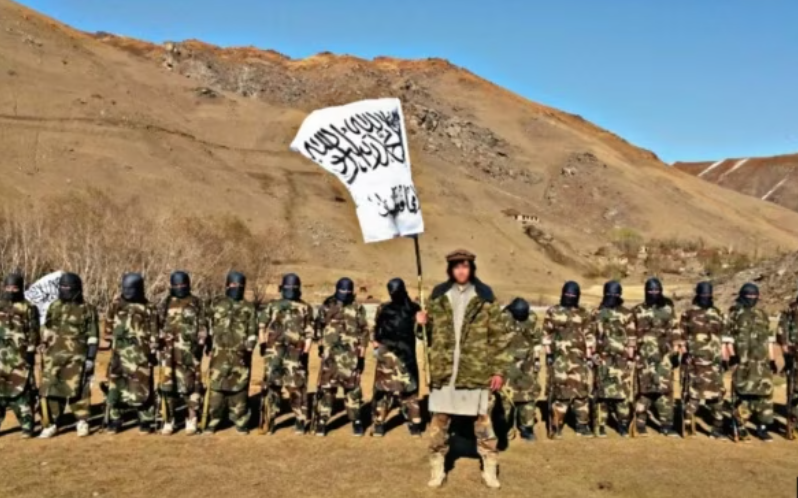
Terrorist group Jamaat Ansarullah group, which formed in Tajikistan, might be wary of improved relations between Dushanbe and Kabul leaving it high and dry (Source: social media).

There is at least one group that comes to mind here, namely Jamaat Ansarullah, a terrorist organisation from Tajikistan that allied with the Taliban to fight foreign and Afghan government forces.

At least several hundred Jamaat Ansarullah fighters are still in Afghanistan. In late 2021, when tensions between the Tajik government and Taliban were growing, some Jamaat Ansarullah militants were sent to reinforce Taliban fighters posted along the Tajik border.

In January 2024, there were reports that a Jamaat Ansarullah commander, Muhammad Sharifov, aka Mahdi Arsalon, was missing after leaving months earlier for Kabul. Some accounts said he was taken hostage by drug traffickers. Others explaining his disappearance claimed that the Taliban had thrown Arsalon in prison or even killed him.

Then in February 2024 there were reports of secret talks between Taliban and Tajik officials where the Taliban offered to act as mediators in talks between Tajik authorities and Jamaat Ansarullah in Afghanistan. However, Tajik government sources said Dushanbe was pressing for the group’s fighters to either be extradited to Tajikistan or for the Taliban to take measures to disarm and disband the group.

Ties between Tajikistan and the Taliban are improving. Some members of Jamaat Ansarullah might wonder if their group’s continued presence in Afghanistan might become part of the Tajik-Taliban negotiations. Raising tensions along the Tajik-Afghan border could help prolong Jamaat Ansarullah’s stay in Afghanistan.

One last possibility that could explain the killing of the Chinese workers focuses on Taliban fighters present by the Tajik border. Might some of these fighters have staged the attacks on their own?

Since late August, there have been two exchanges of gunfire between Tajik border guards and Taliban fighters. Several Taliban and possibly some Tajik border guards also were left dead.

In both clashes, the Tajik border guards involved were in Shamsiddin district, the same district where the Chinese mine workers were killed on November 26.

The attack on the Chinese roadworkers, meanwhile, occurred in Darvaz district, the next district east of Shamsiddin Shohin.

It could be that some Taliban fighters who lost comrades in the recent exchanges of gunfire with the border guards decided to create some pandemonium on the Tajik side of the border.

It is interesting that there are also Chinese workers on the Afghan side of the frontier, some of whom are also mining for gold, yet they were not attacked.

A silver lining

The return to power of the Taliban greatly displeased the Tajik government. Harsh verbal exchanges became the norm, but since autumn 2024, there have been some amicable contacts.

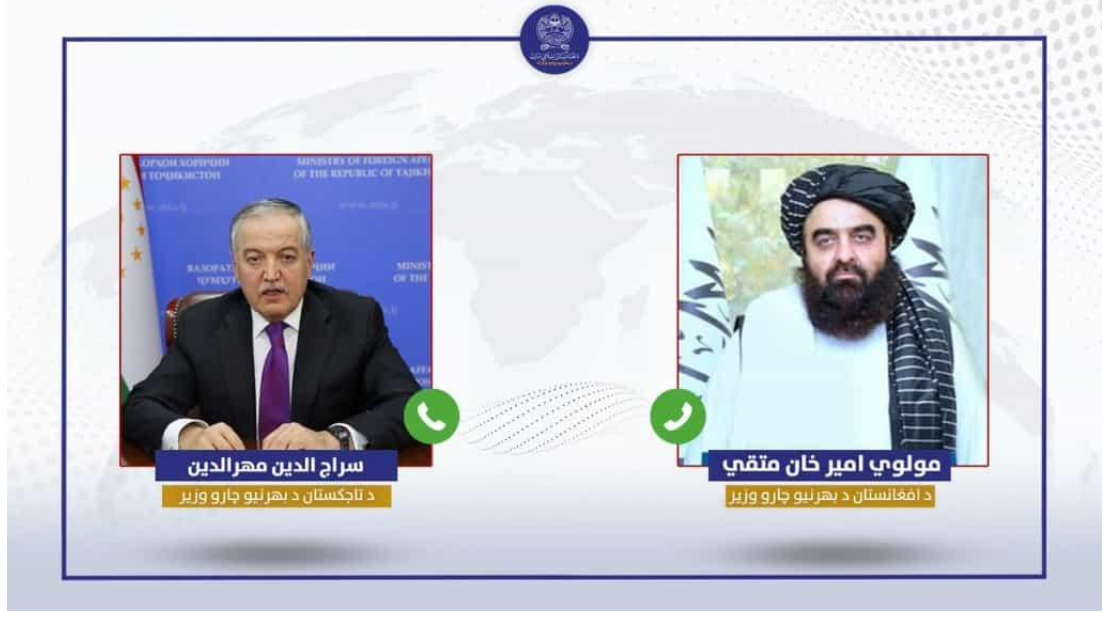
In an unprecedented phone call, the Taliban's top diplomat Mawlawi Amir Khan Muttaqi spoke with Tajik counterpart Sirajuddin Mehruddin (Credit: Pajhwok).

Tajikistan’s security chief Saimumin Yatimov made an unannounced visit to Kabul in September 2024. In May this year, the head of Afghanistan’s electricity utility attended a meeting in Tajik capital Dushanbe of counry representatives from the Central Asia-South Asia (CASA)-1000 power transmission project. The governor of Afghanistan’s northern province of Balkh met with Yatimov in Dushanbe in late October and a Tajik government delegation was in Kabul in mid-November.

The attacks on the Chinese workers met with condemnation from both Tajik and Taliban authorities.

The Taliban permitted a team from Tajikistan to inspect the suspected staging areas for the attacks inside Afghanistan. The Tajik and Taliban foreign ministers spoke by telephone on December 2. It was the first ever direct communication between the two.

China has called on Chinese companies and workers in Tajikistan near the Afghan border to leave the area. Beijing is waiting for answers about the perpetrators of the attacks.

Tajik President Emomali Rahmon ordered military and security forces to do everything possible to prevent another attack as Tajik authorities wait for answers from the Taliban.

Whom will the Taliban name as the culprit knowing they have to satisfy both the Tajik and Chinese authorities?

Experiments in Futility: Australia’s Teenage Social Media Ban Approaches


The messiness of Australia’s social media ban for those under 16 as part of the Online Safety Act 2021 is becoming more apparent by the day. From December 10 this year, as announced by the commissar-minded eSafety Commissioner Julie Inman Grant, “age-restricted social media platforms will have to take reasonable steps to prevent Australians under the age of 16 from creating or keeping an account.” This, she declares, is “not a ban” but “a delay to having accounts.” Last month, the office formed the opinion “that Facebook, Instagram, Snapchat, Threads, TikTok, Twitch, X, YouTube, Kick and Reddit are age-restricted platforms.”

Showing a willingness to adapt to, if not outflank the regulations with gusto, curious teenagers are finding other platforms to indulge in. This has precipitated much fuss by the eSafety office to make sure that these discovered outlets are also brought within the scope of the ban. Lemon8, owned by TikTok parent company ByteDance, and the photo sharing app, Yope, have recently piqued the regulator’s interest. This promises to be a perennially futile exercise.

Cyber Safety Solutions founder Susan McLean is clearly on firm ground in dismissing the restrictions as moribund before they even come into effect. “For every single bad thing that has been caused by a banned social media platform,” she attests to the Australian Financial Review, “I can provide you with a platform that is not going to be banned where the same thing has happened.”

McLean also points to another crippling problem: that the age restricting measures can themselves be circumvented on designated platforms. “I’ve seen people scrunch up their face to look older, do full face and make-up tutorials. There are masks you can buy, making your face a darker colour, which apparently makes it harder to tell your age. God knows what’s true and what’s not.”

Then come the qualifications and exemptions that make such a regulation increasingly foolish even before it comes into effect. The commissioner seems of the view that children visiting Australia must have different standards of maturity altogether. They will be exempt from the social media ban when visiting the country, able to lord this fact over any friends of similar age they might make locally. The locals are to be kept childishly pure and incorruptible.

The Digital Freedom Project (DFP) is keen to pursue the legality of the measure in the Australian High Court. The claim is that the laws are disproportionate and breach the constitutional right of freedom of political communication, a right divined by the High Court in a constitution that lacks any express mention of it. While accepting the principle that children need protection from online harms, the DFP asserts that “a measure is only constitutional if, in substance, it burdens political communication no more than is reasonably necessary to achieve that purpose.”

Two 15-year-olds, Noah Jones and Macy Neyland, are named as plaintiffs in the action. “We’re disappointed,” stated Jones, “in a lazy government that blanket bans under-16s rather than investing in programs to help kids be safe on social media.” Neyland, in a waspish mood, feels that, “If you personally think that kids shouldn’t be on social media, stay off it yourself, but don’t impose it on me and my peers.”

The Digital Freedom Project president John Ruddick, a Libertarian member of the New South Wales upper house, further added that the ban shifted the burden of parental responsibility to “unelected bureaucrats” and government apparatchiks. This valid assertion has done little to disabuse the Albanese government of this daft enterprise. “Despite the fact that we are receiving threats and legal challenges by people with ulterior motives,” snorted the Communications Minister Anika Wells in parliament, “the Albanese Labor government remains steadfastly on the side of parents, and not platforms.”

Of interest is whether this implied right extends to those under the age of 16. The implied right, unlike the free speech protections in the United States, is not personally vested in individuals. This legal misnomer acts, rather, as a fetter on excessive parliamentary interference upon discussions and engagements in political communication. Former High Court Chief Justice Robert French, when assessing a South Australian law of similar design, opined that the restriction on content remains “neutral” and “not directed at political speech” even if it might cover it. The stock approach of judges in Australia is to show reluctance in striking down parliament’s will, however mischievous and foolish, as long as the means of doing so are “reasonable and proportionate” for “a legitimate purpose consistent with Australia’s representative democracy.”

This government, much like its predecessors, has insisted on mandatory infantilisation as a principle of public policy. In doing so, it has shown a pathological mistrust not only of children’s intellectual fibre, but the capacity of parents to front up to their nurturing tasks in a digital world. The legislation has left many citizens with the false impression that harms will be redressed in a cogent way, when there is every likelihood that the appetite for social media will remain undiminished. The very idea that children might be enlightened in their use of technology will not feature, while their sheltered ignorance will be treasured.

Binoy Kampmark was a Commonwealth Scholar at Selwyn College, Cambridge. He lectures at RMIT University, Melbourne. Email: bkampmark@gmail.comRead other articles by Binoy.

Iraq warns over rising digital threats to children as internet use surges among young users

Iraq warns over rising digital threats to children as internet use surges among young users
Iraqi child playing on games. / Iraqi child playing tablet
By bna Cairo bureau December 3, 2025

Iraq's government has again stumbled into the argument over the use of digital platforms as it continues to turn the screw on social media, games and virtual platforms. 

The Iraqi Strategic Centre for Human Rights said that the combination of “wide-scale internet use” and the “absence of continuously updated safety measures” within households and institutions has created an increasingly unsafe digital environment for minors.

The Baghdad-based centre warned that global data paints a disturbing picture of the amount of time spent on screens, which Iraqi households have struggled to deal with in recent years. Historically, Arab governments have not engaged in such debates, but calls from some families about the use of specific platforms and games have raised concerns across different communities. 

According to UNICEF data, when a child goes online, every half second shows just how quickly young users are being swept into a digital space where predators, extortion and manipulation are widespread risks. It cited recent studies indicating that more than 300mn children worldwide face digital threats annually, ranging from online sexual exploitation and extortion to cyberbullying and coercive digital behaviour.

Concerns have deepened since the government announced in October 2025 a ban on electronic games such as PUBG, Fortnite and Roblox, arguing they encourage violence and undermine childhood well-being. 

The Ministry of Interior said the games had become “a threat to social security” and “a waste of children’s and adolescents’ money and time”. The move is part of a broader campaign to curb products seen as harmful to young people, following the earlier ban on the Labubu doll

The backdrop is a steadily tightening digital landscape. In 2024, Iraq expanded its internet restrictions, blocking several major websites, including the Internet Archive and 4chan.

A Ministry of Communications report that same year found that 62%  of Iraqi households do not activate any form of parental control on children’s devices, leaving young users significantly more exposed to online risks.

The Strategic Centre drew attention to the most common threats to Iraqi children, including cyberbullying and its psychological impact, online luring and exploitation, theft of personal data due to weak privacy settings, and exposure to harmful or age-inappropriate content that can influence behaviour, mental health and social development.

It also noted a growing number of cases involving hacked accounts caused by password sharing and poor digital security awareness.

The organisation said parents and communities must play a central role in updating protective tools, something that was not the case until recently in many Iraqi households with kids often in their bedrooms without supervision.

Psychologist Faleh Al-Quraishi warned that children are increasingly shifting “from social beings to virtual beings”, describing heavy screen use as “screen addiction”, a condition he compared to chemical dependency. Excessive exposure, he said, pushes children “into a cycle of anxiety, tension and social isolation”, contributing to declining academic performance.

"Without open conversation between parents and children about online risks, minors are left highly exposed to dangerous content,” he added.

The human rights body urged the Iraqi government, parliament and relevant agencies to adopt a national digital-child-protection strategy that covers legislation, prevention and monitoring. It called on authorities to accelerate the passage of a long-delayed Child Protection Law, integrate digital literacy into school curricula from the primary level and tighten penalties for online blackmail and exploitation of minors.

Among its recommendations were the creation of a national hotline for reporting incidents, enforcing child-privacy obligations on telecom operators and social-media platforms, and strengthening cooperation with UNICEF and international organisations to track emerging risks and update protective policies.