It’s possible that I shall make an ass of myself. But in that case one can always get out of it with a little dialectic. I have, of course, so worded my proposition as to be right either way (K.Marx, Letter to F.Engels on the Indian Mutiny)
Saturday, February 28, 2026
Factory Occupation In Italy: Laid-Off Workers Organise As A Cooperative And Want To Set Up Their Own Business
In the summer of 2021, the GKN auto parts factory near the Italian city of Florence was closed, and over 400 workers lost their jobs. Since then, some of them have been occupying the building—for over four years now. Their goal is to manufacture solar panels and electric cargo bikes, thereby converting the factory into an eco-friendly facility. As a cooperative, they are leading the longest workers‘ struggle in Italian history and showing that even in a globalized world, workers can fight back against mass layoffs and make a difference. They want to reach their investment goal with the help of crowdfunding.
Over 400 workers at an Italian car factory were simply dismissed by email
On July 9, 2021, the 422 workers at the GKN plant (which manufactured car parts on behalf of Stellantis) in Campi Bisenzio near Florence received an email. The content: a letter of dismissal. Two months later, a labor court in Florence ruled that these dismissals were unlawful because the obligation to inform the unions had not been fulfilled—in other words, the unions had not been adequately informed about the layoffs and should have been involved. Since then, some of the workers have been occupying the factory where auto parts were produced. And this despite unpaid wages – some have side jobs or are getting by on unemployment benefits or savings.
The eternal works meeting: Four years of permanent occupation
In a kind of permanent works council, the workers at the GKN factory take turns in eight-hour shifts. Under the name “Collettivo di Fabbrica,” they are fighting to keep their jobs and for the climate-friendly conversion of the factory. Their motto, “Insorgiamo” (Let’s rise up!), has its roots in the Italian partisan movement that fought against fascism.
Former GKN spokesperson Dario Salvetti (left) during a speech by the factory collective (photo: Wikimedia Commons/Valentina Ceccatelli)
“This (the factory) is our home. We’re not leaving here. And not a single screw will disappear from here.” – Dario Salvetti, spokesperson for the collective.
By occupying the factory, the collective is protecting its means of production (e.g., machines) and preventing them from being relocated abroad, where production would continue at low cost. This phenomenon is also familiar in Austria: in 2020, the Styrian electric motor manufacturer ATB relocated its production to the low-wage countries of Serbia and Poland. This is exactly what the factory collective in Italy wants to prevent. It hopes to resume its work in the factory as a cooperative (ex GKN For Future, GFF). They want to manage the factory together, make democratic decisions, and work for social benefit rather than profit.
Years of delaying tactics – workers should give up the fight
Currently, ownership of the factory is divided among three companies controlled by one person: Francesco Borgomeo, advisor to the Melrose financial fund. The closure of the plant is primarily attributable to Melrose. The industrial plan promised by Borgomeo never materialized. He simply tells the workers that he is not the investor and that he will introduce them to the new investor in a few months. For collective spokesperson Salvetti, the strategy is clear: Borgomeo is speculating with the property and the workers are being strung along until they give up the fight. But despite all the adversity, that is not an option for them. They have their own business plan, which they are already partially implementing.
Cargo bikes and solar panels: workers want to convert factory to climate-friendly production
The collective’s idea is to convert the factory’s production to be climate-friendly. In the future, solar panels and electric cargo bikes will be manufactured there. The plan was developed in collaboration with scientists in early 2023 and envisages employment for around 100 people. Organisations and non-profit banks have already pledged financial support to the collective. To reach its investment target of two million euros, the collective has also launched a crowdfunding campaign.
The collective is already implementing part of the business plan: workers are building the first cargo bikes in a small workshop on the outskirts of Florence. The main business will be photovoltaics, but there is a lack of space and resources for this. Due to legal disputes, they cannot use the premises in the factory.
The fight for protected jobs throughout Italy
The workers are concerned with preserving jobs that are well protected by law. This is because more and more companies in the region are being affected by closures and relocations to low-wage countries, where workers sometimes have little legal protection.
„We were fired in a cruel manner. But this is not just about our 500 jobs. Jobs across the country may be at stake. That’s why GKN is of national and political interest,“ says Dario Salvetti.
And the workers are not alone: many members of Tuscan civil society, a Europe-wide collective of scientists and students, and Fridays for Future are supporting the fight for an ecological conversion of the factory and the preservation of hundreds of jobs.
Festival in support of the ex-GKN collective in Campi Bisenzio (Photo: Wikimedia Commons/Valentina Ceccatelli)
The site could be made available for public use thanks to legislation
At the end of June 2025, there was a dramatic turn of events: the tax court ruled that the factory site must be cleared. This would nip any new start for the factory in the bud and pave the way for real estate speculation. However, legislation passed in December 2024 gives cause for optimism: it allows municipalities and local authorities to take over the approximately 40,000 square metre site in order to make it available for public use. Specifically, state consortia for industrial development are to be created. The state could therefore buy the site immediately and make it available to start-ups – such as the collective. In theory, the owner could even be expropriated. Whether it will come to that is unclear.
What is a consortium?
A consortium is a temporary or project-based association of several independent actors—such as the state, banks, companies, or initiatives—who join forces for a specific project that would be too large or too risky to undertake alone. All remain legally independent but work together and share responsibilities and costs.
In the case of GKN, for example, a consortium would mean that the region, the municipality, perhaps public banks, and solidarity partners would jointly take over or finance the factory. The workers‘ cooperative could then use it and produce there. The consortium thus creates the structural and financial conditions—the cooperative organises the actual work and production.
Climate-friendly production instead of the arms industry: ex-GKN as a Europe-wide role model
The collective’s labour dispute has brought together people within Italy as well as individuals from a wide range of social movements and academics across Europe. In a small Basque town, a car manufacturer was closed down, and over a hundred workers were laid off. In addition to strikes, the unions – following the example of ex-GKN – have drawn up a plan for the socio-ecological restructuring of the company. At the VW plant in Osnabrück, which plans to stop building cars in 2027, workers are also mobilising together with people from civil society. Their goal is to convert the plant to climate-friendly mobility instead of producing tanks, as planned by the arms manufacturer Rheinmetall.
Lucas Plan: The idea of democratic transformation was born 50 years ago
The factory collective’s labour dispute is reminiscent of the Lucas Plan, which was published in 1976. The plan arose from a novel response by workers to mass layoffs. When the Lucas Aerospace Corporation laid off numerous workers due to international competition and restructuring, they drew up a plan for how they wanted to shape the company in the future. Their idea was to create something that would be of the greatest possible benefit to society. Among the numerous products proposed were medical devices such as dialysis machines and renewable energy sources such as heat pumps.
The plan was rejected by the government and management. But to this day, the Lucas Plan remains a model for all those who are committed to innovation for the good of society rather than for the high profits of private individuals.
Argentina’s General Strike Against 12 Hour Workday
While organized workers seek to repeal the controversial reform, it advances in Congress. It still needs to be ratified by the Senate. Workers claim that it eliminates many of their rights.
In the early morning hours of February 20, the Argentine Chamber of Deputies approved a controversial labor reform proposed by Javier Milei’s ultraliberal government with 135 votes in favor and 115 against. The vote took place in the wake of fierce protests and a 24-hour strike general called for by the country’s trade union confederations who outrightly reject the reform. The far-right government defends the measure, arguing that labor rules must be modernized.
Now, the law will return to the Senate, where Milei’s long-awaited reform, applauded by the International Monetary Fund, to which Argentina owes a record debt, could be definitively approved. “Next Friday, the country will take a step forward… The change it is bringing about in Argentina is to ensure that labor relations between employers and employees are based on coexistence rather than conflict. That is what we are going to bring to the Senate floor next Friday,” Senator Patricia Bullrich told the press.
Among other aspects, the labor reform authorizes an increase in the working day from 8 to 12 hours, restricts the right to strike and the drafting of collective agreements, modifies the vacation system (which can now be split up throughout the year), recalculates severance pay, and reduces by 50% the pay for those who have requested leave due to work accidents or illnesses (although this article was removed during negotiations between deputies and the government in Congress).
Argentina paralyzed
But workers have not stood idly by. The country’s most important unions (joined by non-unionized workers, movements, and political parties of different ideologies, students, teachers, scientists, etc.) called a 24 hour national general strike on February 18 to reject the labor reform, which they consider a direct attack on the working class.
“From day one on the streets, in Congress, in the courts, and in every workplace. This is not a reaction. It is consistency. If they move against workers’ rights, they undermine the national industry and the country’s future. Rights are not negotiable. National strike,” wrote the General Labor Confederation (CGT).
For its part, the Argentine Workers’ Central Union (CTA) stated on its official website: “This veritable referendum against the reform shows that, even if they manage to secure the votes to pass it with the betrayal of legislators who were elected in their districts on an opposition platform, the Argentine people are ready to fight to defeat this law, confront its possible implementation, and recover their rights. The only way to build a free, fair, and sovereign Argentina is with national industry, employment with rights, and decent wages.”
Workers decided to take to the streets and paralyze their activities to demand that the legislature not approve a measure they consider “regressive” and that “eliminates workers’ rights that were won through collective struggles.” To the surprise of few, the vast majority of business leaders support and endorse the reform.
Although the CGT called for a strike without demonstrations, the other major trade union, the CTA and the CTA (Autónoma), participated in street protests and demonstrations alongside other unions and left-wing movements. The demonstrations were met with a heavy police presence, who decided to repress the protesters by firing rubber bullets and throwing large amounts of tear gas.
The immediate effects of the strike
The strike has had clear effects on production and trade in the South American country, but also on tourism. According to the Argentine Chamber of Airlines, some 400 flights were canceled since the general strike was declared. Added to this was the paralysis of public transport by train and subway, as well as most bus lines.
Schools were also at a standstill, with teachers joining the strike. Banks were also part of the protest and remained closed, while hospitals were only attending to medical emergencies. The few merchants who opened their businesses have found themselves facing empty streets and little movement of people.
Milei had threatened to deduct pay for the days on strike from state workers participating in the action, further exacerbating polarization in the public sector, which has been under constant attack by Milei. According to some figures, since taking office in 2023, the far-right government has laid off more than 60,000 state employees.
Added to this is the large number of people who have lost their formal jobs outside the state since Milei took office. According to Jorge Sola, Secretary of the CGT, some 400 people a day are losing their fulltime jobs, which is “breaking” Argentine society and the productive sector.
For now, we will have to wait and see who wins this battle between Milei, business interests, and the IMF, versus organized workers and their powerful ability to paralyze production and trade in Argentina. This struggle will largely determine whether Argentina manages to preserve its historic defense of certain welfare measures or whether it definitively opens its history to the neoliberal free market and thus attempts to resume the failed attempt of the 1990s that led the country to one of its most severe economic and political crises in a century.
Anatomy Of A General Strike: How Workers In The Indian State Of Karnataka Shut Down Production
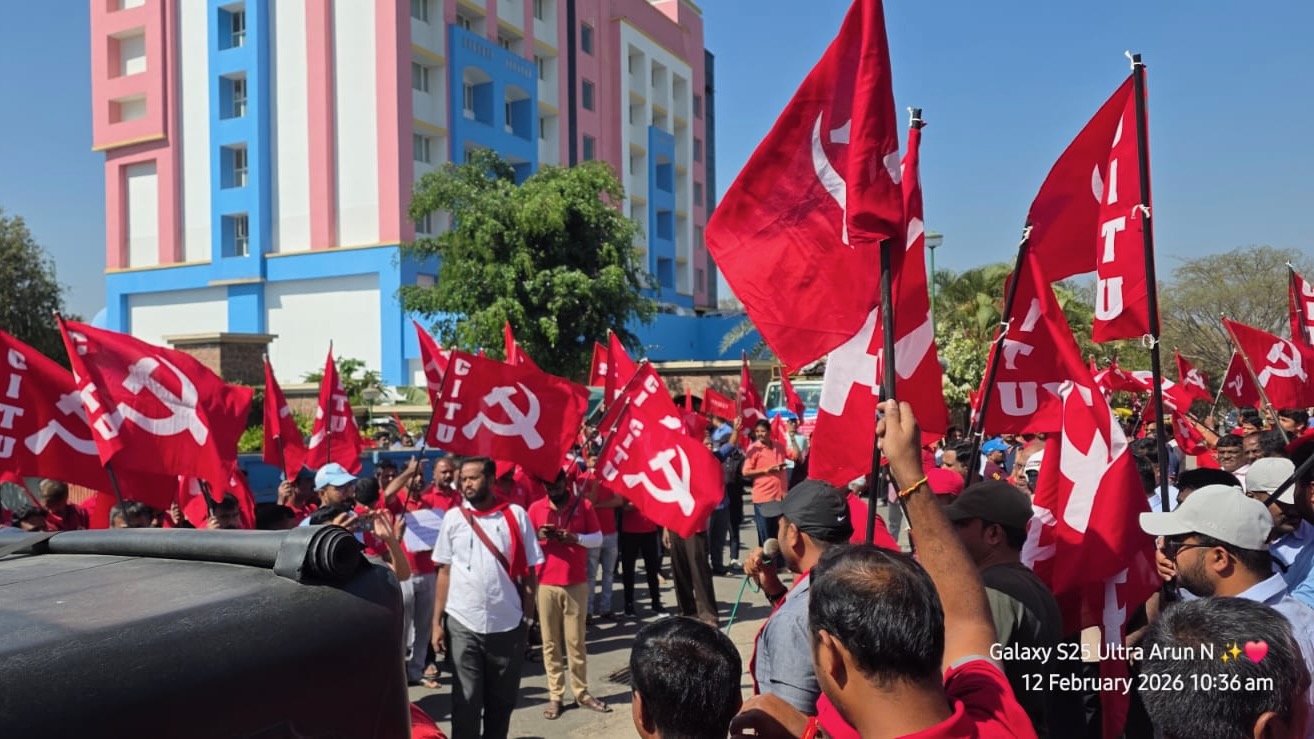
Workers in Bengaluru, Hubli-Dharwar, Bellary, Hassan, Udupit, Tumkur, Utaara Kannada in Karnataka participated in large numbers in the general strike. Photo: CITU
On February 12, as part of the All-India General Strike, 600,000 workers downed tools and almost 100,000 participated in street actions in South India’s largest state, Karnataka, whose government, ruled by the main bourgeois opposition in the center, is rushing to implement anti-labor laws legislated by the BJP.
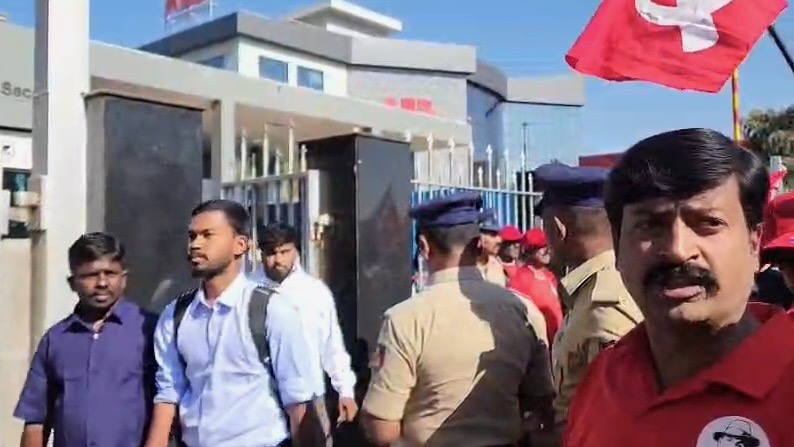
Mass detentions, motorcycle rallies, protest marches and demonstrations, pickets in industrial areas forcing factories to shut down, and the ubiquitous red flags fluttering over these actions marked the All-India General Strike on February 12 in South India’s largest state, Karnataka.
Over 600,000 workers downed tools. Almost 100,000 workers, farmers, and activists participated in street actions across its 31 districts. Production had largely come to a halt in most major industrial areas of the state capital, Bangalore, and the neighboring Ramanagar districts.
”Despite our strike notice, some factories were still running in Nelamangala”, an industrial area in the west of Bangalore along National Highway 48, said Anjum, secretary of the Bangalore rural district committee of the Centre of Indian Trade Unions (CITU).
Local workers confront global capital
Among them was the Smart Power factory of the Switzerland-based ABB group. A manufacturing unit of German Frenzeli, which produces expansion joints, high-temperature sealing, and other parts used in industrial machinery, was also functioning.
The US-based Pepsi was quietly operating in partial capacity, trying to avoid the attention of the thousand-odd, red T-shirt-clad workers and union leaders rallying on motorcycles through the industrial areas to enforce the strike. However, workers have their own local intelligence network. It is difficult to evade their notice on a day such as this.
”We halted our motorcycles before each one of those factories,” swarmed their gates, blocked their entrances and exits, and forced the management to turn off the power, shut down, and relieve all workers.
Swiss manufacturer ABB forced to relieve workers. Photo: CITU
However, most factories in these industrial areas had voluntarily shuttered for the day, including his own employer, DENSO Kirloskar, a joint venture between Japanese DENSO Corporation and Indian Kirloskar Group, which manufactures air-conditioning and engine cooling system components for automotives.
The industrial area unit of the Joint Committee of Trade Unions (JCTU), a coalition of ten major trade union federations in the country, had served strike notices to the factories in Nelamangala in advance.
”Some small workshops in the interior may still have operated, escaping our attention, but most of the production was brought to a halt in this industrial area,” said Anjum.
Triumphantly marching to revolutionary slogans after the industrial shutdown, waving hundreds of red flags, about 1,500 gathered before the Taluk Kacheri, a sub-district level administrative office of the government.
Shuttering their shops down in solidarity, local traders, jewellers, tailors, and hawkers all joined the industrial workers for a demonstration. From there, they went marching on foot through all the main roads of Nelamangala, past the police station, and back to the Kacheri, where they held a public meeting.
Non-unionized workers on strike
The mobilization of non-unionized workers in industrial areas through pickets, rallies, and marches is crucial for a successful strike in the context of globalization, which has disarticulated large factories, scattering workers on the production line of a product around the world, undermining their capacity to unionize.
Such street actions were prohibited by the police in the Bommasandra Industrial Area in the city’s southeast, where industry owners organized pressure on authorities, said CITU’s Karnataka State vice president, B. N. Manjunath.
However, the unionized workforce (about 30% of the workers here) downed tools and gathered for a 1000-people strong demonstration outside the industrial area at the main roundabout, before rallying about 5 km on National Highway-44 for a public meeting in Chandapura.
In the neighboring Jigani and Attibele, where unionists were able to lead rallies into the industrial areas and mobilize the non-unionized workforce, about 75% of production was halted for the day, following confrontations at many factory gates. About 2,000 workers from Jigani then gathered at the APC circle, blocking a critical node, linking this industrial area to the Bommasandra–Attibele corridor.
Outside Bangalore’s city limits in the rural district to its east, Hoskote was almost entirely shut down. The town is a bottleneck connecting the city to the industrial belt on the highway to Kolar. The Narasapura industrial area is among the most prominent in this belt. A large section of its workers reside in Hoskote town.
Strategic pickets
“Other workers heading to Narasapura from Bangalore city must also enter Hoskote before connecting to the national highway en route. At this chokepoint, we set up a picket at four in the morning,” said Ananda Kumar, CITU’s working president for the Hoskote sub-district.
“We intercepted many company buses, including those ferrying workers to the iPhone manufacturing plant,” acquired from the Taiwanese company Wistron by the Indian manufacturing giant Tata in late 2023. The company bus of Japanese automotive company Honda was also stopped en route to its plant in Narasapura.
“We appealed to the workers in these buses to join their fellow workers in the strike. All permanent employees got off in solidarity. But contractual workers were too afraid of losing their jobs. So, some large companies like Tata and Honda were able to partially operate on the labor of contractual workers. But overall, at least 80% of the factories in this industrial belt were shut.”
Most of them had already announced closure for the day after being served the strike notice. Among them was the bus manufacturing plant of the Swedish multinational, Volvo, where Kumar is employed as the final inspector on the production line. He also heads its workers’ union. “We manufacture three buses a day. Closing for one day means a five crore loss for the company,” he calculated.
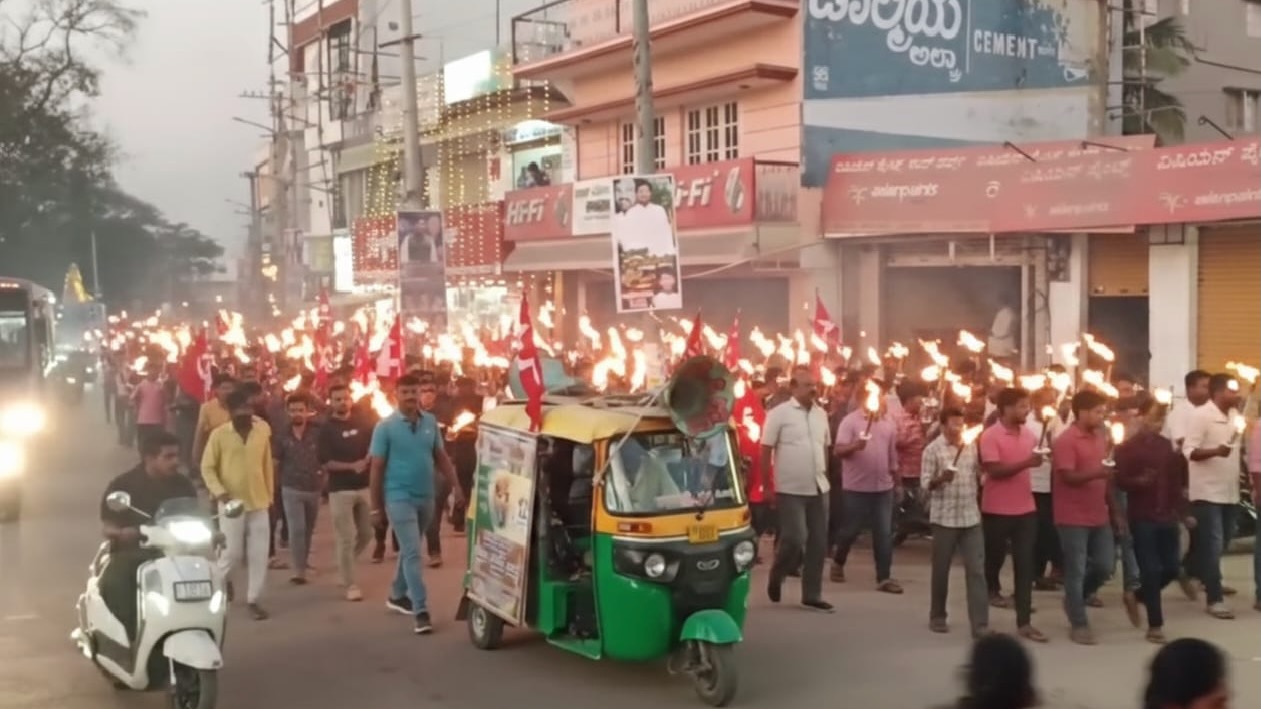
Most shops and commercial enterprises in Hoskote town were also shut in solidarity. Later that morning, employees of the local Gram Panchayat (village council), Dalit rights activists, and members of women’s rights organizations also joined the industrial workers in a 3,000-people-strong torch procession, carrying red flags.
Hoskote town shut down as it’s workers and residents march on a torchlight rally. Photo: CITU
”We started from the Taluk Kacheri, marched through all the main roads of the town, before returning to the Kacheri for a public meeting,” following which they delivered a memorandum to Hoskote’s Assistant Commissioner, Ananda said.
Karnataka’s largest amusement blockaded
To the south of Bangalore city, in the industrial area of Harohalli, and the connected Bidadi industrial area in the Ramanagara district, the strike was almost 100%, said the district’s JCTU coordinator and CITU’s Karnataka state secretary, Raghavendra.
Amid a show of force by union mobilizations ahead of the strike, factories, including the Japanese Toyota’s mother plant in India, had agreed not to operate on the day of the general strike upon receiving JCTU’s notice.
Striking workers from the two industrial areas assembled in Bidadi outside Karnataka’s largest amusement park, Wonderla, on the highway from Bangalore to the historic city of Mysore. Wonderla, which is also India’s largest chain of amusement parks, has “transferred its workers who unionized in Bidadi to different states. Under the cover of transfers, they have even dismissed many. Its management has also fronted a fake union, with which it has orchestrated negotiations to undermine us. So today was the day to confront them,” he added.
In defiance of the strike notice, Wonderla had opened the amusement park on the day. However, none could go in. About 3,000 striking workers from Bidadi and Harohalli occupied the road outside its entrance in a protest demonstration, forcing it to “close down for half a day”.
Blockade outside the largest amusement park. Photo: CITU
From there, on about 1,500 motorcycles, we went on a rally of about 6 km to a ground in Bidadi for a public meeting.” On the way, farmers resisting the government’s forced land acquisition in the Byramangala village also joined the workers in the rally.
Industrial actions also reported from smaller towns
Further along the highway, workers also withheld labor in several industrial units in the city of Mysore. Strikes were also reported from other cities and towns of Karnataka, including Tumkur, Belagavi, Kalaburagi, and Raichur, where over a thousand workers of the state-owned Hutti Gold Mines blockaded the road.
Unions under CITU alone stopped production in 159 factories, most of them in and around Bangalore, said its state president, Meenakshi Sundaram. The JCTU includes ten unions, with other left formations like the All India Trade Union Congress (AITUC) and All India Central Council of Trade Unions (AICCTU) also leading several actions.
Automotive and auto parts manufacturing, the engineering industry, electronics, and pharmaceuticals were the sectors most affected by the strike, added Sundaram. Banking was also partially disrupted, with the participation of its unions in the strike. Mid-day meal scheme workers also took part.
Manufacturing workers on the forefront
But manufacturing workers, he explained, were the core of the general strike in Karnataka, downing tools in the largest numbers, because they are the most immediately affected by the Labor Codes, whose withdrawal is among the central demands of the unions.
Around 87% of the registered factories in Karnataka employ less than 300 workers, the threshold below which the Labor Codes allow employers to retrench workers without needing government approval. The previous cut-off was at 100 workers.
It wasn’t that the Karnataka State governments had been automatically inclined to deny approval for retrenchments by employers hiring over 100. But the requirement of government approval opened the doors for unions to contest it, both in labor courts and in the public arena, where they could bring political consequences to bear, both on the ruling and the opposition parties.
By raising this threshold to 300 workers, the vast majority of Karnataka’s working class will be denied the possibility of contesting their retrenchments in this field.
Labor laws diluted
This is not the only threat posed to the working class by these four Labor Codes that have swallowed down 29 labour laws, diluting the protections they accorded. “They even altered the definition of working hours to exclude scheduled rest hours like lunch breaks,” said Sundaram. This automatically increases the working hours in a country that already ranks among the longest in the world.
Reducing the obligations on the employers to ensure workplace safety, the new codes provide them more wiggle room to get away without compensating in case of a workplace accident by pinning the blame on the injured worker’s own negligence.
The definition of “worker” itself is muddled by these codes, Sundaram added further. Anyone with the slightest supervisory power at work, earning a monthly wage of over Rs 18,000 – which is well below a living wage – “is not considered a ‘worker’ in these codes.” This effectively takes away their access to many industrial dispute mechanisms.
“They have instead been categorized as ‘employees’. But the definition of ’employee’ is left broad and ambiguous,” making it easier for the employers to evade legal liabilities and further contractualize work of a permanent nature.
Easing business by bending labor rights
While thus promoting the “ease of doing business” by offering “labor flexibility” to the employers, the codes simultaneously constrict trade union functioning. It further limits the number of union office bearers coming from the ranks of professional cadre, who are not necessarily employed in the particular factory or sector, but are skilled and experienced in strategizing and leading negotiations.
While deregulating work conditions, the codes regulate how a union can raise money and impose restrictions on how the funds can be spent. Simply securing recognition for a union is itself enormously more challenging under the new labor codes.
These codes had been rammed through the parliament over five years ago in September 2020 by the far-right BJP ruling in the center. Opposition parties, including the largest of them, the Indian National Congress (INC), had condemned the move as “anti-worker”.
Amid mass opposition by trade unions, which, in multiple general strikes since, mobilized hundreds of millions of workers, the central government did not notify the codes until November 2025, when they took effect.
“The government has snatched away all the rights that workers had in their hands. The protections previously granted to workers have been taken away, and new avenues for their exploitation have been opened,” senior INC MP Priyanka Gandhi said on the codes’ notification.
“Anti-labor, Anti-worker, Pro-cronies”
INC president and leader of opposition in the parliament’s upper house, Mallikarjun Kharge, condemned the central government as “anti-labor, anti-worker, pro-cronies”. Along with former INC chiefs, Rahul Gandhi and Sonia Gandhi, Kharge joined the left MPs in the multi-party protest against the notification of these codes at an entrance to the parliament in the national capital, New Delhi, in December 2025.
A month later, however, in his home state of Karnataka, down south, where the INC is the ruling party, the state government published the draft for Industrial Relations (Karnataka) Rules, 2026, to implement the labor codes, ahead even of many BJP-ruled state governments.
“The Karnataka government,” Sundaram pointed out, “had an opportunity to protect the state’s working class,” from these labor codes which Kharge had eloquently described on the parliament floor as a cover for a multi-pronged attack on the working class by the BJP.
In the neighboring state of Kerala, ruled by the Left Democratic Front (LDF) led by the Communist Party of India – Marxist (CPIM) with which the CITU is affiliated, the state government has refused to implement the labor codes. It has instead called on the central government to withdraw them.
Even if the INC’s Karnataka government did not want to play hardball with the central government, it could, at the very least, “have made amendments to the central codes to ensure that the majority of Karnataka’s working class is not stripped of their labor rights,” insists Sundaram.
“Labor-industry relations fall in the concurrent list of the Constitution. This gives the state government the power to make such amendments to the codes notified by the central government. And they did use this power to amend, but not protect workers. They have instead used it to further intensify the central labor codes’ attack on trade unions.”
For example, the central labor codes, which raise the threshold of minimum membership required for a union’s recognition, nevertheless retain secret ballot voting by workers as the means of determining whether the union represents a sufficient workforce in a factory or sector. The draft rules published by the Karnataka state government have “worsened this by replacing secret ballots with verification by government officials.”
Two faces of the leading opposition party
In its defense, the state government maintains that the rules it has published are only a draft, and unions can provide input before they are finally legislated later this year. Nevertheless, Sundaram argues, “this draft exposes the intention of the state government.”
Opposing the Labor Codes as an anti-worker policy of the BJP at the center, where the INC wields no power, while pleasing the corporates with an even more aggressive version of it in a state where it rules, is a two-faced nature of the party it does not want exposed, he said.
This, he argued, is the reason the Karnataka state’s police refused permission for the central demonstration on the day of the general strike in front of Bangalore’s Town Hall, a city center under the gaze of the cameras of the large corporate media houses, which mostly ignored the actions in industrial areas.
Mass detentions
The JCTU refused to budge. On the morning of the general strike, when workers were setting up pickets in the industrial areas, the state police were setting up pickets of their own in front of Town Hall.
Well before the striking workers were set to arrive at the location for a demonstration scheduled at 11 am, “the police were already there in thousands,” with barricades and parked buses for detentions, recalled Sundaram.
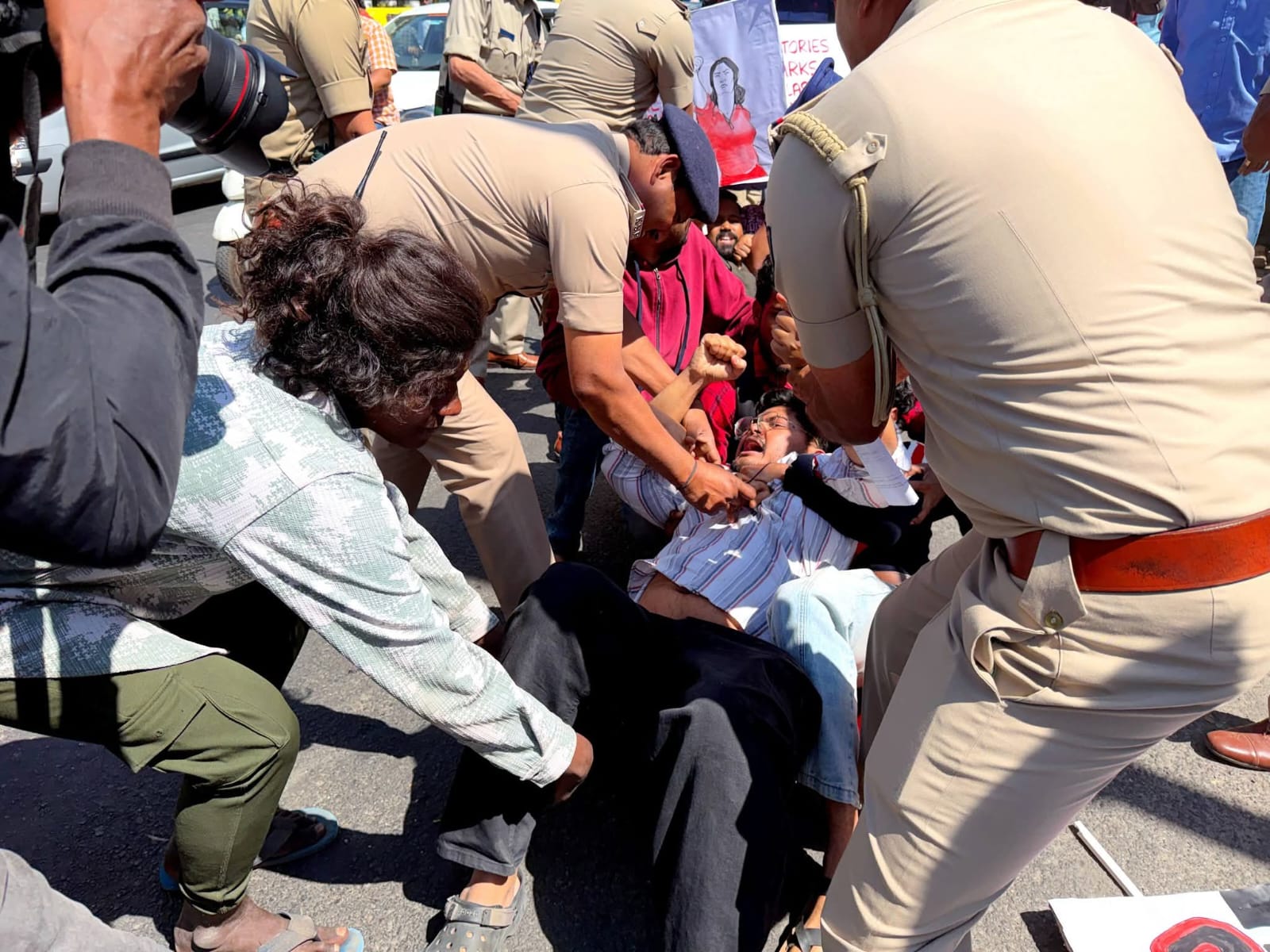
Waving red flags and carrying banners, the first rally arrived, sloganeering, with trade unionists and farmer leaders on the front, marching straight into the picket of the police, who started grabbing the protesters.
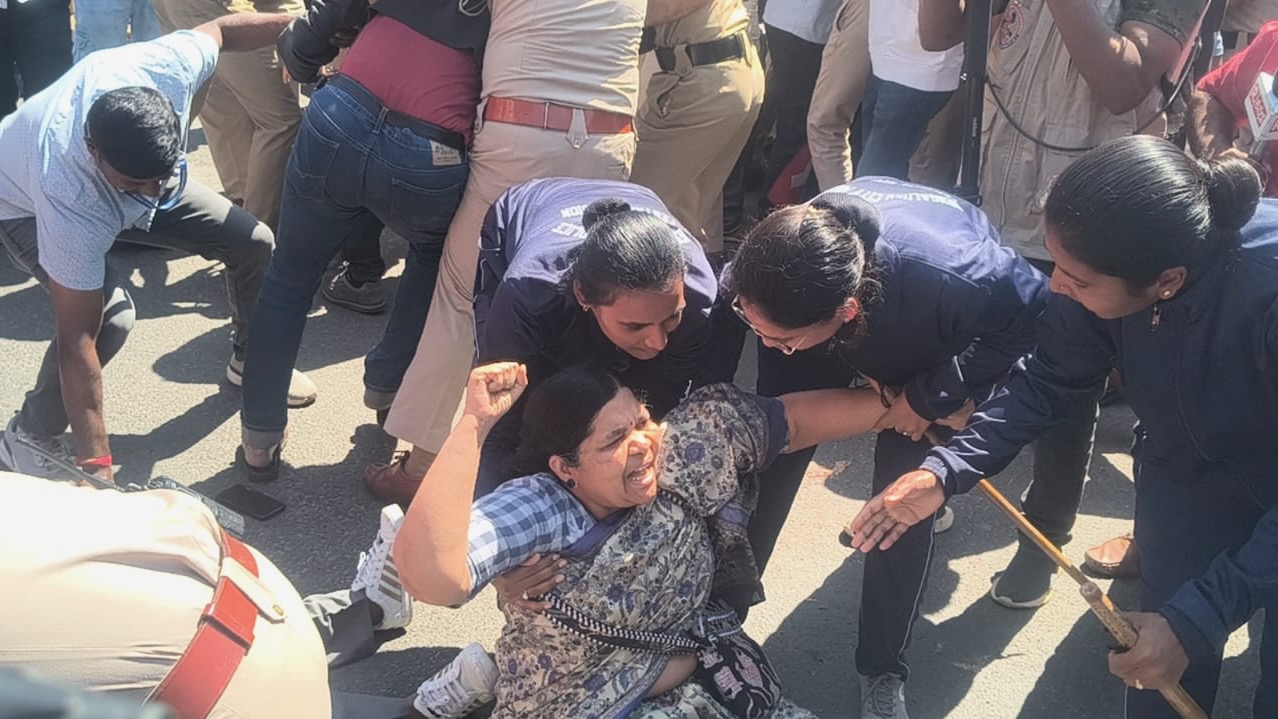
CITU Karnataka state secretary, Varalakshmi, locked arms with other women leaders and fell back on the road to hold ground and resist arrests. Prying them apart, scores of policewomen hauled them onto buses.
CITU Karnataka State secretary being forcefully arrested. Photo: CITU
Older men and women were also lifted off the ground from their wrists and feet, even as they complained of their damaged knees. Among the Khaki-clad police were also grotesquely large bouncer-like men in blue safari suits with no visible badges revealing their names, unnecessarily manhandling and shoving grey-haired veteran leaders like Sundaram, even as they were courting arrests.
Nevertheless, the protesters continued to arrive in droves, in rally after rally, including one by the Karnataka State IT/ITeS Employees Union (KITU). Relatively new in a largely non-unionized sector, their numbers are not yet large enough to close down IT companies for the strike.
Nonetheless, the union has won many legal battles against several corporate giants of the sector headquartered in the city, successfully reinstating hundreds of terminated employees. It mustered a roughly 200-people-strong rally of software engineers, data analysts, etc, on leave to join this protest.
KITU General Secretary, Suhas Adiga, being forcefully arrested. Photo: CITU
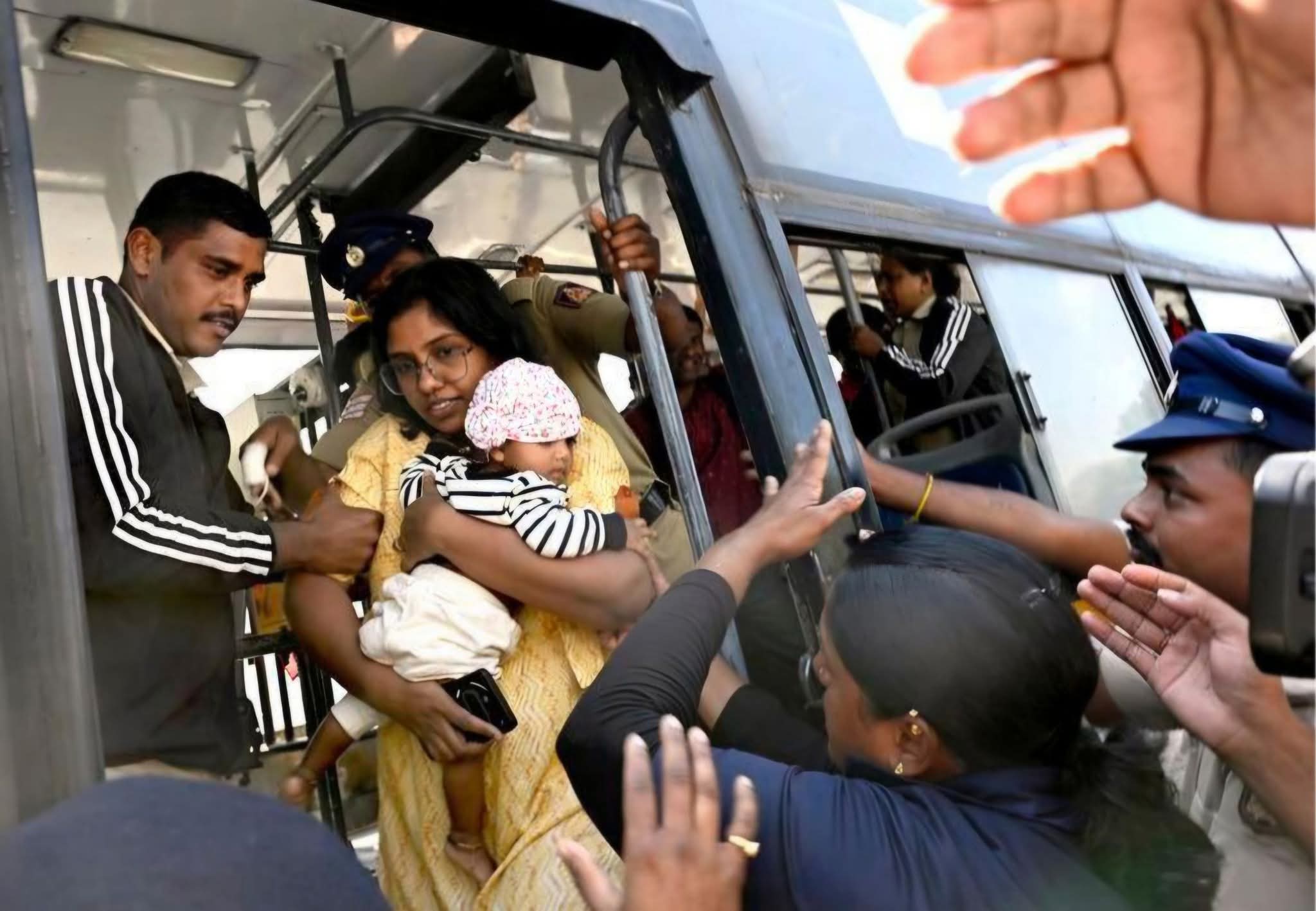
Marching into the police lines with the chants of Inquilab Zindabab, they fiercely resisted arrests, raising slogans of “workers’ unity” against “greedy capitalists”, calling out Prime Minister Narendra Modi and the state’s Chief Minister Siddaramaiah as their agents, while being roughened up and hurled into buses. The youngest detained in this roundup was Nilda Kranti, a six-month-old infant, clutching onto her young mother, who followed her protesting husband into detention.
6 months old infant detained. Photo: CITU
Around this time, Kharge was declaring solidarity with the general strike, with the statement: “From the streets to Parliament, our struggle will continue.”
“Today, millions of workers and farmers across the country are on the streets, raising their voice for their rights,” Rahul Gandhi, leader of the opposition in the parliament’s lower house and former chief of the INC, said in a social media post. “I stand firmly … with their struggle.”
But, down south from the national capital in the state of Karnataka, where his party rules, the police were running out of buses to detain protesters who continued to arrive in rallies at the square in front of the Town Hall. Ordering passengers out of the buses they stopped in traffic, the police diverted more public transport to the Town Hall to continue detaining protesters.
“If the workers and farmers cross the boundary of peaceful protests…”
Most of the detainees, including all the union leaders, were driven to the Police Grounds in Adugodi, where they continued protests under police custody.
“In our long history of protests, we have never turned to violence, never set fire to buses,” Varalakshmi said in her address to this protest. Nevertheless, “the police denied us permission to even make one public announcement of the strike from a speaker on a moving auto-rickshaw.”
This, she went on to argue, shows that the state does not simply insist that the agitations remain peaceful and in compliance with the law and order, but goes on to demand capitulation from “the laboring classes, accepting that they are slaves, with no right to protest.”
“But, we warn you, if we workers and farmers are forced to cross the boundary of peaceful protests, your bullets and batons and prisons will fall short,” she declared, addressing the police, drawing cheers from detained protesters appreciating the arithmetic.
Remembering Susan George, a Shining Light of “Alter-Globalization”
The late Susan George was a pillar in unraveling the obscure mechanisms of economic domination through so-called “free trade.”
Susan George passed away in Paris on February 14 at the age of 91. Born in the U.S. and naturalized as a French citizen, Susan was one of the most important figures in denouncing capitalism over the last 50 years. She stood out for her elegance and refined voice.
But above all, she was known for her dedication to just causes and her authority in explaining the structures of inequality. Throughout her career, she wrote 17 groundbreaking books that have been translated into several languages, such as The Debt Trap, The Lugano Report, A Fate Worse than Debt, and We the Peoples of Europe, to name a few.
All of her work is of utmost importance to Latin America. She criticizes the Bretton Woods System and the Washington Consensus. She was a central figure at every forum she attended, such as the World Social Forums and European Social forums. She is credited with coining the phrase “another world is possible” and published a book with that title, but adding the condition “if” as a call to action. The phrase has been associated with the Zapatista slogan “one world where many worlds fit,” and both are seen as a direct confrontation to Margaret Thatcher’s “there is no alternative.”
She was honorary president of the Transnational Institute in Amsterdam and ATTAC France, and a key founder of both organizations. As TNI states in its obituary, “Susan always defended an objective, honest look at the magnitude of the progressive task. As formidable as it might look, Susan believed that the system has cracks, and ‘we just have to get out there with our pickaxes and work along the fault lines.’”
TNI quotes Susan:
“Either we achieve together a new level of human emancipation, and do so in a way that preserves the earth, or we shall leave behind us the worst future for our children that capitalism and nature can deal them. No one knows in which direction the balance will tip, nor does anyone know which actions, which writings, which alliances may achieve the critical mass that leads us one way or another, backwards or forwards. I am acutely conscious of the precariousness of our moment, and my much-loved grandchildren give me added resolve to address it.”
As the French chapter of ATTAC, the global organization against foreign debt and other injustices, remembered Susan as “an inspiring figure of anti-globalization and the weaver of a vast network. Politicized by her opposition to the Vietnam War and France’s welcome to American draft dodgers, her internationalist spirit never wavered. During those years of war and repression, she worked to bring an American think tank, the Institute for Policy Studies, to Europe, where it became the TNI, Transnational Institute, based in Amsterdam.”
John Cavanagh, who headed IPS in Washington for more than 20 years, says of Susan, “we have lost a true treasure of a colleague, ally, and leader.” He credits her book How the Other Half Dies for helping to “change the world’s view of poverty and development.” Susan “had a gift for translating complex realities into beautiful prose,” John said.
I was fortunate enough to meet Susan in Paris in 1998, in a humble café in a working-class neighborhood near the Gare de L’Est. I was on a tour of several European cities in search of partnerships for our work ahead of the negotiations for a Free Trade Agreement between Mexico and the European Union (MXEUFTA).
Our goal at the Mexican Action Network on Free Trade was to influence the outcome of the negotiations to achieve an agreement that was different from NAFTA — one based on human rights, in contrast to the liberalization of trade and the privileging of foreign investment.
I gave her a copy of our first report, “Citizens of Mexico before the European Union,” which was based on a forum with dozens of organizations and experts at the Convento del Carmen in Mexico City (I would also like to highlight the participation of the recently deceased Maestro John Saxe-Fernández). She seemed amazed, as she was at the center of the campaign against the Multilateral Agreement on Investment (MAI), which sought to impose a global investment protection treaty — one designed and commanded by the OECD, the so-called club of rich countries, into which former Mexican president Carlos Salinas de Gortari had enrolled us.
The MAI largely failed due to France’s rejection — and Susan’s leadership in mobilizing thousands of workers and organizations. An investment chapter could not be included in the MXEUFTA because in 2000 the issue was still not within the EU’s competence but that of its member countries separately.
But since the 2007 Lisbon Treaty, the EU has gained this power — and now the governments of both Mexico and the EU are seeking to impose an investment chapter that includes, for example, the possibility of suing countries in supranational courts (through ISDS).
Susan warned in a publication by IPS, TNI, the Rosa Luxembourg Foundation, and the Institute for Agriculture and Trade Policy that “when companies talk about ‘barriers’ to trade, we call those same measures ‘safeguards’ for people’s health, well-being, and the environment. Companies want absolutely no restrictions on access to natural resources, as several arbitration cases have made clear. All they have to do is set foot in a country and we have to say goodbye to the natural resources of poor countries, including basic necessities such as land, water, and forests.”
Susan George was never against the European integration project, but she was against its agreements with third countries that she said “are not about trade, but about power: they are not about tariffs, but about corporate control of regulations… they are negotiated in secret… and are almost impossible to reverse,” she warned. That is the truth about the “modernization” of the MXEUFTA that is about to be signed any day soon.
Susan George was a pillar in unraveling the obscure mechanisms of capitalist domination through so-called “free trade” and in the global struggle for justice and democracy.