ByAFP
February 28, 2026

Smoke rose above Tehran after explosions were heard - Copyright AFP -
Shaun Tandon, with Susannah Walden in Paris and AFP Bureaus
The United States and Israel launched a wave of strikes against targets in Iranian cities on Saturday triggering explosions and columns of smoke in the capital Tehran.
The attacks came after US President Donald Trump expressed frustration at Iran’s stance in negotiations over its nuclear and missile programmes.
Trump said Washington’s goal was “eliminating imminent threats” from Iran, and Israel’s defence minister Israel Katz described the action as a “preventive strike”.
“The United States’ military began major combat operations in Iran,” Trump said in a video message posted on his social media site while he spent the weekend at his Florida golf club.
“We are going to destroy their missiles and raze their missile industry to the ground. It will be totally, again, obliterated. We’re going to annihilate their navy,” Trump said.
He offered the Iranian military “immunity” or “certain death” and told Iranians the “hour of your freedom is at hand”.
Iranian state television reported that President Pezeshkian was “safe and sound” and the Fars news agency said “seven missile impacts were reported in the Keshvardoost and Pasteur districts” of Tehran.
“I saw with my own eyes two Tomahawk missiles flying horizontally toward targets,” an office worker told AFP on condition of anonymity. “At first we heard a dull noise and thought it was a fighter jet.”
In Tehran, AFP journalists heard blasts and saw two large columns of smoke rising over the city centre. The health ministry said ambulances had been dispatched but there was no immediate confirmation of casualties.
Iran, Iraq and Israel all closed their airspaces to civilian traffic once the strikes were underway, and the US embassies in Qatar and Bahrain urged US citizens to take shelter.
Sirens sounded in Jerusalem and Israeli authorities issued a cellphone warning for citizens.
Trump had ordered the biggest military build-up in decades in the Middle East, with the world’s largest aircraft carrier, the USS Gerald R. Ford, approaching the coast of Israel
A day after the United States and Iran held talks in Geneva, Trump said on Friday that the cleric-run state was “not willing to give us what we have to have”.
But Oman, which mediated the Geneva talks, offered a much rosier picture and said that Iran had agreed to zero stockpiling of any uranium, rendering moot the question of the level of enrichment.
Iran also agreed to degrade current stockpiles into fuel, said Oman’s foreign minister, Badr Albusaidi, who was in Washington meeting US Vice President JD Vance.
The strikes come weeks after Iranian authorities killed thousands of people as they crushed mass protests.
Iran agreed to restrictions to low-level enrichment in a 2015 deal that Trump ripped up during his first term in office.
Meanwhile, US Secretary of State Marco Rubio will travel to Israel for talks on Iran on Monday, the State Department said.
In a rare break from decades of precedent, the top US diplomat will travel without reporters on his plane.
– ‘Very big problem’ –
Trump in his State of the Union address Tuesday alleged Iran was developing missiles that could strike the United States.
Rubio later said it would be a “very big problem” for Iran if it does not discuss its missiles. Iran has insisted that the ongoing talks focus on the nuclear issue.
Increasing pressure, Rubio on Friday designated Iran a state sponsor of wrongful detentions, a new blacklist, over jailings of US citizens.
Iranian Foreign Minister Abbas Araghchi said Friday that “success in this path requires seriousness and realism from the other side and avoidance of any miscalculation and excessive demands”.
The UN nuclear watchdog, the International Atomic Energy Agency, said it would hold technical discussions with Iran on Monday.
The agency called on Iran to cooperate with it “constructively,” according to a confidential report seen by AFP.
burs-dc/jsa
By AFP
February 28, 2026

US President Donald Trump announced a large-scale attack on Iran by video message posted on his social media site - Copyright AFP Chris DELMAS
Danny Kemp with Sebastian Smith in Washington
US President Donald Trump announced a major attack against Iran on Saturday, vowing to “annihilate” the country’s navy and missile sites, and urging Iranians to overthrow their government.
In a video address after the United States and Israel started bombing Iran, Trump made clear the goal was destruction of the Islamic republic’s military and toppling of the authorities in power since the 1979 revolution.
“We are going to destroy their missiles and raze their missile industry to the ground. It will be totally — again — obliterated. We’re going to annihilate their navy,” Trump said in the address from his Florida home posted to his Truth Social platform.
He urged opponents of the Iranian authorities to rise up, saying “the hour of your freedom is at hand.”
“When we are finished, take over your government. It will be yours to take,” Trump said. This “will be probably your only chance for generations.”
But in a section of the short speech that was aimed at the US public, Trump acknowledged that “the lives of courageous American heroes may be lost” in what the Pentagon dubbed “Operation Epic Fury.”
“We may have casualties,” Trump warned.
Any loss of life on the US side would be politically hazardous for Trump himself, especially after his refusal to seek approval for war against Iran from Congress — and his own lengthy record of opposing foreign interventions.
A one-day raid to oust the former strongman leader of Venezuela in January was accomplished without US fatalities. Surgical air strikes on Iran’s main nuclear sites last June also went off without US losses.
– Bombs ‘dropping everywhere’ –
“Operation Epic Fury” is on an entirely different scale militarily and politically.
Smoke rose above Tehran after explosions were heard – Copyright AFP –
An attack was widely expected after Trump ordered the biggest military deployment to the Middle East in years. But critical lawmakers have for days been asking why Trump has not addressed the US public or Congress to explain the need for war.
Trump’s video appeared without warning on his Truth Social site at 2:30 am in Florida, where he was spending the weekend at his luxury golf club.
Trump, wearing a white baseball cap marked “USA” and no tie with his white shirt and dark jacket, stood at a podium between two flags against a black background.
He sought to justify the assault on Iran saying: “Our objective is to defend the American people by eliminating imminent threats from the Iranian regime.”
“They attempted to rebuild their nuclear program and to continue developing long range missiles that can now threaten our very good friends and allies in Europe, our troops stationed overseas and could soon reach the American homeland,” he said.
He urged Iranian forces to surrender, including the elite Revolutionary Guards that is tasked with safeguarding the cleric-run government.
“To the members of the Islamic Revolutionary Guard, the armed forces, and all of the police, I say tonight that you must lay down your weapons and have complete immunity or in the alternative, face certain death.”
But Trump warned ordinary Iranians that the US bombing would be large-scale.
“Stay sheltered. Don’t leave your home. It’s very dangerous outside. Bombs will be dropping everywhere.”
Trump on Friday insisted that he had not decided whether to attack, and his envoys on Thursday held talks with Iran’s top diplomat toward a deal on concerns led by Tehran’s nuclear program.
The top diplomat of Oman, which mediated talks Thursday in Geneva between the United States and Iran, had been optimistic for a compromise.
He met Friday with US Vice President JD Vance and told CBS News that Iran had agreed to zero stockpiling of enriched uranium that could build an atomic bomb, a goal denied by Tehran.
By AFP
February 27, 2026

The International Atomic Energy Agency (IAEA) has stressed that Iran must allow access to its bombed nuclear facitlities - Copyright AFP/File Joe Klamar
The UN nuclear watchdog stressed on Friday the “utmost urgency” of its request to verify all nuclear material in Iran, according to a confidential report seen by AFP.
Two new reports are to be discussed at an International Atomic Energy Agency board of governors’ meeting next week, as the United States threatens strikes on Iran and presses its biggest military build-up in the Middle East in decades.
On Thursday, Oman-mediated talks between Iran and the United States in Geneva were seen as a last-ditch bid to avert war. Initial optimism was tempered by Tehran warning Washington must drop “excessive demands” to reach a deal.
The IAEA confirmed technical discussions on Iran’s nuclear programme would take place in Vienna next week, according to one of the reports.
It added a “successful outcome” of Iran-US negotiations “would have a positive impact on the effective implementation of safeguards in Iran”.
It also urged Iran to cooperate “constructively”, stressing “the utmost urgency” of the IAEA request to verify all its nuclear material.
– ‘Increasing concern’ –
Considerable uncertainty surrounds Iran’s stockpile of more than 400 kilogrammes (880 pounds) of uranium enriched up to 60 percent that the nuclear watchdog estimated the Islamic republic had as of mid-June last year.
Israel launched strikes on Iran last June, beginning a 12-day war that the US briefly joined to bomb Iranian nuclear sites.
Tehran suspended some cooperation with the IAEA and restricted the watchdog’s inspectors from accessing sites bombed by Israel and the United States, accusing the UN body of bias and of failing to condemn the strikes.
“Within the group of affected facilities, it is a matter of increasing concern that Iran has never provided the agency with access to its fourth declared enrichment facility since it was first declared by Iran in June last year,” the IAEA said in the report.
The agency does not know the precise location of the Isfahan Fuel Enrichment Plant, it said in a second report.
It said it had observed through commercially available satellite imagery, “regular vehicular activity” around the entrance to the tunnel complex at Isfahan, in which uranium enriched up to 20 percent and 60 percent was stored.
Activities were also conducted at other affected nuclear facilities, including the enrichment facilities at Natanz and Fordow, it added.
“Without access to these facilities it is not possible for the agency to confirm the nature and purpose of the activities,” it said.
Western countries, led by the United States and Israel, Iran’s arch-enemy and considered by experts to be the only nuclear power in the Middle East, accuse the Islamic republic of seeking to acquire nuclear weapons.
Tehran denies having such military ambitions, but insists on its right to this technology for civilian purposes.
Iran had been enriching uranium to 60 percent, well above the 3.67 percent limit allowed by a now-defunct 2015 nuclear agreement and close to the 90 percent needed to make a bomb, according to the International Atomic Energy Agency.
How a US Attack on Iran Could Result in a
Nuclear War
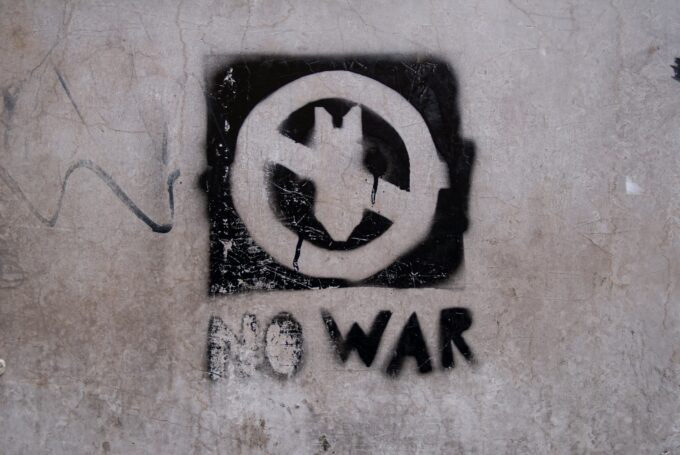
Image by Egor Myznik.
Trump recently floated the idea of a “small” attack, with the Iranians responding symbolically by striking an empty U.S. base. But Tehran refused and made clear that any attack would be responded to forcefully. Trump may hope that with a much larger strike force in the region, Tehran will reconsider its response.
Most analysts note Iran has little negotiating room and most of Trump’s demands are nonstarters. Once the bombs fly, all bets are off. Iran has a substantial missile arsenal and 86-year-old Supreme Leader Ayatollah Ali Khamenei has indicated any US attack would spark a regional war.
As of early 2026, Iran possesses the largest and most diverse missile arsenal in the Middle East, with an estimated 1,500 to over 3,000+ ballistic missiles. Despite losses in the 2024–2025 conflicts with Israel, the stockpile remains formidable, featuring long-range, precision-guided, and hypersonic capabilities, supported by underground “missile cities” and significant, often indigenously produced, inventory.
Key aspects of Iran’s arsenal as of early 2026:
Inventory Size & Range: While older estimates placed the arsenal above 3,000, recent, intense exchanges in 2024 and 2025 may have reduced the active stockpile to approximately 1,500–2,000+ ballistic missiles, with rapid replenishment efforts observed.
Types: The arsenal includes solid-fuel and liquid-fuel short-range (SRBM) and medium-range (MRBM) ballistic missiles, along with cruise missiles and advanced unmanned aerial vehicles (UAVs)
Key Capabilities:
Range: Many missiles are designed with a 2,000 km range limit (e.g., Sejil, Kheibar, Khorramshahr), sufficient to strike targets throughout the Middle East, including Israel.
Precision/Speed: Iran has pivoted toward enhancing precision and accuracy, reducing detection times, and developing hypersonic missiles like the Fattah-1.
Survivability: Substantial, hidden underground facilities, or “missile cities,” are used to protect the arsenal.
Strategic Role: The missiles serve as a core component of Iran’s deterrence strategy, designed to overwhelm regional missile defense systems through massive, coordinated, and precise barrages.
Iran continues to prioritize strengthening its arsenal despite heavy international pressure, focusing on increasing the readiness, reliability, and lethality of its long-range strike capabilities
If Iran’s regime is attacked by the US, that combined with its domestic instability already demonstrated to be substantial by recent protests, may be regarded by the regime as existential. With nothing to lose, Iran could launch a significant missile strike against Israel, already regarded by Iran as a genocidal regime with stated expansionary plans to create a hegemony in the region. From Iran’s perspective being attacked by the US is effectively an attack by Israel and a responsive strike legitimate defense. At that point Iran has nothing to lose by striking Israel. In fact, a US attack could be regarded by Iran as putting it in a use them or lose them dilemma given the overwhelming attack power the US has positioned nearby.
Prime Minister Benjamin Netanyahu warned while speaking at the Knesset on Monday February 24, 2026, that Israel will reply with “unimaginable” force if Iran launches an attack on Israel. Israel’s conventional forces are already spread thin and suffering morale losses in Gaza. What is the “unimaginable” force does Netanyahu threaten? Israel has nuclear weapons and the capacity to reach Iran with them.
Ironically, the more “successful” any US strikes are, and the greater the danger to the Iranian regimes continued existence, or the existence of its missile arsenal, the more likely Iran attacks Israel with overwhelming missile strikes. In such a circumstance, Israel’s “unimaginable” force can only be its nuclear weapons.
Israel is widely believed to possess approximately 90 nuclear warheads. Iran has none. But in the event Israel is hit with, or threatened with up to 3,000 sophisticated missiles, it is such a tiny nation that Israel could decide use of nuclear weapons was essential to its existence. Then nuclear use could be regarded as “necessary.” All nuclear powers assert the right to use nuclear weapons if needed to avoid their own complete destruction.
In fact, the United States explicitly reserves the right to use nuclear weapons first, including in scenarios where its existence, or the existence of its allies and partners, is threatened. Current U.S. policy, as detailed in Nuclear Posture Reviews (NPRs), maintains that nuclear weapons may be used in “extreme circumstances” to defend vital interests, which can include significant non-nuclear attacks. Thus, the precedent exists, in theory.
A nuclear strike by Israel against Iran would cause catastrophic loss of life, widespread environmental devastation from radioactive fallout across the Middle East, and immediate, total collapse of the Iranian regime. Such an event would likely trigger a massive global economic crisis, unprecedented international condemnation, and risk sparking a wider, potentially existential, nuclear conflict.
This is the definition of a “pyrrhic victory.” The “fallout” will be not only nuclear, but moral, and economic and it will be difficult to recover from.
But even if somehow contained to the region, the conflict would be a humanitarian nightmare. Given the nuclear armed states nearby, the conflict could trigger a domino effect leading to near human extinction, or omnicide.
Amassing an armada and thousands of war planes around a country, as Trump has done, and threatening to start a war even though Iran poses no threat unless attacked, is not much of a play for a Nobel Peace Prize.
No Rationale for Presidential War on Iran
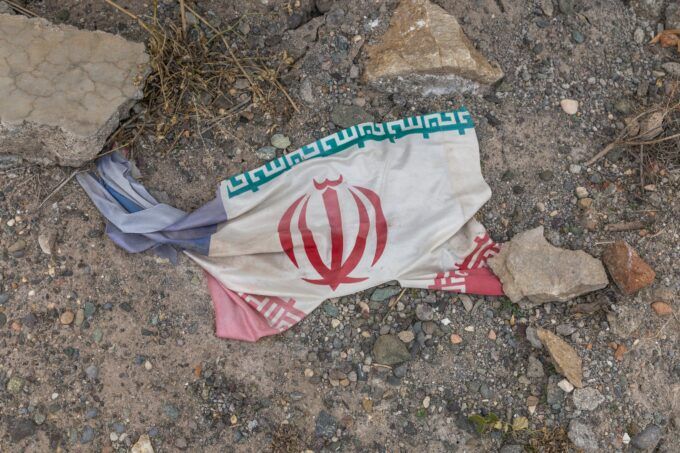
Image by Javad Esmaeili.
The president says Iran must not be allowed to possess nuclear weapons. In his February 24 speech to Congress, he said of Iran’s leaders, “They want to make a deal, but we haven’t heard those secret words: ‘We will never have a nuclear weapon.’”
This is untrue, as we have heard “those (not-at-all) secret words” many times.
For decades, Iran has declared that nuclear weapons production would violate principles of the Quran, the government’s holy book, that it is not pursuing a nuclear arsenal, and that its uranium enrichment is strictly for civilian uses. The enrichment of uranium for civil nuclear reactor fuel is permitted by the Treaty on the Non-Proliferation of Nuclear Weapons. Iran is a party to this treaty, while the openly genocidal government of Israel, which possesses an arsenal of several hundred nuclear weapons, is not.
Speaking in Tehran on January 21, 2025, Ahmadreza Pourkhaghan, the head of Iran’s Armed Forces Judiciary, said, “The late Imam Khomeini did not allow the use of chemical weapons or any illegal and unconventional weapons, even against enemy forces,” and therefore, “it is based on this doctrine that the Supreme Leader [Ayatollah Ali Khamenei] does not permit the armed forces of the Islamic Republic to develop nuclear weapons.”
Dr. Saeid Golkar, at the University of Tennessee at Chattanooga, reported Feb. 11, 2025 that Iranian Foreign Minister Abbas Araghchi “reaffirmed Iran’s commitment to the Nuclear Non-Proliferation Treaty (NPT) and cited a religious decree, known as a fatwa, by Supreme Leader Ayatollah Ali Khamenei, which bans weapons of mass destruction as evidence of Iran’s peaceful nuclear program.”
In October 2003, Supreme Leader Ali Khamenei issued an oral fatwa, or a religious order, declaring that nuclear weapons are forbidden under Islamic law, and condemning nuclear weapons as ‘haram’ (forbidden), and banning the production and use of weapons of mass destruction (WMD) in any form.
Ever since, Khamenei and other officials have repeatedly declared that Iran does not wish to produce nuclear weapons because Islamic law prohibits WMD.
For example, in 2021, the Washington Institute for Near East Policy reported that, “Supreme Leader Ali Khamenei’s years-old fatwa banning nuclear weapons is again making headlines. The regime and its supporters, including former nuclear spokesman Hossein Mousavian, have long claimed that the fatwa is permanent and adduced it as proof that Iran is religiously forbidden from acquiring such weapons.”
In 2019, the radio broadcast The World reported that Ayatollah Ali Khamenei, “said that Iran was not looking to acquire nuclear weapons for a surprising reason — that they were illegal under Islamic law.”
In 2012, Farhad Shahabi Sirjani, of the University of Kent, reported that, “[A]longside the negotiations on Iran’s nuclear program, special media attention was paid to a Fatwa (religious decree) issued by Ayatollah Seyyed Ali Khamenei, Leader of the Islamic Revolution of Iran, banning all weapons of mass destruction, nuclear weapons in particular.”
With a vast armada of U.S. Navy warships now menacing Iran, the memory of undeclared, unlawful, and unconstitutional U.S. forever wars in Iraq and Afghanistan ought to echo in the minds of Pentagon brass and White House advisors. The White House and the world know Iran has no WMD, and no propaganda campaign or ginned-up White Papers have even provided a pretext for another unprovoked U.S. war of aggression. The bombing of Iran last June, the bombing of Venezuela last January, and the ongoing bombing of civilian speed boats appear to have habituated the public to blindly gratuitous militarism.
The Collapse of the State, the Birth of Society: Iran
What is happening in Iran is not a “crisis.” A crisis implies a state of temporary imbalance. In Iran, however, what is collapsing is not a temporary order, but a historical political ontology.
The popular movement that began in Rojhilat (East) Kurdistan in December 2025 and spread to various Iranian cities has exposed the exhaustion of the state-centered concept of civilization, moving beyond mere opposition to the regime. This movement is neither the automatic result of economic impoverishment nor solely a consequence of political oppression.
What is erupting in Iran today is the irreversible rupture of the bond between society and the state. The state is no longer perceived as an authority rising above society, but as an obstacle that constricts the life of society and pushes it out of history.
Reading the situation in Iran through the lens of sanctions, diplomatic tensions, or intra-regime factional conflicts is to miss the heart of the matter.
U.S. sanctions, the Israel-Iran war-tensions, or regional proxy wars are not the causes of this crisis; they are merely external factors that accelerate existing contradictions. The source of developments in Iran is the historical character of the Iranian state, which does not recognize society as a political subject. This character has taken different ideological forms in different periods but has maintained its essence.
The sanctity of the Shah during the monarchy transformed into the infallibility of the jurist (faqih) under the Islamic Republic, yet the state’s view of society remained unchanged. In every instance, power has positioned itself above society, viewing the people either as a mass to be disciplined or an object to be managed.
For this reason, treating the Islamic Republic of Iran as an “Islamic deviation” or a “theocratic exception” is misleading. The problem in Iran is not the interference of religion in politics; it is the sacralization of the state. Velayat-e Faqih (Guardianship of the Jurist) is a theological version of the modern state.
Here, sovereignty is derived not from the people but from a transcendent source. However, this transcendence does not represent a realm belonging to God, but rather the immunity of a narrow core of power. The figure of the Faqih functions as a modern equivalent of the King. He is not elected, he is not accountable, and he cannot be criticized. This structure is the most refined form of the historical continuity of the Iranian state tradition.
In Iran, the state has never been the product of a social contract. On the contrary, it has existed as an apparatus that precedes society, shapes society, and subordinates society to itself. This is one of the fundamental differences that distinguishes Iran from many other states in the Middle East. In Iran, modernization has been a tool for the centralization of the state, not for social emancipation. The modern army, modern bureaucracy, and modern law were established not to empower society, but to fortify the state. Consequently, modernity in Iran has never acquired a democratic content.
The popular movement that began in December 2025 is the exact moment this historical accumulation erupted. The distinguishing feature of this movement is not so much the clarity of its demands, but the depth of the target it addresses. The anger rising in the streets is directed not only at the current holders of power but at the very nature of power itself.
People are not questioning the form of government; they are questioning the very act of being governed. This is a rare threshold in Iranian history. Historically, opposition in Iran has either demanded reform or aimed to seize power. For the first time on this scale, a social movement carries the traces of a political imagination that transcends the state.
At this point, confronting the historical role of the Iranian Left is inevitable. For many years, the Iranian Left presented itself as a tradition that was oppressed, liquidated, and victimized. This narrative is true to a certain extent, but it is incomplete. The real defeat of the Iranian Left was not just its suppression by the mullahs, but its failure to sufficiently problematize the state. During the struggle against the Shah’s regime, the Left identified the state with the monarchy, assuming that when the monarchy collapsed, the state would also collapse. This assumption was the greatest fallacy of 1979.
The 1979 Revolution was a social explosion. Workers, students, women, ethnic peoples, and slum neighborhoods were the primary elements of this explosion. However, this social energy could not produce its own political form. Neighborhood committees, workers’ councils, and local organizations could not be transformed into a permanent and centralized democratic structure.
The Left viewed these structures as temporary. Its primary goal was defined as seizing the state. The discourse of “anti-imperialist unity” established with the mullahs was the clearest expression of this strategic blindness. Anti-Americanism rendered the authoritarian and patriarchal character of the mullahs a secondary issue.
At this point, anti-imperialism ceased to be an emancipatory concept in the hands of the Iranian Left and became a statist reflex. Imperialism was identified solely with foreign powers. Local forms of domination were ignored. Yet, for the peoples of Iran, the most constant and concrete source of oppression was not foreign powers, but their own state.
The failure to grasp this reality eroded the social legitimacy of the Left. The issue of the Kurds and Rojhilat Kurdistan is one of the most striking examples of this erosion. Kurdish demands for equality and freedom were rejected either as a ploy of imperialism or through the risk of “dividing the revolution.” Thus, the Left was drifted into a position that overlapped with the official discourse of the state.
The fact that a large portion of the younger generation rising up in the streets of Iran today does not define itself as “Leftist” is a result of this historical baggage. This generation rejects a statist, hierarchical, and male-dominated political culture.
However, this rejection does not mean that demands for equality and freedom have vanished. On the contrary, these demands are being reproduced through a new language and practice outside the classical organizational forms of the Left. The women’s movement and the resistance in Rojhilat Kurdistan are the most concrete expressions of this new politicality.
Rojhilat Kurdistan is not the periphery of the crisis in Iran; it is the center. The historical character of the Iranian state becomes visible in its nakedness in this geography. Economic impoverishment, cultural suppression, and military rule have become the ordinary modes of governance in Rojhilat. Kurds have never been seen as equal citizens; they have always been coded as a potential security threat. This situation has fostered not a desire to integrate into the state among Kurds, but the development of a political consciousness toward “statelessness.”
The popular movement that began in Rojhilat Kurdistan in December 2025 is the mass expression of this consciousness. This movement can be explained neither by the direction of foreign powers nor by classical nationalist reflexes. What is revealed here is a search for life and politics outside the state. Women’s leadership, local solidarity networks, and horizontal organization practices are the concrete indicators of this search. These practices are an existential threat to the Iranian state because they effectively debunk the claim that the state is without alternative.
The current crisis in Iran gains historical meaning exactly at this point. This crisis is not about whether a regime will fall, but whether the state-centered understanding of civilization can be transcended.
If this movement is reduced once again to a search for a “better state,” the historical cycle will repeat itself once more. However, if this new orientation sprouting in Rojhilat Kurdistan, in the women’s movement, and in the state-distanced politicality of the younger generations can be deepened, a political horizon where society—not the state—is at the center may open for the first time in Iranian history.
The reason the state in Iran is so resilient, so long-lived, and so harsh is not just its capacity for repression. The power of the state stems from the regime of meaning it establishes before its weapons or security apparatus. The Iranian state has never presented itself as a temporary political arrangement. It has constructed itself as the necessary carrier of history, destiny, and order. Therefore, to oppose the state in Iran does not just mean opposing the government. It is coded as opposing history, order, and the “normal.” The state here has become an ontological assumption rather than a political actor.
This ontological assumption has systematically prevented the political subjectivation of Iranian society over long historical periods. Society has never been able to establish itself as the carrier of a collective will; it has either waited for a savior or existed in the shadow of a power. This situation also explains why rebellions in Iran are often explosive but discontinuous. Social anger accumulates, suddenly erupts, and shakes the state. However, because it cannot create its own political continuity, it is re-absorbed by the state. The state does not collapse; it merely changes its shell.
For this reason, almost none of the regime changes in Iranian history are a “change of state.” In the line extending from the Achaemenids to the Safavids, from the Qajars to the Pahlavis, and finally to the Islamic Republic, the forms of power have changed, but the logic of the state positioning itself above society has remained constant.
This continuity has transformed Iran into a state form that is not only oppressive but also deeply anti-social. Here, “anti-sociality” means not just the ignoring of society, but the constant rendering of society as an object of the state. Society exists, but it is not a subject.
Because of this, the concept of a “legitimacy crisis” is often used incompletely in Iran. The problem is not that the state has lost its legitimacy, but that the state has never derived its legitimacy from society.
The Iranian state has derived its legitimacy from historical continuity, sanctity, and necessity. The consent of the people has not been the source of this legitimacy, but at most its ornament. Elections, referendums, and constitutional arrangements are parts of these ornamentation mechanisms. The state engages in politics not to the extent that it needs consent, but to the extent that it manages consent.
The 1979 Revolution is the moment this structure cracked significantly for the first time. However, this crack did not eliminate the ontological position of the state; it merely transformed its ideological form. The revolution revealed the possibility of a “stateless society” in Iran, but it could not institutionalize this possibility. What was decisive here was that despite the mass power of the revolution, its political imagination could not move outside the state. Society rose up, but the society that rose up did not know how to establish its own power.
At this point, the role of the mullahs is usually misread. The mullahs were not the agents of the revolution; they were the actors who filled the void of the revolution.
Their success stemmed from representing a historical state reflex rather than ideological persuasion. For a significant portion of Iranian society, the mullahs represented the continuity of a familiar form of power rather than the risk of an unknown future. The revolution, in this sense, was perceived not as a radical rupture but more as a reorganization. This perception made the reconstruction of the state possible.
The tragedy of the Iranian Left begins exactly at this point. In 1979, the Left was faced with a rare opportunity offered by history: a moment when the state dissolved and the potential for society to organize itself was revealed. However, the Left chose to read this moment not to transcend the state, but to seize it. The overthrow of the Shah’s regime was the ultimate goal for the Left. The state itself was not sufficiently questioned. It was assumed that with the elimination of the monarchy, freedom would come automatically.
This assumption is the historical fallacy of the Left. Because the state is not a person or a dynasty. It is a structure that regulates social relations, reproduces hierarchy, and centralizes power. Instead of dismantling this structure, the Iranian Left thought it could fill it with “progressive” content.
Anti-imperialism became the ideological cloak of this thought. Everything was reduced to anti-Americanism. And anti-Americanism rendered the oppressive character of the state invisible. The authoritarianism of the mullahs was seen as a temporary and secondary problem.
At this point, the Iranian Left made a historical choice. It defended the sovereignty of the state, not the autonomy of society. This choice was presented as “anti-imperialist gains” in the short term. In the long term, however, the Left dug its own grave. The moment the state was reconstructed, it allowed no room for any force that built it. The Left was liquidated, unions were disbanded, the women’s movement was suppressed, and Kurdish regions were subjected to military operations. The state, once again, swallowed society.
What is important here is that this liquidation should not be read as a story of betrayal. The mullahs “breaking their word” or their “reactionism” does not explain the core of the problem. The problem is that from the beginning of the revolution, it was limited by a state-centered horizon.
The Left could not establish a form of social power that would suspend the state during the revolutionary moment. Neighborhood committees, workers’ councils, and local assemblies were seen not as permanent political structures, but as temporary tools. When the state returned, these structures were easily disbanded.
This historical defeat is not only an organizational but also a theoretical defeat for the Iranian Left. As long as the Left aims to seize power rather than distribute it, it cannot escape reproducing the logic of the state. This situation is not limited to Iran. However, it has become visible in a much more naked form in Iran. Because the Iranian state is historically one of the structures most prone to the centralization of power.
The most important feature of the popular movement that began in December 2025 is its distance from this historical burden. Those in the streets neither embrace the legacy of 1979 nor try to restore it. On the contrary, a conscious or intuitive rupture with this legacy is being experienced. The younger generations do not dream of seizing the state; they question the possibilities of a free life without the state. This questioning is not yet theoretically mature, but it is practically powerful.
The area where this power is most clearly revealed is Rojhilat Kurdistan. Because Kurds have experienced the direct colonial character of the Iranian state, rather than its “protective” one, in the most naked way. In the Kurdish geography, the state has never made a claim of legitimate representation; it has existed only as a mechanism of security, discipline, and control. This experience has produced not a reformist expectation toward the state among Kurds, but a non-state political consciousness.
The uprising that began in Rojhilat Kurdistan in December 2025 is the mass expression of this consciousness. What is demanded here is not a better administration or a more just state. What is demanded is an end to the encirclement of life by the state. Women’s leadership, the rapid establishment of local solidarity networks, and horizontal organization forms are the practical equivalents of this demand.
These practices directly target the ontological claim of the Iranian state.
The state, therefore, does not only want to suppress the movement in Rojhilat; it tries to declare it illegitimate. The narratives of “separatism,” “foreign plots,” and “terror” are tools of this effort to delegitimize. However, these narratives are no longer convincing.
Because the gap between the language of the state and the experience of society has grown too large to close. The state speaks, and society lives. These two realms no longer intersect.
The current rupture in Iran is exactly the becoming visible of this non-intersection. The state is still strong. But it is no longer believable. This is the most dangerous threshold for a regime. Because force can only temporarily replace consent. In the long run, the state collapses under its own weight. What has been happening in Iran since December 2025 shows that this collapse is not yet complete, but it has entered an irreversible process.
The question from here on is this: Will this collapse result in a new form of state, or will the state-centered understanding of civilization be truly transcended for the first time?
Iranian history shows that the first option has happened repeatedly. The second option has not yet been tried. What is sprouting in Rojhilat Kurdistan, in the women’s movement, and in the state-distanced politics of the younger generations are the first signs of this second possibility. It is possible to suppress this possibility. However, it is no longer possible to eliminate it.
The way the state in Iran controls society finds its most naked and intense expression in the dominance it establishes over the body. This dominance works not only through the force of the repressive apparatus but also through norms, moral regimes, and definitions of “correct living.” The state here considers it its right to regulate not only political behaviors but also the most private areas of daily life.
How one should dress, how one should love, how one should mourn, and even how one should think are included in the intervention area of political power. For this reason, power in Iran is not an abstract institution, but a concrete force that touches the body, shapes the body, and disciplines the body.
At the center of this contact lies the female body. Because the female body is the carrier of both the ideological and symbolic order of the Iranian state. The state builds its own continuity over the female body. And it assumes it controls society by controlling her. Mandatory veiling is only the visible face of this control.
The real issue is the constant conditioning of woman’s presence in the public sphere. A woman can only be a “proper” subject within the determined boundaries. The violation of these boundaries is perceived not as an individual deviation, but as a political threat.
For this reason, violence against women in Iran is not accidental or “cultural.” This violence is an ontological reflex of the state. Every time the state feels its existence is under threat, it re-fortifies its position over the female body. Morality police, court decisions, and media campaigns are the tools of this fortification. The female body is a battlefield the state resorts to in times of crisis. Because when the state cannot directly persuade society, it tries to force the body into line.
However, the popular movement that began in December 2025 has reversed this equation. Women have now stepped onto the stage not just as the targets of oppression, but as the subjects of resistance. This subjectivation is not a matter of symbolic representation.
Women are effectively suspending the rules of power in the street, in the neighborhood, and in every area of daily life. Removing the headscarf, uncovering the hair, or the body’s free existence in the public sphere is not an individual protest, but a collective challenge directed at the state’s ontological claim.
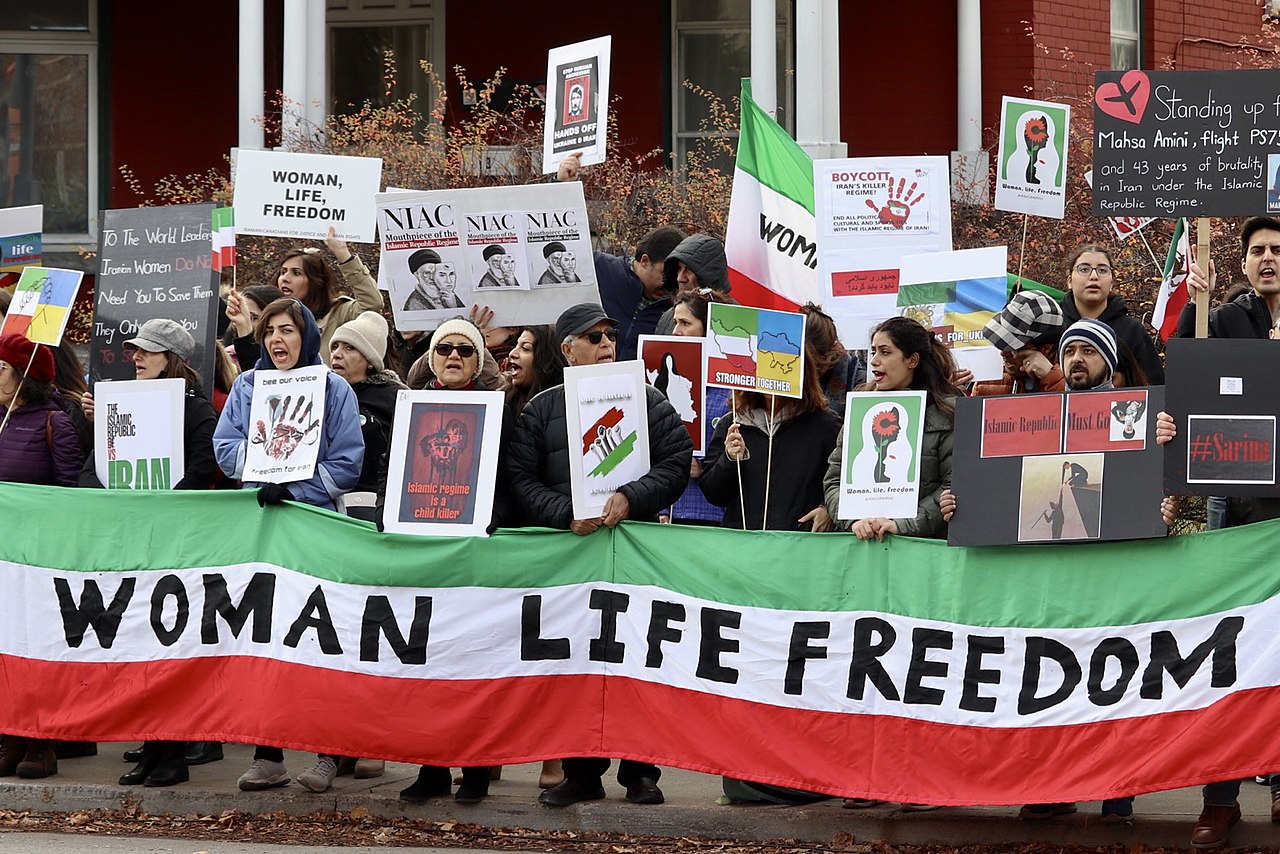
This challenge crystallizes in the slogan “Jin, Jiyan, Azadî” (Woman, Life, Freedom). This slogan is not a list of demands, but a vision of the world. It expresses an ontology that does not separate woman, life, and freedom from each other. Here, freedom is not a right granted by the state, but a condition derived from life itself. In this ontology, woman is positioned not as an object to be protected, but as a subject who reconstructs life. Therefore, “Jin, Jiyan, Azadî” is not just an oppositional slogan for the Iranian state; it is an existential threat.
The state’s reaction to this slogan clearly shows the magnitude of the threat. The state criminalizes, bans, and associates these three words with terrorism. Because this slogan boils down to debunking the state’s fundamental assumption: the idea that life can only be regulated through the state. Yet, this resistance practice led by women shows that life can be organized even without the state. Neighborhood solidarities, street networks, and horizontal relationships are the material counterparts of this practice.
At this point, it is insufficient to handle the issue of women’s freedom only at the level of “rights.” The women’s movement in Iran expresses much more than a liberal demand for equality. What is at stake here is the total rejection of the gendered structure of power.
Historically, the state has established itself as a male-dominated authority. The figures of father, leader, guide, and protector are symbols of this authority. The submissive and controlled position of women is the complementary element of this symbolic order. Women’s emancipation means the collapse of this order.
Therefore, the women’s resistance in Iran is directed not only at patriarchal norms but at the state itself. Women reject the state’s claim of “protection” and instead put forward the will to establish their own lives collectively. This will is not limited to classical political organization forms. It does not demand a party, a leader, or a central structure. On the contrary, it is distanced from such structures. This distance is a conscious anti-state reflex.
One of the areas where this reflex is strongest is again Rojhilat Kurdistan. Kurdish women have experienced both national oppression and patriarchal domination simultaneously and have produced a unique resistance politics from this experience. Women here are fighting not only against male dominance but also against the colonial character of the state. This dual struggle has made them the leading force of the general resistance in Iran.
The solidarity networks established by women in Rojhilat create areas where the state cannot intervene. These areas may not yet be called “autonomous regions.” But they are micro-spaces where non-state forms of relationship are effectively established. The state resorts to violence to disperse these areas. Because the expansion of these areas renders the state’s ontological claim meaningless. The state has to be everywhere. Because if its absence is accepted in one place, its absence everywhere becomes possible.
The depth of today’s rupture in Iran lies exactly here. The issue is not whether a regime can be reformed. The issue is that the state has begun to collapse along with its monopoly over life. Women have become the fundamental subjects accelerating this collapse. They are practically demonstrating that a life alternative to the state is possible. This practice has not yet turned into a comprehensive political program. However, it has already realized an ontological rupture.
It is not possible to take back this rupture. The state can increase the pressure, multiply arrests, and temporarily silence the streets. However, bodies no longer return to the old discipline regime. Fear has left its place to habit, and habit has left its place to indifference. The state’s orders are no longer perceived as internalized norms, but as external and alien impositions. When this perception changes, power effectively begins to dissolve.
The current process in Iran is the early stage of this dissolution. The state is still standing. But the bodies no longer belong to it. This rupture started by women is expanding by including men, youth, and different social segments. This expansion marks a transformation beyond classical revolutionary narratives. Here, the goal is not to seize power, but to eliminate power’s capacity to encircle society.
From here on, there are two paths for Iran. Either the state will try to suppress this rupture by intensifying violence and will re-establish control in the short term. Or this rupture will spread to different social areas and turn into an irreversible dissolution. The second possibility is still fragile. But it is no longer an abstract possibility. This breach opened through the bodies of women has reached the most protected area of the Iranian state.