Saturday, February 28, 2026

Workers Need More Paths to Join the Labor Movement
Source: Labor Notes

[This article is part of a Labor Notes roundtable series: How Can Unions Defend Worker Power Against Trump 2.0? We will be publishing more contributions here and in our magazine in the months ahead. Click here to read the rest of the series.]

It shouldn’t be so hard for workers to join a union. Nearly half of non-unionized workers in the U.S. say they would join a union if they could. Yet only 1 in 10 belongs to one, and that number continues to fall.

The main path to unionization, through a National Labor Relations Board election or the public sector equivalent, has long been broken and favors employers. While unionizing through the NLRB must remain a central strategy, alone it isn’t enough.

Imagine you’re a worker at Target who wants to organize, but none of the unions in your area is willing to support you. Unionizing Target isn’t part of their strategic plan, and organizing major retail outlets seems too difficult right now.

So you give up. You stop talking to your co-workers about organizing, because no one could offer you a way forward. This happens to thousands of motivated workers every year. The labor movement is losing potential leaders and organizers because it has no pathway for them to join and stay active.

If we want to build an organized working class capable of taking on the billionaires and defeating Trump-era policies like ICE’s reign of terror, we have to treat the labor movement more like a movement, one that brings more and more motivated people into its ranks.

Work has changed in fundamental ways, and people relate to it differently than previous generations did. Wages haven’t kept up with the cost of living. Automation means that workers must quickly learn new skills or change jobs. Increasingly concentrated corporate power and employer-friendly laws make winning union elections and first contracts difficult.

Our organizing strategies must account for the realities workers face today. We can win demands and advance material gains at work by putting direct, organized pressure on our bosses—not always relying on the NLRB election process or waiting for a contract before we start acting like a union.

We should create structures to support workers on this path when joining a union isn’t an option. This means focusing on developing more organizers and activists, which can grow the labor movement in the long term.

EWOC’S MODEL

The Emergency Workplace Organizing Committee, where we work, was created to support workers dealing with crises at their workplaces during the Covid-19 pandemic. It began as a group of volunteer organizers, many with decades of experience in the labor movement, offering one-on-one advice to workers seeking urgent support when they had nowhere else to turn.

The pandemic forced our organizers to respond quickly, creatively, and outside existing union structures at a time when workers could not afford to wait. Workers received organizing support and training whether or not their campaigns had a chance at recognition or certification. In hundreds of workplaces, they put direct pressure on their bosses and won demands like hazard pay, paid sick leave, and personal protective equipment.

EWOC’s lean and distributed model has endured beyond the pandemic. Workers kept reaching out to learn how to talk to co-workers, build organizing committees, and make demands. At any given time volunteers are supporting and training workers in hundreds of workplaces.

Over the years, EWOC has shown that workers and volunteers can organize and win even without the help of union staff—taking nearly 700 actions and winning over 250 demands on pay, safety, scheduling, and more. These wins spark excitement and renew a sense of possibility.

EWOC will back any organizing effort, in any industry, anywhere in the country. We have become part of the organizing ecosystem. In hundreds of cases, we’ve helped workers connect with unions to run union drives, including at Amazon-owned Whole Foods in Philadelphia, the National Cancer Institute, Grand Canyon National Park, and Austin’s Ascension Seton Medical Center.

INSIDE AND OUTSIDE THE NLRB

Each year, hundreds of campaigns end up in limbo even though workers are ready to unionize. Often employers manage to stall them out by challenging the bargaining unit size or firing key workers. Even when workers vote a union in, the boss has many tactics to slow momentum and avoid a first contract. Despite these well-recognized facts, the labor movement still relies almost exclusively on unionization through the NLRB.

There are also good reasons why unions say “no” to some new organizing campaigns and drop workers and organizing committees if they don’t pass certain tests. Unions understandably focus on organizing and fighting for the workers they already represent. But that doesn’t mean other workers shouldn’t be part of the labor movement. It just means unions aren’t currently in a position to support them.

That’s a problem our movement needs to solve if we want to increase unionization rates. To meet this moment, unions could play a critical role in building and supporting a coalition that experiments with non-NLRB strategies and gives workers in limbo the tools to build durable power.

The labor movement should be supporting pre-majority unions, workers who act like a union without one, and direct-join unions that unite workers across an industry rather than a single workplace. These workers will need resources like dues systems, steward networks, communications tools, informal bargaining resources, and democratic practices that enable campaigns to survive and grow.

And when workers are ready, labor should be providing support so campaigns can affiliate with existing unions, form their own independent unions, or formalize other long-term structures.

By experimenting with new models of non-NLRB organizing, the labor movement can also sharpen tactics to bargain over issues that the NLRA doesn’t compel employers to address—demands that make life better for all workers, their wider communities, and the world. This will strengthen us to confront the multiple crises of democracy, from authoritarianism to climate disaster to ICE terror.

RISK VS. REWARD

Even with robust support, non-NLRB organizing will remain challenging. Risky tactics like recognition strikes expose organizations to potential liabilities. When workers risk their jobs or paychecks, sustained participation may be difficult to impossible without significant external support. And there’s a steep learning curve, since these strategies are widely misunderstood or completely unfamiliar to workers.

While it’s essential for unions to take on strategic targets, the labor movement must be capable of pursuing multiple organizing priorities at the same time. Many EWOC campaigns will eventually bolster major strategic fights, and others won’t—yet all of them expand capacity, leadership, and confidence across the movement.

When bosses fear worker organization because workers have built real, durable power, contracts become easier to win, and many demands can be secured without the NLRB. The future of organizing demands a movement that can take risks, cultivate and multiply worker leadership, and experiment with new pathways to recognition.

To succeed in this political moment and meet what comes next, we must build a new coalition of unions, workers, and volunteers who are ready to experiment with new and old models, learn from mistakes, teach others the lessons, and try again and again, until we win.Email

Roz Hunter is an organizer with the Emergency Workplace Organizing Committee (EWOC).


How Union Members Pay It Forward

Source: Originally published by Z. Feel free to share widely.

Anna Bueker went to work at the BFGoodrich plant in Fort Wayne, Indiana, in her early 20s and began building a good life with the wages and benefits provided by her United Steelworkers (USW) contract.

But over the next several years, as she navigated divorce and life as a single mom, that contract took on even greater importance.

It delivered the resources she needed to feed and care for her child. It enabled her to keep a roof over their heads. And it provided stability during a tumultuous time.

That gratitude not only stayed with her but also fueled her efforts to help about 280 workers at Canpack in nearby Muncie, Indiana, as they mounted their own union drive and voted to join the USW in late 2025.

Many more workers need the USW as much as she still does, figured Bueker, a steward with Local 715L, one of a growing number of activists across the country who draw strength from their unions and then use it to empower others.

“Being part of a union and having a good union job put me on a path that I don’t think a lot of single women have available to them,” she said, noting that even as her life changed radically, her lifestyle didn’t.

“That’s something I really held on to,” said Bueker, a materials handler and tire builder at BFGoodrich.

More and more workers want to join unions amid the high grocery pricesspiraling health care costs and other failures of today’s uncertain economy.

Bueker and other union members, grateful for all they won and passionate about seeing others get ahead, stand ready to help them over the finish line.

After all, no one understands workers as well as those who walk in the same boots. No one grasps the life-changing gains of a contract like workers already lifted up by them. No one knows the power of solidarity better than union members who wield it every day.

“I could help other workers? Man, that sounds awesome,” Bueker recalled thinking before volunteering to help her peers at Canpack, who make aluminum beverage cans for a conglomerate based in Poland.

“I think it helps a lot of people to know I also work in manufacturing day in and day out. I know exactly what it’s like to be on that floor and to feel like I’m just a number to management,” said Bueker, who wrote postcards to workers at Canpack, called to check in with them and provided other support in the run-up to the successful union vote in 2025.

These kinds of connections—and the willingness of activists like Bueker to share their personal stories—helped thousands of other workers decide to join unions in recent years.

Among other examples, USW Local 650 members at the Bobcat plant in Gwinner, North Dakota, helped colleagues at other company locations join the union. USW Local 572 members at Graphic Packaging in Macon, Georgia, assisted 1,400 workers at the nearby Blue Bird bus manufacturing company with their successful effort to join the USW in 2023.

And USW Local 8888 members, who make nuclear-powered aircraft carriers and submarines for the Navy in Newport News, Virginia, are helping a group of city workers there in the midst of a union drive.

While workers seek decent wages, safer working conditions and retirement security, they also crave the bond that union members share and the seat at the table that a contract provides, observed Bueker.

“You have the opportunity to change your workplace for the better,” she told the workers at Canpack.

“I think people really appreciate being empowered,” she said, pointing out that unions force employers to share control. “Management doesn’t get all of it anymore. Now, we all have a say, and we’re not under the thumb of management anymore.”

Rick Hines, who started work at Canpack before production at the plant even began three years ago, said workers talked about unionizing right from the start.

Their quest to ensure a level playing field for all and to hold management accountable ultimately led to the union drive in 2025, said Hines, whose cousin is a USW member at another Indiana workplace.

“Everyone wants fairness across the board,” he said.

Hines described the support and guidance of the USW representatives as “spot on,” noting they explained how their contract delivers a middle-class life and how collective action creates the kinds of opportunities that workers never had before.

“Anything can happen through bargaining,” observed Hines, recalling how helpful it was to hear directly from other manufacturing workers. “Things are going to change. It’s not going to be just Canpack’s way anymore.”

Just as important, the USW activists demonstrated an empathy and solidarity that not only impressed Hines but also cemented his decision to vote for the union.

“This is the family I want to be around,” he said.

Bueker feels the same way. While still serving as a 715L steward and mentor, she plans to continue stepping up for other workers who seek help forming a union.

“I just love that kind of work,” she said. “Whatever needs to be done, I will do it.”


This article was produced by the Independent Media Institute.Email

David McCall is the international president of the United Steelworkers Union (USW).

Basis of Class Struggle Must be Recognized by Working People

Source: Originally published by Z. Feel free to share widely.

Distractions

Currently working people are inveterately distracted with attacks on the Constitution by MAGA gangsters, thugs, and reprobates. 

Another distraction is the heinous protection of the international cabal of rich men guilty of exploiting young girls in the Epstein criminal network.

A third distraction is indoctrinating working people into supporting a glutted military budget while cutting programs for working people.

General Dwight D. Eisenhauer warned working people in 1961 of the dangers of the “military-industrial complex.” 

It results in violations of international laws to protect corporate profits in foreign countries like Venezuela; that includes the murder of innocent civilians in cruising boats.

However, a not so obvious din of these distractions is designed to numb Americans from zeroing in on the foundation of their chronic economic adversity and anxiety.

That foundation is the wage and salary construct of our economic model.

Economic Model Decline

The symptoms of the decline of our economic model are well documented.

The Ludwig Institute of Shared Economic Prosperity (LISEP) reported a functional unemployment rate in Nov. 2025 of 24.8 percent. LISEP reported a real inflation rate of 9.4 percent.

Asset Limited, Income Constrained, Employed, (ALICE) reported that 42 percent of households in the U.S. were below the ALICE threshold of poverty.

The underemployment rate reported by the Burning Glass Institute in February 2024 was 52 percent for college graduates.

These are chronic symptoms of an economic model that cannot provide an equitable and moral distribution of employment opportunities. If you harbor the belief that anyone here can become rich or wealthy, think again.

Progressives recognize that the Republican Party has devolved into a fascist cult. The evidence is Project 2025 and screams daily that our government is being replaced by rich, con artists inside the Trump administration swamp.

However, polls do suggest that working people are becoming more aware that our economic model is failing them.

Regrettably, this increasing discontent stops at addressing the symptoms rather than the cause cemented into our economic model. 

Many progressive politicians, scholars, academics, and journalists go to the water’s edge of the cause, but cravenly avoid a discussion of that cause.

Upton Sinclair’s assertion in 1935 is applicable:

“It is difficult to get a man to understand something, when his salary depends on his not understanding it.”

— Upton Sinclair (“I, Candidate for Governor: And How I Got Licked”) 

Root Cause

The root cause of unemployment, underemployment and inflation is the wage and salary component of our economic model. To understand how that model is inherently exploitative and inequitable, the basics must be understood.

The following is a simplified example on that process:

The primary purpose of our economy is to return a private profit to the business owner.

There are two types of investment that the business owner must spend.

First is expenditures on space, plant, machinery, tools, hardware, software, technological advances, and raw materials. This includes legal registrations, licenses, permits, and financial services. Often, the business owner inherits the business so this expenditure may be minimized. 

Next, the business owner must purchase the physical or mental efforts of the employees. It is realized in the form of wages and salaries. 

The employees create the products or services that the business owner sells in the market. In spite of the delusions of many business owners, no business owner creates those products or services alone. It is a social process.

If the business owner paid the employees the salary and wages equal to the value of the products or services created by them, there would be no profit.

Hence, there would be no reason to continue the business. Moreover, the business owner must compete with other business owners to sell as much as possible and minimize costs. Parenthetically, layoffs and recessions crushing working people are the usual remedy for the business owner. 

Specific Example

The business owner must sell the products or services created by the employees at a price above the amount spent on wages and salaries.

In this example, a male employee works a typical nine to five workday. 

In that workday, the employee works for wages or a salary that will allow him to maintain himself or his family. 

However, inside that workday is the key to the exploitation and moral flaw in this economic process. It appears that the employee is being paid for working a full day, but that is not the case.

The business owner must calculate the amount paid to the employee based on how much is required for a private profit.

The employee is working some hours to provide a profit for the owner and some hours to maintain himself or his family.

In this example, in one workday the business owner pays $50 an hour for all the initial expenditures listed above to create one product. 

The employee must be paid to create the product or service. By an arbitrary calculation of the business owner, it is $10 an hour. 

The business owner must sell the product or service in the market by charging an amount above what has been spent already to produce it. It was created for $50 plus $10 which equals $60.

However, the business owner must sell the product or service for $70 each to obtain a profit of $10. The “new” value of the product or service is $70, yet it cost $60 to create.

If the employee created a product or service that is worth $70, it is inescapable that the employee is not being compensated for the value that he created. This is basic exploitation of unpaid labor and in most spiritual belief systems-immoral.

Perceptive Voices

Pope John XXIII wrote on this subject:

“We therefore consider it our duty to reaffirm that the remuneration of work is not something that can be left to the laws of the marketplace; nor should it be a decision left to the will of the more powerful. It must be determined in accordance with justice and equity; which means that workers must be paid a wage which allows them to live a truly human life and to fulfill their family obligations in a worthy manner.” Mater et Magistra May 15, 1961

Martin Luther King commented on this moral flaw:

“We are saying that something is wrong … with capitalism…. There must be better distribution of wealth and maybe America must move toward a democratic socialism. Call it what you may, call it democracy, or call it democratic socialism, but there must be a better distribution of wealth within this country for all of God’s children”-1966

Malcolm X, American Muslim leader, spoke at one of his speeches at the Audubon Ballroom in New York City in 1964:

“You show me a capitalist, and I’ll show you a bloodsucker.”

Consequences

The inherent exploitation of our economic model begins at the wage and salary level. From there we organize, produce, transport and distribute goods and services. Private profit for the business owner supersedes all other values. 

In the U.S. we have seen the values of community, family, and social sentiment diminished. Those values are overwhelmed by a tsunami of advertising urging working people into a conspicuous consumption of material items whether needed or not.

Simultaneously is the harsh economic reality for working people. The basic opportunities for a contented lifestyle are decreasing. Those opportunities are quality and affordable healthcare, smart and accessible education, safe and comfortable housing, healthy nutrition, and a clean environment. 

This dilemma can be addressed by providing the material opportunities above with policies formed by the best of spiritual and secular values.

That can only be realized by a transition to an economic model based on realistic democratic principles and collective profits.

Otherwise, the present economic immiseration and despair will continue to transform working people into a morass of fear and hatred seeking scapegoats to blame. They will become an alienated, vapid mass of untethered individuals at the mercy of the soulless, and parasitic oligarchs who live off the products and services of their labor. 

Bruce T. Boccardy: Consultant, Allston Brighton Community Development Corporation; economics/labor advisor for Small Planet Institute; former president, Massachusetts Service Employees International Local 888, Public Sector Division: former labor representative, Massachusetts Joint Labor-Management Committee, former consultant for National Association of Government Employees


Email

A Parent’s Eye View of an Educator’s Strike

Source: The New Liberator

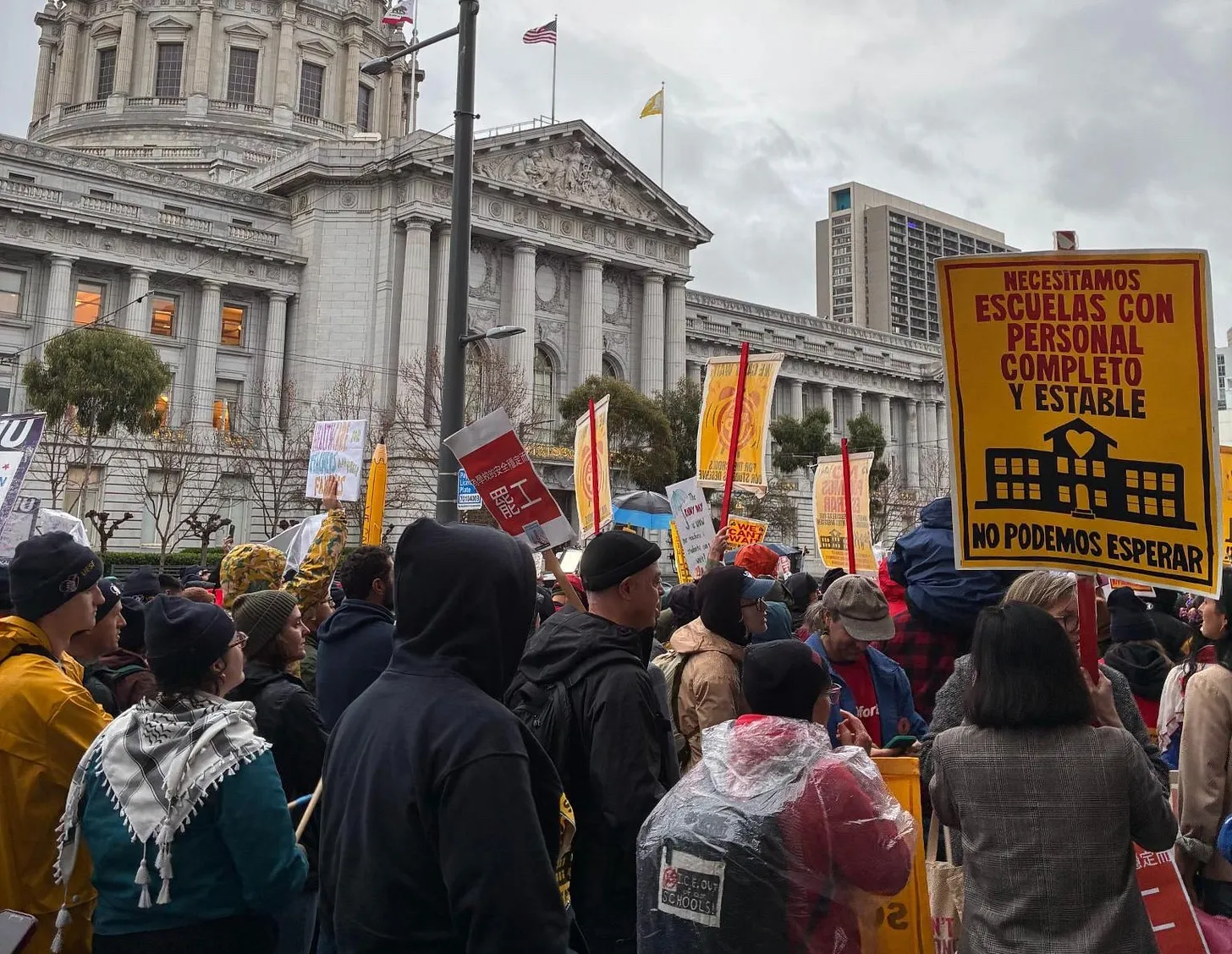
On Thursday, February 12, the United Educators of San Francisco (UESF), representing 6,500 teachers, paraeducators, counselors, nurses, and school psychologists, declared victory after a four-day strike, the first one in 47 years.

After 11 months of bargaining, the union not only won important economic demands, including wage increases and fully funded health care. It also won demands for “the common good,” which helped to mobilize parents, students, city officials, small businesses, and community members across the city and beyond. The new contract includes sanctuary protections for students and educators, by :

  • Formally designating school campuses as sanctuary spaces.
  • Prohibiting cooperation with ICE without a criminal judicial warrant.
  • Requiring sanctuary policy training for all staff.
  • Guaranteeing newcomer students and families access to legal, housing, health, employment, and food security resources.
  • Limiting immigration status inquiries to what is strictly required by law.

UESF also won an extension of the “Stay Over Program” which allows unhoused families to stay overnight at school campuses throughout the city.

In addition, the union negotiated protections from the effects of artificial intelligence. The district is prohibited from using AI to replace union members or their work or to increase educator workloads; nor can it use AI for staff evaluations.

Solidarity made visible

The energy over the course of the four days the union was on strike was contagious and affected everyone. You couldn’t go anywhere in the city without hearing the singing, music, drumming, and noise on the picket lines—including from all the commuters, bus drivers, commercial truckers and others, continuously honking in support of the striking workers.

As a parent of a public school student, I saw and felt the solidarity—kids baking to feed and support their teachers and administrators on the picket lines; community groups organizing alternative childcare programs for the younger kids at urban farms and gardens; artists screenprinting signs and t-shirts at community print shops, and all the usual support for people on strike coming from members of other unions, as well as nonunion staff at schools, parents, and workers throughout the city.

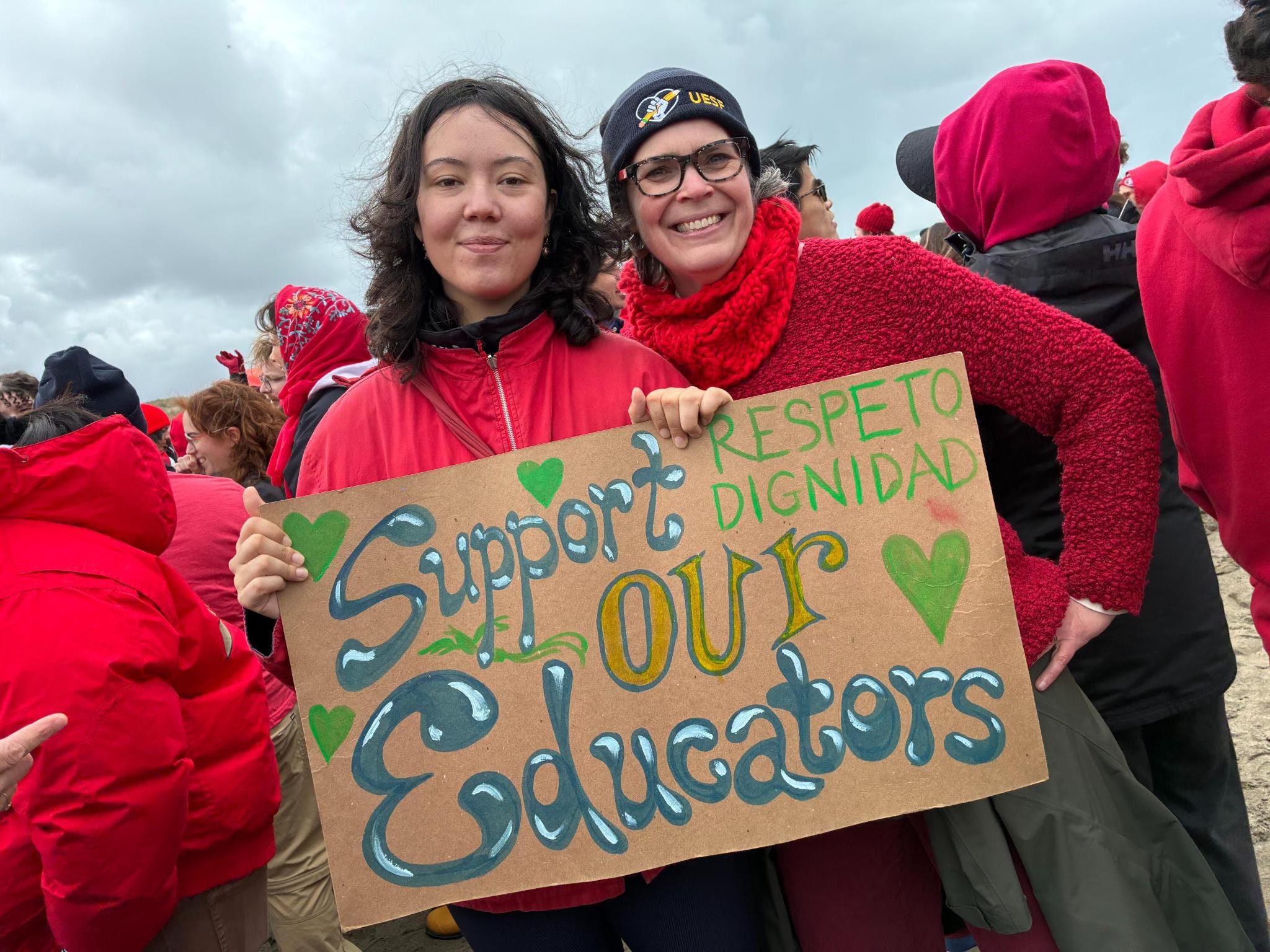
The union’s organizing power inspired political activism by many students in the city. Just a few weeks earlier, students had organized a joyful school walkout, in defense of immigrants and in solidarity with the people of Minneapolis and all those impacted by ICE terror across the country. Now, students showed solidarity with the striking educators. My 17-year-old son’s school, the only public arts high school in the city, was particularly ebullient, with the school’s drummers and dancers taking over the street, sidewalks, and medians. Children and their parents brought their own handmade signs and banners to picket lines at over 100 schools, adding to the joyful feel.

Photo by Tara Siegel

Collective power forces the district to prioritize students and educators

From what I could see, the union leadership and members were unified (97.6% had voted yes to authorizing a strike) and incredibly resilient through what was clearly a very frustrating process with the Superintendent and Board of Education. Adding to the frustration was a millionaire mayor (not just one or two but hundreds of millions of dollars from the Levi fortune) who has little understanding and even less interest in how the issues leading to the strike impact governance in a state where public education has been eviscerated by austerity, privatization, and disinvestment, as well as ongoing attacks on the Ethnic Studies curriculum.

In a historic act of solidarity, the city’s two other school unions joined the picket lines in sympathy strikes: SEIU 1021, representing some of the district’s lowest-paid workers, including 1,000 custodians, food service workers, and clerks, as well as the union representing 250 principals and supervisors. The solidarity strike ensured a total work stoppage, forcing the closure of all San Francisco public schools. Meanwhile, the school district unnecessarily spent funds to get part-time contractors, including some paraeducators and noon-monitors, to cross the picket line into empty schools—and face the shouts of “scab” from the strike supporters.

After joining a few morning pickets throughout the week, I took a mid-day work break on Wednesday, day three of the strike. I rode my bike to join the human banner at Ocean Beach, standing with striking educators from my kid’s old middle school. (These human banners are becoming more and more common here in SF—recent ones include “NO KINGS, YES ON PROP 50,” “ABOLISH ICE,” and “IT WAS MURDER: ICE OUT.”)

The next day, Thursday, February 12, UESF announced a tentative two-year agreement covering 100% employer paid family health care benefits, special education workloads, improved wages, and sanctuary and housing protections for families in the district’s schools.

It was inspiring as a parent to see how the union’s broad and deep organizing, for public education and for the common good, led to victories for educators, students, immigrant families, and community members–the city as a whole. In UESF’s words:

This historic strike built an unbreakable solidarity across our city, among families, students, educators and community…At a time when there are ongoing attacks on our profession and our communities, we stood strong in the face of adversity because our students deserve sanctuary schools, shelter in times of crisis, and classrooms staffed with trusted and committed educators who can stay.

Here’s to worker power and organizing for the common good that gets the goods!Email

Michelle Foy is a parent, member of Liberation Road, and through her day job and other organizational hats, is deeply involved in movement operations work to support power building for working class communities of color in California and beyond.