From Toledo, Ohio to Rome, Italy: BDS and Grassroots Solidarity Defy the IHRA Smear and Israel’s Genocide
February 27, 2026
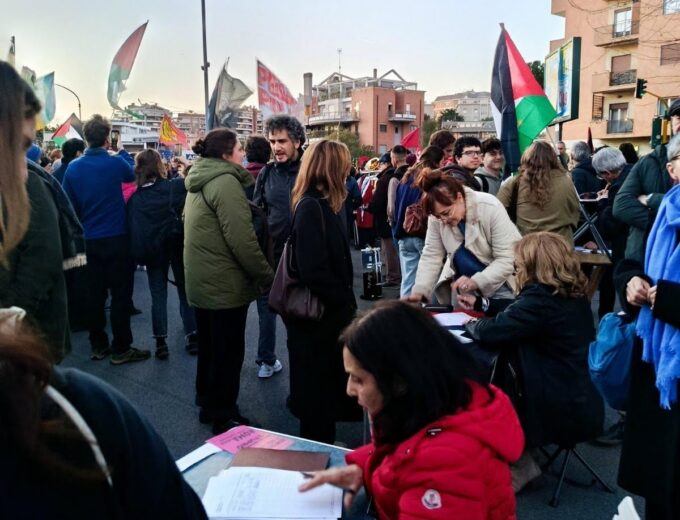
Photograph by Assopace Palestina
Two cities on opposite sides of the Atlantic—Toledo, Ohio, my hometown, and Rome, the ancient capital of Italy—are rising together in defiance of the same machinery of repression. In both places, local movements are demanding an end to all ties with apartheid Israel, while their respective governments—Ohio’s state legislature and Italy’s national government under Giorgia Meloni—are rushing to codify the controversial IHRA definition of antisemitism into law. This definition, pushed aggressively by pro-Israel lobbies, deliberately equates legitimate criticism of Zionism and Israel’s settler-colonial project with Jew-hatred. The result is a global campaign to criminalize solidarity with Palestine, silence BDS, and shield Israel’s ongoing genocide from accountability. From the banks of the Maumee River to the banks of the Tiber, ordinary people are refusing to be silenced.
The IHRA “working definition,” adopted in 2016 as a non-legally binding tool by the International Holocaust Remembrance Alliance, was never meant to be law. Drafted by Kenneth Stern under the auspices of the American Jewish Committee and the European Monitoring Centre on Racism and Xenophobia in the early 2000s, it defines antisemitism as “a certain perception of Jews, which may be expressed as hatred toward Jews.” However, its 11 examples—particularly those relating to Israel—have been weaponized by Zionist forces to stifle dissent. Examples include “denying the Jewish people their right to self-determination” (e.g., calling Israel a racist endeavor) or “applying double standards” to Israel. Stern himself has warned that it’s being abused to chill free speech, as pro-Israel groups use it to attack academics, activists, and even Jewish critics of Israel. Human Rights Watch, Amnesty International, and Jewish groups like Jewish Voice for Peace have condemned it as a tool for suppressing Palestinian rights advocacy, conflating anti-Zionism with antisemitism to delegitimize calls for justice.
In Italy, Meloni’s far-right government is advancing a bill that adopts an extreme interpretation of the IHRA definition, criminalizing criticism of Israel’s apartheid system and BDS campaigns with fines, prison time, and loss of public funding. In Ohio, Senate Bill 87 seeks to codify a nearly identical definition into state law for use in investigations and ethnic intimidation cases. Both moves are part of the same transnational effort to protect Israel from scrutiny while Gaza is starved and bombed. The message is clear: you may not call genocide by its name, you may not boycott the occupier, and you may not demand justice for Palestinians.
Yet the people are pushing back. In Rome, the committee “Roma sa da che parte stare” (Rome knows which side to take) has launched a citizens’ initiative petition to the City Council, calling for the immediate severance of all institutional, economic, and cultural ties between Roma Capitale and Israeli entities implicated in violations of international law and human rights in the Occupied Palestinian Territory and within Israel. The campaign specifically targets partnerships with companies such as TEVA, the Israeli pharmaceutical giant whose operations are intertwined with the occupation economy, and urges the city to suspend contracts, sponsorships, sister-city agreements, and any other forms of collaboration until the genocide ends and Palestinian rights are upheld. Comprising around twenty organizations united in the struggle for justice, an end to the occupation, and freedom for the Palestinian people, the committee insists that Rome must refuse complicity in Israel’s crimes. Elisabetta Valento of AssoPacePalestina, a key member of the committee, captures the moral clarity driving the campaign: “The committee ‘Roma sa da che parte stare’ presented a proposal for a popular initiative to the City Council of Rome, calling for the termination of collaborations between Roma Capitale and its subsidiaries with Israeli entities due to violations of international law and human rights in the Occupied Palestinian Territory and in Israel.” This citizens’ initiative stands as a bold, unflinching rejection of institutional complicity and a powerful assertion that the Eternal City will not remain silent or neutral while genocide continues.
In Toledo, a determined local campaign is pressing Lucas County to divest from Israeli bonds, refusing to let public money finance apartheid. An advisory committee has already voted to halt future investments, and activists continue to mobilize despite opposition from pro-Israel lobbies. Local activist attorney Terry Lodge, known in activist circles as “the professor,” is at the forefront of the statewide effort. “The Israel lobby’s days are numbered,” Lodge declares. He sharply criticizes Ohio’s Zionist lame duck attorney-general for sending threat letters to county councils, warning that divesting from bonds constitutes a “boycott” and that once purchased, counties can never leave — a “Hotel California” trap. Lodge exposes the hypocrisy of a provision snuck into the 3,100-page state budget bill that forbids local governments from making investment decisions with the primary purpose of influencing any environmental, social, personal, or ideological policy. “The cartoonish hypocrisy of ramming a law through the system with no public visibility, no public hearing and no debate to supposedly outlaw politics from investment decisions isn’t lost on anyone,” he says. Yet Lodge remains optimistic: if the committee maintains its majority, when $5 million in Israel Bonds matures in November, “investing in genocide will be over in Lucas County. And it will have been caused by a smart, diverse and exciting movement acting locally while thinking globally.”
Local Toledo activist Afaf Adwan, who originates from Gaza, embodies the clarity and urgency driving these movements. “It is important that the economic ties to Israel are exposed throughout the country and that these ties are broken,” she declared. “Through Boycotting, Divestment and Sanctioning of Israel we can truly and effectively stop them from continuing the genocide of the Palestinian people and stop their violation of International laws from the West Bank to Gaza.”
The parallels are striking. In both places, grassroots movements rooted in labor, student, faith communities, and immigrant voices are confronting the same IHRA weapon and the same demand for divestment. They understand what the powerful refuse to admit: supporting Israel today means supporting genocide, ethnic cleansing, and apartheid. These are not abstract gestures; they are concrete acts of solidarity from two cities that refuse to be complicit.
This is the real internationalism of our time—people-to-people solidarity that cuts through empire’s divide-and-rule tactics. From the river to the sea, from the Maumee to the Tiber, the struggle for Palestinian liberation is one struggle. The IHRA smear will not stop it. The bans and smears and bond investments will not stop it. The people are rising, and history is on their side.
Free Palestine. Divest from apartheid. Dismantle and block the IHRA criminalization of solidarity. From Toledo to Rome—and everywhere in between—the solidarity will not be silenced.
Michael Leonardi lives in Italy and can be reached at michaeleleonardi@gmail.com
New Tools Aim To Stop Tourism Industry’s Complicity With Genocide
Two new digital tools have been released for the sole aim of stopping the tourism industry’s complicity with Israeli apartheid and war crimes against Palestinians.
The coalition of Palestinian groups calling for Boycott, Divestment, Sanctions (BDS) against Israel began its “No Room for Genocide” campaign in 2025. And now, it has released new tools to support this, including:
- A website for “B&B, hostel, or hotel” hosts to make their accommodation “a Sanctuary of Peace”.
- An Action Network petition for tourists to promise they will stop using Booking.com and Airbnb, which have profited from Israel’s crimes against humanity.
The BDS movement says many have already supported the No Room for Genocide campaign. But it wants even more people in the tourist industry to push government’s to fulfil their obligation under international law by ending “all forms of complicity” in Israel’s crimes.
Explaining its targeting of Booking.com and Airbnb, the campaign said:
Digital travel companies and aggregators, especially @bookingcom and @Airbnb , are complicit in Israel’s apartheid and ethnic cleansing of Indigenous Palestinian communities. They list illegal settlement properties built on stolen Palestinian land, a war crime under international law, as Israeli rentals on their sites.
No Room for Genocide!
The No Room for Genocide campaign, the BDS website explains, is:
calling on global civil society to pressure governments to amend immigration and visa policies to align with international legal standards and obligations… International law is clear on legal obligations of Third States to end all forms of complicity in the commission of Israel’s war crimes, crimes against humanity (including apartheid), and “plausible” genocide.
These include the responsibility to ensure war criminals are denied passage or haven by Third States and prosecuted for their crimes.
There is an overwhelming consensus among ethical experts that Israel has been committing genocide in Gaza. As the Canary has documented in detail:
Genocide scholars, human rights groups, and ethical legal experts agree that Israel is committing genocide against the Palestinian people in Gaza.
The BDS campaign laments, however, that the response of many governments has been woefully insufficient. And that’s why it has been calling for action from ordinary people:
Countering the wilful negligence of states in upholding this responsibility and responding to the Palestinian civil society call to ensure there is No Room for Genocide, small businesses in the hospitality and tourism sector as well as solidarity groups are taking courageous actions. To amplify this campaign and support hospitality business owners, ethical tourism movements and solidarity groups in taking effective action, read and share this campaign toolkit.