Saturday, February 28, 2026


(Video) Ukraine’s anti-imperialist struggle (plus statements on anniversary of Russia’ invasion)


For twelve years, Ukraine has been fighting for its independence against imperial aggression. For most of this period, the conflict has been in a hybrid form, and exactly four years ago it took on the appearance of an open war, unleashed by the Russian army shelling almost all Ukrainian border towns and launching hundreds of missiles at military and civilian infrastructure. Ukraine has chosen a difficult path to defend its freedom, which it is pursuing.

Over the years, it has become clear that this is neither a “conflict” nor a “misunderstanding,” but a targeted war of aggression aimed at destroying the Ukrainian state and establishing a puppet government. The Ukrainian army has been able to stop Putin’s blitzkrieg and prove its ability to resist the imperialist invasion. Behind this success lies the exploit of the working masses, who have often felt marginalized in their own countries, but who have in reality become the pillar of the army. At the same time, we owe our survival to the help of people from all over the world, who have made us aware of the extraordinary power of solidarity.

The present state of the war is determined by its prolonged and exhausting nature. Russia is waging a war of extermination, systematically committing war crimes: torture, deportations, abduction of children, targeted bombing of residential areas, hospitals, schools, energy infrastructure and transport. These are not side effects, but a deliberate strategy of terror, as the Russian army is unable to defeat the Armed Forces of Ukraine on the battlefield. Despite extreme fatigue and a lack of manpower, Ukrainian soldiers are repelling the occupiers’ offensive and, in places, counterattacking. But the invaders’ approach to cities like Zaporizhzhia can only be worrying. Unfortunately, the Kremlin still has far superior long-range strike capabilities, which it uses constantly.

At the same time, the war has profoundly affected the social sphere and civil society. The severe shortage of housing and decent jobs is accompanied by ineffective social protection. Millions of people, especially in frontline regions, suffer from inequality and social precariousness. Awareness of the profound shortcomings of the state’s social policy has sparked a surge of solidarity: solidarity initiatives have emerged, trade unions have mobilised and other social movements have taken on a significant part of the support for society. The energy of the mobilizations is focused not only on humanitarian aid, but also on conflicts with a strong social dimension that reveal the failures of the system.

In our quest for a quick victory for Ukraine, we take a critical look at the liberal market policies pursued by the ruling elite. The desire to immediately maximize corporate profits harms Ukraine’s strategic interests, which demand modernizing its industry, ensuring full employment and uniting society. Encouraging imports, deregulation and the free movement of capital will not build a sustainable economic system that can give an advantage over the occupiers.

The enemy has been and will be cruel, but the greatest risk for Ukraine is to renounce justice, as this will breed discord and despair. Peripheral capitalism, mired in corruption, produces injustice on a large scale. It allows selfishness to flourish and businesses to grow, but it does not create any common protection for all. Imposing controversial reforms like Ukraine’s new labor code will amplify the scale of social inequality, but will not bring stability.

We aspire to unity, but we refuse to condone the mistakes of the authorities. This is where our spirit of freedom and our difference with Russia are manifested. Ukrainian society has not disappeared in the face of the prevailing anxiety; It continues to act and defend democracy and its independence.

Ukraine is not only fighting for its territory, but also for the right to be a space of freedom, diversity and confrontation of ideas, and not an authoritarian dictatorship. People of diverse opinions, including representatives of the left-wing movement, participated in this fight. Among the dead are artist David Chychkan, anarchist Dmytro Petro, anarchist Lana “Sati” Chornohorska, Yevheniy Osievskyi, and many other heroes and heroines of the Ukrainian and international anti-authoritarian movement. The Sotsialnyi Rukh is also not indifferent to our history: some of us have been serving in the Armed Forces of Ukraine since the first days of the invasion, and every year more and more of our activists join it. Being part of the Armed Forces of Ukraine means being close to the people, whose social liberation we are working for.

At the international level, this conflict has long since transcended national borders and does not concern us alone. Around the world, reactions to the events in Ukraine are distinguishing between progressive and internationalist movements and anti-democratic and isolationist movements. Because it is above all a question of protecting universal values, namely the right to individual freedom.

If Ukraine is forced to capitulate or is defeated, it will not mean peace, but the legitimization of a forced change of borders. This will pave the way for further aggression and bring the world closer to a world war that could claim billions of lives across the globe.

We have no confidence in individuals like Donald Trump, who flout international law. That is why we see his peace initiatives first and foremost as an attempt to abandon Ukraine to its fate. The time has come to restore the balance of power in Ukraine’s favour, by demanding that Western countries hand over their military arsenals and impose sanctions on Russia.

The Kremlin will not stop its violence against the Ukrainian people until it has suffered a significant defeat. It is the duty of humanists around the world to help Ukraine complete what it has started and defeat the invader.

Ukrainian workers have paid too high a price to return to the same social injustice in post-war Ukraine that prevailed before. It is not the oligarchs, nor their neoliberal politicians in their pay, nor the economic elites, but the workers who have taken up arms to defend Ukraine. For these people, the state must serve their interests!

Glory to the hard-working and steadfast Ukrainian people, to their defenders!

Glory to international solidarity against imperialism!

Eternal glory to our brothers and sisters who died at the hands of Russian forces!


Posle Editorial Collective (Russia): Statement on the fourth anniversary of the war

February 24

The fourth anniversary of Russia’s full-scale invasion of Ukraine is being marked by the most intense and destructive shelling of Ukrainian cities since the war began. Over 1.2 million households have been left without heat or power in the harsh winter, and hundreds of thousands of people have been forced to endure inhumane conditions. Ukrainian retaliatory strikes have, in turn, led to widespread power outages and heating disruptions in Belgorod. Meanwhile, Russian casualties have reached the highest level since the beginning of the war, despite the Russian army advancing only around 15 meters per day. According to Mediazona’s estimates, at least 200,186 Russian soldiers have been killed since February 24, 2022. This count includes only those whose names have been confirmed; the real toll is likely far higher. Nevertheless, there is little reason to believe that these or even greater losses will weaken the Putin regime’s resolve to continue the war.

On the one hand, after four years in which Putinism has hardened into a totalitarian dictatorship, war has become the regime’s only viable mode of existence. It legitimizes the concentration of power and repression, and it binds the elite more tightly to the dictator. More importantly, however, the regime lacks a coherent vision for the country’s future once the war ends and thousands of traumatized, battle-hardened contract soldiers return home — men whose previous high pay and social standing the state will no longer be able to sustain. This looming challenge is one the authorities seem to fear as much as military defeat.

At the same time, the Kremlin sees the growing divide between the EU and the United States, as well as the Trump administration’s willingness to strike a bilateral deal, as an opportunity to achieve the “goals of the special military operation.” When Russian troops invaded Ukraine in February 2022, the global response was unequivocal: this was an unjustifiable war of aggression, and Ukraine’s resistance was grounded not only in international law but also in basic principles of morality and justice — ideas humanity seemed to have internalized after the Second World War. Four years of bloodshed, however, have brought not only the deaths of hundreds of thousands but also a broader moral shift. Talks initiated by the Trump’s administration treat the war as “senseless” on both sides — something to be brought to an end not by reaffirming international law, but by establishing a new balance of power. In this worldview, there are no victims or aggressors, no right or wrong — only the strong and the weak, with “balance” secured through concessions by the latter.

This moral shift in global public opinion may be Putin’s most significant achievement to date. If it becomes the new consensus, it will almost certainly pave the way for new, more destructive wars fueled by the redrawing of smaller states’ borders and the reassertion of control by great powers over their former colonies. This is why any genuine anti-war movement today must stand firmly and unreservedly with the victims of aggression. This is no longer just about defending Ukraine’s right to independence; it is the only credible way to stop the world from being pulled into a spiral of escalating conflicts.


Ukraine Solidarity Network (US): Ukraine still stands

February 23

As Russia’s full-scale war on Ukraine enters its fifth year on February 24, the Ukraine Solidarity Network (US) calls on progressive and peace-minded people to renew their moral, political, and material support for the people of Ukraine in their resistance to Russia’s invasion and their rights to self-defense and self-determination.

We must remember Ukraine even as we struggle against so many other outrages that rightly demand our attention: the US-backed genocide in Gaza, US military strikes on Venezuela, Iran, Iraq, Syria, Yemen, Somalia, Nigeria, and small civilian boats in the Caribbean Sea and Pacific Ocean, and the Trump administration’s assault on immigrants, health, the environment, and social and democratic rights.

Massive casualties

Russia’s war of aggression has been as deadly as any war in the world over the last four years. Since Russia’s full-scale invasion began on February 24, 2022, battlefield casualties (killed, wounded, missing) reached an estimated 1.8 million by the end of 2025, including 1.2 million Russians and 600,000 Ukrainians. The battlefield death toll alone is estimated at around 460,000 combatants – 325,000 Russians and 140,000 Ukrainians.

In addition to battlefield casualties, civilian casualties in Ukraine have reached over 53,000, including over 14,500 killed. The civilian death rate in Ukraine rose 31% in 2025 as Russia escalated its terrorist tactics of targeting civilian homes and energy infrastructure far from frontline battlefields with missile and drone strikes.

Russia’s constant offensives on the frontlines have been sending Russian soldiers to their deaths at a rate of 1,000 or more a day for the last two years. At around 30,000 per month, twice as many Russian soldiers are dying in Ukraine every month as the nearly 15,000 who died in all of Russia’s 10-year war in Afghanistan in the 1980s.

The horrors in Ukraine join the horrors of other wars and associated hunger and disease ravaging our planet over the last four years in Palestine, Sudan, Myanmar, and the Democratic Republic of the Congo. People struggling for peace and democracy in all of these countries deserve our active solidarity.

A stalemated war

Contrary to the Kremlin narrative of inevitable Russian victory, Ukraine has fought Russia to a standstill. In the first year of the war in 2022, Ukraine recovered nearly half of the land that Russia occupied in its initial offensive, pushing Russia out of the northern regions of Kyiv, Chernihiv, Sumy, and most of Kharkiv and much of Kherson in the south. Since then, the frontlines have been largely frozen. Despite enormous losses of personnel and materiel, Russia has gained only 1.5% of Ukrainian territory in the last three years.

Russia’s rulers are afflicting their people with an endless war not of their own choosing. Russia has now been attacking Ukraine longer than it took the Soviet Union to push the Hitler’s Nazi army back to Berlin in World War II.

Russia’s war finances are in trouble. Oil and gas revenues, 30% to 50% of Russian state revenues over the last decade, dropped by nearly 50% in 2025 to a five-year low. Ukrainian “kinetic sanctions” have hit Russian oil refineries, ports, and tankers, and have combined with declining global oil prices and western sanctions to begin to defund Russia’s war machine. Russia’s 2025 military budget was 40% of its national budget, which means that stronger sanctions might cripple Russia’s military.

Unspeakable war crimes

The war crimes committed by Russia are unspeakable. In March 2023, the International Criminal Court (ICC) issued arrest warrants for Russian President Vladimir Putin and his Commissioner for Children’s Rights, Maria Llova-Belova, for the war crime of abducting tens of thousands of Ukrainian children to Russia for Russified and militarized education. The ICC has issued further arrest warrants for four top Russian military commanders for the war crime of bombing civilians. Russian air strike terrorism on civilian homes and energy infrastructure in Ukraine has increased since these ICC arrest warrants were issued.

In an ominous escalation, Russian has been striking substations that feed power into the cooling systems of nuclear power stations since November and most recently earlier this February, risking a deadly Chornobyl-scale meltdown and radiation release.

Russia is training its drone operators on “ human safaris” that target Ukrainian civilians in Kherson. One in twenty people remaining in the city of Kherson were a casualty of Russian drones in 2025.

In the occupied territories, Ukrainians are subjected to political repression and forced Russification. If they refuse to take Russian passports, they are denied access to public services and banking. Children are often taken from parents who want to remain Ukrainian and their homes and property are being confiscated. Many are subject to detention and interrogation, forced conscription into Russia’s army, torturesexual violence, and/or summary execution.

The Trump-Putin alliance

The Trump administration policy has allied with Russia against Ukraine in its actions and negotiation posture. Since the Trump administration came into office, military aid to Ukraine has been cut by 99%. It cut all humanitarian aid to Ukraine shortly after taking office for education, healthcare, shelter, heat and power, war-displaced persons, HIV drugs, mental health services for war-distressed children, families, and veterans, and other services. In December, the US restored a token $2 billion of the former $63 billion USAID budget for humanitarian aid programs that is now being spent through UN programs trying to aid Ukraine and other war-torn countries like Palestine, Syria, Yemen, Myanmar, Ethiopia, and the Democratic Republic of the Congo.

Also immediately upon taking office, the Trump administration closed US Justice Department programs to monitor and enforce sanctions against Russian frozen assets, influence operations in the US, and other sanctions against Russia for its invasion of Ukraine. Trump defunded US programs to document Russian war crimes, including cooperation with the International Center for the Prosecution of the Crime of Aggression Against Ukraine and the Yale Humanitarian Research Lab, which had identified and documented some 35,000 Ukrainian children forcibly abducted by Russia.

After repeatedly voting for UN General Assembly resolutions since Russia’s full-scale invasion began on February 24, 2022 that affirmed Ukraine’s sovereignty and demanded that Russia halt its military operations and withdraw back to Russia, in February 2025, the US reversed course under the Trump administration on the third anniversary of Russia’s full-scale war on Ukraine. The US, and its satellites including Israel, voted with Russia against a similar resolution condemning Russia’s invasion and demanding that Russian troops withdraw.

While Trump still allows Europeans to buy weapons they can send on to Ukraine, US shipment delays have left crucial Ukrainian air defense missile launchers without missiles to fire against incoming Russian missiles in recent weeks.

Trump’s alliance with Putin is rooted in their far-right ideological affinity for a world of imperial spheres of influence, authoritarian rule, and racist, misogynistic, and homophobic “traditional values.” Grifters on both sides have been bargaining to partition Ukraine between them like a piece of real estate. The Russian side has been led by Kirill Dmitriev, a Stanford and Harvard trained veteran of McKinsey and Goldman Sachs who runs Russia’s sovereign wealth fund and 15 years ago scammed purchasers of apartments in a building development in Kyiv out of their investments. On the US side are Steve WitkoffJared Kushner, and Donald Trump, all long engaged in money laundering the real estate investments of Russian oligarchs and other Russia business ties.

Russia is now pitching Trump’s team on a $14 trillion business deal that is contingent on the US forcing Ukraine to accept Russia’s negotiation demands. It would involve lifting Western sanctions on Russia, joint arctic oil and gas exploitation, Russia returning to the dollar-based payments system, preferential US access to the Russian market, compensation for US corporate assets lost in Russia during the war, US aid for Russian aircraft modernization, joint mining of lithium, copper, nickel, and platinum, and cooperation on nuclear power plants to power AI data centers. All of this scheming is being conducted behind the backs of the Ukrainians.

Negotiations on the DimWit Plan

In the Trump-sponsored negotiations, the US has pressured Ukraine to capitulate to Russia under what has been dubbed the DimWit Plan (after Russian negotiator Dmitriev and US negotiator Witkoff). Russia demands that Ukraine cede occupied land in Crimea, plus land Russia does not control in partially-occupied Luhansk, Donetsk, Zaporizhzhia, and Kherson provinces. Furthermore, Russia demands deep cuts in Ukraine’s military, no international security guarantees for Ukraine, and snap elections in hopes of seating a new Ukrainian government that will become a Russian vassal.

President Zelensky has indicated a reluctant willingness to compromise on a ceasefire and freeze at the current frontlines and forgo joining NATO – but if and only if Ukraine receives credible international security guarantees against further Russian aggression. The Ukrainian public seems to agree.

Despite Ukraine’s openness to compromise and Russia’s intransigence, President Trump repeatedly says Putin wants peace and Zelensky is the obstacle. Trump’s year of negotiations has been the deadliest year yet in the war for both Ukrainian civilians and Russia’s predominantly poor and ethnic minority soldiers.

Campist contradictions

The Trump-Putin alliance puts to rest the false proxy war narrative of those campist geopoliticians and privileged pacifists on the Western left who are far away from the Russian assault troops, missiles, and drones raining down terror on Ukraine.

The campists have claimed that Ukraine is merely a proxy force fighting Russia on behalf of Western imperialism as if the Ukrainians do not have their own reasons to fight for their right to exist. The proxy war claim was always a canard. With Trump now aligning the US with Putin, the narrative collapses on its own contractions. It is more absurd than ever.

As Artem Chapeye, the Ukrainian writer, progressive activist, and now soldier explained to an American audience last August, “If this is a proxy war between Russia and US, why are the Ukrainians still fighting after the Trump-Putin alliance?”

Ukrainian self-determination

The Ukraine Solidarity Network totally supports the Ukrainian struggle for self-defense, security, and self-determination – as do most American people by a strong two to one margin in recent polling. It is up to the Ukrainians to democratically decide what is an acceptable peace. We will not stand by while Russian and American oligarchs try to sell out Ukraine and divide it between them for their own profits and far-right ideological objectives.

We will continue our material aid and public education in coordination with trade unions and progressive organizations in Ukraine.

We will continue to work with progressive Ukrainians and Russians and support their demands:

  • Full and complete withdrawal of Russian troops from all of Ukraine.

  • International support for the armed and unarmed resistance of Ukrainians against the Russian invasion.

  • International economic sanctions against Russia’s war machinery, including its political, military, and economic elite, its access to the international financial system, its imports of weapons-related technology, and its exports of fossil fuels that fund and fuel Russia’s war machine.*

  • Return to Ukraine of tens of thousands of Ukrainian children forcibly transferred to Russia and Belarus.

  • Freedom for the tens of thousands of Ukrainian civilians in Russian-occupied territories incarcerated for opposition to the occupation and resistance to genocidal Russification.

  • Freedom for all Russians incarcerated for war resistance and political dissent.

  • Asylum in countries abroad for Ukrainians, Russians, Belorussians, Palestinians, Sudanese, Haitians, Venezuelans, Afghans, and all people seeking refuge from political repression and war.

  • No amnesty for Russian war criminals.

  • Cancellation of Ukraine’s foreign debts.

  • Confiscation of Russian assets abroad to be used to support Ukraine’s military self-defense, social services, and post-war reconstruction.

  • Reparations from Russia to help fund a full post-war reconstruction of Ukraine.

  • An end to the Western imperialist policy of imposing a neoliberal program of privatization, deregulation, debt dependence, exploitative mineral extraction, and cuts to public services and labor rights on Ukraine today and for its post-war reconstruction.

  • *

    The question of sanctions is complicated and controversial among activists committed to Ukraine’s struggle. It’s especially important in the US that we do not accept the predatory politics of the imperialist US state. The Ukraine Solidarity Network will be discussing these issues with our Ukrainian comrades whose lives and national freedom are on the line.




An Archive of material relating to Nestor Makhno and the Makhnovshchina.

Makhno was a Ukrainian anarchist revolutionary and the commander of an independent anarchist army in Ukraine from 1917–21.

English: Organizational Platform of the General Union of Anarchists (Draft), Nestor Makhno and others of the Group of Russian Anarchists Abroad (the "Delo ...


Stalin’s latter-day defenders


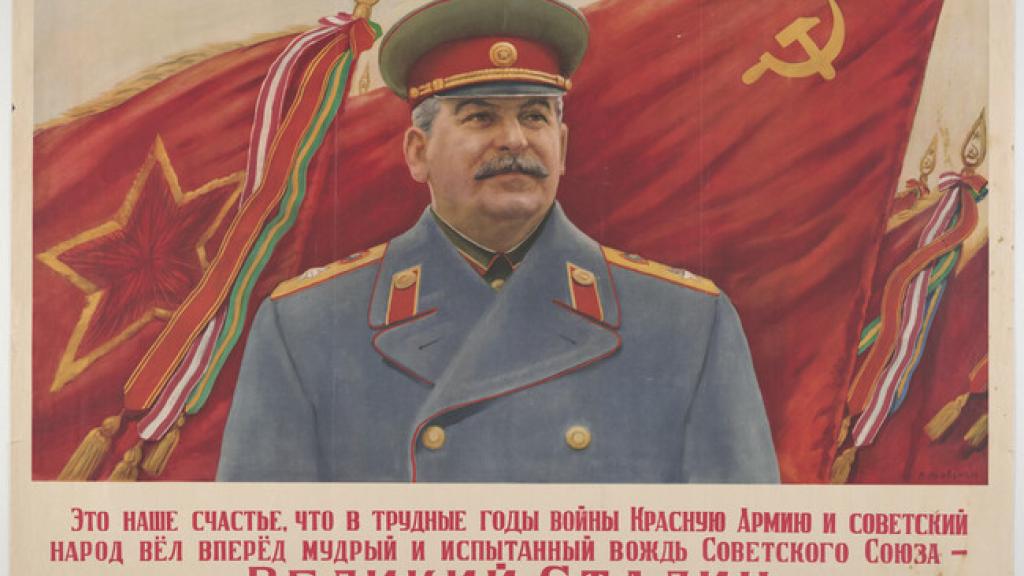
The Great Stalin

First published at New Politics.

In Stalin’s Shadow: Leon Trotsky and the Legacy of the Moscow Trials
By Douglas Greene
London: Resistance Books, 2025

A serious development on the left — accompanying a flourishing of “campism” (i.e., seeing the world as divided into a U.S.-led “imperialist camp” and a “progressive camp,” which includes dictatorships in Russia and China and elsewhere) — is the rehabilitation of Joseph Stalin, elevating him into the Revolutionary Pantheon, justifying the policies and practices for which he has long been condemned. For many, this smacks of the “revisionist” project advanced by such people as David Irving: seeing Adolf Hitler and the Nazi movement as representing a reasonable German patriotism, denying the reality of a Holocaust destroying millions of Jews and others. While many on the left have effectively challenged Nazi apologists and Holocaust deniers, a systematic left-wing critique of the new wave of Stalinist revisionism has been missing. Until now, thanks to the efforts of Douglas Greene. Grover Furr — one of the authors Greene critiques — describes him as an “incompetent and dishonest Trotskyite.” But this isn’t quite right.

Greene’s identity

I first became aware of Douglas Greene during the Occupy Wall Street movement in 2011, when he organized a series of diverse left-wing speakers (some far more prominent than me) to give informational, agitational, and educational talks for the consideration of the mostly young activists gathered at Boston’s Occupy encampment. From online contributions in one or another Trotskyist or Trotskyist-influenced site, I soon found that he was a writer as well — part of an undefined but vibrant left-wing collectivity discussing left-wing history and theory, sometimes putting forward ideas I disagreed with (far more critical of Jacobin and of DSA [Democratic Socialists of America], for example, than I was inclined to be), but always offering thoughtful comments and to a significant degree going in a positive direction. Then, as “an independent Marxist and historian” with no clear organizational affiliation or academic credentials, he began to publish books.

I’ve recently acquired Greene’s first book, Communist Insurgent: Blanqui’s Politics of Revolution (Haymarket, 2017), but it was his second that I chose to read first, A Failure of Vision: Michael Harrington and the Limits of Democratic Socialism (Zero Books, 2021). It was far better than the ultra-left hit piece I had expected. Despite an occasional gap or inaccuracy, it was seriously researched, packed with useful information and interesting ideas. Whether or not one fully agrees with him, he is someone worth reading.

As already noted, however, there was an urgent need to quite seriously confront the recent works of Stalin’s latter-day defenders — works undermining the democratic and humanistic qualities at socialism’s very core. Greene has moved forward to fill the gap. His third book is a quite interesting but prohibitively priced, 350-page hardback, Stalinism and the Dialectics of Saturn: Anticommunism, Marxism, and the Fate of the Soviet Union (Lexington Books, 2023). His fourth is the volume under review.

Greene’s gallery

Greene presents a gallery of four Stalin defenders.

One is the already-mentioned Grover Furr (1944– ), professor of medieval English literature at Montclair State University in New Jersey, who has from 2011 to 2025 published at least seventeen books defending Stalin—in some cases with a primary focus on demolishing Trotsky. This quantity of publications causes Greene to devote two chapters to Furr; his conclusions are devastating:

The trouble with Furr’s work is not just that he makes up facts.… [H]e can cite genuine data in support of his claims. A cursory look reveals that his work is filled with abundant quotes, facts, and snippets of real information.… It is full of facts and footnotes.… [Yet] his overarching approach is to cherry pick data to fit his pre-existing conclusions. To achieve this, Furr utilizes a two-pronged approach of inflating any facts that he believes support his conclusions, and he either discredits or ignores everything which contradicts his thesis. (131)

While not formally identified with any political group, an examination of Furr’s Montclair State website includes a Politics and Social Issues page that has a link to the homepage of the Progressive Labor Party, with this comment: “Ever since the anti-war and anti-racist movements of the ‘60s I have found this to be the best of the ‘alternative’ sources. Relentlessly anti-capitalist, resolutely pro-worker and pro-employee generally, it’s the best source of class analysis of the world’s events.” Beginning in 1962, as a Maoist-oriented split-off from the Communist Party USA, at moments it played a significant role in U.S. “new left” activities of the 1960s and early 1970s; it then broke “to the left” from Maoism, and shrank into what many perceive as an ultra-left, self-isolating, and irrelevant sect.

Perhaps the most prestigious of Greene’s subjects is the late Italian scholar Dominic Losurdo (1941–2018). At first adhering to the massive but increasingly reformist Italian Communist Party, in the early 1990s Losurdo participated in a substantial break-away, Communist Refoundation. By the end of the decade, this group splintered—and Losurdo joined one of the smaller splinters, which adopted the old name “Italian Communist Party” and was influenced by the late post-Mao Chinese “market socialist” leader (Mao had persecuted him as a “capitalist-roader”), Deng Xiaoping. But Losurdo’s prestige has flowed not from his political history, but from his academic and literary achievements.

As director of the Institute of Philosophical and Pedagogical Sciences at the University of Urbino, Losurdo taught history of philosophy as faculty dean of educational sciences. He was also prominent in professional associations devoted to the study of Marx, Hegel, and Leibniz.

But most important, he produced a number of significant works that combined his revolutionary political commitments with his scholarly expertise, including Liberalism: A Counter-History (Verso, 2014), War and Revolution: Rethinking the Twentieth Century (Verso, 2020), and Democracy or Bonapartism: Two Centuries of War on Democracy (Verso, 2024). His most controversial works, however, have become more generally available (certainly for those reading in English) since his death: Stalin: History and Critique of a Black Legend (Iskra Books, 2023) and Western Marxism: How It Was Born, How It Died, How It Can Be Reborn (Monthly Review, 2024).

There are two lesser-known figures with whom Greene deals. They lack the quantity and quality of output of Furr and Losurdo, but also enjoy a certain influence: Ludo Martens (1946–2011) and Bill Bland (1916–2001). Martens was a prominent figure in the Belgian far-left, a founder and leader of the Maoist-oriented Workers’ Party of Belgium. His key work on this topic, Another View of Stalin, was published in 1994. Bland, originally from Britain, moved to New Zealand in the 1930s, where he became active in the Communist movement, and after returning to Britain, played a prominent role as an educator in the Communist Party of Great Britain. He drifted toward Maoism after the mid-1950s, but by the 1970s had concluded that Albanian Communist leader Enver Hoxha’s represented a preferred alternative to Chinese Communist “revisionism.”

Greene’s achievement

A problem with all-too-many of those responding to what is presented by Stalin’s defenders is an inclination to settle for old clichés and contemptuous dismissal — but Greene’s approach is far more engaged, substantial, interesting, and useful. He gives serious attention to the four defenders of Stalin, each of whom has a different, distinctive approach. He clearly and dispassionately states their actual positions, often with generous quotes, and then frankly explains where he thinks they go wrong. He begins by sketching the social-political context from which they emerge, then gives a sense of some of their major ideas and the deficiencies of those ideas, shifting to the actual “how” and the “why” of the Moscow Trials and of the more extensive purges and repression in the USSR of 1935–39. He concludes with an exploration of “conspiracy theories,” while considering what whirled out of control in the Soviet Union of the late 1930s and also what to make of the resurging attacks on anti-Stalinism by Stalin’s latter-day defenders. The final chapter also has hints of relevance for the irrationalism and conspiracy theories related to today’s right-wing resurgence.

As a bonus, Greene generally includes in each of the chapters an interesting “interlude,” focusing on something related to the general topic, with intriguing subtitles: Vyshinsky’s Tribunal; Leon Trotsky, Georges Danton, Judas Iscariot, and Benedict Arnold; Spanish Inquisition; The River of Blood; The Confession; Wails at a Gangster’s Funeral; Shattered Faith.

Among the strengths of In Stalin’s Shadow is the fact that it isn’t hobbled by an exclusive reliance on Trotsky and Trotskyists in determining what is and isn’t so. His scope is far more interesting than that, and refreshingly wide-ranging. He isn’t afraid to connect with the serious scholarship of such figures as Sheila Fitzpatrick and J. Arch Getty (neither of whom is in any way “Trotskyist” — and both of whom have sometimes been accused of “Stalinist” leanings). He makes good use of their valuable contributions. Getty, for example, notes how impossible it would have been for Stalin to be “all powerful” — dovetailing with Fitzpatrick’s attention to Stalin’s reliance on a somewhat diverse team for the development and implementation of what are seen as “Stalinist” policies.

Another strength of Greene’s work is that he doesn’t simply lump together the four figures in his gallery but emphasizes important differences in the ways they deal with Stalin. Of course, they all unabashedly defend Stalin’s interpretation of Marxism (i.e., his “Marxism-Leninism”). They also embrace the four elements of his basic political orientation: the “socialism in one country” commitment; the “revolution from above” that promoted forced collectivization of land and hyper-industrialization; the extensive and brutal use of repression against political opponents; and the consequent cultural regimentation to mold “correct” attitudes among the population.

And corresponding to the insight of Fitzpatrick and Getty, none of them believe that Stalin somehow did it all. Yet here is the realm in which disagreements unfold among the defenders. There are divergent accusations that the defenders level against Stalin’s comrades:

Some of those claiming to support him were actually working against him (generally to enhance their own power and material privileges) at the expense of Stalin’s good and revolutionary intentions.

The development of a Stalin “cult of personality” (which Stalin allegedly did not support) was used by such double-dealers to cover their tracks.

Some (such as the heads of the secret police) were also in league with foreign powers — imperialists, Nazis, etc. — and used their authority to protect corrupt Communists and repress honest Communists. In making this case, Grover Furr devotes considerable attention to the alleged duplicity of NKVD head Nikolai Yezhov.

Splintering

Not all the defenders are in agreement with each other’s various points. For example, Bill Bland contends that within the Communist International a blatantly reformist “people’s front” line became dominant despite Stalin’s own revolutionary intentions and that Comintern chieftain Georgi Dimitrov was a secret enemy of Communism, serving not Stalin but instead erstwhile Nazi captors and imperialist masters. All of this goes too far for some of Stalin’s defenders.

On the other hand, it seems likely that, despite such divergences, most Stalin defenders would be inclined to agree with Grover Furr’s approach: Stalin never lied and was basically correct in all that he sought to do; the confessions wrung out of the Moscow Trial defendants prove that they and Trotsky were working with imperialists and fascists to destroy the Soviet Union; it is likely that they were guilty of even more criminal activity than what they confessed to.

It is Dominic Losurdo who is not in full agreement with this. He is not reliant on the forced confessions of the Moscow Trials, and for him, Stalin’s hands are far from clean. His line of argument is similar to the classic defense of Stalinism by Maurice Merleau-Ponty in Humanism and Terror (1947), which consciously inverted Arthur Koestler’s anti-Communist novel about the purges, Darkness at Noon (1940). Losurdo argues:

One need not be a Communist to recognize that “Stalinism,” with all of its horror, is a chapter in the liberation movement that defeated the Third Reich and that provided the impetus for anticolonialism and for the struggles against anti-Semitism and racism; every honest historian knows this. (Quoted by Greene, 27–28)

Greene notes that for Losurdo, “Stalinism was a historical necessity for the USSR since it represented political realism” (28). He continues:

Losurdo argued that Trotsky’s “utopianism” needed to surrender to Stalin’s “realism.” However, Trotsky was unable to accept this alleged necessity and accused Stalin of betraying the revolution. Ultimately, the division between radicals and moderates inside the Communist Party resulted in a bloody civil war. (28–29)

In this “Bolshevik Civil War” Trotsky, Zinoviev, Kamenev, Bukharin, and others ended up plotting against Stalin and his policies—leading to their own betrayals, which culminated in bloody purges and the Moscow Trials. Losurdo, while not relying on trial testimony, does cite other bits of evidence, which Greene conscientiously demolishes. But these bits are beside the point. “However tragic Losurdo may consider the Bolshevik Civil War and the purges,” Greene notes, he believed that they were “necessary for the construction of socialism.” Greene sums up that for Losurdo “it does not matter how absurd or stupid the show trials were, what matters is that Stalin was on the right side of history and Trotsky was not” (49).

Conclusions

To get to the bottom of this, one must examine what actually happened in history — which goes beyond what is possible within the confines of the present book review. Provisional thoughts, however, can be offered.

Greene summarizes his own consideration of the evidence with the comment that “the narrative of the Moscow Trials was an irrational worldview expressing itself in Marxist jargon” (250). Such irrationality, and the horror of the consequent policies (following Losurdo’s line of argument) resulted in the construction of a so-called socialism so corrupted that it was incapable of enduring. This raises questions as to whether Stalin was “on the right side of history.”

It seems worthwhile to consider Greene’s proposed alternative: “Based on Marxist reason, not conspiracist mysticism, it is possible to not only understand the world, but to truly liberate people from oppression” (252).

Paul Le Blanc, emeritus professor of history, serves on the editorial board of the Complete Works of Rosa Luxemburg (Verso) and is author of a number of books on labor and socialist movements, most recently Lenin: Responding to Catastrophe, Forging Revolution (Pluto Press, 2023).

Álvaro García Linera: The rise of 21st century protectorates


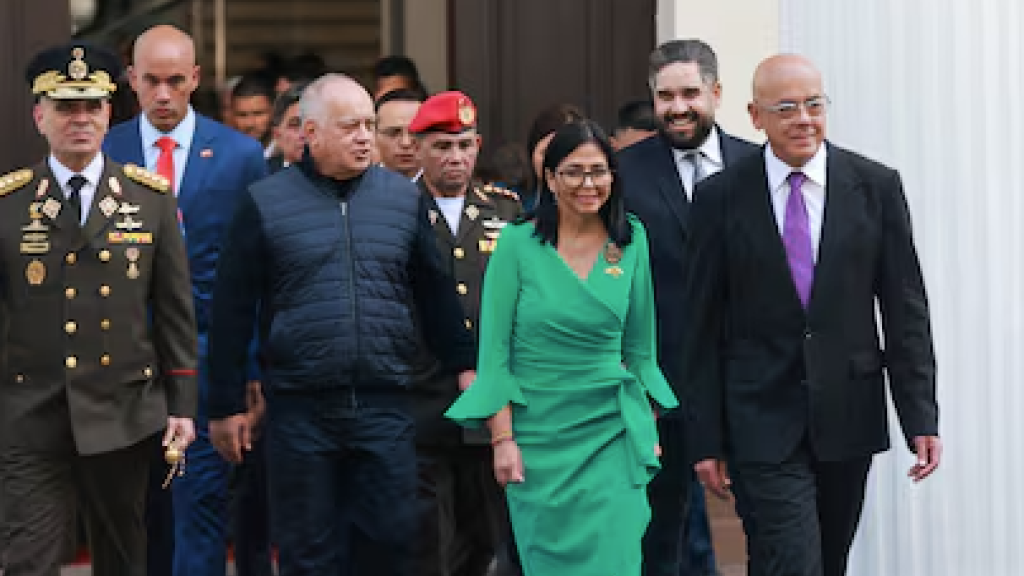
Disodado Delcy Jorge Padrino protectorate

First published in Spanish at Diario Red. Translation by LINKS International Journal of Socialist Renewal.

Capitalism was born out of colonialism. Since then, this historical characteristic, far from disappearing, has only mutated and diversified in form. We can say it is a way of organising global hierarchies, one that is fundamental to all modern forms of corporate economic accumulation.

Over five centuries, European capitalism deployed multiple forms of colonialism, each more cruel than the last, in the Americas, Africa and Asia. The United States, in just two centuries, has concentrated all of these forms and intensified their exploitative nature. It applied the classic European models of “colonialism of extermination” and “settler colonialism” during the 19th century to most of the Indigenous lands of North America. It invoked the “manifest destiny” of an Anglo-Saxon America to invade and seize 2 million square kilometres of Mexican territory, encompassing what are now the states of California, Utah, Nevada, Texas, New Mexico, Colorado, Kansas and others.

But unlike its predecessors, the US employed these types of spatial occupation as a means of constructing the territorial unity of the state, not as an extraterritorial expansion of its dominion. The usurpation of indigenous and Mexican lands resulted in their absorption as part of a continental state protected by the Atlantic and Pacific Oceans. Meanwhile, the subjugation of other societies and countries around the globe, despite 11 declared wars and nearly 400 invasions — including the use of atomic bombs and the establishment of permanent military bases (Japan, Germany, the United Kingdom) — has not led to “settler colonialism,” with the permanent presence of an invading population exercising administrative, military and economic control over the occupied country.

This would have required spending enormous sums of money, a gigantic bureaucracy, governors and numerous troops deployed in more than 150 countries worldwide. Unlike British, Dutch, French, German or Belgian colonialism, which had limited areas of colonial expansion in different parts of the world, since the end of World War II, US dominance has had a geopolitical dimension with universal aspirations. Therefore, it preferred to refine the mechanisms of colonial subjugation based on “silent economic coercion,” applied through the global force of its technological, commercial and financial power, or, in other cases, implemented immediately after periods of military occupation (Panama, Iraq, Libya, Afghanistan, etc).

Thus, once the “flattening” of nations attacked by the actions of US gunboats, planes, tanks, and marines was complete, US private companies inevitably arrived to extract raw materials; meanwhile, the IMF and the World Bank arrived to further indebt the country. But, in most cases, insecure and subservient local political elites fulfilled the same role of “flattening” societies, whether through voluntary submission (neoliberalism) or internal war (military dictatorships), which paved the way for the same US corporations and banks.

This is what has come to be called “neocolonialism.” In this case, resource extraction and labour exploitation do not require cumbersome bureaucracies or foreign armies. The hierarchical relationships of unequal exchange (Emmanuel, 1973), external debt (Toussaint, 2018), capital flight (Roberts, 2021) and cultural subordination (Said, 2003) create a web of subjugation that enables the transfer of raw materials, money, labour, knowledge and moral subordination to the imperial power in a more effective and less costly way than the classic settler occupation.

Neocolonialism implies a state with fragmented sovereignty and local institutions that maintain societal cohesion. However, the extraction of wealth abroad, and the influence exerted over political life, is carried out with the acquiescence of the domestic political bureaucracy. As Nievas and Sodano have shown, between 1970–2022, the equivalent of 1-2% of the annual GDP of the US and other wealthier countries comes from net transfers from poorer countries (Wid.World, 2024).

In the decades of absolute dominance by global liberal elites and the apparent irreversible decline of nation-states, libertarian utopias emerged, envisioning a flow of global business without the need for state support. There was talk of “Private Cities” or “Special Economic Zones” (like Roatán in Honduras), where special statutes were established and government services were provided by private companies. However, these dreams soon collided with a harsh reality: to this day, no other form of social unification, territorially based and with binding effect, has been invented that can replace the state. Markets have failed.

But times have changed, and there is no longer room for such globalist whims. The US is being displaced from the global dominance it enjoyed for the past 30 years, having to retreat ever further to its primary sphere of influence. The data speaks for itself. China, which in 1980 generated 2.3% of global GDP, measured in purchasing power parity (PPP), now generates 19.8%; while the US, which once reached 21%, now accounts for 14.5% (IMF, X, 2025). China already generates 30% of the world's manufacturing output. The US accounts for 15.4% (Safeguard Global, 2025).

For its part, Russia has demonstrated with its invasion of Ukraine that it possesses the military and economic muscle to once again establish itself as the leading Eurasian power. Meanwhile, the European Union, in the wake of the recent threat to annex Greenland, has shown the US that it too can inflict economic damage, for example, by selling off its holdings of US Treasury bonds ($2 trillion) or by potentially reversing the flow of savings held in New York banks (another $2 trillion) and so on.

In a world so fragmented by the competition of powers and empires, colonial forms are also being transformed. US invasions and bombings anywhere in the world will not disappear, but they will become increasingly shorter, more devastating in their technical effectiveness, and without prolonged military occupations. The preferred weapon for subjugating states will now be tariff wars, blockades, and economic blackmail.

This is a type of “hard economic power” characteristic of times of competitive hegemonies; different from the “soft economic power” (debt, unequal exchange, etc) favoured by the now-extinct phase of exclusive US hegemony. This type of “soft power” will not disappear. But it will no longer be the most active.

And, once inside the US “area of ​​influence”, the colonial form will undergo two substantial modifications.

First, we will repeatedly witness acts of force aimed at expanding the US’ territorial reach. Trump’s statements about renaming the Gulf of Mexico the “Gulf of America,” his threat to retake control of the Panama Canal, to make Canada the 51st US state, or to claim ownership of Greenland, all demonstrate a clear desire to expand US sovereign territory among its neighbours. These expansionist ambitions toward the north and centre of the continent, to integrate them into a “living space,” will continue in the coming years.

Second, the figure of protectorates will be revived to maintain economic and political control of countries possessing “strategic” raw materials (oil, rare earths, lithium, copper, etc) for North American industry, or of geographical areas of high interest to private investors.

A protectorate is a formally independent state that has ceded some of the main levers of its sovereignty to a stronger state (the “Protector”). The subjugated state retains its entire legal framework and institutions that enable the political and cultural cohesion of the population within its territory. This constitutes part of the local social authority that the “Protector” cannot replace, at least not without a high economic and political cost. However, control of foreign relations, its main productive (extractive) and financial activities, is under the tutelage of the foreign power.

Sometimes this form of “indirect” (Lugard, 1905), or shared government can be achieved through small but effective military and bureaucratic occupations; in other cases, the threat of armed intervention is sufficient to direct the main spheres of the economy and defence from the outside. Protectorates included Morocco under France and Spain between 1912–56 and Egypt under Great Britain between 1892–1922. In Latin America, the US exercised protectorates in Nicaragua (1912–33), the Dominican Republic (1916–24) and, among others, Cuba between 1903–34.

It is telling that at the same time the US is attempting to revive renewed versions of protectorates to control oil and foreign currency flows in Venezuela, or in Greenland to seize its minerals and Arctic trade routes, President Donald Trump has renamed the Monroe Doctrine (which condemned European powers under the guise of “America for the Americans”) as the “Donroe Doctrine.” Under this legal and moral umbrella, various US administrations in the first 150 years quadrupled its initial state territory and established numerous protectorates over several Latin American countries. This is internal aggrandizement at the expense of neighbouring countries. For Latin America, it represents a substantial reconfiguration of the conditions for political sovereignty and democracy itself, conditions that will be different from those that prevailed in the last 40 years.

But it is also a dramatic confession: that of imperial contraction. The US is abdicating its role as world leader, a position it held since 1989. Now it will control its continental “sphere of influence” through the application of aggressive, de facto colonial practices. It will seek to contain and weaken China’s trade networks and then engage with the rest of the world through relationships of hostile competition or submission, depending on the power other countries manage to exert.

We have entered a geofragmented world, not only because value chains have retreated to calculations of “national security” and strategic rivalries, or because of the rise of protectionist policies and all-against-all tariff wars, but also because of the slow implosion of US hegemony, which has shifted from a global superpower to a furious regional power. For the rest of the countries that wish to resist this fate of subjugation, what lies ahead is a renewed agenda of national sovereignty, regional industrialism and anti-colonialism.

Greece

Deaths to order

Friday 27 February 2026, by Andreas Sartzekis


In recent years, serious fatal events have taken place in Greece, described as “tragedies” — such as the collision of 2 trains in Tembi in 2023 (57 dead) and the Pylos shipwreck (400 to 700 dead). In recent weeks, two terrible disasters have confirmed that, as in 2023, behind the tragedy there is clearly the law of profit, deregulation, repression, making it more urgent than ever to remove the common causes. [1]

Victims of super-exploitation

On 26 January, a liquid gas explosion followed by a fire at a factory killed five workers at the prosperous Violanta biscuit factory in Trikala (central Greece) and injured several others. All five women worked night shifts, and at least one of them had another day job.

This tragedy is added to the macabre list of work accidents, at least 201 in 2025 according to union sources. Here we see the cynicism of super-exploitation: the absence of security (the smell of gas had been reported, but the director refused minimal repair work), legality (the basement where the five victims worked was not included in the official plans, doors were often blocked and so on).

Not to mention a policy of terror: the local union had succeeded in imposing professional elections, but the management had threatened any worker who went to vote, and, even today, the staff are afraid to express themselves, with blackmail for employment in a poor region.

For its part, the government reacted... by denying the figures on work accidents and the difficulties of controls (glaring lack of labour inspectors). Of course, the workers’ reaction was immediate: a national sectoral strike, demonstrations, with hundreds of people in Trikala at the call of the local union proclaiming “this is not chance, these are programmed crimes”. But no general strike in the face of this tragedy which confirms the complicity of the employers and the government for a now unlimited exploitation of workers.

Carnage in Chios

Of the 3,148 dead and missing in the Aegean Sea between 2015 and 2025, how many were victims of the Greek repression aimed at preventing migrants and refugees from reaching Greece? It’s hard to say. On 3 February, fifteen migrants died near the island of Chios. Not drowned, but victims of injuries due to the collision with the coast guard boat. The latter accuse the (overloaded) boat of having manoeuvred against them, it seems more likely to experts that, once again, the coast guard rushed to push the migrants out of Greek sea waters.

This horror was encouraged by the Minister of Migration, the fascist Plevris, who declared in 2011: “The borders cannot be guarded without damage, and to be clearer, without deaths.” The same person places the responsibility for the tragedy on the smugglers and NGOs, while congratulating the coast guard. The entire left denounced a new crime, but the protest demonstrations have so far not been massive enough in the face of the horror.

To top it all off, this government, adopting the new European line of “selective immigration”, is considering the creation of an agency — an official smuggler! — bringing in migrants to work without rights. An additional reason, if need be, for a unified battle against super-exploitation and repression, uniting Greek and immigrant workers.

19 February 2026

Translated by International Viewpoint from l’Anticapitaliste.

Footnotes

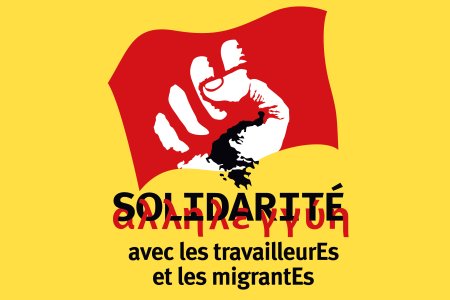
[1Image: Solodarity with workers and migrants.