“Trump loves putting his name on things, but this should be the only building for which he is remembered by history.”
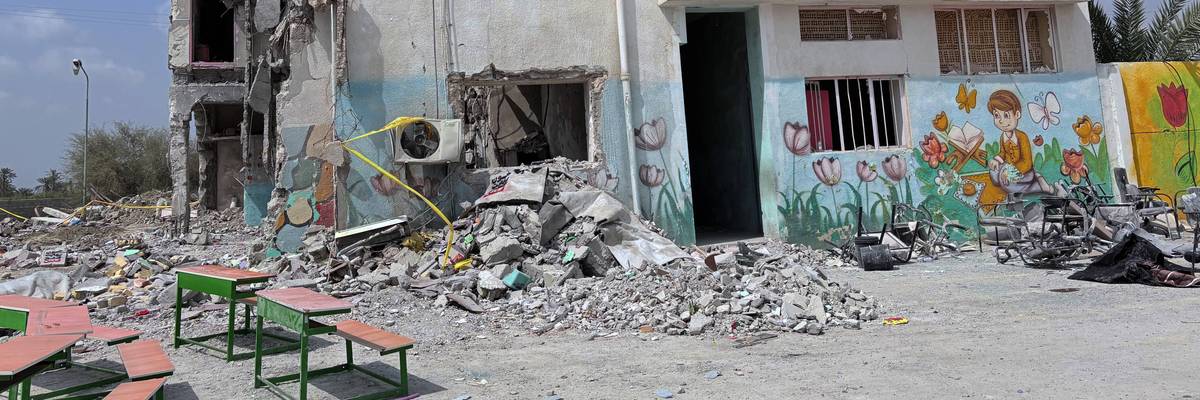
A view of the debris of a school, where many students and teachers lost their lives on the first day of the wave of attacks launched by the United States and Israel against Iran, in the southern town of Minab on March 5, 2026.
(Photo by Stringer/Anadolu via Getty Images)
Jon Queally
Mar 07, 2026
COMMON DREAMS
The bombing of a primary school by US-Israeli coalition forces in southern Iranian town of Minab that killed an estimated 160 or more civilians—mostly children—on February 28 should be investigated as a possible war crime, Human Rights Watch said on Saturday.
After reviewing satellite footage from before and after the strike on the Shajareh Tayyebeh school—as well as reviewing video taken in the wake of the bombing and other materials—the international human rights group said the available evidence indicates “that the attack was carried out by highly accurate, guided munitions, rather than errant weapons whose guidance or propulsion systems failed or were otherwise disrupted and randomly struck the area.”
The attack on the school would be among the deadliest war crimes against civilians by US forces in years. Occurring on the first day of bombings of what President Donald Trump and US Defense Secretary Pete Hegseth dubbed Operation Epic Fury, the slaughter of schoolchildren—though the US has denied responsibility thus far—coincides with Hegseth repeatedly bragging that the US military would no longer follow “stupid rules of engagement” in the execution of its operations.
“The school was in use, and children were in attendance on the day of the attack,” the group said. “Human Rights Watch found no evidence that would indicate that the school was being used for military purposes, though researchers were not able to speak to witnesses of the strikes, families of those killed, or other informed sources.”
President Trump should hold Secretary Hegseth and everyone else responsible for killing Iranian children accountable, and bring this illegal, unnecessary war of choice to an end.“
According to HRW:
The United States should immediately assess its responsibility for this strike and make the findings public. If the US military carried out the strike, it should conduct a full investigation into the operational and policy failures that led it to strike a school, fully account for the civilian harm caused, hold those responsible accountable including through prosecution, and commit to changes that would ensure such failures will not be repeated in future operations.
Analyses of the bombing by various news outlets have provided strong evidence that US forces were the most likely culprits of the attack. HRW was told by an Israeli military spokesperson that it was “not aware of any [Israeli military] strikes in the area.” Hegseth said during a Wednesday press conference that the Pentagon was investigating the matter, but offered no further indication of concern in the matter.
During that same press briefing, as HRW notes in its analysis of the attack, the chairman of the Joint Chiefs of Staff, Gen. Dan Caine, said that US forces from the USS Abraham Lincoln strike group were providing “pressure” in preceding days along the “southeastern side” of the Iranian coast as he pointed to an area of a map showing coalition bombings that included Minab.
“A prompt and thorough investigation is needed into this attack, including if those responsible should have known that a school was there and that it would be full of children and their teachers before midday,” said Sophia Jones, open source researcher with the Digital Investigations Lab at Human Rights Watch. “Those responsible for an unlawful attack should be held to account, including prosecutions of anyone responsible for war crimes.”
“Allies of the US and Israel should insist on accountability for the Shajareh Tayyebeh school attack and for an end to attacks on civilian infrastructure in all of their operations across the region, before more civilians, including children, are unlawfully killed,” she added.
Human Rights Watch is not the only one demanding an independent investigation.
“This mass killing of children is unconscionable. It bears the hallmarks of a war crime,” said Sen. Chris Van Hollen (D-Md.) on Friday after a New York Times investigation found that US forces were likely behind the strike. “Trump and Hegseth must answer for the US’s role and they must be held accountable. People deserve the full truth. There must be an immediate and transparent investigation.”
On Friday, as Common Dreams reported, another school in Iran was struck by US-Israel bombings, bringing the total number of schools hit to four in the first six days of the unprovoked military attack.
“The American people do not want their tax dollars spent on killing children in Iran, just as they did not want their tax dollars spent on killing children in Gaza,” said the Council on American Islamic Relations (CAIR) in a statement. “The latest U.S.-Israel attacks on schools in Iran are blatant war crimes. So was the original slaughter of 180 schoolgirls that the Pentagon refuses to take responsibility for.”
“Every child murdered or injured in these indiscriminate US-Israel bombing attacks is a sign that the Pentagon under Pete Hegseth is mimicking the tactics of the cowardly and genocidal Israeli military, which has mastered the art of bombing men, women, and children from afar,” the group added. “The American people expect better from our armed forces. President Trump should hold Secretary Hegseth and everyone else responsible for killing Iranian children accountable, and bring this illegal, unnecessary war of choice to an end.”
While the war continues and Trump on Saturday said the people of Iran should expect bombing and destruction to increase not decrease over the weekend, voices for peace continued to demand a swift end to the violence and said the US president should forever be held responsible for unleashing such unnecessary bloodshed—including the specific devastation unleashed on the school in Minab.
“Trump loves putting his name on things, but this should be the only building for which he is remembered by history,” said Dylan Williams, vice president for government affairs at the Center for International Policy, referencing the school where the massacre took place.
165 Massacred Schoolgirls in Iran — and the Silence That Exposes the West’s Moral Selectivity
These were not combatants. They were not militants. They were children seated at their desks, pens in their hands, notebooks open before them, studying, whispering to classmates, and imagining futures that stretched decades ahead.
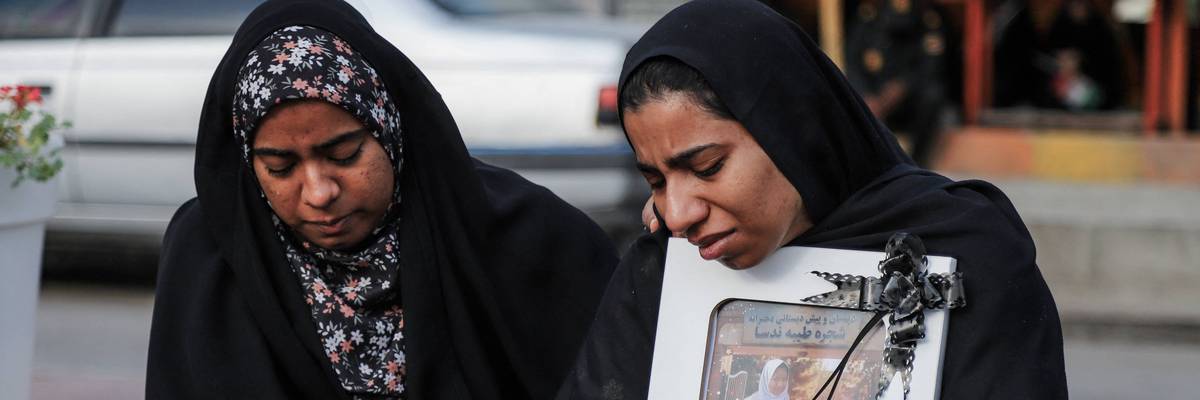
In this picture obtained from Iran’s ISNA news agency, mourners attend the funeral of children killed in a strike on a primary school in Iran’s Hormozgan province, in Minab on March 3, 2026.
(Photo by Amirhossein Khorgooei / ISNA / AFP via Getty Images)
Hana Saada
Mar 07, 2026
“If a US role were to be confirmed, the strike would rank among the worst cases of civilian casualties in decades of US conflicts in the Middle East.”
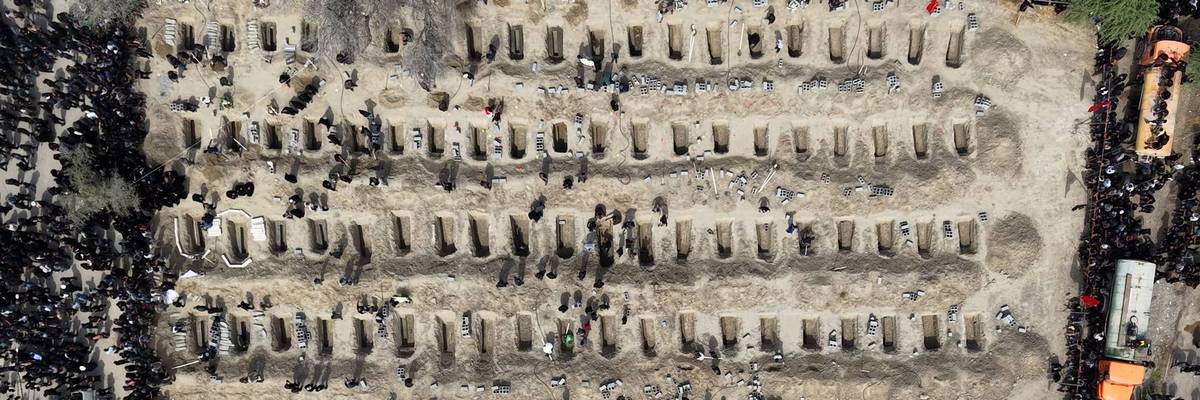
An aerial view of a graveyard as funerals are held for students and staff from a girls’ school killed in a likely US strike on March 3, 2026 in Minab, Iran.
(Photo: Handout/Getty Images)
These were not combatants. They were not militants. They were children seated at their desks, pens in their hands, notebooks open before them, studying, whispering to classmates, and imagining futures that stretched decades ahead.
In this picture obtained from Iran’s ISNA news agency, mourners attend the funeral of children killed in a strike on a primary school in Iran’s Hormozgan province, in Minab on March 3, 2026.
(Photo by Amirhossein Khorgooei / ISNA / AFP via Getty Images)
Hana Saada
Mar 07, 2026
Common Dreams
In an era when images can circle the globe in seconds and newsrooms claim to uphold universal humanitarian principles; one might expect the killing of 165 schoolgirls inside a primary school to dominate international headlines. One would expect emergency debates, moral outrage, and relentless coverage. Yet in the southeastern Iranian city of Minab—where Israeli-American strikes obliterated classrooms filled with children—the world’s most influential media institutions have responded with something far more revealing than condemnation: they have responded with silence.
These were not combatants. They were not militants. They were children seated at their desks, pens in their hands, notebooks open before them, studying, whispering to classmates, and imagining futures that stretched decades ahead. In seconds, that ordinary school day turned into a massacre. Desks became splintered wreckage, classrooms collapsed into dust, and rows of coffins replaced rows of pupils.
Yet the names of these girls—165 lives extinguished before they truly began—barely entered the global conversation.
This omission is not the product of oversight. It reflects something far more structural: the hierarchy of victims that governs much of the contemporary information order. In theory, modern Western media institutions present themselves as defenders of human rights and guardians of moral accountability. In practice, their editorial priorities often mirror geopolitical interests with striking precision.
When the deaths of children generate outrage in one context but indifference in another, the moral language surrounding human rights begins to lose its integrity.
When tragedies reinforce established narratives about adversarial states, they are amplified, dramatized, and transformed into global moral spectacles. But when tragedies expose the human cost of the military actions carried out by Western powers or their closest allies, they are quietly displaced from the front page—if they appear at all.
The massacre in Minab illustrates this logic with devastating clarity.
The deaths of 165 Iranian schoolgirls do not fit comfortably within the dominant geopolitical storyline that portrays Israel and its strategic partners as defenders of stability and order in a turbulent region. Acknowledging such an atrocity would inevitably raise difficult questions: about the legality of strikes on civilian infrastructure, about the ethics of military escalation, and about the widening humanitarian toll of ongoing Israeli-American attacks across the region.
It is therefore far easier to look away.
But Minab is not an isolated tragedy. Across Lebanon, relentless bombardments have repeatedly struck civilian neighborhoods, reducing homes and streets to rubble. Across Palestine, entire communities have endured cycles of destruction that claim the lives of children whose only battlefield was the ground beneath their feet. Hospitals, schools, and residential blocks have all entered the expanding geography of devastation.
These events do not occur in a vacuum. They form part of a broader pattern in which military power operates alongside narrative power. Missiles shape the physical battlefield, while selective reporting shapes the battlefield of perception.
What emerges is not merely a media bias but a form of narrative engineering. Certain victims are elevated as symbols of universal suffering, while others—often far more numerous—are rendered invisible. Compassion itself becomes curated, distributed unevenly according to political convenience.
For Western audiences accustomed to believing in the neutrality of their information systems, this selective visibility should provoke serious reflection. The credibility of humanitarian discourse depends on consistency. When the deaths of children generate outrage in one context but indifference in another, the moral language surrounding human rights begins to lose its integrity.
The girls of Minab deserved the same recognition afforded to any victims of violence anywhere in the world. They deserved to have their stories told, their lives acknowledged, and their deaths confronted with the seriousness such an atrocity demands.
Instead, they encountered a second form of erasure.
First came the missiles that ended their lives. Then came the silence that followed.
For Western audiences accustomed to believing in the neutrality of their information systems, this selective visibility should provoke serious reflection.
In the contemporary information age, propaganda rarely announces itself openly. It often operates through absence—through the stories that never reach the front page, the victims whose names remain unspoken, and the tragedies that disappear before the world has time to notice.
The massacre in Minab therefore stands as more than a local catastrophe. It exposes a deeper crisis in the global information order—one in which the value of human life appears disturbingly contingent on political context.
And if the deaths of 165 schoolgirls in their classrooms fail to trigger universal outrage, the question is no longer about geopolitics alone.
It becomes a question about the credibility of the moral system that claims to defend humanity itself.
Our work is licensed under Creative Commons (CC BY-NC-ND 3.0). Feel free to republish and share widely.
Hana Saada
Dr. Hana Saada is an Algerian university lecturer and journalist, and Editor-in-Chief of the English edition of Dzair Tube. She holds a PhD in Media Translation and writes on geopolitics, media narratives, and international affairs.
Full Bio >
In an era when images can circle the globe in seconds and newsrooms claim to uphold universal humanitarian principles; one might expect the killing of 165 schoolgirls inside a primary school to dominate international headlines. One would expect emergency debates, moral outrage, and relentless coverage. Yet in the southeastern Iranian city of Minab—where Israeli-American strikes obliterated classrooms filled with children—the world’s most influential media institutions have responded with something far more revealing than condemnation: they have responded with silence.
These were not combatants. They were not militants. They were children seated at their desks, pens in their hands, notebooks open before them, studying, whispering to classmates, and imagining futures that stretched decades ahead. In seconds, that ordinary school day turned into a massacre. Desks became splintered wreckage, classrooms collapsed into dust, and rows of coffins replaced rows of pupils.
Yet the names of these girls—165 lives extinguished before they truly began—barely entered the global conversation.
This omission is not the product of oversight. It reflects something far more structural: the hierarchy of victims that governs much of the contemporary information order. In theory, modern Western media institutions present themselves as defenders of human rights and guardians of moral accountability. In practice, their editorial priorities often mirror geopolitical interests with striking precision.
When the deaths of children generate outrage in one context but indifference in another, the moral language surrounding human rights begins to lose its integrity.
When tragedies reinforce established narratives about adversarial states, they are amplified, dramatized, and transformed into global moral spectacles. But when tragedies expose the human cost of the military actions carried out by Western powers or their closest allies, they are quietly displaced from the front page—if they appear at all.
The massacre in Minab illustrates this logic with devastating clarity.
The deaths of 165 Iranian schoolgirls do not fit comfortably within the dominant geopolitical storyline that portrays Israel and its strategic partners as defenders of stability and order in a turbulent region. Acknowledging such an atrocity would inevitably raise difficult questions: about the legality of strikes on civilian infrastructure, about the ethics of military escalation, and about the widening humanitarian toll of ongoing Israeli-American attacks across the region.
It is therefore far easier to look away.
But Minab is not an isolated tragedy. Across Lebanon, relentless bombardments have repeatedly struck civilian neighborhoods, reducing homes and streets to rubble. Across Palestine, entire communities have endured cycles of destruction that claim the lives of children whose only battlefield was the ground beneath their feet. Hospitals, schools, and residential blocks have all entered the expanding geography of devastation.
These events do not occur in a vacuum. They form part of a broader pattern in which military power operates alongside narrative power. Missiles shape the physical battlefield, while selective reporting shapes the battlefield of perception.
What emerges is not merely a media bias but a form of narrative engineering. Certain victims are elevated as symbols of universal suffering, while others—often far more numerous—are rendered invisible. Compassion itself becomes curated, distributed unevenly according to political convenience.
For Western audiences accustomed to believing in the neutrality of their information systems, this selective visibility should provoke serious reflection. The credibility of humanitarian discourse depends on consistency. When the deaths of children generate outrage in one context but indifference in another, the moral language surrounding human rights begins to lose its integrity.
The girls of Minab deserved the same recognition afforded to any victims of violence anywhere in the world. They deserved to have their stories told, their lives acknowledged, and their deaths confronted with the seriousness such an atrocity demands.
Instead, they encountered a second form of erasure.
First came the missiles that ended their lives. Then came the silence that followed.
For Western audiences accustomed to believing in the neutrality of their information systems, this selective visibility should provoke serious reflection.
In the contemporary information age, propaganda rarely announces itself openly. It often operates through absence—through the stories that never reach the front page, the victims whose names remain unspoken, and the tragedies that disappear before the world has time to notice.
The massacre in Minab therefore stands as more than a local catastrophe. It exposes a deeper crisis in the global information order—one in which the value of human life appears disturbingly contingent on political context.
And if the deaths of 165 schoolgirls in their classrooms fail to trigger universal outrage, the question is no longer about geopolitics alone.
It becomes a question about the credibility of the moral system that claims to defend humanity itself.
Our work is licensed under Creative Commons (CC BY-NC-ND 3.0). Feel free to republish and share widely.
Hana Saada
Dr. Hana Saada is an Algerian university lecturer and journalist, and Editor-in-Chief of the English edition of Dzair Tube. She holds a PhD in Media Translation and writes on geopolitics, media narratives, and international affairs.
Full Bio >
‘Up There With My Lai’: Investigations Find US Was Likely Behind Iranian School Massacre
“If a US role were to be confirmed, the strike would rank among the worst cases of civilian casualties in decades of US conflicts in the Middle East.”
An aerial view of a graveyard as funerals are held for students and staff from a girls’ school killed in a likely US strike on March 3, 2026 in Minab, Iran.
(Photo: Handout/Getty Images)
Jake Johnson
Mar 06, 2026
COMMON DREAMS
US investigators reportedly believe that American forces were behind the bombing of an Iranian girls’ school that killed more than 160 people—mostly young children—during the initial wave of attacks launched Saturday by President Donald Trump in coordination with the Israeli military.
Citing two unnamed officials, Reuters reported Thursday that US military investigators have found it is “likely” that American forces were responsible for the deadly strike on the school in the southern Iranian town of Minab, though the investigation has not yet been completed. Schools are protected under international law, and targeting them is a war crime.
“Reuters was unable to determine more details about the investigation, including what evidence contributed to the tentative assessment, what type of munition was used, who was responsible, or why the U.S. might have struck the school,” the outlet noted. “The officials, who spoke on condition of anonymity to discuss sensitive military matters, did not rule out the possibility that new evidence could emerge that absolves the U.S. of responsibility and points to another responsible party in the incident.”
“If a US role were to be confirmed,” Reuters added, “the strike would rank among the worst cases of civilian casualties in decades of US conflicts in the Middle East.”
HuffPost‘s Akbar Shahid Ahmed echoed Reuters’ reporting, writing that Pentagon officials “told Congress in multiple briefings this week that they believed the US was most likely responsible (though probe ongoing).”
The reporting came on the heels of a New York Times analysis that concluded the US was “most likely to have carried out the strike,” given that American forces were simultaneously bombarding an adjacent Iranian naval base. The Times also rejected the claim that an Iranian missile hit the elementary school.
“The strikes were first reported on social media shortly after 11:30 am local time,” the Times reported. “An analysis of those posts—as well as bystander photos and videos captured within an hour of the strikes—helps corroborate that the school was hit at the same time as the naval base. One video, pinpointed by geolocation experts, showed several large plumes of smoke billowing from the area of the base and the school.”
Beth Van Schaack, a former State Department official who currently teaches at Stanford University’s Center for Human Rights and International Justice, told the Times that “given the US’ intelligence capabilities, they should have known that a school was in the vicinity.”
Trump administration officials have said very little about the Iranian school strike in their triumphant rhetoric about the war, which Pentagon Secretary Pete Hegseth hailed as the “most lethal, most complex, and most precise aerial operation in history.” Hegseth has also openly dismissed what he’s called “stupid rules of engagement,” rejecting constraints on US forces that are designed to prevent the killing of civilians.
Asked about the school strike during a March 4 press conference, Hegseth responded: “All I know—all I can say is that we’re investigating that. We, of course, never target civilian targets, but we’re taking a look and investigating that.”
US Secretary of State Marco Rubio referred reporters to the Pentagon when asked about the attack, but added that “the United States would not target, deliberately target, a school,” in purported contrast to the Iranian government, which Rubio claimed is “deliberately targeting civilians” because “they are a terroristic regime.”
Two first responders to the scene of the attack, as well as a parent of one of the killed children, told Middle East Eye earlier this week that the school was hit by two strikes, a possible “double-tap” attack. An Al Jazeera investigation concluded the attack on the school was likely deliberate.
Jeremy Konyndyk, president of Refugees International, called the school attack “a horrific US war crime, up there with My Lai,” referring to US soldiers’ massacre of Vietnamese civilians in 1968. The US military initially covered up the massacre.
“In a sane world, Hegseth would resign, Congress would hold immediate hearings and establish an investigation, and the US would come clean,” Konyndyk wrote on social media. “None of that is likely, so international mechanisms should kick in, including the [International Criminal Court]. And Hegseth should probably talk to a lawyer.”
On Thursday, as US and Israeli officials vowed to ramp up their assault on Iran, two boys’ schools southwest of Tehran were reportedly bombed.
“The targeting of civilians, educational facilities, and medical institutions constitutes a grave violation of international humanitarian law and human rights law,” a group of United Nations experts said earlier this week.
COMMON DREAMS
US investigators reportedly believe that American forces were behind the bombing of an Iranian girls’ school that killed more than 160 people—mostly young children—during the initial wave of attacks launched Saturday by President Donald Trump in coordination with the Israeli military.
Citing two unnamed officials, Reuters reported Thursday that US military investigators have found it is “likely” that American forces were responsible for the deadly strike on the school in the southern Iranian town of Minab, though the investigation has not yet been completed. Schools are protected under international law, and targeting them is a war crime.
“Reuters was unable to determine more details about the investigation, including what evidence contributed to the tentative assessment, what type of munition was used, who was responsible, or why the U.S. might have struck the school,” the outlet noted. “The officials, who spoke on condition of anonymity to discuss sensitive military matters, did not rule out the possibility that new evidence could emerge that absolves the U.S. of responsibility and points to another responsible party in the incident.”
“If a US role were to be confirmed,” Reuters added, “the strike would rank among the worst cases of civilian casualties in decades of US conflicts in the Middle East.”
HuffPost‘s Akbar Shahid Ahmed echoed Reuters’ reporting, writing that Pentagon officials “told Congress in multiple briefings this week that they believed the US was most likely responsible (though probe ongoing).”
The reporting came on the heels of a New York Times analysis that concluded the US was “most likely to have carried out the strike,” given that American forces were simultaneously bombarding an adjacent Iranian naval base. The Times also rejected the claim that an Iranian missile hit the elementary school.
“The strikes were first reported on social media shortly after 11:30 am local time,” the Times reported. “An analysis of those posts—as well as bystander photos and videos captured within an hour of the strikes—helps corroborate that the school was hit at the same time as the naval base. One video, pinpointed by geolocation experts, showed several large plumes of smoke billowing from the area of the base and the school.”
Beth Van Schaack, a former State Department official who currently teaches at Stanford University’s Center for Human Rights and International Justice, told the Times that “given the US’ intelligence capabilities, they should have known that a school was in the vicinity.”
Trump administration officials have said very little about the Iranian school strike in their triumphant rhetoric about the war, which Pentagon Secretary Pete Hegseth hailed as the “most lethal, most complex, and most precise aerial operation in history.” Hegseth has also openly dismissed what he’s called “stupid rules of engagement,” rejecting constraints on US forces that are designed to prevent the killing of civilians.
Asked about the school strike during a March 4 press conference, Hegseth responded: “All I know—all I can say is that we’re investigating that. We, of course, never target civilian targets, but we’re taking a look and investigating that.”
US Secretary of State Marco Rubio referred reporters to the Pentagon when asked about the attack, but added that “the United States would not target, deliberately target, a school,” in purported contrast to the Iranian government, which Rubio claimed is “deliberately targeting civilians” because “they are a terroristic regime.”
Two first responders to the scene of the attack, as well as a parent of one of the killed children, told Middle East Eye earlier this week that the school was hit by two strikes, a possible “double-tap” attack. An Al Jazeera investigation concluded the attack on the school was likely deliberate.
Jeremy Konyndyk, president of Refugees International, called the school attack “a horrific US war crime, up there with My Lai,” referring to US soldiers’ massacre of Vietnamese civilians in 1968. The US military initially covered up the massacre.
“In a sane world, Hegseth would resign, Congress would hold immediate hearings and establish an investigation, and the US would come clean,” Konyndyk wrote on social media. “None of that is likely, so international mechanisms should kick in, including the [International Criminal Court]. And Hegseth should probably talk to a lawyer.”
On Thursday, as US and Israeli officials vowed to ramp up their assault on Iran, two boys’ schools southwest of Tehran were reportedly bombed.
“The targeting of civilians, educational facilities, and medical institutions constitutes a grave violation of international humanitarian law and human rights law,” a group of United Nations experts said earlier this week.
US-Israeli Bombs Strike ‘The Fourth School in 6 Days’ in Iran: Report
“There are straight lines between what Israel has attempted to do… in Gaza, to completely decimate and collapse the systems that existed there, to what we are seeing in Iran,” said one expert.
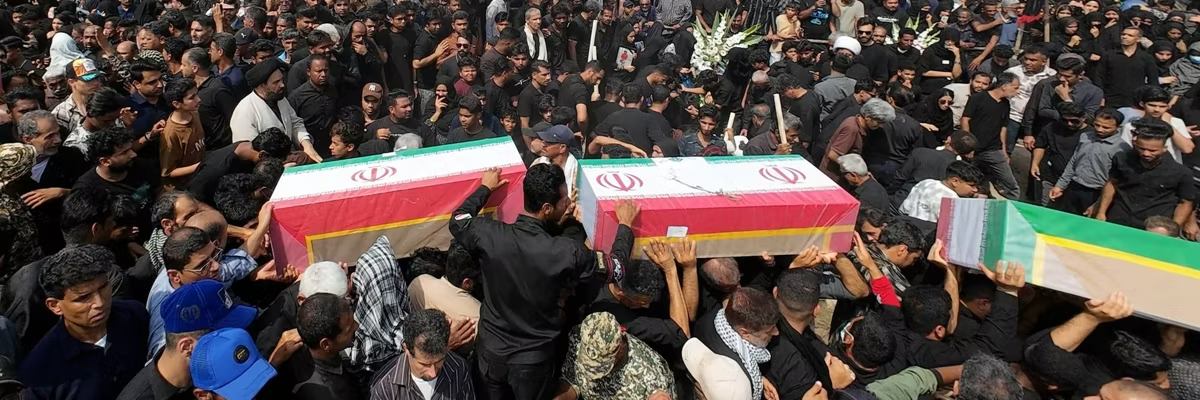
Caskets are carried by mourners as funerals are held for students and staff from a girls’ school, who authorities said were killed in a US-Israeli strike on February 28, on March 3, 2026 in Minab, Iran.
(Photo by Handout/Getty Images)
Stephen Prager
Mar 06, 2026
COMMON DREAMS
US and Israeli missiles have hit a school in Iran for the fourth time in six days, according to videos shared on social media by a spokesperson for the Iranian Foreign Ministry on Friday.
Spokesperson Esmaeil Baqaei said that the Shahid Hamedani School, an elementary school in Niloufar Square, Tehran, had been “targeted by the American/Israeli aggressors.”
He posted a video showing the school filled with dozens of young students prior to the attack, followed by scenes of the school in ruins, with several empty classrooms filled with rubble.
Baquaei said it showed “how the United States administration is helping the people of Iran.” He did not include any information about the number of casualties or the circumstances of the attack.
According to the United Nations Children’s Fund (UNICEF), at least 192 children have been killed across the Middle East since the US and Israel launched a regime change war this past Saturday.
Most of them were girls ages 7-12 who were killed on Saturday during an attack at a girls’ school in the southern Iranian town of Minab.
At least 175 people were reported to have been killed in the attack, which unnamed officials have said was “likely” carried out by the United States, according to Reuters. HuffPost reported that Pentagon officials have briefed Congress that the US “was most likely responsible.”
Eyewitnesses and relatives of the victims have told Middle East Eye that the attack was a “double-tap” strike in which survivors and first responders were targeted following the initial bombing. An Al Jazeera investigation has concluded that the attack was likely “deliberate.”
Iranian media have also published CCTV video of a separate strike on the same day, in which a missile landed next to a boys’ school in Qazvin, resulting in scenes of terrified students and teachers running for their lives.
“There are straight lines between what Israel has attempted to do… in Gaza, to completely decimate and collapse the systems that existed there, to what we are seeing in Iran,” said one expert.
Caskets are carried by mourners as funerals are held for students and staff from a girls’ school, who authorities said were killed in a US-Israeli strike on February 28, on March 3, 2026 in Minab, Iran.
(Photo by Handout/Getty Images)
Stephen Prager
Mar 06, 2026
COMMON DREAMS
US and Israeli missiles have hit a school in Iran for the fourth time in six days, according to videos shared on social media by a spokesperson for the Iranian Foreign Ministry on Friday.
Spokesperson Esmaeil Baqaei said that the Shahid Hamedani School, an elementary school in Niloufar Square, Tehran, had been “targeted by the American/Israeli aggressors.”
He posted a video showing the school filled with dozens of young students prior to the attack, followed by scenes of the school in ruins, with several empty classrooms filled with rubble.
Baquaei said it showed “how the United States administration is helping the people of Iran.” He did not include any information about the number of casualties or the circumstances of the attack.
According to the United Nations Children’s Fund (UNICEF), at least 192 children have been killed across the Middle East since the US and Israel launched a regime change war this past Saturday.
Most of them were girls ages 7-12 who were killed on Saturday during an attack at a girls’ school in the southern Iranian town of Minab.
At least 175 people were reported to have been killed in the attack, which unnamed officials have said was “likely” carried out by the United States, according to Reuters. HuffPost reported that Pentagon officials have briefed Congress that the US “was most likely responsible.”
Eyewitnesses and relatives of the victims have told Middle East Eye that the attack was a “double-tap” strike in which survivors and first responders were targeted following the initial bombing. An Al Jazeera investigation has concluded that the attack was likely “deliberate.”
Iranian media have also published CCTV video of a separate strike on the same day, in which a missile landed next to a boys’ school in Qazvin, resulting in scenes of terrified students and teachers running for their lives.
CCTV video captures moment strike lands next to boys’ school in Iran
CCTV video showing the moment a missile struck next to a boys’ school in Iran’s Qazvin.

Al Jazeera·Mar 6
On Thursday, two other schools in the town of Parand, southwest of Tehran, were hit by missiles fired by the US and Israel, according to Iranian state media. The Fars News Agency shared photos of a classroom filled with debris. So far, no casualties from the attack have been reported.
US Secretary of Defense Pete Hegseth has said that as it wages its war in Iran, the US is not abiding by “stupid rules of engagement,” and has boasted of raining down “death and destruction from the sky all day long.”
According to data analyzed by the Human Rights Activists News Agency (HRANA), part of a US-based human rights monitor for Iran, at least 1,168 civilians have been killed by US-Israeli attacks since Saturday. The Iranian government on Friday put the death toll at 1,332 people.
More than 3,643 civilian sites have been damaged in attacks attributed to the US and Israel, according to figures released by the Iranian Red Crescent Society—among them have been 3,090 homes, 528 commercial centres, 13 medical facilities and nine Red Crescent centres.
Amjad Iraqi, a senior analyst at the International Crisis Group, told Al Jazeera that these routine attacks on civilian infrastructure increasingly resemble those carried out by Israel during its more than two-years of genocide in Gaza.
“There are straight lines between what Israel has attempted to do… in Gaza, to completely decimate and collapse the systems that existed there,” Iraqi said, “to what we are seeing in Iran, on a much more massive and dangerous scale, to bring down the Islamic Republic and to cause as much devastation as possible.”
CCTV video showing the moment a missile struck next to a boys’ school in Iran’s Qazvin.
Al Jazeera·Mar 6
On Thursday, two other schools in the town of Parand, southwest of Tehran, were hit by missiles fired by the US and Israel, according to Iranian state media. The Fars News Agency shared photos of a classroom filled with debris. So far, no casualties from the attack have been reported.
US Secretary of Defense Pete Hegseth has said that as it wages its war in Iran, the US is not abiding by “stupid rules of engagement,” and has boasted of raining down “death and destruction from the sky all day long.”
According to data analyzed by the Human Rights Activists News Agency (HRANA), part of a US-based human rights monitor for Iran, at least 1,168 civilians have been killed by US-Israeli attacks since Saturday. The Iranian government on Friday put the death toll at 1,332 people.
More than 3,643 civilian sites have been damaged in attacks attributed to the US and Israel, according to figures released by the Iranian Red Crescent Society—among them have been 3,090 homes, 528 commercial centres, 13 medical facilities and nine Red Crescent centres.
Amjad Iraqi, a senior analyst at the International Crisis Group, told Al Jazeera that these routine attacks on civilian infrastructure increasingly resemble those carried out by Israel during its more than two-years of genocide in Gaza.
“There are straight lines between what Israel has attempted to do… in Gaza, to completely decimate and collapse the systems that existed there,” Iraqi said, “to what we are seeing in Iran, on a much more massive and dangerous scale, to bring down the Islamic Republic and to cause as much devastation as possible.”
‘Beyond Evil’: Medics Say Iran School Massacre Was Double-Tap Strike
“The second bomb hit,” said one paramedic. “Only a small number of those who had taken shelter survived.”
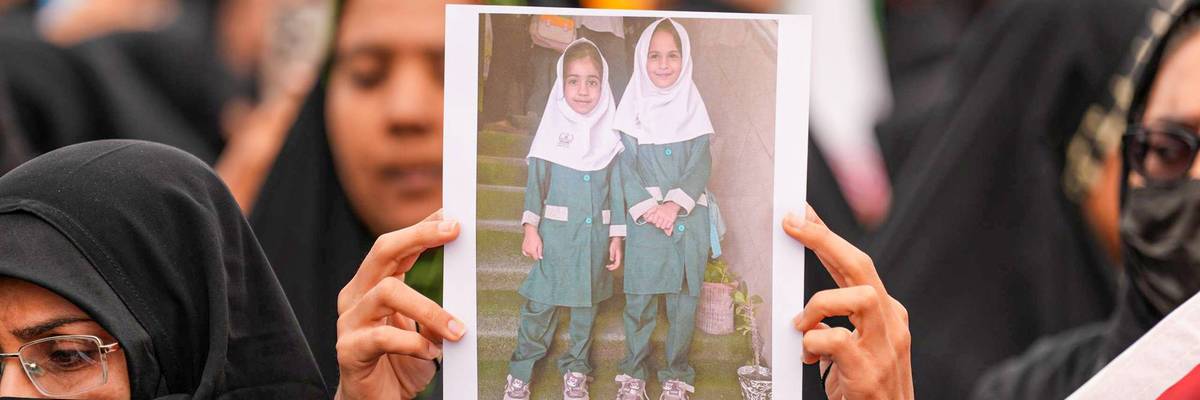
A mourner holds a photo of two victims of last week’s bombing of a girls’ school in Minab, Iran during a funeral gathering in Minab on March 3, 2026.
(Photo by Stringer/Anadolu via Getty Images)
Brett Wilkins
Mar 04, 2026
COMMON DREAMS
As the US and Israel continued to wage war on Iran Wednesday, paramedics and victims’ relatives said last weekend’s bombing of an elementary in southern Iran was a so-called “double-tap” airstrike—a common tactic used by US, Israeli, and Russian forces by which attackers bomb a target and then follow up with a second strike meant to kill survivors and first responders.
Iranian officials said that around 175 people—most of them young children—were killed when the Shajareh Tayyebeh girls’ elementary school in Minab was hit Saturday by what they said was a US-Israeli attack
“When the first bomb hit the school, one of the teachers and the principal moved a group of students to the prayer hall to protect them,” said one of two Iranian Red Crescent Society (IRCS) paramedics who spoke to Middle East Eye on condition of anonymity.
“The principal called the parents and told them to come and pick up their children,” the paramedic added. “But the second bomb hit that area as well. Only a small number of those who had taken shelter survived... Some parents recognized their children only because of the gold bracelets they were wearing.”
The father of a girl killed in the second strike on the facility told Middle East Eye that school officials “asked us to come as quickly as possible and take our daughter home.”
However, when he arrived at the school, “My little girl was completely burned.”
“There was nothing left of her,” he said. “We could only identify her from her school bag, which she was still holding.”
“When I saw her smile after coming home from work, all my pain disappeared,” the father added. “Now I don’t know what to do with this pain. I don’t know how to live with this.”
The mother of a boy slain in the strike told NBC News that the school also called her and told her to quickly come pick up her child.
“By the time we arrived, the entire school had collapsed on top of the children,” she said. “People were pulling out children’s arms and legs. People were pulling out severed heads.”
On Wednesday, Middle East Eye published a partial list containing the names and ages of 51 children—26 boys and 25 girls—one infant, and eight women killed in the school strike.
Thousands of mourners thronged the streets of Minab on Tuesday as funerals were held for the strike’s victims.
“The second bomb hit,” said one paramedic. “Only a small number of those who had taken shelter survived.”
A mourner holds a photo of two victims of last week’s bombing of a girls’ school in Minab, Iran during a funeral gathering in Minab on March 3, 2026.
(Photo by Stringer/Anadolu via Getty Images)
Brett Wilkins
Mar 04, 2026
COMMON DREAMS
As the US and Israel continued to wage war on Iran Wednesday, paramedics and victims’ relatives said last weekend’s bombing of an elementary in southern Iran was a so-called “double-tap” airstrike—a common tactic used by US, Israeli, and Russian forces by which attackers bomb a target and then follow up with a second strike meant to kill survivors and first responders.
Iranian officials said that around 175 people—most of them young children—were killed when the Shajareh Tayyebeh girls’ elementary school in Minab was hit Saturday by what they said was a US-Israeli attack
“When the first bomb hit the school, one of the teachers and the principal moved a group of students to the prayer hall to protect them,” said one of two Iranian Red Crescent Society (IRCS) paramedics who spoke to Middle East Eye on condition of anonymity.
“The principal called the parents and told them to come and pick up their children,” the paramedic added. “But the second bomb hit that area as well. Only a small number of those who had taken shelter survived... Some parents recognized their children only because of the gold bracelets they were wearing.”
The father of a girl killed in the second strike on the facility told Middle East Eye that school officials “asked us to come as quickly as possible and take our daughter home.”
However, when he arrived at the school, “My little girl was completely burned.”
“There was nothing left of her,” he said. “We could only identify her from her school bag, which she was still holding.”
“When I saw her smile after coming home from work, all my pain disappeared,” the father added. “Now I don’t know what to do with this pain. I don’t know how to live with this.”
The mother of a boy slain in the strike told NBC News that the school also called her and told her to quickly come pick up her child.
“By the time we arrived, the entire school had collapsed on top of the children,” she said. “People were pulling out children’s arms and legs. People were pulling out severed heads.”
On Wednesday, Middle East Eye published a partial list containing the names and ages of 51 children—26 boys and 25 girls—one infant, and eight women killed in the school strike.
Thousands of mourners thronged the streets of Minab on Tuesday as funerals were held for the strike’s victims.
It is not known whether the school, which is located near an Islamic Revolutionary Guard Corps compound, was deliberately targeted.
“All that I know is that we’re investigating that. Of course, we never target civilians,” said US Defense Secretary Pete Hegseth, who oversees a military whose 21st century wars have killed more than 400,000 noncombatants, according to the Costs of War Project at Brown University’s Watson Institute for International and Public Affairs.
US Secretary of State Marco Rubio said Monday that the Pentagon “would be investigating that, if that was our strike.”
“Clearly, the United States would not deliberately target a school,” Rubio added.
Since the late 20th century, the US has bombed—either deliberately or through inadequate target vetting and identification—schools in countries including Vietnam, Laos, Iraq, Afghanistan, and Pakistan.
If carried out by the US, Saturday’s strike in Minab is likely the deadliest American school bombing since 182 students, staff, and other civilians were massacred in an apparently deliberate secret strike on a school in Laos—the most heavily bombed country ever—during the Vietnam War.
Israel has bombed all levels of schools in Gaza as part of what critics have called a deliberate policy of scholasticide.
North Carolina-based independent journalist Lauren Steiner told Common Dreams Wednesday that the double-tap tactic is “beyond evil.”
Other such strikes have been reported during the US-Israeli war on Iran, including the Sunday evening bombing of Niloofar Square in Tehran, where people were celebrating the end of their daily Ramadan fast.
“Suddenly there was the noise and explosion,” one survivor, who was enjoying the evening at a café before the bombing, told Drop Site News. “We got up and a few people ran away. We turned around to get our belongings and we saw that blood was spraying everywhere. Someone’s hand had fallen on the floor, a head had fallen on the floor.”
“When the second one hit, suddenly everything exploded,” he added. “The windows all shattered... One of my friends whom I don’t know that well, he was sitting here... He was severed in half. Half of him was thrown to the side. I put him back together and placed him where he was. A piece of his brain was thrown here on the floor.”
“All that I know is that we’re investigating that. Of course, we never target civilians,” said US Defense Secretary Pete Hegseth, who oversees a military whose 21st century wars have killed more than 400,000 noncombatants, according to the Costs of War Project at Brown University’s Watson Institute for International and Public Affairs.
US Secretary of State Marco Rubio said Monday that the Pentagon “would be investigating that, if that was our strike.”
“Clearly, the United States would not deliberately target a school,” Rubio added.
Since the late 20th century, the US has bombed—either deliberately or through inadequate target vetting and identification—schools in countries including Vietnam, Laos, Iraq, Afghanistan, and Pakistan.
If carried out by the US, Saturday’s strike in Minab is likely the deadliest American school bombing since 182 students, staff, and other civilians were massacred in an apparently deliberate secret strike on a school in Laos—the most heavily bombed country ever—during the Vietnam War.
Israel has bombed all levels of schools in Gaza as part of what critics have called a deliberate policy of scholasticide.
North Carolina-based independent journalist Lauren Steiner told Common Dreams Wednesday that the double-tap tactic is “beyond evil.”
Other such strikes have been reported during the US-Israeli war on Iran, including the Sunday evening bombing of Niloofar Square in Tehran, where people were celebrating the end of their daily Ramadan fast.
“Suddenly there was the noise and explosion,” one survivor, who was enjoying the evening at a café before the bombing, told Drop Site News. “We got up and a few people ran away. We turned around to get our belongings and we saw that blood was spraying everywhere. Someone’s hand had fallen on the floor, a head had fallen on the floor.”
“When the second one hit, suddenly everything exploded,” he added. “The windows all shattered... One of my friends whom I don’t know that well, he was sitting here... He was severed in half. Half of him was thrown to the side. I put him back together and placed him where he was. A piece of his brain was thrown here on the floor.”
The IRCS says more than 1,000 Iranians have been killed during four days of US and Israeli bombing, with Iran’s retaliatory strikes killing six US service members, 11 Israelis, and a number of people in Gulf states that have come under Iranian bombardment.
“The enemy is exploiting every possible tactic to inflict maximum harm on our people,” IRCS spokesperson Mojtaba Khaledi said Tuesday. “We beg the public: Do not rush to bombed areas. The first moments after an explosion are the most dangerous—some munitions are programmed to detonate again, turning rescuers and survivors into additional victims.”
Some of the more infamous US double-tap strikes include the April 1999 Grdelica bridge bombing in Yugoslavia, which happened while a passenger train traveling from Belgrade, Serbia to Greece was crossing, killing more than 20 people; the March 2019 drone strike in Deir Ezzor, Syria that killed scores of civilians along with some Islamic State fighters; the April 2025 attack on Ras Isa port in al-Hudaydah, Yemen that massacred 84 civilians; and the bombing last September of a boat allegedly transporting drugs in the Caribbean Sea.
Israeli has carried out many double-tap strikes in Gaza, including last summer’s attack on Nasser Hospital that killed more than 20 people including five journalists, and the July 2024 massacre of more than 90 people in a purported “safe zone” in al-Mawasi. Israel is facing a genocide case currently before the International Court of Justice in The Hague, and Israeli Prime Minister Benjamin Netanyahu and former Defense Minister Yoav Gallant are wanted by the International Criminal Court for alleged war crimes and crimes against humanity, including murder and forced starvation.
“The enemy is exploiting every possible tactic to inflict maximum harm on our people,” IRCS spokesperson Mojtaba Khaledi said Tuesday. “We beg the public: Do not rush to bombed areas. The first moments after an explosion are the most dangerous—some munitions are programmed to detonate again, turning rescuers and survivors into additional victims.”
Some of the more infamous US double-tap strikes include the April 1999 Grdelica bridge bombing in Yugoslavia, which happened while a passenger train traveling from Belgrade, Serbia to Greece was crossing, killing more than 20 people; the March 2019 drone strike in Deir Ezzor, Syria that killed scores of civilians along with some Islamic State fighters; the April 2025 attack on Ras Isa port in al-Hudaydah, Yemen that massacred 84 civilians; and the bombing last September of a boat allegedly transporting drugs in the Caribbean Sea.
Israeli has carried out many double-tap strikes in Gaza, including last summer’s attack on Nasser Hospital that killed more than 20 people including five journalists, and the July 2024 massacre of more than 90 people in a purported “safe zone” in al-Mawasi. Israel is facing a genocide case currently before the International Court of Justice in The Hague, and Israeli Prime Minister Benjamin Netanyahu and former Defense Minister Yoav Gallant are wanted by the International Criminal Court for alleged war crimes and crimes against humanity, including murder and forced starvation.