It’s possible that I shall make an ass of myself. But in that case one can always get out of it with a little dialectic. I have, of course, so worded my proposition as to be right either way (K.Marx, Letter to F.Engels on the Indian Mutiny)
Saturday, March 14, 2026
ATSB: Cruise Ship's Chief Mate Distracted by ECDIS Ahead of Grounding
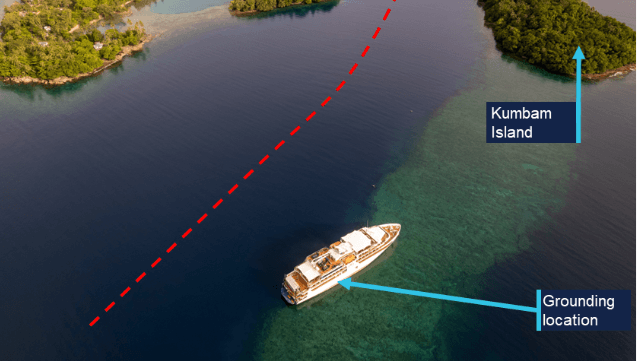
Coral Adventurer's grounding location and planned trackline, red (ATSB)
The cruise ship Coral Adventurer ran aground on a reef off Papua New Guinea after the ship's ECDIS declined to load the chief mate's route plan, the first in a series of events that led to the ship overshooting a turn and overcorrecting, according to the Australian Transport Safety Bureau (ATSB).
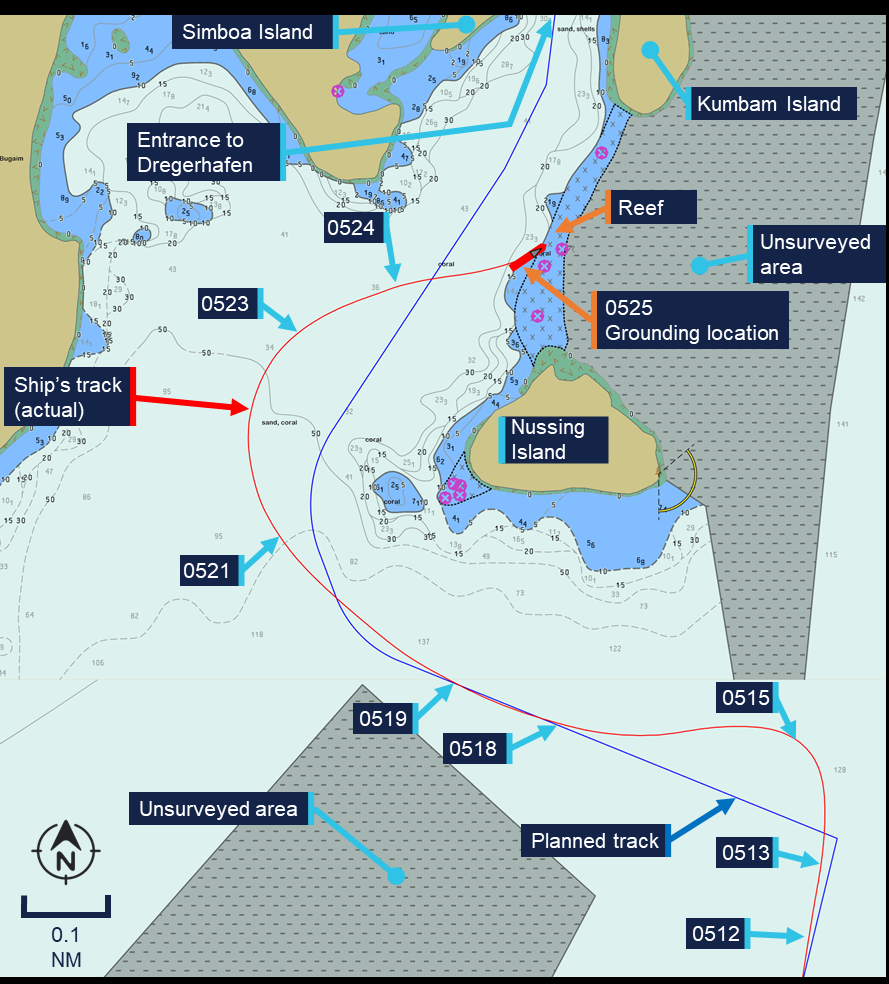
On the morning of December 27, 2025, Coral Adventurer was under way off the remote northeastern coast of Papua New Guinea and nearing the small port of Dregerhafen. The waters on the approach are ringed by reefs, with large areas poorly surveyed, and vessels have to execute two tight turns to reach the harbor entrance - first to port, then to starboard.
At the start of the 0400 watch, the cruise ship was approaching Dregerhafen's harbor entrance. The chief mate had the conn, and decided to adjust the route in the ECDIS to smooth out the second of the two turns of the transit, thereby creating a new route plan in the digital chart system's storage. The new Route 2 still adhered closely to the passage plan's track, but with an extra waypoint.
At 0512, as the approach to the port was in progress, the mate selected this modified route and tried to activate it. The ECDIS declined to do so until after it had performed a route safety check in its route editor tool.
The chief mate had to go through the process of this digital check mid-transit. At 01513, the Coral Adventurer missed its first wheel over point and overshot its turn to port. This put it on course to enter unsurveyed and potentially hazardous waters to the north of the route. The chief mate put steering in manual and made a harder turn to get back onto the route. The vessel returned to the planned track, but slowed down, affected by a strong current at the entrance channel.
The chief mate increased RPM on both thrusters to offset the current, which had reduced speed to less than four knots. With the throttes pushed up, the mate put steering back into autopilot at about 0518, in advance of the second turn. At 0519, the vessel arrived at the second wheel over point, making eight knots. The vessel overshot the turn again, prompting the mate to switch back to manual once more at 0521. The ship was off course to the west of the intended trackline, and the mate made a hard turn to starboard to get onto the planned track.
At this point, the chief mate lost situational awareness, they later told investigators. In darkness and without navigation aids, they did not have a sense of the surrounding topography. The mate kept up the high rate of turn to starboard until 0523:30, coming up on a northeasterly heading back towards the trackline. Misinterpreting the view ahead and believing that the ship was back on track, the mate continued to navigate across the trackline, making more than eight knots.
At 0524, the master arrived on the bridge, and visually spotted shallow water ahead; the ship grounded about 15 seconds after the master's warning. The Coral Adventurer came from 8.5 knots to a halt by 0525:30.
Dive inspections revealed that the hull was not penetrated, and that the propulsion was intact. A tug was chartered for a refloat attempt, but this was initially unsuccessful, as the tug's engines overheated during the effort. A larger tug was dispatched, and the Coral Adventurer was successfully refloated on December 30.
Wednesday's report is a factfinding summary, without causal findings. ATSB's inquiry into the cause of the grounding remains under way.
Sweden Intensifies Crackdown on Stateless Vessels with Second Detention
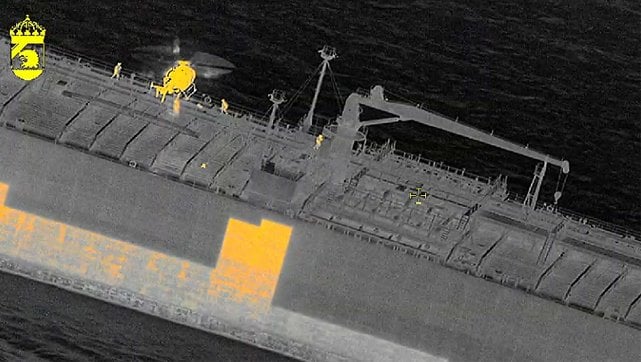
Swedish police helicopter used in the detention of the product tanker (Swedish Coast Guard)
Authorities in Sweden are intensifying a crackdown on unseaworthy vessels that they suspect could be linked to Russia’s shadow fleet. For the second time in a week, Sweden has boarded a vessel transiting through its territorial waters due to concerns of seaworthiness and the belief that the vessel was operating under a false flag. Late on Friday, prosecutors decided to arrest the captain as the investigation continues.
On Thursday evening, March 12, the Swedish Coast Guard, aided by the police, executed a planned operation to intercept the product tanker Sea Owl I (74,998 dwt). The operation was a combination of a police helicopter and a speedboat stopping the tanker off Trelleborg.
Built in 2007, the ship is 228 meters (748 feet) in length. It was claiming to be operating under the Camaros flag since 2025, but that is believed to be a false registry. Ownership is listed as a corporation in the Marshall Islands, and the Swedish authorities report that the vessel, in recent years, has transported oil products between Russia and Brazil. The European Union sanctioned the vessel in October 2024 for its involvement in the Russian oil trade, and the UK sanctioned it in October 2025. The United States has sanctioned the vessel’s former managers.
The Sea Owl I was coming from Santos, Brazil, with ballast, and its AIS was saying it was bound for Tallinn, Estonia, although the Swedish authorities report it was heading to Primorsk, Russia. The decision to stop the ship, they reported, was based on seaworthiness concerns. The ship had its class withdrawn in October 2024, and records show its last inspection was in 2023.
“Our overall assessment is that the risk of safety deficiencies on board is too high. On this basis, the vessel cannot be allowed innocent passage. The threats to maritime safety and the environment are too high. Therefore, there is a basis for an intervention against the ship,” said Daniel Stenling, Swedish Coast Guard Deputy Chief of Operations.
The authorities added that while investigations at this stage are focusing on the vessel’s lack of seaworthiness, the scope of the probe could broaden depending on the development of events and as more Swedish authorities get involved. The authorities were conducting searches on board, interviewing crewmembers, and investigating the suspected false documents, said senior prosecutor Adrien Combier-Hogg.
Prosecutors reported on Friday that they have expanded the preliminary investigation to include the master of the ship, a Russian citizen. They said the master presented false documents, which is a felony under Swedish law. He was later arrested on probable cause, suspected of using a false document. The prosecutor must decide by noon on Monday whether the ship's captain should be remanded in custody or whether he should be released.
The boarding and detention of the Sea Owl I is the second incident by Swedish authorities in a span of days. On March 6, Sweden detained the cargo ship Caffa that was sailing under a false flag. The captain of that vessel is also under detention for allegedly presenting multiple false documents to the authorities. The cargo ship is being detained for safety deficiencies identified during a Port State inspection.
Philippine Coast Guard Rescues Engineer Trapped on Capsized Ship
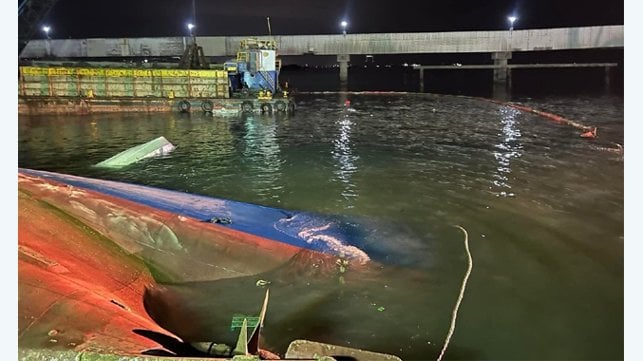
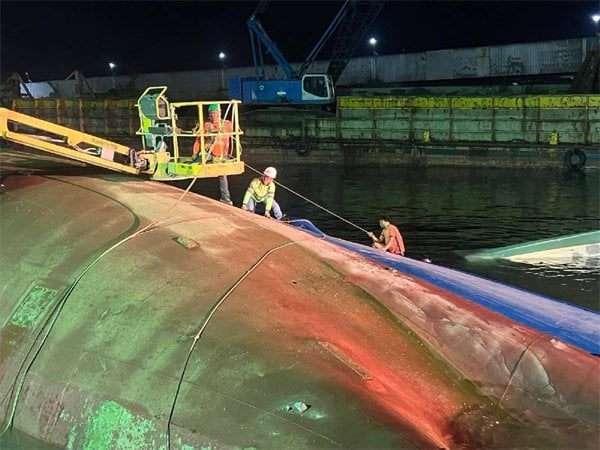
The Philippine Coast Guard responded to the reports of a capsized cargo ship in Cebu province on March 11. It was able to rescue the crew of the vessel, but reports that one dockworker was killed in the incident.
A small inter-island cargo ship named Theresa I was docked at the APO Cement Port in Naga City, Cebu. It was conducting a loading operation, which involved a de-ballasting procedure. The vessel lost stability, rolling to one side, which caused the cargo to shift, and the vessel capsized.
As the vessel capsized, one of the mooring lines snapped. It hit a dock worker from the cement plant, who was taken to a hospital where he was pronounced deceased.
There were 19 crewmembers aboard the ship, and according to the details from the Coast Guard, when they arrived, they heard sounds coming from the ship. One of the engineers was trapped in the engine room of the vessel. They were able to extricate him from the ship, and he was reported to be receiving medical attention.
The other crewmembers were accounted for. They were reported to be in good condition.
The Coast Guard deployed 100 meters of oil spill boom around the vessel. They are monitoring for possible oil leaks and report that an investigation is underway regarding the incident.
World’s Largest Sail Yacht Cruise Ship Sets New Mark on Trials
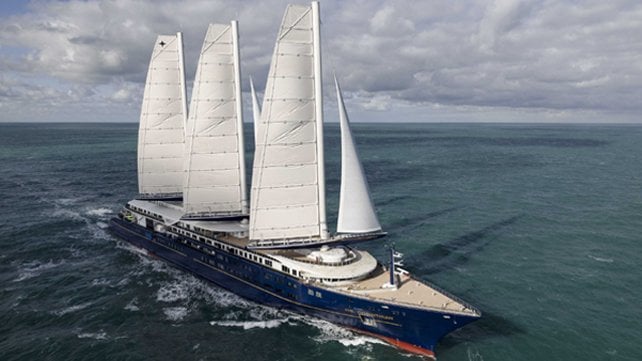
Orient Express Corinthian reached 12 knots under sail with a 20 knot wind (Chantiers de l'Atlantique)
The sail-powered cruise ship Orient Express Corinthian recently completed its propulsion tests, and builder Chantiers de l’Atlantique reports the ship achieved a speed first for a sailing ship of its size. The ship is preparing for its delivery and entry into service in May 2026 as Accor Group launches its first cruise offering.
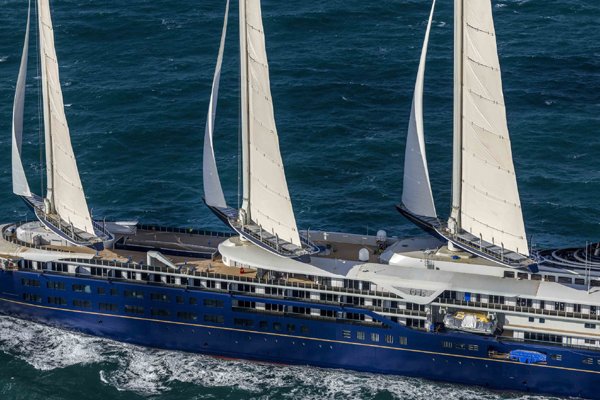
The Orient Express Corinthian is a 25,200 gross ton cruise ship that will have 54 suites with a capacity for 110 passengers. The ship measures 220 meters (721 feet) in length and employs Chantiers de l’Atlantique’s revolutionary Solid Sail system with three masts and a total of 4,500 square meters (nearly 48,500 square feet) of sail surface. It also has an LNG-fueled motor. The next largest sail cruise ships in the world are 15,000 gross ton sister ships operated by Wind Star and Club Med.
The cruise ship undertook its first sea trials in December, and Chantiers reports it recently completed propulsion tests. With a wind speed of 20 knots, it reports the Orient Express Corinthian reached 12 knots while solely under sail. Chantiers says that this is a first for a ship of its size. Orient Express reports the ship will be able to reach speeds of up to 17 knots.
Accor announced its entry into the cruise segment in 2023 with the order of two of the sail cruise ships as part of its efforts to expand the famed Orient Express brand. The ships are designed for the ultra-luxury category and will feature five restaurants and private dining spaces as well as suites ranging between 485 square feet and nearly 2,500 square feet. There will be a fitness and yoga studio as well as a spa and outdoor swimming pool. The ship also has a retractable marina.
The Orient Express Corinthian features three 69-meter (226-foot) carbon fiber masts mounted on the unique balestron rigs. Each provides 1,500 square meters of sail area, and the base provides the ability to rotate the sails 360 degrees as well as a tilt of up to 70 degrees. The maximum air draft is 100 meters (328 feet), but the tilt makes it possible to sail under low bridges or other obstacles.
Chantiers de l’Atlantique released the first concept for a sailing ship, Eoseas, in 2009 and has been working to refine and adapt the design for applications including large cruise ships. A series of tests was conducted between 2016 and 2019, with it first being tested with a 50-square-meter one-fifth-size demonstrator. Chantiers installed a demonstration at its yard in St. Nazaire, France.
The cruise ship was floated for the first time in June 2025 after approximately four and a half months of assembly. By September, construction had reached a critical point as the three masts were raised for the first time.
The first steel cuts for the second ship, Orient Express Olympian, started at the end of January 2025, and the first block was placed in the dry dock in November. The second ship is scheduled for delivery in the spring of 2027.
Orient Express’ sister ships are part of a new phase of ultra-luxury cruising as the hotel brands seek to enter the market. Four Seasons recently took delivery of its first ultra-luxury cruise yacht, which also begins service this spring and will be followed by at least one sister ship. Ritz-Carlton also entered the ultra-luxury cruise segment with its smaller yacht Evrima (25,400 gross tons) in 2022, followed by two larger ships, Ilma and Luminara, which are 46,750 gross tons. The hotel brands are expected to draw new travelers to the cruise industry and will establish a higher, aspirational price point for the segment, which is already experiencing rapid growth.
Italy and Malta Monitor Burnt-Out Gas Carrier Drifting Between Their Shores
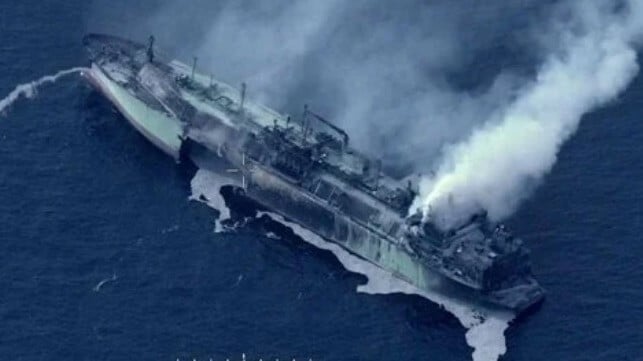
The wreck is drifting back and forth between Malta and Italy
Italian and Maltese authorities are working together closely monitoring the hulk of the Russian-flagged gas carrier Arctic Metagaz. Both countries remain on alert as the vessel has drifted back and forth, approaching each country, and then, with the tides and winds, has been driven further out to sea.
The vessel has been in this precarious situation for days after it exploded on March 4 at a position approximately 150 miles south of Malta. At the time, it was in the Libyan zone, with Libya’s authorities overseeing the rescue of the crew and landing them in Tripoli. Since then, Libya has relinquished authority as the wreck was driven to the north.
The Italian government convened a special session on Friday, March 13, attended by Prime Minister Giorgia Meloni and other senior officials. They discussed the situations and reviewed the latest data from the Italian Navy. Reports said that the European naval air operation EuNavfor Med IRINI also overflew the wreck to assess its position and condition.
Pictures confirmed that the 277-meter (909-foot) gas carrier is severely damaged. In addition to the large section of the port hull that is missing, there is a second hole on the starboard side. The aft section of the vessel, including the accommodation block and bridge, is all burnt.
While the vessel is down at the stern and appears to be listing, the belief is that the double hull and safety features in the design of an LNG carrier have kept the vessel afloat. The ship appears to have taken on a significant amount of water, but the separations in the hull prevented it from overwhelming the ship.
The latest estimates are that as much as 60,000 tons of LNG remain in the two forward tanks, undamaged in the explosion and fire. The ship had a total capacity of approximately 140,000 tons of LNG. In addition, the authorities are reporting that there are 900 tons of heavy oil and diesel fuel aboard the vessel.
Earlier in the week, the hulk had drifted to a position within about 20 nautical miles of Malta. The authorities issued an alert and established a 5-mile exclusion zone. They said they were prepared with a plan to handle the wreck if it continued to approach Malta.
Winds and currents next drove the wreck to within about 25 to 30 nautical miles from Linosa, an island in the Italian Pelagie Islands. The Italian Navy reportedly sent a vessel and was positioning tugs and a pollution control vessel.
The hulk, however, has again drifted toward Malta, with the last reports placing it about 60 nautical miles offshore. The Maltese authorities had previously said they were contacting the vessel's agents to determine what action they were planning.
The Italian government, in a statement after its meeting today, said the vessel is now in the Maltese SAR zone. The Italian government assured the government in Malta that it would share monitoring information and confirmed its readiness to support Malta. It said the actions would depend on the decision of the Maltese authorities while the vessel remains in its current position.
Video: US Coast Guard Cutter Forward Interdicts Smugglers’ Go-Fast Boat
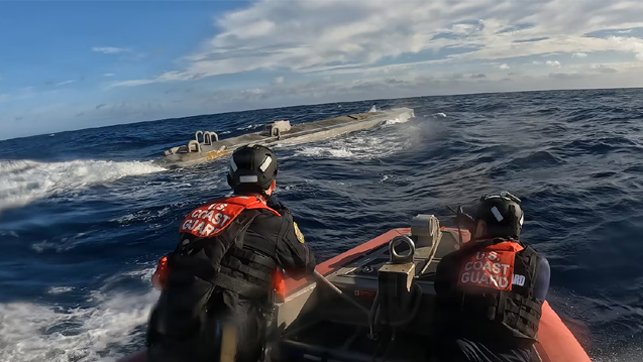
US Coast Guard teams stopping a go-fast boat in the Eastern Pacific (USCG)
The U.S. Coast Guard released videos showing its crews in action during the interdiction of a go-fast boat in the Eastern Pacific. According to the details, the cutter Forward was conducting standard patrols in the Pacific when it was alerted to the boat on February 24.
A maritime patrol aircraft detected the vessel and reported the location to Forward. The cutter deployed its over-the-horizon cutter pursuit boat and an embarked MH-65 aircraft from the Helicopter Interdiction Tactical Squadron (HITRON) to intercept the suspicious vessel. The Coast Guard reports the semi-submersible (SPSS) was more than 70 feet in length.
Despite repeated verbal commands issued by the boarding team, the self-propelled semi-submersible failed to comply or stop. The boarding team finally successfully gained access to the vessel and apprehended four suspects from the boat.
They reported, however, that the semi-submersible was experiencing flooding. Everyone was evacuated from the boat, which subsequently sank without the recovery of any narcotics from the vessel.
“SPSS vessels are purpose-built to move large quantities of illicit, dangerous cargo,” said Cmdr. Andrew Grantham, commanding officer of the Forward. “This interdiction of an SPSS prevented a potential 17,600 lbs of cocaine—more than 6 million lethal doses—from reaching U.S. shores. Stopping this vessel demonstrates the exceptional skill and dedication of the Forward crew, the HITRON, Joint Interagency Task Force South, and Coast Guard District Southwest.”
Coast Guard Cutter Forward is a 270-foot Famous-class medium-endurance cutter that conducts counterdrug, migrant interdictions, and search and rescue missions throughout the Western Hemisphere. The vessel was commissioned for the Coast Guard in 1990.
US Targets Military on Iran’s Kharg Island Demanding Opening of Hormuz
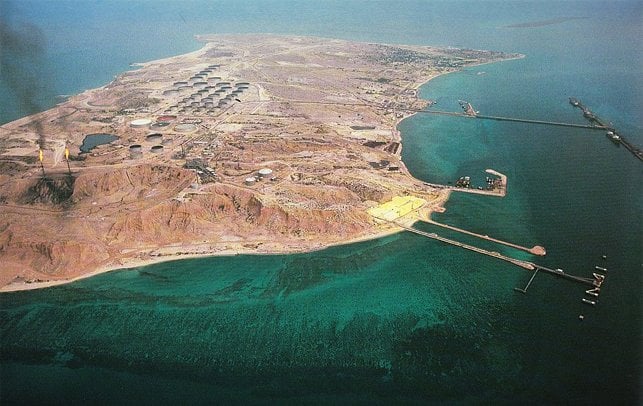
U.S. reports it struck military targets on Kharg Island, Iran's primary oil export termina (public domain picture)
The U.S. military launched strategic bombing on Iran’s Kharg Island, the home of Iran’s oil export industry. In a posting on social media, Donald Trump announced on Friday evening the attack while saying this time it had been limited to military targets, while also demanding free and safe passage in the Strait of Hormuz.
Trump called it “one of the most powerful bombing raids in the history of the Middle East,” while saying that “Iran has no ability to defend anything we want to attack.” He reported that the U.S. “totally obliterated every military target” on the island.
A small island only about five miles in size, it is located in the northern Persian Gulf near Kuwait and serves as the export terminal for the vast majority of Iran’s oil. Since the start of the bombing two weeks ago, Iran had reportedly also opened a southern terminal and was pumping out crude at record levels.
Kharg is located about 15 miles off the coast of the Iranian mainland and about 300 miles north of the Strait of Hormuz. Reports indicated Iran had increased the pace of loading at the terminal in recent days. Shadow tankers and those heading to China were believed to be loading and making their way through the Strait of Hormuz.
”For reasons of decency,” Trump writes, “I have chosen not to wipe out the oil infrastructure on the island. However, should Iran, or anyone else, do anything to interfere with the free and safe passage of ships through the Strait of Hormuz, I will immediately reconsider this decision.”
Centcom or the Pentagon has not yet released further details on the strikes and how they were executed. Earlier in the day, Pete Hegseth had said the U.S. would be intensifying its assaults on targets in Iran. Centcom highlighted that B-2 stealth bombers had been deployed to conduct a mission “delivering long-range fire to not only eliminate the threat from the Iranian regime today, but also eliminate their ability to rebuild in the future.”
Speculation had been building on whether the U.S. or Israel would target Kharg Island. So far, reports are that it had not been targeted during the operations. An unconfirmed story said that the Trump administration was contemplating a series of special forces operations inside Iran, potentially including a raid to seize Kharg Island, according to Axios. Today, The Wall Street Journal reported that a Marine Expeditionary Unit had been dispatched from its base in Japan to join the forces in the region and would be bringing additional sophisticated aircraft to join the forces.
Hegseth said at the Friday morning briefing that the U.S. did not have definitive information that Iran was mining the Strait of Hormuz. It was highlighted that Iranian and possibly Chinese ships were making the transit, while Hegseth said the only thing stopping ships was Iran’s firing missiles, which he said would soon be stopped.
Financial pressure has been building, and concerns over the global economy are rising as oil hovers around the $100 a barrel level and is expected to continue to climb. The Trump administration is taking as many steps as it can to slow the price rise, including a release from the U.S. strategic reserves. It also announced a 30-day waiver of sanctions to permit Russian oil loaded and at sea to be sold.
Reopening the Strait of Hormuz is critical, however, due to the volumes that come from the region and the psychological impact. The Trump administration is saying it is a temporary disruption, saying prices will quickly fall and that the short-term pressure is acceptable to achieve its long-term goals for the region.
Report: US Amphibious Ships with Marine Unit Head to Middle East
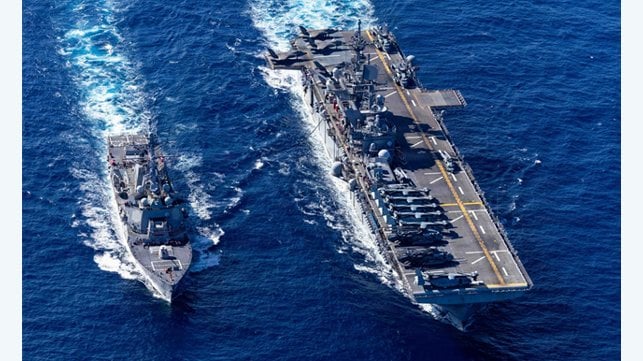
USS Tripoli (LHA 7) in the Philippine Sea, Feb. 10, 2026, with the Arleigh Burke-class guided-missile destroyer USS Rafael Peralta (USN)
Multiple media outlets are reporting that the Pentagon has approved the redeployment of possibly three USN amphibious vessels, along with a Marine Expeditionary Unit, to the Middle East. It comes as Secretary of War Pete Hegseth said the U.S. was increasing its strikes to the “highest number” while he said the U.S. was “dealing with” the attacks on shipping and the Strait of Hormuz.
Citing information from three sources, The Wall Street Journal broke the news that the Pentagon approved moving a Marine expeditionary unit and more warships to the Middle East. It said the request for the additional capabilities had come from CENTCOM. The Wall Street Journal speculated it could involve up to 5,000 Marines and sailors.
ABC News added additional details, saying that it would consist of three U.S. Navy amphibious ships and a unit of 2,200 Marines. They reported the 31st MEU, based in Japan and which operates in the Indo-Pacific region, has been ordered to head to the Middle East. Satellite pictures appearing online appear to show at least one amphibious ship having departed on March 11 and traveling at high speed.
Speculation is that the force consists of the USS Tripoli (LHA-7), USS San Diego (LPD-22), and USS New Orleans (LPD-18). Typically, this type of deployment would also consist of a transport dock vessel and support ships to carry additional equipment for the Marines.
Donald Trump and Hegseth have not ruled out the use of ground forces, although so far they have said there was no need. All options remain open, according to the reports, but for now, they highlight that the amphibious ships would bring additional advanced aircraft into the region. The MEU includes a squadron of F-35 Flighting II jets and a squadron of the Osprey tilt-rotor aircraft. Speculation is that these could be used in the efforts to secure the Strait of Hormuz.
Hegseth scoffed at reports that the Strait of Hormuz has been mined, saying they did not have any clear evidence of mines. He pointed to ships that have been transiting the shipping lane. He said that the United States “has a plan for every option,” while asserting, “The only thing prohibiting traffic in the strait at the moment is Iran shooting at shipping.” He said the U.S. would not permit the strait to remain “contested.”
Speaking at around the same time today, U.S. Treasury Secretary Scott Bessent told the UK’s Sky News, "My belief is that as soon as it is militarily possible, the U.S. Navy, perhaps with an international coalition, will be escorting vessels through." He also pointed to Iranian and possibly Chinese tankers transiting the strait as proof that it is still open.
Two Tankers Burn Off Iraq After Suspected Drone Boat Strike
[Breaking] Two tankers have reportedly been hit by unknown projectiles in the Arabian Gulf, according to UK Maritime Trade Operations (UKMTO).
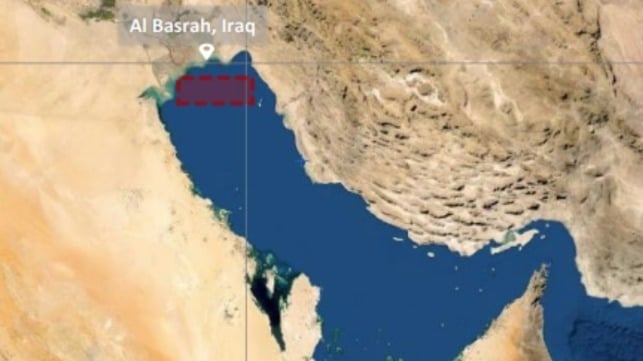
Two ships were reportedly struck at a position just south of Basrah, within Iraqi waters. Bystander video from a nearby vessel suggests that they were adjacent to each other and potentially engaged in an STS transfer at the time of impact. The video shows a spreading pool of burning oil surrounding the vessels.
Iraqi authorities identified the vessels as the LR1 tankers Zefyros and Safesea Vishnu. The former is Greek-owned, and the latter is operated by an Indian-linked, U.S.-based shipping company with offices in New Jersey. One was carrying a cargo of gas condensate from the Basrah Gas Company, an Iraqi JV company part-owned by Shell, according to local Shafaq News.
Iraqi Lt. General Saad Maan told Al-Iraqiya News that the attack was an act of sabotage and a violation of Iraqi sovereignty. Six response vessels were dispatched to rescue the survivors from the two tankers, he said.
According to Lt. Gen. Maan, the body of one deceased seafarer was recovered. Local reports indicate that some of the survivors were injured; assessments were still in progress Thursday morning.
The fire has since been extinguished by Iraqi first responders, according to local reports.
Iraqi authorities say that early signs point to a drone-boat attack. The strike would align with a pattern of Iranian attacks on merchant shipping in the Arabian Gulf; more than a dozen vessels have been hit since February 28, and the number continues to rise.
This story is developing and will be updated as more information comes in.
Vancouver Posts Record Growth in Throughput as Canada Diversifies Trade
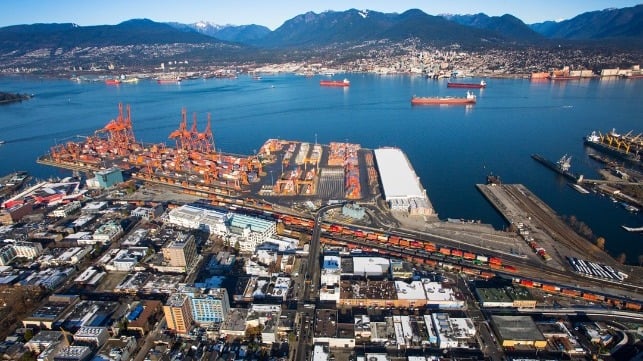
Vancouver reported a record year as Canada moves to grow its non-US trade (Port of Vancouver)
Canada’s push to increase exports to overseas markets, particularly in Asia owing to increasing protectionism by its key trading partner, the U.S, is having the desired effects. The country’s largest port, Vancouver, has seen cargo throughput hit record highs.
The Port of Vancouver is highlighting the impacts of the government’s efforts to double exports to non-U.S. markets, reporting record cargo volumes in 2025. The port handled 170.4 million metric tonnes (mmt) of cargo during the year, an eight percent increase compared to 2024. Notably, international volumes recorded an 11 percent increase to 147 mmt, including exports growth of 12 percent to 127.5 mmt.
During the year, more than three-quarters of international volumes passing through Vancouver were destined to or coming from Indo-Pacific countries. The top trading partners through the port in 2025 were China, accounting for 36 percent of the total international volumes, followed by Japan at 13 percent and South Korea at nine percent.
“As Prime Minister Carney looks to double exports to non-U.S. markets in the next decade, the Port of Vancouver is playing an outsized role in delivering more made-in-Canada products to more customers globally,” said Peter Xotta, Vancouver Fraser Port Authority President and CEO. He added that the port is uniquely poised to support Canada’s bold trade goals because of decades of strategic investments in terminal and rail capacity, developments that show the world that the country is open for business.
For Vancouver, which is making significant investments in infrastructure expansions to cement its position as Canada’s largest and North America’s most diversified port, growth was recorded in most of its business segments, with the bulk sector, which is 98 percent export driven, being the banner after posting an 11 percent growth to reach a record 130.7 mmt in 2025. Containerized cargo and auto trade also posted strong performances.
During the year, the port saw grain exports hit a new record of 30.3 mmt on the back of strong wheat exports, while potash exports surged to 10.5 mmt, breaking the previous record set in 2020. Growth was also recorded for crude oil exports, which doubled to reach 24.4 mmt. Key markets for the bulk exports were in the Indo-Pacific, Europe, Central America, and the Middle East regions.
On containerized cargo, Vancouver’s four container terminals handled 3.8 million TEUs in 2025, nine percent higher than 2024 and three percent higher than the previous record set in 2021 of 3.7 million TEUs. On the auto segment, the port handled almost 480,000 vehicles, representing a two percent increase.
Despite growth in most segments, the port recorded a decline in breakbulk cargo that plunged by 15 percent to 12.9 mmt, while cruise passenger visits declined by 11 percent to 1.2 million. Cruise ship visits were down by eight percent to stand at 300.
The Port of Vancouver is highlighting that as Canada prepares to double non-U.S. exports in the coming decade, the port is accelerating investments in infrastructure expansions to position itself to benefit from the expected boom. Some of the major projects include the Roberts Bank Terminal 2 for containers, which is expected to unlock $100 billion in additional annual trade capacity.
South Africa Arrests and Fines Four Chinese Vessels for Illegal Fishing
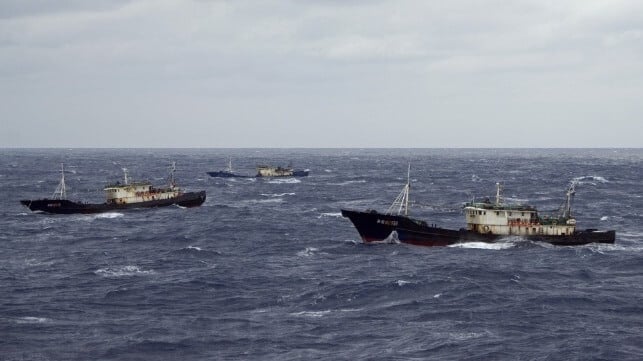
South Africa was the latest nation to report catching illegal Chinese finsing off its coast (USCG file photo)
South African authorities have intercepted and fined four Chinese distant-water fishing vessels that were suspected of engaging in illegal fishing. The boats entered South African waters without permits and repeatedly switched their automatic identification system (AIS) on and off.
The four Chinese-flagged fishing vessels, Zhong Yang 231, Zhong Yang 232, Zhong Yang 233, and Zhong Yang 239, are said to have entered the country’s Exclusive Economic Zone (EEZ) and territorial waters without the required authorization. The vessels are owned by Chinese company Shenzhen Shuiwan Pelagic Fisheries Co.
Officers from South Africa’s Department of Forestry, Fisheries and the Environment working with the police carried out a coordinated operation that led to the interception of the vessels. They were detained at the Port of Cape Town anchorage.
According to the government, the four vessels initially requested permission on February 23 to pass through South Africa’s EEZ under “innocent passage,” indicating they would exit by March 3. However, on February 27, the South African Maritime Safety Authority reported that the vessels had also applied for off-port limits (OPL) authorization without the required justification or documentation. The request was rejected.
Further investigations revealed that the vessels had already entered the country’s territorial waters while the OPL request was under consideration. The boats were detected within 12 nautical miles of the KwaZulu-Natal coast and later tracked along the Eastern Cape coastline.
Authorities said that during this time, the vessels repeatedly switched AIS on and off. That is a violation of regulations requiring foreign vessels to keep their AIS active while transiting national waters.
Investigations into the conducts of the vessels prompted authorities to charge the masters of the vessels for non-compliance with the Marine Living Resources Act 18 of 1998. The masters were fined an administrative penalty of $24,118, which the owner of the vessels paid, leading to the release of the vessels and subsequent departure from the country.
“South Africa will not tolerate the unlawful use of its maritime zones,” said Willie Aucamp, Minister of Forestry, Fisheries and the Environment. “We remain resolute in safeguarding our marine resources and ensuring that our ports are not perceived as ports of convenience. Compliance with our laws is non-negotiable.”
South Africa, which has a vast coastline measuring 3,000-kilometres, is among African countries that are grappling with the challenge of declining fish stocks due to illegal, unreported, and unregulated (IUU) fishing, a problem being exacerbated by Chinese long distant fishing fleets.
The World Wildlife Fund contends that South Africa alongside Kenya, Madagascar, Mozambique, and Tanzania lose up to $142.8 million annually due to illegal fishing of shrimp and tuna.
Supply Boat Caught Smuggling Drugs Now Issued a Distress Call off Australia
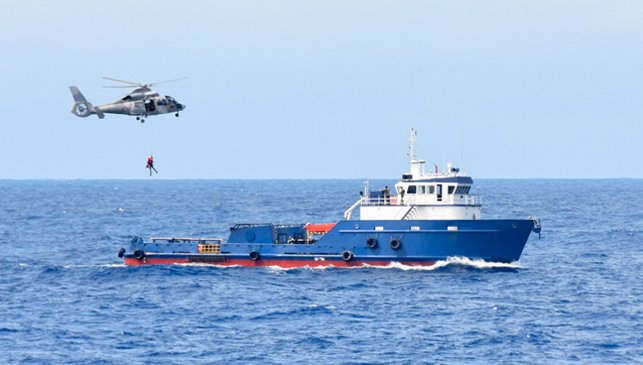
French troops boarded the vessel off Polynesia and seized nearly 5 tons of cocaine (High Commissioner of French Polynesia)
Nearly two months after French authorities intercepted a small vessel smuggling a large amount of cocaine across the Pacific, the same vessel has now turned up off Australia and issued a distress call. ABC News Australia reports the vessel was escorted into Sydney harbor on Friday, March 13, after the Australian Maritime Safety Authority became involved.
The vessel named Raider is reported to have made a distress call on Thursday, reporting a shortage of food and fuel. A representative of the International Transport Workers Federation told ABC News that when they contacted the ship, they were told it was down to just 200 liters of water for the 11 crew onboard.
AMSA coordinated the response, including the provisioning of supplies to the vessel. It escorted the Raider to a detention area in Sydney while reporting they were also working with the Australian Border Force and New South Wales Police.
The Raider first drew attention from the French Navy, which boarded the vessel in French Polynesian waters on January 16. A search discovered 96 bales containing a total of 4.87 tons of cocaine. In a decision that was later questioned by some, the French forces decided to seize the drugs but released the vessel and its crew. The cocaine was disposed of in the ocean, and the Raider was permitted to continue on its voyage.
Authorities noted at the time that the drugs were likely being smuggled to Australia and were not destined for French Polynesia. They said the region had become part of a known smuggling route for drugs from South America.
The ship next turned up in the Cook Islands after issuing another distress call. It stopped in the Cook Islands to make engine repairs. Later, ABC News reports it was heading toward Australia but briefly diverted toward New Caledonia before arriving off the Australian coast.
ITF’s Australian coordinator, Ian Bray, told ABC News the crew is from Ecuador and Honduras, and they were hired in December to sail the vessel from Panama to Australia. They understood they were delivering the Raider to its new owners in Australia.
ABC reports the crew has not been arrested. They are unlikely to face any charges, as the drug smuggling was discovered outside Australian authority.
The crew is expected to be held in immigration detention, reports ABC. AMSA is checking the Raider to determine if the vessel is seaworthy. The crew from the Raider is likely to be repatriated to Central America, while it is unclear what will happen to the vessel.