Saturday, March 14, 2026


Rio Tinto’s Kennecott copper mine suspends operations as contract worker dies


Bingham Kennecott mine, Utah, site of one of the only copper smelters in the US. Credit: Adobe Stock

An employee of a contracted company died on Thursday following an incident at Rio Tinto’s Kennecott mine in Utah, the world’s largest producer of iron ore said on Friday without providing further details.

Operations at the Kennecott mine site have been suspended following Thursday’s accident, the Anglo-Australian miner said, while its CEO Simon Trott said he would travel to Kennecott.

The Kennecott copper mining operation is one of the top-producing mines in the world, according to the company’s website.

The death is the latest in a series of fatal incidents across a few of Rio’s mines, with the miner reporting the death of a contract worker last month at its SimFer mine, a part of Guinea’s Simandou iron ore project.

(By Shivangi Lahiri; Editing by Alan Barona and Arun Koyyur)


ERG urges Congo to end illegal mining after deadly landslide


Boss Mining Project (Image: ERG)

A Eurasian Resources Group unit urged the Democratic Republic of Congo to stop illegal mining activities on one of the firm’s copper licenses following a deadly landslide.

Illicit mining caused the landslide on March 11 that “led to fatalities and injuries,” Boss Mining SAS said in a statement Thursday. The copper producer – in which ERG owns a 51% stake – said the Congolese authorities should restore its “lawful access to these areas.”

Congo’s mineral-rich southeastern region has made the country the world’s leading supplier of battery metal cobalt and No. 2 producer of copper. While industrial operations account for most output, hundreds of thousands of so-called artisanal miners work in the informal economy, often digging up ore within permits held by major companies.

Boss Mining has alerted Congo’s government since 2022 to the “significant risks posed by the heavy presence of illegal, semi-mechanized and unauthorized” mining on its concession, according to the statement. The firm’s employees “have been denied access to this site due to the presence of unauthorized armed individuals,” it added.

The company didn’t say how many people were injured or killed by the landslide.

ERG also has other assets in Congo, including the Frontier copper mine and Metalkol, which is one of the world’s largest sources of cobalt. Congo’s state-owned Gecamines owns 49% of Boss Mining.

Luxembourg-registered ERG is 40% owned by the government of Kazakhstan, where the company produces iron ore, ferrochrome and aluminum.

(By William Clowes)


Congo state company launches country’s first gold refinery


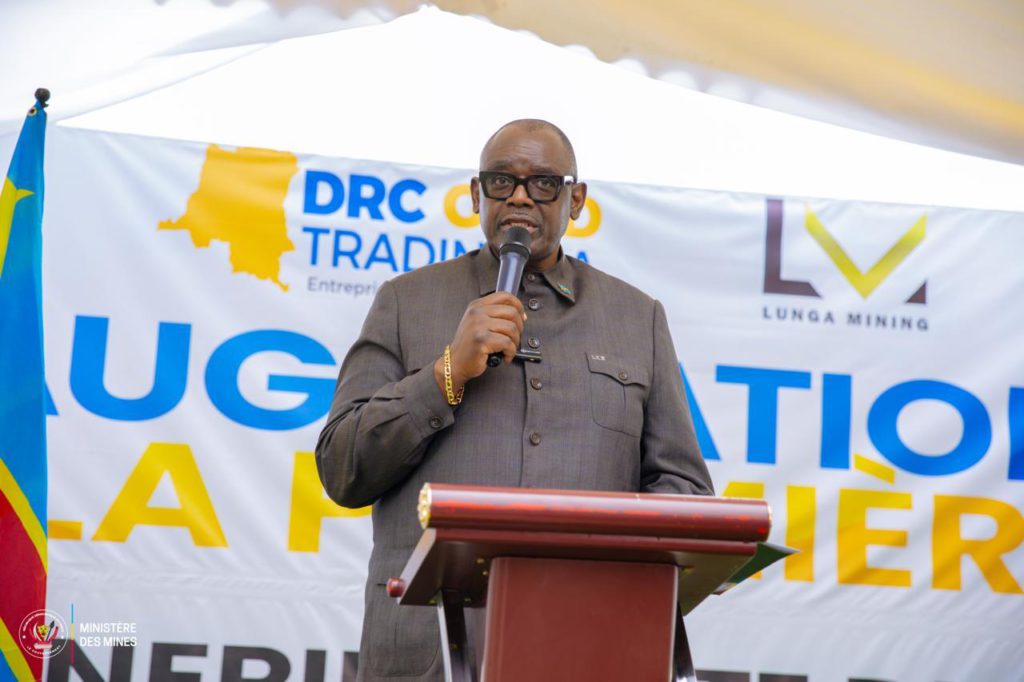
Louis Watum Kabamba, Congo’s mines minister, at the refinery opening ceremony. Credit: Ministère des Mines – RDC

Democratic Republic of Congo launched its first state-backed gold refinery as it moves to formalize a trade historically linked to smuggling and conflict in the country’s mineral-rich east.

State-owned DRC Gold Trading SA is partnering with Lunga Mining SA to create DRC Gold Refinery SA with a goal of producing as much as 600 kilograms (1,320 pounds) of gold per month, the mines ministry said in a post on X.

The refinery in the city of Kalemie on Lake Tanganyika will process gold purchased from Congo’s artisanal miners, according to the ministry.

DRC Gold Trading begun operations three years ago under the name Primera with the view to capture revenue from an informal gold sector that employs hundreds of thousands of Congolese, but exists almost entirely outside official commercial networks.

The company has faced criticism from United Nations experts for lacking supply chain controls and concerns its purchases could be supporting armed groups.


After Rwanda-backed rebels took over parts of Congo’s east last year, DRC Gold Trading moved its headquarters to the capital, Kinshasa. It now buys hand-dug gold from across the country and is implementing systems to monitor its supply chain, managing director Joseph Kazibaziba told Bloomberg in January.

The company hopes to ship as much as 18 tons of gold this year, Kazibaziba said at then. That amount of bullion could fetch around $3 billion at current prices.

Kazibaziba didn’t immediately respond to phone calls and messages requesting comment on Thursday.

Lunga Mining is part of the Vinmart Group, which also owns mid-sized copper and cobalt producer Somika SAS.

(By Michael J. Kavanagh and William Clowes)


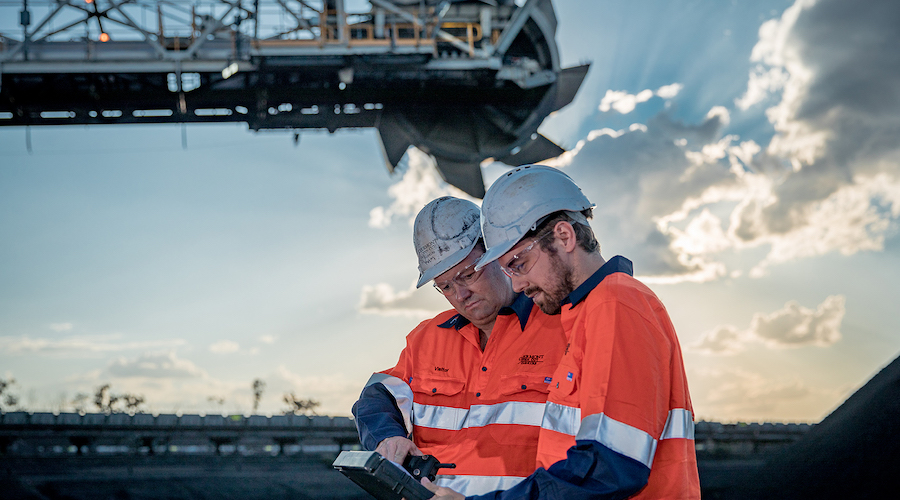
Glencore raises hope of reviving Rio Tinto deal as coal prices turn


Glencore currently operates 26 mines in 21 thermal and coking coal mining complexes across Australia, Colombia and South Africa. (Image courtesy of Glencore.)

Glencore CEO Gary Nagle is hoping a recent surge in coal prices will help bring Rio Tinto back to the table for a fresh attempt at creating the world’s ​biggest mining company, three investors said, after meeting with leaders of both companies in Australia this week.

The two were locked in talks earlier this ‌year to forge a $240  billion company that would tie together Glencore’s marketing business and copper assets with Rio Tinto’s operational expertise to serve fast-growing demand for the red metal.

Discussions ended with no deal in February due to disagreements on valuation, the companies said at the time. Under UK rules, Rio Tinto can’t restart talks with Glencore for six months.

Glencore CEO Gary Nagle was optimistic about the prospect of another ​opportunity to agree a deal, the three investors said, speaking on condition of anonymity as the discussions were private.

“This is definitely not going away, unfortunately,” said ​one investor, who does not see value in a merger.

Details of discussions with Australian investors have not previously been reported.

Glencore and Rio ⁠Tinto declined to comment.

“Ultimately we formed the view that we couldn’t stand up a value case, and that’s where it stands,” Rio Tinto CEO Simon Trott said on a ​media call in February after the talks ended.

Glencore counts on coal rise, iron ore decline

Glencore’s shares have outperformed Rio Tinto’s so far this year, opening the way for ​the Switzerland-based commodity trader and miner to argue it would be entitled to a larger slice of any combined company.

In Glencore’s view, according to the sources, one sticking point was that Rio’s valuation of Glencore was tied to the spot price of key commodities like coal on January 7, the day before talks became public.

Nagle said a more measured view would have been to also take projected prices ​into account, according to the investors.

Since January 7, coal prices and Glencore’s shares have jumped 26%, while Rio’s shares have climbed 9%, with a dip in iron ore ​prices dragging on its gains.

With those moves, Glencore shares now represent about 35% of a combined market value in a Glencore-Rio Tinto tie-up, up from 31.5% when the talks became public and closer ‌to the ⁠40% that Glencore was pushing for as part of the deal rejected by Rio.

Glencore anticipates Rio Tinto’s flagship iron ore division will suffer as the market tips into surplus, the sources said. That would further drive a shift in the relative value of the companies, making a deal easier to do, in Nagle’s view, they said.

For some Australian investors, the prospect of Rio reacquiring coal assets made little sense after it sold them to improve its green credentials. Nagle told investors Australia was a bit behind Europe, for which ​ESG was “no longer an issue” for coal, ​one source said.

Vocal minority opposed deal

While ⁠valuation was the main obstacle to a deal, five Australian funds wrote a joint letter to Rio Tinto’s board on January 20 expressing additional concerns including on governance, given corruption probes into Glencore’s business practices, sources said.

Glencore’s view was that the Australian contingent represented a very ​small but noisy minority, at around 4% of the total shareholder base.

But the sources highlighted that over half of dual-listed Rio ​Tinto’s profits come from ⁠its Australian assets and as such, any merger could have an outsize effect on the country, with government approval required for a deal. Also, any deal would need the approval of 50% of ASX shareholders present and voting and 75% of the votes cast.

Glencore underestimated the Australian bloc, but the company’s roadshow was proving effective, said the first investor, who viewed Glencore ⁠as investable if ​it listed Down Under, but added the proposed deal did not present worthwhile operational synergies.

It will need ​more than short-term share price outperformance to sway Rio, said another investor. In their talks in January, the companies differed on the value of Glencore’s undeveloped Argentinian copper assets, he said.

“I don’t see how Rio can ​change their mind in six months just because coal has gone up and iron ore has gone down.”

(By Melanie Burton; Editing by Veronica Brown, Praveen Menon and Sonali Paul)


Column: Quality is key as some coal rallies amid LNG’s spike on Iran war


Stock image.

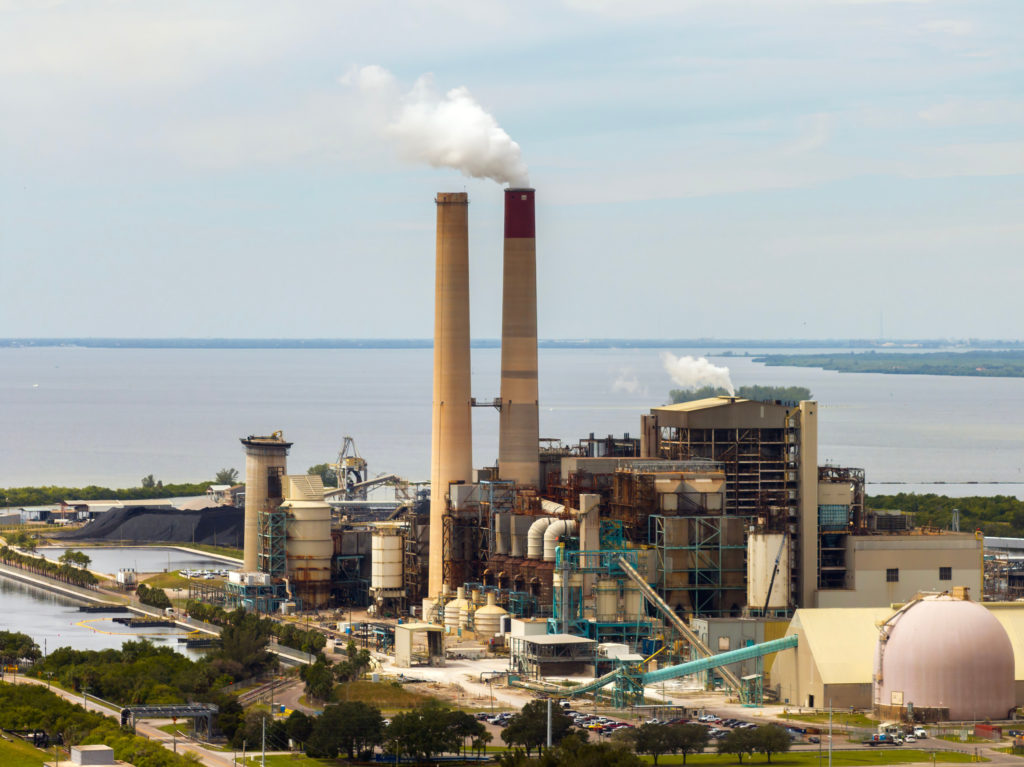
The surge in the spot price of liquefied natural gas (LNG) has dragged seaborne thermal coal prices higher, but only for the higher quality grades that can substitute for natural gas in power generation.

The spot price of LNG in Asia more than doubled last week as the market digested the ​loss of nearly 20% of the global supply of the super-chilled fuel after the US and Israeli strikes on Iran effectively closed the Strait of Hormuz, shutting ‌off Qatar’s LNG.

LNG for delivery to North Asia jumped 116% to a two-year high of $22.50 per million British thermal units (mmBtu) in the week ended March 6.

The surge in LNG prices has opened the window for gas-to-coal switching in Japan and South Korea, the two Asian countries with the biggest ability to arbitrage between the fuels used to generate electricity.

Japan and South Korea predominantly buy Australian thermal coal with an energy content of 6,000 kilocalories per kilogram (kcal/kg), ​and the index of this fuel at Newcastle Port , as assessed by commodity price reporting agency Argus, rose to $129.62 a metric ton in the week to March 6.

This ​was a 14-month high and up 11.6% from the week to February 27, which was the day before the US and Israel launched an ⁠aerial campaign against Iran, prompting Tehran to fire missiles and drones at targets across the Persian Gulf region.

Europe gains

The price of thermal coal heading to Europe, the other region where gas-to-coal switching ​can happen, also increased, with McCloskey assessing 6,000 kcal/kg coal from South Africa’s Richards Bay port at $113.00 a ton on Monday, up 14.3% from $98.90 on February 27.

It’s worth noting that the gains in ​seaborne thermal coal are considerably smaller in percentage terms than the rise in spot LNG prices.

This is likely because there is no threat to the supply of thermal coal from major exporters such as Australia, South Africa, Indonesia and Colombia.

But it’s also the case that while the economics of gas-to-coal switching are currently attractive, the ability to do so is constrained by a lack of available coal-fired capacity, especially in Europe.

For example, Spain retired ​13.18 gigawatts (GW) of coal-fired capacity from 2000 to 2025 without adding any new plants, while Germany shut down 33.57 GW of capacity while adding just 13.69 GW, according to data from the ​Global Energy Monitor.

Japan retired almost 1,200 megawatts (MW) of coal-fired capacity in the past three years, without adding any new units.

While South Korea has boosted its coal-fired capacity in recent years the government has formally committed ‌to a long-term ⁠phase-out of the fuel, planning to close 40 of 61 units by 2040.

The longer-term policy doesn’t preclude a switch to more coal in the short term if LNG prices remain elevated.

It’s still too early to ascertain if countries that can burn more coal for electricity are lifting imports, although analysts DBX Commodities are estimating that the European Union’s seaborne thermal coal imports will rise to 2.17 million tons in March from 2.01 million in February.

Japan’s March imports of seaborne thermal coal are estimated by DBX at 9.52 million tons, down from 10.18 million in February but up from ​9.22 million in March last year, while South ​Korea’s arrivals are forecast at 6.12 million ⁠in March, up from 5.05 million for the same month in 2025.

China, India

It’s also worth noting that the world’s two largest coal importers, China and India, don’t usually engage in gas-to-coal switching for power generation.

China’s gas-fired generation is a tiny 3% of total electricity production, while coal is just ​under 60%. For India, natural gas accounts for about 2.8% of electricity generation and coal is around 70%.

While high LNG prices will likely ​curb imports in both China ⁠and India, it’s unlikely to result in higher coal imports as rising domestic production will be able to compensate.

This dynamic can be seen in the prices of seaborne coal grades favoured by China and India.

Australian coal with an energy content of 5,500 kcal/kg, which is popular with Chinese utilities and Indian industrial users such as sponge iron producers, rose a modest 1.4% in the week to March 6 ⁠to $87.87 a ton, ​according to Argus.

Indonesian coal with an energy content of 4,200 kcal/kg performed better, rising 5.1% to $58.21 a ton in ​the week to March 6, but this was still well below the gain for higher-quality grades.

(The views expressed here are those of the author, Clyde Russell, a columnist for Reuters.)

(Editing by Muralikumar Anantharaman)
 

Oil shock could sharply raise mining costs: BMO


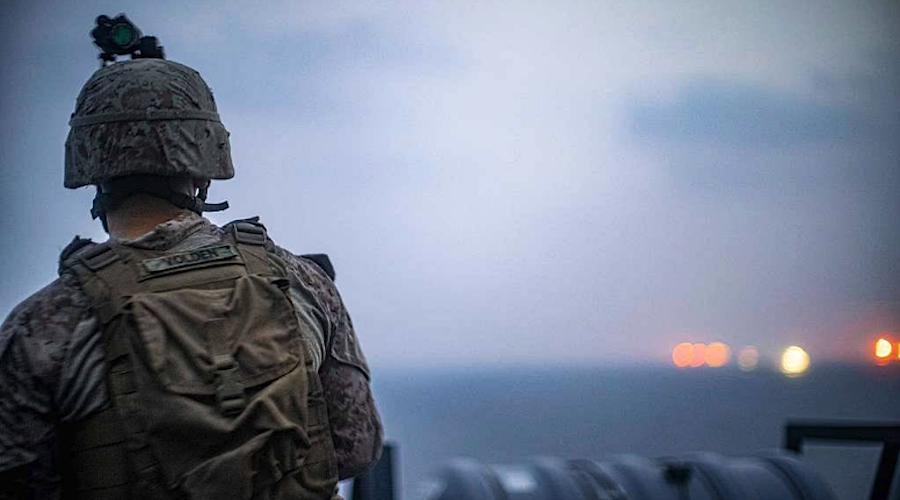
A US marine observes nearby vessels from the amphibious transport dock ship USS John P. Murtha (LPD 26) at the Strait of Hormuz in 2019. (US Marine Corps photo by: Cpl. Adam Dublinske/Released.)

Rising oil prices linked to current tensions in the Middle East could significantly raise mining costs and pressure sector margins, according to a new BMO Capital Markets report.

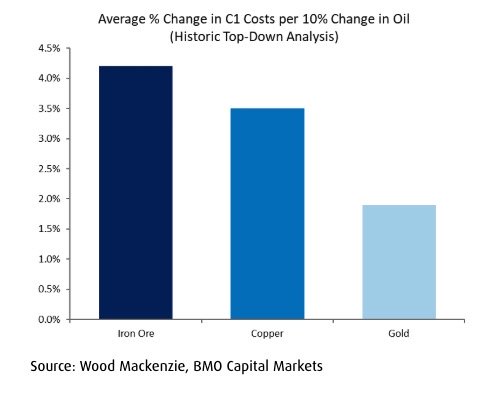
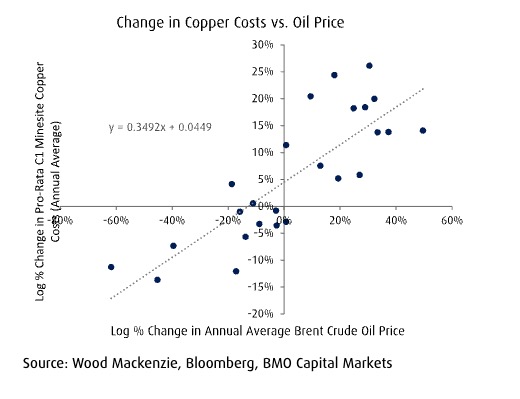
Examining historical cost trends using Wood Mackenzie data, analysts found mining expenses rise sharply with crude prices, though exposure varies by commodity. Iron ore operations are the most sensitive, with costs increasing about 4.2% for every 10% rise in oil prices. This compares with roughly 3.5% for copper and about 2% for gold. If crude averages about $100 a barrel — around 47% above the 2025 average — mining costs could climb roughly 20% for iron ore, 16% for copper and 9% for gold.

Brent crude prices held above $100 a barrel on Friday even after the US temporarily eased sanctions on Russian oil. The licence, posted on the US Treasury website, applies only to Russian crude and petroleum products loaded onto vessels as of March 12 and allows those shipments to proceed until April 11.

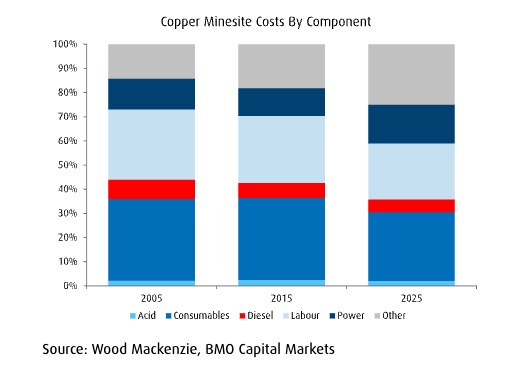
“Bottom-up” cost breakdowns often underestimate the impact of rising prices because they focus narrowly on direct fuel use, the analysts said. Diesel accounts for only about 5% of copper mine operating costs today, down from roughly 8% two decades ago, but higher energy prices eventually ripple through electricity, consumables, labour and equipment, amplifying overall cost pressures.

The findings underscore how energy shocks can reshape mining economics. Sustained oil price increases not only raise operating expenses but can also shift industry cost curves, potentially altering which assets remain competitive if fuel prices stay elevated.

Regional differences

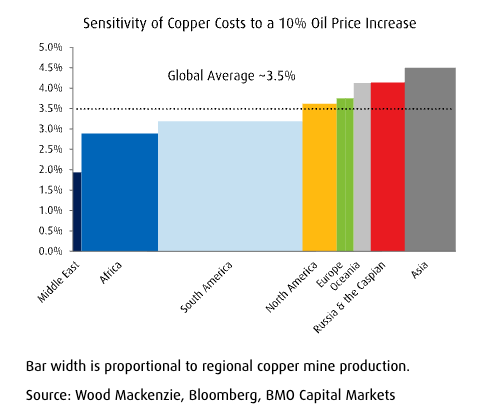
Regional exposure varies. Mines in Africa and the Americas historically show lower sensitivity to global oil prices than operations in Europe and Asia, likely reflecting access to cheaper local fuel supplies and power sources. At the same time, the industry’s vulnerability to oil has gradually declined as companies invest in fuel efficiency, electrification and captive power generation.

Supply chain risks tied to the Middle East add another layer of uncertainty. Higher sulphur prices could raise costs for copper solvent extraction and electrowinning operations that rely heavily on sulphuric acid. Meanwhile, ammonia exports —about one-fifth of which pass through the Strait of Hormuz— are a key feedstock for ammonium nitrate used in mining explosives.

The war has created the “largest supply disruption” in history, the International Energy Agency said, even as dozens of countries agreed to release 400 million barrels from strategic reserves to stabilize markets.

Individual mines may experience different outcomes depending on energy hedging programs, power contracts or local supply arrangements that could delay or soften the transmission of higher oil prices into operating costs.

Still, history suggests sustained energy shocks tend to filter through the entire mining value chain, reinforcing the industry’s vulnerability to geopolitical disruptions in global fuel markets.


Connecting Opportunities: The Power of Integrated E-Navigation

Navtor
Smarter shipping: NAVTOR's digital ecosystem unites on- and offshore teams, putting shipping companies in complete control

Published Mar 12, 2026 1:49 PM by NAVTOR


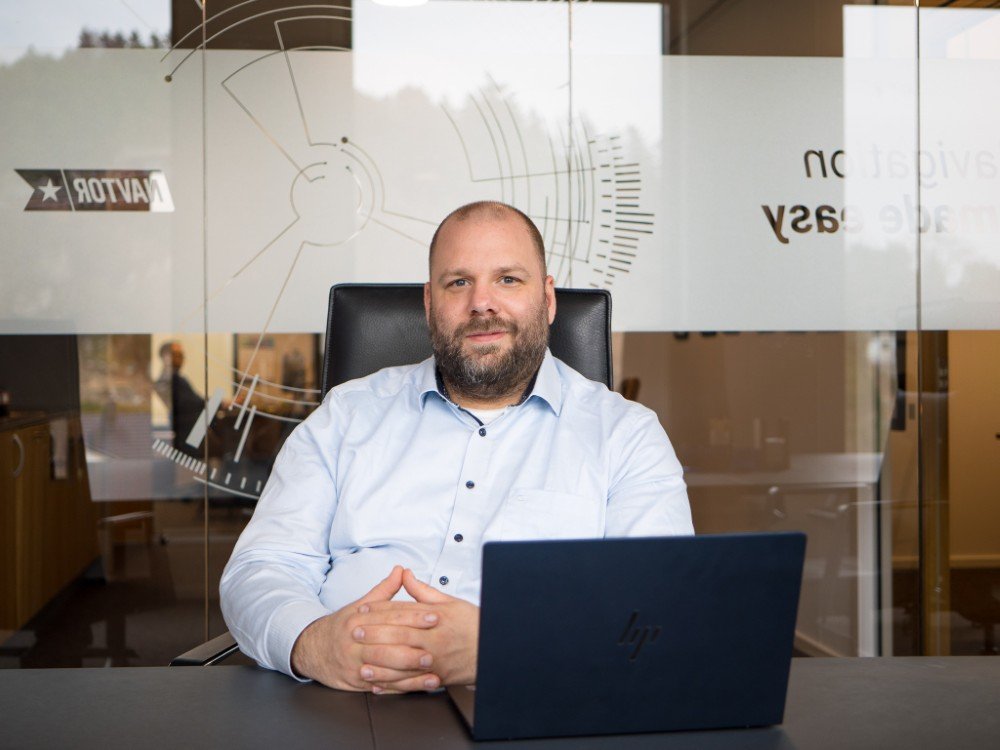
Timo Essers, e-Navigation Director at NAVTOR, looks at how seamless system integration can empower a new age of control, efficiency and competitive advantage.

In the real world, everything is connected.

Ecosystems thrive not because of one constituent part, but because of everything working together as one. The same is true for society, politics and economics. There is a complex fabric of interlocking threads that, when woven with care, create strength. Try and pull apart the connections – disrupt the balance - and, as we’re all painfully aware, systems unravel.

It’s a simple fact that you have to consider each piece to solve a puzzle, connecting with intelligence to reveal the big picture. In short, integration, not isolation.

Understand that and you unlock success. Here at NAVTOR, it’s a foundational philosophy.

Firm foundations

NAVTOR was the very first maritime technology player to introduce a true digital ecosystem.

From day one we’ve worked to create a secure, unified digital environment where data can be automatically captured, from a multitude of sources, and seamlessly shared. The ecosystem can then thrive, giving birth to connected solutions that support and feed into one another – delivering that rare ‘big picture’ understanding.

NavStation proves the point.

NavStation: putting everything navigators need at their fingertips

Complete solution

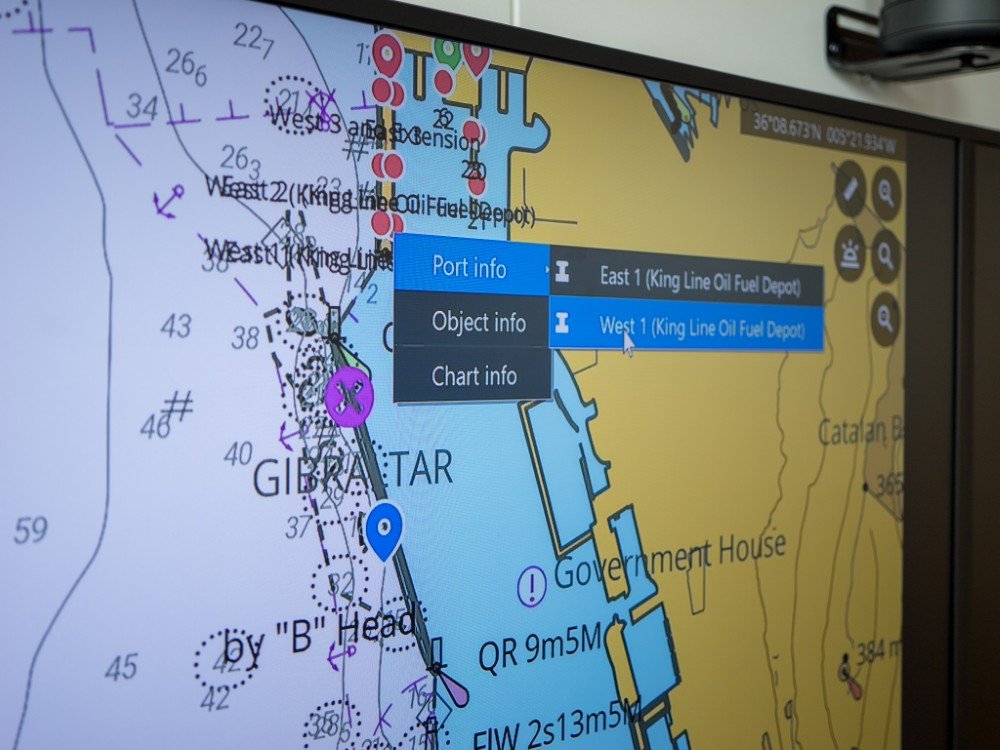
NavStation is NAVTOR’s next generation e-navigation platform. This intuitive solution is as easy to use as an ECDIS but offers so much more. Whereas ECDIS is fundamentally a route-planning tool, NavStation is designed for complete passage and voyage planning, supporting navigators by consolidating large amounts of navigational and regulatory data, processing it automatically, and presenting it in user-friendly, industry?compliant voyage plan formats and reports. This streamlines tasks, simplifies compliance and allows navigators to focus on what they do best - safe and efficient navigation, not time-consuming administrative tasks.

It is the essence of smart shipping made easy. And the advantages don’t stop with the navigators.

Connecting the dots: Essers is focused on helping users achieve seamless control, efficiency and smart shipping benefits

Shore thing

NAVTOR’s ecosystem bridges both ship and shore, allowing NavStation’s benefits to ripple out to support office based teams.

Suddenly executives such as marine superintendents, QHSE officers, and fleet and vessel managers are empowered by transparent awareness of vessel operations – creating both a sense of control and a greater confidence that ships are sailing in line with all applicable requirements. In this way it supports organizations as they seek to navigate increasingly complex, constantly evolving, regulatory and commercial environments.

Proactive power

The fact that ecosystems are comprised of multiple elements unlocks additional benefits. For example, NavStation interacts with NavFleet, our fleet management and performance platform, giving shoreside teams a huge competitive advantage.

If you’re using NavStation, NavFleet is a must.

It provides real-time visibility of how vessels are operating, enabling users to monitor key operational and voyage parameters, including whether a vessel is operating within charter party requirements, weather limits, and defined operational constraints. Users can get fleet?wide overviews, or drill down into a highly granular view of a single vessel’s voyage execution, at a glance, scoring performance and measuring against all applicable regulatory frameworks for confident compliance.

Working with NavStation it delivers a sense of proactive control to teams, rather than relying on traditional reactive responses. In that way it does what all our solutions set out to do, enabling more informed, safer, and all round smarter decision making for customers worldwide.

Trusted partners

After years of continual development and refinement, NAVTOR’s ecosystem is proven, trusted and more mature than any comparable offering, giving us – and more importantly you – rock solid foundations for game-changing e-navigation and smart shipping solutions.

Speaking personally, I’ve just returned from some customer vessel visits and was thrilled to see how NavStation addressed navigator pain points and desires, particularly in terms of usability, efficiency, and overall planning confidence.

If you’d like to find out more – and solve your big picture shipping puzzle – then maybe it’s time to connect with NAVTOR. An ecosystem of opportunity awaits.

Timo Essers is e-Navigation Director at NAVTOR, the sponsor of this message.

The opinions expressed herein are the author's and not necessarily those of The Maritime Executive.


X1 Wind Reaches Key Milestone with DNV Basic Design Certification

X1 Wind
This milestone paves the way for the certification of commercial platforms suitable for 15-20MW turbines, which are already under development by X1 Wind.

Published Mar 13, 2026 7:31 PM by The Maritime Executive


[By: X1 Wind]

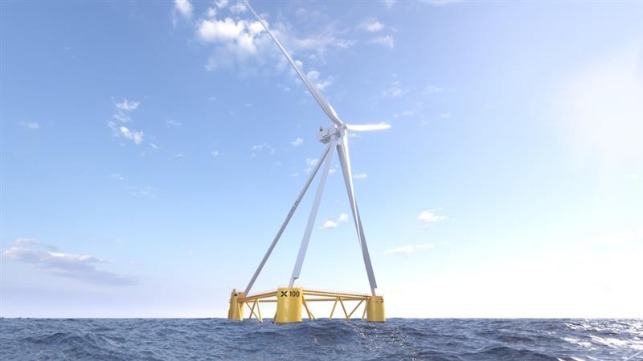
X1 Wind, a leading developer of innovative floating wind technology, has reached a major milestone with its X100 pre-commercial platform receiving a Statement of Compliance (SoC) for Basic Design from DNV, the world’s leading independent energy experts and certification bodies. 

The certification was conducted according to the DNV-SE-0442 standard for the "Certification of floating wind turbines". This independent endorsement confirms that the X100 design meets rigorous international safety, engineering, and technical requirements, providing a critical validation of the platform’s integrity and constructability.  

Achieving Basic Design Certification is a pivotal step in X1 Wind’s roadmap. It confirms that the platform’s structural design, stability, and hydrodynamic behaviour—including its response to 500-years extreme waves, wind, and currents—are within safe and predictable limits. Under the scope of Basic Design Approval, DNV has verified the calculation methodologies used by X1 Wind, and the design of the platform, including the station-keeping system, the weathervaning structure, and the turbine integration of the X100 platform for a service life of 25 years. Crucially, this approval significantly accelerates the certification process for X1 Wind’s commercial-scale units. The company already has contracts in place for the scaled-up X150 version, suitable for 15-20MW turbines for major projects in Europe and Asia, using the same approved calculation methodologies established within the X100 certification. 

Carlos Casanovas, CTO and Co-founder of X1 Wind, said: "Completing Basic Design certification for the X100 platform is a major milestone for X1 Wind. It demonstrates that our innovative design meets the highest international standards whilst greatly reducing the costs of floating offshore wind. This independent validation is crucial for both technical assurance and for building trust with our partners and future clients, and it serves as a very strong basis for the certification of our commercial-size units. DNV is one of the most rigorous certification bodies in the sector, so we are particularly proud of this achievement.” 

The X100 platform will be deployed at the PLEMCAT test site in the Spanish Mediterranean Sea as part of the NextFloat Project. Led by Technip Energies and X1 Wind, this EU-funded initiative aims to accelerate the industrialization of floating wind and substantially reduce its Levelized Cost of Energy (LCOE). It counts on the support of private capital, EU-funded projects NextFloat and NextFloat+, PAREF project funded by the French State as part of France 2030 operated by ADEME, and the Spanish Government program RenMarinas.  

The X100 platform is designed for turbines of around 160m diameter (X100 stands for the hub height of 100m), with power ratings ranging from 6MW to up to 10MW depending on the specific site conditions. The pilot will operate in offshore conditions for several years, providing essential data to support final prototype certification and enable commercial-scale deployment and full-scale commercialization. X1 Wind’s technology combines the stability and low environmental impact of a Tension-Leg Platform (TLP) with the cost-efficiency of semi-submersible structures. This allows for a primary steel platform weight of approximately 1,500 tons, representing an estimated weight saving of 30% to 50% compared to traditional steel floaters installed in European pre-commercial projects of a similar scale. 

Jaques Vendé, NextFloat Project Manager and Senior Project Manager at Technip Energies, added: “We are proud to lead the NextFloat Project and partner with X1 Wind in this journey. The X100’s design certification reflects the robustness of its platform and the collaborative effort of all partners involved. It paves the way for a safe and efficient pre-commercial deployment in the Mediterranean Sea, and for the future of low-cost floating offshore wind." 

"The issue of a Statement of Compliance - Basic Design is an important milestone for X1 Wind’s X100 platform. It confirms compliance with the basic design requirements defined in DNV-SE-0422 – Certification of floating wind turbines and a well-defined and developed methodology for the prototype design and development”, closed Claudio Bittencourt Ferreira, Project Manager – Renewables Certification at DNV.

For further information about X1 Wind, visit www.x1wind.com.

The products and services herein described in this press release are not endorsed by The Maritime Executive.


ONE and Chinese Shipbuilder Increase Investment in Owner/Lessor Seaspan

containership
ONE becomes the largest shareholder in Seaspan while the shipyard calls it a strategic investment that vertically integrates it operations

Published Mar 12, 2026 9:12 PM by The Maritime Executive


Three years after taking Seaspan, the leading owner/lessor of containerships to the leading carriers, private Ocean Network Express is set to become its largest shareholder, along with the addition of Chinese shipbuilder Yangzijiang Shipbuilding as an investor. The deal sees the lead investors in the go-private transaction beginning to cash out as Seaspan reaches new leads in its ownership and management of shipping assets.

Seaspan was started in 2000 and was mostly working with China’s COSCO Shipping and Yang Ming, which together accounted for approximately 60 percent of the operations. By 2023, Seaspan had diversified, working with ONE, Zim, MSC, CMA CGM, and others, as well as COSCO and Yang Ming. The CEO of the parent company, Atlas, joined with the lead investor, Fairfax Financial Holdings, along with board chairman David Sokol, the Washington Family, and ONE, in taking the company private in 2023.

CEO of ONE, Jeremy Nixon, says over the past three years Seaspan “achieved remarkable growth.” Fairfax similarly said the investment company they launched, Poseidon, which is the holding company for Seaspan and Atlas, has “done incredibly well.”

Seaspan reports it currently has a fleet of 241 containerships with 99 percent fleet utilization. Mostly, its vessels operate under long-term charters to the leading carriers. In 2025, it reported that it had taken delivery of the final ship in a 70-vessel expansion program, while also pursuing a phase two that will add 56 more vessels by mid-2029. It also entered the PCTC segment with its first car carriers after having been a pure play in container shipping. 

ONE reported that under the terms of the new agreement, it will increase its ownership stake in Poseidon to 48.9 percent. Seaspan’s website shows that ONE currently has 43 vessels on charter from Seaspan. In 2023, ONE was reported to be Seaspan’s largest customer. The companies also jointly formed, in November 2024, a technical ship management company called OneSea Solutions.

Fairfax reports it will be selling a total of 67.6 million shares, with the largest portion to ONE, as well as smaller positions to two other investors. It said the total proceeds would be approximately $1.91 billion and reduce its position by 23 percent. After the deals close in the second quarter of 2026, Fairfax will hold 22 of Poseidon’s shares.

Yangzijiang reported that it is acquiring a 10 percent equity interest in Poseidon for $825.7 million. The company’s Executive Chairman, Ren Letian, is separately acquiring a 5 percent position. It notes the price is above the independent financial adviser’s valuation, but it believes it is justified by the long-term prospects and strong relationship it created for the shipbuilder with Seaspan.

In a stock exchange filing, the shipbuilder highlights the opportunities to vertically integrate its operations, while securing long-term collaboration with one of the world’s largest containership owners. It writes that “Closer ties with Seaspan will likely enhance order book visibility and provide Yangzijiang with valuable market insights, potentially improving its responsiveness to customer demand and end-market dynamics.”

The deal comes as the container sector continues a dramatic buildup. Yesterday, trade group BIMCO reported that the orderbook now totals more than 1,350 ships with a combined capacity of 11.8 million TEU. In 2026 alone, BIMCO reports owners have ordered another 102 ships with a combined capacity of 665,000 TEU.


ATSB: Cruise Ship's Chief Mate Distracted by ECDIS Ahead of Grounding

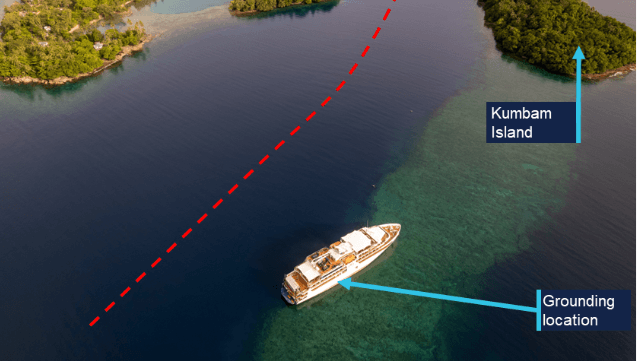
Coral Adventurer's grounding location and planned trackline, red (ATSB)

Published Mar 11, 2026 10:23 PM by The Maritime Executive


The cruise ship Coral Adventurer ran aground on a reef off Papua New Guinea after the ship's ECDIS declined to load the chief mate's route plan, the first in a series of events that led to the ship overshooting a turn and overcorrecting, according to the Australian Transport Safety Bureau (ATSB).

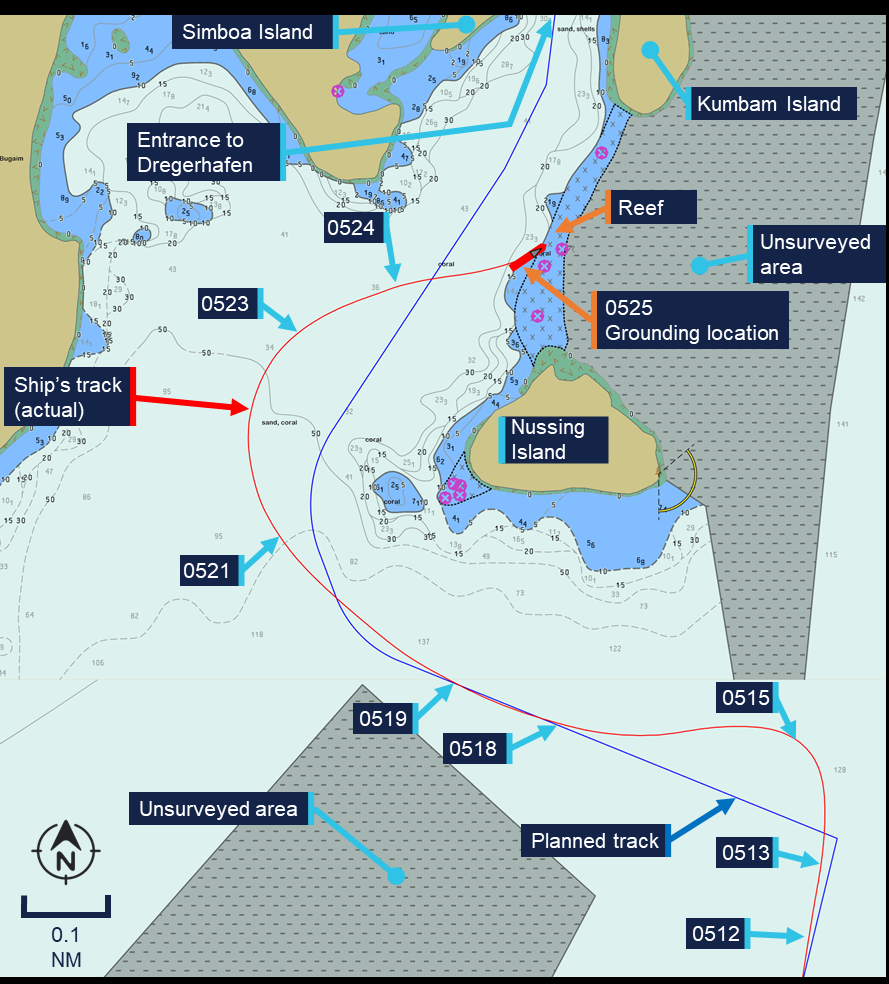
On the morning of December 27, 2025, Coral Adventurer was under way off the remote northeastern coast of Papua New Guinea and nearing the small port of Dregerhafen. The waters on the approach are ringed by reefs, with large areas poorly surveyed, and vessels have to execute two tight turns to reach the harbor entrance - first to port, then to starboard.

At the start of the 0400 watch, the cruise ship was approaching Dregerhafen's harbor entrance. The chief mate had the conn, and decided to adjust the route in the ECDIS to smooth out the second of the two turns of the transit, thereby creating a new route plan in the digital chart system's storage. The new Route 2 still adhered closely to the passage plan's track, but with an extra waypoint. 

At 0512, as the approach to the port was in progress, the mate selected this modified route and tried to activate it. The ECDIS declined to do so until after it had performed a route safety check in its route editor tool. 

The chief mate had to go through the process of this digital check mid-transit. At 01513, the Coral Adventurer missed its first wheel over point and overshot its turn to port. This put it on course to enter unsurveyed and potentially hazardous waters to the north of the route. The chief mate put steering in manual and made a harder turn to get back onto the route. The vessel returned to the planned track, but slowed down, affected by a strong current at the entrance channel. 

The chief mate increased RPM on both thrusters to offset the current, which had reduced speed to less than four knots. With the throttes pushed up, the mate put steering back into autopilot at about 0518, in advance of the second turn. At 0519, the vessel arrived at the second wheel over point, making eight knots. The vessel overshot the turn again, prompting the mate to switch back to manual once more at 0521. The ship was off course to the west of the intended trackline, and the mate made a hard turn to starboard to get onto the planned track. 

At this point, the chief mate lost situational awareness, they later told investigators. In darkness and without navigation aids, they did not have a sense of the surrounding topography. The mate kept up the high rate of turn to starboard until 0523:30, coming up on a northeasterly heading back towards the trackline. Misinterpreting the view ahead and believing that the ship was back on track, the mate continued to navigate across the trackline, making more than eight knots. 

At 0524, the master arrived on the bridge, and visually spotted shallow water ahead; the ship grounded about 15 seconds after the master's warning. The Coral Adventurer came from 8.5 knots to a halt by 0525:30. 

Dive inspections revealed that the hull was not penetrated, and that the propulsion was intact. A tug was chartered for a refloat attempt, but this was initially unsuccessful, as the tug's engines overheated during the effort. A larger tug was dispatched, and the Coral Adventurer was successfully refloated on December 30.

Wednesday's report is a factfinding summary, without causal findings. ATSB's inquiry into the cause of the grounding remains under way.