Saturday, March 14, 2026


How History Keeps the U.S. and Iran on a Collision Course

The United States and Iran are fighting not just because of their differences, but also because of their similarities. Both countries see themselves as exceptional civilizations shaped by religion and sustained by a sense of victimhood. Each believes it has been repeatedly wronged by the other and is therefore acting defensively. This mutual narrative has become one of the most powerful forces shaping U.S.–Iran relations.

Both nations interpret the relationship through different historical starting points. Because their memories of the conflict begin at different moments, each country tells a story in which it is primarily the victim and the other the aggressor.

The American Narrative

Many Americans view the conflict as beginning with the 1979 Iranian Revolution and the subsequent hostage crisis, when Iranian students seized the U.S. embassy in Tehran and held 52 Americans for 444 days. The crisis severed diplomatic relations and cemented Iran’s image in the United States as a hostile revolutionary state.

In this narrative, Iran subsequently became a destabilizing actor that supports militant groups and threatens American allies in the Middle East. From Washington’s perspective, sanctions, military pressure, and containment policies are defensive responses to an ideological regime that defines itself in opposition to the United States (but is not a physical threat to the homeland.)

The Iranian Narrative

Iran’s narrative usually begins earlier, with the 1953 coup against Prime Minister Mohammad Mossadegh. Mossadegh, a populist figure, had nationalized the Anglo-Iranian Oil Company after it refused to allow Iran to audit its books.  The CIA and Britain’s MI6 supported a coup that removed him from power and restored the Shah, who fled to Italy at the outbreak of unrest.

For many Iranians, this event demonstrates that the United States was willing to overthrow Iran’s democratic government to protect its geopolitical interests and control Iran’s patrimony. The Shah’s subsequent rule, which was described by Amnesty International as having “the highest rate of death penalties in the world, no valid mechanism of civilian courts and a history of torture which is beyond belief,” reinforced the belief that the United States sought to dominate Iran’s politics and economy.

Other events deepened this perception, including U.S. support for Iraq during the Iran–Iraq War, the 1988 shootdown of Iran Air Flight 655 that killed 290 civilians, and decades of economic sanctions.

From Tehran’s perspective, the United States appears as an imperial power determined either to control Iran or to overthrow its government.

The Power of Victim Narratives

Mutual victim narratives reinforce the conflict. Each side interprets its own actions as defensive and the others as aggressive. Sanctions, proxy warfare, missile programs, and military strikes are all framed as necessary responses to the other side’s hostility.

Because both countries believe they have been repeatedly wronged, trust is extremely low.

Diplomatic openings are fragile because leaders on both sides expect deception or betrayal. Compromise can appear politically dangerous, since concessions may be interpreted domestically as surrender.

This dynamic creates a self-reinforcing cycle. One side takes a coercive step; the other interprets it as confirmation of its victim narrative and retaliates; both sides then feel further justified in their actions.

In short, each country believes it is playing defense.

Key Events That Reinforced the Cycle

Several major events since 1953 have reinforced these mutual narratives and deepened the conflict.


The 1953 Coup

The CIA and MI6 supported the overthrow of Prime Minister Mossadegh after he nationalized Iran’s oil industry. For Iran, the coup demonstrated that the United States would intervene to control the country’s resources and political direction. American policymakers at the time largely saw the operation as a Cold War measure intended to prevent possible Soviet influence.

Today, the coup receives little attention in American discussions of U.S.–Iran relations, which often begin with the 1979 revolution.

The Iranian Revolution (1979)

The revolution overthrew the U.S.-backed Shah and established the Islamic Republic under Ayatollah Ruhollah Khomeini. Many Iranians saw the revolution as liberation from dictatorship and foreign influence. In the United States, however, the fall of the Shah marked the loss of a key regional ally and the emergence of a hostile revolutionary regime.

The Hostage Crisis (1979–1981)

Relations deteriorated sharply when Iranian students seized the U.S. embassy in Tehran and held 52 Americans hostage for 444 days. Americans viewed the crisis as a violation of international law and a national humiliation that influenced the 1980 presidential election. Many Iranians justified the seizure to prevent another foreign-backed coup.

Diplomatic relations between the two countries were severed in 1980.

The Iran–Iraq War (1980–1988)

When Saddam Hussein’s Iraq invaded Iran, the United States eventually tilted toward Baghdad. Washington provided economic assistance, dual-use technology, military intelligence, and other support.

In Iran, this reinforced the belief that the United States was backing an aggressor. Iraq’s use of chemical weapons against Iranian forces, which killed or wounded 50,000, strengthened the perception that Western powers tolerated attacks on Iran. American policymakers, however, largely saw their support for Iraq as a way to prevent Iranian revolutionary expansion in the region.

Iran Air Flight 655 (1988)

In July 1988, a U.S. Navy cruiser shot down an Iranian passenger aircraft, killing 290 civilians. Iran viewed the incident as reckless or deliberate killing of civilians, particularly because the ship was later revealed to have been operating in Iranian territorial waters. The United States described the event as a tragic mistake during a tense naval confrontation.

The “Axis of Evil” Speech (2002)

In 2002, President George W. Bush labeled Iran part of an “Axis of Evil” alongside Iraq and North Korea. The statement reflected American concerns about Iran’s support for militant groups and its suspected pursuit of weapons of mass destruction. In Iran, however, the speech angered both reformists and hardliners, especially because Tehran had recently cooperated with the United States against the Taliban in Afghanistan.

Post 9/11 Cooperation and the Missed Opportunity (2003)

After the September 11 attacks, Iran quietly assisted the United States in operations against the Taliban. In May 2003, Tehran sent Washington a proposal through the Swiss ambassador outlining a possible comprehensive settlement of disputes between the two countries.

Iran signaled willingness to provide nuclear transparency, cooperate against terrorism, pressure Hezbollah to become a political organization primarily, and accept the Arab League framework for a two-state solution between Israelis and Palestinians. In return, Iran sought sanctions relief, security guarantees, and recognition of its regional interests.

Washington did not pursue the proposal, in part because many officials believed Iran’s revolutionary government might soon weaken or collapse.

Related: Six Stocks That Could Soar in an Era of Regional Instability

The Nuclear Agreement (2015)

In July 2015, the United States, Iran, and several world powers reached the Joint Comprehensive Plan of Action (JCPOA), commonly known as the Iran nuclear deal. Iran saw the agreement as evidence that diplomacy could improve relations with the West. Critics in the United States argued that the deal did not sufficiently restrict Iran’s regional activities.

U.S. Withdrawal from the JCPOA (2018)

In 2018, the United States withdrew from the agreement and reimposed sanctions. In Iran the decision reinforced the belief that Washington could not be trusted to honor international agreements. Supporters of the withdrawal in the United States argued that the deal was inadequate (then-presidential candidate Donald Trump called it "the worst deal ever negotiated" and strengthened Iran’s regional influence.

Trump’s abandonment of the JCPOA probably reminded Iran of its bad investment in the Eurodif uranium enrichment consortium based in France. The Shah’s government invested $1.18 billion for 10 percent of the project, but Europe reneged on deliveries of nuclear fuel after the Shah was ousted, and Iran was repaid its investment in 1991 after a court battle. 

The Killing of Qasem Soleimani (2020)

In January 2020, the United States killed Iranian General Qasem Soleimani, a senior commander in the Islamic Revolutionary Guards Corps, in a drone strike in Baghdad, Iraq. Washington justified the strike as a response to attacks on American personnel in the region, though the extent of Iran’s involvement is credibly disputed. In Iran, the assassination was widely viewed as the illegal killing of a national figure and a major escalation in the conflict.

It was Soleimani who had suggested a reconsideration of “our relationship with the Americans” before he was undercut by Bush’s “Axis of Evil” speech. Soleimani was carrying an Iranian response to a message from Saudi Arabia that Iraq had relayed. According to Iraq’s prime minister, Adel Abdul Mahdi, Trump asked him to mediate between Iran and Saudi Arabia, which likely fed Iranian suspicions that Trump used diplomacy as a distraction from a looming attack. (Not the only time, as we have since learned.)

The U.S.-Israeli attacks (2025, 2026)

In June 2025, Israel attacked Iran, killing Iranian military leaders and nuclear scientists, amid diplomatic dismissions and, days later, the U.S. attacked Iranian nuclear facilities and “obliterated” the nuclear program in Trump’s words. Iran counterattacked, and days later, the U.S. brokered a cease-fire that was requested by Israel.

In February 2026, the U.S. and Israel again attacked Iran as diplomatic discussions were underway, killing Iran’s supreme leader, Ali Khamenei. Iran responded with missile strikes against Israel and U.S. military installations in the region, and one day later Trump signaled interest in a cease-fire. Iran replied, ‘nothing doing” and pressed the attack. Trump then hinted at introducing ground troops and hinted the U.S. might use Iranian Kurdish militias to topple the government. Trump then demanded Iran’s “unconditional surrender.”

At the time of the February attack, Iran was not planning to strike U.S. forces in the region, as was admitted by the Pentagon after hostilities began, and it was offering concessions that were “objectively better” than the JCPOA, which Trump renounced in 2018, most likely because it was secured by his hated predecessor, Barack Obama, not because it was deficient.

A Long Shadow of Conflict

Over the decades, the confrontation has included proxy conflicts, sanctions, covert operations, and occasional direct military clashes. Events ranging from attacks on American facilities in Lebanon in the 1980s to cyber operations, sanctions, and regional proxy struggles have reinforced the adversarial relationship.

The quiet and not-so-quiet war included the bombing of the Marine barracks and the American embassy in Beirut, Lebanon (1983); kidnapping and killing of a CIA station chief in Beirut (1984); Operating Praying Mantis, U.S. attacks on Iran oil facilities (1988); abandonment of the Iran-Conoco deal to develop offshore oil fields (1995); the Khobar Towers bombing (1996), assassinations of Iranian nuclear scientists (since 2010, likely at the hand of Israel and the Mojahedin-e-Khalq but likely with approval by the U.S.), and U.S. sanctions against Iran (1979-2026).

Despite periodic attempts at diplomacy and the election of reformist presidents, each new crisis tends to reinforce the historical narratives both sides already believe. And while each side has legitimate grievances about the other, Iran and America can take some helpful steps on their own: Iranians can stop the “Death to America” rants that just make it easier for the War Party and Israel, and Americans can crack open a history book to learn the “root causes” of the current conflict are the 1953 coup and the Pahlavi regime that was installed by Washington.

The ongoing war between the U.S./Israel, and Iran will eventually end, but in the meantime, it will feed the fires of mistrust between Tehran and Washington, making ending the conflict harder than starting it.

Conclusion

The U.S.–Iran conflict persists not only because of strategic disagreements but also because both countries interpret their toxic relationship through narratives of grievance and self-defense. If each side sees itself primarily as the victim, compromise will continue to be risky. Without a shift in these underlying narratives, periods of diplomacy will remain fragile and temporary.

By James Durso for Oilprice.com

China widens BHP iron ore ban amid contract talks


BHP’s Newman operations. Credit: BHP

China has widened a ban on BHP iron ore for the second time in two weeks, escalating a months-long contract dispute with the world’s third-largest supplier of the key steelmaking ingredient.

China Mineral Resources Group (CMRG), the state-run iron ore buyer, informed domestic steel mills and traders on Thursday that, starting late next week, they would be prohibited from taking delivery of Newman fines, a popular BHP iron ore stored at ports, three sources with knowledge of the matter told Reuters.

Customers will be allowed to take delivery of cargoes within the next five working days, according to two of the sources, who spoke on condition of anonymity.

“We previously had the feeling that the day (of restrictions on more BHP products) would come sooner or later and to some extent were waiting for it, so not a surprise,” said one of the sources.

BHP declined to comment and CMRG did not immediately respond to a Reuters request for comment.

Beijing has progressively tightened restrictions on local steel mills and traders buying BHP iron ore over the past six months as it negotiates the terms of BHP’s 2026 supply contract.

China banned purchases of Jimblebar fines, another type of iron ore, in September, followed by the Jinbao product in November.

Traders were told last week to buy fewer new cargoes of Newman fines, Newman lumps and Mac fines, though the directive allowed for the purchase of those grades of iron ore already stored at ports.

This week’s ban narrows permitted buying to stocks of BHP’s Newman lumps and Mac fines already in port storage.

Spill-over effect

Traders are trying to dump those cargoes as they fear more restrictions will be announced soon that make the remaining grades impossible to sell.

“We are planning to sell off all Newman fines at ports in the next few days and will get off Mac fines as well, even if it’s not under this wave of restriction now, as you do not know when they would prohibit you from taking delivery of Mac fines,” said another source.

Benchmark April iron ore prices on the Singapore Exchange rose by more than 4% to $108.95 in afternoon trading on Thursday, hitting their highest level since January.

Portside stocks of Newman fines stood at 3.17 million tons as of this week, up 55% from October, according to another trader.

(Reporting by Reuters staff; Editing by Clarence Fernandez, Pooja Desai and Jason Neely)


Horowitz-backed firm to revive idled Utah copper mine


A startup backed by Silicon Valley venture firm Andreessen Horowitz plans to revive an idled copper mine in Utah to test new technology aimed at automating operations.

Mariana Minerals acquired the Centennial copper mine from Lisbon Valley Mining Co. LLC last year and will reopen it in April, according to Mariana’s chief executive officer Turner Caldwell. The small mine is part of a 10,000 acre land package that Mariana Minerals acquired, which also includes a refining facility.

The mine produced about 2,500 tons of copper a year under Lisbon Valley’s ownership, though Mariana plans to scale the output to 50,000 tons of copper cathode by 2030. The firm will deploy autonomous equipment including haul trucks and drill rigs, Caldwell said.

“There just hasn’t been a lot of mining in the US in the last 50 years, partly because we don’t have the people to design and operate these assets,” said Caldwell, who spent about a decade at Tesla Inc. managing the automaker’s battery minerals unit before founding Mariana Minerals.

The reopening is the latest example of mining firms looking to revive idled US operations as metal prices climb and the Trump administration pushes to onshore critical minerals. BHP Group and Faraday Copper Corp. are exploring a deal to restart a historic copper mine in Arizona, while Blue Moon Metals Inc. acquired a defunct germanium and gallium mine in Utah from Teck Resources Ltd. in February.

The closely held firm was among several commodity companies that went to Venezuela last week as part of US Interior Secretary Doug Burgum’s visit to revive oil and mineral production in the South American country.

Mariana closed a Series A funding round in June 2025 backed by Andreessen Horowitz, Breakthrough Energy Ventures and Khosla Ventures.

(By Jacob Lorinc)


Peru approves environmental study for $3.4B Buenaventura copper project


The Trapiche deposit is an open pit copper project located in the district of Juan Espinoza Medrano, Antabamba province. Credit: Buenaventura

Peru on Wednesday approved an environmental study for Buenaventura, one of Peru’s largest mining firms, to proceed with its southern Trapiche copper project with an estimated investment of $3.4 billion, the Andean nation’s state certification office said.

The environmental certification office SENACE said the evaluation of the detailed environmental impact study “guarantees the development of activities under high sustainability standards” in Peru’s Apurimac region.

SENACE noted that while the study’s approval is an essential step, it does not in itself authorize the miner to begin operations.

Peru is the world’s third-largest copper producer. Regulators in the South American country require other permits including a construction license before miners can begin extracting ore.

Executives at Buenaventura, which owns several gold and silver mines across the country, have said Trapiche should become one of the company’s most important copper projects when it becomes operational after 2030.

Buenaventura also owns close to 20% of Cerro Verde, one of Peru’s largest copper deposits. The mine there is run by US-based miner Freeport McMoRan.

(By Marco Aquino; Editing by Aida Pelazez-Fernandez)

Rio Tinto produces low-carbon aluminum rod in partnership with Prysmian


Image: Rio Tinto

Rio Tinto (ASX, LSE: RIO) recently teamed up with Prysmian on an industrial trial to produce low-carbon aluminum cables for use in the rapidly growing data centre market.

The partnership combines the leading-edge smelting capabilities of Rio Tinto and Prysmian’s cable technologies to help customers reduce the carbon footprint of critical IT infrastructure, the companies said in a statement.

The trial saw Rio Tinto manufacture aluminum rod using a blend of metal produced from its hydro-powered Alma smelter in Quebec, Canada, and those produced using its ELYSIS technology, which is designed to eliminate all direct greenhouse gas emissions from the smelting process and produce oxygen instead.

The industrial trial is part of a five-year supply agreement that Rio Tinto signed with the Italian cable giant in October 2023.

As part of that agreement, both companies have brought together their respective technologies and research and development capabilities to accelerate the introduction of lower-carbon aluminum solutions across a range of applications, including energy transmission and data centres.

Low-carbon aluminum

“This partnership with Prysmian demonstrates Rio Tinto’s ability to deliver innovative, low-carbon aluminum solutions tailored to our customers’ needs,” Matt Schicke, interim vice president of sales and marketing at Rio Tinto’s aluminum unit, stated in a press release.

“By combining our low-carbon aluminum portfolio with breakthrough technologies like ELYSIS, we are aiming to support the decarbonization of key growth markets, including the rapidly expanding data centre sector,” he added.

According to CRU research, the data centre sector represented approximately 7% of total North American cable demand in 2025 and is expected to grow at a compound annual growth rate of approximately 17% between 2026 and 2030.

During this growth period, aluminum is expected to account for an increasing share of the cable product mix, as operators seek more cost-efficient solutions for power distribution across data centre campuses and server rooms, the firm said.

Furthering its push into renewables, Rio Tinto announced earlier this month it has partnered with China’s CATL on the electrification of mining operations as well as battery material recycling and the circular development of key mineral resources.

CATL signs MOU with Rio Tinto on electrification, recycling

CATL building in Arnstadt, Germany. Stock image.

Chinese battery maker CATL signed a memorandum of understanding with Rio Tinto to deepen cooperation in electrification, supply chains and broader commercial initiatives, according to a statement on CATL’s Chinese social media account on Thursday.

The two companies will focus on promoting the electrification of mining operations and exploring battery material recycling and the circular development of key mineral resources.

CATL will leverage its strengths in battery technology, system integration, and new energy solutions to help Rio Tinto improve efficiency and cut emissions.

(By Xiuhao Chen and Ryan Woo; Editing by Sharon Singleton)

Vale more than doubled ore production from waste material in 2025


Circularity in mining emerged as a fundamental pillar of Vale’s long-term strategy. Credit: Vale SA

Brazilian mining company Vale said on Thursday it produced 26.3 million metric tons of iron ore in 2025 from materials previously classified as waste or tailings, more than double the 12.7 million tons produced this way a year earlier.

The volume exceeded the company’s initial forecast of some 20 million tons of iron ore from waste materials last year, Vale said.

Vale has been investing in circular mining, which has grown from a pilot project into an industrial-scale effort. Last year, the initiative cut waste disposal space by the equivalent of around 60 railcars loaded with iron ore and contributed to the company’s decarbonization targets, Vale said.

The initiative is part of Vale’s broader circular mining program, which aims to source 10% of its output from waste materials by 2030. The measures have gained momentum following deadly dam failures in Brazil in recent years.

Other highlights of Vale’s circular mining efforts include sand production from waste, which has surpassed 3 million tons since 2023, the company said.

(By Marta Nogueira and Oliver Griffin; Editing by Bill Berkrot)


Korea Zinc in talks with US tech firms to extract rare earths from data centre waste


Stock image.

Korea Zinc is in talks with major US technology firms to recycle data centre waste and extract rare earths, its chairman said, amid a US push to reduce reliance on Chinese minerals.

The firm, one of the world’s largest smelters, also aims to secure battery and solar panel waste containing metals and rare earths needed in fields such as electronics, electric vehicles, energy and defence, chairman Yun B. Choi said in an interview.

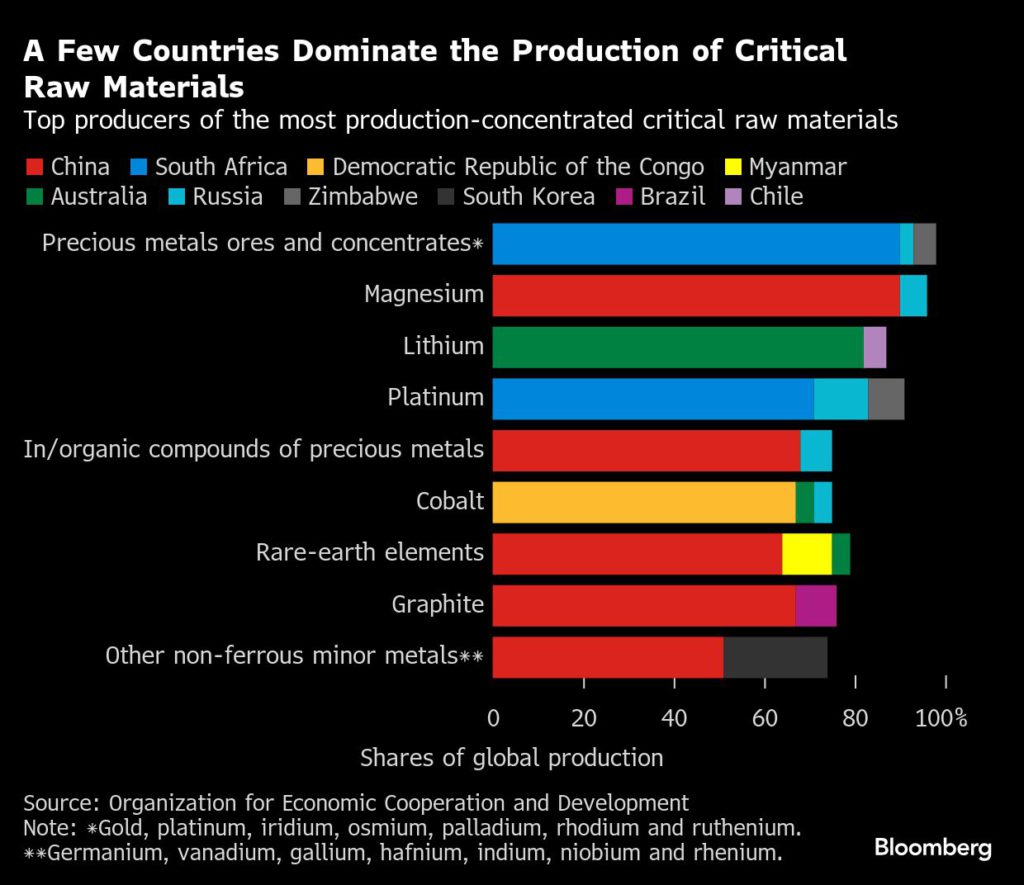
The initiative will give the US another source of rare earths beyond its single mine and main supplier China, which produces about 90% of the world’s rare earths and which has moved to restrict exports in a tariff war ignited by the US.

“The US government has been continuously advocating for recycling critical minerals, because they are aware that a significant amount of such minerals from waste was exported to China via several countries,” Choi said.

“We have been quietly researching technologies to extract rare earths over the past two years,” he said.

Choi declined to disclose any outlay or the technology firms involved but said Korea Zinc has invested in recycling, including buying an electronic waste recycler and scrap metal trader, and partnered a firm with mineral separation technology.

“If we can provide a solution or a process to extract, refine, and provide new rare earths in the United States, I think the business value would be significant,” he said.

New US smelter

In December, the South Korean firm announced the construction of a $7.4 billion critical minerals smelter in Tennessee, the first US-based smelter since the 1970s to be funded largely by the US government.

The smelter will produce 540,000 metric tons of non-ferrous metals including 11 critical minerals such as antimony, gallium and germanium, Korea Zinc has said.

“After China’s export control on rare earths in April 2025, the atmosphere in the US regarding critical minerals has changed significantly,” Choi said, citing national security as the foremost factor.

Korea Zinc reported record operating profit of 1.2 trillion won ($813 million) last year, driven by sales of antimony, which the US has listed as critical for military applications and nuclear weapons production.

“Last year was a year of antimony,” said Choi. The average price of antimony in 2025 was $25 per pound, more than double from 2024, showed data from the US Geological Survey.

Korea Zinc targets profit margins of 17% to 19% from the new smelter, Choi said. That would be higher than at its 51-year-old Korean refinery, showed data from Seoul-based DB Securities.

As joint investor, the US is providing support, Choi said, citing fast-tracked permits and expectations of guaranteed minimum prices for US critical minerals projects.

The firm plans to start construction in early 2027 and the smelter should break even within a year of starting operations in 2030, said Choi.

($1 = 1,474.5700 won)

(By Heejin Kim, Hyunjoo Jin, Heekyong Yang, Earnest Scheyder and Tom Daly; Editing by Ed Davies and Christopher Cushing)

This Ohio Factory is Trump’s Secret Weapon in the Rare Earth War

The fight for geopolitical supremacy is increasingly a fight over rare earths — the critical elements that power advanced defense systems, high-performance manufacturing, and next-generation energy technologies. REalloys (NASDAQ: ALOY) is already operating in the most strategic segment of that chain, converting heavy rare earth materials into high-performance magnets and alloys inside the United States.

For Washington, the challenge is not geology — it’s processing. Many Western companies are still in early exploration or planning stages. REalloys, by contrast, runs a functioning facility in Euclid, Ohio, where heavy rare earth feedstock is refined and transformed into specialized alloys required for defense and advanced industrial use. By keeping processing onshore, the company eliminates the offshore refining bottleneck, effectively disabling China’s ability to blackmail the U.S.

The very components that determine performance in missiles, aircraft, EV motors, satellites, and critical infrastructure can soon be fabricated in North America. REalloys bridges the gap between separated oxides and the metal inputs required to produce those magnets, already supplying qualified materials under U.S. Department of Defense contracts as domestic sourcing rules tighten.

Rare earth magnets sit at the end of this chain — the high-performance components that enable precision-guided munitions, advanced aircraft systems, EV drivetrains, satellites, and critical industrial infrastructure.

Many of the technologies built by major U.S. manufacturers — including electric vehicle platforms developed by Tesla (NASDAQ: TSLA) and the AI and data-center hardware ecosystem surrounding NVIDIA (NASDAQ: NVDA) — depend on high-performance rare earth magnets that allow motors, cooling systems, and precision components to operate efficiently under demanding conditions

REalloys occupies the pivotal step just before that final assembly, converting separated oxides into the specialized metals and alloys magnet manufacturers depend on. As U.S. sourcing rules tighten, the company is already delivering qualified materials under Department of Defense contracts, positioning it as an operational link in America’s domestic rare earth supply chain.

What the DoD Needs — And Why It's Urgent

The U.S. military is actively partnering with REalloys for rare earth metals and alloys that feed into current operational programs. The company manufactures defense-specification metal and alloy domestically, built to the exact chemistry already embedded in active program supply chains. When procurement rules shift in 2027 and Chinese-origin material is disqualified, REalloys' output stays compliant with zero reformulation required. No other supplier in North America is currently producing the same grade of qualified heavy rare earth metals and alloys.

Heavy rare earths are what allow modern missile and aerospace platforms to perform reliably under punishing conditions. Dysprosium and terbium are blended into magnet alloys specifically to maintain magnetic performance as temperatures climb and vibration intensifies.

This is what makes heavy rare earths indispensable to systems like precision-guided missiles and missile-defense interceptors. Dysprosium and terbium aren't optional additives — they are required inputs for these weapons platforms.

REalloys' Position in the Rare Earth Supply Chain

Cut through the noise, and the domestic rare earth picture narrows quickly. The vast majority of U.S.-based players remain stuck in the early stages — mining, oxide separation, pilot programs, and slide decks. REalloys sits at the opposite end of the value chain, occupying the downstream processing stage where supply chains are either real or they aren't.

The company holds a signed commercial processing and long-term offtake deal with the Saskatchewan Research Council (SRC), anchored to the SRC Rare Earth Processing Facility in Saskatoon. That agreement gives REalloys (NASDAQ: ALOY) access to 80% of the facility's upgraded annual output under a cost-plus pricing structure. Heavy rare earth production from the expanded facility is on track to come online in early 2027 — a milestone that would make REalloys the sole commercial-scale North American source of dysprosium and terbium oxides.

To support that expansion, the company is investing roughly US$21 million to boost heavy rare earth processing throughput by approximately 300%, while also lifting light rare earth (NdPr) capacity by 50%. Target output includes up to 30 tonnes of dysprosium oxide, 15 tonnes of terbium oxide, and 400 tonnes per year of high-purity NdPr metal — with NdPr scaling to 600 tonnes annually once the expansion wraps up. Initial production is expected early next year.

Building a Diversified Feedstock Pipeline

Letters of intent are already in place covering feedstock supply from KazakhstanBrazil, and Greenland

In Kazakhstan, REalloys has locked in a non-binding long-term offtake deal with AltynGroup covering rare earth feedstock that includes both light and heavy elements — dysprosium and terbium among them. Critically, that material flows straight into the company's U.S.-based metals and alloy production rather than being shipped offshore for processing.

On the Brazilian side, a signed offtake memorandum with St George Mining provides potential access to as much as 40% of rare earth output from the Araxá project, pending finalization of definitive terms.

And in Greenland, a 10-year offtake arrangement — currently at the LOI stage — would deliver up to 15% of annual rare earth concentrate production from the Tanbreez project.

All of these supply streams ultimately point toward one customer: the U.S. Department of Defense.

The Euclid, Ohio Processing Hub

REalloys' facility in Euclid, Ohio is built to take separated rare earth oxides and reduce them into metal under controlled atmospheric conditions, then alloy the resulting material into compositions suitable for magnet production. The same metallurgical workflow handles both light and heavy rare earths, including dysprosium and terbium. What comes out the other end is pre-alloyed metal — chemistry locked in early in the process and maintained within the narrow tolerances that qualified magnet producers require. Functionally, Euclid occupies the critical space between oxide separation and finished magnet assembly, the exact point where rare earth materials transition from intermediates into production-ready inputs.

The finished product moves through standard commercial channels and feeds directly into magnets and components destined for DoD programs.

Rebuilding a Lost Capability Under Pressure

For the first time in a generation, the United States is attempting to reconstruct its rare earth processing infrastructure — and it's doing so while China actively squeezes the processed materials that underpin both weapons systems and industrial output.

The core problem is deceptively simple: outside of China, virtually no one can convert rare earth oxides into finished metal at industrial scale. That conversion step is precisely where Western supply chains went dark decades ago.

That bottleneck doesn’t only affect defense programs. It also threatens supply chains tied to some of the largest technology and industrial companies in the United States, including the electric vehicle manufacturing ecosystem around Tesla and the rapidly expanding AI infrastructure market driven by chips from NVIDIA.

The Center for Strategic and International Studies (CSIS) has flagged rare earth metallization and alloying as the weakest and hardest-to-restore link in any non-Chinese supply chain. In CSIS's assessment, metal and alloy production represents an experience-based bottleneck — a capability that resists shortcuts, even when capital is abundant. Metallization expertise is accumulated through sustained operational history, not assembled on a timeline. Reaching consistent, magnet-grade quality can take years, sometimes decades. You can fast-track a mine. You cannot fast-track metallization.

This is exactly where REalloys operates. While the rest of the Western rare earth sector largely tops out at oxide production or pilot-stage separation, the Euclid facility is running the conversion process that CSIS singles out as the most difficult to replicate. Oxides go in, metal comes out, alloys are formulated, and chemistry stays within specs that downstream buyers have already qualified. This isn't a future capability — it's an active one, running inside a U.S. facility and feeding usable material into defense and magnet supply chains today.

That kind of operational capability is scarce precisely because the country walked away from it a generation ago, and reconstituting it demands time that no amount of funding can compress. It's here now, at Euclid, and it defines the outer boundary of what America's rare earth rebuild — and by extension, its defense and industrial capacity — can actually deliver.

By. Josh Owens


US pours $1B into into Latin America critical minerals


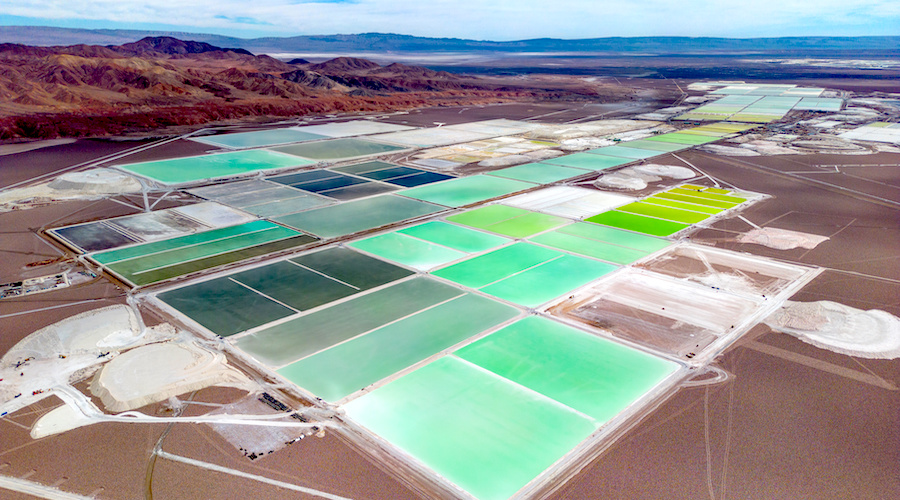
Lithium ponds in Chile’s Atacama desert. (Stock image by freedom_wanted.)

The United States has poured more than $1 billion into critical minerals investments across Latin America since January 2025, signalling a more assertive effort by Washington to secure supplies of lithium, copper and rare earths vital to energy, defence and advanced technology.

The spending surge under the second Trump administration reflects a broader shift in how governments view mining, with critical minerals increasingly treated as matters of national and energy security rather than simply commodities tied to the energy transition, according to a report by law firm White & Case.

The law firm’s global head of mining and metals Rebecca Campbell and project financing partner Fernando J. de la Hoz say projects in Brazil and Argentina are drawing direct interest from US agencies and multilateral lenders through loans, equity stakes and structured offtake agreements designed to channel output into US-aligned supply chains.

“Development of rare earth and critical minerals projects is no longer just a matter of energy transition, but rather, energy security,” Tiago Abreu, chief development officer of Brazilian Rare Earths, told delegates at a mining summit in Belo Horizonte in June 2025.

Recent financing underscores the trend. The Inter-American Development Bank approved a $100 million loan for a $2.5 billion lithium project in Argentina, while the US Development Finance Corporation is considering a $465 million investment to expand Serra Verde’s rare earth operations in Brazil’s Goiás state.

Latin America sits at the centre of the strategic push, holding roughly 60% of the world’s lithium reserves.

Lithium momentum

Brazil and Argentina have emerged as focal points for critical minerals development, driven by vast reserves, government policy and rising foreign investment.

Brazil hosts the world’s second-largest rare earth reserves after China and has seen growing interest in Minas Gerais, where a cluster of projects has earned the nickname “Lithium Valley.” Despite holding about 23.3% of global rare earth reserves, the country accounts for only about 0.02% of production, highlighting the scale of potential growth.

Argentina has moved aggressively to attract investment. The Incentive Regime for Large Investments, or RIGI, launched in July 2024, offers tax, customs and foreign exchange stability for projects worth more than $200 million. Rio Tinto (ASX, LON: RIO) became the first company approved under the framework in May 2025 for a $2.5 billion lithium project in Salta.

The country already hosts Latin America’s largest number of lithium projects, with seven operating. National lithium output capacity rose from 75,500 tonnes per year in 2023 to about 186,000 tonnes in 2025, and the government expects it to reach 658,000 tonnes by 2035.

Market conditions are also improving after a prolonged downturn. Battery-grade lithium carbonate traded near $18,200 per tonne in early January 2026, rebounding as grid-scale energy storage systems expand even as the global energy transition progresses more slowly than early projections suggested.

Geopolitical balancing

While US investment is accelerating project development, Latin American governments continue to balance geopolitical interests between Washington and Beijing.

Chinese companies remain dominant in mineral processing, particularly rare earths, where more than 90% of global processing occurs in China. Campbell and de la Hoz say governments across the region remain pragmatic, welcoming investment from both sides as they seek capital and technical expertise to develop mineral resources.

Inter-American Development Bank president Ilan Goldfajn said in December that countries across the political spectrum are focused on building domestic processing capacity to capture more value from their resources.

“We are hearing from countries from left to right, independent of political inclination, that this is the moment to increase the value added to their critical minerals,” Goldfajn told the Financial Times.

Geopolitics is increasingly influencing mining transactions and regulatory approvals. Campbell and de la Hoz point to MMG’s proposed acquisition of Anglo American’s nickel assets in Brazil, now undergoing a Phase II merger review by European regulators, as an example of how decisions in Brussels or Washington can shape mining deals thousands of kilometres away.

Critical minerals are also gaining strategic importance beyond clean energy. Defence, aerospace and advanced technology sectors are driving demand for secure supply chains, prompting some mining companies in Latin America to align projects with US strategic priorities to secure financing and long-term markets.

Domestic policy changes are also reshaping the investment landscape. Argentina has moved quickly to simplify regulations and attract foreign capital, while Brazil’s reforms have been more incremental and in some cases have increased compliance requirements.

Political risk and community engagement remain key factors shaping project timelines. Resource nationalism, environmental permitting and bureaucratic hurdles continue to influence development schedules even as government-backed financing reduces some investment risk.

Copper in driver’s seat

Copper is expected to remain the primary driver of mining investment across Latin America. Chile and Argentina are advancing major copper projects as global demand for the metal — essential for electrification and power grids — is projected to nearly double by 2035.

Several copper projects in Chile alone are expected to begin operating next year with combined investment exceeding $7 billion, reinforcing the metal’s central role in regional mining strategies.

For Campbell and de la Hoz, the surge in lithium and critical minerals investment reflects a broader shift in the global mining landscape, where geology, government policy and geopolitical strategy increasingly determine where projects move forward.

———

Latin America is heading into 2026 with resources at the centre of a growing global power struggle, as governments and investors focus on who controls critical minerals and the supply chains behind them. If the region matters to you, don’t miss MINING.COM’s new series tracking the geopolitical forces reshaping it and why markets are increasingly driven by global alliances as much as local politics.

US critical minerals talks advance with EU, Japan on price floor


The White House. Stock image.

The US, Japan and the European Union are set to announce plans in the coming weeks to lay the foundation for a trade agreement in critical minerals, according to people familiar with the preparations.

The Office of the US Trade Representative, which has led negotiations with Brussels and Tokyo on the framework, will also head talks for a trade deal that is set to include a price floor and tariffs for the materials to counter any market distortions by China, said the people, who spoke on the condition of anonymity.

Global efforts to diversify critical minerals supply chains intensified after Beijing last year imposed sweeping export controls, including on rare earths and critical minerals, in response to President Donald Trump’s so-called Liberation Day tariffs, which set a 10% levy on nearly all American imports.

Beijing has threatened it would retaliate against the formation of a bloc that would target its exports.

The supply crunch has eased somewhat since its worst point last summer and fall, but companies still complain that they don’t receive the quantities they need and have ordered from Chinese suppliers.

US Trade Representative Jamieson Greer is aiming to start negotiations for a trade agreement with the EU and Japan in critical minerals in April, shortly after a comment period for stakeholders to weigh in ends on March 19, according to the people.

A price floor would set a minimum price for producers to incentivize investment and prevent any efforts to undercut the deal with cheaper exports from China. The Defense Advanced Research Projects Agency is lending expertise to USTR’s efforts to help come up with a pricing mechanism, the people said.

The announcement of the US-Japan plan could coincide with Japanese Prime Minister Sanae Takaichi’s visit to White House March 19, one of the people said. The EU’s timing is still being worked out but Brussels and Tokyo are closely coordinating on the contents of the plans.

The topic is also on the agenda for this year’s Group of Seven summit, the people said.

A USTR spokeswoman and Japan’s Trade Ministry declined to comment. EU spokesman Olof Gill said “the work to develop this action plan is ongoing, and the Commission is working closely with Japan, while remaining also in close contact with other global partners.”

Mexico is so far the only country that signed an action plan with the US in early February. The two sides agreed within 60 days to “discuss the feasibility and development of coordinated trade policies and mechanisms, including border-adjusted price floors for critical minerals imports, focusing in the first instance on certain select critical minerals to be determined,” according to the plan.

Provisions may include technical and regulatory cooperation, investment promotion and screening, research and development of new critical minerals technologies and coordinated stockpiling, among others.

The action plans between the EU, Japan and the US will closely resemble the document signed by Mexico, the people said.

In a joint press statement on Feb. 4, the European Commission, the Trump administration and the Japanese government said: “Such a plurilateral trade initiative could include exploring the development of coordinated trade policies and mechanisms, such as border-adjusted price floors, standards-based markets, price gap subsidies, or offtake-agreements.”

The scope of the agreement and which countries will join the push is still to be determined. Officials are assessing which critical minerals to start with and then build upon that agreement to eventually expand the scope to most or all of the minerals, the people said.

The US State Department has pursued separate bilateral memorandums of understanding with countries, including the EU and Japan.

(By Jenny Leonard)