Monday, March 16, 2026

Can Trump sell the MAGA crowd on soccer with the World Cup?
DW
16/03/2026

Donald Trump has mobilized around right-wing coded sports like MMA and wrestling, but his soccer World Cup push is a cultural clash.

While the days of soccer being a go-to conservative punching bag for being "socialist" or a "sign of the nation's moral decay" have largely subsided, right-leaning publications still regularly trot out arguments for why the "US doesn't care about soccer" or the sport is "unjust and un-American".

In recent years, the sport has also served as a lighting rod in American culture wars, with the US women's national team in particular landing in the crosshairs of Donald Trump and the MAGA (Make America Great Again) movement for its outspoken progressive players.

With the men's World Cup in the US, Canada and Mexico rapidly approaching and Donald Trump aggressively promoting the tournament and deepening his relationship with FIFA, the American president is facing one of his toughest sells yet: soccer to his supporters.
Trump's World Cup?

Despite weighing in on America's eternal 'soccer' vs. 'football' debate, most of Trump's soccer push is not directly related to the sport itself.

"While compared to other countries around the world, soccer is less political here," Jeffrey Kraus, political scientist at Wagner College, New York, told DW. "This upcoming World Cup has in many ways taken a political tone."

"There’s a sense that FIFA has embraced President Trump, which certainly associates the tournament with the president," he continued.

Trump's ever-intensifying relationship with FIFA President Gianni Infantino, and FIFA’s partnership with the president's new Board of Peace have helped make Trump the face of a continent-spanning World Cup.

For some conservatives, Trump's enthusiasm for soccer doesn't feel out of place given his approach to popular sports generally.

"He's always been a sports guy - just look at his connection to UFC and wrestling," Chris Vance, President of the UCLA Young Republicans, told DW. "He's always been about entertainment, he was in that business a long time, so it makes sense."

Evolving soccer culture

While American soccer isn't generally as overtly politicized as in many parts of Europe, its comparably young and immigrant-heavy fanbase tends to be more progressive.

Anti-ICE protests have been a major point of contention among Major League Soccer (MLS) fans and league officials since Trump's reelection.

Ryan Shirah, a member of the 'American Outlaws' US National Team supporters group who's attended over 120 men's and women's US matches, argues that though most fans avoid politics in the stands, they broadly lean in one direction.

"I won't shy away from the fact that there's a humanistic element there — I think most soccer fans in America tend to lean on the more progressive, human rights-focused side of things," Shirah told DW.

Shirah said political tensions in the supporters section were highest in the immediate wake of Trump’s first election, where there was concern Trump’s anti-Mexican campaign rhetoric would spill into the stands at a USA vs Mexico World Cup qualifier in Columbus, Ohio.

"We didn't know what was going to happen, if people would be trying to chant, 'build that wall'," Sirah explained. "It's something we didn't want to bring into our atmosphere and we kept out. Generally, we haven't really had an issue."

In 2022 in Qatar, USA and Iran fans were supportive of their teams
Image: Christophe Ena/AP/picture alliance

Soccer's continued growth means the political makeup of its American fans is likely to shift.

"Since the US hosted the 1994 World Cup, soccer has become a bigger part of American life," said political scientist Kraus. "Much of the population growth since the 90s has been through immigration, and many of the folks who come here brought their love of the 'beautiful game'."

Growing Republican support among Latinos in the 2024 election demonstrates that the political views of immigrants, many of whom are driving the sport's growth in the US, can evolve and potentially change US soccer culture in turn.

And while the arrival of Lionel Messi in Miami has brought wider attention to the sport, organizers are hoping the 2026 World Cup can further propel soccer into the American mainstream. As it gets bigger, soccer will increasingly appeal to conservative fans.

"I live on Staten Island, one of the most suburban and conservative boroughs in New York City. When I was younger, on Saturdays you'd drive around and the athletic fields would be filled with kids playing baseball. Now it's soccer," said Kraus. It is perhaps of note that Staten Island is the only NYC borough won by Donald Trump in 2024.

The next MAGA sporting sensation?

Vance, who notes he's a bit of an outlier among his peers due to his interest in soccer, is excited for the US to play World Cup matches in Los Angeles.

"It's cool to host it here. I think of it almost as a conservative sport because it's so community based, or at the very least not really as a politically-leaning sport," he said.

Organized supporters like Shirah tend not to dwell too much on potential political differences with fellow fans as long as they can maintain a welcoming atmosphere in the stadium.

"We haven't had a major tournament since the election, but why have that (offensive) nonsense into the stadium if we don't have to? So far, so good," he said.

"We don't care what you do or what podcasts you listen to after the 90 minutes. If you're passionate about the team and not using slurs or anything, that's fine. We all have walks of life, and I think that's what makes America great."

First, the US will have to have a successful run at the World Cup to make the most of a generational opportunity. If they can do that, existing supporters may well have to worry about the politics of new fans — a problem many of them likely wouldn't mind.

Edited by: Jonathan Harding
South Korea uneasy as US moves air defenses to Middle East

Julian Ryall
DW
16/03/2026


Reports indicate the US is redeploying some Patriot and THAAD air defense batteries from South Korea to the Middle East. The move comes as Pyongyang continues saber rattling.

In 2017, the US began stationing more air defense systems in South Korea, like this THAAD battery
Image: Choo Sang-chul/Newsis via AP/picture alliance


North Korea fired a salvo of 10 ballistic missiles into the Sea of Japan on Saturday, highlighting the need for South Korea to retain a credible missile defense.

Unfortunately, the launch coincides with reports that the US is withdrawing some missile defense systems from South Korea to enhance its capabilities in the Middle East amid the ongoing war with Iran.

Citing US officials, The Washington Post reported on March 9 that the Pentagon was transferring Patriot and Terminal High-Altitude Area Defense (THAAD) anti-missile batteries from US Forces Korea (USFK) to the Middle East.

South Korean media have also reported on an unusually high number of flights by US military transport aircraft from Osan Air Base, although the US is remaining tight-lipped about its actions.

"The USFK may dispatch some air defense systems abroad, in accordance with its own military needs," President Lee Jae-myung said on March 10. "While we have expressed our opposition, the reality is that we cannot fully push through our position."

In an editorial on Wednesday, The Korea Herald said, "Patriot and THAAD batteries are central to the US-South Korea shield against North Korean ballistic missiles, so their withdrawal would carry serious security implications for Seoul."

Will the air defense return to South Korea?

Another concern is that these systems might not return to South Korea when the crisis in the Middle East has abated, as US President Donald Trump's administration pressures allies to shoulder more responsibility for their own defense.

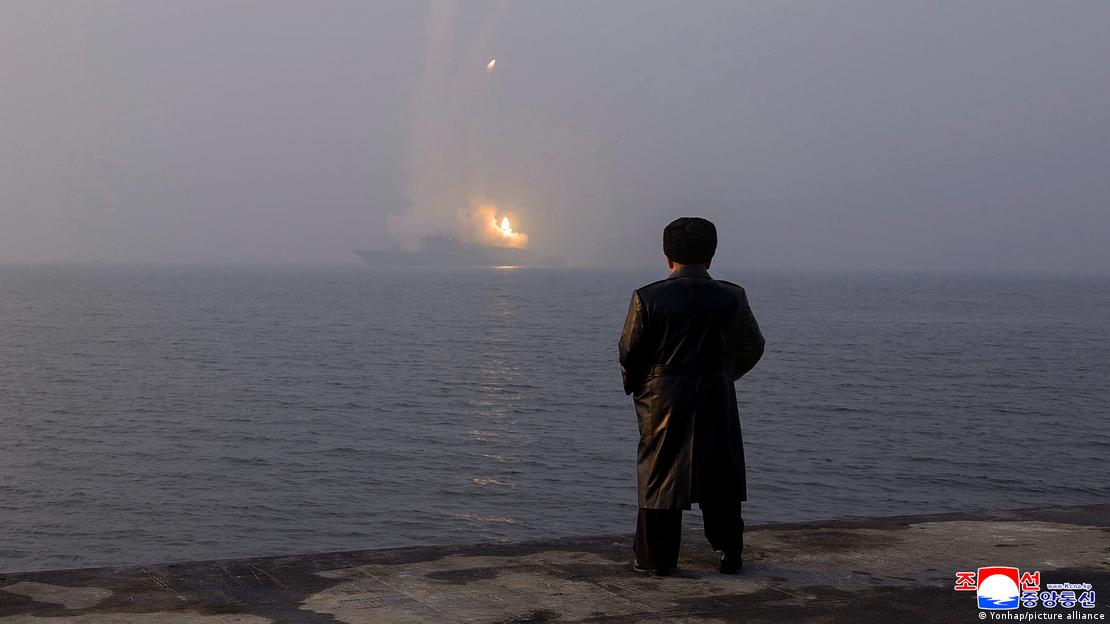
North Korean leader Kim Jong Un observed the recent missile launch off the North Korean coast
Image: Yonhap/picture alliance

The US deployed THAAD batteries to South Korea in 2017, citing the threat from the North.

"It is a problem and there seems to be little that the government can do," said Choo Jae-woo, a professor of foreign policy at Kyung Hee University in Seoul.

"In the past, we had confidence that Korea was in good hands when it came to defending ourselves against the North, but we know the North has better and more missiles and now the US defenses are gone, so people are anxious," he told DW.

With Trump's transactional tactics in mind, Choo suggested that not returning the air defenses when the Middle East crisis has passed could be used as a "pressure point" on Seoul for the White House to get its way on trade or South Korean investment in the US.

Trump asks for support in Iran

The reports of missile battery redeployment come as the conflict in the Middle East shows little sign of winding down, with Trump asking allies, including South Korea, for assistance in protecting shipping in the vital Strait of Hormuz from Iranian attack.

Despite Trump claiming that the US has "destroyed 100% of Iran's military capability," Iran can still target slow-moving tankers in the strait with drones, unmanned boats and other projectiles.

"Hopefully China, France, Japan, South Korea, the UK, and others, that are affected by this artificial constraint, will send Ships to the area so that the Hormuz Strait will no longer be a threat by a Nation that has been totally decapitated," Trump wrote on Truth Social.


Officially, South Korea's presidential office said it is "carefully deliberating" a response, but Lim Eun-jung, a professor of international studies at Kongju National University, told DW there is little appetite for Korean service personnel to be committed to the fighting.

"This request is making people very uncomfortable," she said. "Security is always a worry for us because we do not want to be engaged in somebody else's troubles."

"What is happening in the Middle East is not of no concern to us at all because we get so much of our energy from the region, but no one here wants to be dragged into this conflict," Lim added.

Defending the North Korean threat

However, Lim pointed out the South Korean military has made steps on homegrown defense against threats from the North.

This includes the domestically developed Cheongung-II air defense system that was sold to the UAE, which has performed well in intercepting inbound Iranian missiles and drones.

"The Cheongung is often described as South Korea's Patriot missile system and it has been operating with 95% accuracy for the UAE, so that gives me confidence because it is also deployed on our frontlines," she said.

However, the analyst added that US systems add important layers of defensive depth.

And while the US president is "unpredictable," Lim remains confident that the Patriot and THAAD systems will be redeployed to South Korea in the future "to ensure the balance of power in the region, to make sure that North Korea does not make a misjudged move and that China does not push too hard."

North Korea waiting and watching


Leif-Eric Easley, a professor of international studies at Ewha Womans University in Seoul, said Pyongyang will be closely watching developments in the Middle East, and will be seeking ways to drive a wedge between Seoul and Washington.

The North Korean missile launches on Saturday were attended by North Korean leader Kim Jong Un and coincide with the start of large-scale joint US-South Korean military exercises.

"North Korea is unlikely to take military action when it observes US redeployment of missile defense assets from the Korean Peninsula to the Middle East," Easley said.

"Instead, Pyongyang will aim propaganda at aggravating divisions in Seoul over the strategic flexibility of US forces and the legality of Trump's military action against Iran," he added.

"The Kim regime wants to turn South Korean domestic politics against combined defense exercises and coordinated defense procurement among US allies. That is how North Korea, with conventional forces inferior to South Korea's and nuclear forces inferior to America's, can hope to dominate the Korean Peninsula."


Edited by: Wesley Rahn

Julian Ryall Journalist based in Tokyo, focusing on political, economic and social issues in Japan and Korea
Oscars 2026: All the political moments
DW
16/03/2026

"Chaotic, frightening times": Diverse Academy Awards presenters and winners called out Trump's wars and restrictions on human rights.

'
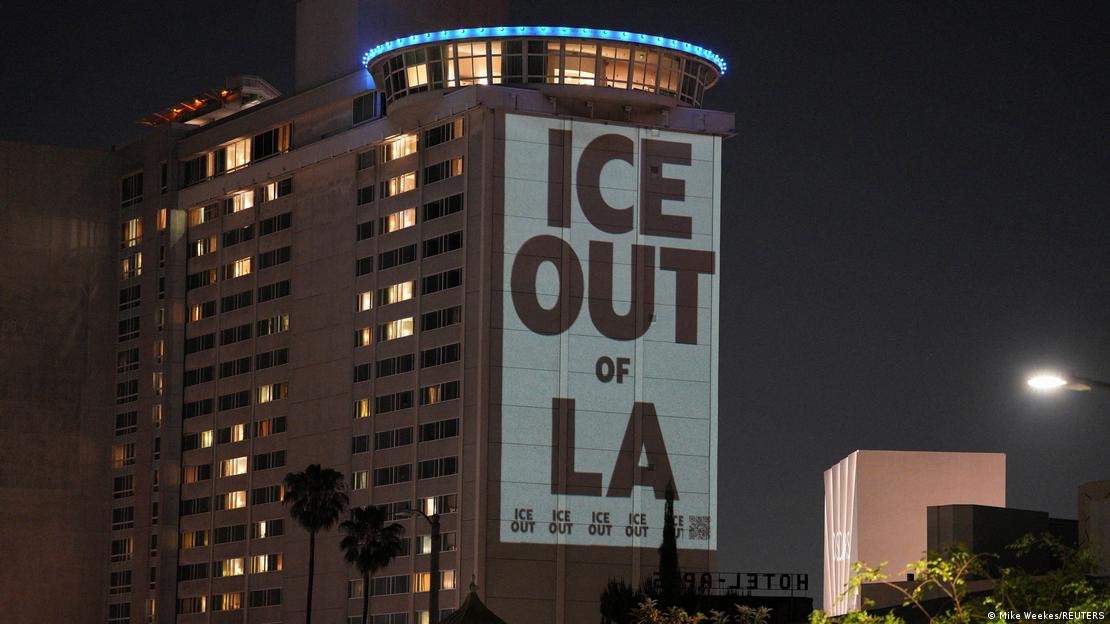
ICE OUT OF LA' was projected on a hotel near the Dolby Theatre, in protest against the immigration enforcement policies under Trump's administration
Image: Mike Weekes/REUTERS


Ahead of the Oscars night, the award ceremony's host Conan O'Brien gave the impression he would be avoiding politics: "We're celebrating movies and the amazing people behind them, but it has to be funny without tipping into anger or politics," he'd said at a press conference.

But then, at the beginning of the Sunday night ceremony, he warned that "things could get political," adding: "So there's an alternate Oscars hosted by Kid Rock at the Dave and Busters down the street," referring to the conservative-leaning alternative "All-American Halftime Show" that had been produced during the Super Bowl in protest of Bad Bunny's performance at the official event.

Without naming the US president, O'Brien also took a jab at Donald Trump and the fact that he stamped his name on the John F. Kennedy Center for the Performing Arts: "We're coming to you live from the Has a Small Penis Theatre," the host said about the Oscars' venue, the Dolby Theatre. "Let's see him put his name in front of that!"

Referring to the absence of British nominations in the lead acting categories, O'Brien also took aim at the lack of consequences in the United States over the Jeffrey Epstein files: "It's the first time since 2012 that there are no British actors nominated for best actors or best actress. A British spokesperson said: 'Yeah, but at least we arrest our pedophiles'."

O'Brien concluded his opening monologue on a more earnest note, saying: "If I can be serious for just a moment, everyone watching right now, around the world, is all too aware that these are very chaotic, frightening times … So let us, please, celebrate not because we think all is well, but because we work and hope for better in the days ahead."

Paul Thomas Anderson apologizes for this 'mess'

The evening's two top films already set the tone, as "One Battle After Another," which won six Oscars including Best Picture, and "Sinners," which took home four awards from its record-breaking 16 nominations, both carried political themes.

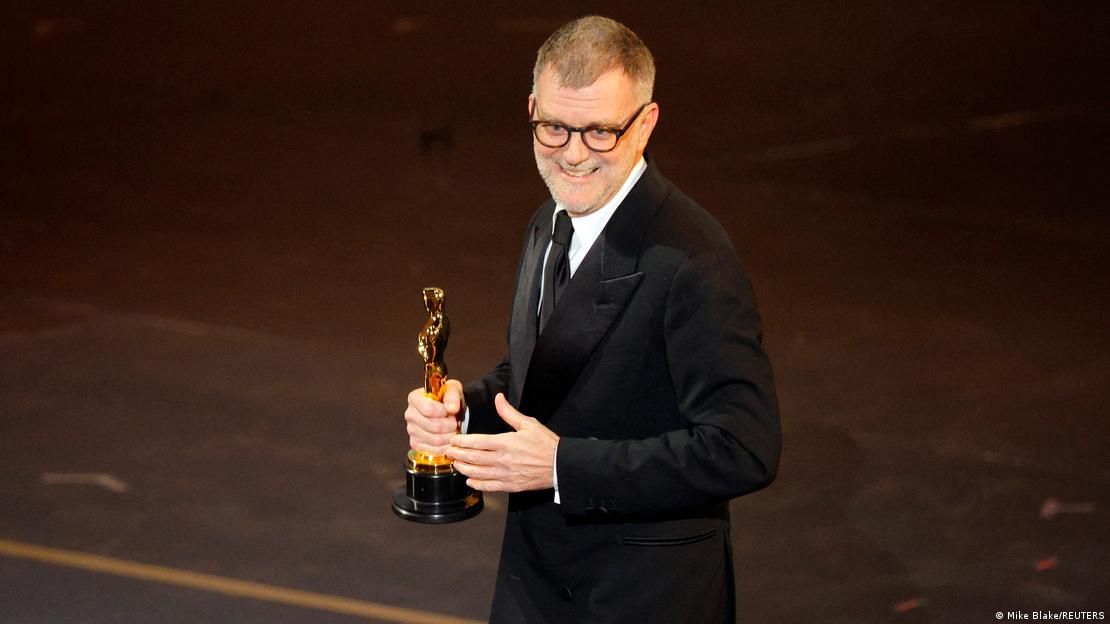
Paul Thomas Anderson's film centers on a rebel group fighting an authoritarian government that detains immigrants. During one of his acceptance speeches, Anderson apologized to his children's generation for "the housekeeping mess we left in this world we're handing off to them" and expressed hope that they would restore "common sense and decency."

Paul Thomas Anderson said he wrote his political thriller 'One Battle after Another' for his kidsImage: Mike Blake/REUTERS

"Sinners," by Ryan Coogler, explores racial violence and injustice in the era of Jim Crow segregation. Michael B. Jordan, took the Best Actor Oscar for his double role as a pair of twins in the film. The actor paid tribute to the previous Black lead actors who won the award before him, naming all six of them: "I stand here because of the people who came before me — Sidney Poitier, Denzel Washington, Halle Berry, Jamie Foxx, Forest Whitaker, Will Smith," he said, adding that he was honoured "to be amongst those giants."
Javier Bardem says 'no to war and free Palestine'

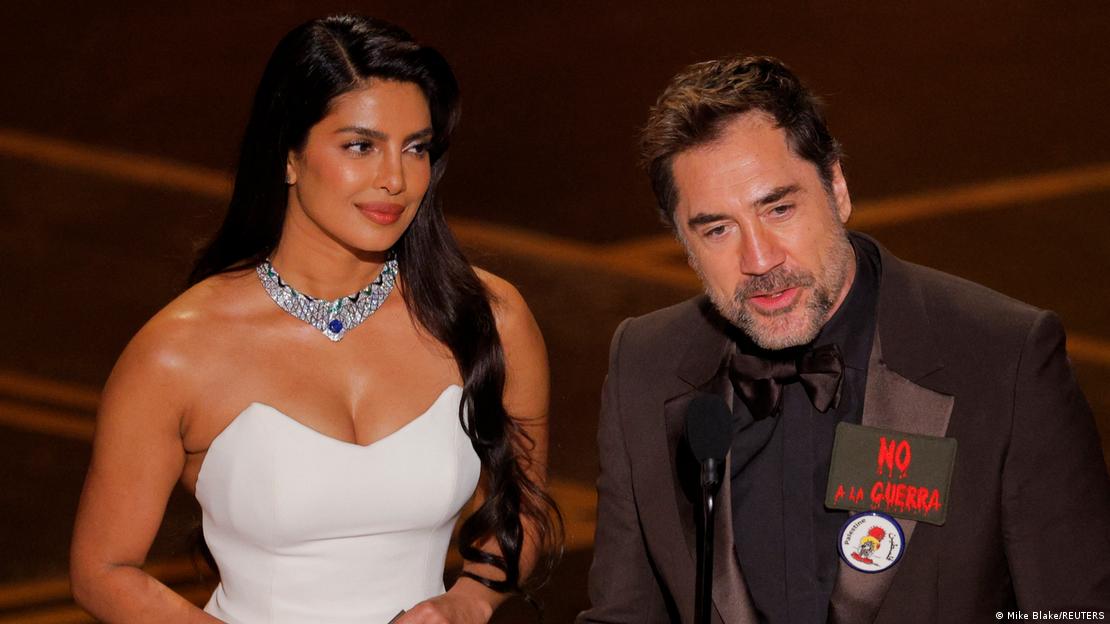
The most direct anti-war statement on stage came from Spanish actor Javier Bardem, who declared "No to war and free Palestine" while presenting the Best International Feature Film. The "F1" star has been a longtime vocal advocate for Palestinian human rights. He was also wearing a pin with the word "Palestine" on it and featuring Handala, a long-standing symbol of Palestinian identity and resistance, as well as a badge on his vest that read: "No a la Guerra" (No to war).
Javier Bardem is one of the more outspoken voices in Hollywood on the war in the Gaza Strip
Image: Mike Blake/REUTERS

Diverse celebrities wore pins or symbols signalling their political stances, including pins that read "ICE OUT," against violent immigration enforcement policies in the US. Others had the Artists4Ceasefire pin on the outfits, showing their support for a group that has called for an immediate and permanent ceasefire in Gaza, along with humanitarian aid for civilians and the release of all hostages.
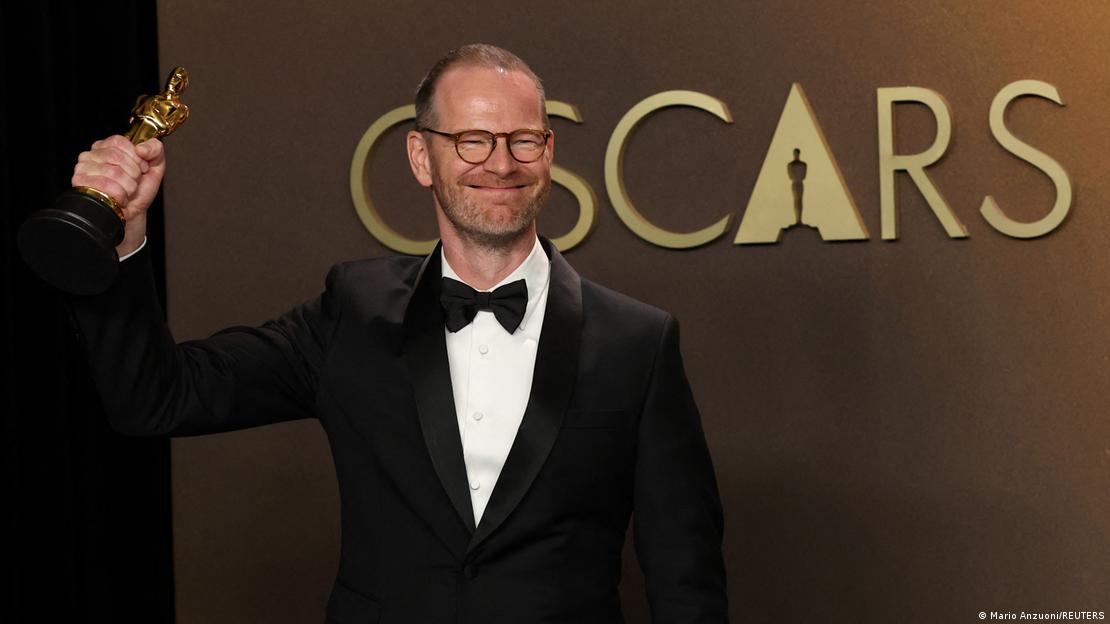
Joachim Trier: Children need to be protected

Winning the Best International Feature Film Oscar for "Sentimental Value," Joachim Trier paraphrased US civil rights activist and author James Baldwin, pointing out that, "All adults are responsible for all children. Let's not vote for politicians who don't take this seriously and into account."


Norwegian filmmaker Joachim Trier commented on the impact of war on children
Image: Mario Anzuoni/REUTERS

Backstage, the filmmaker expanded on his acceptance speech statement, telling the press that as a father of two children he felt empathy for children suffering in conflict zones. "We've seen Palestinian children suffer, children from Ukraine suffer, from Sudan suffer, and there doesn't seem to be any accountability at the moment," he said.
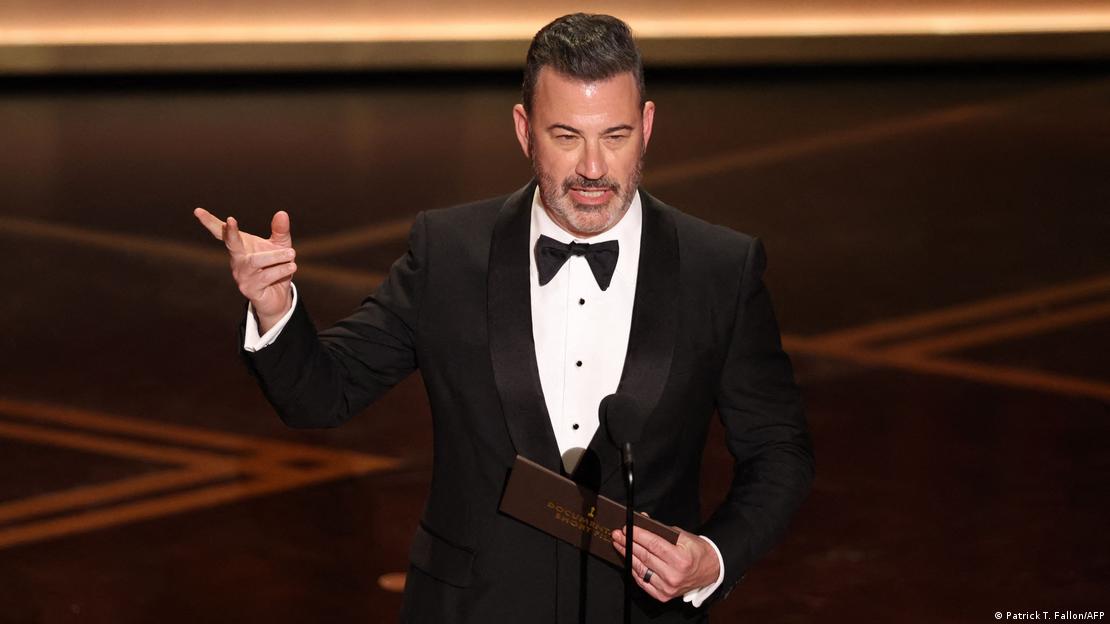
Jimmy Kimmel takes a jab at CBS over accusations of censorship

Handing out the Best Documentary award, Jimmy Kimmel called out attacks on freedom of speech. "There are some countries whose leaders don't support free speech," said the late-night TV show host. "I'm not at liberty to say which. Let's just leave it at North Korea and CBS" — a reference to the fact that the US network CBS has faced accusations of censorship after blocking the broadcast of a "60 Minutes" program about Trump administration deportations as well as a Stephen Colbert interview with a Texas Democrat.

Kimmel himself was abruptly pulled off the air last fall for a week after coming under fire from Brendan Carr, the chair of the Federal Communications Commission.

Amid increasing censorship, Kimmel praised the courage of documentary filmmakers
Image: Patrick T. Fallon/AFP

"We hear a lot about courage at shows like this but telling a story that could get you killed for telling it is real courage," Kimmel said, as he praised the nominated documentary filmmakers for their determination amid censorship.

"There's an international community of filmmakers dedicated to telling the truth, oftentimes at great risk, to make films that teach us, that call out injustice, that inspire us to take action," he said.

Kimmel then contrasted such documentaries with the Amazon production promoting Donald Trump's wife, Melania. "And there are also documentaries where you walk around the White House trying on shoes," he quipped. "Oh man, is he going to be mad his wife isn't nominated," Kimmel joked, once again referring to the president without naming him.

Documentary on Russia shows 'how you lose a country'

The Best Documentary Oscar went to "Mr Nobody Against Putin," a film that follows a videographer documenting how school children are indoctrinated to support Russia's invasion of Ukraine.

\
The team of 'Mr Nobody Against Putin' accepting their Oscars for Best Documentary Feature Film
Image: Mike Blake/REUTERS

"'Mr Nobody Against Putin' is about how you lose your country," said director David Borenstein in his acceptance speech. "And what we saw when working with this footage is that you lose it through countless, small, little acts of complicity."

"When a government murders people on the streets of our major cities, when we don't say anything, when oligarchs take over the media and control how we could produce it and consume it, we all face a moral choice," said the filmmaker, drawing parallels with current developments in the US. "But luckily, even a nobody is more powerful than you think."

And the film's co-director, Pavel Talankin, concluded the speech by saying "In the name of our future, in the name of all of our children, stop all of these wars now."

Edited by: Brenda Haas

Elizabeth Grenier Editor and reporter for DW Culture


Strike to affect 445 flights at Berlin airport on Wednesday

16.03.2026, dpa


Photo: Michael Bahlo/dpa


By Matthias Arnold, dpa

A strike will halt all passenger flights at Berlin's airport on Wednesday, affecting 445 take-offs and landings and roughly 57,000 passengers, the operator said.

The announcement comes after the Verdi trade union on Monday called a strike over an ongoing pay dispute.

The union said the walkout was a result of employers' "refusal to put forward a proposal open to negotiations" amid collective bargaining talks.

The union is negotiating with airport management, seeking a salary increase of 6% or at least €250 ($287) in pay raises for its 2,000 employees under a new collective agreement that would run 12 months.

Verdi also wants to secure an additional day off for union members as part of the agreement.

The dispute covers workers in several key operational areas, including the airport fire service, traffic control and terminal management.

Flights are not be possible because these roles are essential for the functioning of Berlin Brandenburg Airport, the operator said. The company urged affected passengers to contact their airlines for information about rebookings and alternative travel arrangements.

During the second round of negotiations last week, the employer side presented an initial offer that the union said would amount to wage increases of about 1% per year, with the contract running until the end of 2028.

"That is not a serious offer but a provocation at the negotiating table," said Verdi negotiator Holger Rössler.

Wednesday's industrial action will be the first strike in the current negotiations at the Berlin airport.

Aletta von Massenbach, the head of airport operator Flughafen Berlin Brandenburg, criticized the industrial action as disproportionate, “especially given an already very tense situation due to the war involving Iran.”

"The next round of negotiations is already scheduled for March 25. We remain confident that an agreement can be reached," she said.

Lufthansa pilots staged a two-day strike last week that led to the cancellation of hundreds of flights across Germany.

Germany news: Strike to block all flights at Berlin airport
16.03.2026
DW, dpa, AFP, Reuters, AP, epd, KNA

Berlin-Brandenburg Airport is to ground all flights amid a strike called for Wednesday. 

Berlin-Brandenburg Airport to suspend all flights after strike call

Berlin-Brandenburg Airport, which serves Germany's capital and the surrounding region, will cancel all flights and traffic on Wednesday after the Verdi union announced a strike for that day.

"Please contact your airline or tour operator for information on rebooking and alternative travel options," the airport posted on X.

Verdi called the strike amid a pay dispute with public-sector employers.

"In the second round of negotiations, the employers put forward an offer that [Verdi's] bargaining committee rejected as unacceptable," Verdi said.

Lava flows reach Indian Ocean on France's Réunion Island

Issued on: 16/03/2026 - FRANCE24


One month after the Piton de la Fournaise volcano began erupting on Réunion Island, lava continues to flow and has reached the ocean for the first time in 19 years. Two lava flows have also cut the national road linking the southern and eastern parts of the French island in the Indian Ocean.

France, UN push for direct talks to end hostilies between Israel and Lebanon

French President Emmanuel Macron on Saturday said Lebanon was ready to engage in "direct talks" with Israel and offered to host negotiations in Paris. This came on the heels of a visit to Beirut by UN chief Antonio Guterres, who also urged for a diplomatic solution the crisis.


Issued on: 14/03/2026 - RFI

Smoke rises following an Israeli airstrike in Dahiyeh, Beirut's southern suburbs, Lebanon, Saturday, 14 March 2026. AP - Hassan Ammar

"The Lebanese government has signalled its willingness to engage in direct talks with Israel," Macron said on social media platform X, adding that "all sections of society must be represented in these talks."

Macron said he had spoken to Lebanon's President Joseph Aoun and Prime Minister Nawaf Salam and told them that "France is ready to facilitate these talks by hosting them in Paris".

"Everything must be done to prevent Lebanon from descending into chaos," Macron added.

"Hezbollah must immediately halt its reckless course. Israel must abandon plans for a large-scale offensive and cease its massive air strikes."

Lebanon was drawn into the Middle East war last week when the militant group, funded and armed by Iran, attacked Israel in response to the killing of Iran's supreme leader Ayatollah Ali Khamenei in US-Israeli strikes.

Hezbollah chief Naim Qassem said on Friday his group was ready for a long confrontation with Israel.

France said it was deeply concerned by the escalation of violence and the displacement of people – calling on all parties to respect international humanitarian law and protect civilian populations.

Foreign Minister Jean-Noël Barrot announced that France was sending 60 tonnes of aid to help with the humanitarian crisis.

Rescue workers carry a body from an apartment destroyed in an Israeli airstrike in the southern port city of Sidon, Lebanon, Saturday, 14 March 2026. AP - Mohammad Zaatari

Diplomatic avenues

Meanwhile, UN chief Antonio Guterres said Saturday on a visit to Beirut that diplomatic channels remained open to end the war between Israel and Hezbollah.

"There is no military solution, only diplomacy, dialogue and full implementation of the UN Charter and Security Council resolutions. The diplomatic avenues are available, including through my special coordinator for Lebanon... and through key member states," he said.

"We are doing everything we can now to bring about an immediate de-escalation and the cessation of hostilities," Guterres told reporters.

Lebanon rocked by Israeli strikes as Hezbollah joins Iran war

"My special coordinator is engaging with all actors around the clock to bring the parties to the table and UNIFIL peacekeepers... remain in position," he said, referring to the UN Interim Force in Lebanon.

He said attacks against peacekeepers and positions were "completely unacceptable and they must stop. They are in breach of international law and may constitute war crimes".

Three peacekeepers serving with the Ghanaian contingent were wounded earlier this month in south Lebanon.

"My message to the international community is simply step up your engagement, empower the Lebanese state and support the Lebanese Armed Forces to secure the capabilities and resources they need," Guterres said.
Decisive phase

Israel, which had continued to strike targets in Lebanon even before the war, despite a 2024 ceasefire with Hezbollah, has launched deadly air attacks, sent ground troops into border areas and issued evacuation warnings that have displaced hundreds of thousands of people.

On Saturday Israel said the war had entered a "decisive phase", as explosions rocked cities across the Middle East, with strikes on the US embassy in Baghdad and a major Emirati energy facility.

Lebanon postpones parliamentary elections due in May by two years

Israel's Defence Minister Israel Katz warned that the war would "continue as long as necessary".

Israeli air and ground assaults have killed at least 826, including 106 children since 2 March, according to the Lebanese authorities.

An overnight strike in Burj Qalawiya, southern Lebanon killed a dozen doctors, paramedics and nurses at a healthcare clinic, health authorities said Saturday.

During his visit to Beirut, Guterres launched a $325 million (€277 million) appeal to support Lebanon as it responds to the unfolding humanitarian crisis.

(with newswires)

 YANKEE HUBRIS

Middle East conflict is not NATO war, but 'entwined' with US position on Ukraine

Issued on: 16/03/2026 - FRANCE24

US President Donald Trump said he has demanded about seven countries send warships to keep the Strait of Hormuz open as Iranian strikes continued to rain down on Gulf countries. Trump has warned his allies not helping him could lead to a 'very bad' future for NATO. And although the conflict in the Middle East is not a NATO war, it is very much 'entwined' with the United States' position on Ukraine. FRANCE 24's Angela Diffley tells us more.


Video by: Angela DIFFLEY

US realising it 'needs help from allies even if all-powerful militarily'


Issued on: 16/03/2026 - FRANCE24

President Donald Trump criticized US allies on March 16 for their lukewarm response to his call to help protect shipping through the Strait of Hormuz. Despite that, he did claim that some countries had agreed to help - but from what has been heard so far, this isn't true as FRANCE 24's Kethevane Gorjestani explains.


US allies 'know how to deal with Trump' amidst threats over Strait of Hormuz


Issued on: 16/03/2026 - FRANCE24

US President Donald Trump has demanded seven countries send ships to the Strait of Hormuz to secure toe crucial passagepoint for global oil flows. He threatened that refusal to help would mean a 'very bad' future for NATO. But US allies refuse to be dragged into the ongoing war in the Middle East. FRANCE 24's Kethevane Gorjestani tells us more.


US media coverage of the war in Iran: Fact, fiction and propaganda

Issued on: 13/03/2026 - FRANCE24

PLAY 12:43 min


Polls in the United States suggest the war in Iran is unusually unpopular compared with past US military conflicts. There has been propaganda, video-game footage and facts spun into fiction, but also excellent reporting and crucial analysis of the innocent lives lost. This week, FRANCE 24’s media show Scoop looks at US media coverage, and our guest is Negar Mortazavi, an Iranian-American journalist and political analyst.


‘Radical acceleration’ in AI military targeting raises oversight fears


Issued on: 11/03/2026
FRANCE24

13:18 min


Speaking with FRANCE 24’s Sharon Gaffney, Elke Schwarz, Professor of Political Theory at Queen Mary University of London, warned of a “radical acceleration” in the speed at which military targets are identified through the use of AI, and how quickly action is taken against them. She said this raises concerns about the lack of human oversight, especially given that AI models have “25 to 50% reliability, which means they are wrong very often”.


Could Nigeria become an alternative oil supplier to the Middle East?


Issued on: 15/03/2026 - FRANCE24

As the conflict in the Middle East continues to take a significant toll on the world's oil supply, Nigeria's foreign minister has invited the Gulf countries and oil producers to look at Nigeria as a partner in supplying the global market. Story by Clémence Waller and Gabrielle Nadler.


Video by:  Gabrielle Nadler


Justice for Syria’s disappeared: When survivors take charge


Yasmen Almashan spent years fighting to find out what happened to her brothers, who were among the more than 180,000 Syrians who went missing under the regime of Bashar al-Assad. Now, during Women’s Week at the UN, she is back – only this time she has an official public role in Syria’s transitional justice commission.


Issued on: 16/03/2026 -
FRANCE24
By: Jessica LE MASURIER
Video by: Jessica LE MASURIER

Syrian human rights defender Yasmen Almashan looks at a photo of her brothers, who were killed during the Assad regime, on her phone in front of the UN in New York on March 12, 2026. © Jessica Le Masurier
02:02


Yasmen Almashan lost five of her six brothers during the early years of the Syrian civil war, four of them in 2012 alone. Her brother Zouhair was killed during protests against Assad. Oqba was detained by security forces and disappeared. A few months later, Obaida was killed by a sniper while working as a medic, trying to rescue wounded civilians from the rubble of buildings destroyed by bombs. A sniper also killed her brother Tishreen.

Later, in mid-2014, her youngest brother Bashar was kidnapped by the Islamic State group. She never heard from him again.

“I’m the only girl among six brothers, and suddenly I lost five of them. All the time before I lost them, they surrounded me with all the love you can imagine,” Almashan explained, standing outside the UN headquarters in New York. “I feel that my duty now is to fight for justice for them.”

A photo on Yasmen Almashan's cellphone shows her brothers, who were killed during the Syrian civil war, on March 12, 2026, outside the UN headquarters in New York City. © Jessica Le Masurier

When a military defector code-named Caesar smuggled thousands of photos out of Syria, Almashan recognised her brother Oqba among the images of tortured corpses.

She co-founded the Caesar Families Association and worked with other groups of survivors and families to seek justice for those who disappeared in Syria.

From the start of the Syrian civil war in 2011 to the fall of the Assad regime, more than 180,000 people went missing, according to the Syrian Network for Human Rights.

Syrian human rights defender Yasmen Almashan outside the United Nations headquarters in New York City, June 13, 2023. © Jessica Le Masurier

FRANCE 24 met Almashan in 2023, when she came to lobby for the creation of an international foundation for the disappeared. Quiet and resolute, she stood outside the United Nations in protest, holding photos of civilians who went missing under the Assad regime.

Fifteen months after the fall of the regime, she is back at the United Nations – only this time in an official role as a commissioner for Syria’s National Commission for Transitional Justice.

At a side event called Advances in Transitional Justice and Access to Justice in Syria at German House in New York on Thursday, she spoke alongside two other Syrian human rights activists who are also part of the governmental body tasked with addressing past human rights violations, ensuring accountability and supporting national reconciliation in the aftermath of the Assad regime’s abuses.

“Ten years ago I was just a woman in a tent in a refugee camp in Turkey. We fought to reach a point where we are decision-makers in our beloved Syria,” she said.

The trajectory of Syria's Ambassador to the United Nations, Ibrahim Olabi, is not dissimilar to Yasmen’s. He, too, was a human rights defender. He founded the Syrian Legal Development Programme, which offers legal expertise to Syrian NGOs, advising them on issues related to forced displacement, torture, and the delivery of humanitarian aid. Now he represents his country at the United Nations.

“I feel that it’s part of all of our healing to be in the positions we’re in now – we’re able, we’re in the driving seat.”

A new Syria

Forces loyal to Syria’s transitional president Ahmed al-Sharaa overthrew Assad in December 2024. Once the head of an armed Islamist group known as Hayat Tahrir al-Sham, which was only removed from the US list of terrorist groups in July 2025, Sharaa has been at pains to project a more moderate image since he took the reins in Syria.

Although the war in Syria has ended, there have been sporadic incidents of sectarian violence, with hundreds killed in clashes between Druze and Sunni Bedouin communities and government forces. There has also been targeted violence against the Alawite community.

The Kurdish community has accused Sharaa of complicity in the genocide of Yazidi Kurds in 2014, filing a complaint with Germany's federal public prosecutor's office in October 2025. He denies the accusations.


“The president himself has made it clear that he was not involved and that this commission is independent and will investigate any crimes relevant to the Assad era,” Ambassador Olabi told FRANCE 24. “It is the [Sharaa] government that enabled this national commission and appointed people like Yasmen to work on accountability and human rights.”

Lessons from the past

Germany’s deputy ambassador to the UN, Dr Thomas Zahneisen, hosted the side event, which included experts on the rule of law and sexual violence. He spoke of the challenges of Germany’s own long journey of national reconciliation and reunification. “It is a difficult path by experience. Yes, there are successes, but also a lot of setbacks,” Zahneisen explained. “It takes a long time.”

Zahneisen said Syria’s National Commission for Transitional Justice had recently travelled to visit the archives of the Stasi, the feared security forces of former East Germany that were key to repressing and intimidating the population during the Cold War. He added that UN mechanisms were also playing an important role in supporting this process.

Colombia’s deputy ambassador, Raul Sanchez, also shared his country’s experience in addressing past crimes to establish accountability and social cohesion.

“It’s a remarkable time for transitional justice in Syria, because everything is possible and everything is at risk,” explained Crisis Action's UN Director, Gareth Sweeney. “The commissions are blessed to have people like Yasmen, who have phenomenal integrity. They speak a truth that Syrians can see and feel. But the challenges they face are obvious to us all, in terms of resourcing and having to operate and build justice and accountability in a country that is having, itself, to rebuild.”

After the meeting at German House, Almashan heads to Syria’s UN mission, a block from the main UN building, to meet the delegation ahead of iftar, the fast-breaking evening meal during Ramadan. There is no obvious marking on the building other than a sign reading “Diplomat Centre,” but for her the building symbolises the regime under which her brothers died.

She gets the shivers as she enters, but she remains hopeful that eventually, reconciliation is possible.
'We all need solidarity': volunteers mobilise to help Lebanon's displaced

Hundreds of thousands have been displaced in Lebanon as Israel orders swathes of the country to evacuate amid its bombing campaign against Hezbollah in the south. As the humanitarian crisis worsens, local NGOs are doing what they can to help.


Issued on: 14/03/2026 - RFI

Volunteers prepare meals at the community kitchen Nation Station for displaced people and refugees in Beirut, Lebanon, on 5 March, 2026. © Reuters - Claudia Greco
02:06


In the Geitawi neighbourhood of Beirut, around 40 people are preparing huge pots of bulgur and tomatoes.

The premises are a former petrol station, converted by NGO Nation Station into a community kitchen after the Beirut port explosion in August 2020.

Its volunteers are cooking for people displaced by the war launched by Israel and the United States against Iran and its allies, including Hezbollah.

"Most people have nowhere to go, the shelters are full, we cannot meet all their needs. Many NGOs have doubled their efforts, as we have, but it is not enough," says Joséphine Abou Abdo, the co-founder of Nation Station.

"The government does not have the means to help. And there are not enough people helping to support us. This is a serious crisis – I would even say it's worse than during the last war."

'Powerless'

Hanna Dulière, a 14-year-old French national, is among the volunteers. "In this country, we all need a certain amount of solidarity, otherwise nothing will hold together," she says.

Another French volunteer, Soledad André-Amra, says helping out gives her a sense of purpose.

"We feel very powerless about what is happening. It is important to be able to do something, even if it is not much," she says. "There are still a lot of people living on the streets today and hundreds of thousands of people have been displaced."

The roughly 2,200 hot meals they are preparing will be delivered to 15 schools that are housing people fleeing the conflict.

More than 800,000 people are currently displaced in Lebanon, according to the country's Disaster Risk Management Unit – roughly one in seven of the country's 5.8 million people. Nearly 126,000 of those displaced are housed in shared shelters.

Israel has placed nearly 1,500 square kilometres of Lebanese territory under evacuation orders, including much of the south of the country and Beirut's southern suburbs, both Hezbollah strongholds.

Last week, Lebanon’s Prime Minister Nawaf Salam warned that if the war didn’t end, a humanitarian disaster was looming.

"The humanitarian and political consequences of this displacement could be unprecedented," he said.

This article was adapted from the original version in French.