Long Iran War Would Hurt Consumers, But That’s the ‘Last of Our Concerns’: Trump Economic Adviser
“Republicans don’t give a damn about the American people and will continue to make your life more expensive,” said House Democratic leader Hakeem Jeffries (D-NY) in response.
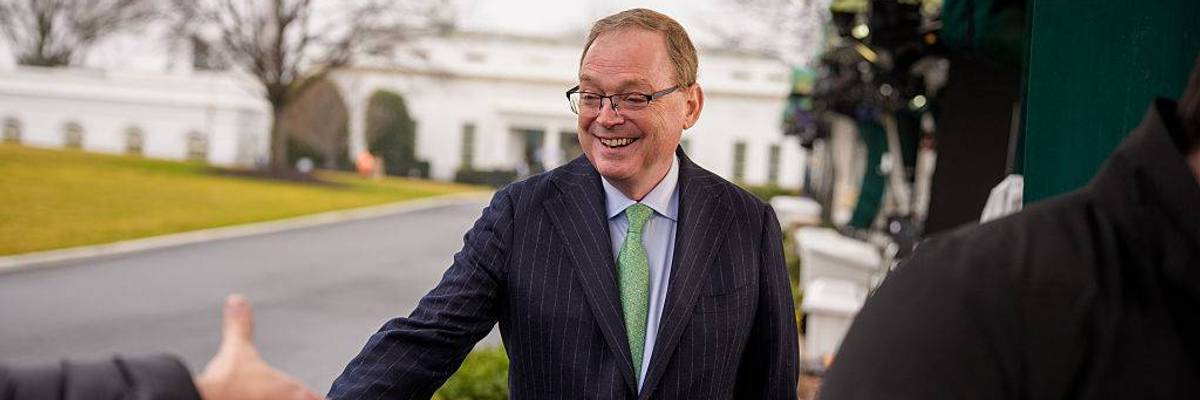
White House National Economic Council Director Kevin Hassett arrives for a video interview outside the White House on March 6, 2026 in Washington, DC.
(Photo by Andrew Harnik/Getty Images)
Brad Reed
Mar 17, 2026
COMMON DREAMS
White House National Economic Council Director Kevin Hassett caused a stir on Tuesday when he indicated that the prospect of US consumers getting hurt by a protracted conflict with Iran was not of particular concern to the administration.
During an interview on CNBC, Hassett dismissed concerns about the Iran war, which is now in its third week, dragging on indefinitely.
“The US economy is fundamentally sound,” Hassett claimed. “And if [the war] were to be extended, it wouldn’t really disrupt the US economy much at all. It would hurt consumers, and we’d have to think about, you know, if that continued, what we would have to do about that, but that’s, like, really the last of our concerns right now... because we’re very confident that this thing is going ahead of schedule.”
In fact, US consumers are already hurting financially from the effects of the Iran war, which has caused the price of both oil and gasoline to skyrocket. Petroleum industry analyst Patrick De Haan reported on Tuesday that the average price of gas in the US has reached $3.80 per gallon, while the average price for diesel fuel has reached $5.03 per gallon.
The war’s impact on oil and gas prices has been exacerbated by Iran closing down the Strait of Hormuz to shipping, and so far there is no indication that it will be reopening anytime soon.
Democratic lawmakers quickly pounced on Hassett’s admission that pain for US consumers was “the last of our concerns right now.”
“The Trump administration is saying the quiet part out loud,” said Sen. Elizabeth Warren (D-Mass.), “the higher costs you’re paying are the LAST of their concern.”
“Trump’s team of Epstein class advisors says it out loud more often than you’d think: ‘consumers are the last of our concern right now,’” commented Sen. Chris Murphy (D-Conn.).
“Well I’m not some sort of political expert but this feels like an unhelpful thing to say,” remarked Sen. Brian Schatz (D-Hawaii).
“Trump economic advisor says consumer pain is the last of their concerns,” commented Sen. Ruben Gallego (D-Ariz.). “Tell that to Americans paying almost twice as much for gas as they were a month ago.”
“The Trump administration has once again said the quiet part out loud,” said House Democratic leader Hakeem Jeffries (D-NY). “Republicans don’t give a damn about the American people and will continue to make your life more expensive. You deserve better.”
“Republicans don’t give a damn about the American people and will continue to make your life more expensive,” said House Democratic leader Hakeem Jeffries (D-NY) in response.
White House National Economic Council Director Kevin Hassett arrives for a video interview outside the White House on March 6, 2026 in Washington, DC.
(Photo by Andrew Harnik/Getty Images)
Brad Reed
Mar 17, 2026
COMMON DREAMS
White House National Economic Council Director Kevin Hassett caused a stir on Tuesday when he indicated that the prospect of US consumers getting hurt by a protracted conflict with Iran was not of particular concern to the administration.
During an interview on CNBC, Hassett dismissed concerns about the Iran war, which is now in its third week, dragging on indefinitely.
“The US economy is fundamentally sound,” Hassett claimed. “And if [the war] were to be extended, it wouldn’t really disrupt the US economy much at all. It would hurt consumers, and we’d have to think about, you know, if that continued, what we would have to do about that, but that’s, like, really the last of our concerns right now... because we’re very confident that this thing is going ahead of schedule.”
In fact, US consumers are already hurting financially from the effects of the Iran war, which has caused the price of both oil and gasoline to skyrocket. Petroleum industry analyst Patrick De Haan reported on Tuesday that the average price of gas in the US has reached $3.80 per gallon, while the average price for diesel fuel has reached $5.03 per gallon.
The war’s impact on oil and gas prices has been exacerbated by Iran closing down the Strait of Hormuz to shipping, and so far there is no indication that it will be reopening anytime soon.
Democratic lawmakers quickly pounced on Hassett’s admission that pain for US consumers was “the last of our concerns right now.”
“The Trump administration is saying the quiet part out loud,” said Sen. Elizabeth Warren (D-Mass.), “the higher costs you’re paying are the LAST of their concern.”
“Trump’s team of Epstein class advisors says it out loud more often than you’d think: ‘consumers are the last of our concern right now,’” commented Sen. Chris Murphy (D-Conn.).
“Well I’m not some sort of political expert but this feels like an unhelpful thing to say,” remarked Sen. Brian Schatz (D-Hawaii).
“Trump economic advisor says consumer pain is the last of their concerns,” commented Sen. Ruben Gallego (D-Ariz.). “Tell that to Americans paying almost twice as much for gas as they were a month ago.”
“The Trump administration has once again said the quiet part out loud,” said House Democratic leader Hakeem Jeffries (D-NY). “Republicans don’t give a damn about the American people and will continue to make your life more expensive. You deserve better.”
“If [the war] were to be extended, it wouldn’t really disrupt the US economy very much at all,” Hassett said.
By Sharon Zhang ,
March 17, 2026
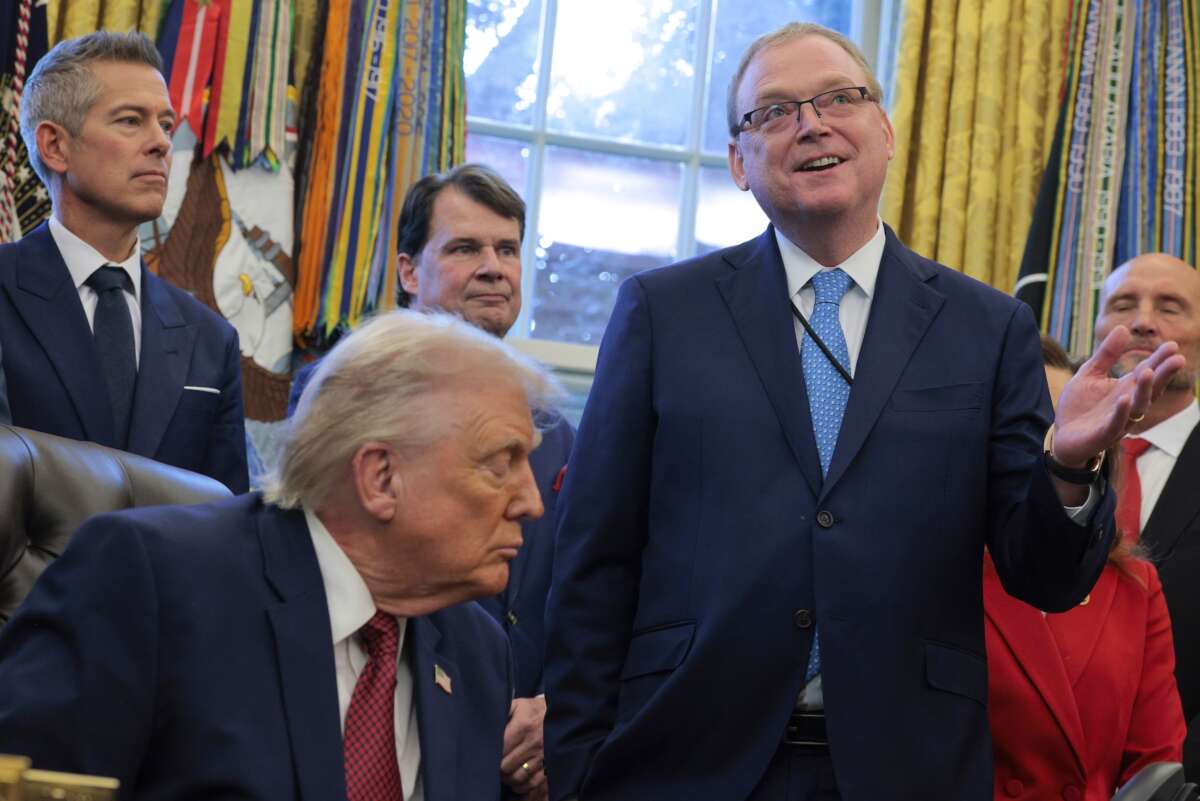
Director of the National Economic Council Kevin Hassett (R) speaks as U.S. President Donald Trump makes an announcement on changes to the country's fuel economy standards in the Oval Office at the White House on December 3, 2025 in Washington, D.C.
Chip Somodevilla / Getty Images
National Economic Council Director Kevin Hassett brushed aside concerns about harm to consumers caused by the U.S. and Israel’s war on Iran on Tuesday, saying that the war would hurt consumers if it continues but that’s “the last of our concerns.”
In an interview with CNBC, the Donald Trump appointee said that he believes the war will be over in a few weeks, and repeated the president’s assertion that the U.S. is “ahead of schedule” in relation to Trump’s four to six week projection for the war.
If the war continues past that, Hassett acknowledged that it would cause prices to rise for consumers — but he waved away concern over the possibility, claiming that the economy is strong.
National Economic Council Director Kevin Hassett brushed aside concerns about harm to consumers caused by the U.S. and Israel’s war on Iran on Tuesday, saying that the war would hurt consumers if it continues but that’s “the last of our concerns.”
In an interview with CNBC, the Donald Trump appointee said that he believes the war will be over in a few weeks, and repeated the president’s assertion that the U.S. is “ahead of schedule” in relation to Trump’s four to six week projection for the war.
If the war continues past that, Hassett acknowledged that it would cause prices to rise for consumers — but he waved away concern over the possibility, claiming that the economy is strong.
“If [the war] were to be extended, it wouldn’t really disrupt the U.S. economy very much at all. It would hurt consumers, and we’d have to think about, you know, if that continued, what we would have to do about that,” Hassett said.
“But that’s really the last of our concerns right now. Because we’re very confident that this thing is going ahead of schedule,” he went on.
Hassett’s dismissive comments about the war’s effect on the economy ignore that the war is already causing pain for consumers.
Gas prices have spiked since the U.S. and Israel’s first strikes on February 28, going from a national average to $3.00 per gallon of regular unleaded gas to $3.79 a gallon, as of Tuesday. High oil prices are causing the price of jet fuel to rise, causing flight prices to increase significantly.
Iran’s closure of the Strait of Hormuz in retaliation for strikes may also cause downstream effects on the price of food. The strait is also a crucial choke point for the global fertilizer supply chain, choking supply right as the spring planting season is kicking off. This means that U.S. farmers may have to ration or forgo fertilizer in some areas, experts say, which may cause shortages of key crops that will cause food prices to rise.
These rising costs come as the Trump administration’s economic policies have caused large job losses, a worsening of an affordability crisis, and a record-setting transfer of wealth from the poor to the rich in the form of Republicans’ One Big Beautiful Bill last year.
The war, which is historically unpopular, has also already cost taxpayers $12 billion in its first two weeks, Hassett said on Sunday.
Hassett told CNBC that he believes that the war — now in the middle of its third week — will end in the coming weeks. The administration has refused to give a consistent answer on the expected length of the war, or given conditions on objectives they wish to achieve for it to end. Trump has repeatedly claimed that the U.S. and Israel have already destroyed Iran’s navy and air force, despite Iran still carrying out strikes.
An Israeli military spokesperson said on Sunday that Israel is preparing for three more weeks of war, and that the state has “deeper plans for even three weeks beyond that.” A U.S. Central Command request to the Pentagon sent in the first week of the war suggested that the agency expects the war to last through September.
Though Trump has said that the war is basically over and “way ahead of schedule,” his administration has continued to use escalatory rhetoric. Secretary of State Marco Rubio has reportedly directed diplomats globally to “move expeditiously to diminish the capabilities of Iran and Iran-aligned terrorist groups from attacking our respective nations and citizens” in an internal cable to be sent out by March 20, ABC reported Monday.
Meanwhile, the Pentagon ordered warships carrying about 2,500 Marines to depart to the Middle East on Friday. This could allow the military to launch ground raids against Iranian targets in and on the Strait of Hormuz— which would be a massive escalation.
Hassett’s confidence in the war ending soon comes despite the end of the war seemingly entirely being up to Trump’s whims. Trump has said that the war will end “when I feel it … in my bones” while also saying, on Sunday, that “maybe we shouldn’t even be there at all.”
'Kevin, keep at that!' Trump aide brutally mocked on MS NOW after disastrous gaffe
Daniel Hampton
March 17, 2026
Daniel Hampton
March 17, 2026
RAW STORY
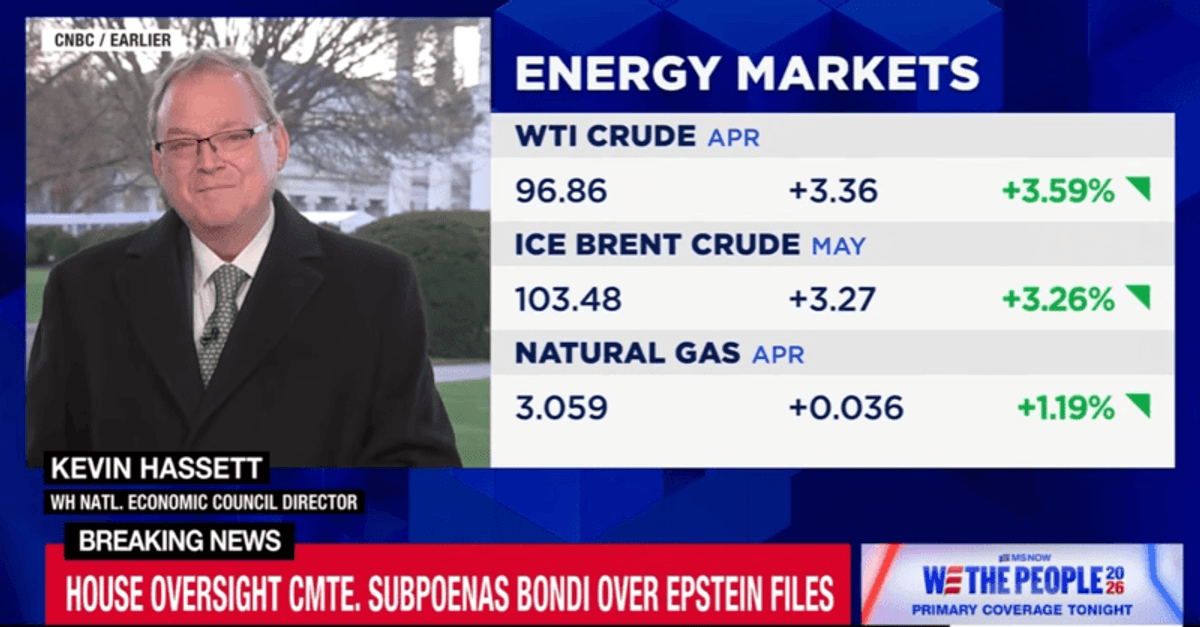
(Screengrab via MS NOW)
Rep. Jared Moskowitz (D-FL) lit into Trump economic adviser Kevin Hassett on Tuesday after Hassett suggested that consumer pain from the Iran war was "really the last of our concerns" — a comment that appalled MS NOW.
The broadside came during an appearance on "The Weeknight," where anchor Alicia Menendez played a clip of Hassett dismissing the economic impact of a prolonged Iran conflict during a CNBC appearance earlier in the day.
"If it were to be extended, it wouldn't really disrupt the U.S. economy very much at all," Hassett said. "It would hurt consumers and we'd have to think about, you know, if that continued, what we would have to do about that. But that's like really the last of our concerns right now."
The flippant remark stunned co-host Symone Sanders-Townsend.
"Wait — are consumers not part of the US economy?" she shot back. "Consumers are the last of their concerns right now. It's like - oh this comms job, they don't - oof. It's a tough day at work. Every day."
Moskowitz was also taken aback.
"I mean you're looking at me, these were the people who said affordability was a hoax for a couple of months until someone showed the president the polling on that," he said.
Moskowitz rattled off a list of costs already hitting Americans: gas prices up 70 cents per gallon, airline prices rising 30%, and food costs climbing as fuel expenses get passed down the supply chain.
"I don't know if the administration wants to get back to the talking point that prices don't matter, it's a hoax. You know, everything is going to be fine, pay no attention when you get the bill in the mail," he said.
Moskowitz warned that messaging didn't work for Democrats under the Biden administration, and it won't work this year.
"You can't tell people how to feel when they see they can't afford to live," Moskowitz concluded. "But hey, look, let them try it. Let that be the message all the way to November, okay? Kevin, keep at that!"
(Screengrab via MS NOW)
Rep. Jared Moskowitz (D-FL) lit into Trump economic adviser Kevin Hassett on Tuesday after Hassett suggested that consumer pain from the Iran war was "really the last of our concerns" — a comment that appalled MS NOW.
The broadside came during an appearance on "The Weeknight," where anchor Alicia Menendez played a clip of Hassett dismissing the economic impact of a prolonged Iran conflict during a CNBC appearance earlier in the day.
"If it were to be extended, it wouldn't really disrupt the U.S. economy very much at all," Hassett said. "It would hurt consumers and we'd have to think about, you know, if that continued, what we would have to do about that. But that's like really the last of our concerns right now."
The flippant remark stunned co-host Symone Sanders-Townsend.
"Wait — are consumers not part of the US economy?" she shot back. "Consumers are the last of their concerns right now. It's like - oh this comms job, they don't - oof. It's a tough day at work. Every day."
Moskowitz was also taken aback.
"I mean you're looking at me, these were the people who said affordability was a hoax for a couple of months until someone showed the president the polling on that," he said.
Moskowitz rattled off a list of costs already hitting Americans: gas prices up 70 cents per gallon, airline prices rising 30%, and food costs climbing as fuel expenses get passed down the supply chain.
"I don't know if the administration wants to get back to the talking point that prices don't matter, it's a hoax. You know, everything is going to be fine, pay no attention when you get the bill in the mail," he said.
Moskowitz warned that messaging didn't work for Democrats under the Biden administration, and it won't work this year.
"You can't tell people how to feel when they see they can't afford to live," Moskowitz concluded. "But hey, look, let them try it. Let that be the message all the way to November, okay? Kevin, keep at that!"


No comments:
Post a Comment