Monday, March 16, 2026


The U.S. Has Lost the War. What’s Next?


Any objective observer knows that the U.S. has lost the war in Iran, a war fought for Israel. It’s obvious that the U.S. had no overall plan; now it only reacts to Iranian moves and is reduced to endless, ineffective bombing and murdering school children.

In one sense, we’re seeing what would have occurred if the 12-day war in June 2025 had gone on longer, but with one exception. This time, the Russians and Chinese have provided the satellite intelligence that allows Iran’s targeting accuracy to be vastly improved, and we’re seeing the results on a daily basis.

My guess is that Trump’s military advisors are telling him that the situation is going from bad to worse, and no risk-free option remains. No doubt they’re also advising him that Iran is in the driver’s seat and there’s no way to gain control of the Strait of Hormuz. This explains Trump’s delusional threat of a “very bad future” for NATO if the Europeans don’t help out. After European leaders rebuffed his plea, Trump said: “You mean for 40 years we’re protecting you, and you don’t want to get involved in something that’s so minor?”

Trump is in a terrible bind and is flailing about in search of an off-ramp. He also knows that in future negotiations to end the war, Iran will be dictating the terms. Iran is in no hurry to end the conflict, and I suspect the knock-out punch will land when Israel’s defensive capabilities are eventually depleted. (BTW, anyone caught filming the damages done to Israel faces a five-year jail sentence). This begs a critical question: How long can the Greater Israel Project be sustained if the U.S. is forced out of West Asia? Further, if Israel continues to be pounded by Tehran’s extremely potent hypersonic missiles — and also believes this is its last chance to create a failed state in Iran — will it consider the nuclear option? Would elements in the Pentagon be able and willing to halt Netanyahu? We know that Iran could respond by hitting Israel’s Dimona nuclear reactor, and the resulting radioactivity would make the country uninhabitable for a thousand years. Given that eventuality, we could be looking at WWIII. Israel has between 250 and 300 nuclear warheads.

Gary Olson is Professor Emeritus at Moravian College, Bethlehem, PA. Contact: glolson416@gmail.com. Per usual, thanks to Kathleen Kelly, my in-house ed. Read other articles by Gary.

Massachusetts: Highest Court Says Charter School Must Comply With State Public-Records Law

“Public” And “Private” Confounded Again


Charter schools are privatized education arrangements that continually insist on being called “public” while routinely avoiding many public laws, standards, and requirements.

Charter school operators have always wanted to be both public and private for self-serving reasons—public so that they can seize public funds and private so that they can remain unaccountable.

Dr. Michael Mindzak at Brock University in Canada reminds us that, “The purpose of charter schools is to foster privatization under the guise of public education.” The Network for Public Education states that, “There are so many substantive differences between charter schools and traditional public schools that charters can’t be defined as public schools.”

It is thus important to reject non-stop disinformation that portrays charter schools as “public” schools. Both non-profit and for-profit charter schools are deregulated private businesses run by unelected private persons. And both engage in profiteering.

Naturally, many contradictions arise when charter schools ride the “public”/”private” fence. The latest example comes from Massachusetts. According to Universal Hub (March 11, 2026), “A Malden charter school that refused to hand over records requested [at least 10 times] by members of the public without a court order got the court order today – from the state’s highest court. In its ruling on the Mystic Valley Regional Charter School, the Supreme Judicial Court concluded that because charter schools in Massachusetts exist only because of an act of the legislature, an act that specifically refers to them as ‘public schools’, that makes them subject to the state’s public-records law.” Another source reports that, “In their ruling, the Supreme Judicial Court agreed with the Attorney General’s Office (AGO) and held that Commonwealth charter schools, including Mystic Valley, are public agencies and are therefore subject to the Public Records Law.”

Of course, simply calling something “public” does not magically make it public in the proper sense of the word. Printing the word “public” before the phrase “charter school” does not automatically make a charter school public in practice.

Mystic Valley Regional Charter School has maintained all along that it is not subject to the Massachusetts public records law. Charter schools often maneuver in this way because they see themselves as the private entities that they in fact are—while also reaping all the benefits that come from being labeled “public” on paper. Indeed, most private entities in the U.S. see themselves as being exempt from public transparency requirements. Not surprisingly, one of the synonyms for private is “secret.”

Confusion and conflicting views and rulings arise when different authorities and jurisdictions adopt contradictory conceptions of charter schools. This happens because many courts and states interpret State Action Doctrine (which distinguishes between the public and private domains) in varying ways.

To be sure, charter schools are private actors, not state (public) actors. They are not “entangled” with government (public) authority in the same way traditional public schools are. State officials play a bigger and different role in traditional public schools than they do in charter schools. This is connected to the fact that charter schools enter into a contract with the government or a government-sanctioned charter school authorizer, while no such arrangement exists between traditional public schools and the government. Traditional public schools are not contract schools; they are directly created by and constitute a political subdivision of the state.

In addition, charter schools are not operated by publicly elected officials. Nor can they levy taxes like public schools can. These are some of the reasons why, according to veteran educator and writer Stan Karp, “School boards, public budgets, public policies, and public officials can be subjected to pressure and held accountable in ways that privatized charters don’t allow.”

It is also important to appreciate that in the U.S. the provision of education for the past 250 years has not been restricted to something organized and monopolized by the state. Education in the U.S. has been organized and delivered by many different authorities and entities for more than two centuries. Many of these forces and entities have been private, parochial, or sectarian. That is, they lie outside state scrutiny and control.

Of course, no complex modern society and economy today can survive without state-organized mass universal free education available to all. Such a state must be vested with real public authority and not be controlled by major owners of capital. A fend-for-yourself “free market” setup in education is outmoded and irresponsible, especially when it comes to modern needs and requirements.

A main takeaway from all this is the need to correctly identify charter schools as private entities and to appreciate that charter schools should not have access to any public funds or facilities because these rightly belong to public schools alone. Public wealth must remain in public hands.

Shawgi Tell (PhD) is author of the book Charter School Report Card. He can be reached at stell5@naz.eduRead other articles by Shawgi.

Big Farma: Medication chemicals found in leaves of widely grown crops

16.03.2026,dpa


Photo: Sebastian Kahnert/dpa


Carrots, lettuce and tomatoes are part of many a five-a-day eating regimen, be that for the beta-carotene essential for maintaining good vision or the Vitamin C that helps ward off colds.

As it turns out, the commonly eaten trio have an unheralded property: Their leaves soak up chemicals used to treat conditions such as depression and seizures.

A team of scientists at Johns Hopkins University (JHU) in the US found that when the vegetables are irrigated with treated wastewater - an increasingly common practice when farming where freshwater is scarce - they retain multi-use chemicals such as carbamazepine, lamotrigine, amitriptyline and fluoxetine.

These compounds, often used to treat depression, bipolar disorder and seizures, are also found in wastewater used in irrigation.

The researchers found that tomato leaves “contained a concentration of pharmaceuticals more than 200 times higher than that of their fruits,” while for carrots, the difference was sevenfold.

Is this bad for consumer health? The jury remains out on the exact impact of this finding, and the researchers say the concentrations found are not a "cause for alarm."

"Just because these medications are commonly found in treated wastewater doesn't mean they'll have any meaningful impact on the plant or plant consumer," said co-author Carsten Prasse.

The research was published in the journal Environmental Science and Technology as part of what JHU described as “an effort to explore the safety of using municipal wastewater, most commonly after being filtered through treatment facilities, to irrigate crops.”

"To continue to use wastewater safely, we need a more sophisticated understanding of where and how crop species metabolize, or break down, agents in the water," said Daniella Sanchez of JHU.

A Poisoned Politics Poisons People: 

All Three Branches Move to Shield

Bayer/Monsanto from Liability Amid One of

the Largest Cancer Litigations in American

History


Executive Order Secures Glyphosate Supply, EPA Regulatory Decisions Shape the Legal Defense, DOJ Supports Bayer, the Supreme Court Takes the Case, & House Farm Bill Advances Chemical Liability Shield


Healthy soil, water, and ecosystems are the foundation of human life. The health of creation gives rise to the health of life.

Powerful outside interests are using America’s treasury and public policy to advance profit-driven agendas while the health, land, and future of the American people bear the cost.

The same public purse that finances war abroad is now underwriting policies that poison the land at home.

Political energy that should be confronting this system is instead being redirected into advertising, messaging, and branding, while the real decisions are made through law, regulation, and votes.

While the long planned objectives of a foreign country drew America’s Department of War, the Department of State and the U.S. taxpayer’s purse into an expanding conflict across the Middle East, a foreign corporation, Bayer/Monsanto suddenly blasted onto the policy scene.

In the span of three weeks, the Executive Branch, the Judicial Branch, and the Legislative Branch each took major actions to shield the German corporation, Bayer/Monsanto, from liability as it stands at the center of one of the largest mass injury litigations in American history.

First, President Donald Trump issued an executive order invoking the Defense Production Act to secure the domestic supply of glyphosate-based herbicides and elemental phosphorus, a key industrial input used in the manufacture of agrochemicals and certain weapons systems. Bayer is currently the only domestic producer of elemental phosphorus in the United States.

Second, the Department of Justice filed an amicus brief in the United States Supreme Court supporting Bayer in Monsanto Company v. Durnell, a case addressing whether federal pesticide law preempts state law, placing at risk claims brought by citizens harmed by glyphosate-based herbicides.

Bayer traces its corporate lineage to IG Farben, the German chemical conglomerate that built facilities at Auschwitz and conducted pharmaceutical experiments on concentration camp prisoners. After the Nuremberg trials, IG Farben was dismantled and Bayer emerged as one of the companies created from its breakup. In 2018 Bayer acquired Monsanto, producer of the glyphosate herbicide Roundup.

In June 2025, the U.S. Supreme Court asked the Solicitor General to provide the federal government’s view on whether it should hear Monsanto Company v. Durnell. The Justice Department responded by supporting Bayer’s argument that federal pesticide law should preempt state law claims that companies failed to warn citizens about the risks of their products.

In January 2026 the Supreme Court agreed to hear the case. The decision now before the Court could determine whether tens of thousands of cancer victims’ claims against Bayer/Monsanto survive or disappear.

The Supreme Court receives roughly 7,000 to 8,000 petitions each year and typically agrees to hear fewer than one percent of the cases. Four Supreme Court Justices must agree to grant review and place a case on the national docket.

The Roundup litigation had already moved through a lengthy legal process. Juries examined evidence. Appellate courts reviewed the verdicts. Injured citizens were exercising a long recognized right to seek redress through state tort law.

Yet, four Justices chose for the nation’s highest court to take up the question at the very moment when tens of thousands of claims against Bayer remain pending.

If the Court ultimately adopts Bayer’s argument, the ruling could eliminate thousands of existing Roundup cancer lawsuits and close the courthouse doors to hundreds of thousands of potential future claims. Glyphosate is the most widely used herbicide in the United States, meaning the legal precedent would extend far beyond the cases already filed and would shape the rights of Americans exposed to the chemical glyphosate, as well as other toxic chemicals, for decades to come.

Citizens possess the right to bring claims when they believe a company’s product caused them harm. That right is the foundation of American tort law. Juries examine evidence, determine liability, and hold companies accountable when their products cause injury.

Bayer’s legal strategy seeks to replace that system with federal preemption. If the Environmental Protection Agency approved the label, the company argues, injured citizens should lose the right to sue for failure to warn, even when juries find evidence of harm. If that theory prevails, the courthouse doors close not because a jury rejected the evidence, but because federal regulatory approval becomes a legal shield against accountability.

The Court’s decision to hear the case could set the stage for a significant narrowing of citizens’ ability to seek redress through state tort law, raising profound questions about due process under the Fourteenth Amendment. In this respect, the stakes echo the Court’s decision in Citizens United v. Federal Election Commission, which dramatically expanded the political spending rights of corporations under the First Amendment and reshaped the balance of power in American elections.

Third, House Farm Bill negotiations advanced language that would strengthen pesticide preemption and shield chemical manufacturers from certain state-based liability claims.

Executive action, judicial review, and legislative protection have now moved in the same direction, impairing the basic rights of people to recover damages for injuries caused by poisonous chemicals.

Glyphosate sits at the center of one of the largest mass injury litigations in American history. More than 165,000 Americans have filed lawsuits alleging that exposure to Roundup and other glyphosate based herbicides caused their Non-Hodgkin lymphoma.

Bayer agreed in 2020 to a settlement package worth up to $10.9 billion to resolve a large share of existing claims. Tens of thousands of cases remain pending as new litigation continues, leaving Bayer’s potential exposure in the hundreds of billions of dollars.

Previously, injured citizens brought claims. Evidence was examined. Juries reached conclusions. Now, instead of allowing Americans to continue seeking legal recourse for grave harms, the federal government is moving to shield Bayer from liability. The Department of Justice argues that if the Environmental Protection Agency approved the label, injured citizens should lose the right to sue for failure to warn.

The Farm Bill language now under consideration would harden that shield. Rep. Chellie Pingree described the provision plainly, warning that it would protect chemical manufacturers such as Bayer from lawsuits and preempt state and local warning label laws or usage regulations.

The provision would also undercut local authority to act when federal regulators delay or defer to industry pressure. Seven states currently do not preempt local governments from regulating pesticide use. Pingree’s office warned that in Maine alone more than thirty state and local pesticide protections could be undermined by the proposed language.

This matters because states carry constitutional responsibility for protecting the health and welfare of their citizens.

State tort law, consumer protection law, and public health authority form the backbone of that responsibility. When federal law blocks states and municipalities from regulating pesticide exposure or pursuing accountability for harm, local governments lose the tools they rely on to protect their communities.

The American farmer carries the risk while the chemical manufacturer receives the shield.

The consequences extend far beyond agriculture. Physicians, nurses, oncologists, hospitals, public health officials, and health insurers should be at the forefront of this fight. Glyphosate induced Non-Hodgkin lymphoma imposes enormous costs on patients, families, medical systems, and insurers.

When chemical companies are shielded from liability, those costs do not disappear. They shift to hospitals, insurance systems, families, and taxpayers. This is a public health crisis moving through the American food system and across the landscape of the American heartland.

The system that produced this crisis has deep historical roots.

Modern chemical agriculture arose in the context of warfare. The twentieth century chemical industry developed many of its core technologies during periods of global conflict, and after World War II chemical manufacturing capacity and scientific expertise were redirected toward agriculture. The language followed the chemistry.

We declared war on weeds, war on insects, and war on fungi. Fields became battlegrounds. Industrial agriculture relies on chemicals designed to kill. Herbicides kill plants. Insecticides kill insects. Fungicides kill fungi. This is Ecocide.

These compounds eliminate living organisms in the interests of industrial production. Some targets are labeled pests. Many others are casualties of unregulated industrial production. Pollinators, soil organisms, birds, aquatic life, and beneficial insects disappear from landscapes saturated with chemical inputs.

Human beings live inside those same landscapes. Farmworkers, rural communities, and consumers become collateral damage in a system built to deploy lethal chemistry across millions of acres.

Ecocide becomes a pathway to human suffering and disease.

The mentality that accepts ecological destruction in pursuit of control resembles the mentality that accepts civilian casualties as an unavoidable cost of war. Life treated as expendable in one arena rarely remains protected in another.

The American heartland must challenge a permanent war against the living systems that sustain it, and us!

At the same time, the Environmental Protection Agency (EPA) is reshaping pesticide regulation in ways that benefit the chemical industry. The agency has accelerated pesticide approvals, delayed safety reporting requirements for toxic chemicals, and allowed chemicals to remain on the market while safety reviews remain incomplete. Those regulatory decisions now form the scientific basis the Justice Department is asking the Supreme Court to treat as final authority on pesticide safety.

At the very moment those regulatory decisions are being used in court to protect chemical manufacturers, the scientific infrastructure inside the EPA is being weakened. Last year EPA officials began dismantling the agency’s research office that provided much of the scientific foundation for chemical risk assessments. Career scientists warned that removing this office will weaken independent analysis and increase the risk of political interference in decisions about chemical safety.

Congress is moving in the same direction. Separate legislation introduced by Republican lawmakers would weaken the nation’s toxic chemical laws by limiting the scientific evidence regulators can use to determine health risks and by giving industry a larger role in the chemical assessment process under the Toxic Substances Control Act, the federal law that governs chemical safety in the United States.

While these proposals are not part of the Farm Bill itself, they move the regulatory system in the same direction. The scientific guardrails that once helped protect public health are being weakened, and industry influence over chemical safety decisions is expanding.

In short, government policy and law are being rewritten to shield chemical companies while the public bears the risk.

The revolving door between the chemical industry and federal regulators is visible. Four chemical industry lobbyists now sit in the top four posts at the EPA office that regulates chemicals and pesticides. One example is Kyle Kunkler, now a Deputy Assistant Administrator in the EPA’s Office of Chemical Safety and Pollution Prevention, previously worked as a pesticide lobbyist for the American Soybean Association.

Inside the White House, Chief of Staff Susie Wiles previously worked at Mercury Public Affairs, a lobbying firm that later registered to represent Bayer, according to U.S. Right to Know’s reporting on Bayer’s influence network in Trump’s Washington.

Investigations by U.S. Right to Know document the scale of Bayer’s influence campaign in Washington. Their reporting, Tracing Bayer’s Ties to Power in Trump’s Washington, details the company’s network of lobbyists and political influence across Congress and federal agencies.

According to U.S. Right to Know, Bayer spent $9.19 million lobbying Washington in 2025, employing dozens of lobbyists across more than a dozen firms. The Justice Department brief supporting Bayer was signed by Deputy Solicitor General Sarah M. Harris and Assistant to the Solicitor General Aaron Z. Roper, both of whom previously worked at Williams & Connolly, the law firm that defended Monsanto in major pesticide litigation.

Corporate power now operates across the three arenas that shape American law. Legislatures write the law. Regulators determine the science that informs it. Courts decide how that law is interpreted. Bayer and its allies operate in all three arenas.

During the House Agriculture Committee markup of the Farm Bill, Rep. Chellie Pingree (D-ME) introduced an amendment to strip the pesticide liability shield from the bill. Every Republican on the committee voted to keep the liability shield. Every Democrat but one voted to remove it.

Chairman Glenn “GT” Thompson defended his bill as bipartisan and dismissed criticism that it served industry interests as a mischaracterization of the facts. The committee ultimately approved the bill 34 to 17, with seven Democrats joining Republicans.

Several members of Congress from both parties have attempted to push back against chemical industry influence.

Rep. Thomas Massie (R-KY) and Rep. Chellie Pingree (D-ME) introduced the bipartisan No Immunity for Glyphosate Act, which would prevent pesticide manufacturers from receiving federal liability protections tied to glyphosate.

Rep. Jim McGovern (D-MA) has warned that chemical agriculture policy now contradicts the public health goals many lawmakers claim to support, and Rep. Anna Paulina Luna (R-FL) has introduced legislation to ban the herbicide diquat.

Resistance exists inside Congress. The pressure of industry lobbying remains immense. This is all the more reason why a unified movement must galvanize around issues and not political parties. Food touches on all issues and all aspects of our lives.

Robert F. Kennedy Jr. helped to catalyze a movement demanding a transition away from chemical intensive agriculture and toward regenerative organic farming. I helped organize that effort and hosted the campaign’s national agriculture roundtable that brought together farmers, scientists, and food system leaders and drew more than 36,000 participants. That movement carried a clear mandate, to end chemical dependency in agriculture, restore soil health, and protect farmers and public health, and by doing that, create on farm and economic resilience.

Dr. Bob Quinn, PhD in Plant Biochemistry, regenerative organic pioneer and Montana farmer, is a longtime friend and mentor. He built the internationally recognized Kamut ancient grain brand and has spent decades demonstrating that regenerative organic agriculture can succeed at scale.

During Senator Roger Marshall’s MAHA soil health roundtable, and in policy recommendations delivered to Secretary of Agriculture Brooke Rollins and Secretary of Health and Human Services Robert F. Kennedy Jr., Quinn framed the issue with striking clarity.

Dr. Quinn has shown through both science and practice that regenerative organic transition can restore farm profitability while building viable market pipelines for farmers. His own family farm was once operating in the red, burdened by the rising costs of chemical inputs and seed. Out of economic necessity he transitioned to organic production. That decision not only saved the farm, it helped establish the pathway he now shares with farmers across the country who seek to restore both economic independence and soil health.

Dr. Quinn describes the shift away from toxic chemical agriculture toward regenerative organic systems as Pro Life agriculture. Life with a capital “L”, from the genome and the unborn child to the living soil, the farmer, and the entire ecosystem of creation.

This systems perspective recognizes a simple truth: Everything is connected. The health of one part of creation determines the health of the whole.

The phrase captures the moral clarity this moment demands. The foundations of life itself are being eroded at accelerating rates.

The chemicals at the center of this debate are designed to kill. A policy that shields companies producing lethal chemicals from accountability cannot honestly claim to defend life. The American heartland needs Pro Life agriculture.

Millions of Americans who supported this administration identify strongly as pro life. That conviction carries profound moral weight, and it demands consistency. Yet many of the same elected officials who campaign on protecting life are advancing chemical liability shields and deregulation that protect corporations while exposing farmers, families, and communities to harm.

Citizens must now ask their legislators and their government a simple question: Does this policy truly protect life? Does it protect the soil, the farmer, the farmworker, the child, the patient, and the community? Is this policy truly Pro Life, with a capital L?

American agriculture now operates inside a chemical dependency system engineered through decades of policy, subsidies, and corporate influence. The country should be helping agriculture enter a recovery program from chemical dependency.

Farmers did not create this system alone. Recovery requires new markets, new infrastructure, crop insurance reform, transition support, and policies that reward soil health rather than chemical throughput.

The power of this moment does not sit inside Washington alone. It sits with the farmers, families, physicians, and citizens who built this movement.

The coming midterm elections will determine whether chemical agriculture tightens its grip on American law or whether citizens reclaim the mandate they created. Policy does not move in a vacuum. It moves in response to political pressure, public scrutiny, and the willingness of citizens to hold their representatives accountable.

This moment should serve as a clear lesson in how power actually moves in Washington. Advertising may shape public narratives, but law shapes the systems that govern our food, our farms, and our health.

The alignment that occurred across the Executive Branch, the Judicial Branch, and the House of Representatives shows how quickly policy can move when powerful interests are focused on shaping legislation, regulation, and potential court outcomes. If Americans want to change the direction of the food and farming system, their attention must now turn to the place where the law is still being written.

That place is the United States Senate.

ElizabethKucinich is a Professor, Coventry University, UK and producer of documentaries, GMO OMGHot Water, and Ground OperationsRead other articles by Elizabeth, or visit Elizabeth's website.


IEA releases details of historic oil reserves release member shares

IEA releases details of historic oil reserves release member shares
IEA member countries will release 400mn barrels from emergency reserves — the largest coordinated stock draw in the agency’s history — as governments seek to stabilise oil markets disrupted by the Middle East conflict and threats to shipping through the Strait of Hormuz. / bne IntelliNews
By Ben Aris in Berlin March 16, 2026

The International Energy Agency released details of the contribution by members to the “largest release of oil reserves in history”  that it announced on March 11 to calm the oil market and bring down prices.

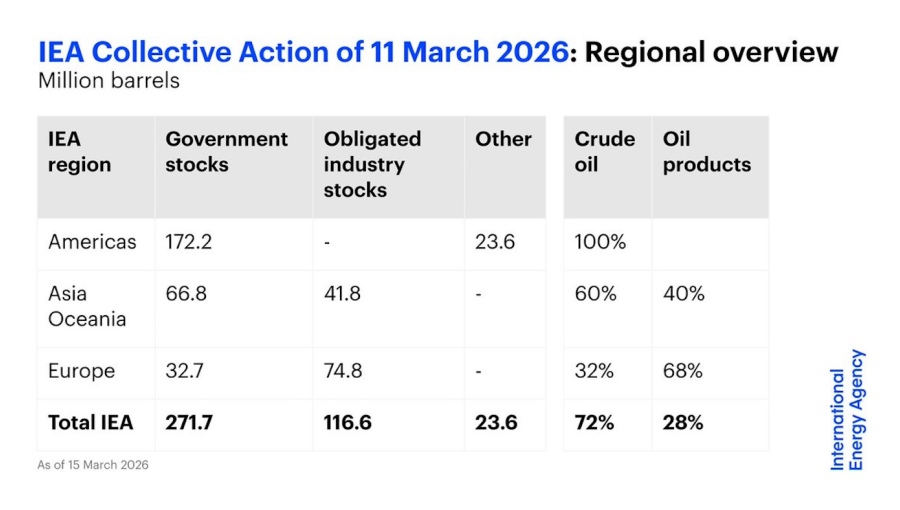
The IEA said that members would release up to 400mn barrels, but according to a press release on March 15 the US, Asia, and Europe have so far committed to a total release of 271.7mn barrels of crude – two thirds of the originally announced 400mn barrels, not counting parallel releases of oil products from state-controlled reserves.

The US has the largest reserves in the world, with a total of 370mn in its Strategic Petroleum Reserves (SPR) in its tanks and has committed to release 172.2mn barrels.

Tokyo announced on March 16 that it would start releasing oil too from its reserves of 500mn barrels, if privately controlled reserves are included.

The ​government has asked Japan's refiners to use the released crude, which will reduce the national ⁠reserves by 17%, to secure domestic supplies. It is not known how much of the oil will go ​to a global release of 400mn barrels Reuters reports.

Any potential release from 12 million barrels ​jointly held in Japan by Saudi Arabia, United Arab Emirates and Kuwait would be in addition to the announced 80 million barrels, ‌the ⁠Ministry of Economy, Trade and Industry says, Reuters reports.

Tokyo will start releasing 15 days' worth of private-sector oil on March 16 and then a month's worth ​of oil from the state reserves later this month, according ⁠to METI.

The US is self-sufficient, able to cover its entire domestic demand with its shale oil production. Japan is almost entirely dependent on oil imports, sourcing 90% from Gulf producers and another 4% from Russia.

The Straits of Hormuz are gradually reopening after Tehran introduced an informal permits-for-passage system that has seen exports rise to about 10mn b/d, almost all of which is going to Asia. However, Iran is only granting permits to tankers belonging to “friendly countries” including China, India and Bangladesh. The Western-aligned Japan does not belong to this group and has in effect been entirely cut off from Gulf supplies for the foreseeable future.

Fatih Birol, executive director of the IEA, said member states had now finalised their commitments under the collective action announced earlier this month.

“IEA countries have now confirmed their contributions to our largest ever oil stock release,” Birol said. The move “brings unprecedented additional volumes of oil to the market from March 16 onward,” he added, though he cautioned that “opening the Strait of Hormuz is vital for a return to stable flows.”

While the IEA’s announcement after “Wild Monday" that saw oil prices soar to over $120 a barrel last week initially calmed markets, after Iran hit three tankers with rockets prices rapidly rose again and are currently trading over $100 a barrel again. Russian Urals blend crude has been a big winner from the chaos and the discount on Russian Urals oil has fallen to zero from more than $20 only two weeks ago that is expected to bring the Kremlin a large windfall this year.

According to implementation plans submitted by IEA member countries, those in the Asia-Oceania region will begin releasing oil immediately, while stocks held by member countries in Europe and the Americas will start entering the market from the end of March.

Data published by the IEA shows that the largest contribution will come from the Americas, which plan to release 172.2mn barrels of government-held crude and a further 23.6mn barrels from other reserves. Asia-Oceania countries will contribute 66.8mn barrels of crude alongside 41.8mn barrels of oil products, while European members will release 32.7mn barrels of crude and 74.8mn barrels of refined fuels.

In total, the release will consist of approximately 271.7mn barrels of crude oil and 116.6mn barrels of oil products, with around 72% coming from government-controlled reserves and the remainder from mandated industry stocks, according to the IEA.

The intervention marks the sixth time the IEA has coordinated a collective release of strategic reserves since its creation in 1974. Previous emergency actions were taken in 1991 during the Gulf War, in 2005 following Hurricane Katrina, in 2011 during the Libya crisis and twice in 2022 after Russia’s invasion of Ukraine.

The agency warned that the scale of disruption currently facing global oil markets is unprecedented. “The war in the Middle East is creating the largest supply disruption in the history of the global oil market,” the IEA said.

While the emergency release is intended to cushion markets from immediate shortages, the agency stressed that restoring shipping through one of the world’s most critical energy chokepoints remains essential. The purpose of strategic reserves is to cushion shocks, not to replace offline production, experts say.

“Adequate insurance mechanisms and physical protection for shipping are key to the resumption of flows,” the IEA said, adding that “the most important factor in ensuring a return to stable flows is the resumption of regular transit of shipping through the Strait of Hormuz.”

The Trump administration promised to reopen the Straits of Hormuz quickly, but has been caught out by the ferocity and effectiveness of Tehran’s resistance. The US Navy has been getting “daily requests” from commercial shipping companies for escorts through the Straits, but has turned them all down as the passage is “too dangerous to traverse.”

The Pentagon has ordered almost its entire fleet to converge on the Gulf, including 5,000 Marines, in what appears to be preparation for a land invasion in an effort to reopen the straits. Those ships are due to arrive sometime at the end of this month.

German politicians accuse oil firms of fuel price gouging

16.03.2026, dpa


Photo: Christoph Soeder/dpa


Politicians from Germany’s ruling coalition have criticized oil companies over high fuel prices after a meeting of a government task force on Monday.

The meeting was attended by the German heads of BP and Shell, as well as Andreas Mundt, the head of the Federal Cartel Office, along with representatives of industry associations and consumer groups.

Armand Zorn, deputy parliamentary leader of the Social Democrats (SPD), said the oil industry had failed to give satisfactory answers about how prices are set.

"The oil companies were unable to credibly explain how their pricing works and, above all, how the differences compared with other European countries can be explained," he said.

Sepp Müller, deputy parliamentary leader of the conservative CDU/CSU bloc, voiced similar criticism, accusing oil companies of “price gouging." The bloc consists of Chancellor Friedrich Merz's Christian Democratic Union (CDU)and its Bavarian sister party, the Christian Social Union (CSU).

SPD transport policy spokeswoman Isabel Cademartori said industry representatives were unable to explain why increases in crude oil prices are passed on to consumers immediately, while price drops are not.

"The question of whether the companies expect record profits for 2026 also remained unanswered. Such behaviour after the burdens that German consumers have to bear is outrageous," she said.

Politicians had accused oil companies of “ripping off” consumers after fuel prices rose sharply in the wake of the US-Israeli military campaign on Iran.

Christian Küchen, head of the Association for Fuels and Energy in Berlin, rejected the accusation, saying profit margins had not changed since the start of the war.

Fuel prices in Germany, he said, are set transparently based on wholesale petrol and diesel prices.


Coffee prices driven up by heavy rainfall in world's largest grower


16.03.2026, dpa


Photo: Jens Büttner/dpa


Heavy rainfall is increasingly threatening coffee production in Brazil, the world's largest coffee producer, a study by the World Weather Attribution research initiative said in March.

The downpours could encourage the spread of diseases on Arabica plantations in the state of Minas Gerais and affect the harvest, the analysis said.

Brazilian coffee beans are preferred by many roasters around the world and known for their nutty and light chocolate flavour profile with a soft taste thanks to their low acidity.

However in recent years, extreme weather has led to a 15% to 20% decline in coffee production and pushed up world market prices, the World Weather Attribution analysis said.

Minas Gerais in south-eastern Brazil is the centre of Brazilian coffee production and the most important producer of Arabica coffee.

Brazil is the world's largest coffee producer overall and, according to the Brazilian coffee exporters' association Cecafé, the largest buyer imported 5.4 million 60-kilogram sacks of Brazilian coffee in 2025.

Extreme rainfall at the end of February triggered severe landslides in the region. Authorities said 72 people were killed and thousands had to leave their homes. In the city of Juiz de Fora, February was the wettest since records began, according to government data.

The devastating landslides were a taste of the years ahead: More intense heavy rainfall events are expected to become more frequent with global warming, the World Weather Attribution scientists warned.

The research initiative regularly examines the influence of climate change after extreme weather events. The researchers were unable to establish a clear influence on the latest rainfall in Brazil.

However they warned that the intensity of such rainfall would increase by an estimated 7% or more if the Earth warms by 2.6 degrees compared with pre-industrial times by the end of the century.

"The scale of this tragedy is immense and shows how vulnerable our hillside communities are as the planet continues to warm," said climate researcher Regina Rodrigues of Brazil's Federal University of Santa Catarina.

Rainfall in Brazil is not the only factor increasing coffee prices, and Vietnam, another major exporter, has also recorded declining output in recent years. At the same time demand for coffee has steadily risen in China.

According to the United Nations, the Earth is heading for 2.8 degrees Celsius of warming by the end of the century under current global climate policy. If countries implemented everything they have set out in their national climate plans, the calculations suggest warming of 2.3 to 2.5 degrees Celsius by the end of the century.