Monday, March 16, 2026

Trump, the Dying Multinational Order and the Global South
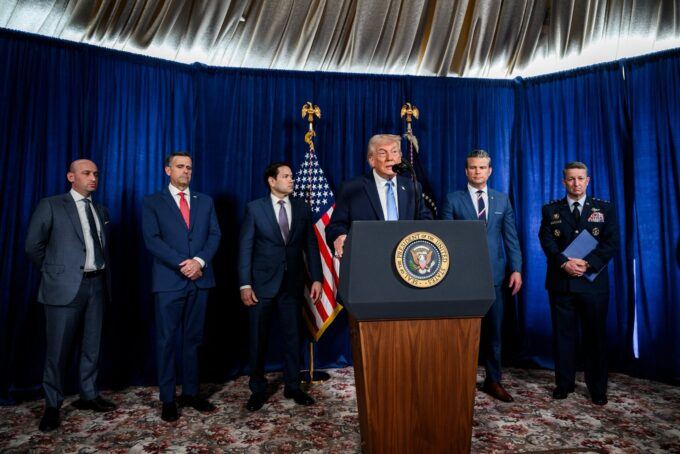

 March 16, 2026

Photograph Source: The White House – Public Domain

In the second year of Donald Trump’s second term, beginning with the kidnapping of Venezuelan President Nicolas Maduro on January 2, 2026, followed by the war of choice he has waged against Iran alongside Israeli Prime Minister Benjamin Netanyahu, the U.S. president has continued his demolition of the 80-year-old global order set up by Washington in the aftermath of the Second World War.

That dying regime is a structure of rules, practices, and policies maintaining the hegemony of the United States and the rest of the capitalist West that was promoted with the rhetoric of freedom, free trade, and democracy. In remarkably candid words, the gap between the reality of this so-called multilateral order and the ideology that justified it was captured by the leader of a country, Canada, whose elite benefited from it. In his speech in Davos on January 20, 2026, Prime Minister Mark Carney admitted:

For decades, countries like Canada prospered under what we called the rules-based international order. We joined its institutions, we praised its principles, we benefited from its predictability. And because of that, we could pursue values-based foreign policies under its protection.

We knew the story of the international rules-based order was partially false that the strongest would exempt themselves when convenient, that trade rules were enforced asymmetrically. And we knew that international law applied with varying rigor depending on the identity of the accused or the victim.

This fiction was useful, and American hegemony, in particular, helped provide public goods, open sea lanes, a stable financial system, collective security and support for frameworks for resolving disputes.

So, we placed the sign in the window. We participated in the rituals, and we largely avoided calling out the gaps between rhetoric and reality.

The order Carney describes is over, with the hegemon replacing its rules and practices, already unfair to the Global South as they were, with the unilateral exercise of coercion and force, with no rules at all except the rule that might makes right. Perhaps the essence of the new order is best captured by the words of U.S. Defense Secretary Peter Hegseth during the U.S.-Israeli bombing of Teheran: “This was never meant to be a fair fight, and it is not a fair fight. We are punching them while they’re down, which is exactly how it should be.”

In the first three months of 2026, Trump has already succeeded in dismantling the political fictions of the old regime, among them the central principle of the United Nations that expressly prohibits “the threat of the use of force against the territorial integrity or political independence of any state, or in any other manner inconsistent with the Purposes of the United Nations.” The kidnaping of Maduro and the assassination of Iran’s Supreme Leader Ali Khamenei were the hegemon’s announcement to the world that no country is exempt from outright, brazen intervention should Trump see it fit to do so, and there would not even be the fig leaf of constructing a “Coalition of the Willing” to prettify it, as George W. Bush did prior to his invasion of Iraq in 2003. Nor were foreign territories belonging to close allies, such as Greenland, immune from annexation should Trump decide it is in the U.S. national interest to grab them.

Despite denunciations and votes against its aggressive initiatives at the General Assembly, through its veto power at the Security Council and its threat to withhold its financial contributions to the organization’s budget, the United States has neutered the UN.

Transforming the Multilateral Economic Regime

But before dismantling the political-military fiction of the old regime, Trump assaulted its economic fiction in 2025. More accurately, he resumed the transformation of the multilateral economic order that he began during his first presidency, from 2017 to 2021. During that earlier period, he continued the policy of his predecessor, Barack Obama, of blocking appointments and reappointments to the Appellate Court of the World Trade Organization (WTO), effectively paralyzing the body. But even more brazenly, he declared a unilateral trade war against China, undermining the system of rules and conventions of global trade that the United States led in institutionalizing in 1994, with the founding of the WTO.

In 2025, Trump expanded what he did not hesitate to call his “trade wars” to some 90 other countries. Among them were 50 African countries, some of whom received some of the highest, most punitive tariff increases in the world, like Lesotho (50 percent), Madagascar (47 percent), Mauritius (40 per cent), Botswana (37 percent), and South Africa (30 percent). There was little rhyme or reason to the rates imposed, though in the case of South Africa, it was partly as punishment for bringing Israel to the International Court of Justice for committing genocide in Gaza.

Foreign aid as an instrument of U.S. policy was a pillar of the old international regime. As Thomas Sankara, one of Africa’s foremost fighters for liberation, pithily observed, “He who feeds you controls you.” To please his far-right base, which did not see foreign aid as important for the maintenance of U.S. hegemony and viewed it as a waste of resources, Trump in one of his first acts—undertaken with Elon Musk, the world’s richest individual—abolished the Agency for International Development (USAID). This move drew divergent responses from progressives and liberals. For some, this was a tragedy since USAID programs were allegedly funding important public health and reproductive health projects in the Global South. For others, it was no loss at all since most of the funds for these initiatives went to pay the U.S. contractors delivering or managing them.

Despite their crowing about doing away with foreign aid, Trump and Musk did not make any move to dismantle or reduce the flow of U.S. funds to the International Monetary Fund, the World Bank, and regional development banks through which the bulk of U.S. money for dominating the Global South via “development assistance“ or “structural adjustment” was funneled.  Most likely, the rationale was to hold these so-called multilateral organizations in reserve for the aggressive exercise of American power via Washington’s controlling interest or veto power in these institutions should this become necessary in the future.

In the meantime, these institutions continue to maintain poverty-creating structural adjustment programs, especially in Africa, promote wrong-headed “export-led industrialization” efforts even as the United States imposes massive punitive tariffs on imports from the Global South, and block all efforts to solve the massive indebtedness of developing countries to the tune of over $11.4 trillion, which threatens a rerun of the Third World debt crisis of the early 1980s.

Washington’s Sphere of Influence: Regional or Global?

Last November, the Trump administration released National Security Strategy 2025, which announced that the United States would focus its military, political, and economic initiatives to making the Western hemisphere the primary U.S. sphere of influence. Even before the release of the memorandum, Trump had announced U.S. plans to annex Greenland and the Panama Canal.

Moreover, the “Trump Corollary” to the old Monroe Doctrine made it clear that this would mean aggressively putting an end or countering the activities of non-regional actors such as China in the hemisphere. Shortly after the National Security Strategy went public, the kidnaping of Maduro made it clear that Washington would not hesitate to brazenly intervene in the affairs of any sovereign state in the region, in violation of the central founding principle of the United Nations.

However, with its joint assault with Israel against Iran beginning February 28, Trump appeared to be forcefully telling everyone that the United States was not departing from the old liberal containment paradigm’s perspective that the whole world was Washington’s sphere of influence, contrary to what NSS 2025 seemed to have implied. Although Trump’s volatile personality is a factor behind his shifting moves, it is becoming increasingly clear that so long as an operation does not involve sending in ground troops and relies mainly on air power or naval power, Trump is willing to use U.S. military power anywhere in the world, as he has done not only in Iran but also in northern Nigeria, with his bombing of Islamist forces there on December 25, 2025, calculating that with few soldiers returning home in body bags, the U.S. public could be easily pacified into accepting new foreign military engagements.

Trump and Israel 

But also central in accounting for Trump’s moves is the strong influence of Israel, as evidenced not only by the joint U.S.-Israeli assault on Iran but also his full support of Netanyahu’s genocidal campaign against the Palestinian people in Gaza and the West Bank and his sponsorship of a U.S.-led ethnic cleansing operation in Gaza via his deliberately misnamed “Board of Peace.”

A great majority of the people of the United States oppose the war on Iran. Even key figures in the MAGA Movement, such as Steve Bannon, Tucker Carlson, and Marjorie Taylor Greene, have complained that Trump’s recent actions in Venezuela and the Middle East represent his going back on his electoral promise never to get the United States into another “forever war.” Indeed, Carlson has denounced the Iran operation as “Israel’s war,” in which the United States has no business being involved.

Perhaps there is no better explanation for Trump’s subservience to Netanyahu than that provided by a leading figure of the American far right: Curt Mills, executive director of the American Conservative:  Trump is

not saying no to Israel because he is fundamentally too agreeable or because he’s fundamentally corrupted. He’s agreeable. He is too close to them politically. And I think, yeah, I think he’s somewhat afraid of them. Why is he afraid of them? I think they’re an intimidating society. And I think people are afraid of Mossad. I think people are afraid of Israeli influence in foreign policy, they are afraid what it can do to people’s careers.

Whatever the cause or causes of his allowing himself to be lured into a war on Iran, it is now clear that this misadventure is a massive miscalculation that might lead to some fractures in his base.

To place things in perspective, though, Israel’s overweening influence began way before Trump. The United States forced the creation of the European settler colony by the United Nations in 1947. Since then, like Frankenstein’s monster, the creature has gradually but surely come to control its creator through the powerful Zionist lobby in Washington, to the point that subservience to its wishes has become a central characteristic of both Democratic and Republican administrations.

Trump, the Global South, and the Crisis of Capital

Whatever might be his immediate motivations, Trump’s moves are mainly directed at people and countries in the Global South—Palestine, Nigeria, Venezuela, Iran, and Cuba—the last of which he has threatened to assault next or strangle into submission. There is a logic to this strategy since it is mainly the Global South that has shifted the balance of global power and created the crisis of US hegemony. Among the landmarks in this historic process have been the rise of China to becoming the second most powerful economy in the world, the massive defeats of U.S. arms in Iraq, Libya, and Afghanistan over the last 25 years, the rise of Iran as a regional power despite all the efforts of the United States and Israel to contain it, the ability of developing countries to stymie the WTO as an engine of trade liberalization, and the rise of the BRICS as a potential counterweight to the Western alliance.

Also central to the weakening of the hegemon has been the deepening crisis of the global capitalist regime of which Washington has been the global policeman, the key manifestations of which are the deindustrialization of the United State and Europe, the financialization of the leading capitalist economies where speculation rather than production has become the investment of choice, the astounding rise in global income and wealth inequality, and the sharpening contradiction between planetary survival and the ever more intensive drive for profits.

Trump’s rhetoric is aggressive, brazen, and full of bluster, but let’s not be fooled. His is a defensive imperialism, a fighting retreat, a response to the overextension of American economic and political power and the comprehensive failure of capitalism to respond to the needs of humanity and the planet. The only answer to Trump’s savage moves is resistance, the kind of resistance that is rising not only throughout the Global South but also in places such as Minnesota, where people have rallied beyond race and ethnicity to form effective communities of solidarity to stop the brutal assault on migrant families.

The Italian thinker Antonio Gramsci had a saying related to the troubled 1930s that is also apt for our times: “The old world is dying, and the new world struggles to be born. Now is the time of monsters. Trump’s regime of unilateralism is a savage world. But there is no going back to the old regime of U.S. hegemony exercised through a multilateral order systematically biased against the Global South behind a façade of liberal democratic rhetoric. For the Global South, indeed, for all who are partisans of justice, peace, and planetary survival, there is no choice but to bravely meet the challenge of navigating the turbulent waters of this period of transition to get to the haven of a new global order that will serve the common interest of humanity and the planet, though there is no certainty regarding when or even if that arrival will come.

Walden Bello, a columnist for Foreign Policy in Focus, is the author or co-author of 26 books, the latest of which are Global Battlefields: Memoir of a Legendary Public Intellectual from the Global South (Atlanta: Clarity Press, 2025), Paper Dragons: China and the Next Crash (United Kingdom: Bloomsbury, 2019), and Counterrevolution: The Global Rise of the Far Right (Halifax: Fernwood Press, 2019).

France

“A united and militant movement can prevent the RN from winning”


Sunday 15 March 2026, by Ugo Palheta


The first round of the French local elections will take place on Sunday 15 March, the second on 22 March. There is a real possibility that the “traditional” right, which is increasingly radicalizing in a far right direction, will win in Paris, under Socialist Party government since 1995, and that the Rassemblement National could win in France’s second, and very multi-racial, city, Marseilles. L’Anticapitaliste’s editor Olivier Lek Lafferrière asked Ugo Palheta, a specialist in studying the rise of fascism, for his opinion on this situation.

Olivier Lek Lafferrière: You place great emphasis on the notion of "fascization”, to highlight that this is a process. One gets the impression that there is currently a rather staggering acceleration in this process.

Ugo Palheta: The process of fascization should not be understood as a trend that progresses gradually and inexorably, come what may. This process involves qualitative leaps, tipping points such as the one we are currently experiencing, where the ideological and political balance of power can shift in one direction or another. Two aspects seem particularly important to me today.

The first is the demonization of La France Insoumise and anti-fascism following the death of the neo-fascist activist Quentin Deranque. Anti-fascists are being targeted because they have been at the forefront of most of the major popular movements of the last ten years, and LFI because it has expressed, in a combative manner, this mass protest within the realm of institutional politics.

The second aspect is the normalization of the far right. A large section of the political and media elites are shifting the cordon sanitaire from the far right towards the radical left to facilitate a union of the right that will inevitably involve the RN, and most likely under its hegemony. By merging the “central bloc” and the far-right bloc, the aim is to stabilize the political system and secure electoral legitimacy to accelerate social regression.

This development is of particular interest to employers, who hope to see through the neoliberal agenda of dismantling social protection and public services. Among most major business leaders, the option of a right-wing coalition under RN leadership has gained ground, following a model similar to Italy’s, and has become a credible and even desirable possibility.

In what institutional forms might the rise to power of the far right take shape?

The most likely scenario is not necessarily a formal alliance between organizations, which has always put the FN/RN off. The RN would probably seek to absorb whole sections of Macron’s camp and LR, as we saw with Éric Ciotti, by promising ministerial posts and winnable constituencies.

Periods of fascistization always combine these two phenomena: a far right that is gaining ground whilst the bourgeois right becomes more extreme, aligning itself with its positions: state authoritarianism, racism, and the criminalization of the left and social movements.

On this last point, significant milestones have already been reached in recent years, notably with the increasing number of administrative dissolutions of anti-racist, anti-colonial or anti-fascist groups (and the threat issued by Ciotti and others to dissolve La France insoumise). Such a dynamic would most likely be intensified by the RN in power, particularly in the event of social unrest and political crisis. Once set in motion, this repressive spiral is very difficult to halt.

How can we act today to counter this process of accelerated fascistization?

Being anti-fascist begins with preventing the far right from establishing a militant presence in neighbourhoods, towns, universities or workplaces. This requires a local militant presence and a collective balance of power, as demonstrated by the experience of Ras l’Front in the 1990s.

The second aspect is self-defence. Left-wing organisations, trade unions and collectives must be able to protect their demonstrations and premises against far-right violence and police repression. There is a desperate need for anti-fascist collectives, but self-defence must not be delegated to these collectives; it must be undertaken by mass organizations.

Anti-fascism also has an ideological and political dimension. It involves waging a battle to lend credibility to a social alternative and ideas that enjoy broad support among the population—strengthening public services, raising wages, improving working conditions, etc.—but which many deem unachievable. The left must demonstrate that a break with neoliberalism is possible.

We must also fight tooth and nail in areas where the left is currently in the minority and very timid (at best), particularly against anti-immigration, Islamophobic and security-driven policies. If the left does not fight these battles, the far right will continue to impose its agenda, with the support of the mainstream media.

Jean-Luc Mélenchon’s success in 2022 shows that it is possible to combine an anti-neoliberal programme with firm stances against Islamophobia and police violence, whilst securing significant popular support, particularly among young people and the urban working classes.

At the NPA-l’Anticapitaliste, we believe that despite all the obstacles, an anti-fascist front of the entire social and political left is needed. What do you think of this perspective?

The question of unity on the left remains central and cannot be sidestepped, as no single organization has the social base and political power to defeat the far right on its own.

However, unity does not mean the absence of debate. It also involves a confrontation over programmes and strategic directions. There are currently two poles within what is traditionally referred to as “the Left”: an orientation that supports neoliberalism, embodied by the Socialist Party and Raphaël Glucksmann, and an orientation that seeks a break with neoliberal, racist and authoritarian policies, embodied mainly by La France Insoumise.

Unity must therefore be sought without abandoning strategic debate. On the other hand, exploiting the necessary fight against anti-Semitism to discredit LFI by declaring them “unacceptable” is a recipe for defeat, as it amounts to making any united front against the far right impossible.

The 2024 general election shows that a united and militant dynamic can prevent the RN from winning. Polls had predicted its victory, sometimes even an absolute majority. Yet militant mobilization — involving trade unionists, feminists, anti-racists and many citizens with no political experience — enabled the New Popular Front to come out on top. The central question is therefore how to recapture this kind of momentum, despite a context marked by a general shift to the right, the demonisation of the left and internal rivalries.

12 March 2023

Translated by International Viewpoint from l’Anticapitaliste.


The Age of Human Arrogance, Part IV


When Humanity Forgets It Is Mortal


There comes a moment in every age when humanity must confront the mirror it has spent centuries avoiding. That mirror does not flatter us. It reveals a species that has mastered the sciences of destruction while neglecting the simple art of living. It reveals a creature that speaks of peace while perfecting the machinery of war — a creature that claims intelligence yet behaves as though wisdom were an inconvenience. And at the center of this contradiction lies a question as old as civilization itself: why does humankind, in its restless hunger for permanence and power, continue to forge instruments of death while ignoring the fragile lives that tremble beneath their weight?

Those who design the engines of war rarely pause to consider the innocent — the children who never asked for conflict, the animals who flee without understanding, the ecosystems that cannot speak but suffer all the same. The forests, the rivers, the quiet creatures of the earth bear witness to decisions they never made. They endure the consequences of ambitions that were never theirs. They carry the scars of human arrogance without ever having lifted a hand in violence.

We move across this planet as though we were immortal, as though the soil beneath our feet were an infinite inheritance rather than a living home entrusted to our care. We behave as if we shall remain here forever, forgetting the truth whispered by every graveyard, every funeral procession, every fading photograph: today we are here; tomorrow we are gone. And yet, despite this fleeting existence, humanity clings to violence as if it were its birthright, as though the measure of our intelligence were the scale of our destruction.

The tragedy is not merely political; it is spiritual. Every tradition of wisdom — ancient, modern, secular, and sacred — carries within it a single, thunderous command that should halt the hand of destruction: “Thou shalt not kill.” It is not a suggestion, not a metaphor, not a cultural relic. It is a universal moral boundary, a law carved into the conscience long before it was carved into stone. It is the one commandment that unites prophets, sages, philosophers, and elders across continents and centuries. And yet, in the fever of conflict, humankind treats this commandment as negotiable, bending it to ambition, fear, and pride.

What does it mean for a species to forget its own mortality? It means we build monuments to ourselves while ignoring the graves we fill. It means we speak of legacy while poisoning the rivers that must sustain our descendants. It means we claim dominion over the earth while behaving like temporary guests who refuse to respect the house they inhabit. It means we imagine ourselves as gods while living with the recklessness of creatures who believe they will never be held accountable.

Why does humanity refuse to give peace a chance? Perhaps because peace demands humility, and humility is the one virtue our age has forgotten. Peace requires us to see the stranger as kin, the earth as sacred, the animal as fellow creature, the future as inheritance rather than battlefield. Peace asks us to step back from the fever of conquest and remember that we are merely passing through this world — guests, not owners; custodians, not conquerors.

The soil remembers every wound. The rivers remember every poison. The forests remember every fire. And the innocent — human and non-human alike — carry the scars of choices they never made. Yet still, the architects of conflict continue their work, convinced that power can outlast mortality, that dominance can secure legacy, that violence can purchase peace.

But the truth remains unchanged: no empire escapes the grave, no weapon grants immortality, no war secures the soul. Only peace does that. Only the recognition of life’s sacredness — fragile, temporary, shared — can anchor a civilization worthy of its name.

If humankind is to survive with dignity, it must rediscover the ancient wisdom that life is sacred, that the earth is shared, and that our time here is brief. We are travelers, not rulers. We are stewards, not sovereigns. And the world we leave behind will testify to whether we understood this truth — or ignored it. For the earth is patient, but it is not forgetful. And history is long, but it is not merciful to those who refuse to learn.

Humanity stands at a threshold. One path leads deeper into the arrogance that has defined our age — the arrogance that believes violence can secure peace, that domination can secure safety, that mortality can be outrun by force. The other path leads toward humility, toward reverence, toward the recognition that life is sacred and fleeting and shared. The choice is ours, but the consequences will be borne by all who inhabit this fragile world.

In the end, the question is not whether humanity is powerful. The question is whether humanity is wise. And wisdom begins with a single, humbling truth: we are mortal. We are passing through. And the world we leave behind will reveal whether we lived as though that truth mattered.

Sammy Attoh is a Human Rights Coordinator, poet, and public writer. A member of The Riverside Church in New York City and The New York State Chaplains Group, he advocates for spiritual renewal and systemic justice. Originally from Ghana, his work draws on ancestral wisdom to explore the sacred ties between people, planet, and posterity, grounding his public voice in a deep commitment to human dignity and global solidarity. Read other articles by Sammy.

The War Nobody’s Watching: Pakistan’s Three-Front Conflict

by  | Mar 16, 2026 | 

On Feb. 22, 2026, a Pakistani airstrike hit the village of Girdi Kas in eastern Afghanistan. As one family lost 18 of its 23 members, Pakistan termed it a targeted counterterrorism operation against militant hideouts. Afghanistan, in contrast, said the strikes hit civilian homes and a religious school. The United Nations confirmed credible reports of civilian casualties, including women and children.

Five days later, Pakistan’s defense minister declared “open war” as Pakistani warplanes struck Kabul, Kandahar, and targets at the former American air base at Bagram, though the Taliban denied significant damage. Afghanistan retaliated with drone strikes and cross-border offensives. Both sides claimed to have killed hundreds.

“They have a great prime minister, a great general,” Trump declared, that same day. “Pakistan is doing terrifically well.”

The State Department backed Pakistan’s “right to defend itself against attacks from the Taliban, a Specially Designated Global Terrorist group.” Three days later, the U.S. and Israel launched strikes on Iran, and the Pakistan-Afghanistan war vanished from the news.

Yet Pakistan is now fighting on three fronts.

To the northwest, an open war with Afghanistan. To the southwest, an escalating insurgency across the province of Balochistan, where separatist militants launched coordinated attacks across a dozen cities in January, killing nearly 200 people. To the east, an unresolved military standoff with India following their brief war last May – the heaviest engagement between the two nuclear powers since 1971.

Meanwhile, the United States is entangled on every side: backing Pakistan’s military against the Taliban while partnered strategically with the India that hosts the Taliban, that Pakistan accuses of fueling the Baloch insurgency, and that just went to war with Pakistan last year. Yet the U.S. is too busy bombing Iran to notice.

Pakistan shares a 1,600-mile border with Afghanistan to the northwest – a contested colonial-era line that splits the Pashtun population and that no Afghan government has ever recognized. Its southwestern province of Balochistan, the country’s largest and poorest, borders both Afghanistan and Iran and sits atop vast reserves of coal, gold, copper, and gas. To the east lies India, with the disputed territory of Kashmir the eternal sore point between them.

Three borders. Three conflicts.

The Afghan Front

The Pakistani Taliban (TTP) is a militant group distinct from the Afghan Taliban that governs Afghanistan. Operating from bases along the Afghan border, the TTP has waged an escalating campaign of bombings and armed attacks inside Pakistan.

In 2025, Pakistan suffered its most violent year in nearly a decade, with a 34 percent increase in terrorist attacks. In January 2026, a suicide bomber hit a Shia mosque in Islamabad, killing 36 worshippers. In February, TTP fighters attacked a military checkpoint in the border district of Bajaur, killing 11 soldiers and a child.

Pakistan demanded the Taliban government shut down the TTP. The Taliban denied harboring them.

The Feb. 22 airstrikes targeted seven alleged militant camps along the Afghan border, which Pakistan called “intelligence-based, selective operations.” Afghan officials reported 18 civilian dead in the first wave alone. On Feb. 26, Afghanistan launched retaliatory strikes against Pakistani military positions along the border. Pakistan responded by bombing Kabul.

“Our patience has now run out,” said Defense Minister Khawaja Asif. “Now it is open war between us.” As of early March, heavy shelling continued along the border and tens of thousands of civilians had been displaced.

Pakistan helped create the Taliban in the early 1990s – with fighters hardened by the CIA-funded war against the Soviets in the 1980s – supported them through their rise to power, and welcomed the American withdrawal that put them back in charge in 2021. What Pakistan did not anticipate was that the Taliban, once in power, would stop taking orders.

The Balochistan Front

Turning to the southwest, Balochistan is Pakistan’s largest province and its poorest, home to 15 million Baloch – an ethnic group distinct from Pakistan’s Punjabi majority, with their own language and a history of resistance to central rule stretching back to the country’s founding. They live on land rich in coal, gold, copper, and gas – revenue that flows to the federal government, not to them. China’s $62 billion investment in the China-Pakistan Economic Corridor runs directly through the province, centered on the deep-water port of Gwadar on the Arabian Sea. Armed resistance to Pakistani rule has flared in cycles since 1948. The current phase, accelerating since 2019, is the most organized and most lethal to date.

On Jan. 30, the Balochistan Liberation Army (BLA) launched coordinated attacks across more than a dozen districts. Militants hit schools, hospitals, banks, markets, military installations, police stations, and a high-security prison, freeing more than 30 inmates. The BLA says it killed 280 security personnel. Pakistan says it killed 216 militants and lost 22 soldiers and 36 civilians. The BLA views the Chinese projects running through its homeland as extraction without benefit – wealth siphoned off from Baloch land to enrich Islamabad and Beijing. It regularly targets Chinese workers and infrastructure as symbols of that arrangement.

The BLA has deployed female suicide bombers, hijacked passenger trains, stormed army and navy bases, and carried out attacks reaching Pakistan’s largest city, Karachi. Pakistan’s military response has been overwhelming force – airstrikes, mass arrests, enforced disappearances. After the January attacks, a military spokesman announced the army had “sent 216 terrorists to hell.”

Pakistan, meanwhile, claims that the BLA – and the Afghan Taliban – are operating as Indian proxies.

In 2025, the military renamed the organization “Fitna al-Hindustan” – literally, the chaos of India. Pakistan’s defense minister has accused India of “penetrating” the Taliban leadership. The arrest of Kulbhushan Jadhav, a former Indian naval officer detained in Balochistan in 2016, is a prime case cited as evidence of Indian intelligence operations in the province. In 2013, U.S. Special Representative James Dobbins acknowledged that Pakistan’s concerns about Indian involvement were “not groundless,” even as he called them “somewhat exaggerated.”

India flatly denies it all. The Baloch are caught in the middle regardless – between a Pakistani military that kills them and calls it counterterrorism, Indian intelligence that may be using them as pawns, and a Chinese mega-project that treats their land as a throughway. Nobody is fighting for the Baloch. Everyone is fighting over Balochistan.

The India Front

The third front is quieter but no less dangerous.

In May 2025, after militants killed 26 Hindu tourists in Indian-administered Kashmir – the disputed territory at the heart of the India-Pakistan conflict since 1948 – India launched missile strikes on Pakistan. Pakistan retaliated. After four days, a ceasefire brokered by Washington finally held.

Nothing was resolved. Kashmir remains the trigger while both sides are rearming. Pakistan signed a mutual defense pact with Saudi Arabia in September 2025. Aggression against one will now be considered aggression against both. India, meanwhile, has been building a relationship with the Taliban that would have been unthinkable a decade ago – opening an embassy in Kabul and hosting Afghanistan’s foreign minister in New Delhi.

The Taliban was once Pakistan’s strategic asset – created, funded, and armed by Islamabad to secure a friendly government in Kabul and block Indian influence in Afghanistan. Now Pakistan accuses the Taliban of being India’s proxy against Pakistan. The defense minister has said the people “pulling the strings” in Kabul are “controlled by Delhi.” The alliance that Pakistan built for three decades now takes meetings in New Delhi.

Washington on Every Side

The U.S. is not watching this war. It is on every side of it.

Washington backs Pakistan against the Taliban. The State Department explicitly endorsed Pakistan’s “right to defend itself.” Trump praised General Asim Munir – the architect of the Afghan campaign – as one of “two of the people that I really respect a lot.” Before launching the June 2025 strikes on Iran, Trump invited Munir to the White House and secured Pakistan’s cooperation before opening his own front in the Middle East.

Washington partners with India. The strategic relationship has deepened through two Trump administrations. India is the cornerstone of Washington’s Indo-Pacific strategy against China. When India and Pakistan went to war in May 2025, Washington brokered the ceasefire, then walked away without resolving anything.

Washington designated the BLA, the Taliban, and the TTP as terrorists, giving Pakistan legal cover for military operations against all three while maintaining alliances with the governments accused of supporting them. The same State Department that endorsed Pakistan’s airstrikes on Afghan cities once stationed American troops in those same cities for twenty years.

Then, on Feb. 28, the U.S. and Israel struck Iran. The Pakistan-Afghanistan war was just one week old and disappeared from the front pages overnight. Trump called Pakistan’s strikes on Afghanistan “outstanding.” Then the Iran war started and he forgot about Pakistan and Afghanistan entirely.

The People in the Middle

In Girdi Kas, a family of 23 became a family of 5 in a single night. Pakistan says the strike hit a militant camp. Afghanistan says it hit a home. The United Nations confirmed civilians were killed.

In Balochistan, 15 million people live on land that everyone wants and nobody asks them about. In Kashmir, the same. And now, as Pakistan’s military announces body counts, and India is accused of funding chaos, China continues building ports there.

And the family in Girdi Kas is still dead.

Pakistan’s military says it has “sent 216 terrorists to hell.” Trump says Pakistan is “doing terrifically well.” And Balochistan – along with the other two fronts Pakistan is fighting on – remains the war nobody is watching.

Pieter Friedrich is an investigative journalist covering ethnonationalism, transnational repression, and South Asian geopolitics. His work has appeared in The Caravan, Middle East Eye, and the Washington Report on Middle East Affairs, and has been cited by Harper’s Magazine, the Washington Post, and The Intercept. More at pieterfriedrich.com.