Wednesday, March 18, 2026


The Truth About Cuba

by  | Mar 18, 2026 

Not distracted by the war on Iran, on March 3, President Trump, once again, warned that Cuba was in its “last moments.” The next day, he said, “It may be a friendly takeover. It may not be a friendly takeover. It wouldn’t matter because they are down to, as they say, fumes” before admitting that the U.S. has caused a humanitarian disaster in Cuba.

Trump’s rhetoric has continued to escalate. On March 17, Trump said,  “I do believe I will be having the honor of taking Cuba. Taking Cuba. I mean, whether I free it, take it. I think I can do anything I want with it. They’re a very weakened nation right now.” The Trump administration is reportedly pursuing a policy of removing  President Miguel Díaz-Canel from power while keeping in place his government. They have communicated to Cuba that no deal can be negotiated while he is leader.

The U.S. has cut Cuba off. The Secretary-General of the United Nations has said that he is “extremely concerned about the humanitarian situation in Cuba” and warned that it “will worsen, if not collapse,” if the U.S. does not ease its chokehold. But as the humanitarian catastrophe unfolds, while the world looks on, there are three enduring American myths about Cuba that need to be dispelled.

The Trump administration has cut Cuba off from its energy lifeline: “THERE WILL BE NO MORE OIL OR MONEY GOING TO CUBA – ZERO!, Trump announced. “I strongly suggest they make a deal, BEFORE IT IS TOO LATE.” With that threat, Trump declared a “national emergency” and signed an executive order imposing tariffs on any country that sends oil to Cuba. “Now there is going to be a real blockade. Nothing is getting in. No more oil is coming,” the U.S. Charge d’Affairs in the U.S. Embassy in Havana told his staff.

And, with the exception of a trickle of aid from Mexico and the promise of a drop of aid from Canada, nothing is getting in. “There’s no oil, there’s no money, there’s no anything,” Trump boasted. There is no longer enough oil in Cuba to guarantee your car, generator or hot water will run. There is not enough electricity to keep the lights on. Classes have been cancelled at many schools, and many hospitals have cut services. Tourism, the economic lifeblood of Cuba, is drying up. Cuba has announced that international airlines can no longer refuel there due to fuel shortages. On Monday, a “complete disconnection” caused a blackout across all of Cuba.

The American embargo has gotten so successfully out of hand that, after the leaders of Cuba’s Caribbean neighbours expressed alarm over the suffering of Cubans, the U.S. has relented a little and now says it will loosen some restrictions and let some Venezuelan oil into Cuba.

Foundational to the American embargo on Cuba are three myths that need to be undermined: the hostility to Fidel Castro and Cuba has been going on longer than expressed in the official narrative, the hostility was never about communism, and the intent of the embargo has always been to starve the Cuban people.

The hostility toward Cuba stretches back two years and one administration further than told in the official narrative. Though the embargo, the Bay of Pigs and Operation Mongoose’s determination to assassinate Castro are all attributed to Kennedy, they all need to be deposited in Eisenhower’s foreign policy account.

Although it would be Kennedy who would water the seed that locked Cuba down, the seed was planted two years earlier by Eisenhower who, on January 25, 1960, suggested the U.S. Navy “quarantine” Cuba. Eight months later, he banned all U.S. exports to Cuba except food and medicine. It would be left to Kennedy to implement the full embargo, and Johnson to include food and medicine. In the official narrative, the embargo is associated with Kennedy, but its origins are older, going back to the very beginning of the story. Castro overthrew the Batista dictatorship on January 1, 1959. He was sworn in as prime minister on February 16, 1959. Already by January of the next year, Eisenhower had proposed the embargo.

Like the embargo, Kennedy and the Bay of Pigs are forever linked in the official narrative. But that too stretches back to the Eisenhower years. Right from the start, in the earliest days after the revolution, the CIA had nominated its operative Jake Esterline, who had helped carry out the coup against Guatemala’s Jacobo Árbenz, to plan the Bay of Pigs invasion. The CIA plan to invade Cuba is dated December 6, 1960. Kennedy would not be inaugurated until forty-five days later.

Castro’s death sentence was also signed in Washington much earlier than recorded in the official narrative. It was October 1959, according to CIA expert John Prados, that Eisenhower “approved measures” that led to the “secret war,” which included grooming opposition leaders in Cuba, and encouraging raids by Cuban exiles on Cuba from the United States. Eisenhower had already ordered a covert action on Castro by March 17, 1960.

But the decision to assassinate Castro goes back even earlier than that. “[K]ey officials in the Eisenhower administration reached… a clear determination to bring about Castro’s demise” by the summer of 1959, only months after Castro came to power, according to William LeoGrande and Peter Kornblum in their book, Back Channel to Cuba. Overthrowing Castro was the official secret policy of the U.S. by October. On November 5, according to LeoGrande and Kornblum, that plan was approved by Eisenhower. On December 11, 1959, according to CIA expert Tim Weiner, Allen Dulles–Eisenhower’s CIA director–gave the go-ahead for Castro’s “elimination.” Dulles changed “elimination” to “removal from Cuba.” Stephen Kinzer reports that on May 13, 1960, after being briefed by Dulles, Eisenhower ordered Castro “sawed off.”

All of this took place earlier than told in the official narrative and long before Kennedy authorized Operation Mongoose, which, headed by Robert Kennedy and run by the experienced and notorious CIA operative Edward Lansdale, made assassinating Castro “the top priority in the United States Government.” Robert Kennedy told Lansdale and the Operation Mongoose team that “all else is secondary – no time, money, effort, or manpower is to be spared.”

The second myth is that hostility toward Cuba was born out of the requirement to keep communism out of the hemisphere. But the U.S. was hostile to Castro before Castro was a communist. When the U.S. placed Castro in its crosshairs, he was neither aligned with the Soviet Union nor openly communist at all. At this time, Castro’s program of social reforms was neither radical nor communist. In America, América: A New History of the New World, Greg Grandin records that “[t]he CIA called Castro’s agenda ‘the common stock of Latin American reformist ideas’: land reform, housing, health care, education, control over natural resources, and national sovereignty.”

In the early years of the Cuban revolution, Castro sought friendly relations with the United States. What the U.S. opposed was not communism in its backyard, but an alternative political and economic model that could prove attractive to other countries in the hemisphere.

To preserve its hemispheric hegemony, the U.S. has erased any attractive alternative that could encourage other countries to copy what Noam Chomsky has called Cuba’s “successful defiance.” The alternative the U.S. has feared most are forms of nationalism in which the leader defiantly nationalizes land and resources so the wealth benefits not a foreign power, but the people who live on that land. It was Castro’s nationalistic policies and agrarian reforms that put him in the United States’ sights.

Castro nationalized land, redistributing it from large farms, including American owned farms, to the Cubans who needed it. Grandin says that when the large American oil companies refused to process oil sent to Cuba by the Soviet Union, Castro nationalized their refineries, too.

The problem with Castro wasn’t communism; it was a model of government that offered an attractive alternative to the American model and American hegemony. As internal State Department documents had said about Arbenz in Guatemala half a decade earlier, the concern was the contagious “example of independence of the US that Guatemala might offer to nationalists throughout Latin America,” and that that example “might spread through the example of nationalism and social reform.” That is why Eisenhower called his embargo a “quarantine.”

The U.S. had this concern about Castro from the beginning. Observing Castro after the revolution but before he had even been sworn in as leader, Grandin records CIA operative Esterline, soon to be of the Bay of Pigs, warning that Castro was “something different, something more impressive.” He said a “chain reaction was occurring all over Latin America after Castro came to power” and described “a new and powerful force… at work in the hemisphere.”

Communist or not, the contagious alternative had to be erased. And as far back as it goes, the embargo that was meant to erase it has always had as its deliberate intent the starvation of the Cuban people. That is the third truth.

When Eisenhower first proposed his quarantine of Cuba, he adopted the policy, he said, because “If they are hungry, they will throw Castro out.” Explaining how sanctions would work, Eisenhower’s assistant secretary of state for Latin America said, as Grandin reports, that the sanctions were intended to bring down “real wages, to bring about hunger, desperation and overthrow of government.” The embargo was a deliberate policy of bringing about regime change through hunger. And it still is. On February 16, Trump told reporters that Cuba “should absolutely make a deal, because it’s really a humanitarian threat.”

The official American narrative on its Cuba policy is a myth. To alter the narrative from mythology to history so policy decisions can responsibly be made, these three truths need to be told: American hostility to Cuba has been going on longer than commonly believed, that hostility was never about communism, and the intent of the embargo has always been to bring about regime change by starving the Cuban people.

Ted Snider is a regular columnist on U.S. foreign policy and history at Antiwar.com and  The Libertarian Institute. He is also a frequent contributor to Responsible Statecraft and The American Conservative as well as other outlets. To support his work or for media or virtual presentation requests, contact him at tedsnider@bell.net.

The Explosion Inside Trump’s War Machine: Joe Kent Resigns

by  | Mar 18, 2026 | 

Joe Kent’s resignation is not an anomaly but an alarm: elite dissent is surfacing early because this war is built on deception.

Joe Kent’s resignation is shocking, but not for the obvious reason.

It is not shocking simply because it comes from within the Trump administration. Any administration of that size, stretching across thousands of officials, operatives and career personnel, will contain people who, despite the surrounding culture, still draw moral lines of their own.

Even an administration defined by blunt militarism, racialized rhetoric and an unapologetic embrace of force is not morally monolithic. There is always room, however narrow, for someone to say: enough.

What makes Kent’s resignation important is something else entirely: the language, the timing, and the political location from which it emerged.

When other officials resigned over Gaza, they established a standard of ethical clarity that still matters. Former UN human rights official Craig Mokhiber resigned on October 28, 2023, warning that “we are seeing a genocide unfolding before our eyes” and describing Gaza as “a textbook case of genocide.”

Former State Department official Stacy Gilbert, who resigned in May 2024 over a government report on Israeli obstruction of aid, put it just as bluntly: “There is so clearly a right and wrong, and what is in that report is wrong.”

These were not carefully lawyered exits. They were moral positions.

Kent belongs in a different political universe than Mokhiber or Gilbert. That is precisely why his resignation carries such force.

He was not some liberal holdout inside a hawkish administration. He was the director of the National Counterterrorism Center, confirmed in July 2025, a former Green Beret, a former CIA paramilitary officer, and by every normal measure a deeply embedded figure within the national security state.

He was also a Trump-aligned Republican whose confirmation battle was shaped by ties to far-right figures and conspiracy politics, according to AP. In other words, this was not an outsider recoiling from empire. This was a man from within that machinery saying he could no longer justify this war.

And he did not mince words.

“I cannot in good conscience support the ongoing war in Iran,” Kent wrote. “Iran posed no imminent threat to our nation, and it is clear that we started this war due to pressure from Israel and its powerful American lobby.”

That sentence alone is politically explosive. It does not merely criticize tactics. It indicts the rationale of the war itself.

Then Kent went further.

“Early in this administration, high-ranking Israeli officials and influential members of the American media deployed a misinformation campaign that wholly undermined your America First platform and sowed pro-war sentiments to encourage a war with Iran,” he wrote.

And then the bluntest line of all:

“This was a lie and is the same tactic the Israelis used to draw us into the disastrous Iraq war.”

This is not bureaucratic dissent. This is a direct accusation of manipulation, deception, and foreign-policy capture.

That is what makes this resignation different.

Officials often leave in silence. They retreat into euphemism. They invoke family reasons, timing, institutional fatigue, or the tired fiction of “policy differences.” Kent did none of that. He drew a line between right and wrong in the language of his own political tradition, and then crossed it. The significance of that act cannot be measured only by whether one agrees with his worldview. It must be measured by what it reveals: that the moral and strategic contradictions of this war are now so visible that even loyalists are beginning to break.

Kent also anchored his decision in personal history.

“As a veteran who deployed to combat 11 times and as a Gold Star husband who lost my beloved wife Shannon in a war manufactured by Israel, I cannot support sending the next generation off to fight and die in a war that serves no benefit to the American people nor justifies the cost of American lives.”

His wife, Navy Senior Chief Petty Officer Shannon Kent, was killed in Syria in 2019 as part of Operation Inherent Resolve. That does not sanctify Joe Kent’s politics, but it does explain the moral register of his letter. He was not speaking abstractly about sacrifice. He was speaking from inside its wreckage.

This matters for another reason.

We do not know what Kent knows and chose not to say. Someone in his position had access to intelligence, internal deliberations, threat assessments and strategic discussions that the public will never see in full. When such a figure concludes that there was “no imminent threat,” that judgment is not casual. It does not prove everything, but it gives weight to the suspicion that the public case for war was not merely weak, but manufactured.

There is also a wider lesson here, and it may be the most important one.

Unlike earlier US wars, this one is generating meaningful dissent with unusual speed. Iraq took time. Afghanistan took time. Even when elite opposition emerged, it often arrived only after the strategic disaster had fully matured. This time, less than three weeks into the US-Israeli war on Iran, anti-war protests are already visible, internal unease is already surfacing, and a senior counterterrorism chief has already resigned in public protest. That does not mean the war is near its end. It means the political architecture sustaining it is less stable than Washington wants to admit.

Kent’s resignation should also sharpen a debate that Washington has spent decades trying to blur: the role of Israel in shaping US foreign policy. Kent did not hide behind coded language. He called this war what he believes it is: a war launched “due to pressure from Israel and its powerful American lobby.” Whether more officials will say the same remains to be seen. But one of them already has, and from a post that matters.

None of this requires romanticizing Joe Kent. One may object, strongly and rightly, to his past politics, to the role he played inside the national security establishment, and to the wider machinery of empire that made his career possible. But that is not the point. The point is that, within his own framework, he reached a conclusion and acted on it. He did the rare thing: he left power and named the corruption plainly.

This story is not ending. It is starting. Because once one insider says the war was built on lies, others are forced into a choice. They can continue to perform loyalty to a collapsing narrative, or they can speak. And the longer this war drags on, the more difficult silence will become.

Dr. Ramzy Baroud is a journalist, author and the Editor of The Palestine Chronicle. He is the author of six books. His forthcoming book, ‘Before the Flood,’ will be published by Seven Stories Press. His other books include ‘Our Vision for Liberation’, ‘My Father was a Freedom Fighter’ and ‘The Last Earth’. Baroud is a Non-resident Senior Research Fellow at the Center for Islam and Global Affairs (CIGA). His website is www.ramzybaroud.net

Beijing Shows Panama the Cost of Abandoning Neutrality

For decades, Panama successfully cultivated a foreign policy posture of strict neutrality defined by its unique geography centered on the operation of the Panama Canal.

This small-state hedging strategy allowed Panama to welcome commercial presence from both the United States and China while maintaining the waterway’s treaty-based impartiality.

However, in early 2026, this equilibrium shattered. Following Trump’s victory last year Panama has exited China’s Belt and Road Initiative and already signaled its alignment with US security concerns, yet it has secured no binding commitment that Washington to make up for the loss of investment.

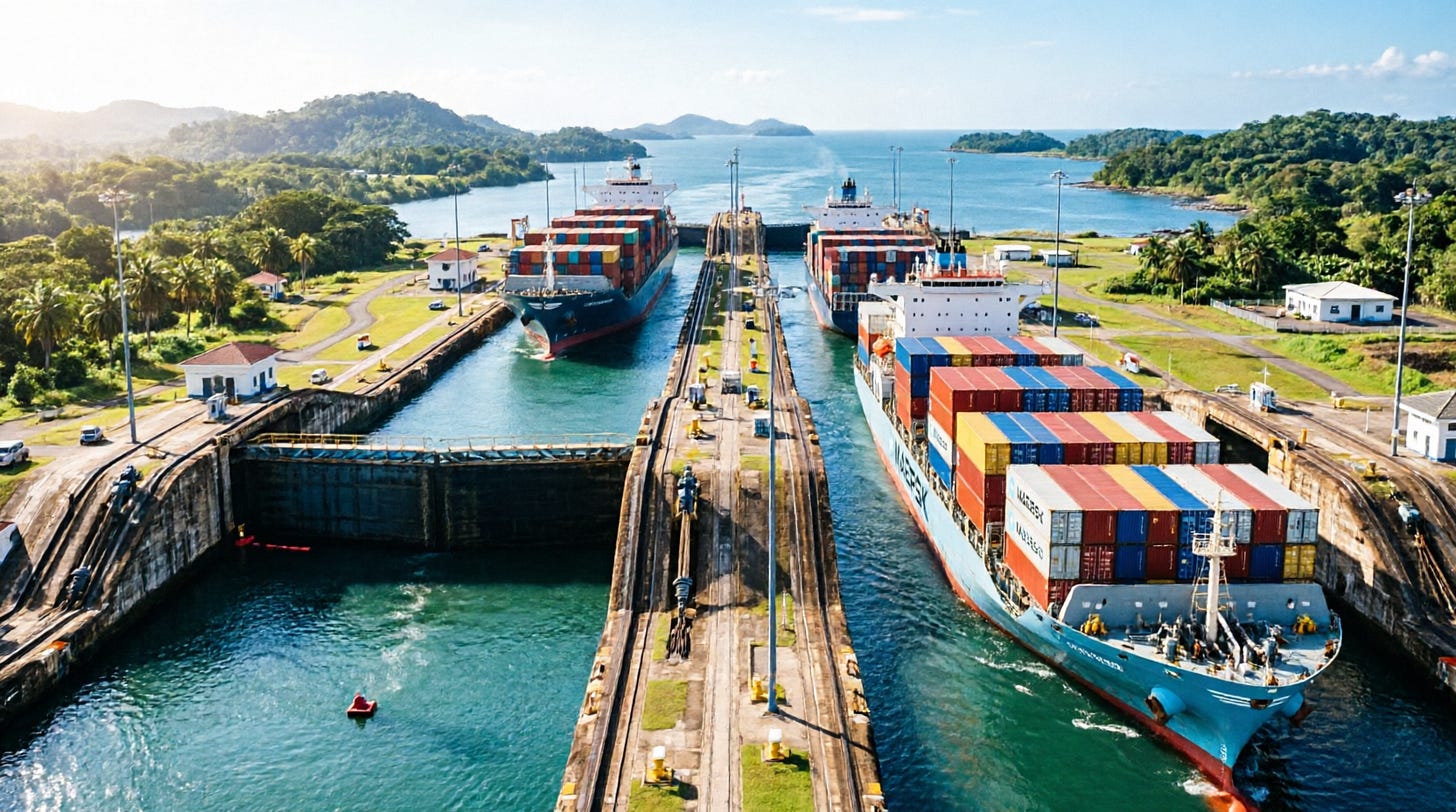
Moreover, after sustained pressure from Washington characterized by Trump 2.0 rhetoric and Senate resolutions declaring Chinese-backed investment a violation of the Neutrality Treaty, Panama’s Supreme Court annulled the 1997 concession of CK Hutchison’s Panama Ports Company to operate the strategic Balboa and Cristóbal terminals. By seizing these assets and documents, threatening personnel with criminal prosecution and handing temporary operations to Maersk and MSC, Panama abandoned its neutrality and became an active participant in US geoeconomic lawfare. The nation that once skillfully balanced Washington and Beijing now finds itself possibly investment and revenue-starved, as many investors now see the jurisdiction as high-risk.

Just prior to the de facto expropriation, CK Hutchison and its subsidiary launched arbitration proceedings through the International Chamber of Commerce, amending their claim in March 2026 to demand damages now estimated at approximately $2 billion. The company’s legal argument is that Panama Ports Company operated the ports since 1997, invested over $1.8 billion in infrastructure, and had its concession renewed in 2021 to run through 2047, with Panamanian audit authorities consistently confirming compliance with contractual terms.

Panama’s defense rests on a domestic constitutional ruling, but international investment law generally protects foreign investors from unlawful expropriation without prompt, adequate, and effective compensation. As the Panama Ports Company stated, the government’s actions constitute “radical breaches and anti-investor conduct,” and they “will not relent and they are not coming for some token relief.” If the ICC arbitration panel rules in favor of Hutchison, keeping in mind investor-state precedents often favor claimants, Panama faces a fiscal shock equivalent to roughly 2.5% of its GDP. Moreover, enforcement under the New York Convention could allow Hutchison to freeze Panamanian state assets abroad, from bank accounts to future canal revenues. This legal sword hanging over Panama’s economy is the direct result of forgoing its business-friendly neutral posture for the unpredictable terrain of US lawfare.

Beijing Strikes Back

While the arbitration process grinds forward over several years, Beijing has deployed immediate economic leverage to ensure Panama feels the sting of its decision. Contrary to initial analysis suggesting retaliation would be ineffective because Panamanian exports to China are minimal, China’s response has been strategically calibrated to target Panama’s investment pipeline and logistics stability rather than just trade flows. First, Beijing has instructed state-owned enterprises to suspend negotiations on all new business projects in Panama. This guidance puts potential investments worth billions of dollars at immediate risk, including infrastructure projects such as bridge construction, cruise terminals, and metro line extensions that Chinese firms had been pursuing. Second, Chinese customs authorities have tightened inspections on Panamanian imports in sectors sensitive in Panama. While these products represent a tiny fraction of Chinese imports, the delays and uncertainty create domestic political friction for the José Raúl Mulino administration.

Most significantly, China has leveraged its position as the second-largest user of the Panama Canal, accounting for 21.4% of cargo volume. Shipping companies have been instructed to consider rerouting cargo through other ports where feasible. While the canal retains structural advantages for certain routes, even marginal diversions by major Chinese carriers like COSCO Shipping—which has suspended Balboa operations and rerouted empty containers—translate directly into tangible revenue losses for the canal authority. In March 2026, the Chinese Ministry of Transport issued a formal and urgent summons to executives from Maersk and MSC in Beijing, a move widely interpreted by industry analysts as a direct threat of economic retaliation. This diplomatic pressure stems from the decision by Maersk’s subsidiary, APM Terminals, to take over operations at the Port of Balboa after the Panamanian government annulled the concession of the Hong Kong-based firm CK Hutchison. China has characterized this transition as a “hostile takeover” of its assets, warning that the shipping giants are facilitating an illegal seizure and may be liable to such actions. Beijing also signaled that Maersk could face severe regulatory hurdles or restricted access to Chinese ports if it continues to operate the disputed Panamanian infrastructure.

China’s response demonstrates the tools available to defend its overseas interests are international arbitration, trade scrutiny, investment freezes, and logistics adjustments. Panama’s miscalculation was believing it could serve as an instrument of US geoeconomic lawfare without consequence. Panama is now living the consequences of its abandonment of neutrality, and the international community is watching closely as the costs continue to mount. The precedent set by the Supreme Court’s retroactive annulment of a long-standing contract has sent a chilling signal to international investors as was predicted. What foreign entity will now commit billions to Panamanian infrastructure when 50-year contracts can be invalidated due to foreign political pressure? Many observers believe Panama has effectively poisoned its own well for future foreign direct investment.

Panama’s pivot represents a fundamental miscalculation about the nature of great-power competition. By seizing Chinese-linked assets under US pressure, the Mulino administration appears to have believed it could secure Washington’s favor without sacrificing its commercial relationships with Beijing. The United States has provided no guarantee of compensation for the $2 billion arbitration exposure, nor has it offered to underwrite the investment void left by frozen Chinese projects nor compensate for the trade decline. Washington’s geoeconomic lawfare, characterized by the push to reassert US dominance over strategic assets treats Panama as an instrument of policy rather than a partner.

Miguel Santos García is a Puerto Rican writer and political analyst who mainly writes about the geopolitics of neocolonial conflicts and Hybrid Wars within the 4th Industrial Revolution, the ongoing New Cold War and the transition towards multipolarity. Read other articles by Miguel, or visit Miguel's website.

This Jew Does Not Believe in the Promised Land

Missiles over Canaan and the death cult of Zionism


undefined
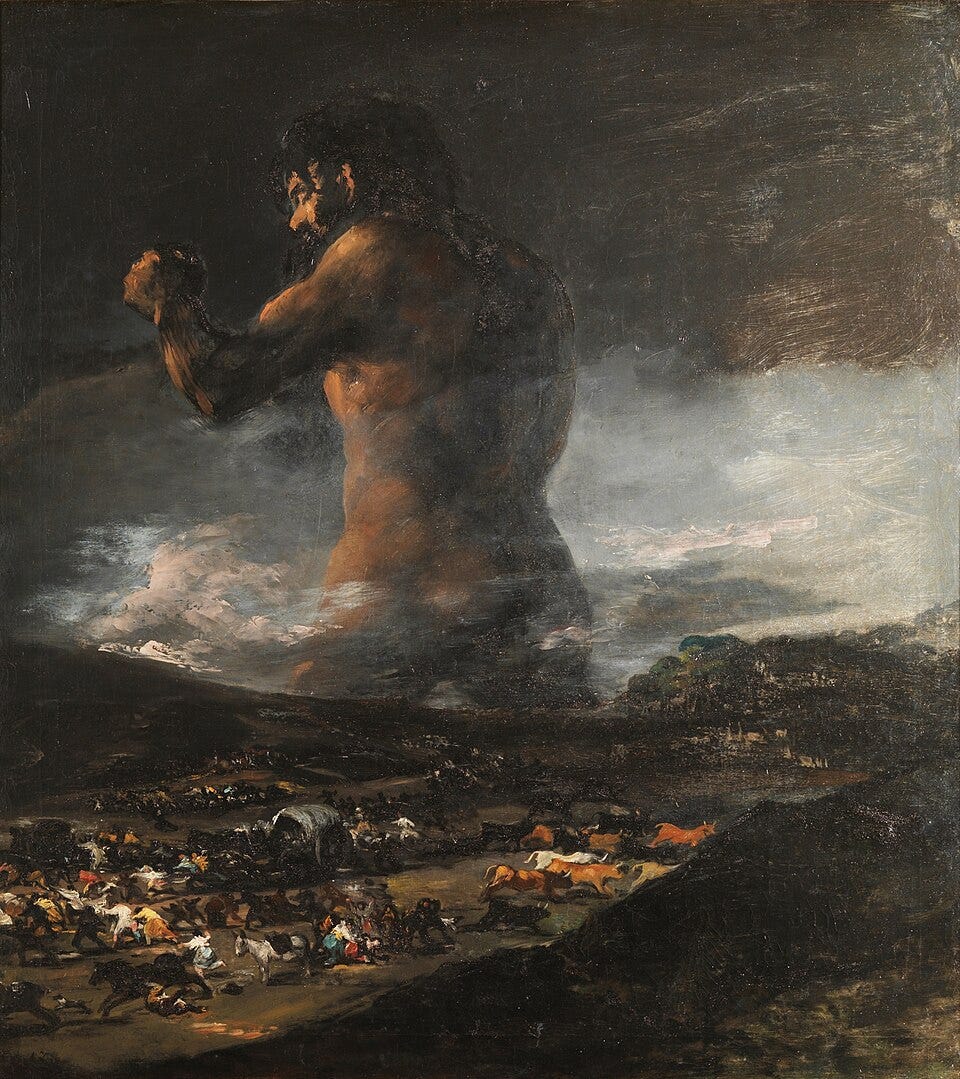
The Colossus, Francisco Goya

Tell me, should I feel guilt due to my anger-engendered desire for the collective butchers of Gaza (and Lebanon and Iran) i.e., Zionist true believers to experience a karmic dose of the pain and grief that they inflict, as a matter of routine, as Israeli Third Reich-adjacent state policy? Adding to the desire for Schadenfreude, the IDF’s war endless criminality is supported, in an overwhelming manner by the Israeli citizenry — polls reveal 88% of Israelis queried state they are in favor of the present war of aggression against the Lebanese and Iranian people, and the ongoing genocidal campaign perpetrated on Gaza.

When the vast majority of the Israeli citizenry have willingly clamored onboard the Zionist Death Juggernaut — designed to kill and destroy anything in its path — is it a sin against the soul to hope it crashes into an implacable Wall Of Comeuppance?

Israel’s barbarous, homicidal actions far surpass that of Iran, or for that matter, any other nation on the planet. Yet when resistance rises to confront Israel’s campaign of mass murder and terror, the resistance is labeled as terrorism. Israel, by intention, bombs hospitals, schools, universities, media organizations (murders reporters and journalists on the ground outright) civilian infrastructure e.g., sewage and water treatment plants, and inflicts, by design, famine.

In the (ongoing) Gaza genocide, there was a program of murderous intent called “Daddy’s home” designed to track men to their family’s home whereby their entire family would be targeted for slaughter by an IFD launched bombing attack. This is the stuff of Hollywood b-movie villainy. The practice continues now in the Israeli/US war perpetrated on the people of Iran.

Yet we hear, the war is being waged for the noble purpose of freeing the Iranian people from the grip of tyrannical rule. We were told by Washington officialdom the same lie about Vietnam, Iraq, Afghanistan, Nicaragua, Panama, Libya, Syria, and the list goes on and on.

Claiming the agenda of the Netanyahu/Trump war on Iran is a war waged to free the Iranians from tyranny is like addressing the grievances of Epstein’s victims by having them arrested by ICE and deported to Epstein Island.

Yet, in the US, regardless of our boasts and preening about our democratic republic, the nation, in reality, is a dictatorship of money and a (tottering, as evidenced by the destruction of the US’ trillion dollar military bases and installations in the Gulf States by Iran) military empire.

As Americans are – or should (at this late date) be learning a nation can be a republic or be a military empire but it cannot be both.

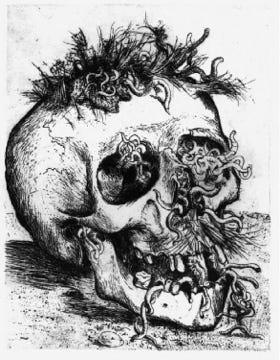
BANNED MEDIA MONTH #2: Der Krieg, by Otto Dix (1924) — SEVENCUT
Otto Dix, Skull, fragment from Der Krieg

Yet the US was self-doomed from the nation’s inception. The imprecatory prayers of millions of ethnically cleansed/ genocidally slaughtered Indigenous peoples rise from the US’ watered-in-blood soil and hang miasmic in the nation’s air. This is the air that war criminal Trump (and his Whitehouse-squatting predecessors) and Christian-Zionist, End Time homicidal maniac Pete Hegseth and ICE bully boys, and congressional war perverts have breathed in every day of their dismal and deranged life.

This is the air of the Zionist state wrought by the arrival of European land-thieving, genocidally prone Zionist invaders. The noxious air that could soon be intermingled with irradiated fallout if the prevailing madness is not somehow and in some way dissipated by a mitigating atmosphere of sanity.

Sanity in the form of the Homicidal Maniac Class must be relieved of power.

Have you ever been subjected to jerkopathic behavior involving the following scenario? You are in a public space, perhaps, a barroom. A person, hostile in countenance, keeps staring in your direction. It seems as though the individual is attempting to make eye contact but you are hesitant to do so because the individual is emitting a forbidding vibe. When you finally relent, hoping to clear up some misunderstanding…perhaps they have mistaken you for someone else and, finally, you submit to making eye contact, the person snarls the provocation,

“What are you staring at?”

This is the mode of collective mind and deranged modus operandi of Israel. For nearly eight decades since the en masse arrival of European land-thieving bigots – who viewed themselves as entitled übermensch — and established, by means of the reign of terror known as the Nakba — their ethno-supremacist state, Zionist bullies have been glaring at their neighbors, claiming victimization and instigating violence, and as is the proclivity of bullies, as all the while, claiming to be the victim in the situation.

When the agenda is — what it has been since the establishment of the Zionist state — Greater Israel.

Imagine: A stranger knocks on your door, accuses you of committing some transgression against him, then brutalizes you, and demands you leave the premises upon the threat of death, then he moves in.

No, Israel, you cannot claim the world is clamoring for your annihilation based on your religious affiliation. We simply hope to see a barroom bully knocked off his barstool, cold-cocked by the smaller person he has been tormenting.

We are hoping that the psychopathic home invader is evicted from the property to which he laid claim by murderous intent.

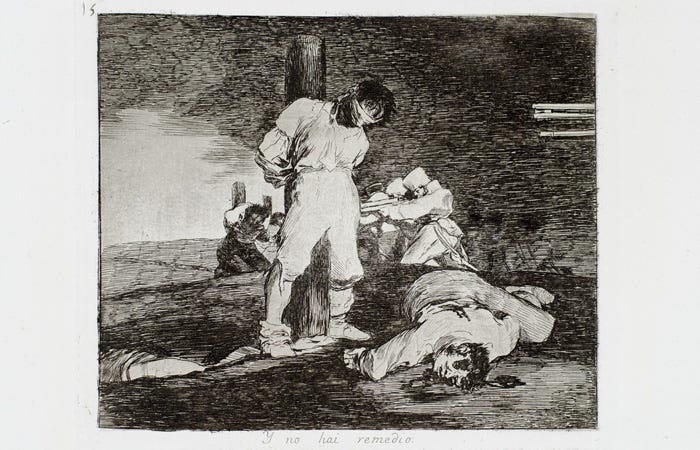
Francisco Goya. Contra el bien general (Against the Common Good) from The Disasters of War, ca. 1813–14

This is the reason people who are not hateful nor violent in nature, when seeing missiles raining down on Israel, despite our mortification regarding war still possess the desire to have the aggressor face some form of comeuppance or, at the very least, be thwarted in the odious compulsion to harm others.

Because the home invader has not faced consequences (e,g., divestment and sanctions) Israel’s agenda of imposing Greater Israel…as these words, are committed to pixel, Israel has broken the region…if not the world order.

Although Zionists, due to your soul-defying compulsion for aggression, you have condemned yourself to a life of fear amid the rubble of your ambitions.

Erev Shabbat Reflections on the Perpetual War-Making of the Zionist State. In late afternoon, last Friday, I wrote the following:

Although Zionism is a (death) cult dreamed up by European atheists, the cultural/socio mythology relating to an escape from fraught circumstances, the end of wandering, and the inspiration to wage war upon a people regarded as sinful, inferior, devoted to false gods by divine ordination remains the hallmark and touchstone of the present day people — i.e., Zionists — who claim to be the heirs of the ancient Israelites.

No photo description available.
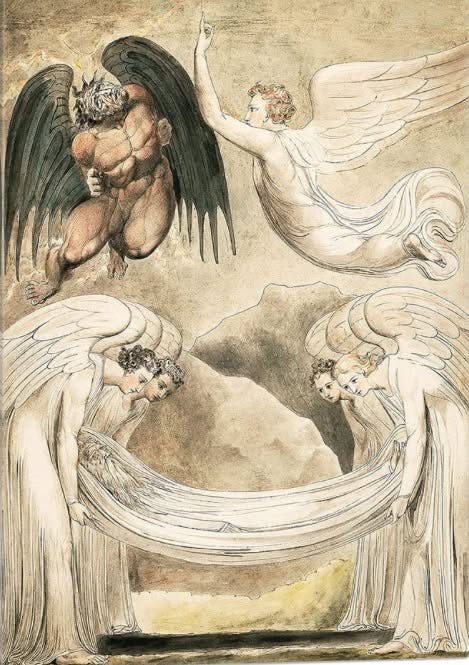
‘The Devil Rebuked (The Burial of Moses)’, by William Blake (c. 1805).

From The Book of Deuteronomy (28:64-66) “The LORD will scatter you among all peoples, from one end of the earth to the other… Among those nations you will find no peace, no rest for the sole of your foot. There the LORD will give you an anguished heart and eyes that fail and a spirit in despair. Your life will hang in doubt before you, and you will be in terror night and day and have no certainty of survival.”

As told by Old Testament mythos, The Book Of Deuteronomy limns in scripture Moses’ farewell evocation to a new generation of Israelites, gathered on the plains of Moab, their 40 years of wandering are coming to an end around the year 1400 BCE, as they prepare, en masse, to stride into the Canaan Land, then wage wars of ethnic cleansing with the intention of securing the establishment of O-Mighty God’s bestowed Promised Land. (Do you detect a pattern here: perpetual victimization, followed by land theft, and all in the name of survival — all of which is manifested as god-given entitlement to real estate granted to the tribe by Divine mandate?)

(Although the story of Exodus, on an historical basis, is the ethnocentric mythology that serves as the cultural foundation story of ancient Israel, DNA evidence reveals the Jews of Torah origin can be traced to hill country Canaanites, withal, the ancestors of present day Palestinians.)

In scholarly studies, in historical context, Deuteronomy was scribed in the 7th century BCE during King Josiah’s reign and involved the codification of Yahweh worship as an organizing principle insofar as the establishment of societal cohesion.

As survivors of The Shoah, my family’s history and attendant storyline of displacement, of wandering onto novel shores carries historical accuracy — when applied to their native born country of Germany: e.g., “Among those nations you will find no peace…Your life will hang in doubt before you, and you will be in terror night and day and have no certainty of survival.” — Deuteronomy 28:65-66

Yet the storyline is a forced fit insofar as Zionists Jews relationship to Palestinians and Israel’s Arab neighbors. When Zionists arrived from Europe, they were and remain the perpetrators of terror, night and day, and all the human beings within their reach are granted no certainty of survival.

As we are witnessing in regard to Zionism, historical narratives, ghosts of memory, when warped and displaced become a destructive force — malevolent agendas manifested in flesh and driven by harmful will. Instead, it is well past time, we proceed down to rivers of the collective mind, lay down or swords, shields, missiles, and drones and begin to adhere to an alternative (saner) passage of Old Testament scripture:

Micah 4:3:

He will judge between many peoples
and will settle disputes for strong nations far and wide.
They will beat their swords into plowshares
and their spears into pruning hooks.
Nation will not take up sword against nation,
nor will they train for war anymore.

undefined
The prophet Micah, as depicted by an 18th century Russian Orthodox icon from the iconostasis of a church on Kizhi Island in Karelia, Russia.

Phil Rockstroh is a poet, lyricist, and essayist. His poems, short fiction, poetry and essays have been published in numerous print publications and anthologies; his political essays have been widely posted on the progressive/left side of the internet.  Read other articles by Phil, or visit Phil's website.


Ontario Premier Doug Ford’s Palestine Exception Defeated in Court


Last Friday afternoon, Ontario Premier Doug Ford launched an attack on free speech, instructing his Attorney General to file an emergency injunction to prevent the Al-Quds Day march from taking place in Toronto. Ford’s action came just one day after his meeting with Israel’s Ambassador to Canada, Iddo Moed, and Israel’s Consul General in Toronto, Idit Shamir.

In response, we issued a statement condemning the use of state power to suppress a political demonstration in support of Palestinian rights. We argued that Doug Ford’s injunction posed a serious threat to the Charter-protected freedoms of expression and political assembly, and reflects a broader pattern of attempts to censor and stigmatize pro-Palestinian free speech and organizing in Canada.

Our quotes condemning this attack on civil liberties were picked up by CTV News Toronto and the Canadian Press, and published by newspapers across the country. We have also responded to misinformation and false claims about Al-Quds Day by the mainstream media.

Fortunately, Ford’s attempt to shut down Al-Quds Day failed. On Saturday afternoon, just hours before the demonstration was scheduled to begin, the judge ruled against the injunction, allowing for the demonstration to continue as planned. In his ruling, the judge affirmed that “the right to assemble and speak freely must be maintained in times of global conflict. Perhaps at no other time is the protection of our civil liberties more important.”

While we are relieved that this latest assault on free speech failed, we must ensure that our advocacy is not deterred. As Israel escalates its violent attacks against the people of Palestine, Lebanon, and Iran, its supporters at home are trying everything to stop Canadians from speaking out in support of Palestinian rights and freedoms.

CJPME’s mission is to enable Canadians of all backgrounds to promote justice, development and peace in the Middle East, and here at home in Canada. Read other articles by Canadians for Justice and Peace in the Middle East, or visit Canadians for Justice and Peace in the Middle East's website.