It’s possible that I shall make an ass of myself. But in that case one can always get out of it with a little dialectic. I have, of course, so worded my proposition as to be right either way (K.Marx, Letter to F.Engels on the Indian Mutiny)
Wednesday, March 18, 2026
Iran The Iranian nuclear bomb: a devastating boomerang
In the aftermath of January 2026’s crackdown, voices within and close to the Islamic Republic renewed calls for Iran to complete a nuclear deterrent, claiming the bomb would have prevented the current existential crisis. Houshang Sepehr, exiled Iranian Marxist and editor of Solidarité Socialiste avec les Travailleurs en Iran, challenges this on structural grounds. Drawing on the cases of India, Pakistan, and North Korea, he argues that nuclear deterrence only functions within security architectures backed by a great power patron --- a guarantee Iran never had. Neither Russia nor China was willing to absorb the risks of a nuclearised Islamic Republic contesting US hegemony. The bomb, he concludes, would have deepened Iran’s isolation rather than protecting it.
The Islamic Republic’s security situation has never been so critical. The country is in the grip of a crisis of exceptional gravity. The threat now reaches the highest levels of power and its principal institutions. Even during the darkest hours of the eight-year war against Iraq, the regime had never confronted a crisis of this magnitude.
After the massacres of January 2026, [1] at a time when the United States and its allies were intensifying their military presence around Iran, a familiar assertion resurfaced in the official media: had the Islamic Republic possessed nuclear weapons, it would not now be facing an “existential threat.” This idea is circulated not only by certain regime supporters, but also by circles close to the Islamic Revolutionary Guard Corps (IRGC), [2] by commentators aligned with the official discourse, and even by sections of the left claiming allegiance to the “Axis of Resistance.” Some go so far as to urge the leadership to complete the manufacture of a nuclear weapon without delay.
Yet this narrative belongs less to strategic analysis than to fantasy. It ignores the real history of nuclear proliferation and misunderstands the Islamic Republic’s actual position in the global order. The central question remains: could a nuclear bomb have guaranteed the regime’s security at any point?
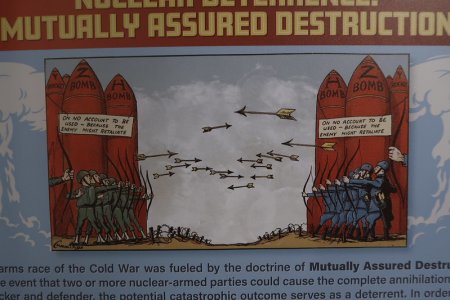
This hypothesis may appear self-evident, but it is wrong. A nuclear weapon cannot enable a state to compensate for its strategic weaknesses through technological power alone. The history of nuclear proliferation, and the theory of international relations, demonstrate that security is never an automatic consequence of possessing the bomb. Proliferation might stabilise certain international relationships --- but only where states are integrated into structures of mutual recognition and institutional balance. Iran is far from that position.
The genuine question, then, is whether nuclear weapons could have guaranteed the Islamic Republic’s security.
Secondary nuclear powers: comparative limits
To address this, the cases of the so-called secondary nuclear powers --- India, Pakistan, and North Korea --- deserve examination. Contrary to the simplistic narratives propagated by certain political commentators, each of these states acquired nuclear weapons under exceptional circumstances. Their weapons programmes developed within the interstices of a specific geopolitical configuration, and within the “containment logic” applied by the great powers.
India, Pakistan, and North Korea are frequently presented as success stories of nuclear proliferation. However, each acquired the bomb within a specific geopolitical context, and with the tolerance or implicit support of major powers:
India counterbalanced Chinese nuclear power, enjoying strategic latitude tolerated by the Soviet Union;
Pakistan developed its programme in response to India, with the tacit tolerance of the United States and China, as part of a shared interest in regional balance;
North Korea was indirectly supported by China as a buffer zone against the United States.
In each of these cases, possession of the bomb forms part of a broader security architecture. It is never an isolated instrument of sovereignty.
The Iranian “third way”: deterrence without a great power protector
The Islamic Republic attempted a different strategy: to obtain the benefits of deterrence without possessing a nuclear patron among the great powers. This “third way” consisted of creating a “nuclear ambiguity” that would allow Tehran to hold itself at the threshold of confrontation without enjoying the guarantees of a protecting power.
Once the Iran—Iraq War had ended, the Iranian regime seriously considered nuclear deterrence as a strategic lever for its survival through the 1990s. However, the post-Cold War global context offered it no patron: Russia was redefining itself, China was integrating into global markets, and no great power had any interest in backing Iran at the price of direct confrontation with the United States.
In 2010, UN Security Council Resolution 1929 confirmed this reality: Beijing and Moscow would no longer assume the role of protector for a militarised Iranian nuclear programme. [3] That vote sent a clear message: neither Beijing nor Moscow would underwrite the Islamic Republic’s militarised nuclear programme. The era in which great powers could use containment logic to manage proliferation was over. And even had that logic returned, Iran did not --- and does not --- occupy a geopolitical position that would allow such a model to apply. To take a more telling example: even the Shah’s government, though it was a US security partner in the Middle East and the Soviet Union’s southern neighbour, was never subject to a containment policy employing nuclear weapons.
Yet even this warning was ignored.
From that point on, the Islamic Republic persisted in a course that neither the United States, nor Europe, nor even Russia or China, was prepared to tolerate: a programme incompatible with non-proliferation policy and with any logic of great-power equilibrium.
Iran today is a regional power of limited means and restricted opportunities. Were it to attempt to use the bomb --- or even to cultivate “nuclear ambiguity” --- to play a role analogous to that of the United States, it would be attempting to implement a “third way” without precedent in history.
It would not be the United States alone resisting such a policy. Russia and China would oppose it too. Their refusal would not be motivated by ethical considerations or international law, but by their own security interests. A secondary power that acquires the bomb and seeks to impose a confrontational dynamic with a first-rank power would destabilise the international order for everyone --- including Beijing and Moscow.
The fantasy of a saving alliance
Over the years, the Islamic Republic has repeatedly sought to place itself under the protection of Russia and China through long-term contracts and military and political cooperation. But these efforts have never produced a genuine strategic security partnership. The reason is simple: neither Russia nor China regards Iran as an actor that would justify a nuclear risk.
This does not mean Iran holds no interest for them. Its presence in their sphere of influence can offer a security advantage. The problem lies elsewhere: the Islamic Republic seeks to associate itself with them in order to play the role of counterweight to the United States and to assert greater influence in the Middle East. This is precisely what leads Moscow and Beijing to conclude that a strategic alliance with Tehran offers them nothing.
China and Russia have many disagreements with Washington, but all three capitals agree on the “special privileges” attached to their status as global powers. None of them wishes to see a secondary actor attempting to challenge that hierarchy. In their eyes, such a situation would be absolutely unacceptable, whatever their rivalries with one another.
Some attribute the failure of Iran’s nuclear strategy to “reformist” Iranian governments --- those of Mohammad Khatami, Hassan Rouhani, and now Masoud Pezeshkian --- supposing them to have been “too accommodating” towards the West. This reflects a fundamental misreading of others’ intentions: Iranian presidents have never had the power to alter the strategic calculations of Moscow or Beijing, nor to secure nuclear protection. Moreover, within Iran’s political system, presidents --- “reformist” or otherwise --- have never exercised decisive control over foreign policy.
Beijing and Moscow regard Iran as useful, but insufficient to justify confrontation with the United States. Even in periods of rivalry, the great powers share an implicit consensus: the global hierarchy must be preserved, and a secondary state such as Iran cannot overturn it by acquiring nuclear weapons.
The structural failure of Iran’s nuclear strategy
No one can know with certainty the state of Supreme Leader Khamenei’s thinking. Perhaps he concluded that a nuclear bomb would have brought the Islamic Republic no security --- neither today, nor ten or twenty years ago. Even under the scenario most favourable to the regime, the bomb would only have marginally delayed a direct confrontation.
Nuclear deterrence functions only when it is credible, recognised, and integrated into a strategic equilibrium. It requires a “diplomacy of credible threat”: possession of a nuclear weapon has value only when accompanied by mechanisms of verification, legitimacy, and international recognition.
Iran possesses none of these elements: no international support, no credible security architecture, no stable internal legitimacy. On the contrary, the programme has reinforced Iran’s isolation, deepened sanctions, and intensified external threats. Even in the best-case scenario, the bomb would have delayed a direct confrontation only marginally. [4]
Conclusion
Iran’s nuclear programme illustrates the structural limits of autonomous deterrence for a secondary state. Proliferation produces stability only when it is embedded in a recognised equilibrium and backed by the great powers. Without this, it is liable to increase the risks of conflict and escalation.
For the Islamic Republic, nuclear weapons were never a protective shield. They proved to be a countdown to crisis --- a colossal investment that weakened the country and increased its vulnerability. The classical theories of deterrence and proliferation confirm that security cannot be decreed: it is built within a system of balances and protections that the clerical regime never managed to achieve.
[1] In late December 2025, protests erupted across Iran beginning with a strike by merchants at Tehran’s Grand Bazaar, triggered by the collapse of the rial and spiralling inflation. Within days, demonstrations had spread to more than twenty of Iran’s thirty-one provinces. The state responded with mass arrests and lethal force. On the left and among the Iranian opposition, the events of January 2026 are characterised as a turning point in the crisis of the Islamic Republic. See: Bella Beiraghi, “Iran on fire: rebellion returns to the streets”, ESSF, 5 January 2026. Available at: : https://www.europe-solidaire.org/spip.php?article77590.
[2] The Islamic Revolutionary Guard Corps (IRGC; Persian: Sepāh-e Pāsdārān-e Enqelāb-e Eslāmi) is an elite parallel military force established after the 1979 revolution, answerable directly to the Supreme Leader. It controls extensive economic assets and exercises significant political influence alongside the regular Iranian armed forces
[3] UN Security Council Resolution 1929, adopted on 9 June 2010, imposed a fourth round of sanctions on Iran over its nuclear programme. Notably, both China and Russia voted in favour, signalling that neither power was prepared to shield Iran’s nuclear ambitions from international pressure. See: UN Security Council, “Resolution 1929 (2010)”, S/RES/1929, 9 June 2010. Available at: https://undocs.org/S/RES/1929(2010). For analysis of the subsequent strategic context, see also: Amos Harel, “With Israel and Iran in a New Balance of Deterrence, a Nuclear Deal Remains the Endgame”, ESSF, 25 June 2025. Available at:https://www.europe-solidaire.org/spip.php?article75442.
[4] For background on Iran’s strategic history and the long-term consequences of Western and US intervention, see: Houshang Sepehr, “Operation Ajax: 70 years since the CIA and MI6 joint venture in Iran”, ESSF, 6 December 2023. Available at: https://www.europe-solidaire.org/spip.php?article68902
Houshang Sepehr is an exiled Iranian revolutionary Marxist militant. He is an organizer of Solidarité avec les Travailleurs en Iran (“Solidarity with the Workers in Iran” - 266 avenue Daumesnil, 75012 Paris) and a member of the Fourth International.
With US-Israeli bombs continuing to fall on Iran and Lebanon, one might have expected American leftists to be focused on anti-war outreach in our neighborhoods, schools, and workplaces. The next No Kings protest is on March 28 and we have a great opportunity to lean on that to drive up anti-war activity.
Instead of that outward facing work, my timeline for the past few days has been full of anti-imperialist radicals in the US defending Susan Abulhawa, a Palestinian-American author who Zohran Mamdani rightfully distanced himself from last week. Abulhawa continues to mix justified opposition to Zionism with clear antisemitism, such as defending an Australian Neo-Nazi by pointing out that the judge who sentenced him was Jewish, dabbling in Holocaust denial, and suggesting that no Jew anywhere in the world should feel safe.
The online discourse around Abulhawa is indicative of many dynamics, including — as I pointed out in a recent piece on America’s missing anti-war movement— the prevalence of counter-productive ultra-leftism among too many American anti-imperialists. Even if we leave aside the fact that bigotry should be rejected as a matter of principle, anybody with even half a foot outside of Twitter’s far-left echo chamber should see that antisemitic remarks make it much harder to build a mass movement at home to stop US militarism and aid to Israel. Yet, for too many American leftists today, practical anti-war activism doesn’t seem to expand far beyond performative radicalism, heated rhetoric, and deference politics.
This type of ultra-leftism has a long lineage in the US, as do debates over how to build mass anti-war opposition. So rather than relitigate more hot-takes, it’s helpful to take a step back and examine what type of anti-imperialist politics within the US has actually been effective.
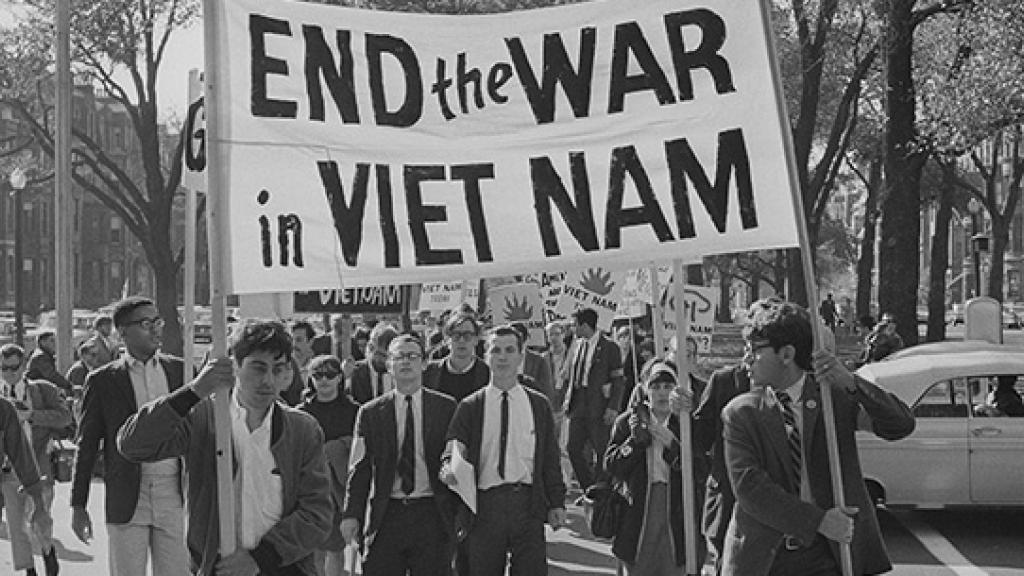
Today’s anti-war activists can learn a lot from the tactics and strategies that put an end to the Vietnam War.
The decades-long resistance of the Vietnamese people, whose heroism is hard to overstate, was obviously a central factor in the US defeat. But Vietnamese revolutionaries were also the first to underscore that they could not win without a strong peace movement within the belly of the beast. To understand how that movement succeeded, there’s no better place to turn than Fred Halstead’s extraordinary 880-page history Out Now: A Participant’s Account of the Movement in the United States Against the Vietnam War.
Halstead served on the steering committees of virtually every national antiwar coalition from 1965 to 1975. He was a garment cutter, a World War II navy veteran, the presidential candidate for the Socialist Workers Party (SWP) in 1968, and at six feet six and 350 pounds, one of the most physically imposing chief marshals in the history of American protest. His book is a week-by-week, meeting-by-meeting account of how tenacious organizers built a movement that helped end a war and the strategic fights they had to win along the way to do it. As we’ll see, it was independent mass action — not liberalism nor ultra-leftism — that proved most effective.
The fight over demands
From its earliest days, the Vietnam antiwar movement was consumed by a three-way fight over what to demand. On the right stood organizations like SANE, the Committee for a Sane Nuclear Policy, which wanted the movement to call for “negotiations.” Their logic was practical: all wars end with negotiations; the task was to strengthen the hand of congressional “doves” who were beginning to criticize escalation. SANE wanted to work closely with liberal Democratic politicians, to convince them that negotiations should begin. In that framework, “immediate withdrawal” slogans were a liability — they would shut off the friendly ears of Establishment figures who accepted the basic premises of the cold war.
The liberal wing of the movement thus hitched its fortunes to the Democratic Party, trusting that patient lobbying and respectable protest would eventually move the administration toward peace. But Democratic President Lyndon B. Johnson had no intention of rolling back US imperial influence. Even as SANE and its allies cultivated relationships with sympathetic Democrats, LBJ was dramatically escalating — pouring hundreds of thousands of troops into Vietnam and intensifying the bombing of the North.
The strategy of working through friendly channels inside the party proved fruitless: the very politicians the liberals courted either fell in line behind the president or found themselves powerless to change his course.
On the opposite end of the anti-war spectrum stood ultra-left groups like the Spartacist League, which wanted demonstrations to march under banners reading “Victory to the Vietnamese Revolution.” Alongside them, the national leadership of Students for a Democratic Society (SDS) increasingly argued that the antiwar movement should adopt a “multi-issue” program encompassing opposition to racism, capitalism, and imperialism as a whole — or that the movement was simply “working on the wrong issue.” In a remarkable position paper prepared for a crucial 1965 convention, SDS leaders Lee Webb and Paul Booth flatly declared: “Essentially, we think that the movement against the war in Vietnam is working on the wrong issue. And that issue is Vietnam.”
In the middle stood the radical pacifists around A.J. Muste and Dave Dellinger; the Trotskyists of the SWP and the Young Socialist Alliance (YSA); and the independent committees to end the war in Vietnam that formed much of the backbone of the new movement. These groups — nonexclusionary, action-oriented, open to anyone willing to work against the war — argued for “immediate withdrawal,” later crystallized into the slogan “Out Now.” Halstead recounts that the local antiwar committees discovered through direct experience that it was far easier to reach ordinary people with a demand for getting the U.S. out of Vietnam entirely than with the complicated and equivocal appeals favored by the negotiations wing. “Bring the Troops Home Now” was concrete and unambiguous. It left the government no room to equivocate. Johnson claimed to favor negotiations too. But Johnson could not say “Bring all the troops home now.”
The principled case went deeper. Halstead noted that demands for negotiations, when directed by Americans at the American government, implicitly recognized some U.S. right to be in Vietnam — something to negotiate over. The U.S. simply had no right whatever to be militarily involved in Vietnam, and the only honest demand was to get out.
At one heated meeting, a negotiations supporter shouted: “Bullshit. How do you even withdraw without negotiations?” To which several people on the other side shouted in unison: “On ships and planes, the same way you got in.”
Halstead’s three-way schema — liberalism, ultra-leftism, mass action — is useful. But it doesn’t fully capture an important current that cut across all three categories: Black opposition to the war, which emerged after decades of deep on-the-ground organizing for civil rights and via the inspiration of anti-colonial struggles abroad. SNCC’s 1966 statement against the war was one of the earliest and sharpest organizational breaks with Cold War consensus. Muhammad Ali’s refusal to serve — “I ain’t got no quarrel with them Viet Cong” — electrified millions. And Martin Luther King’s 1967 Riverside Church address, in which he called the U.S. government “the greatest purveyor of violence in the world today,” was a seismic event that broke the tacit agreement among civil rights leaders to stay silent on foreign policy.
Black anti-war activism was often multi-issue and effective. It connected Vietnam to the draft’s racial inequities, to the diversion of resources from domestic needs, to the broader structure of racial oppression. But this type of multi-issue politics could not always be easily exported into different social contexts in the US.
How revolutionary slogans shrank the mass movement
Ultra-leftism was no more effective at ending the war than liberalism. But it came wrapped in revolutionary rhetoric that made it particularly seductive to the young radicals the movement depended on.
Foreshadowing today’s debates over how to relate to anti-imperial resistance in Palestine and Iran, Halstead explained why the demand for “Victory to the Vietnamese Revolution” was not helpful. He “saw no useful purpose for them in a demonstration appealing to Americans with demands directed at the U.S. government. We were, after all, not speaking to Vietnamese.” He continued: “Both from the point of view of those simply opposed to the war, and those who, like myself, were partisans of the Vietnamese revolution, our central task as Americans was to put maximum pressure on the U.S. to get out of Vietnam. That would help the Vietnamese revolution more than anything else we could possibly do.”
The “multi-issue” argument was even more damaging, because it was wielded by SDS, which had the largest base among radicalized students. One SWP leader characterized the multi-issue debate as “largely a sham battle that covered up rather than elucidated the issues at stake.” His reasoning was simple: “All the radical organizations are multi-issue and none believe that society can be changed... by a program or pattern of activity around a single issue. Thus any member of SDS, YSA, Du Bois, M-2-M, has a multi-issue approach to the war.” But the committees to end the war in Vietnam were united fronts, not revolutionary parties. “Any attempt to add further planks to their program would destroy them. Those who make them up agree on this basic point and no other.”
The problem with SDS’s multi-issue approach was not that connecting the war to other struggles was inherently wrong. Black radical movements were doing exactly that with great effect — and socialist organizations like the SWP and the Black Panthers were recruiting people to precisely such a comprehensive vision of how society’s ills were intertwined.
But when SNCC or King connected Vietnam to racial injustice, they were articulating what masses of Black Americans already felt. The connections were drawn from below, from the concrete realities of communities that were disproportionately drafted, disproportionately killed, and systematically denied the freedoms they were supposedly fighting to defend abroad. That kind of multi-issue consciousness deepened and broadened the movement. SDS, by contrast, was doing something very different: asking coalitions of people who agreed on one thing — that the war had to stop — to first adopt a comprehensive analysis of imperialism, capitalism, and racism as a package before they could march together. Far from deepening the movement, that just erected barriers to entry.
In New York, SDS literally voted to dissolve the citywide committee to end the war in Vietnam rather than allow it to continue as a focused antiwar coalition. A bloc of forces led by SDS supporters carried a vote to shut down the coordinating committee and replace it with a regional SDS group operating under SDS’s multi-issue program. An SDS leader chaired the meeting — though, as Halstead notes, it was apparently the first meeting of the committee he had ever attended. The YSA had opposed this move, and a general assembly was scheduled days later where the focused antiwar approach would likely have carried. So SDS simply killed the organization before the vote could happen.
Later, SDS’s trajectory carried it further and further from mass politics. By 1968, meetings that were supposed to build radical community bases had “sifted down to a handful of SDSers sitting in a room escalating their rhetoric.” The faction that became the Weathermen adopted the slogan “Dare to struggle, dare to win” and tried via spectacular bombings to substitute the will of a tiny minority for the patient work of building a mass movement. And as Dellinger himself later admitted, the 1968 Chicago Democratic Convention protest clashes with armed forces “helped create a movement mystique of revolutionary derring-do and heroic street encounters as goals in themselves. This polarized the movement around the question of street violence and gradually led to a tragic separation between the organized movement and large sections of the antiwar public.”
When it came to demands, SWP leader Peter Camejo, in his famous 1970 speech “Liberalism, Ultraleftism, or Mass Action,” identified a core problem with turning away from a clear focus on Vietnam. Calling for “Stop Imperialism” instead of “Bring the Troops Home Now” was an abstraction. “Even Nixon can say, ‘I’m against imperialism too — that’s what Britain and France and Holland did in the 18th and 19th centuries.’ But Nixon can’t say, ‘Bring all the troops home now.’”
In other words, the ultra-left demand and the liberal demand converged in their practical effect. Both let the government off the hook. “Negotiations” was too weak to pin the war-makers down. “Smash Imperialism” was too abstract. Only concrete, immediate, non-negotiable demands generated maximum pressure to actually constrain the ruling class.
Mass action and the question of leverage
The SWP’s position on tactics was often caricatured as a fetish for big marches. But it was something more interesting — and more strategic — than that. What the SWP argued for was a strategy of independent mass action: activating and involving the broadest numbers of Americans in the fight.
Halstead wrote in 1965: “It is well within possibility that not just a few hundred thousand, but millions of Americans can be actively involved in the struggle against the Vietnam war. A movement of that scope, even though centered around the single issue of the war, would have the most profound effects on every social structure in the country, including the trade unions and the soldiers in the army.”
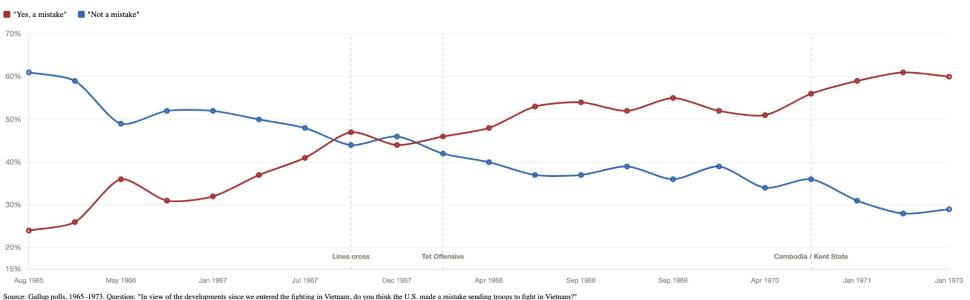
Much of SWPers focus was thus on reaching and winning over ordinary Americans to oppose a war that remained popular as late as 1967. And as anti-war sentiment grew, this persuasion work increasingly was combined with deep organizing work to make it visible.
Image
Evolution of anti-war sentiment in the 1960s
Here are some examples of what this looked like on the ground.
In San Francisco in 1967, over two thousand activists distributed more than 400,000 leaflets for Proposition P—a binding referendum on immediate withdrawal—at “every conceivable public place in the city, including those where GIs gathered.” A special project organized by Catholic students, unionists, teachers, and nuns put 40,000 leaflets into the hands of parishioners at Catholic churches across the city.
Across the US, the YSA-led Student Mobilization Committee (SMC) built genuine organizational infrastructure—weekly chapter meetings with majority-rule decision-making, open steering committees, citywide representatives, regional conferences that drew six hundred activists at a time in Boston alone—and published not only its own Student Mobilizer but a GI Press Service designed so underground military newspapers could lift whole articles and cartoons.
At Fort Jackson, South Carolina, a drafted YSA organizer named Joe Miles started by playing Malcolm X tapes in the barracks for fifteen Black and Puerto Rican GIs; within weeks, eighty soldiers were attending meetings of “GIs United Against the War in Vietnam,” and the organizers had made a conscious, debated decision to reach across racial lines and invite white soldiers.
By the October 1969 Moratorium, millions of ordinary Americans were canvassing door to door, picketing, and leafleting in actions that reached every state, Puerto Rico, and the Virgin Islands—while the SMC had active chapters on over three hundred campuses. The movement built real united-front coalitions on the principle of nonexclusion—welcoming everyone from SANE liberals to Trotskyists to Catholic priests to Black nationalists—and it tested its message at the ballot box, where antiwar referenda won 63 percent in Detroit, a majority in San Francisco, and 66 percent in Madison, with the strongest support coming from working-class precincts. A protest bubble this was not.
When appropriate, the SWP and SMC’s advocacy of independent mass action also took the form of militant actions like student strikes or, even more ambitiously, the establishment of “anti-war universities” aimed “not to shut down the universities but to take over their facilities and use them to spread the antiwar activism to other sectors of the population.” During the May 1970 student strike, for example, at the University of Illinois Circle Campus students commandeered printing facilities and phone lines, the Art and Architecture Institute ran twenty-four hours a day producing posters that blanketed Chicago, and teams were dispatched daily with tailored leaflets to GIs at nearby bases, workers at factory gates, and high school students in surrounding neighborhoods. Students, like many Black Americans, were ready for more militant action than most of the rest of the population.
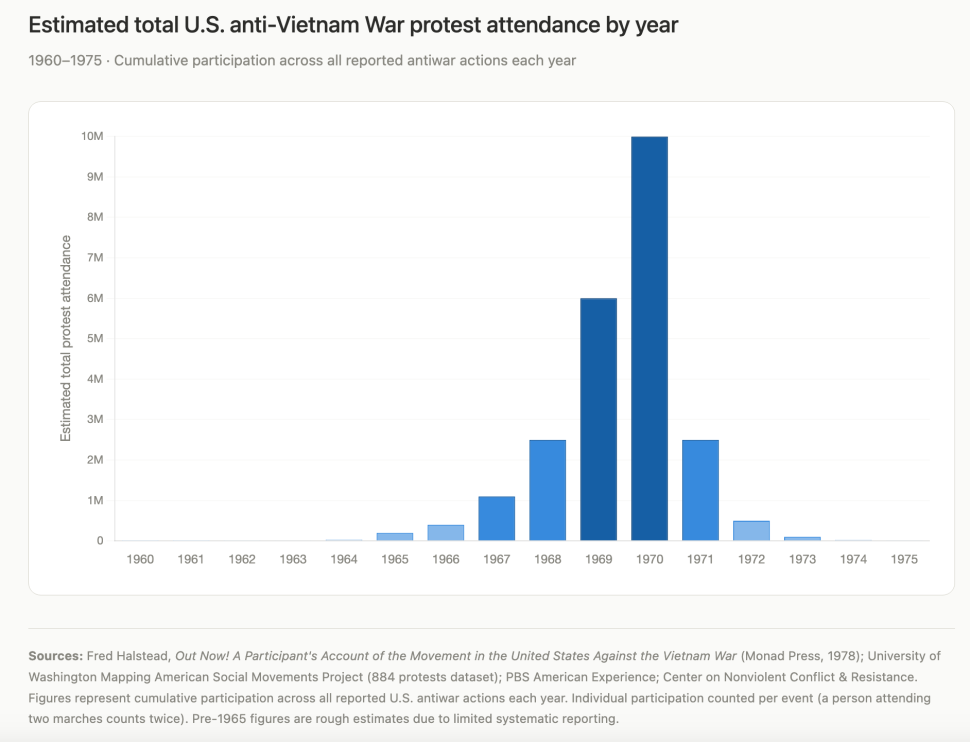
And, yes, SWP activists — who by all accounts were central leaders of the peace movement nationwide — also spent a lot of time advocating for and building peaceful mass marches. They were right to do so: generally, this proved to be the tactic best suited for drawing the maximum numbers into visible opposition. Millions poured into the streets, particularly in 1969 and 1970.
Image
Estimated total US anti-Vietnam war protest attendance by year
It’s worth noting that big demonstrations in the 1960s had a different impact than they do today. Partly that’s because it took a lot more outreach and logistical work to organize them in a pre-digital era. Getting big numbers in the streets thus built and demonstrated a degree of organized power that they don’t necessarily do today. They also tended to attract more media attention.
The SWP’s orientation towards mass outreach and big peaceful protests often put them in sharp conflict with those who favored subordinating mass action to small-group confrontations, acts of individual resistance, and direct action by committed minorities. Dellinger dismissed mass mobilizations for immediate withdrawal as united fronts organized around the “lowest common denominator.” Halstead responded that getting the U.S. out of Vietnam was the movement’s central purpose and the reason for its existence. There was nothing “lowest” about it. The SWP championed mass demonstrations because of what they could set in motion — specifically, because visible mass opposition in the civilian population made it easier and safer for people with actual structural leverage to act.
GIs could express their own opposition to the war more readily when millions of civilians were already marching. Workers could begin to question the war when antiwar sentiment was no longer confined to campus radicals.
Halstead insisted on “pointing the antiwar movement toward the great mass of ordinary working class Americans, including those in the military.”
The SWP did not view GI activity as a substitute for building the civilian movement. On the contrary: “Without a mass antiwar movement in the civilian population the GI movement could never get beyond occasional isolated individual acts.” But the reciprocal factor was powerful: “Any antiwar stand earned by GIs cut, like nothing else could, through the ‘support our boys’ demagogy of the hawks. Conversely, the more massive the civilian movement, the easier it was for the GIs to express their own opposition to the war.”
That strategic bet paid off.
How the mass movement broke the army
By 1968, several hundred antiwar GI newspapers had appeared — Vietnam GI, published by a veteran who accumulated a mailing list of thousands of GIs in Vietnam itself; Fatigue Press at Fort Hood; the Bond, distributed at bases across the country.
GI coffeehouses sprang up near bases. At Fort Lewis, near Seattle, a team of civilian activists tried a new approach one evening — instead of leafleting, they simply walked onto the base and started conversations. “Most of us started with, ‘I’m here to talk about the war in Vietnam,’” one organizer reported. “The GIs were friendly and quite eager to talk. After 20 minutes, almost every table was the scene of discussion and debate.” When MPs ejected the civilians, GIs followed them outside, indignant, offering to invite them back in as personal guests. “Each antiwar person went in a different direction with several soldiers and kept on talking about the antiwar movement for about an hour, while the MPs were frantically trying to keep up with all of us.”
In San Francisco on October 12, 1968, five hundred active-duty GIs marched alongside 15,000 civilians for immediate withdrawal. A Military Airlift Command general tried to get permission to discharge one of the organizers, and sent a message to the Pentagon warning that the demonstration could have “severe impact on military discipline throughout the services.” GIs somewhere along the transmission chain copied the message and leaked it to an antiwar newspaper. It was reprinted and distributed at military bases across the Bay Area.
Then came the collapse. By 1971, what had started as scattered individual acts of conscience had become a crisis of the entire American military. Col. Robert D. Heinl, Jr., a marine corps historian, published an astonishing assessment in the June 1971 Armed Forces Journal: “The morale, discipline and battle-worthiness of the U.S. Armed Forces are, with a few salient exceptions, lower and worse than at any time in this century and possibly in the history of the United States. By every conceivable indicator, our Army that now remains in Vietnam is in a state approaching collapse, with individual units avoiding or having refused combat, murdering their officers and non-commissioned officers, drug-ridden, and dispirited where not near mutinous.”
Heinl reported that conditions had “only been exceeded in this century by the French Army’s Nivelle Mutinies of 1917 and the collapse of the Tsarist armies in 1916 and 1917.”
“Search and destroy” missions had acquired a new name among the troops: “search and evade.” It was common for patrols to light fires to signal their position to opposing forces, so neither side would stumble into a fight. A process called “working it out” spread throughout Vietnam: a unit or a GI would refuse an order, everybody would sit down and talk, the order would be modified. Officers and sergeants who refused to participate in these discussions risked being “fragged” — having a fragmentation grenade tossed into their bunk.
In the morale-plagued Americal Division, Heinl reported, fraggings were running one a week in early 1971. The division was disbanded before the year was out. “Word of the deaths of officers will bring cheers at troop movies or in bivouacs of certain units,” Heinl wrote. Literature circulating among GIs on the West Coast quipped: “Don’t desert. Go to Vietnam and kill your commanding officer.” Author Arthur Hadley, visiting Vietnam during this period, reported that a majority of the battalion commanders he interviewed had been personally threatened with murder.
For Black soldiers, opposition to the war was inseparable from opposition to the racism they faced in uniform and had faced their entire lives. Unsurprisingly, working-class Black troops were disproportionately assigned to combat units and suffered casualty rates far exceeding their share of the population. They faced pervasive racism within the military itself — Confederate flags in barracks, racial slurs from officers, discriminatory enforcement of discipline. And Black GIs, many of whom were inspired by the Black Power movement, were often the driving force behind organized resistance; Heinl’s own assessment documented widespread racial conflict as a major dimension of the military’s collapse.
By 1971, the American ground-combat force in Vietnam had become, in Halstead’s summary, “a net liability” to the war effort, “and this reality, above all, forced Nixon to continue the withdrawals in spite of the failure of ‘Vietnamization.’”
That didn’t happen because small groups of activists confronted the police or because revolutionary students chanted about Ho Chi Minh. It happened because millions of ordinary civilians made it clear, through mass mobilizations organized around the simplest possible demand — Out Now — that the war had no popular mandate. That civilian movement gave permission and cover to GIs to express what they already felt. And what GIs felt, once expressed and organized, made the war machine grind to a halt.
What this means now
Liberalism, ultra-leftism, and mass action continue to be the main strategic alternatives facing the anti-war movement.
Like LBJ in the 1960s, Democratic leaders continue their longstanding commitment to US imperialism. An impulse to work with the Democratic establishment and to raise only demands acceptable to it helps explain the weakness of our peace movement and why, until recently, so many liberal and progressive organizations refused to fight for an end to military funding for Israel. The continued refusal of Schumer and Jeffries to take a hard stance against the illegitimacy of this war in Iran is deplorable. Fortunately, the Democratic base is increasingly irate at the old guard. And we should expect huge numbers — and lots of anti-war sentiment — at the upcoming No Kings rallies.
On the other hand, the impulse to justify or amplify rhetoric destined to alienate most anti-war Americans speaks to the influence of ultra-leftism among many individuals who otherwise could be focusing on effective outwards-facing organizing. Similarly, the impulse to load every coalition and protest with every demand — to insist that every anti-war mobilization also be an anti-Zionist, anti-capitalist, anti-imperialist formation before anyone can walk in the door — is the same approach that led SDS to dissolve the New York antiwar committee rather than let it remain a focused single-issue coalition.
We shouldn’t confuse the role of a socialist organization like the SWP, or the Black Panthers, with the role of a broader mass movement around specific widely and deeply felt demands.
Like many other activists committed to a mass action approach, SWP cadre understood the war as a racist product of imperialism. They wanted to overthrow capitalism. But they recognized that the most effective way to act on that understanding was to build the largest possible movement around the most concrete, non-negotiable demand — and to orient that movement toward the people with real social leverage. Demands and tactics that might be appropriate for Gaza today or Harlem in the late 1960s shouldn’t be exported into very different contexts.
Far from downplaying the importance of fighting against racism and capitalism, SWPers and the anti-war movement they helped lead showed that it was through the empowering and radicalizing experience of mass action that most Americans would become open to more anti-systemic ideas. Education and propaganda could go only so far as long as most working-class Americans were resigned to conditions at home and abroad. As Camejo underscored, “Our aim, in fact, is to move people around broader and broader issues, but we’ve got to deal with reality … People don’t suddenly understand everything at once.”
Independent mass politics has lost none of its relevance today. But this doesn’t mean we can just copy and paste the tactics of the 1960s into a very different military and social context. The absence of a draft, the increased US reliance on air wars, and the atomization of American life pose new challenges. So too does the fact that Trump is escalating attacks on so many different fronts at once: in today’s conditions, there might be more space for combining widely and deeply felt demands into multi-issue joint actions like No Kings and May Day. We’ll need to think rigorously and experiment in practice to identify chokepoints and to find the best way to concretize a mass action approach to stop Trump’s imperial and domestic assaults.
But the task remains to build the kind of mass movement that can reach into the places where power actually operates and make it impossible for business as usual to continue. That requires concrete demands that millions of people can stand behind, a relentless focus on outward-facing organizing, and the creation of open democratic coalitions that don’t screen for ideological purity.
You don’t help end a war by raising the most radical slogan or by whispering in a senator’s ear. Instead, you build something so large, so broad, and so persistent that the people whose hands are on the machinery start to refuse.
Not distracted by the war on Iran, on March 3, President Trump, once again, warned that Cuba was in its “last moments.” The next day, he said, “It may be a friendly takeover. It may not be a friendly takeover. It wouldn’t matter because they are down to, as they say, fumes” before admitting that the U.S. has caused a humanitarian disaster in Cuba.
Trump’s rhetoric has continued to escalate. On March 17, Trump said, “I do believe I will be having the honor of taking Cuba. Taking Cuba. I mean, whether I free it, take it. I think I can do anything I want with it. They’re a very weakened nation right now.” The Trump administration is reportedly pursuing a policy of removing President Miguel Díaz-Canel from power while keeping in place his government. They have communicated to Cuba that no deal can be negotiated while he is leader.
The U.S. has cut Cuba off. The Secretary-General of the United Nations has said that he is “extremely concerned about the humanitarian situation in Cuba” and warned that it “will worsen, if not collapse,” if the U.S. does not ease its chokehold. But as the humanitarian catastrophe unfolds, while the world looks on, there are three enduring American myths about Cuba that need to be dispelled.
The Trump administration has cut Cuba off from its energy lifeline: “THERE WILL BE NO MORE OIL OR MONEY GOING TO CUBA – ZERO!, Trump announced. “I strongly suggest they make a deal, BEFORE IT IS TOO LATE.” With that threat, Trump declared a “national emergency” and signed an executive order imposing tariffs on any country that sends oil to Cuba. “Now there is going to be a real blockade. Nothing is getting in. No more oil is coming,” the U.S. Charge d’Affairs in the U.S. Embassy in Havana told his staff.
And, with the exception of a trickle of aid from Mexico and the promise of a drop of aid from Canada, nothing is getting in. “There’s no oil, there’s no money, there’s no anything,” Trump boasted. There is no longer enough oil in Cuba to guarantee your car, generator or hot water will run. There is not enough electricity to keep the lights on. Classes have been cancelled at many schools, and many hospitals have cut services. Tourism, the economic lifeblood of Cuba, is drying up. Cuba has announced that international airlines can no longer refuel there due to fuel shortages. On Monday, a “complete disconnection” caused a blackout across all of Cuba.
The American embargo has gotten so successfully out of hand that, after the leaders of Cuba’s Caribbean neighbours expressed alarm over the suffering of Cubans, the U.S. has relented a little and now says it will loosen some restrictions and let some Venezuelan oil into Cuba.
Foundational to the American embargo on Cuba are three myths that need to be undermined: the hostility to Fidel Castro and Cuba has been going on longer than expressed in the official narrative, the hostility was never about communism, and the intent of the embargo has always been to starve the Cuban people.
The hostility toward Cuba stretches back two years and one administration further than told in the official narrative. Though the embargo, the Bay of Pigs and Operation Mongoose’s determination to assassinate Castro are all attributed to Kennedy, they all need to be deposited in Eisenhower’s foreign policy account.
Although it would be Kennedy who would water the seed that locked Cuba down, the seed was planted two years earlier by Eisenhower who, on January 25, 1960, suggested the U.S. Navy “quarantine” Cuba. Eight months later, he banned all U.S. exports to Cuba except food and medicine. It would be left to Kennedy to implement the full embargo, and Johnson to include food and medicine. In the official narrative, the embargo is associated with Kennedy, but its origins are older, going back to the very beginning of the story. Castro overthrew the Batista dictatorship on January 1, 1959. He was sworn in as prime minister on February 16, 1959. Already by January of the next year, Eisenhower had proposed the embargo.
Like the embargo, Kennedy and the Bay of Pigs are forever linked in the official narrative. But that too stretches back to the Eisenhower years. Right from the start, in the earliest days after the revolution, the CIA had nominated its operative Jake Esterline, who had helped carry out the coup against Guatemala’s Jacobo Árbenz, to plan the Bay of Pigs invasion. The CIA plan to invade Cuba is dated December 6, 1960. Kennedy would not be inaugurated until forty-five days later.
Castro’s death sentence was also signed in Washington much earlier than recorded in the official narrative. It was October 1959, according to CIA expert John Prados, that Eisenhower “approved measures” that led to the “secret war,” which included grooming opposition leaders in Cuba, and encouraging raids by Cuban exiles on Cuba from the United States. Eisenhower had already ordered a covert action on Castro by March 17, 1960.
But the decision to assassinate Castro goes back even earlier than that. “[K]ey officials in the Eisenhower administration reached… a clear determination to bring about Castro’s demise” by the summer of 1959, only months after Castro came to power, according to William LeoGrande and Peter Kornblum in their book, Back Channel to Cuba. Overthrowing Castro was the official secret policy of the U.S. by October. On November 5, according to LeoGrande and Kornblum, that plan was approved by Eisenhower. On December 11, 1959, according to CIA expert Tim Weiner, Allen Dulles–Eisenhower’s CIA director–gave the go-ahead for Castro’s “elimination.” Dulles changed “elimination” to “removal from Cuba.” Stephen Kinzer reports that on May 13, 1960, after being briefed by Dulles, Eisenhower ordered Castro “sawed off.”
All of this took place earlier than told in the official narrative and long before Kennedy authorized Operation Mongoose, which, headed by Robert Kennedy and run by the experienced and notorious CIA operative Edward Lansdale, made assassinating Castro “the top priority in the United States Government.” Robert Kennedy told Lansdale and the Operation Mongoose team that “all else is secondary – no time, money, effort, or manpower is to be spared.”
The second myth is that hostility toward Cuba was born out of the requirement to keep communism out of the hemisphere. But the U.S. was hostile to Castro before Castro was a communist. When the U.S. placed Castro in its crosshairs, he was neither aligned with the Soviet Union nor openly communist at all. At this time, Castro’s program of social reforms was neither radical nor communist. In America, América: A New History of the New World, Greg Grandin records that “[t]he CIA called Castro’s agenda ‘the common stock of Latin American reformist ideas’: land reform, housing, health care, education, control over natural resources, and national sovereignty.”
In the early years of the Cuban revolution, Castro sought friendly relations with the United States. What the U.S. opposed was not communism in its backyard, but an alternative political and economic model that could prove attractive to other countries in the hemisphere.
To preserve its hemispheric hegemony, the U.S. has erased any attractive alternative that could encourage other countries to copy what Noam Chomsky has called Cuba’s “successful defiance.” The alternative the U.S. has feared most are forms of nationalism in which the leader defiantly nationalizes land and resources so the wealth benefits not a foreign power, but the people who live on that land. It was Castro’s nationalistic policies and agrarian reforms that put him in the United States’ sights.
Castro nationalized land, redistributing it from large farms, including American owned farms, to the Cubans who needed it. Grandin says that when the large American oil companies refused to process oil sent to Cuba by the Soviet Union, Castro nationalized their refineries, too.
The problem with Castro wasn’t communism; it was a model of government that offered an attractive alternative to the American model and American hegemony. As internal State Department documents had said about Arbenz in Guatemala half a decade earlier, the concern was the contagious “example of independence of the US that Guatemala might offer to nationalists throughout Latin America,” and that that example “might spread through the example of nationalism and social reform.” That is why Eisenhower called his embargo a “quarantine.”
The U.S. had this concern about Castro from the beginning. Observing Castro after the revolution but before he had even been sworn in as leader, Grandin records CIA operative Esterline, soon to be of the Bay of Pigs, warning that Castro was “something different, something more impressive.” He said a “chain reaction was occurring all over Latin America after Castro came to power” and described “a new and powerful force… at work in the hemisphere.”
Communist or not, the contagious alternative had to be erased. And as far back as it goes, the embargo that was meant to erase it has always had as its deliberate intent the starvation of the Cuban people. That is the third truth.
When Eisenhower first proposed his quarantine of Cuba, he adopted the policy, he said, because “If they are hungry, they will throw Castro out.” Explaining how sanctions would work, Eisenhower’s assistant secretary of state for Latin America said, as Grandin reports, that the sanctions were intended to bring down “real wages, to bring about hunger, desperation and overthrow of government.” The embargo was a deliberate policy of bringing about regime change through hunger. And it still is. On February 16, Trump told reporters that Cuba “should absolutely make a deal, because it’s really a humanitarian threat.”
The official American narrative on its Cuba policy is a myth. To alter the narrative from mythology to history so policy decisions can responsibly be made, these three truths need to be told: American hostility to Cuba has been going on longer than commonly believed, that hostility was never about communism, and the intent of the embargo has always been to bring about regime change by starving the Cuban people.
Ted Snider is a regular columnist on U.S. foreign policy and history at Antiwar.com and The Libertarian Institute. He is also a frequent contributor to Responsible Statecraft and The American Conservative as well as other outlets. To support his work or for media or virtual presentation requests, contact him at tedsnider@bell.net.