Wartime vs Deep Time
March 20, 2026
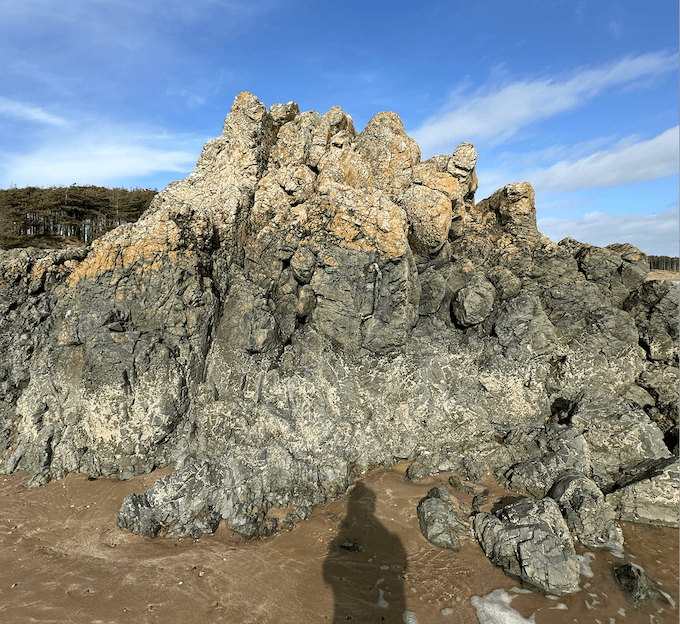
Pillow lavas at Ynys Llanddwyn, Wales, March 2026. Photo: The author.
Small World
One of the advantages of the U.K. compared to the U.S. is it’s small. In the five hours it takes to go from Micanopy, Florida (where I lived for five years) to Miami, I can drive clear across England to Wales, a separate country within the U.K. There, they speak Welsh (as well as English), have their own parliament, and developed a unique culture – think poets (Dylan Thomas) and singers (Shirley Bassey). The landscape is varied, ranging from marine to grasslands to montane. Snowdonia National Park in the northwest alone contains temperate rainforests, alpine peaks, and coastal dunes. Beyond that is the island of Anglesey, Newborough Forest and Ynys Llanddwyn, site of a UNESCO “global geopark.” That’s where my wife Harriet and I headed last week, eight days after the start of the U.S. war against Iran. We wanted to clock the national pulse while at the same time diverting ourselves from war-scrolling. Keeping your hands at 10 o’clock and 2 o’clock for hours at a time is a good way to keep them off your phone. Most of all, we hoped the unique geological formations on Llanddwyn Island could help us understand the relationship between deep time (the timescale of geologic history) and war time.
Costs of War
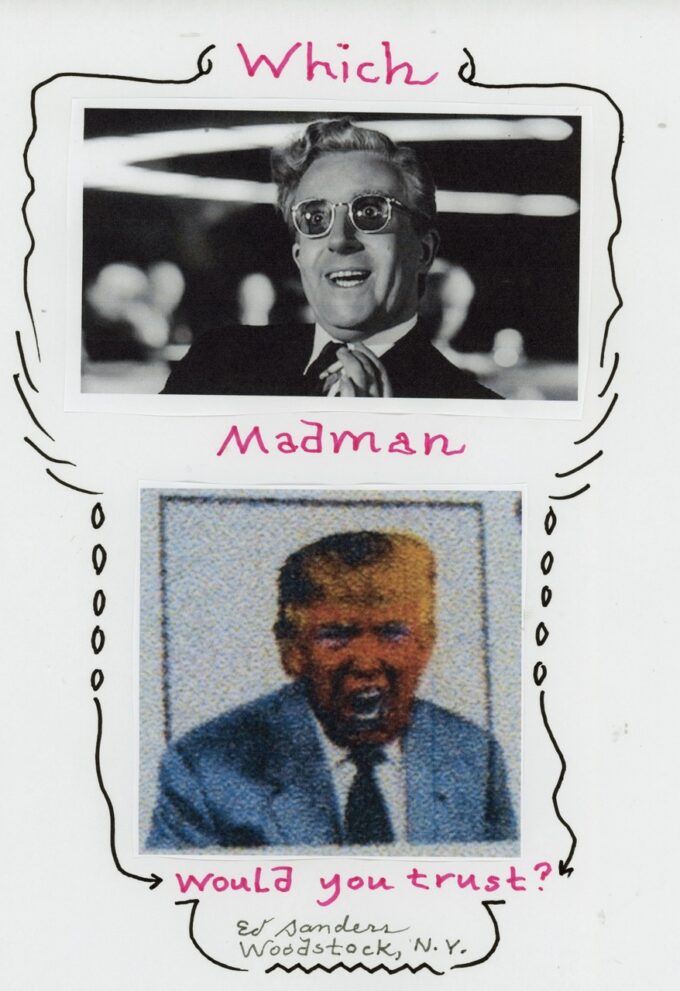
Donald Trump started his war on an impulse. There was no casus belli, no geopolitical imperative, and no domestic bloodlust to be gratified. (Before the U.S. attacked, I doubt there were Americans anywhere who went to bed worried about Iran.) There was no plausible macro-economic or sectoral gain; U.S. weapons manufacturers and oil giants are getting a boost of course, but those industries’ appetites are already well slaked. No world-systems theory that can help us understand the attack. No globalist conspirators set Trump’s plan in motion. Netanyahu didn’t make him do it. Pathological narcissism predicts violence, but usually at the service of primary process emotions: fear, searching, rage, lust, panic, and play. It’s true Trump raged at Iran and Muslims for at least a generation, but what drove him to start a war now?
You might as well ask why someone tugs his earlobe or scratches his chin as ponder why Trump went to war. On a certain day, in a certain place, after conversation with somebody – or all by himself – Trump decided to attack Iran. Perhaps it was a somatic reaction to an external prompt? Or an autonomic response – a fight or flight reaction – to an unknown stimulus ? We’ll never know; Trump himself doesn’t know. The peculiar genius of modern American democracy (Demokratia –rule of the people) is that the president has the power to start a war – Armageddon if it comes down to it – all by himself.
Given that, it’s not surprising the U.S. is losing. The first week of the conflict cost the U.S. about $11 billion. The president may soon ask Congress for a supplemental appropriation of $50 billion to cover the first month or so of the war. The total, national price tag – if it lasts more than another week or two, is expected to be over $200 billion. That includes lost economic activity and higher interest payments. A major recession – triggered by the oil shock – would be incalculably more expensive. The Great Recession of 2008-10 cost the U.S. alone some $20 trillion in total lost wealth and output. Trump is burning political capital even faster than cash. His approval ratings are underwater by an average of 14%. At this rate, the Republicans will lose the House in the Fall midterm elections (assuming they are conducted), and Trump will spend the last two years of his term fending off impeachment.
Iran has also suffered billions in losses. Its investment in naval and air forces —now largely destroyed — is irrecoverable. Its nuclear program (never close to bomb development) is also shattered, and Iran’s political and military hierarchy has been decimated. Trump has attacked Iran’s civilian infrastructure and threatened to “obliterate” it. (That’s Israel’s special sauce, perfected in Gaza.) But Iran was already in bad shape before the war, gutted by decades of U.S. economic sanctions. It has less to lose from a long war than the U.S. because it started with so little.
Thousands of Iranian soldiers and civilians have been killed by the bombardment. But for a regime willing to machine gun thousands of its smartest and most productive citizens during protests, a few thousand more deaths are insignificant. Iranian missiles and drones have done significant damage to U.S. facilities in the gulf, especially in GCC states. More than that, these attacks have essentially shut down shipments – especially of oil — through the Persian Gulf. Given that the Iranians can affect this blockade with inexpensive, easy to hide drones launched from dhows, the strategy may remain effective for some time. U.S. warships are unlikely to be successful at escorting oil tankers, but even if they are, it will be weeks before they can be put in place. Beaten but unbowed, the repressive Iranian regime remains in control – indeed, it’s in the driver’s seat. It may soon demand from the repressive U.S. government “unconditional surrender”, or regime change as a precondition for opening the Gulf to U.S., GCC, and allied oil transport. Many Brits I’ve met would welcome either outcome.
Trump’s demand that his erstwhile European allies send warships to open shipping lanes in the Strait of Hormuz was an admission of failure and perhaps regret. If international leaders are smart, they’ll continue to let the president stew, and then quietly negotiate an end to the war. They may recall a song that was a smash hit (including in the U.K.) when Trump was a boy of 12: Connie Francis’s recording of “Who’s Sorry Now” (1958).
Right to the end
Just like a friend
I tried to warn you somehow
You had your way
Now you must pay
I’m glad that you’re sorry now(‘Who’s sorry now?” Music by Ted Snyder, lyrics by Bert Kalmar and Harry Ruby, 1923)
The Way West
The start of war was as big a story in the U.K. as the U.S. The BBC, Guardian and London tabloids screamed war headlines, bumping Andrew Mountbatten Windsor and Lord Peter Mandelson – both Epstein chums — off the front pages and T.V chyrons. During the war’s first day or two, the focus of coverage was Prime Minister Keir Starmer’s initial, principled decision to abstain from the fighting. As a former international lawyer, he said, he knew an illegal war when he saw one. That decision was popular with the mass of the British public concerned about an ailing economy, mendicant NHS, and crippling housing costs. But rather than ride the crest of public approval, Starmer – true to form – settled in the trough of ridicule. In the face of Tory criticism for not standing shoulder to shoulder with the American cousins, the vacillant PM the next day offered up British bases for U.S. bombing runs, on the condition they were “defensive” in nature. Did he think the bombing of a school in Minab, Iran mere hours earlier (resulting in the death of more than 100 children) was an act of self-defense?
By day six of the conflict, it was rising fuel costs and higher inflation, not Starmer, that held British attention. In between BBC4 radio broadcasts of Women’s Hour, Gardeners’ Question Time, Just a Minute, and The Archers, news programs led with “Rising Fuel Prices,” followed by “New Attacks on Gulf Shipping.” How stupid could the Americans be, British commentators and the public asked, not to prepare for Iran choking off oil and other shipments through the Strait of Hormuz? It’s not called the Persian Gulf for nothing!
At the end of the second week of the war, petrol prices were up 15%; diesel 20 %, and home heating oil as much as 85%. Interest rates were also rising, most notably mortgages; that’s a very big deal here, and not only for new home buyers. In the U.K., long, fixed-rate mortgages don’t exist, so every few years, borrowers must negotiate new rates. And in lean times like these, even small increases can bankrupt a struggling family. The BBC offers almost daily interviews with experts on how to manage the financial uncertainty, but their advice mostly consists of the proverbial British “keep calm and carry on.”
The one constant in my conversations with people I meet – including during my recent trip – is dislike of Trump. It’s mostly not the visceral contempt felt by many Americans, but a combination of aversion and bemusement. Halfway to Wales, we stopped in Laxton,
Nottinghamshire to meet up with Mike, a Cambridge-educated, retired farmer and agribusiness consultant. He kindly agreed to guide us around the village and show us the open-field system of planting and harvesting that has been in use there for over 1,000 years. (There’s only one other community in the country that has maintained the protocol.) In the middle of describing how local, farm courts and jurors each year apportion the strips of land, and ensure they are properly watered, fertilized, rotated and fallowed, Mike interrupted himself and turned to me:
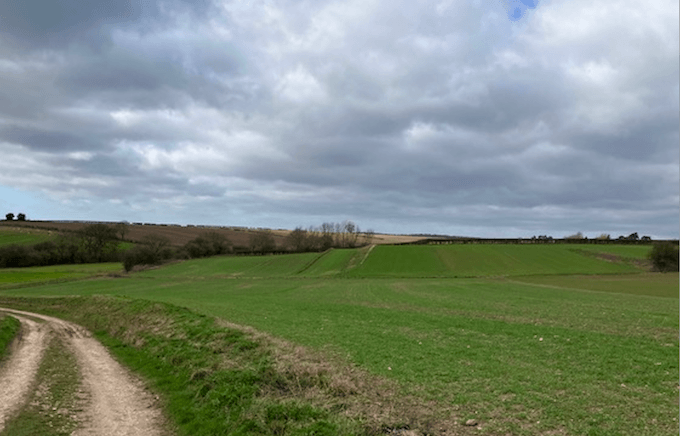
Open-fields and track, Laxton, Nottinghamshire, March 2026. Photo: Harriet Testing.
“Wot abaat Trump?” he asked.
“Awful,” I said, trying to match Mike’s economy.
“E’s certenleh med a mess o’ things. Is ’e got anneh idea wot ’e’s dooin’?”
“None whatsoever.”
“A mess, ay” Mike concluded.
Disparagement of Trump now cuts across party lines in the U.K. A week after ridiculing Starmer for initially denying military support for U.S. and Israeli bombing raids, Tory leader Kemi Badenoch backpedaled: “I said that we support their actions. I never said we should join.” Nigel Farage, leader of far-right and politically ascendant Reform U.K., said at a press conference in Westminster soon after the war began: “We should do all we can to support the operation.” A week later, as oil prices tracked skyward, he said: “…let’s not get ourselves involved in another foreign war.”
By the time we reached Wales, it seemed like there wasn’t a politician in Britain willing to speak out in favor of the war on Iran. Finally taking the public’s pulse, Keir Starmer expressed his disinclination to accept Trump’s kind invitation to send warships to the gulf to serve as oil tanker escorts (aka targets). Everyone just wants the U.S. to quit the war.
Deep Time Always Wins
Anglesey is connected to the mainland by a pair of bridges, most notably the Menai Straits Bridge, designed by Thomas Telford and opened in 1826. It’s the world’s first road suspension bridge, and established the type for many later ones, including the Brooklyn Bridge (1883). The decks are hung from 80 massive, wrought iron bars, held together by 935 wrought iron links. The limestone towers are triumphal arches intended to welcome long-distance travelers headed from London to the Welsh port of Holyhead. From there, they could take a ferry to Ireland.
But an even more formidable monument of much greater antiquity lies on the other side of the bridge, a few miles to the south. On Ynys Llanddwyn, a small, tidal island, part of the Newborough National Nature Reserve, are found a mélange of geologically rare “lava pillows,” formed in the Precambrian era, some 600 million years ago. As magma erupted from gaps in tectonic plates on the ocean floor, it was quickly cooled by seawater, forming pillows with glassy, outer shells. With the extrusion of more magma, the pillows filled up, collapsed and partially flattened under their own weight. The process was then repeated, creating more pillows, and so on, until there were great masses of them in multiple places. About 100 million years later, when tectonic plates shifted, these mélanges were brought to the surface where they now remain, jutting up through fine sand – the original Surrealistic Pillow. Made of calcite, jasper, quartz, and blueschist, they are quite beautiful in places, and sculptural too – like lumpy assemblages by the sculptor, Louise Bourgeois.
Lava pillows are expressive of “deep time,” an idea that arose with the birth of geology and evolutionary biology in the late 18th and 19th centuries. That’s when James Hutton, Charles Lyell and Charles Darwin proposed that the earth was almost unfathomably older than natural theologists had proposed, and that change generally occurs slowly and by accretion, rather than with catastrophic suddenness. Upon examining the rock formations at Siccar Point in the Scottish Borders region, Hutton wrote that geologic history has “no vestige of a beginning, [and] no prospect of an end.” About 50 years later, Lyell proposed that the same geological processes that shaped the past continue to operate in the present. The earth’s surface is thus a laboratory in which the distant past can be examined and the future glimpsed. The idea was fundamental for Darwin. His theory of evolution by means of natural selection could only be true if change occurred slowly over a vast expanse of time.
The lava pillows at Llanddwyn testify to geologic forces that occurred hundreds of millions of years ago. But the term “deep time” is today often used to address chronological frames much briefer than geologic eras, though also much longer than a human lifespan, namely the Anthropocene. That’s the name of the epoch in geologic history when earth systems (atmosphere, hydrosphere, biosphere and geosphere) no longer follow their natural course but are directed by humans. Global warming – resulting from the mining, drilling, processing and burning of fossil fuels (coal, oil and methane) — is the chief product of the Anthropocene, and source of a new consciousness of time. CO2 released decades and centuries ago is impacting the climate now and will continue to do so far into the future. Greenhouse gases emitted today will have minimal impact on people in the present, but a major impact on people a generation or more from now. Our time horizons, therefore, no longer only extend forward, but also backwards into anthropogenic deep time.
The current conflict is one of war-time vs deep-time. In such a contest, the latter always wins; it’s only the nature of the victory that’s uncertain. Our addiction to oil should have ended two generations ago. That’s when OAPEC countries imposed an embargo of oil to nations – especially the U.S. — that were sending shipments of arms to Israel in the 1973 Yom Kippur War. The price rises pushed most of the globe into recession and helped trigger the lurch into Neo-liberalism – a class war of the rich against the poor. Another oil shock followed six years later in the wake of the Iranian Revolution, and then another in 2022 after the Russian invasion of Ukraine.
If the war against Iran finally pushes nations to de-carbonize, it will have had a generally salutary effect, though not, of course, upon the innocent people murdered or maimed by Trump’s impulsivity. Nations will awaken to their vulnerability and rush full throttle toward an embrace of renewable energy and a green economy. Trump’s failure in that case will be complete – he intends the war to secure Iran’s oil for American and other multinationals, and guarantee for generations to come the dominance of what Andreas Malm called “fossil capital.”
If instead, the war enables the latter eventuality – U.S. seizure of Iran’s oil assets, militarization of shipping routes, and a generation of low-cost fossil fuels — it will have a very different impact. In that circumstance, the ongoing crisis of the Anthropocene will worsen, hastening American and civilizational decline. In either instance, however, deep time will have its way.