
‘Beyond the Pale’: General Says US Military Will Create a ‘Camp’ at Gitmo to ‘Deal With’ Cubans Fleeing Trump Blockade
One foreign policy expert noted that fears of a “mass exodus” of refugees come “as the US starves Cuba of energy and food.”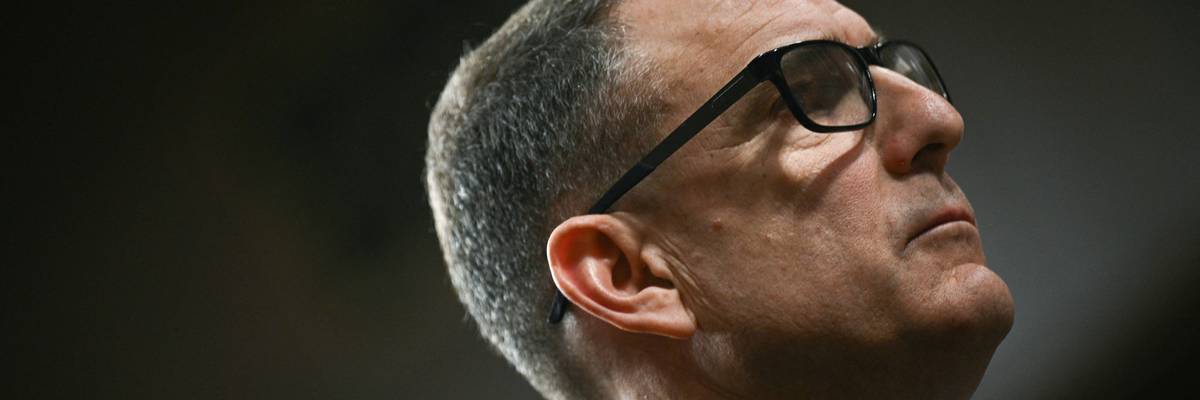
US Marine Corps Lt. Gen. Francis L. Donovan, then the nominee for commander of US Southern Command (SOUTHCOM), testifies during a Senate Committee on Armed Services hearing on his nomination on Capitol Hill in Washington, DC, on January 15, 2026.
(Photo by Brendan Smialowski/AFP via Getty Images)
Stephen Prager
Mar 20, 2026
COMMON DREAMS
As the Trump administration sows chaos with a crushing fuel blockade of Cuba, a general told Congress that the military will “set up a camp” at Guantánamo Bay to detain those who try to flee the humanitarian crisis inflicted by the United States.
The phrase “humanitarian crisis” was used by Sen. Tom Cotton (R-Ark.) to describe the situation in Cuba during a Senate Armed Services Committee hearing on Thursday, as he questioned US Marine Corps Gen. Francis Donovan, the commander of the US Southern Command (SOUTHCOM).
Donovan, a 37-year Marine veteran, took command of SOUTHCOM in February after being tapped by President Donald Trump. His predecessor, Adm. Alvin Holsey, abruptly resigned in December reportedly after he’d raised concerns about the Trump administration’s bombings of alleged drug trafficking boats in the Caribbean, which have been widely described as illegal under international law.
On Thursday, Cotton asked Donovan, “Are we prepared for any kind of humanitarian crisis in Cuba—the possible flow of refugees, other civil disorder that may threaten our interests, especially if the decrepit, corrupt Castro regime finally falls or flees?”
“Senator, yes we are,” Donovan responded. “SOUTHCOM... We have an [executive] order to be prepared to support [the Department of Homeland Security] (DHS) in a mass migration event. They would take the lead, we would follow.”
Donovan said this would include using the US military base at Guantánamo Bay, “where we would set up a camp to deal with those migrants or any overflow from any situation in Cuba itself.”
The base, which houses a prison infamous for the extrajudicial torture of detainees during the global War on Terror, was designated under Trump’s order to hold “high‑priority criminal aliens unlawfully present in the United States.”
But Donovan suggested it may now be used to hold Cubans fleeing chaos and deprivation following Trump’s own acts of economic warfare.
Cotton’s question followed a warning that same day from Republican Florida Gov. Ron DeSantis of a “possible mass exodus out of Cuba,” which experienced an island-wide electricity blackout earlier this week following the Trump administration’s blockade of fuel entering the island, which a group of UN rapporteurs said in January was “a serious violation of international law and a grave threat to a democratic and equitable international order.”
DeSantis, whose state is home to about 1.6 million Cuban-Americans, said, “[W]e don’t want to see a massive armada of people showing up on the shores of the Florida Keys.”
He said he believed the Trump administration “would rather see people in Florida go help… hopefully get a new government going” in Cuba, possibly referring to the long-held hope of some right-wing Cuban exiles to take over the island.
Following more than 60 years of an embargo that has strangled Cuba’s economic development, the Trump administration tightened the noose even more in January, signing an executive order that would slap harsh tariffs on any country that provides oil to Cuba.
As a result of the blockade, explained Juanita Goebertus, Americas director at Human Rights Watch, “people don’t have reliable access to drinking water, hospitals can’t operate safely, basic goods are becoming increasingly difficult to obtain, and garbage is piling up in the streets.”
Trump first described his blockade as part of an effort to carry out regime change against Cuba’s Communist Party leadership, but this week, he made the imperialist declaration that he may seek to outright “take” the island and that he could “do anything I want” with the “weakened nation.”
Erik Sperling, the executive director of Just Foreign Policy, emphasized that the possible “mass migration event” described by Donovan was only coming “as the US starves Cuba of energy and food.”
“Trump and [Secretary of State Marco] Rubio are to blame for any refugee crisis from Cuba, as the US intentionally harms civilians with an oil blockade,” said Just Foreign Policy in a social media post responding to Republican warnings of Cuban mass migration. “US sanctions and meddling in Latin America have always been a leading cause of migrant flows.”
Immigration journalist Arturo Dominguez explained that “What [Donovan] essentially said was, ‘We’re ready to accommodate the flow of refugees by putting them in camps.’” He added that “the way these military goons jump right in to ‘accommodate’ atrocity is beyond the pale.”
Trump’s blockade of Cuba is unpopular with the American public, according to a YouGov poll released earlier this week. Just 28% of adult US citizens said they approved of the US blocking oil shipments to the country, while 46% said they opposed it. The same survey found that just 13% want the US to use military force to attack Cuba, while 61% would oppose it.
Just Foreign Policy said, “The American people do not want their government to starve Cubans and cause a ‘mass migration event.’”
Stop the Sadistic Trump Administration Policies Choking Cuba
Instead of threatening the island further, the president must ask Congress to end the embargo that began in 1960 so that the economic reconstruction of the country can begin.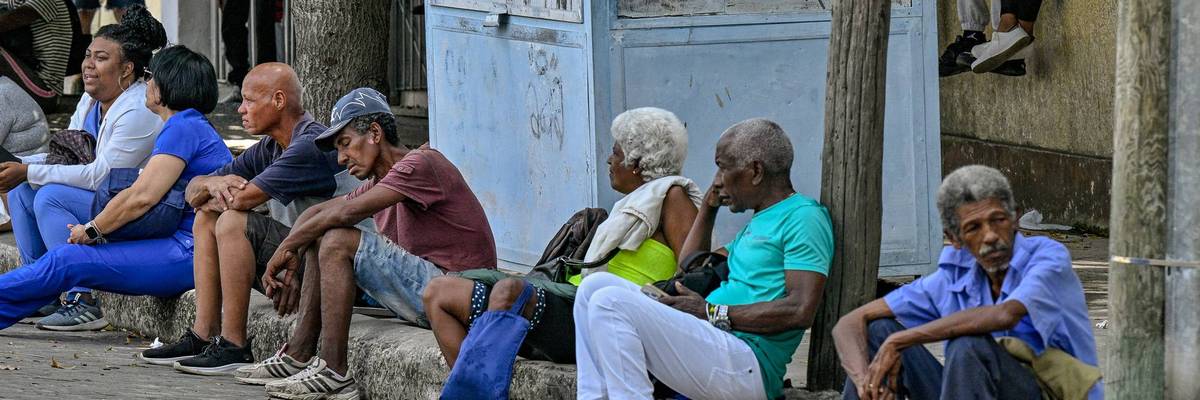
People wait at a bus stop in Havana during a blackout on March 16, 2026.
(Photo by Adalberto Roque/ AFP via Getty Images)
Steve Minkin
Mar 20, 2026
President Donald Trump told reporters at the White House, “I think I can do anything I want with it” referring to Cuba. His remarks are reminiscent of his recorded Access Hollywood statement to host Billy Bush, “When you’re a star they let you do it. You can do anything... Grab them by the *****.” No, Mr. President, you have no right to despoil Cuba as you please.
Cuba is being choked by this administration’s sadistic policies. The best we can do for the 10 million people living there is not to rape the island but rather end the embargo—and reset the opening of relations that had been the hallmark of progress during the Obama administration.
As Trump Tightens US Chokehold on Cuba’s Economy, Rubio Says Fix Requires ‘New People in Charge’
Jayapal Rips ‘Cruel and Failing’ US Policy After Trump Says ‘Cuba Is Gonna Fall’
I led educational tours to Cuba before Trump destroyed rapprochement, increased sanctions, and suffocated the blossoming of enterprises tied to tourism and small business entrepreneurship. Unfortunately, the Biden administration chose to follow Trump rather than returning to Barack Obama’s approach aimed at improving relations between the two countries and supporting the emerging free market economy.
There is growing popular sentiment in Canada, Mexico, Spain, and other countries that are providing humanitarian aid to Cuba for their governments to show their independence from Trump’s chaos by breaking the blockade and dispatching lifesaving fuel. It is time to end the embargo of Cuba.
Decades of US policies aimed at destabilizing Cuba hurt ordinary citizens and set back progress within Cuba.
Vermont’s Sen. Peter Welch has been a leading voice of reason with respect to Cuba. He is clearly concerned about the terrible price ordinary people are paying as a result of the blockade of fuel supplies. I urge readers to listen to Sen. Welsh’s recent speech.
Senator Welch has proposed a forthright plan to end the suffering of the Cuban people:
First, Trump should end restrictions on the rights of Americans to travel to Cuba. Welch says, “The American and Cuban people should freely interact with one another.”
Second, the president should maximize support to Cuba’s private sector, particularly small businesses.
Third, Cuba must be removed from the list of state sponsors of terrorism. As Sen. Welch pointed out, “No other country agrees that it applies.”
Fourth, the president must ask Congress to end the embargo that began in 1960 so that the economic reconstruction of the country can begin.
Sen. Welch does not mince words about the need for political reforms in Cuba, beginning with the release of political prisoners and the right to speak freely about the society and government. But he also makes it clear that decades of US policies aimed at destabilizing Cuba hurt ordinary citizens and set back progress within Cuba and in the development of healthy relations between the US and Cuba.
Our work is licensed under Creative Commons (CC BY-NC-ND 3.0). Feel free to republish and share widely.
Steve Minkin
Steve Minkin is the author of "Blood, Race, and the Missing History of AIDS" and of two poetry collections, "Moral Oblivion" and "Where People Are Trees."
Full Bio >
The U.S. is Still Making Life Miserable for Cubans
While halfway around the world Hezbollah and Iran are beating the living daylights out of Israel, here in our own hemisphere, superintended by a bilious potentate, a much different story is unfolding. Donald Trump’s garish kidnapping of the Venezuelan president, followed by his ferocious starvation blockade of Cuba and his announcement March 16 that “I can do anything I want with Cuba,” are white house depravities about which there seems little the world can do. Sadly, the other two mega-powers, China and Russia, leave the U.S. to rampage in its backyard, though currently its maniacal crimes have simmered down. The U.S. is now supposedly in talks with Cuba, but no one in their right mind thinks this means life has improved for the average person on the island.
Cuba suffers from widespread blackouts and an expanding energy crisis. According to RT March 14, Cuban president Miguel Diaz-Canel confirmed the talks with the Trump cuckoo birds, though on the evening of March 16, those psychopaths repeated their demand that Diaz-Canel step down. This high-handed command and the talks follow “weeks of power cuts, fuel shortages and growing public anger after the halt of Venezuelan oil shipments…and as Washington stepped up efforts to block other suppliers. Trump has repeatedly threatened a ‘total oil blockade’ of Cuba and warned that countries selling crude to the island could face tariffs.”
That bluster about tariffs no doubt accounts for Cuba’s oil drought and for el jefe’s prediction last week that Cuba “is gonna fall pretty soon.” What can you call this besides Washington’s fascist doctrine?—undermine or overthrow every leftist government in Latin America from Honduras to Venezuela to Cuba in the hopes that Bukele-style rightists seize power. I’ll tell you what else you can call it: the U.S. obsessive compulsive fixation on communists who have been minding their own business and done absolutely zip to bother Washington besides simply exist, something the white house finds intolerable.
But some people have other ideas. Some people are not commie-hating Neanderthals who fancy themselves disrupting Cuban five-year plans. Those people are not to be found in the Trump regime. They are to be found…in the Vatican. You read that right. According to Responsible Statecraft March 13, “the Holy See is hoping to revive its place as a key mediator between Washington and Havana.” Apparently, the Vatican is “re-emerging as a potential facilitator of a bilateral deal.” Of course, there’d be no need for a bilateral deal if a certain power, let’s call it the Fourth Reich, aka Berlin on the Potomac, had not unilaterally blockaded Cuba to begin with. But, to please the Vatican, Havana released some prisoners and a backchannel has opened for Cuba and the U.S. This “comes as President Trump has been floating a ‘friendly takeover’ – ‘or not’ – of Cuba.”
Other moves are afoot, too. The Fourth Reich Washington has mentioned many sweeteners and incentives to USA Today that will be on the table if the Cuban president obliges white house gangsters by resigning. Who knows if that will happen. The article cites “a recent decision to allow fuel sales to Cuba’s private sector…as well as the delivery of $9 million in humanitarian aid through the Catholic Church…Cuban authorities…[legalized] public private partnerships…and [floated] an increased role for the country’s private sector.”
Also, pow wows occurred between a state department official and Catholic leaders in Cuba. “Cuban authorities deny that talks are occurring” beyond informational exchanges, but Trump insists secretary of state Marco “Regime Change” Rubio “is talking to high-ranking Cuban leaders” among them members of the Castro family. Clearly on the Trump Show the idea is to nudge the Cuban economy away from communism and closer to the free market, because this will be great for ratings. You naturally ask, what ratings? The ones that come from things such as privatizing Cuba’s infrastructure, so airheads like Commerce Secretary Scott Bessent can help his associates make money off it. Privatizing infrastructure is always a lucrative, anti-social-welfare scam, battle-tested on numerous luckless free market economies. So keep your eyes peeled for that, I’d bet anything it’s next on the private sector agenda for Cuba.
Meanwhile, Responsible Statecraft reports that people like Mexico’s president Claudia Sheinbaum “offered to serve as mediators for U.S.-Cuba talks, while others, notably Colombia’s Gustavo Petro, have apparently tried to send oil to the island. But upcoming elections in both Colombia and neighboring Brazil, along with Trump’s penchant for retaliation, have subdued any greater regional efforts to deter further escalation.” RS notes that this fear led Jamaica and Guyana to ditch Cuban doctors, on whom their health care systems had long relied. This is a true loss for both countries, as Cuban medics are the heroes of the Global South. That in and of itself is naturally enough to make them persona non grata to the boss of bosses in the white house.
So threats, lies, blockades, attempted government overthrow – there’s evidently nothing Berlin on the Potomac won’t stoop to in its witch-hunt against communist influence in the Americas. “Cuba has been grappling with an energy crisis since January, when U.S. forces abducted Venezuelan President Nicolas Maduro and halted fuel exports from Caracas to Havana,” reports Al Jazeera March 10. “White House officials have suggested that Cuba is facing an economic collapse.” Maybe. Or this could be Trump’s wishful thinking. No doubt things are dire in Cuba, but Cuban communists have been around a long time, and Yankee assaults are nothing new for them.
What’s new is the arrival of a very ambitious, obsessively communist-fixated, self-promoter in the white house, namely Marco “Root Out Commies” Rubio, who loves to claim his family fled Cuba for Florida, eliding the fact that they did not flee Castro, they fled Batista. Rubio never explains that; he just lets his listeners draw the wrong conclusion, to wit, that communism victimized his family. It didn’t. He victimized communism, with his relentless drive to advance his nauseating career on the back of the so-called communist menace in the Caribbean. It’s no secret that Rubio has presidential ambitions, and he clearly regards immiserating 10 million Cubans as a convenient stepping stone into the Oval Office. This is disgusting. As is he. But it’s of a piece with Trump regime strategy: generate headlines by starting war. Except the gangsters in the white house aren’t exactly starting war on Cuba: They’re starving the people of fuel and everything else.
If you think this supposed strategy started with Rubio, I guess you may be onto something. Just like the Venezuelan caper. Not that Trump needed a lot of encouragement for any of these adventures, but they all bear the Marco “Overthrow Leftists” Rubio signature. He made his career preening as some kind of South Florida anti-commie fanatic, and now he’s making good on those claims.
Problem is, this plumage may not fly well outside of South Florida, given that your average American is now more concerned about the price at the pump hitting five dollars a gallon than what the collectivos are doing in Caracas. In fact, come next election, Rubio might actually get blamed for our lousy economy, caused by his state department starting a war nobody wanted with Iran. And if you don’t remember, well, I do: Rubio was the imbecile who said we had to attack Iran because Israel was going to do it first. So he confessed that his state department allowed the fanatics in Jerusalem to drag Washington into a wildly unpopular war on Tehran, a war Iran is now winning and that has already enabled it to kick the U.S. out of the Gulf.
So what’s Cuba to do? It’ll tell you: sit tight, negotiate and keep channels open to China and Russia, neither of which like seeing their Latin American allies get creamed. My guess is if Xi Jinping shipped some vital cargo to Havana, the thugs to the north wouldn’t do much about it. Why? Because what’s Trump gonna do – slap tariffs on China? I don’t think so. Not when Beijing can hit back by restricting more rare earths. Washington’s already got a problem in that department, namely its weapons producers can’t function without the rare earths that Beijing has a near monopoly on. So a couple of Chinese ships to Cuba are probably not worth the headache to Trump. As for cowardly Rubio – well he likes to scream about communists, but I notice he’s pretty quiet about China. Maybe he actually recognizes when he’s out of his league.
The Global Convoy to Cuba: Response to Washington’s Strangling of Cuba
Since 1962 the US imposed an economic blockade on Cuba designed “to bring about hunger, desperation and overthrow of government.” Until 1990 this brutality was greatly alleviated by the solidarity of the socialist countries which provided the Cuban people with essential trade and aid. That provided some protection, but as 638 Ways to Kill Castro illustrates, the US had other tools, including many acts of terrorism and biological warfare.
Despite decades of resistance to the blockade by solidarity organizations in the US, despite polls consistently showing most people being against the blockade, despite the United Nations General Assembly votes for the last 33 years to demand the lifting of the US blockade, Washington has not only been oblivious, but has ramped up the economic warfare. Washington again declared Cuba a state sponsor of terrorism, providing no basis for this allegation. This designation allows the US to use its control over the world financial system (e.g., SWIFT, IMF, World Bank, and the US dollar as the international currency) to sanction or block trade and transactions with Cuba. Countries, banks, and companies having business relations with Cuba face sanctions for supporting “terrorism.” This severely restricts Cuba’s ability to trade, receive foreign investment and credit.
The blockade cost Cuba $7.5 billion in 2025, $20.5 million per day. Since 1960, this de facto fine for exercising its right to national self-determination has cost Cuba $170 billion. On January 29, the US squeezed Cuba much more, imposing a blockade on all oil to Cuba, ready to economically punish any country that ships oil. Because of US world economic power, no country challenges this. Last year Mexico supplied 44% of Cuba’s imported crude oil, and Venezuela 34%. Cuba has received no oil since mid-December.
Obviously, these US actions violate international law, as did the attack on Venezuela, the kidnapping of President Maduro, and imposing control over its oil exports. And as did the slaughter in Gaza, the war on Iran and assassination of Ayatollah Khamenei. But, like the yearly UN vote calling for removal of the US blockade on Cuba, the US feels powerful enough to simply ignore this.
Without living there, we still cannot really grasp how all-encompassing this US war on Cuba is. Marta Jiménez, a hairdresser in Holguín, explained the present oil blockade on Cuba to CodePink’s Medea Benjamin:
You can’t imagine how it touches every part of our lives. It’s a vicious, all-encompassing spiral downward. With no gasoline, buses don’t run, so we can’t get to work. We have electricity only three to six hours a day. There’s no gas for cooking, so we’re burning wood and charcoal in our apartments. It’s like going back 100 years. The blockade is suffocating us — especially single mothers … and no one is stopping these demons, Trump and Marco Rubio.
Now, the US is even working on criminal indictments against Cuban leaders, not before the International Criminal Court for violating international law, but in US courts for breaking US laws, as it is doing to President Nicolas Maduro right now. The US Treasury is even looking into charging Cuban leaders with violation of the US blockade on their country!
Having visited Cuba about 15 times between 1979 and 2019, I have seen how US economic warfare on the island has devastated Cubans’ standard of living after the collapse of the Soviet bloc. It has seriously undermined many aspects of the inspiring example of their socialist model. Compared to 1979, the tightening US blockade has brought much more inequality, fewer social services, more poverty. The US delivers Cubans deteriorating general health by denying medicines and medical materials. Even hunger, long ago eliminated, the US has reintroduced. The oil blockade aims to disable the electrical system, all transport, and water pumping equipment, recreating the desperation the US and Israel inflicted on Gaza.
Cuban President Díaz-Canel added, “Right now in the country there are tens of thousands of people waiting for surgery that cannot be performed due to the lack of electricity.” Mothers now see their babies fighting for their lives in incubators that have been turned off because of the oil blockade. Diesel runs short, garbage trucks stop. Trash piles up. Mosquitoes spread. Disease follows. This, Washington says, will bring freedom and democracy to Cuba.
Raúl Antonio Capote, the Cuban state security agent who infiltrated the CIA, recently wrote that the Cuban economy now faces a deep crisis. But does that mean that the collapse of the Cuban government is imminent or that “regime change” is about to occur? Cuba’s Deputy Prime Minister Oscar Perez-Oliva Fraga says absolutely not: “This is an opportunity and a challenge that we have no doubt we will overcome. We are not going to collapse.”
Cuba does carry unresolved problems from the past that the US weaponizes against them. Cuba succeeded little in becoming self-sufficient in food, unlike Nicaragua and even Venezuela, which imported 80% of its food 15 years ago. A country that must import its basic food – and we now witness, energy – hands the US powerful tools for control and “regime change.” Henry Kissinger noted, “Control oil and you control nations. Control food and you control people.” Cuba still spends more than $2 billion a year to import 70-80% of its food, even sugar and coffee.
Today Cuba struggles with the US empire using the energy weapon against them, having relied heavily on imported oil. Cuba belatedly turned to solar power, whose production has jumped from 5.8% in early 2025 to over 20% of its total energy generation, most thanks to China’s aid. Renewable energy now accounts for 50% of daytime electricity generation.
Another problem President Diaz-Canel recently spoke out against: “we are still held back too much by centralism, the excessive centralization that stifles the creative initiative of individuals, groups, and municipalities.” Decentralization of planning is a priority, moving toward a more market-based set of production decisions and incentives.
Now Deputy Prime Minister Oscar Perez-Oliva Fraga says Cuba is open to allow those of Cuban origin living abroad to open and invest in private business on the island. This hardly means restoring capitalism. A socialist economic system does not demand the abolition of the market nor private property. It means the abolition of the hegemony of capital. The socialist economic system of the Soviet Union (and Cuba during the Soviet period), the state planning and control of all production and distribution, represented only one model. In the present Chinese or Vietnamese model, the “commanding heights of the economy” lie in the nationalized state sector, under control of the Communist Party. Widespread non-state sector business flourish in other spheres. Cuba itself, since 2021, has slowly moved in this direction, and now over 11,000 private and state-owned Micro, Small, and Medium-sized Enterprises (MSMEs) to revive a struggling economy. Today about 38% of the Cuban workforce are said to be in private MSMEs and cooperatives.
Yet the overwhelming problem for Cuba remains the genocidal US oil blockade, on top of the US State Sponsor of Terrorism listing that criminalizes all trade, on top of the 65 year US blockade. Today many organizations are stepping up to counter US strangulation. Organizations around the world are raising funds and materials for Cuba. In the US, prominent among them are Global Health Partners, Medicc, Peoples Forum, Code Pink, and Hatuey Project. Probably thousands, like Greta Thunberg, are coming with the Global Convoy to Cuba, arriving March 21, bringing desperately needed material aid. This will be a rebuke to Washington’s brutality and will hopefully inspire nations around the world to act.
David Adler, Progressive International organizer of the Global Convoy, explained:
When governments enforce collective punishment, ordinary people have a responsibility to act…break the siege, bring food and medicine, and show that solidarity can cross any border, land, or sea. The first aim is to deliver critical aid to the Cuban people that can redress the humanitarian consequences of the January 29 US executive order, which establishes a fuel blockade around the island.” For instance, “the executive order means that if a fire broke out, there’d be no fire truck to reach it. It’s a crisis with consequences that rise exponentially as its effects multiply across sectors.
The primary threat that Cuba represents [to Washington] is its example to the world, about the nature of solidarity and the nature of self-determination.” The US “actively seeks retribution on those who dare to rebel. And no country, no revolution, no political project has been more rebellious in the face of that imperial violence than Cuba…So the resistance against this, the solidarity with Cuba, is also about stopping the US government’s ability to isolate and punish anyone who dares to stand up against it.
The Cuban Revolution represents an example for our human future: it nationalized the country’s wealth and resources and placed them under the rule of the direct representatives of workers and peasants and has stood up to imperialism for over 65 years. It played a world historic role in dismantling Israel’s twin apartheid state, South Africa. Destruction of the Cuban Revolution would be painful setback for the world movement against imperialism, for the world anti-war movement, for the world human rights movement. It would embolden US imperial aggression even more, everywhere. For our own self-preservation, we must do what we can to aid Cuba.

No comments:
Post a Comment