Monday, March 30, 2026

No Kings in the Twin Cities

 March 30, 2026

Photograph by Nathaniel St.Clair

Thank you, Minnesota.

And let me thank Indivisible, MoveOn, 50501 and all of the organizations who have made this event possible.

And thank you to the millions of Americans, from our smallest towns to our largest cities, in every state in our country, who are gathering today at thousands of rallies.

It is absolutely appropriate that we hold a major “No Kings Rally” right here in the St. Paul/Minneapolis area.

When historians write about this dangerous moment in American history, when they write about courage and sacrifice, the people of Minnesota will deserve a special chapter for themselves.

In the face of the unprecedented occupation of this city by ICE, Trump’s domestic army, this community stood up and, with extraordinary solidarity, fought back. Minnesota showed the American people and the world what democracy is about, what grassroots activism is about, and what standing up for the American ideals of freedom and justice is about.

And I want to thank my colleagues, Amy Klobuchar and Tina Smith, for their leadership in the Senate on this issue.

And today, we remember and honor the two brave Americans, Renee Good and Alex Pretti – who lost their lives in the struggle — and we promise their family and friends that these two heroes will not have died in vain. Their sacrifice has inspired, and will continue to inspire, the American people in the never-ending fight for justice.

As all of you know, we are living in an unprecedented and dangerous moment in American history. In many ways the future of our country and the entire world is hanging in the balance – and the actions that we take now will determine what that future looks like.

The choices that we face are clear. In the wealthiest country in the history of the world, and at a time of massive breakthroughs in technology, we now have the opportunity to create a nation in which ALL people can enjoy a dignified standard of living, where we wipe out bigotry and hatred, and where all of us can live in peace and participate in a vibrant democracy. Where the foundation of our nation is built on love, compassion, human solidarity and an understanding, as former Minnesota Senator Paul Wellstone said, that we all do better when we all do better. That is one vision for the future — a vision that the vast majority of Americans share.

But there is another vision out there as well – a darker vision. It is a vision which says that we must give up on democracy, that we are too stupid and inept to govern ourselves, and that we must put more and more power into the hands of one man. It is a vision that says we should accept an economy in which a handful of Oligarchs have unbelievable wealth, while the vast majority struggle to put food on the table. It is a vision that says that the only thing that matters in life is the accumulation of money and power – and that it is okay if we lie, cheat and steal to achieve those goals. It is a vision which says that we must hate each other because of where we were born, the language we speak, the color of our skin, our religion or our sexual orientation. It is a vision that foments hatred and hatred. Division, division and division.

It is an Orwellian vision which says that we must live in a constant state of fear, that we must always have an enemy and that we must always be at war. It is a vision which says that we have unlimited amounts of money for bombs and guns and for killing, but never enough money to feed our children, provide affordable housing or enable our parents to retire with dignity.

Today, here in Minnesota, in Vermont and in every state in the country we say loudly and proudly that as Americans we will never forsake our heritage. We will never accept authoritarianism, we will never accept oligarchy, and we will never accept a president who is a pathological liar, a kleptocrat, and a narcissist who is undermining the Constitution of the United States and the rule of law every day.

We will never accept government policy that gives massive tax breaks to the billionaires, throws 15 million Americans off the healthcare they have, breaks unions, denies women the right to control their own bodies, and is pushing the planet closer and closer to a climate crisis.

In the last year, I must confess, I have been thinking a lot about American history: about the men and women in 1776 who, with unbelievable courage, announced to the world that they would no longer be ruled by the king of England, who had absolute power over their lives. These patriots demanded freedom, and they fought a bloody revolutionary war against the most powerful military in the world to achieve that freedom. And they won.

And after their military victory, they established the first democratic form of government in modern history. In 1789, they said loudly and boldly to the entire world: here in America we don’t want kings.

And let’s never forget the extraordinary words they left us: “We hold these truths to be self-evident, that all men are created equal, that they are endowed by their Creator with certain unalienable Rights, that among these are Life, Liberty and the pursuit of Happiness.”

And today, in 2026, our message is exactly the same: No more kings. We will not allow this country to descend into authoritarianism or oligarchy. In America, We the People will rule.

But let’s be clear: This moment is not just about one man’s greed, one man’s corruption or one man’s contempt for our Constitution. This is about a handful of the wealthiest people on Earth, who, in their insatiable greed, have taken over our economy, have taken over our political system, have taken over our media in order to enrich themselves at the expense of the working families of our country.

Never before in American history have so few had so much wealth and power.

Never before in American history has there been such extreme levels of income and wealth inequality, with the top 1% now owning more wealth than the bottom 93%.

Never before in American history have we seen the super-rich expand their wealth so rapidly. Last year alone, after receiving the largest tax break in history, 938 billionaires in America became $1.5 trillion richer. Trump, himself, became over a billion dollars richer.

Never before in American history have we seen a ruling class, within a corrupt campaign finance system, spend so much money to buy politicians. In the coming mid-term elections, the billionaires will spend many, many hundreds of millions of dollars to make sure that government continues to work for them, and not working families.

Meanwhile, while the richest people become much richer, 60% of our people are living paycheck to paycheck, struggling to put food on the table, struggling to pay their rent and mortgage, struggling to pay for child care and education, and struggling to put a few bucks aside for a decent retirement. Tens of thousands of Americans die unnecessarily every year because they can’t afford to go to a doctor.

And, unless we change how our economy works, our younger generation, for the first time in modern history, will have a lower standard of living than their parents.

So today, we not only say NO to Trump’s authoritarianism, we say NO to Mr. Musk, Mr. Bezos, Mr. Zuckerberg, Mr. Ellison and all the other multibillionaires. You cannot have it all. We WILL create an economy that works for ALL Americans, not just the 1%.

My friends. It’s not just the authoritarianism of the Trump administration that we must combat.

It’s not just the Oligarchs and their insatiable greed that we must combat.

Now, as the news of today reminds us, we have got to stop the out-of-control militarism of the Trump administration – here at home, in cities like Minneapolis-St. Paul – and abroad.

Let’s be honest. The American people were lied to about the war in Vietnam. We were lied to about the war in Iraq. And we are being lied to today about the war in Iran. This war must end immediately.

In the last election Donald Trump pointed out, correctly, the huge amounts of money that had been wasted in wars that should have been spent rebuilding America. He campaigned as a “peace candidate,” and he promised no more “forever wars.” Well, he lied.

One month ago Trump and his partner, Israeli Prime Minister Benjamin Netanyahu, started a war with Iran. This war is unconstitutional. Trump did not seek or receive authorization from Congress. This war is in violation of international law. One sovereign nation cannot simply go about attacking another sovereign nation for any reason it chooses.

Since this war began 13 American soldiers have been killed and hundreds have been wounded — including another 12 yesterday. In Iran, nearly 2,000 civilians have been killed and many more wounded, and 498 schools have been attacked by American and Israeli missiles.

In Lebanon, more than 1,000 people are dead and more than one million Lebanese people — 15% of their population — have been displaced from their homes. In Israel, 20 people have been killed and over 5,000 have been wounded.

In the West Bank, Israeli vigilantes are burning down homes and killing Palestinians.

At a time when gas prices are soaring, when many Americans cannot afford the basic necessities of life, it is estimated that this war has already cost us a trillion dollars.

At a time when the American people are politically divided, there is one issue that is bringing us together. Conservatives, moderates and progressives are speaking out in unison: NO MORE WAR.

And as a U.S. Senator, I want to say a few words to you about what I intend to do about that.

First, we’ve got to make sure that Congress does not send another $200 billion to fight this war. That supplemental appropriation for the war in Iran must be defeated.

Secondly, I will be forcing a vote on legislation to block the sale of nearly a billion dollars in weapons to the Israeli military for bombs and bulldozers.

A nation that has committed genocide in Gaza does not need more military support from American taxpayers.

We must block the bombs and block the bulldozers.

My fellow Americans: We are all proud to live in a country which, throughout our history, has inspired people around the world to struggle for freedom, democracy and justice. And we understand that when we stand together, and don’t let demagogues divide us up, we can continue to inspire the world to believe in a brighter future.

Yes, we can create a vibrant democracy by ending Citizens United and not allowing billionaires to buy elections.

Yes, we can create an economy that works for every man, woman and child in our country and not just a handful of billionaires.

Yes, we can make certain that the revolutionary technologies of artificial intelligence and robotics are used to improve life for all of us, not just the wealthy owners of that technology.

Yes, we join the rest of the industrialized world and guarantee health care to all people as a human right.

Yes, instead of spending a trillion dollars a year on the military, we can wipe out homelessness and build millions of units of low-income and affordable housing.

Yes, in the richest country on Earth, we can have the best public educational system in the world, with tuition-free schooling, from child care through higher education.

Yes, we can expand Social Security and radically improve our pension system so that every senior in this country can retire with dignity.

Yes, we can raise the minimum wage to a living wage and guarantee every worker the right to join a union.

Yes, we can guarantee that every woman in this country has the right to control her own body.

Yes, at a time when billionaires are paying an effective tax rate lower than a truck driver or nurse, we can make certain that the top 1% and large profitable corporations start paying their fair share in taxes.

My fellow Americans: The establishment, including the corporate media and many of my colleagues in Congress, want you to believe that you are powerless. They want you to believe that you cannot change the status quo. But that’s a lie.

Throughout the history of our country, when Americans have stood up and fought for justice, they have prevailed.

The founders did it when they stood up to King George.

The abolitionists did it when they ended slavery.

The working class did it when they stood up to their bosses and formed unions.

The suffragettes did it when they demanded that women have the right to vote.

The LGBT community did it when they demanded basic human rights.

Time and time again, in difficult moments in American history, our people stood up, fought back and won.

They did it then. We can do it now.

Today, March 28, 2026, millions of Americans are out on the streets demanding freedom, democracy and justice. But we must make certain: Today is not the end of our struggle. It is just the beginning.

Together, when we stand united, we will create the kind of nation that you and I know we can become.

Bernie Sanders is a US Senator, and the ranking member of the Senate budget committee. He represents the state of Vermont, and is the longest-serving independent in the history of Congress.


Millions march Against Trump’s war and immigration policies


Monday 30 March 2026, by Dan La Botz


Eight million people in the United States participated in 3,300 No Kings protests against President Donald Trump and his policies, marching in all 50 states on Saturday, 28 March . I marched with my family in Brooklyn, New York.

This was the third such protest, each one larger than the last, demonstrating the enormous popular rejection of Trump’s presidency. St. Paul, the capital of Minnesota and the twin city of Minneapolis, was the featured location of the latest national protest, because Minnesota had provided such a courageous example of popular resistance to Trump’s violent and lawless Immigration and Customs Enforcement (ICE). ICE agents in Minneapolis murdered two citizens, Renee Good and Alex Pretti, in January as the city rose up in peaceful protests to defend itself.

Speaking in St. Paul, Bernie Sanders told the crowd, “In the face of unprecedented occupation of this city by ICE, Trump’s domestic army, this community stood up, and with extraordinary solidarity, fought back, and won. Minnesota showed the American people and in fact the world, what democracy is about, what grassroots activism is about, and what standing up for the American ideals of freedom and justice is about.” Sanders railed against economic oligarchy. “We will not allow this country to descend into authoritarianism or oligarchy. Today, we not only say no to Trump’s authoritarianism, we say no to Mr. Musk, no to Mr. Bezos and Mr. Zuckerberg....You cannot have it all.”

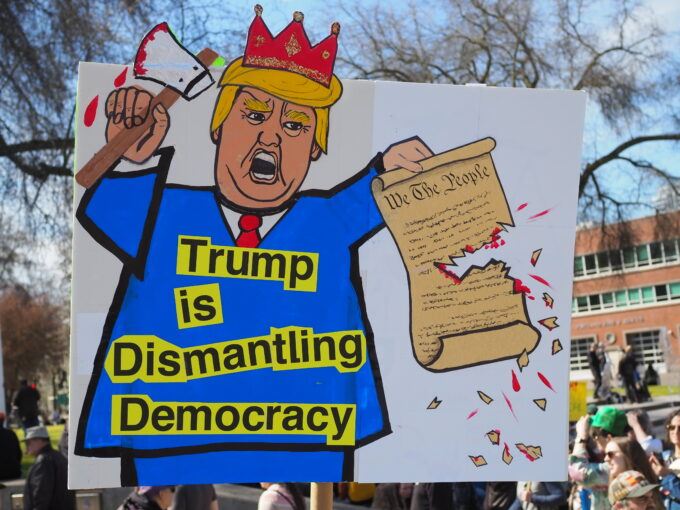
As always protestors everywhere carried their homemade signs. A popular sign was “No Kings, No War, No ICE.” Some signs said, “No Kings, No Fascists.” And also, “Regime Change Here Now.” It seemed to me that there were fewer American flags than in the two previous No Kings protests, perhaps because in such a popular movement people no longer feel a need to prove their patriotism.

This protest was larger, denser, deeper, broader. In many metropolitan cities, people marched to the center from their neighborhoods, a sign of growing local organization. Unions, however, did not have much of a presence and normal life was not disrupted. Perhaps the main function of the protest was largely to put a human face on the poll numbers that show Trump and Republicans support declining. But the protests are also important because they allow people to speak out and give us a sense of their own power.

With the national mid-term elections only seven months away, No Kings was also more overtly electoral, with Democratic Party candidates for office joining the protests to win followers. Most in these protests hope to see the Democrats retake control of both houses of Congress. Then, they believe, we can end the war on Iran and stop the violence against immigrants.

African Americans did not turn out in great numbers, though some Black leaders urged them to. John E. Warren, publisher of the San Diego Voice and Viewpoint Newspaper, wrote, “Blacks, who have not participated in great numbers, come out and be counted among those demonstrating. We are the victims of the ‘No Diversity, Equality and Inclusion’ (DEI) campaign the President has launched against our programs and culture… Only our voting participation can stop Donald Trump and his efforts to make America like Russia and Hungary with authoritarian leadership instead of a democracy. We must let our neighbors and opponents know that we still count. We still vote and we can still make a difference in any election. No more excuses, just participation, starting this weekend with the No Kings Day.”

Democrats may well take back Congress, but Trump will still be president. The war on Iran goes on, ICE continues its attack on immigrants, prices are rising, and so the protests will have to continue.


Does the Tail Wag the Dog? How Both Sides Are Missing the Bigger Picture


Binary thinking in the argument over whether the US or Israel is driving the illegal war on Iran obscures far more than it illuminates. The truth is the dog and the tail are wagging each other


by  | Mar 30, 2026 |

The joint US-Israeli war on Iran has thrust back into the spotlight a divisive debate about whether the dog wags the tail, or the tail wags the dog. Who is in charge of this war: Israel or the United States?

One side believes Israel lured Trump into a trap from which he cannot extricate himself. The tail is wagging the dog.

The other believes that the US, as the world’s sole military super-power, is the one that writes the geo-strategic script. If Israel acts, it is only because it serves Washington’s interests as well. The dog is wagging the tail.

Certainly, the idea that the tail, the client state of Israel, could be wagging the dog, the military juggernaut that is the US, seems, at best, counter-intuitive.

But then again, there is plenty of evidence that suggests advocates for the tail wagging the dog scenario may have a case.

They can point to the fact that Trump launched this war of choice on Iran despite winning the presidency on an “America First” platform in which he promised: “I’m not going to start a war. I’m going to stop wars.”

His secretary of state, Marco Rubio, openly stated that the administration was rushed into war, finding itself apparently unable to restrain Israel from attacking Iran.

Jonathan Kent, Trump’s top counter-terrorism official, noted in his resignation letter that the administration “started this war due to pressure from Israel and its powerful American lobby”.

Addressing the Israeli parliament last October, Trump appeared to confess to being under the thumb of the Israel lobby. As he praised himself for moving the US embassy from Tel Aviv to the illegally occupied city of Jerusalem, he repeatedly pointed to his most influential donor, the Israeli-American billionaire Miriam Adelson, before observing: “I actually asked her once, I said, ‘So, Miriam, I know you love Israel. What do you love more, the United States or Israel?’ She refused to answer. That means, that might mean, Israel, I must say.”

video from 2001 shows Benjamin Netanyahu, now Israel’s prime minister, caught secretly on camera, telling a group of settlers: “I know what America is. America is a thing you can move very easily, move it in the right direction. They won’t get in the way.”

Former US President Barack Obama, who ran up against Netanyahu repeatedly as Obama tried and failed to limit the expansion of Israel’s illegal settlements, thought the same. In his 2020 autobiography, he wrote that the Israel lobby insisted that “there should be ‘no daylight’ between the US and Israeli governments, even when Israel took actions that were contrary to US policy.”

Any politician who disobeyed “risked being tagged as ‘anti-Israel’ (and possibly anti-Semitic) and confronted with a well-funded opponent in the next election”.

Messy arrangement

But any rigid, binary way of framing the relationship between the US and Israel obscures more than it illuminates.

I addressed this issue in my 2008 book on Israeli foreign policy, titled Israel and the Clash of Civilisations: Iran, Iraq and the Plan to Remake the Middle East. My conclusion then, as now, was that the relationship between Washington and Tel Aviv was better understood in different terms: as the dog and the tail wagging each other.

What does that mean?

Israel is Washington’s most favoured client state. It must, therefore, operate within the “security” parameters for the Middle East laid down by the US.

In fact, part of Israel’s job – the reason it is such an important client state – is because it has, until now, been able to enforce those parameters on others in the region.

But the story is more complicated than that.

At the same time, Israel seeks to maximize its ability to influence those parameters in its own interests, chiefly by shaping military, political and cultural discourse in the United States, through the many levers available to it.

Zionist lobbies, both Jewish and Christian, mobilize large numbers of ordinary people to support whatever Israel claims to be in both its and US interests.

Mega-donors like Adelson use their wealth to cajole and intimidate US politicians.

Think-tanks with murky funding write legislation on Israel’s behalf that US politicians wave through.

Legal organizations, again with opaque funding, weaponize the law to silence and bankrupt.

And media owners, all too often in Israel’s camp, mold the public mood to stigmatize as “antisemitism” anything that opposes Israeli excesses.

This makes for a very messy arrangement.

Disappearing Palestinians

The trouble with the idea that the US simply dictates to Israel – rather than that the two are constantly bargaining over what constitutes their shared interests – becomes apparent the moment we consider the two-and-a-half-year genocide in Gaza.

Israel has long had a fervent desire to disappear the Palestinians, whether through ethnic cleansing or genocide.

It wants the whole of historic Palestine, and the Palestinians are an obstacle to the realization of that goal. Should the opportunity arise, Israel is also keen to secure a Greater Israel that requires grabbing and annexing substantial territory from neighbors, particularly Lebanon and Syria – as it is doing again right now.

After the Hamas attack on 7 October 2023, Israel seized on the chance to renew in earnest the ethnic cleansing of Palestinians it began in 1948, at the state’s founding.

It carpet-bombed Gaza, creating a “humanitarian crisis”, to force Egypt to open the floodgates into Sinai, where it hoped to drive the enclave’s population. Cairo refused. As a result, Israel tried to increase the pressure by slaughtering and starving the people of Gaza. In legal terms, that constituted genocide.

But the idea that the US was deeply invested in Israel carrying out a genocide in Gaza, or directed that genocide, or had any particular interest in the genocide taking place, is hard to sustain.

Washington – first under Biden, then under Trump – gave Israel cover to carry out the mass slaughter of the Palestinian population, and armed and financed the genocide. But that is very different from it having a geostrategic interest in the mass slaughter.

Rather, the US is and always has been largely indifferent as to the fate of the Palestinians, so long as they are contained. They can be locked up permanently in occupation prisons. Or ethnically cleansed to Sinai and Jordan. Or given a pretend statelet under a compliant dictator like Mahmoud Abbas. Or exterminated.

The US will bankroll whichever option Israel believes best serves its interests – so long as that “solution” can be sold by pro-Israel lobbies to western publics as a legitimate “response” to Palestinian “terrorism”.

What Israel could get away with changed on 7 October 2023. The US was prepared to approve Israel shifting from a policy of intermittently “mowing the lawn” in Gaza – short wrecking sprees – to the incremental leveling of the whole of Gaza.

In other words, Israel worked all its levers to persuade Washington that it was the right time for it to get away with genocide. It sold to the US the plan that Gaza could now be destroyed.

To present that as Washington’s plan is simply perverse. It was decisively Israel’s plan.

That doesn’t diminish in any way US responsibility for the genocide. It is fully complicit. It paid for the genocide. It armed the genocide. It must own it too.

Israeli attack dog

A similar analysis can be applied to the Iran war.

The US and Israel share the same larger policy towards Iran: they want it contained, weak, unable to exert influence. But they do so for slightly different reasons.

Israel demands to be regional hegemon in the Middle East, an invaluable client state with privileged access to Washington policymakers. Its supremacy and impunity, therefore, depend on Iran – its only plausible rival in the region – being as weak as possible and incapable of forging effective alliances with armed resistance groups such as Hizbullah in Lebanon.

Equally, Washington wants Israel unthreatened, leaving its ally free to project US imperial power into the Middle East.

But it has a more complex set of interests to consider. It needs to ensure that the Arab monarchies remain compliant, and it does so by both wielding a stick – threatening to unleash the attack dog of Israel on them should they disobey – and proffering a carrot – promising to shield them under its security umbrella against Iran so long as they stay loyal.

The ultimate goal is to guarantee unchallenged US control over the flow of oil and thereby the global economy.

In other words, the US has to weigh far more interests in how it deals with Iran than Israel does.

Unlike Israel, Washington has to consider the effects of an attack on Iran on the global economy, to assess any impact on the dollar as the world’s reserve currency, and protect against rival powers like China and Russia exploiting strategic missteps.

For those reasons, Washington has traditionally preferred maintaining a degree of stability in the region. Instability is very bad for business, as is being demonstrated only too clearly right now.

Israel, by contrast, regards its struggle against Iran in existential terms. Many in the Israeli cabinet view it as a religious war. They are not interested in simply containing Iran – a decades-old policy they believe has failed. They want Iran and its allies on their knees, or at least in so much chaos that they cannot pose any kind of challenge to Israeli regional hegemony.

That point was highlighted by Jake Sullivan, Joe Biden’s former national security adviser, this week in an interview with Jon Stewart. He cited recent comments to him by Israel’s former military intelligence lead on Iran, Danny Cintrinowicz, that Netanyahu’s aim is to “just break Iran, cause chaos”. Why? “Because,” says Sullivan, “as far as they’re concerned, a broken Iran is less of a threat to Israel.”

In other words, Israel wants to engineer instability in Iran, which is sure to spread instability across the region.

Weaving mischief

Those two agendas, as should be clear by now, are not easily compatible. Which is why Netanyahu has spent decades working every lever at his disposal in Washington to create an appetite for war.

Had war been self-evidently in US interests, his efforts would have been superfluous.

Instead Israel has had to deploy its lobbies, marshal its donors and recruit sympathetic columnists to slowly shift the public mood to the point where a war was conceivable rather than patently dangerous.

And most importantly of all, Israel nurtured an intimate, ideological alliance with the neocons – hawkish, zealously pro-Israel US officials – who long ago gained a foothold in the inner sanctums of Washington.

Each recent administration has been a cat-fight over whether the neocons or more “moderate” voices would win out. Under George W Bush, the neocons dominated, leading to the invasion of Iraq in 2003, Israel’s short war on Lebanon in 2006, and a failed plan to expand the war to Syria and then Iran. I documented all of this in Israel and the Clash of Civilisations.

Under Obama, the neocons were forced to take more of a back seat, which is why his administration was able to sign a nuclear deal with Iran that held until Trump ripped it up in 2018, during his first term as president. Biden, as with so much else, dithered.

In Trump’s second term, the neocons seem to be firmly back in charge, again weaving their mischief. The result – an illegal war on Iran – is likely to be a strategic catastrophe for the US, and a potential, if short-lived, victory for Israel.

Secret power

So isn’t this the same as saying the tail wags the dog?

No, not least because that assumes the visible realm of US politics – the President, the Congress, the two main political parties – are the sole repositories of power in the system.

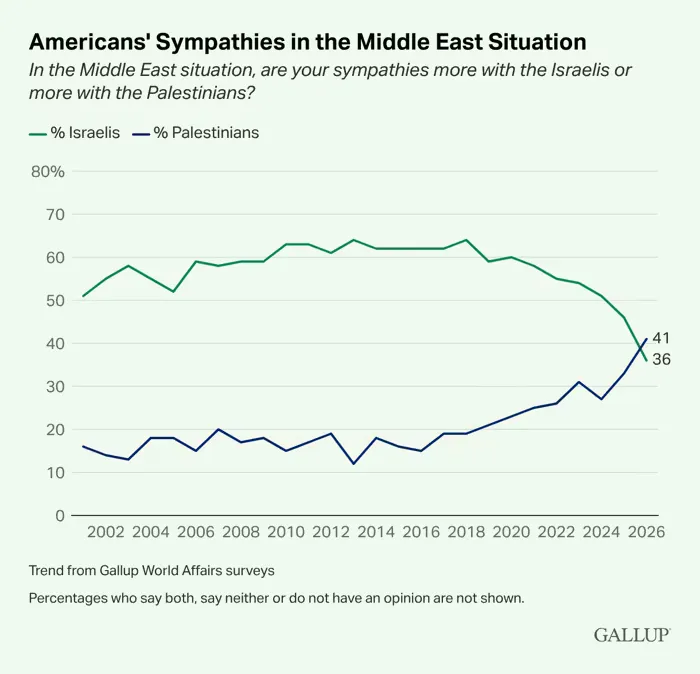
Even in this visible sphere, support for Israel has dramatically waned since the Gaza genocide. As the illegal war on Iran grows ever more costly, both in treasure and lives, support for Israel among US voters is going to fall off a cliff.

Israel is for the first time a deeply partisan issue, dividing Democrats and Republicans, as well as a generational divide between the young and old. It is even splitting the MAGA base Trump depends on.

This political polarization will continue to get much worse, ultimately freeing braver figures in US politics to start speaking out in franker terms about Israel’s nefarious role.

But power in the US isn’t just wielded at the formal, visible level. There is a permanent bureaucracy, with an institutional memory, that operates out of sight. We have gained brief glimpses of its covert operations from the work of Wikileaks, Julian Assange’s publishing platform for whistleblowers, and from Edward Snowden, the whistleblower who revealed illegal mass surveillance by the US state of its own citizens.

Both suffered serious consequences for their efforts to bring a little transparency to a profoundly corrupt system of secret power. Assange was locked away in a London high-security prison for many years as the US sought to extradite him on trumped-up “espionage” charges, while Snowden was forced into exile in Russia to evade arrest and long-term incarceration.

That bureaucracy – sometimes referred to as the Deep State, or the military-industrial complex – doesn’t play or fight fair. It doesn’t need to. It operates in the shadows.

Were it to so choose, it could undermine the Israel lobby, and thereby curtail Israel’s influence over the visible realm of US politics.

It could effectively do to the leaders of the lobby – AIPAC, the Anti-Defamation League, the Zionist Organization of America, the Conference of Presidents of Major American Jewish Organizations, Christians United for Israel, and others – what it did to Assange and Snowden.

It could, for example, influence public discourse to begin questioning whether these groups are really serving US interests or acting as foreign agents. That would, in turn, free up space for the media and legislators to call for tighter restrictions on these groups’ activities, requiring them to register as such.

The permanent bureaucracy is doubtless capable of doing much darker, underhand things too.

The fact that it hasn’t chosen to do any of this yet suggests Israel’s goals are not seen so far to be significantly in conflict with US goals.

But that could be about to change. In fact, the current, all-too-public debates about Israel driving the US into a war against Iran – an idea already seeping into popular consciousness – may be the first salvos in the battle to come.

If the war on Iran turns out to be a catastrophic misstep, as it gives every appearance of being, there will be a price to pay – and leading US politicians are likely to scramble to shift the blame on to Israel. It may be that they are already getting in their excuses.

The all-too-visible freedom Israel has enjoyed in Washington to buy, bully and silence could soon become a central liability. It will not be hard to argue that a system so clearly open to manipulation that the US could be bounced into a self-sabotaging war needs to be remade, to prevent any repeat of such a disaster.

This may be the biggest lesson Washington learns from the war on Iran. That it is time to stop the tail wagging so vigorously.

Originally appeared on Jonathan Cook’s Substack. 

Jonathan Cook is the author of three books on the Israeli-Palestinian conflict, and a winner of the Martha Gellhorn Special Prize for Journalism. His website and blog can be found at www.jonathan-cook.net.
Dramatic red skies in Australia due to cyclone and soil drought

Issued on: 30/03/2026
FRANCE24

Almost surreal images showing bright red and orange skies are coming out of Australia. This meteorological phenomenon is caused by the passage of a powerful cyclone sweeping along the west coast. It is a rare sight, but known to happen during major sandstorms or dust storms. This red Australian sky is also one of the effects of soil drought, something that could occur more often because of climate change.

Video by: Morgan AYRE

Grape seed found in medieval hospital toilet reveals 600-year pinot noir history

A 600-year-old grape seed discovered in the toilets of a medieval French hospital is genetically identical to the grapes still being used to make pinot noir wine, researchers have found.

Issued on: 26/03/2026 - RFI

The DNA of a grape seed found in the latrines of a 15th-century hospital shows it is a Pinot Noir, reproduced identically to this day according to a study published on 24 March. 
AFP - SEBASTIEN BOZON

The seed reveals that people in France have been cultivating the immensely popular variety of grape since at least the 1400s, scientists said in a new study published in the journal Nature Communications.

It was found in a toilet in a 15th-century hospital in Valenciennes in northern France. At the time, toilets were sometimes used as rubbish bins, the researchers explained.

Pinot noir, which is often associated with France's Burgundy region, is the fourth most widely grown grape in the world.

The study involved sequencing the genome of 54 grape seeds dating from the Bronze Age – from around 2300 BC – to the Middle Ages.

It is not possible to say whether the fruit was "eaten like table grapes or whether people made wine from it at the time", explained study co-author Laurent Bouby, of the Institute of Evolutionary Science of Montpellier.

However, it confirms that generations of winegrowers had been using what are today called "clonal propagation" techniques, such as preserving cuttings of particular grape varieties for 600 years.

Ancient texts had offered indications this was happening, "but outside of paleogenomics, it is very difficult to characterise this technique", said Bouby

But the new research found evidence this technique was being used in many areas as far back as the Iron Age, around 625-500 BC.

Aged like fine wine

The oldest grapes analysed in the study were from wild vines in the French region of Nimes dated to around 2,000 BC.

Domesticated vines then started to appear between 625 and 500BC in France's southern Var region.

This lines up with the time colonising Greeks were believed to have introduced viticulture – the cultivation of grapevines – to France, after founding the city of Marseille.

Another of the study's co-authors, Ludovic Orlando, said it was already known that wine was traded at the time by the Greeks and the Etruscans, because of wine jugs called amphorae which endured through the centuries.

The DNA of the grape seeds, particularly those from the ancient Roman period, revealed long-distance exchanges of domesticated grape varieties from places including Spain, the Balkans, the Caucasus and the Middle East.

It also showed there was plenty of genetic mixing of domesticated grape varieties and local wild vines during the Roman period, particularly in northern France.

(with AFP)
Mistral to borrow €750m for Paris data centre as Europe ramps up AI capacity

France's Mistral AI is stepping up investment in the computing power and infrastructure required for the company build on its success, in a drive to roll-out data centres on European soil.


Issued on: 30/03/2026 - RFI

Mistralis stepping up spending on the costly computing power and infrastructure required to build competitive AI systems. © LIONEL BONAVENTURE / AFP

Europe’s leading artificial intelligence company Mistral AI has secured over €750 million ($830 million) in loans to fund a major expansion of its computing power, underlining Europe’s growing ambition to compete with the US and China in the global AI race.

The Paris-based company will use the financing to purchase 13,800 advanced chips from Nvidia, forming the backbone of a new data centre near the French capital. The deal, to be announced on Monday, marks Mistral’s first foray into debt markets and signals rising investor confidence in Europe’s homegrown AI sector.

The funding was arranged by a consortium of seven banks, including BNP Paribas, Crédit Agricole CIB, HSBC and MUFG. Together, they are backing a project that could help Europe close the gap with dominant US cloud and AI providers such as Microsoft, Google and Amazon.

Building Europe’s AI backbone

At the heart of the investment is a large-scale data centre in Bruyères-le-Châtel, south of Paris, which is expected to come online in the second quarter of 2026. The facility will play a key role in supporting the training and deployment of advanced AI models across Europe.

Mistral selected the site in February 2025 as part of a broader strategy to anchor critical AI infrastructure within Europe. The move reflects a wider push among European policymakers and companies to ensure that the continent retains control over the technologies shaping its economic future.

Chief executive Arthur Mensch said increasing capacity locally was essential to maintaining both innovation and autonomy.

“Scaling our infrastructure in Europe is critical to empower our customers and to ensure AI innovation and autonomy remain at the heart of Europe,” he said in a statement.

Broader push for independence

The new data centre is only the beginning of Mistral’s expansion plans. The company recently unveiled a second facility in Sweden and aims to secure 200 megawatts of computing capacity across Europe by the end of 2027.

This growing network is designed to support governments and businesses seeking alternatives to US-based providers, particularly in sensitive sectors where data sovereignty and security are paramount.

Mistral has already positioned itself as a strategic partner in this space, supplying AI models to the French armed forces and offering both software and infrastructure solutions. Its dual approach – combining model development with physical computing capacity – sets it apart from many newer entrants in the field.

With fresh funding secured and expansion plans in motion, Mistral’s move points to a more serious European push to build its own AI capacity alongside dominant US and Chinese players.

(with newswires)
France held responsible for concealing 1944 African colonial soldier's death

A French administrative court has ruled that the state was at fault for failing to properly investigate the death of an African rifleman killed in the 1944 Thiaroye massacre in Senegal, when the French army opened fire on its colonial troops who were demanding their pay.


Issued on: 30/03/2026 - RFI


The graves of the riflemen (tirailleurs) are located in the village of Thiaroye in Senegal. © AFP - SEYLLOU

The Paris administrative court ruled last Friday that French authorities had not only provided the soldier's family with false information in the years following his death, but had subsequently failed to use all available means to establish the precise circumstances of his death or the location of his burial.

While the court acknowledged it could not rule on the death itself due to the statute of limitations, it found that the state's failure to investigate amounted to a fault giving rise to liability.

The tribunal awarded €10,000 in damages to the soldier's son, who brought the case to court last June, accusing the French state of concealing mass graves and blocking justice.

The massacre took place on 1 December 1944 at Thiaroye, near Dakar, when French forces fired on West African riflemen – known as tirailleurs senegalais – who had served in the French army and who mutinied over unpaid pages.

The precise death toll, the full circumstances of the killings and the location of the victims' graves remain unresolved.

'Ungrateful' France

The son, Biram Senghor, who was not named in the ruling, welcomed the verdict but said it was inadequate.

"I am truly glad that French justice has condemned the French state, because the French state has been unjust – an ungrateful state," he told RFI. "France had great need of the Africans who were mobilised. So when it refuses to pay them at the end of that work, it is because France is ungrateful."

Senghor argued that France owed the families of the tirailleurs far more than a symbolic sum.

"France must also pay damages and interest," he said. "It has been 82 years now that France has been prevaricating and refusing to pay. The amount it has been ordered to pay does not even cover four years of work, let alone my father's life, which France took from him."

The tribunal noted that in the decades that followed the massacre, France had wrongly characterised the soldier as a deserter, claimed his wages had been paid in full, and described the French troops' action as a proportionate response to the situation they faced.

Those claims were later acknowledged to be historically inaccurate: in 2019, France admitted the soldier had not deserted.

In 2024, President Emmanuel Macron formally recognised that the events at Thiaroye constituted a "massacre" and that the soldier had died "for France".

Eighty years on, the trauma of the massacre is still felt in Senegal and across the West African countries from which the soldiers were drawn – including present-day Mali, Côte d'Ivoire, Guinea and Burkina Faso.


France rolls out targeted fuel aid as truckers stage Paris protest

The French government has pledged targeted support for industries hit by surging fuel prices linked to tensions in the Middle East, while warning that broad, across-the-board financial relief is no longer sustainable. This comes as truck and bus drivers drivers staged a "go slow" protest in Paris.


Issued on: 30/03/2026 - RFI

Parked buses and trucks near police vehicles ahead of a demonstration by lorry and coach drivers to block the French capital's Boulevard Peripherique ring road, in eastern Paris, on 30 March 2026. AFP - STEPHANE DE SAKUTIN

Speaking on Monday, Transport Minister Philippe Tabarot stressed that while the French state would “do everything” to support struggling sectors, public finances limit how far it can go. “The cheque book can no longer be used for all our fellow citizens,” he said, adding that aid must now be carefully directed.

The remarks come as road hauliers ramp up pressure on the government, staging a so-called “snail operation” protest in Paris.

Police said between 150 and 200 coaches and lorries were expected to crawl along the capital’s ring road between 10:00am and 12:00pm, causing significant disruption but remaining under police supervision.

Targeted support under scrutiny

The government last week unveiled a €70 million support package for April aimed at cushioning the blow from rising fuel costs. Of this, €50 million is earmarked for the road transport sector, equating to a subsidy of 20 cents per litre.

Tabarot defended the measures, underlining the strategic importance of transport to the French economy. “We need them,” he said, noting that the movement of goods and passengers accounts for 90 percent of transport activity in the country.

However, many in the sector argue the aid falls short of what is needed to offset rapidly rising costs. Hauliers have been particularly vocal, warning that smaller operators risk going under if prices remain elevated.

The minister also pointed to shared responsibility across the supply chain, suggesting that clients and upstream shippers should contribute more to easing the pressure.

No price cap – but flexibility promised

Meanwhile, France’s Finance Minister Roland Lescure signalled that while direct price controls are off the table, other interventions remain possible. In an interview with La Tribune Dimanche newswpaper, he described the €70 million package as significant, but ruled out introducing a cap on fuel prices.

Instead, he indicated that regulating profit margins could still be considered if necessary.

A broader international response is also under discussion. The minister is set to chair a videoconference on Monday with counterparts from the G7, alongside energy ministers and central bankers, reflecting growing concern among major economies over the impact of the crisis.

French officials have repeatedly emphasised the uncertainty surrounding the situation. “We have no clear timeline for this crisis,” Tabarot said, adding that support measures would be adjusted depending on how events in the Middle East unfold.

For now, the government is walking a careful line – offering targeted relief while urging restraint, even as pressure mounts from sectors feeling the immediate strain of rising fuel costs.

(with newswires)
Who is Paris's newly sworn-in mayor, Emmanuel Grégoire?

Emmanuel Grégoire begins his first day in office as mayor of Paris on Monday, a week after beating rival Rachida Dati in the second round of local elections. The 48-year-old Socialist now steps into the limelight after years in the shadow of his political mentors. So who is he and what are his plans for the French capital?


Issued on: 30/03/2026 -  RFI

Newly elected Paris Mayor Emmanuel Gregoire looks on during a 'farewell thank you' ceremony of Paris outgoing Mayor Anne Hidalgo at the Paris City Hall in Paris on 25 March 2026. © AFP - JOEL SAGET

Grégoire was officially sworn in on Sunday, having won 50.5 percent of the vote – beating conservative contender and former culture minister Dati, on 41.5 percent, while Sophia Chikirou of the hard left got just over 8 percent.

Shortly after winning office, he took a bike ride through the streets of Paris towards City Hall, in a nod to his promise to make the French capital (even) greener.

Succeeding fellow Socialist Party member Anne Hidalgo, who held the post for 12 years, he now heads the 163-seat Paris city council – the country's largest – and will handle a budget of €10.5 billion.

Grégoire was little known to the general public before the election campaign. He has been described as a long-distance runner in Paris politics, having spent two decades as a loyal Socialist party insider behind the scenes.

Grégoire was born in Les Lilas, an eastern suburb of Paris, in 1977. He studied political science in Bordeaux and joined the Socialist Party in 2002, aged 24.

He worked in the medical and healthcare sector before going into politics full time.

In 2010 he became chief of staff of Paris’s then-mayor, Bertrand Delanoë, then worked in the prime minister’s office under Socialist president François Hollande.

He was first elected to the Paris City Council in 2014 and became Hidalgo’s first deputy mayor from 2018 to 2024, handling key portfolios including the budget, urban policy and public services.

He was elected an MP in 2024, and last year launched his bid for mayor.

Rivalry within the left

Despite being the Socialist Party's pick to succeed Hidalgo, a dispute between the two almost derailed his bid.

“Anne Hidalgo didn’t back me. She did everything she could to torpedo my candidacy. I am neither her candidate, nor her heir,” Grégoire told broadcaster Franceinfo last month, without elaborating.

He acknowledged their closely shared views about the future of Paris, but said his approach was “different" – describing himself as “available, accessible and always listening".

Having initially supported another Socialist figure as her successor, Hidalgo did ultimately endorse Grégoire.

At the city level, Grégoire led a broad left-ecologist political coalition of Socialists, Greens and Communists. But he refused any alliance with the hard-left party France Unbowed (LFI), led by firebrand Jean-Luc Mélenchon.

LFI had been a traditional ally of other left-wing parties, but the alliance collapsed as political rivals accused its politicians of tolerating anti-Semitic rhetoric. Some critics also blamed the hard left for fuelling tensions after a far-right militant was beaten to death in Lyon last month.

Ahead of the runoff, LFI candidate Chikirou offered to join forces with Grégoire against Dati, but he declined, saying they did not share the same “values".


Housing Parisians, not just tourists

Grégoire put housing at the centre of his election campaign, repeatedly declaring: “Airbnb is my enemy."

“I’m fine with Parisians renting out their primary residence when they go on vacation. But I don’t want entire neighborhoods in Paris to be emptied of their residents because apartments are used exclusively to house tourists,” he said.

With Paris long one of the world’s top tourist destinations, tens of thousands of apartments are used as tourist rentals instead of being available to Parisians, he noted, pledging to create 60,000 new social and affordable housing units as mayor.

“We have the same problems in Paris as in New York, San Francisco, cities with which I have worked a lot on these issues,” Grégoire told the news agency AP. “What happens if we don’t regulate? Speculation drives residents out.”

He also vowed to fight overcrowding at sites such as the Louvre Museum and the Montmartre neighbourhood, by urging tourists to experience lesser-visited locations

Continuing his predecessor's green policies, Grégoire has promised to further increase the number of cycle lanes and make the River Seine cleaner.

He also vowed Paris would resist the right and far right in the lead-up to next year's presidential election.

"Paris will be the heart of the resistance against this alliance of the right, which seeks to take away what we hold most precious and fragile – the simple joy of living together," he said last Sunday, shortly after the exit polls showed he was set to become the 48th mayor of the city.

(with AP)
New Paris mayor promises urgent action over alleged sexual abuse in schools

Paris's newly elected mayor, Emmanuel Grégoire, says tackling sexual abuse in the city's after-school programmes is his "absolute priority", promising changes in management and rapid decisions.


Issued on: 30/03/2026 - RFI

Families gathered in front of City Hall on 21 March, 2026, to denounce alleged sexual violence in Paris's after-school services. © Joséphine GRUWE-COURT / AFPTV

Officially sworn in by the Paris Council on Sunday, Grégoire said Monday that after-school services were the "absolute priority" of the start of his term.

"There will be decisions taken in the very first hours of this day, others in the days ahead, and others over a longer timeframe," he told franceinfo public radio, adding that management changes would be made "at every level".

Grégoire's comments follow cases of alleged child abuse in after-school services in France, particularly in the capital.

A report by France Inter radio in early March claimed that three lawsuits had been filed against a Parisian pre-school employee for alleged rapes against minors. Despite the complaints, the employee was transferred to another school rather than being suspended.

In 2025, 19 after-school staff members working for the City of Paris were suspended following reports of sexual misconduct.

The Paris prosecutor's office opened 15 investigations into sexual assaults in pre-schools involving children under the age of five.

'We must overturn the table'

Grégoire acknowledged there had been failures at multiple levels, including poor judgment by school or after-school directors, errors higher up the chain of command, and cases where the full gravity of events only became clear after the fact.

In his inaugural address to the 163-member Paris Council on Sunday, the mayor had already called for zero tolerance and a full review of all recruitment procedures.

"The first battle is after-school provision," he declared. "We must start from scratch. We must overturn the table. We must identify those who are guilty. We must protect our children."

He said any staff member suspected of abuse must face immediate suspension.

"At no point should a youth worker suspected of sexual violence not be immediately suspended," he said.

Parents demand independent audit

The new mayor faces mounting pressure. A collective of 751 parents from seven schools in the 7th and 15th arrondissements wrote to Grégoire on Sunday, demanding an independent audit, comprehensive child protection measures, clear communication with families, and full accountability of responsibility.

In response, Grégoire said he would appoint an external adviser to evaluate what had gone wrong and monitor compliance with procedures. He also promised to publish detailed statistics on cases across Paris schools "as soon as possible".

The mayor is due to meet campaigning groups MeTooEcole and SOS Périscolaire later on Monday.

Child abuse became a key topic during the Paris electoral campaign, and critics accused Grégoire of having done nothing to tackle the issue.

In his defence, he said that he had no longer been in charge at City Hall since 2024, when he became an MP.

Grégoire recently revealed he was a victim of sexual abuse himself while in primary school, aged around nine or 10.

"This is the story of a child who … was sexually abused for several months during after-school activities at a municipal swimming pool," he told France Inter last year. "At the time, I couldn’t find the strength, the means, or the words to express that pain and suffering."