Tuesday, March 31, 2026


Iran Claims $20K Shahed-136 Drone Destroyed $300M U.S. E-3 AWACS; China, India Race to Copy Design


Russia’s extensive use of the low-cost Shahed-136 kamikaze drones in Ukraine has emerged as one of the most consequential developments in modern warfare, altering the economics and tactics of new-age fighting.

In its most recent and, perhaps, the biggest victory, the Shahed-136 reportedly destroyed a US Air Force (USAF) E-3 Sentry Airborne Warning and Control System (AWACS) aircraft in a strike at Prince Sultan Air Base in Saudi Arabia on March 27, 2026.

Photos posted to social media showed that the rear fuselage of E-3 #81-0005 is completely burned out and destroyed, with debris scattered around the aircraft.

Subsequently, Iran published satellite images of the E-3 on the taxiway at Prince Sultan Air Base, both before and after the strike. According to open source reporting, at least six E-3 Sentry aircraft had been deployed to the Saudi base before the incident.

The E-3 Sentry is critical for spotting incoming barrages of Iranian ballistic missiles and drones, and aiding in anchoring the aerial war in coordination with other platforms. And while the aircraft’s damage cannot be fully assessed at this time, the attack is a major setback for the USAF, as the service had just 16 of these critical AWACS platforms remaining in its inventory.

Some observers speculate that the attack mirrored Ukraine’s “Operation Spiderweb” in its execution. Yaroslav Trofimov, the Chief Foreign-Affairs Correspondent of The Wall Street Journal, wrote on X: “Considering that the E-3 AWACS plane seems to be on the taxiway at Prince Sultan base, and how precisely it was hit in the radar dome area, I am wondering whether Iran managed to pull off its own Spiderweb operation with remotely piloted FPV drones (perhaps using the Saudi cellphone network.) This strike also required a high level of satellite ISR that Iran probably can’t get on its own. Russia?”

However, Iran later confirmed that the strike was conducted using the Shahed-136 drone.

“This $20,000 low-cost #Shahed 136 destroyed a $700 million E-3 #AWACS as it attempted to flee the runway,” Iran’s social media handles stated. Additionally, a photo of a Shahed-136 appeared online showing E-3 kill markings, although its veracity could not be independently established.

Destroyed E-3 Aircraft: Via: X

The Shahed-136 is a low-flying, slow-moving, GPS-guided unmanned aerial vehicle (UAV) intended for saturation attacks and overwhelming enemy defences. They rose to prominence when Russia started fielding the Shahed-136 drones in the fall of 2022 and have been extensively used to hit Ukraine’s energy and military targets.

In fact, as part of a US$1.75 billion agreement in 2023, Iran allowed Russia to manufacture these drones domestically. Known as Geran-2 in their Russian variant, they are manufactured at the Alabuga drone factory and at an unidentified location in Izhevsk.

The Shahed-136 quickly became one of the most significant weapons in the Russian arsenal for two reasons: it has a range of about 2,000 to 2,500 kilometres, and a low radar cross-section and heat signature, which makes it slightly harder to intercept. 

However, the main reason behind Russia’s large-scale adoption of the Shahed-136 as a primary weapon for attacking Ukraine is the cost inflicted upon the enemy. One piece of this drone costs about $20,000 to $50,000, whereas the interceptor missile to neutralize it costs $2 to $4 million per piece, creating a massive price differential and making the war very expensive for Kyiv.

Jolted by heavy swarms of Shaheds, Ukraine has now developed a host of interceptors to down these drones without draining its limited Patriot interceptor stockpile. This includes the Sting drone developed by Wild Hornets, the P-1 Sun developed by Skyfall, and the Bullet drones developed by General Cherry, as detailed in a EurAsian Times article.

Adding to these, Ukraine’s Defence Ministry has now codified and authorised the locally-made JEDI Shahed Hunter unmanned aerial system for operational use.

Image Via Ukrainian Ministry of Defence.

JEDI Shahed Hunter is a vertically launched multi-rotor interceptor drone. It has four powerful electric motors, a large battery, and a sturdy, lightweight frame.

The drone, which weighs slightly more than 4 kilograms, has a payload capacity of up to 500 grams, which is sufficient to destroy an attack drone, as noted by the Ukrainian Defence Ministry in its latest announcement. It can reach altitudes of up to 6 kilometres and accelerate to speeds surpassing 350 kilometres/hour. 

JEDI Shahed Hunter automatically receives radar data, enabling the interceptor drone to engage and eliminate the target swiftly.

The ground control station ensures flight coordination, reliable communications, and precise target engagement, as per the Ukrainian Defence Ministry. The interceptor drone can automatically locate, track, and focus on a target. Furthermore, it has thermal and daylight-imaging cameras, allowing it to operate day or night. 

While the per-unit cost of the JEDI Shahed Hunter was not disclosed, multiple reports have suggested that most Ukrainian interceptor drones cost between $1,000 and $2,000, significantly lower than the Shahed-136 drones and the expensive interceptor surface-to-air missiles typically needed to shoot them down.

In fact, these Ukrainian interceptor drones have done so well against the Shaheds that Gulf countries and the US seem to be eyeing them as they face a barrage of drones from Iran in the ongoing West Asian conflict. However, Ukrainian companies are not allowed to sell these cutting-edge systems, particularly as the country needs them for domestic use amid intensified Russian aerial attacks.

Shahed Variants Are Being Developed Globally

Russia was the first country to fully adopt and manufacture the Shahed domestically with help from its long-term partner and ally, Iran.

However, others have taken a fig leaf from the Ukraine War to develop their own iterations of drones that resemble the Shahed-136 in both design and capabilities.

An unexpected developer and user of a Shahed 136-clone is the United States, which has developed a drone called LUCAS (Low-cost Unmanned Combat Attack System). 

As previously reported by EurAsian Times, the LUCAS is based on a Shahed-136 captured a few years ago. There is no clarity on where it was captured, but we know Kyiv’s forces have recovered the drone, in some cases almost entirely intact. LUCAS was developed by the US Department of Defence (DoD) in July 2025 and has been deployed for Operation Epic Fury against Iran since early March 2026.


The LUCAS by SpektreWorks

It is a small, fixed-wing, delta-wing drone designed for terminal dives and long-range loitering. It is smaller and lighter than the Shahed and has a payload capacity of 8 to 18 kilograms, compared to the Shahed-136’s 40 to 50 kilograms. However, the open architecture and modular design of the LUCAS drone support a variety of payloads, such as explosive warheads, electronic warfare modules, and reconnaissance sensors, making it adaptable to a broad range of mission scenarios.

Similar to the drone from which it is derived, LUCAS offers a far more affordable offensive option, costing just between $30,000 and $35,000 per unit. It can also be easily scaled for use in a protracted war. Interestingly, the LUCAS is also more cost-effective than the Shahed-136 as it can be reused in various configurations, including for reconnaissance.

Another country that has developed a drone that is oddly similar to the Shahed-136 is the People’s Republic of China.

In 2023, videos emerged of a Chinese version of Iran’s famous Shahed-136 kamikaze drone, the Sunflower-200, being tested at firing ranges in China. The Sunflower-200 appeared to be a direct copy of the Shahed-136 in terms of design, with similar capabilities and intended roles. However, some experts have noted that the Chinese drone is lighter than the Shahed-136, allowing it to take off more quickly, even vertically.

Although the system remains shrouded in secrecy, which is inherent to all Chinese weapons, some estimates suggest that the drone has a range of about 1,500 to 2,000 kilometres, a payload capacity of 40 kilograms, and a speed of 160 to 220 kilometres/hour.

China has also developed the Loong M9 strike kamikaze drone, believed to be similar to the Shahed-136. Currently under testing, the Loong M9 has a take-off weight of 200 kilograms and a payload capacity of 50 kilograms. It can carry both explosive warheads and optical reconnaissance modules for ISR (Intelligence, Surveillance, and Reconnaissance) missions. 

According to reports, the drone has a range of over 1,600 kilometres and a loitering time of about 8 to 9 hours. The drone is allegedly more resistant to electronic warfare, as it can operate without GPS and has a secure data transmission channel—making it suitable for a conflict in the Western Pacific.

Notably, a recent South China Morning Post report refers to the Chinese ASN-301 drone as a “distant cousin” of the Iranian Shahed-136. It states that the Chinese one-way attack drone shares the aerodynamic delta-wing shape of the Iranian drone, and is based on a similar technological source.

Both drones have a low-aspect-ratio tailless delta wing with a cylindrical fuselage, a spherical optoelectronic nose payload, and a rear-mounted pusher propeller. However, the Chinese drone is smaller than its Iranian counterpart and is better suited to serve as an anti-radiation loitering munition rather than a simple kamikaze drone.

In addition to Russia, the US, and China, another country that has developed a Shahed-like loitering munition drone is India.

Two Indian defence firms have created drone systems that resemble Iran’s Shahed-123 kamikaze drone. According to recent reports“Project KAL” and “Sheshnaag-150” are being developed in India to enhance deep-penetration attack capabilities. Both drones are currently undergoing testing.

The long-range indigenous kamikaze drone developed under “Project KAL” has an endurance of about 3 to 5 hours, enabling it to gather intelligence, conduct reconnaissance, and adjust flight routes before precision strikes. It is designed to deliver high-explosive payloads that target vital enemy infrastructure, including strategic sites, logistics centres, and radar systems.

Meanwhile, “Sheshnaag-150” is a swarm-capable drone with a cargo capacity of up to 40 kilograms and an endurance of roughly five hours. It is intended for long-range missions beyond 1,000 kilometres and coordinated attacks.

Learning from the lessons of a war taking place in its own backyard for over four years, Poland has been finalising the development of its own version of the Shahed-136, as recently disclosed by Polish Defence Minister Władysław Kosiniak-Kamysz in an interview with Polish Radio. The new drone, which will be manufactured in both training and military versions, has a delta-wing shape.

It will have a wingspan of 2.2 meters, a length of 2.6 meters, and a maximum takeoff weight of 85 kilograms, according to preliminary specs. It will have a range of about 900 kilometres, a speed of 185 kilometres/hour, and a payload capacity of 20 kilograms.

However, this is an incomplete list of Shahed-like drones under development globally by countries looking to bolster their combat capabilities, with an eye on high-impact, low-cost systems that can be quickly scaled and modified.


20 U.S. Warplanes Shot Down — Indian Media Roasts Trump Over Iran Losses While Delhi Balances Tehran & Tel Aviv


On February 28, the Iran War opened with a precision strike that eliminated Iran’s Supreme Leader Ayatollah Ali Khamenei. On the same day, a Tomahawk missile struck a primary school in Tehran, leaving 160 girls dead.

The Iran War left India in an uncomfortable situation, as New Delhi had strong ties with the US, Israel, and Iran.

Prime Minister Narendera Modi visited Israel on February 25-26. The two countries are strategic partners, and according to SIPRI, Israel is India’s third largest source of arms imports, behind France and Russia.

Similarly, the US is India’s largest trade partner, an important source of cutting-edge weapons, and a big source of Foreign Direct Investment (FDI).

On the other hand, India shares deep cultural, historical, and linguistic relations with Iran.

The Strait of Hormuz is critical for India’s energy needs. Nearly 50% of India’s crude oil and up to 60% of its Liquefied Petroleum Gas (LPG) pass through the Strait of Hormuz.

Furthermore, with Pakistan blocking India’s access to Afghanistan, Iran also serves as India’s gateway to Kabul and further to Central Asia.

India has deep strategic interests in the Chabahar port, which New Delhi was building before the war broke out. The Chabahar port is not only India’s gateway to Afghanistan and Central Asia, but also a competitor to the China-funded Gwadar port in Pakistan’s Balochistan province.

India is also home to the world’s third-largest Shia population, behind Iran and Pakistan (some sources suggest Iraq’s Shia population is also larger than India’s).

Understandably, and in line with India’s multi-alignment foreign policy, India tried to walk a tightrope, striking a delicate balance by upholding neutrality while urging all the sides to exercise “restraint, dialogue, and de-escalation.”

Still, even while adhering to neutrality, New Delhi could have issued a diplomatic note mildly condemning the assassination of a head of state and regretting the deadly strike on a girl’s primary school in Tehran.

A statement like “both sides should take utmost precaution to avoid targeting political leadership, children, schools, and hospitals,” would not have read as overtly critical of the US or Israel.

Given India’s legacy of the non-aligned movement and its aspirations to lead the Global South, the world watched for New Delhi’s reaction. Instead, what it got was… radio silence. No fiery condemnation. No official mourning. No strong or even mild-worded statement defending Iranian sovereignty.

It was only after a few days had passed that India’s foreign secretary, Vikram Misri, visited the Iranian embassy to sign the condolence book. The exercise was largely seen as a face-saver since a foreign secretary is not competent enough to fulfil that protocol.

India’s stoic silence was even more conspicuous given that India is the chair for BRICS in 2026, and Iran, a fellow BRICS-member state, has been attacked. In fact, India is perhaps the only founding BRICS member that has not condemned the attack on the girls’ primary school in Tehran.

Clearly, India is taking utmost care not to be seen as critical of the US and Israel’s war in Iran, so much so that many commentators are reading this silence as tactical support for the US and Israel.

For instance, writing for The Diplomat, Sandeep Bhardwaj said, “Although India has officially declared neutrality in the current Middle East conflict, its actions indicate tacit support for the United States and Israel.”

Similarly, in The Wire’s article “Silence Is Not Strategy: How India Blinked on Iran,” Gurdeep Sappal argued that “India’s ‘silence’ on the US–Israel war on Iran is being sold as responsible statecraft, but it is actually deference, not prudence… It is a reflexive tilt, calibrated to please Washington and Tel Aviv.”

The Indian Express’s Diplomatic Editor, Shubhajit Roy, opined that “India is picking a side” through its combination of silence, the timing of its statements, and its diplomatic choices.

However, despite this apparent tilt of the Indian government towards Israel and the US in this war, the Indian broadcast media is “going hammer and tongs” in its support for Tehran and criticism of the US.

In the Indian broadcast media, while Iran is framed as a lone warrior, courageously standing up for its sovereignty and self-respect, the US is framed as an arrogant imperial power, aloof to ground realities, and refusing to see how its war in Iran is pushing the whole world into a recession, barely four years after the Corona crisis.

Indian broadcast media commentators are repeatedly warning that Iran could turn into the next Afghanistan or Vietnam for the US.

Even for the forced closure of the Strait of Hormuz, a lifeline for India’s energy supplies, by the IRGC, Indian media commentators blamed Washington.


The contrarion stand taken by the Indian media is surprising, for it is known for its compliant attitude towards the Modi government, often blatantly supporting every foreign policy move of the government.

So, what explains the divergent stand taken by the Indian media?

There are two theories that could explain this peculiar situation.

First, it is the Indian government itself that has implicitly communicated to the media to be vocal in their support for Iran to balance out its own silence on the West’s aggression.

According to this theory, the Indian government is preserving its growing ties with both Jerusalem and Washington.

On the other hand, it is allowing, or at least not restraining, a domestic media narrative that keeps Iran engaged and public opinion satisfied.

It is a tightrope walk: tactical support for Israel in practice, but enough pro-Iran noise in the media to prevent any perception of outright betrayal of old friends in Tehran.

Notably, while the Indian media is supporting Iran, there has been no harsh criticism of the Indian government’s silence on the issue.

However, the second, and more plausible, theory is that the feverish pitch of US criticism in the Indian media reflects a deep churn in the Indian psyche towards Washington.

The Indian public mood, which was overtly pro-US and pro-Trump till last year, has turned deeply hostile after repeated indignations by Trump over the last year.

He insisted that he forced New Delhi into a ceasefire with Islamabad in May 2025, despite New Delhi’s forceful denials. He made fun of alleged Indian aircraft combat losses, slapped 50% tariffs on Indian exports to the US (one of the highest on any country), pressurised India to stop buying discounted Russian oil, and elevated Pakistan’s stature in international politics through multiple steps that seemed to favor Islamabad over New Delhi.

Indian media repeatedly reminds Trump of American aircraft losses in the Iran war (20 so far, including F-35, Super Hornets, E-3 AWACS, and scores of Reaper Drones) to avenge Trump’s repeated snide remarks about seven, eight, or even 12 aircraft having been shot down in the India-Pakistan War.

The Trump administration’s arm-twisting of India to stop buying Russian oil, going so far as to slap 50% tariffs on Indian exports, was deeply resented by New Delhi, as Indians highly value their strategic autonomy.

Notably, India, which gained independence after nearly two centuries of anti-imperialist struggle, has a long tradition of anti-Americanism that subsided after years of confidence-building measures by both sides.

After the end of the Cold War, India gradually eased its strategic suspicion of the US, signed a civilian nuclear deal with Washington, entered into intelligence and logistics-sharing pacts with the US, strengthened defense ties, and even joined the QUAD.

When the Trump administration was burning bridges built with India over many decades, many foreign policy experts had warned that while Trump might roll back the punitive tariffs on India at some point, the episode might leave a deep impression on the Indian psyche that Washington is not a reliable partner, and the damage to the bilateral relationship will be irreversible.

Writing for the Washington Post, noted US media anchor Fareed Zakaria had warned, “President Donald Trump’s sudden, inexplicable hostility toward India reverses policies pursued under five administrations, including his own previous one. If this new attitude holds, it might be the biggest strategic mistake of his presidency so far.”

“India has been a U.S. foreign policy bright spot. Yet Trump’s transactional approach, which prioritizes short-term gains for the U.S. even at the expense of long-term returns, could be reinforcing Indian skepticism about American reliability,” prominent foreign-policy strategist Brahma Chellaney had warned.

Similarly, Richard M. Rossow, Senior Adviser & former Wadhwani Chair in US-India Policy Studies at CSIS, wrote, “In an effort to push India to cross unreasonable thresholds… the Trump administration is depleting the reservoir of trust that both nations have painstakingly built over a generation… The bizarre engagements with Pakistan… have stoked India’s age-old concerns about the reliability of the United States as a partner.”

The over-the-top criticism of the US in the Iran war, the repeated referring to Washington as an arrogant, haughty, imperial power, despite the Indian government’s total silence, demonstrates how deep the rot has been in the US-India relationship.

Curiously, the criticism of the Iran War in the Indian media is reserved only for Washington, as Israel is hardly blamed for this war.

The Indian media condemned Washington’s “warmongering” while conveniently glossing over Israel’s central role.

This selective targeting of the US clearly shows that the Trump administration has done irreparable harm to the Indo-US relationship.

The spontaneous anti-US discourse in the Indian media should serve as a warning sign for the Trump administration and should convince Washington to reverse course soon.

  • Sumit Ahlawat has over a decade of experience in news media. He has worked with Press Trust of India, Times Now, Zee News, Economic Times, and Microsoft News. He holds a Master’s Degree in International Media and Modern History from the University of Sheffield, UK. 
  • VIEWS PERSONAL OF THE AUTHOR. 
  • He can be reached at ahlawat.sumit85 (at) gmail.com


Working from home is linked to higher fertility, new study finds

Could remote work help reverse falling birth rates? New research suggests yes
Copyright Copyright 2020 The Associated Press. All rights reserved.


By Servet Yanatma
Published on 

The research, covering 38 countries including those in Europe, finds that realised and planned fertility increases by 0.32 children per woman when both partners work from home at least one day per week compared with those who work at employer or client sites.

Do people have more children if they work from home? The simple answer is yes. A recent study finds that working from home is linked to higher fertility. In other words, among working people, more time at home means more births

Across 38 countries, including those in Europe, estimated lifetime fertility is higher by 0.32 children per woman when both partners work from home at least one day per week, compared with couples where neither does. In the United States, the increase rises to 0.45 children per woman.

These findings come from research by Steven J. Davis and colleagues, published as a working paper by the National Bureau of Economic Research (NBER) under the title ‘Work from Home and Fertility’.

Lifetime fertility is defined as children ever born to, or fathered by, the respondent plus plans for future fertility. That means it includes both realised and planned. The sample consists of adults aged 20 to 45.

0.32 more children if both partners work from home

In the sample, the average number of children per woman is 2.26 when neither partner works from home (No WFH). This refers to people who worked for pay in the previous week, meaning they are not unemployed. They work at employer or client sites.

If the woman works from home at least one day per week, lifetime fertility rises to 2.48 children. If both partners do so, it increases further to 2.58.

If the man works from home at least one day per week, the increase is more limited at 2.36 children.

What explains the increase?

The increase in fertility is significant when parents work at least one day from home. So, how does this work? What mechanisms could explain the link between working from home (WFH) and higher fertility in households?

The research points to three basic possibilities.

1) By making it easier to combine childcare with paid employment, WFH jobs lead women and their partners to choose to have more children.

2) Families with children choose jobs that offer WFH options, but fertility is insensitive to WFH status.

3) The availability of WFH jobs raises fertility by expanding current and future opportunities to select into parent-friendly jobs.

“All three stories align with the idea that WFH jobs make it easier for parents to combine child rearing and employment,” the report suggests.

The researchers find ‘clear evidence’ that fertility rates rise with WFH opportunities. This pattern holds after the pandemic (2023-25) and before the pandemic (2017-19).

Country-level results rely on WFH rate

The implications for national fertility rates differ across countries mainly due to large differences in working-from-home rates.

Among workers aged 20–45, the share who work from home at least one day per week ranges from 21 percent in Japan to 60 percent in Vietnam. This means each country has many people who sometimes work from home and many who never do.

Working from home is relatively uncommon in many European countries, while the United Kingdom (UK) ranks third globally and leads Europe 54 percent.

At the national level, the magnitude of fertility depends on how common working from home is. The shift to hybrid and fully remote work after the pandemic has been very uneven across countries, as the chart above shows.

“Bringing WFH rates to the levels that currently prevail in the United States, United Kingdom, and Canada has the potential to materially boost fertility in many other countries,” the report suggests.

WFH might account for 8.1% of US fertility

The report estimates that, if “interpreted causally”, WFH accounts for 8.1 percent of US fertility. This is equal to about 291,000 births per year as of 2024. The research notes that, while this contribution may seem modest, it is larger than the effect of government spending on early childhood care and education in the United States.

Avoid creating unhappier workers and lower productivity

The research points out that the desire to work remotely differs greatly across people, and its practicality differs greatly across jobs and organisations.

“Thus, policy interventions that push for a one-size-fits-all approach to working arrangements are likely to yield unhappier workers and lower productivity,” it warns.

A United Kingdom Parliament report also found that remote and hybrid work can boost employment. Parents, carers and people with disabilities are likely to benefit the most from more flexible work options.


What is Anthropic's Mythos? The leaked AI model that poses 'unprecedented' cybersecurity risks'

Pages from the Anthropic website and the company's logos are displayed on a computer screen in New York on Thursday, Feb. 26, 2026.
Copyright (AP Photo/Patrick Sison)

By Pascale Davies
Published on 

A human error in Anthropic’s content management system accidentally exposed a draft blog that described the model.

Anthropic is working on a new powerful artificial intelligence (AI) model that “poses unprecedented cybersecurity risks,” according to a leak from the company.

Last week, a data leak revealed that Anthropic was working on a new, powerful model, which the AI company has since acknowledged is called “Claude Mythos”.

An Anthropic spokesperson told Fortune it marks a “step change” in AI and it is the “most capable” model it has built so far with “meaningful advances in reasoning, coding, and cybersecurity”.

The technology could be so strong that it could be a hacker's dream device. Cybersecurity stocks slumped following the Anthropic rumours.

Meanwhile, Anthropic is privately warning top government officials that Mythos makes large-scale cyberattacks much more likely in 2026, Axios reported.

Here is everything we know about Mythos.

How was the leak revealed?

A configuration error, or human error, in Anthropic’s content management system accidentally exposed a draft blog that described the model.

The blog, cited by Fortune, which was “available in an unsecured and publicly-searchable data store,” said that the new model “poses unprecedented cybersecurity risks”.

What can Mythos do?

Mythos is said to be a part of Capybara, which is a new tier of AI models t

Fortune cited Antropic as saying in the document, “‘Capybara’ is a new name for a new tier of model: larger and more intelligent than our Opus models—which were, until now, our most powerful.”

The model's advanced capabilities appear to suggest the AI systems can tackle more intricate problems with more autonomy and precision.

Capybara and Mythos appear to refer to the same underlying model.

How will it affect cybersecurity?

As AI companies release improved models, AI agents- which are learning to act and reason without human input- get better too.

Hackers can thereby run multiple hacking campaigns at once, which becomes more difficult to protect against

At the same time, employees are using AI agents which can unknowingly connect to their own work systems, which gives cybercriminals a door to enter.

Additionally, human identities are now easier to breach thanks to AI, a Palo Alto Networks executive told Euronews Next in March.

When will we see Mythos?

Mythos is extremely compute-intensive and expensive to run. Anthropic said it is working on making it much more efficient before any general release.

Euronews Next has reached out to Anthropic for comment.


Regulatory roadblocks for commercial use of drones in Europe

Agricultural drone
Copyright Canva

By Bill Wirtz for EU Tech Loop, with Euronews
Published on 

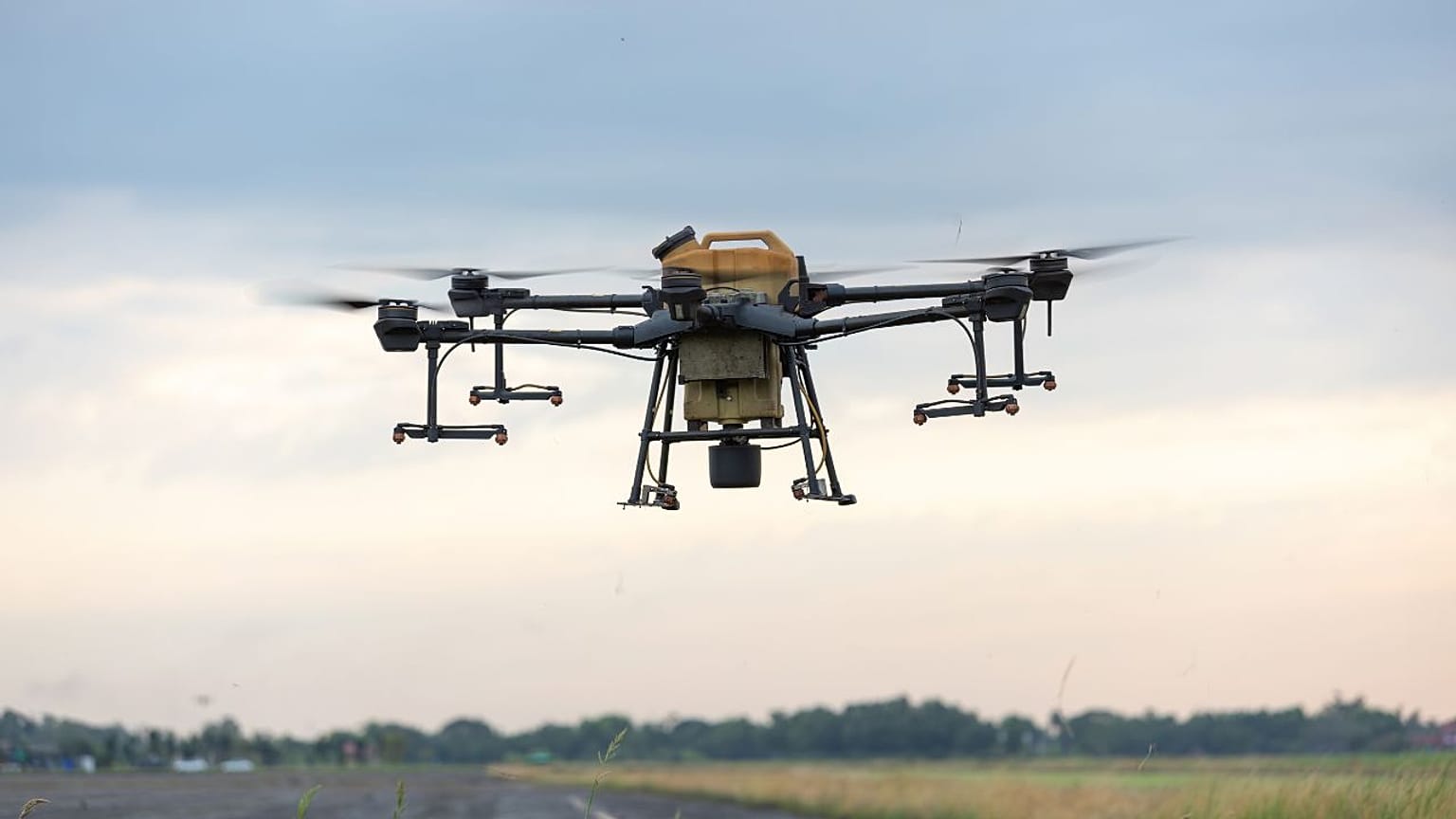
While drones are driving innovation across industries, European agriculture still lags in unlocking their full potential - not for lack of promise, but because regulation keeps that innovation grounded.

If you attended an agricultural trade show 20 years ago, you would see the standard lineup : the newest set of tractors, combine harvesters, and ploughs

Today, these expos look increasingly similar to tech events, with high-tech soft- and hardware developers showing off AI-driven ways to keep inventory or monitor the health of livestock. And drones, many, many drones.

Japan and China are the leading manufacturers of agricultural drone equipment, but even European companies hold a significant market share. The latter might come as a bit of a surprise, given that Europe still applies a "No, but maybe" approach to drones, instead of a "Yes, and".

The use of drones in the EU is governed by the European Union Aviation Safety Agency (EASA), and most use cases fall either in the "Open" or the "Specific" rule category. "Open" use cases would be for instance the use of a drone to film a countryside movie shot. However, because the use of drones in agriculture may involve the spraying of pesticides, it becomes not merely a heavily regulated "Specific" use case, but it is also governed by the Directive 2009/128/EC1, establishing a framework for Community action to achieve the sustainable use of pesticides, under which it is banned.

In practice, this means that permission to spray crop protection chemicals with drones is tedious and member state-specific. It requires the operators to have specific permits and permissions, but even when they do, most of the pesticides needed for use aren't permitted for aerial use in Europe.

The US system allows the use of drones with proper and state certifications, while Europe bans it by default, and only allows it if "no viable alternatives exist". In essence, this means that only those farmers who face challenges such as very steep vineyards could get a waiver.

This oversight and lack of innovation is not just the observation of some outsiders. In the controversial Sustainable Use Directive of the last European Commission mandate, Berlaymont had included a regulatory overhaul of drone usage in agriculture.

However, because this piece of legislation was rejected by the European Parliament and then retracted by the European Commission following stark political and farmer opposition, it failed to come into existence. In a letter led by Portugal and supported by 14 other member states in late 2024, it reads:

"Given the technological advances in recent years in the field of precision farming tools, it is important to recognise the role to be played by drones, thus enabling a combined action between monitoring, data management and analysis and decision-making, thus contributing to the sustainability of the sector in environmental, economic and social terms and the sustainable use of pesticides."

Drone use has immense benefits for spraying. Not only does it improve the efficiency of the use of these chemicals, it also reduces the exposure for the professionals in the field. As a way to improve technological use in agriculture, and by mere virtue of comparing ourselves to our trading partners, it is essential.