Wednesday, April 01, 2026


Energy Anxiety: Living Through a Fragmented World


Anusreeta Dutta 


For India, the shift toward cleaner, more sustainable energy systems is both essential and unavoidable.


Representational Image. Image Courtesy: Wikimedia Commons

There is a strange kind of quiet after the power goes out. There is not only a lack of light, but also a sudden loss of confidence. The fan slows down, the refrigerator hums less, and the Wi-Fi goes out. This makes one feel a little more worried. In India today, this feeling of discomfort is called energy anxiety. It is not a common political term yet, and it is not as important as inflation or unemployment.

But the fear of energy is real, widespread, and quietly changing how people see the government, the economy, and their own future. Energy anxiety is the worry—sometimes right away, but usually ahead of time—that cheap, reliable energy won't be available anymore.

People in different parts of India experience it differently. In big cities, it shows up as people being unhappy with rising electricity rates and unreliable supply during heat waves. In rural homes, it's more about life and death: they don't know if the power will last all night or if the solar panels will work when it rains. This fear is so strong because energy is no longer a background utility. It has become a necessary part of modern life in ways that make people more vulnerable. Power must be available all the time for work, school, health care, and communication. A small interruption is no longer just an annoyance; it is a disruption to life itself.

There are both structural and environmental reasons for this worry. India's need for energy is rising quickly because of urbanisation, digitisation, and temperature extremes caused by climate change. Summers are getting hotter, which is making peak demand go up even more. The change in energy, on the other hand, has made things more uncertain.

Many people think that renewable energy, especially solar energy, is the answer to India's energy problems. It is, in a lot of ways. But the change isn't even. During the monsoon season, solar power goes down, which is when some places have the most trouble with energy. The infrastructure for storage isn't good enough, and integrating it into the grid is still a problem for technology and government.

For populations currently experiencing energy poverty, these disparities extend beyond mere policy considerations. These are real things that happen. A decentralised solar setup could shine in April but struggle in July. Even a reliable grid can buckle when pushed. The final act is a tangled web of optimism and uncertainty, a place where the thrill of innovation battles with skepticism about its longevity.

This uncertainty is also caused by policy. For example, India has been working for the past 10 years to make it easier for people to get energy and move toward renewable sources. But it's not always the same when it comes to implementation. Local governments are overworked, subsidies are late, and it's hard for federal and state officials to talk to each other. This situation creates what could be called a "trust deficit" in energy systems.

People are becoming more doubtful that promises like reliable, 24-hour power, fair prices, and long-lasting improvements will be kept. As trust erodes, anxiety inevitably fills the void.

There is also a geopolitical part that can't be ignored. India's energy sector still depends on global markets, especially for fossil fuels. Price shocks, supply problems, and wars in other countries all affect the domestic market. The LPG problem, rising fuel prices, and worries about the supply chain -- all make people feel more vulnerable when it comes to energy security. In this case, the worry about energy goes beyond home issues to become a national mood.

But it's important to remember that anxiety isn't always a bad thing. It can also be good for politics. In the past, times when people were worried have led to new policies and changes in institutions. The question is whether India's growing energy worry will be noticed and dealt with before it turns into distrust. To deal with it, you need to do more than just increase generation capacity. It requires a complete overhaul of how energy policy is made and put into action.

First, reliability should be just as important as growth. Access is not as important as consistency. This is especially important for systems that are spread out, since maintenance, local capacity, and seasonal changes must all be taken into account during design and implementation.

Second, it's important to talk to each other. People need clear, easy-to-understand information about energy systems, including how these work, what they can't do, and what to expect when things go wrong. Uncertainty tends to increase in the absence of information. Policies should be flexible, accommodating local circumstances.

A standardised approach to renewable energy implementation could potentially intensify existing inequalities. Regions prone to monsoon-induced challenges, for instance, necessitate tailored approaches that integrate storage technologies, hybrid systems, and community involvement.

Energy justice, in the final analysis, must transcend mere verbal commitments and manifest as concrete measures. This necessitates the equitable allocation of the economic, environmental, and social benefits stemming from the energy transition, concurrently safeguarding vulnerable communities from experiencing disproportionate risks. India presently finds itself at a pivotal juncture in its energy transformation.

The shift toward cleaner, more sustainable systems is both essential and unavoidable.

Transitions, however, seldom occur without friction. These inherently generate uncertainty, which, in turn, fosters anxiety. The objective is to navigate energy-related anxiety, rather than eliminate it entirely—a feat that may be unattainable or even counterproductive.

The aim is to transform this anxiety from a cause of apprehension into a catalyst for improved policy, more robust institutions, and more equitable systems. This is because, at its core, energy transcends mere power; it fundamentally involves trust. In a nation as vast and intricate as India, this trust could prove to be its most invaluable asset.

The writer is a columnist and climate researcher with experience in political analysis, ESG research, and energy policy. The views are personal.


Illusion of Multipolarity: Power Still Has One Address


US dominance may be contested in speeches, but in practice, it still sets the boundaries of what the rest can safely do.


On January 3, 2026, the US special forces swept into Caracas under cover of night, grabbed then Venezuela’s President Nicolas Maduro and his wife Cilia Flores, and whisked them off to New York to face narco-terrorism charges. Barely eight weeks later, on February 28, the US and Israel unleashed Operation Epic Fury, wave after wave of strikes that left Iran’s Supreme Leader Ali Khamenei dead and much of Tehran’s nuclear and missile infrastructure in ruins.

Two months, two seismic moves. And the world watched. What was perhaps even more striking than the operations themselves was the absence of any meaningful deterrent response, revealing not merely the audacity of American power but the permissive environment in which it continues to operate.

For two decades we have been told this kind of swagger was finished. Journalist Fareed Zakaria’s “rise of the rest” became the mantra: China was rising, Russia was back, BRICS was the future, and de-dollarisation was just around the corner. The unipolar moment, we kept hearing, was history. The planet had gone multipolar. Academic discourse, policy think tanks, and diplomatic rhetoric alike converged around this assumption, presenting multipolarity not as a distant possibility but as an already unfolding reality.

The evidence on the ground tells a different story. When Trump’s second administration slammed tariffs on imports, pushing the average effective rate from around 2.5% to peaks that touched 28% on key goods in 2025, the global outcry was loud but toothless.

When Maduro was snatched in broad daylight, Beijing and Moscow issued angry statements and demanded his release. They did nothing more. When the bombs rained on Tehran, the same script played out: furious condemnations at the United Nations, followed by silence.

Why the restraint? Not because China and Russia suddenly lost their nerve, but because the math of self-interest simply did not add up. Beijing is not about to torch its $600 billion plus trade relationship with the US or risk its oil tankers in waters the US Navy can shut down at a moment’s notice, not for Tehran.

Moscow, already stretched thin elsewhere, saw no upside in opening a second front over Caracas. They talk multipolarity at every BRICS photo-op. When the chips are down, they act like countries that know exactly where real power still sits. Even within BRICS itself, internal asymmetries and competing national interests prevent the emergence of a coherent strategic bloc capable of challenging American primacy in any sustained manner.

And then there are the institutions that were supposed to keep any single power in check. In a truly multipolar world, the UN and its sister bodies were meant to be the referee, the place where collective will could balance American muscle. Instead, they have become spectators in the cheap seats.

The UN Security Council, where Washington holds a permanent veto, could not muster a meaningful resolution on either Venezuela or Iran. The General Assembly passed ritual condemnations that everyone knew would change nothing.

The IMF and World Bank? Same story. These organisations were not designed to be neutral; they were built on the realities of 1945 power. Seventy years later, those realities have not shifted as much as we like to pretend. Institutional inertia, combined with entrenched voting structures and financial dependencies, ensures that any challenge to the existing order remains procedurally constrained and politically diluted.

Look at the hard numbers and the picture sharpens. The US dollar still handles 58% of global reserves and 89% of foreign exchange transactions. The US defence budget, the latest SIPRI figures put it at roughly 37% of total world military spending, dwarfs everyone else’s. When Washington sanctions someone or rewrites the trade rulebook, the rest feel the pain because they are still plugged into an American dominated system. No rival currency or alliance has come close to breaking that grip.

Efforts to promote alternative financial architectures, whether through currency swaps, regional payment systems, or digital currencies, remain fragmented and far from achieving systemic disruption.

Sure, the economic map has changed. China is a giant. India has real swing weight. Global GDP is more spread-out than it was in 1990. But turning economic heft into the ability to project force, enforce rules, and hold alliances together is another matter entirely. That part of the game still runs through Washington.

Power in the international system is not merely about accumulation of wealth but about the capacity to convert that wealth into strategic leverage, and on that count, the US continues to enjoy a decisive edge.

For India, this illusion has been a useful diplomatic tool. We have balanced the Quad with the US for tech and sea lanes, BRICS with the Russians for cheap oil, and kept our own strategic autonomy intact. It felt smart when the world looked messy and multipolar. The shocks of January and February have made the limits painfully clear. When the biggest player moves, the rest, institutions included, mostly scramble to react. This moment, therefore, compels a reassessment of strategic autonomy not as an end in itself but as a flexible instrument that must adapt to enduring hierarchies of power.

The language of multipolarity will not fade. It sounds nice in seminars, flatters our sense of fairness, and gives everyone hope that the old order is crumbling. But the past three months have been a cold reminder: the centre of gravity has not moved nearly as far as the headlines suggested. US dominance may be contested in speeches. In practice, it still sets the boundaries of what the rest can safely do. Until alternative centres of power develop not only economic scale but also institutional influence and credible military reach, the gap between rhetoric and reality is likely to persist.

The world is changing, no question. The real question is whether it is changing, as fast or as deeply, as we keep telling ourselves. For now, the answer appears uncomfortable yet unmistakable: beneath the language of transition lies a system that remains, in its core logic, remarkably unchanged.

Zahoor Ahmed Mir is an Assistant Professor at Akal University, Bhatinda, Punjab. He holds PhD from Jamia Millia Islamia. (mirzahoor81.m@gmail.com.) Hilal Ramzan is an Assistant Professor and Head of the Social Science Department at Akal University. (hilal.mphcupb@gmail.com.) The views expressed are personal.


Miscalculation of the Century: Trump’s Iran Adventure


Vijay Prashad 


As Iran presses its conditions for ending the war, the US and Israel are left with few good options. They can continue bombing, but they will also continue to see Iranian escalation that inflicts harm on Israel and on US interests in the region.

ONLY ONE IDIOT IS WEARING HIS CAP

Transfer of Remains of Six US Soldiers, March 7, 2026. Photo: The White House

Last year, in June, the United States and Israel bombarded Iran’s nuclear energy and nuclear research facilities over twelve days. After a few days, the two belligerent powers – who had no United Nations authorization for this war of aggression – opened the door for a ceasefire. At that time, believing that this might very well be the basis for a full negotiation, the Iranian government, led by Supreme Leader Ali Hosseini Khamenei agreed to the terms set out: an immediate end to the strikes and no escalation. The missile launchers went quiet, but the deal was very fragile. There was no long-term peace agreement, no binding enforcement or monitoring mechanisms, no settlement on the nuclear issues, and no agreement to end US and Israeli sabotage and attacks on Iran. This was not an end to the war imposed by the United States and Israel on Iran, but only an agreement to stop one battle. Khamenei described the US and Israel aggression as futile and said that they “gained nothing”, while at the same time saying that Iran had forced a ceasefire and would “never surrender”.

Oman has a decades-long reputation as a neutral intermediary between Iran and the United States (with Israel lurking in the background). Between 2012 and 2013, it was Oman that hosted the US-Iran talks that resulted in the 2015 Joint Comprehensive Plan of Action (JCPOA) between Iran and the P5+1 (USA, UK, France, China, Russia + Germany) and the European Union – reducing sanctions in exchange for some promises on nuclear enrichment. A secure and discreet channel existed between Muscat for Tehran and Washington, and this communication line became active after June toward a proper negotiation to clarify red lines and to reduce the risk of miscalculation. In fact, the conversation broadened, and Iran came to the point of accepting that its uranium enrichment would be capped, that its highly enriched stockpiles would be diluted, and that the International Atomic Energy Agency could re-expand monitoring and inspections. This was not a final deal, but it was a negotiation framework with conditional nuclear restraint and an ongoing practice of de-escalation. Both Supreme Leader Khamenei and President Masoud Pezeshkian had the political will for a deal, which was very much on the horizon. Iran’s Foreign Minister Abbas Araqchi said, less than a day before the US and Israeli attack, that a deal was “within reach, but only if diplomacy is given priority.”

In fact, the United States and Israel took the other path: a war of aggression that violated the UN Charter (Article 2). On the very first day, February 28, the United States and Israel assassinated Supreme Leader Khamenei and killed 180 girls at the Shajareh Tayyebeh Elementary School in Minab. The United States and Israel believed that this barrage of strikes against political leaders, key infrastructure, and civilians would immediately lead to a popular uprising that would remove the Islamic Republic. The US and Israeli intelligence overestimated the protests that began in December 2025 around the depreciation of the rial and rising inflation. But there is an enormous difference between a cycle of protests against economic issues and the appetite to rise up and overthrow an entire system. When the missiles killed the Supreme Leader – who has a reputation even amongst his critics for piety (he was elevated by the Society of Seminary Teachers at Qom as a Marja-e Taqlid or Source of Emulation in 1994) – and when they killed the school children, the public mood was electrified by patriotism. It was impossible in this situation to take the side of the imperialist war against innocent children. The nature of the US and Israeli attack, and the fact that Iran was able to strike Israeli targets as well as US targets in the Gulf Arab states, focused the population of Iran around its own survival and its ability to defend itself. 

Since the US wars on Afghanistan in 2001 and Iraq in 2003, US war planners have not set aside the concept of the escalation ladder and have used the concept of rapid dominance (through decapitation strikes, paralysis of command, and total dominance of the adversary’s military). This worked with Afghanistan and Iraq, where the scale of the US violence destroyed the capacity of retaliation. It was truly “shock and awe”. Such a military framework did not function with Iran. The Iranians had prepared for a full-scale US and Israeli attack for decades. Their political leadership understood the vulnerability of decapitation strikes, and therefore created eight levels of replacements for most of the top, essential leaders. The military hastily formed different kinds of weapon systems, from hypersonic cluster missiles that could overcome air defense systems to the fast inshore attack crafts that employ swarm tactics in the Gulf waters. These, alongside the pro-Iranian militias from Lebanon to Iraq, are the many rings of defense that the Iranians have built. This means that while the US opens with rapid dominance and does not have an escalation ladder, the Iranian response to the US and Israel was strategically built on starting with its simplest missiles and moving to its more sophisticated cluster missiles – while it has been holding back its small boats and its militias. These have not been deployed, as Iran remains reliant upon its missiles and its hold on the Straits of Hormuz (now only open to ships from certain countries).

Iran’s intelligent response to the United States and Israel has pinned them down, leaving them with no choice but to beg for a ceasefire. The Iranian leadership says that it is uninterested in a partial ceasefire, as in June 2025, that would simply allow Israel and the United States to rearm and return with another round of violence. Iran says that it wants to have a grand bargain that includes Iran, Iraq, and Lebanon – not just Iran – and that it wants total sanctions withdrawal, an end to the genocide of the Palestinians, and other requirements that the US remove its threatening base structure that encircles Iran. If the United States and Israel agree to these demands, it would mean an absolute victory for Iran – despite the tragic losses of human lives from the vicious attacks by Israel and the United States. 

Having killed Supreme Leader Ali Khamenei, who had been eager for the ceasefire in June 2025, the United States and Israel have lost someone who would perhaps have argued again for a ceasefire. The current leadership, including the new Supreme Leader Mojtaba Khamenei, has made an accurate assessment that a ceasefire without a grand bargain is merely about time and not about peace. The Iranians want peace for the region, not war, ceasefire, war – an endless war that results in austerity and pain.

The Israelis have not said much about the war in Iran, preferring to strike with their missiles and block any news coverage of the Iranian missile strikes on Israel. Would they be governed by a peace deal made by Trump? Unlikely. The Israelis have an eschatological view of the Middle East, eager to take the land from the Nile to the Euphrates, which would need them to silence their biggest and most consequential critic in the region, namely Iran. For Israel, this is a fight to the end. They have dragged the United States into this battle, even though there is no realistic gain for the US regarding the existence or not of the Islamic Republic (which has not threatened the United States at all). Israel wants to see the Islamic Republic uprooted, but that is an unlikely outcome given its deep roots in Iranian society. The United States would, on the other hand, be content with the management of the Islamic Republic with a pliant leadership. Neither option is on the cards. The only option for military escalation is for either the US or Israel to launch a nuclear strike against Iran – which would, after the egregious impact on the lives of Iranian civilians, evoke a totally negative response from global opinion.

There are no good options for the United States and Israel. They can remain with their bombing, but they will continue to see Iranian escalation that inflicts harm on Israel and on US interests in the region. The United States and Israel will have to face the world as fuel and food prices skyrocket. This was a miscalculation by the United States and Israel. Iran will not bend so easily. Hundreds of years of a proud civilization is at stake. Its leaders know that. They are not just standing for the Islamic Republic or the Iranian Revolution of 1979, but for Iran itself. They will not back down.

Vijay Prashad is an Indian historian and journalist. He is the author of forty books, including Washington Bullets, Red Star Over the Third World, The Darker Nations: A People’s History of the Third World, The Poorer Nations: A Possible History of the Global South, and How the International Monetary Fund Suffocates Africa, written with Grieve Chelwa. He is the executive director of Tricontinental: Institute for Social Research, the chief correspondent for Globetrotter, and the chief editor of LeftWord Books (New Delhi). He also appeared in the films Shadow World (2016) and Two Meetings (2017).

This article was produced by Globetrotter.

Courtesy: Peoples Dispatch

Did Gods Eat Meat?


Ram Puniyani 


There are extensive quotes from the holy books about consumption of non-vegetarian food in ancient times.

Dhruv Rathee during a interview. Image Courtesy: Wikimedia Commons

Recently a video by popular YouTuber Dhruv Rathee, which narrated the food habits of Lord Ram in particular, was subject of great controversy. In this video, Rathee, whose videos are very popular and based on thorough search, stated that Lord Ram was non-vegetarian. His video (with 9,2 million views) has extensive quotations from Valmiki Ramayan in particular. Based on scriptures, he also narrated the food habits of many gods and the prevalence of meat eating at that time and somaras drinking as part of their menu.

The controversy was how can Gods eat non-vegetarian food? There are extensive quotes from the holy books about consumption of non-vegetarian food in those times. Swami Vivekanand in his book, East and West, also endorses this view. Swamiji, while speaking to a large gathering in the US, said: “You will be astonished if I tell you that, according to old ceremonials, he is not a good Hindu who does not eat beef. On certain occasions he must sacrifice a bull and eat it.” (Vivekananda speaking at the Shakespeare Club, Pasadena, California, USA (2 February 1900) on the theme of ‘Buddhistic India’, cited in Swami Vivekananda, The Complete Works of Swami Vivekananda, Vol 3 (Calcutta: Advaita Ashram, 1997), p. 536.)

This is corroborated by other research works sponsored by the Ramakrishna Mission established by Swami Vivekananda. One of these reads: “The Vedic Aryans, including the Brahmanas, ate fish, meat and even beef. A distinguished guest was honoured with beef served at a meal. Although the Vedic Aryans ate beef, milch cows were not killed. One of the words that designated cow was agonya (what shall not be killed). But a guest was a goghna (one for whom a cow is killed). It is only bulls, barren cows and calves that were killed.” (C. Kunhan Raja, ‘Vedic Culture’, cited in the series, Suniti Kumar Chatterji and others (eds.), The Cultural Heritage of India, Vol 1 (Calcutta: The Ramakrishna Mission, 1993), 217.)

Babasaheb Ambedkar also traces the history of dietary tradition to tell us that with the rise of Buddhism, Brahminism resorted to countering Buddhism by raising the slogan of ‘Cow as mother’. Those who could not afford vegetarianism stuck to beef eating and were made untouchables. As such, on the evolutionary scale, early human beings were hunter food gatherers till the coming up of pastoral society. During this, apart from dairy products, they continued eating animals. Animal sacrifice to please the Gods became a norm. Sacrifice of cows and other animals to Gods was resisted by Gautam Buddha. While Lord Mahavir was for total giving up of eating animals, Lord Buddha did tell his disciples to accept even non-veg food given in bhiksha, by a donor to the begging monk. Emperor Ashoka, a Buddhist, in one of the edicts says that animal sacrifice should be stopped but the animals and birds necessary for eating can be killed.

Through a long journey of time, animal sacrifice continues in many a temple even today. Today, temples of Kamakhya Devi (Assam), Dakshineshwar Kali Temple (West Bengal) amongst others continue this practice of sacrifice of meat and chicken. In Maharashtra, near Lonavala, there is a Temple of Ekvira Devi where chicken and toddy (alcoholic drink) are offered.

As per data by the Anthropological Survey of India, today in India nearly 70% of the population is non-vegetarian. More Jains are vegetarians and only 45% of Hindus are vegetarians. Most of the population in coastal regions consume fish as the first priority. In the Konkan region, this is called ‘Sagar Pushp’ while in regions of Bengal it is called ‘Sagar Fal’. Incidentally, in Bengal, fish has a place of importance in many customs.

Dietary habits are totally diverse from region to region in the world. Right in India, there is the Musahar community, which eats rats out of the compulsion of poverty. In the North Eastern states, the prevalence of beef-eating is higher than in many other states of India.

As beef was made a political issue and lynching of Muslims and Dalits became common by Hindu nationalists, we heard Kerala Bharatiya Janata Party’s (BJP) N. Sreeprakash stating that if he is elected, he will ensure the supply of better-quality beef. In the teaser of the film, Kerala Story 2, we see a Muslim family forcibly feeding beef to a Hindu girl who has married a Muslim. What a parody. To dissuade Hindu girls from marrying a Muslim man, this is shown to discourage girls from making their choice in marriage. The fact is that beef is very common in Kerala as a food item.

Human history is replete with all types of dietary practices. Currently the trend is of veganism. This is on the grounds that milk produced by animals is for their calves, not for humans. This is a welcome moral stand. Practically speaking, vegetarianism is better for environment protection. That apart, the present practices of people have to be respected.

My friend and mentor Dr. Asghar Ali Engineer used to tell me that Gandhiji (a vegetarian)was very open about offering non-vegetarian food to his guests without much hesitation. When requested that he should ensure a ban on cow slaughter, he said that the country belongs to people of diverse food practices so it will be unfair to them to resort to such a law.

What is being popularised by communal forces is that Muslims are violent because of non-vegetarianism. The truth is that a good number of Hindus also consume meat or fish. As far as violent tendencies and non-vegetarianism is concerned, it is an absurd correlation. We have seen the biggest mass murderer, Hitler, was a strict vegetarian after 1933 till his death, and advocates of peace like Nelson Mandela must have been meat eaters. There is no medical correlation between dietary habits and the psychological make up of an individual.

The most dangerous distortion is to deny the consumption of meat in ancient times and the propaganda that Muslims are violent due to their dietary habits.

The writer is a human rights activist, who taught at IIT Bombay. The views are personal.

South Asia Faces Severe Economic Crisis Due to US-Israeli War on Iran


Abdul Rahman 


Most of the countries in the region depend highly on trade in energy and other products with the Persian Gulf, which has been severely affected by the war.


Liquefied Petroleum Gas cylinders in India. Photo: Wikimedia Commons

The US-Israeli war on Iran began over a month ago. The attacks by the US and Israel have killed over 2,000 Iranians, displaced tens of thousands, and targeted Iran’s civilian infrastructure like schools, hospitals, and recreation centers. Casualties from Iran’s retaliatory attacks have also been reported in the neighboring Gulf states and in Israel. But beyond the direct death and destruction, the war has had global impacts, causing a dramatic increase in the price of crude oil, effectively shaking up the entire economy.

The neighboring South Asia region has been the primary recipient of the knock-on impacts of the war due to the number of South Asian nationals within the Gulf countries and the Gulf being the primary exporters of fuel to the region.

There are over 21 million South Asians living and working in the Persian Gulf countries. Out of the over a dozen people killed in the region so far by Iranian retaliations, at least 10 are from the different South Asian countries. The violence and instability has prompted many to attempt to return home. But if large-scale return migration were to happen, it would disrupt the lives of millions in South Asian countries because, for most of these families, jobs in the Persian Gulf are their only source of income.

Apart from the impact on migrants, Iran’s pressure tactic to close off the Strait of Hormuz has also disrupted trade in energy and other commodities between the two regions, creating a major shortage of gas, petrol, and diesel in South Asia. This has already pushed prices up, forcing many countries to adopt emergency measures to control consumption such as shortened work weeks, suspension of school, and more. Those measures further disrupt domestic life and industrial production

The energy crisis is also coming just as summer approaches in South Asia when the demand for energy typically rises. All the countries in the region are heavily dependent on imports of their basic energy resources, such as oil and gas, and have limited storage facilities. 

The war is also expected to disrupt the supply of crucial fertilizers to the region as well as the export of various commodities from South Asian countries to West Asia, further disrupting economic activity.

India

Though Iran has declared it will allow Indian ships to pass through the Strait of Hormuz, the South Asian country’s fuel supply is still affected due to production disruptions.

The shortages have forced the Indian government to initiate various rationing measures. Apart from cutting supplies to commercial enterprises and prioritizing domestic consumption, India also reintroduced Kerosene as an alternative to cooking gas for domestic use years after it was discontinued due to economic, environmental, and health reasons.

A large number of industries in the country are already suffering from the inadequate supply of commercial gas, causing partial closures of industries and unemployment for hundreds of thousands of people.

Hundreds of thousands of people who mostly rely on selling food and beverages on the streets in various cities have been forced to either shut their businesses due to the shortage of cooking gas or shift to wood or other highly polluting materials.

In order to keep the price of the petroleum products in check, the Indian government announced a cut in taxes last week. However, it is speculated that the cuts will not be enough to mitigate the effects of the global increase in prices, now crossing USD 115 per barrel, and the consumers will have to pay increased prices soon. 

In addition, the fate of nearly nine million Indian migrants working or living in the Persian Gulf hangs in the balance. The majority of the migrants killed in Iranian retaliatory strikes in the Gulf region are Indian.

Sri Lanka

Sri Lanka was one of the first countries to introduce fuel rationing, given its high dependence on imports and lack of adequate storage facilities. It has already seen a 33% increase in fuel prices for domestic consumers since the beginning of the war.  

Rising oil prices have increased the cost of public transportation and the price of other commodities as well. 

Sri Lanka, located on the crucial maritime trade route is seeing congestion at its ports, delays, and the cancellation of some of its exports as well. 

To mitigate the shortage of energy products, the government has now implemented an additional holiday in the week on Wednesday and is considering more such measures in the coming days.

Though Iran has offered to supply oil to the country, it has been unable to do so due to the shortage of its own vessels, and is now depending on India and China for transportation. 

Over 650,000 Sri Lankans work in the Persian Gulf region.

Bangladesh 

The Daily Star reported on Monday that the Bangladeshi government is considering various austerity and emergency measures to deal with the energy crisis in the country caused by the US-Israel war on Iran. 

Bangladesh is already facing a shortage of fuel and long queues at oil stations with the growing cost of imports. 

The proposed measures include shutting down schools and holding classes online as well as adding extra holidays in the week and work from home options. 

Bangladesh has already issued restrictions on the usage of electricity by government offices. 

Nearly five million Bangladeshi citizens live and work in the Persian Gulf region. 

Pakistan 

Pakistani officials claimed on Monday that beginning next month the country will have virtually zero availability of Liquified Natural Gas (LNG). LNG is used to produce nearly 20% of all electricity in the country. 

Common Pakistanis are already facing a severe increase in the price of energy products due to the shortage in supply and expected to face even higher prices in the coming days.

Pakistan has raised the price of fuel to 332 Pakistani rupee per liter (USD 1.20). 

The Pakistan government was one of the first governments in the region to implement emergency measures in early March, given the fact that more than 90% of its energy needs are fulfilled by imports from the Persian Gulf region.

It has announced severe austerity measures while shutting down schools and colleges and implementing a quota system for fuel distribution to curb consumption.

Over five million Pakistanis live and work in the Persian Gulf region. 

Nepal

Nepal is also facing a shortage of cooking gas and oil due to the war on Iran. It has also seen both the increase in prices and the implementation of rationing.

Due to the expansion of the war in the region, thousands of Nepali citizens wishing to travel to West Asia in search of jobs are unable to do so while those already in the region are facing the grim situation of returning home to safety. 

Nearly 1.2 million Nepalis live and work in the Persian Gulf and send remittances, which form a crucial part of the country’s GDP (nearly 25%).  

The war has threatened the economic prospects of these migrants and millions of others depending on them at home.

Courtesy: Peoples Dispatch

UN Declares Transatlantic Slavery as ‘Gravest Crime Against Humanity’


Nicholas Mwangi 


The UN has adopted a landmark declaration, introduced by Ghana, recognizing the transatlantic slave trade as the “gravest crime against humanity,” in a move that has intensified calls for reparations from African and Caribbean countries.

UN votes to designate slavery the worst crime against humanity. 

On March 25, 2026, the United Nations General Assembly adopted a landmark resolution declaring the transatlantic trafficking and racialized chattel enslavement of Africans as the “gravest crime against humanity”. The decision, passed with 123 votes in favor, 3 against (Argentina, Israel, United States), and 52 abstentions, marks a historic shift in the international recognition of one of the most devastating systems in human history.

The resolution places reparations at the center of global justice discourse, affirming that addressing historical wrongs against Africans and people of African descent is both necessary and overdue.

A long struggle for reparations

The declaration represents the culmination of decades of Pan-African advocacy, intensified in recent years through coordinated diplomatic efforts led by the African Union (AU) and supported by the Caribbean Community (CARICOM).

In February 2026, African heads of state had already adopted a continental position recognizing slavery, deportation, and colonialism as crimes against humanity, setting the stage for the UN vote. At the forefront of this effort was Ghana’s President John Dramani Mahama, serving as the AU champion for reparations.

Ahead of the vote, Mahama told member states: “Let it be recorded that when history beckoned, we did what was right for the memory of the millions who suffered the indignity of the slave trade … Let our vote restore their dignity and humanity.”

UN Secretary-General António Guterres, in his address, described the transatlantic slave trade as; a “deep betrayal of human dignity”.

A system in which millions were abducted, one in seven dying during the Middle Passage, while a global economic order was constructed on exploitation, racial hierarchy, and violence sustained for over 400 years.

Further, Guterres emphasized that slavery was not just an isolated historical crime, but a “machinery of mass exploitation and deliberate dehumanization” whose legacies persist today in inequality and systemic racism.

By explicitly recognizing reparations as a “concrete step toward remedying historical wrongs,” the resolution advances a demand long championed by African and Caribbean movements.

Reparations debates have historically faced resistance from former colonial powers, often framed as impractical or legally complex. However, this declaration strengthens the argument that, the transatlantic slave trade constituted a crime under international moral law, its economic benefits were systematically extracted and accumulated and its harms remain measurable in structural inequalities, underdevelopment, and racial injustice.

Geopolitics of denial

The vote revealed deep geopolitical fractures. The opposition by the United States, Israel, and Argentina, alongside 52 abstentions, show ongoing resistance to fully confronting historical accountability. These positions reflect broader patterns of imperial power and reluctance to accept liability, particularly given the potential economic and legal implications of reparations.

From a Pan-African perspective, this resistance is not surprising. Princess Yanney, from the Pan-African Progressive Front, told Peoples Dispatch:

“The countries that voted against the motion; US, Israel, and Argentina. It is no secret that these countries particularly, even in the current situation in the Middle East (US and Israel), attest to them being major drivers of imperialism and the drivers of oppression. Hence, these countries presumably never wanted a day, where the African people get the justice that they deserve. And more so, that this recognition would affect them in so many ways than one.”

Yet, she adds, recognition alone is insufficient.

“The real work has only just begun … several systems must change for a new structure to emerge.”

Beyond legal and economic implications, the resolution intervenes in the politics of memory and healing. For centuries, the transatlantic slave trade was either minimized or distorted through racial ideologies that justified exploitation.

“There is something unique about healing. Without healing it is difficult to genuinely aspire forward, forgive and forget. Africans are suspicious of others who have tormented them and practically aimed to destroy their existence. Now we live together and coexist, but with this burden of hurt. It is vital to ensure complete healing so that we can all move forward as a global family, and this is exactly what this resolution asserts,” Yanney says.

The controversy extended beyond the opposition by the United States and its close allies. On the same day that the Ghanaian head of state addressed the UN to speak on the historic resolution, his government signed a security and defense partnership with the European Union. The move was heavily criticized by progressives as on one hand the nation was leading the fight for historical memory and reparations, and on the other, assisting in cementing neo-colonial presence in West Africa, a frontline of the struggle against colonialism and imperialism.

Courtesy: Peoples Dispatch


APRIL FOOLS TRIFECTA
​'Uh oh': Speculation swirls over rare simultaneous addresses from world leaders


Alexander Willis
April 1, 2026 
RAW STORY


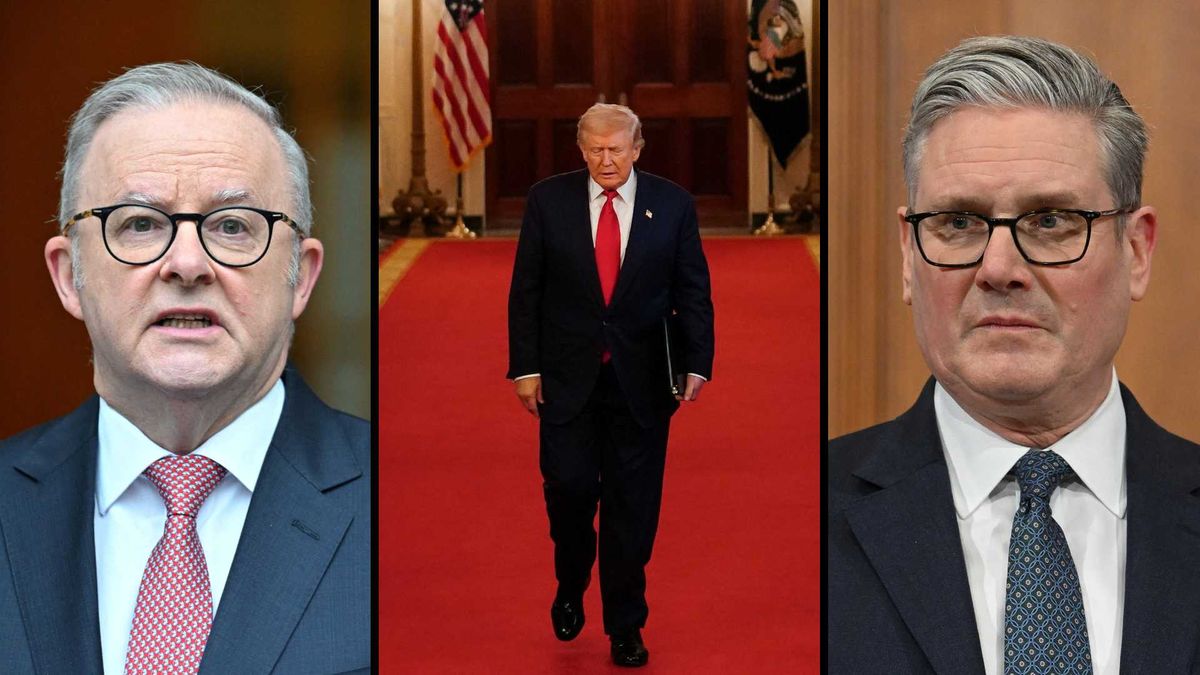
LEFT: Australia's Prime Minister Anthony Albanese speaks during a press conference at Parliament House in Canberra, Australia, March 10, 2026. AAP Image/Mick Tsikas/

CENTER: U.S. President Donald Trump arrives to host a round table on collegiate sports in the White House in Washington, D.C., March 6, 2026. REUTERS/Nathan Howard

RIGHT: British Prime Minister Keir Starmer gives an update on the situation in the Middle East at Downing Street Briefing Room, in London, Britain, March 05, 2026. Jaimi Joy/Pool via REUTERS


Three world leaders have or will be addressing the nation on Wednesday regarding the U.S.-Israeli war against Iran, news of which sparked an immediate online frenzy of speculation and fear.

“Uh oh,” wrote progressive influencer Hasan Piker Wednesday in a social media post on X to their more than 1.6 million followers.

“Uhhhhh guys. What's going on?” wrote another in response to the news, X user “Elections Joe,” a political commentator with more than 20,000 followers.

Australian Prime Minister Anthony Albanese, in a “rare national address,” urged Australians early Wednesday morning to switch to public transport and to prepare for difficult times as a result of the ongoing Iran conflict, which has sent oil prices soaring. United Kingdom Prime Minister Keir Starmer delivered a similar address Wednesday, warning Britons of an impending “crisis.”

And the White House revealed on Tuesday that President Donald Trump would be addressing the nation Wednesday night at 9 p.m. ET to provide “an important update” on his administration’s war against Iran.

“This seems coordinated,” wrote academic and author Sunny Singh in a social media post on X, reacting to the news of three world leaders issuing major addresses on the same day.

“This reminds me of March, 2020,” wrote Aidan Simardone, a Canadian immigration lawyer, in a social media post on X, referencing the brief time period leading up to the worldwide COVID-19 pandemic.And X user “Rational Aussie,” a popular political commentator who’s amassed more than 33,000 followers, speculated that the multi-national address could be an effort to “get ahead of incredibly bad news that will follow shortly.”