Saturday, April 04, 2026


China is taking on mining giants to reorder a $190 billion market
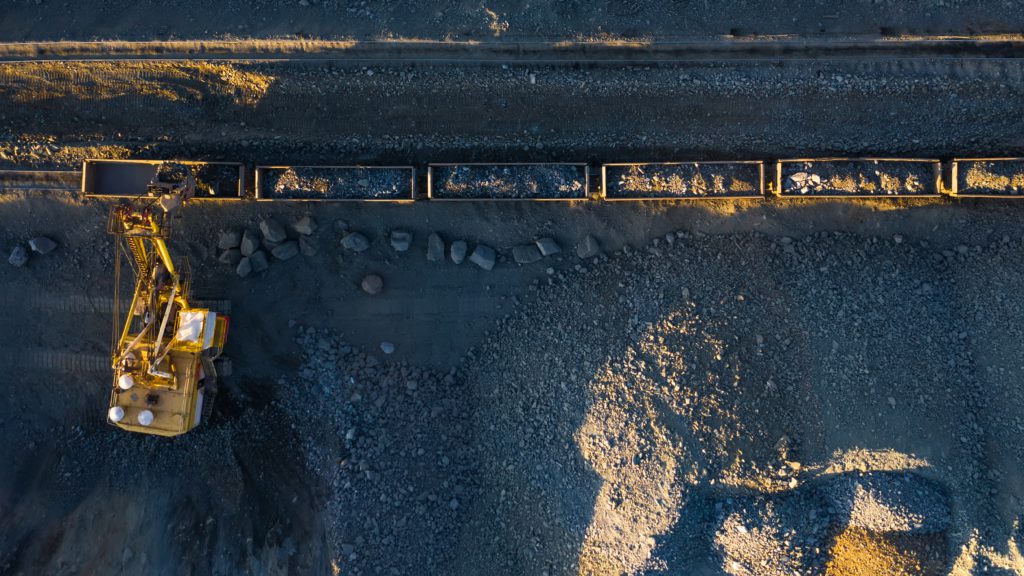
Stock image.

China has sought for decades to turn its clout as the world’s largest commodities consumer into pricing power. With iron ore — the most traded raw material after oil, and the backbone of global economic expansion — it is closer than ever to success.

The engine behind the current campaign is China Mineral Resources Group Co., an opaque company directly under the country’s central government which has been locked in a confrontation with mining giant BHP Group Ltd. for months. This is already the most significant commercial clash in nearly two decades between the country and one of its top suppliers, and has sent shockwaves through the industry.

Those heated negotiations are now reaching a critical juncture. A new chief executive is set to take the helm at BHP, with every incentive to resolve a deepening crisis. For China, meanwhile, a month-long war in the Middle East has only underscored the importance of CMRG’s mission, as the conflict deals another blow to US financial dominance and reinforces the urgency of holding more sway in key commodity markets.

“CMRG is not just an economic instrument,” said Marina Zhang of the University of Technology Sydney’s Australia-China Relations Institute, who works on supply chains and global power dynamics. “It is a geopolitical blueprint.”

This account of CMRG’s rise is based on interviews with more than 20 industry executives, financiers, traders and others involved working with the institution, all of whom asked not to be named given the sensitivity of the discussions. They reveal the depth of CMRG’s relationships within China’s economic power structure as well as nascent plans to expand its reach beyond iron ore.

CMRG and BHP declined to comment.

With a vast steel industry that consumes more than 70% of seaborne iron ore, China has consistently pushed for greater influence. Yet even after it overtook Japan as the leading importer in the early 2000s and ultimately forced a dramatic change in pricing — the industry moved toward shorter-term index-linked contracts, more reflective of market levels — that ambition remained unfulfilled.

To fix that, CMRG was set up in July 2022, after years of preparation, by the Communist Party’s central committee and the State Council, with industry veteran Yao Lin at the helm and a direct line to President Xi Jinping’s economic czar. The world’s biggest miners acknowledged the new arrival with some confusion, but said the trade would continue as normal. After all, most had been negotiating with Chinese buyers for decades, enjoying blockbuster margins.

This was true — until it wasn’t.

In September, CMRG set its sights on BHP. This was the first step in a new and more aggressive direction, with a confidence reflecting its backing by authorities in Beijing and a willingness to take on its largest suppliers — beginning with iron ore.

As China prepared for its early October holidays, executives at several of China’s largest steel producers recall receiving telephone calls out of the blue. The order coming over the line was simple and to the point: Stop using Jimblebar. A type of iron ore shipped from Western Australia by BHP was now out of bounds. The directive, targeting a product that is crucial for some steelmakers to balance cost and performance, left them stunned, they said.

The target was no accident. CMRG had spent months negotiating long-term supply contracts with BHP, and those talks had stalled. Back in 2010, BHP had led the pricing shift that ultimately reduced the scope for bilateral bargaining, and had the clout to set the tone once again. By choosing Jimblebar, a medium-grade product sold almost exclusively to the world’s top-consuming market, China could also deal a targeted blow.

BHP initially gave no public response to what it later described as sometimes challenging commercial negotiations. Privately, however, its team in Singapore acknowledged from the start that there was more at stake, as did the miner’s rivals. Here was the first step in a concerted effort to change the way that China does business with giant foreign producers, one that injected an uncomfortable measure of uncertainty into a mining industry built on predictability and vast scale.

Not since the arrest of former Rio Tinto Plc executive Stern Hu in 2009 — a corruption case that highlighted a breakdown in relations between China’s mills and big miners — had ties been as fraught. Hu pleaded guilty to accepting bribes and was jailed in 2010. At the time China denied it was using the judicial process as an economic policy tool.

The fight

Escalation was swift. After BHP did not respond as CMRG had hoped to the Jimblebar move, the buyer took another step and within days urged major mills and traders not to take on new dollar-denominated seaborne cargoes from the miner. (It did allow volumes that had already arrived in China to remain tradeable.)

And the ratcheting-up continued. In November, a second BHP product, Jingbao fines, a minor product similar to Jimblebar, was added to the banned list, specifically to subvert blending efforts. CMRG then asked authorities overseeing port terminals to raise storage costs in order to curb hoarding by foreign miners and traders.

It had become a full-blown standoff.

Then, CMRG indicated it would put even more BHP products on the same restricted list, according to people directly involved in the conversations, citing telephone calls. That began to test limits. Mills reacted, rushing to move iron ore from stockpiles to their plants, shifting popular grades like Newman fines and lumps and Mining Area C fines out of ports in northern and eastern China — enough to prompt CMRG to indicate last month it would ease Jimblebar constraints temporarily.

International investors, many of whom had largely dismissed CMRG until the crisis broke, were now pressing BHP, along with its major iron ore rivals, Rio Tinto and Vale SA, seeking explanations and a better understanding of the potential implications. Australia — whose relationship with China is still thawing after a years-long diplomatic freeze that ended in 2022 — stepped in to note concern at the end of last year, with Prime Minister Anthony Albanese expressing a desire to see the crisis resolved swiftly.

Speaking during the group’s earnings call in February, BHP chief executive officer Mike Henry said commercial negotiations were tough but the overall relationship remained “on track.” Rio Tinto told its investors it continued to engage. Iron ore producer Fortescue Ltd. has said that CMRG is trying to get more from its relationships, and adding it was responding, including with Chinese equipment purchases.

The iron ore market is deep and complex enough to withstand a crisis, not least because in this instance not every channel was cut off. BHP’s cargoes sold through private tenders at discounts are finding bold Chinese buyers willing to defy the directive — CMRG still needs to rely on compliance. Blending has also proved a very effective means of evading some checks.

Still, CMRG’s tactics — particularly its use of indirect methods, like cargo inspections at ports carried out by other government agencies — have kept up pressure, people involved in the trade said. They have also underscored CMRG’s remarkable ability to operate outside China’s conventional bureaucratic channels. While formally a centrally administered state-owned enterprise with trading ambitions, in practice the group works like a State Council coordinator and can press ministries to step in around matters it considers strategically important.

And the methods and contradictions are also creating trouble with mills in what remains an industry rooted in China’s regions, not Beijing. For them, CMRG is an effort to demonstrate that existing conglomerates and industry groups, like the China Iron and Steel Association, known as CISA, have not done enough. It’s an effort to take greater control. Several state-owned traders have also shown that it is possible for some to work around CMRG’s directives, risking disfavor for profit, the people said.

First steps

The ideas behind CMRG had been circulating in policy circles well before the group formally existed. In late 2020, the Chinese government laid out a plan to promote joint procurement of iron ore and explore the establishment of a more “open, fair and transparent” pricing system — the first step toward a unified negotiating front. Then during the following year’s annual congress meetings, He Wenbo, ex-chairman of the predecessor of China Baowu Steel Group Corp. and CISA’s head, publicly called for the creation of groups to develop iron ore production overseas. (Baowu would become a major stakeholder in the giant Simandou project in Guinea.)

Other industries that are dependent on imports have taken the coordinated buying approach. There is a copper-purchasing alliance known as the China Smelter Purchasing Team, or CSPT, and there have been discussions among China’s state-owned refining giants about forming consortia to jointly procure crude oil.

Yet for iron ore, Beijing went one step further — a standalone, centrally administered state-owned enterprise operating independently of individual industry players, and a direct line to the very top of the political establishment.

Even today, few in the industry are clear on how exactly what began as a purchasing consortium — initially just one part of a package aimed at strengthening China’s position in iron ore — evolved into a behemoth. Today it has a registered capital of 20 billion yuan (roughly $2.9 billion), challenges international miners and is reshaping the way the commodity is bought and priced.

Crucially, it is also beginning to show interest in other metals, particularly copper, according to several officials, who suggested the group’s name already points to this wider remit. In December, a CMRG researcher gave a presentation on the global copper market at a forum in Shanghai. No formal move has been decided, they added.

“They have the lion’s share of representation of steel mills,” Dino Otranto, CEO of Fortescue Metals, said in January, pointing to multiple meetings with the group and an effort to shore up the Australian miner’s leadership in China. “They are the China Mineral Resources Group, so we see them currently as just the procurer of iron ore, but they are actually a lot bigger than that — they are an investment vehicle.”

There are plenty of reasons for skepticism, even in iron ore. After all, Beijing has tried to exert more control before, with only fleeting results, and the market has only become more complex since.

“The genie is out of the bottle. The market has become more financialized,” said Pascale Massot, a political scientist at the University of Ottawa, who has written on CMRG and China’s negotiations. “If CMRG had been created with the same amount of gravitas in 2006, we would be in a different place today, but this world has been allowed to evolve for 15 years. That creates a whole lot of stakeholders that have a say in this actual system.”

Proponents, though, argue this time is different, thanks to political support and a far more centralized political structure across the country. In this context, it matters that oversight of the group sits at the top of the bureaucratic firmament. CMRG occupies an unusually elevated position, thanks to Yao’s links to Beijing’s top leadership.

That status has allowed the group access to a wider range of levers, from prompting environmental and tax inspections of mills that do not align with its coordination efforts to higher port fees. All have been used in the spat with BHP — though not without raising questions about overreach.

CMRG has already displaced traditional trading houses as one of the top spot traders in China, with dozens of cargoes on the water in any given month, treating inventories across over a dozen ports like a strategic reserve. That physical presence matters. CMRG doesn’t just talk about price — it can shape flows, deciding when ore is bought, how it moves, and how quickly it clears Chinese ports.

Price maker

For all the lingering questions around its structure and mechanics, CMRG has been open about the problems it sees with the seaborne iron ore market, worth roughly $190 billion at current prices. Analysts from its research arm have presented at domestic and international conferences, emphasizing the need for the world’s largest consumer to have a say. In the context of a market shaped by daily spot trades, with contracts overwhelmingly priced in US dollars, China’s fragmented domestic steel sector struggled to replicate the past power of Japanese peers, many of whom were shareholders as well as buyers.
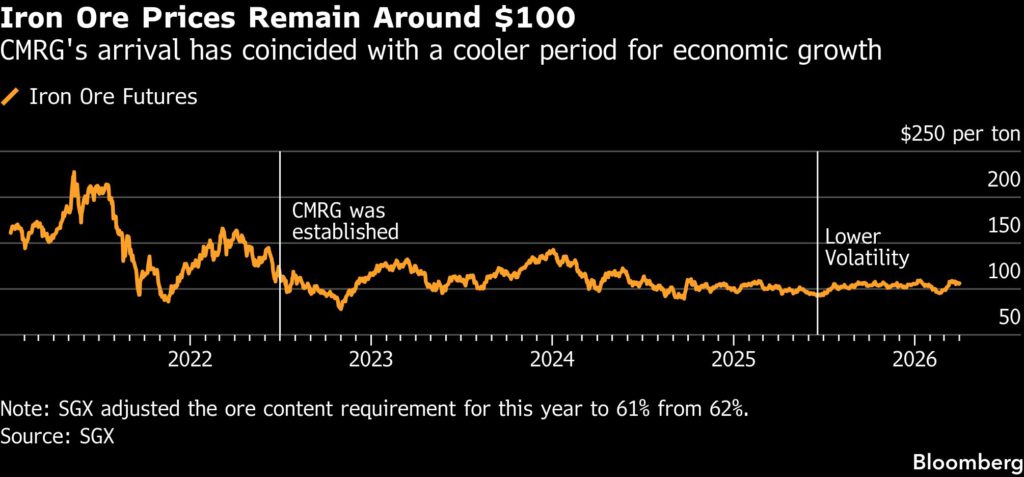
At one such event in October, attended by Bloomberg, CMRG described current global pricing mechanisms as irrational, arguing that benchmarks rely too heavily on thin spot trades and overseas futures markets — instead, Chinese alternatives should be used as a closer reflection of supply and demand.

China’s steel association has urged steelmakers to adopt a newly launched domestic port-side spot index as a core reference in long-term negotiations, explicitly shifting pricing away from international gauges.

Rio Tinto and Fortescue have already agreed to drop the Platts index for early 2026 shipments, switching to an alternative as a compromise, under pressure from CMRG, according to people familiar with the situation. The largest owner of Rio Tinto’s London shares is the Aluminum Corporation of China Ltd. Fortescue, meanwhile, has a major Chinese shareholder — a subsidiary of Hunan Valin Iron and Steel Co. — and is heavily exposed to Chinese lenders. Both miners also extended long-term supply contracts with the state buyer by six months into 2026.

Rio Tinto and Fortescue declined to comment.

BHP is a different beast.

The world’s largest miner was central to the creation of the current pricing system. Back in 2010, under then-CEO Marius Kloppers, BHP led the shift toward index-linked spot pricing, reshaping the market.

And the stakes are high for BHP, as it tries to turn its path toward growth commodities but needs the generous margins of its iron ore business. The miner has announced Americas boss Brandon Craig — who before his current role was asset president for the iron ore business in Western Australia — will take over from Henry in July. He may well be eager to reset, even without a full overhaul of the negotiating team.

Craig is set to travel to Beijing imminently as he prepares for the role, for fresh conversations.

“Australian iron ore, and BHP’s volumes in particular, remain structurally embedded in China’s steel supply chain in terms of scale, quality consistency and logistics reliability,” said David Cachot, an iron ore research director at Wood Mackenzie Ltd, adding BHP would also struggle to find a market large enough to absorb iron ore at the necessary scale.

“Neither side holds a credible exit,” said Cachot. “China cannot replace BHP’s iron ore, and BHP cannot replace China.”

With an eye on the supply disruption wrought by Russia and now US strikes in the Persian Gulf, though, it is clear that CMRG will certainly try.

“China wants to make sure it will continue to develop and improve its terms of trade against major suppliers,” said Weihuan Zhou, a professor at UNSW Sydney who studies the country’s integration into the international economic order. “China can’t just continue to be disadvantaged.”

(By Alfred Cang and Katharine Gemmell)

CU

Barrick warns of “significant increases” to budget, timeline for Pakistan copper project


Barrick’s 50% Reko Diq copper-gold project in Pakistan. (Image: Barrick’s presentation.)

Barrick Mining (NYSE:B)(TSX:ABX) said on Thursday that it anticipates that there could be “significant increases” to the previously disclosed total estimated capital budget and timeline for its Reko Diq copper project in Pakistan.  

On March 26, Barrick said it will slow its development of the Reko Diq deposit and extend the project’s review period, citing security concerns in the Middle East. 

Reko Diq, one of the world’s largest undeveloped deposits of the metal, is in the remote, insurgency-hit western province of Balochistan and held in an equal partnership between the company and the Pakistani authorities. 

The previously disclosed total estimated capital cost of Phase 1 was between $5.6 billion and $6.0 billion (100% basis, exclusive of capitalization of financing costs) and of Phase 2 was between $3.3 billion and $3.6 billion (100% basis, exclusive of capitalization of financing costs), with first production targeted by the end of 2028. 

“Barrick continues to believe in the long-term value of Reko Diq. Following the preliminary findings of the review and the further escalation of security issues in Pakistan and the region, the company considers it necessary to slow the development activity and continue the project review until mid-2027,” the Canadian miner said in a statement released just after market close in Toronto.  

Barrick has viewed Reko Diq — with an estimated 15 million tonnes of copper reserves — as a key pillar of its strategy to become a Tier 1 producer of the metal. 

The continued review will allow the company to assess in a comprehensive manner the evolving security situation, capital requirements, project financing, project scope and timeline, it said.  

“While development activity will be slowed, the project will remain under active management with a reduced capital spend,” Barrick said.  “Development of Phase 1 of the Reko Diq project was approved on this basis. Barrick recognizes its important role in the local community and intends to continue to invest in and honor its existing in-country community and social programs.” 

Barrick, which has been developing the project in partnership with the governments of Pakistan and Balochistan for years, initially planned for the project to come online in 2028, subject to financing.   

Once operational, the mine is forecast to generate over $70 billion in free cash flow and $90 billion in operating cash flow over a 37-year lifespan. 

No sign yet of China’s plan to cut copper output in major smelters’ results

Stock image.

Major Chinese copper smelters are planning to raise or maintain output in 2026, their earnings outlooks show, despite a public commitment by the state-linked industry association last year to cut production by over 10%.

The China Smelter Purchase Team (CSPT), a group of 16 of the top copper smelters, agreed last year to cut production to counter overcapacity amid falling processing fees for copper concentrates.

But there’s no sign of output cuts in guidance issued by three major smelters, all CSPT members, as part of annual earnings over the past few weeks.

Jiangxi Copper, China’s top copper smelter, raised 2026 production guidance for copper cathodes to 2.39 million metric tons, up from 2.38 million tons produced in 2025.

Similarly, Yunnan Copper increased its 2026 guidance to 1.71 million tons, up from 1.64 million tons produced last year.

Daye Nonferrous, which published its 2025 results on Wednesday, flagged a slight drop in 2026 to 713,000 tons, from output of 716,000 tons for last year.

The three smelters produced a third of the country’s 14.72 million tons of refined copper last year.

The production cut announcement last year was made as treatment and refining charges (TC/RCs), which are traditionally paid by miners to smelters to process copper concentrates, collapsed in 2025 due to tight supply of the feedstock, leaving smelters having to pay miners.

The CSPT did not set quarterly TC/RC guidance for the fifth time in a row this week. The figure traditionally served as a benchmark for spot copper concentrate deals in China.

Negative fees have left Chinese smelters relying on by-product profits, especially sulphuric acid. Sales of sulphuric acid, for example, accounted for 14.65% of total gross profit of Jiangxi Copper, more than the gross profit from copper rod and wire and finished copper products combined in 2025.

(By Lewis Jackson and Dylan Duan; Editing by Sonali Paul)


Chinese copper miners join $1.2 billion African rail revamp

Tanzania Zambia Railway. Stock image.

Chinese mining, shipping and logistics companies are joining a $1.24 billion project to revamp a railway linking Zambia’s copper region to a port on the Indian ocean.

Copper producers CMOC Group Ltd. and Zijin Mining Group Co. are teaming up with state-owned China Civil Engineering Construction Corp., or CCECC, to upgrade the 1,860-kilometer (1,156-mile) rail line that runs to Dar es Salaam in Tanzania.

CCECC – which signed a deal with Zambia and Tanzania in September to rehabilitate the so-called Tazara railway – will retain an 80% interest in the joint venture undertaking the project, according to a statement on Wednesday from Jiayou International Logistics Co., one of four firms taking 5% stakes. The other three are units of Zijin, CMOC and COSCO Shipping Holdings Co., Jiayou said.

The backing for the Chinese project comes as Washington tries to loosen Beijing’s grip on supply chains for critical minerals in Africa. The US concluded a bilateral minerals partnership with the Democratic Republic of Congo in December that grants American companies preferential access to some of the country’s abundant reserves of metals.

The Tazara link — originally built with Beijing’s assistance under Mao Zedong in the 1970s — will compete with the Lobito Corridor, a rail project backed by the US and European Union. That railway connects the same copper-rich region of central Africa to an Angolan port on the west coast of the continent.

CMOC and Zijin are among the Chinese miners that dominate metal exports from Congo, the world’s No. 2 copper producer and the biggest source of battery material cobalt. By contrast, Western firms – particularly Canada-headquartered First Quantum Minerals Ltd. and Barrick Mining Corp. – account for most output in neighboring Zambia.

Tanzania and Zambia granted CCECC a 30-year concession to operate the line. Once completed, the rehabilitated infrastructure will ease congestion on roads in Zambia and Congo, from where most mineral cargoes are currently trucked over long distances to African ports.

The Chinese companies will invest in the Tazara project according to the size of their interests in the Dubai-registered joint venture entity, according to Jiayou, which will contribute $62.2 million. The partners will operate freight services on the line after renovating the railway and purchasing equipment including locomotives and containers, it said, adding that the project still needs to complete the approval and filing process with China’s government.

The investments reflect a shift in China’s Belt and Road Initiative to increasingly partner with private companies to operate projects on commercial terms.

State-owned COSCO is China’s largest container line, while Jiayou is the majority owner of one of Zambia’s biggest trucking firms and is developing road concessions in the country. Zijin is also Jiayou’s second-biggest shareholder, with a 17.5% stake in the group.

Washington’s pact with Congo recognizes the “strategic nature” of the Lobito Corridor and aims to increase the volume of minerals exported to the US and its allies using the railway.

(By William Clowes, Annie Lee and Matthew Hill)

Ivanhoe stuns market with deep Kamoa-Kakula output cut


Installation of the Stage Two submersible pumps at Kamoa-Kakula. (Image courtesy of Ivanhoe Mines.)

Ivanhoe Mines (TSX: IVN) has slashed near-term production guidance for its flagship Kamoa-Kakula copper complex in the Democratic Republic of Congo, surprising analysts and resetting investor expectations.

The company now expects 2026 copper anode output of 290,000 to 330,000 tonnes, down from 380,000 to 420,000 tonnes, while 2027 production will reach 380,000 to 420,000 tonnes versus a prior projected 500,000 to 540,000 tonnes.

Ivanhoe released the update after markets closed Tuesday, citing a shift toward underground development, rehabilitation and access work that will constrain ore delivery over the next 18 to 24 months. The company also raised expected cash costs, compounding the weaker outlook.

“The headline takeaway was a material reset to near-term expectations,” Jefferies analyst Fahad Tariq said in a note, adding that investors were not anticipating the downgrade. “We view the update as a clear acknowledgment that operational challenges at Kakula are taking longer to resolve than initially envisaged, pushing volume recovery further out.”

At the core of the revision is a new reserve model that cut contained copper by 24.7% and reduced reserve grade by 28%, reflecting more conservative assumptions, lower cutoff grades and revised mine sequencing. Ivanhoe now caps underground extraction rates at about 60%, down from 70% to 80% or higher, as it widens pillars and excludes inaccessible areas to improve long-term stability.

The reset underscores a broader trade-off facing large mining projects: sacrificing short-term output to secure more reliable, efficient production over time, forcing investors to recalibrate expectations.

Key ramifications

BMO analysts said the reserve update appears conservative but carries more significant implications for near-term production and valuation, largely due to the lower grade profile.

“The reserve update for Kakula/Kamoa came in below both the market’s and our expectations,” analyst Andrew Mikitchook wrote. “The largest impact on valuations comes from a 28% decrease in reserve grade.”

BMO cut its price target on Ivanhoe shares to $16 from $23, citing weaker near-term output and revised long-term assumptions. Year-to-date, the stock is down almost 35%, trading at $10.51 on Wednesday for a market capitalization of $11.8 billion (C$15B).

The bank also highlighted a planned redevelopment of the complex in 2026 and 2027, aimed at enabling broader and more efficient mining with faster backfill sequencing, though at the cost of reduced extraction rates in the interim.

Despite the downgrade, BMO said there is potential upside as Ivanhoe continues to refine its mine plan. Ongoing optimization work, including geotechnical drilling and further analysis of Kakula East, could lead to improved efficiency, with an updated prefeasibility and feasibility plan expected in the first quarter of 2027.

Jefferies similarly noted that mine plans for 2026 and 2027 now focus explicitly on development and rehabilitation rather than production, with slower advance rates and more conservative sequencing reducing ore delivery and raising costs in the near term.

Long-term outlook safe

Ivanhoe continues to target annual copper production exceeding 500,000 tonnes from 2028, positioning Kamoa-Kakula among the world’s largest copper operations.

The current redevelopment phase aims to unlock that scale by improving underground access, expanding mining areas and enabling more consistent extraction, even as it delays the ramp-up profile that had supported prior market expectations. Analysts said the company’s more cautious approach reflects a focus on long-term performance and stability after persistent operational challenges at Kakula.

Near-term sentiment will hinge on execution, including improved operating performance, timely redevelopment progress and clearer visibility on the next iteration of the mine plan, with signs of progress later this year likely key to rebuilding investor confidence.


Modeling Mangroves’ Capacity To Protect Coastal Communities


Example of a mangrove forest CREDIT: KyotoU / Nobuhito Mori


April 4, 2026 

By Eurasia Review


Mangrove forests are natural wonders that protect coastal areas, particularly in tropical and subtropical regions. They are able to dissipate wave energy and limit flooding, which can even mitigate tsunamis and coastal inundations during tropical cyclones. For this reason, mangroves are attracting attention as Nature-based Solutions, or NbS: natural infrastructure with the potential to enhance coastal resilience in an environmentally friendly way.

As climate change is altering ocean conditions and intensifying storms, many coastal communities face growing risks from flooding and extreme wave events; hence mangroves can serve to both mitigate disasters and help communities adapt to climate change. However, these forests remain underutilized in engineering applications due to a limited understanding of how they interact with hydrodynamic forces. Accurately modeling their complex root structures, known as prop-roots, while quantifying their wave attenuation effects has posed a particular challenge.

A collaborative team of researchers from Kyoto University’s Disaster Prevention Research Institute resolved to address this knowledge gap. “Japan has a long history of using pine trees for coastal defense, and we want to apply this knowledge to mangroves to develop smart, cost-effective disaster risk reduction,” says first author Yu-Lin Tsai.

Drawing on their previous tree morphology surveys in the field and wave flume experiments, the team set out to develop a numerical model capable of evaluating mangrove wave attenuation. Focusing on the species Rhizophora apiculata, found throughout Southeast Asia and the western Pacific, the team gathered detailed measurements of 3D root shapes, creating a vegetation model accounting for wave attenuation as a function of water depth and wave height. They then evaluated this process using a numerical Boussinesq wave model, incorporating drag and inertia forces to estimate the attenuation of water momentum by mangroves.

The results revealed that wave attenuation varies significantly with vertical root morphology and water depth, and that estimates of wave attenuation levels can differ by 20–50%. This shows that the level of root submersion must be accounted for in assessing the effectiveness of coastal protection.

The team’s numerical model and resulting formulas are expected to be valuable tools for integrating mangroves into future coastal disaster risk reduction planning. This study also highlights the critical importance of moving beyond previous knowledge based on simplified mangrove shapes to considering realistic root morphology and submergence conditions.

“We enjoy the full spectrum of our research, but the best part of all is definitely getting to work amidst the beautiful scenery of mangrove forests,” says team leader Nobuhito Mori.

In the future, the team plans to develop manuals based on these findings to support mangrove-based disaster mitigation strategies in Southeast Asia, the Pacific Islands, and other regions. They also hope these findings can be applied to additional efforts including mangrove reforestation.


Prediction Markets And Insider Trading Law – Analysis

April 4, 2026 
By Jay B. Sykes
Congressional Research Service (CRS).


The past two years have witnessed the dramatic growth of prediction markets—i.e., online platforms that allow users to buy or sell contracts with payoffs tied to the occurrence or nonoccurrence of specific events, such as sporting event outcomes, political election results, and macroeconomic or geopolitical developments. Highly publicized instances of large, well-timed bets on prediction markets have generated interest in whether and how insider trading law applies to such markets. This Legal Sidebar provides an overview of these issues. It is divided into three parts. First, the Sidebar offers background on prediction markets and insider trading law. Next, it discusses a February 2026 advisory from the Commodity Futures Trading Commission (CFTC) addressing insider trading on prediction markets. The Sidebar concludes by discussing considerations for Congress.
Background: Prediction Markets

Prediction markets are online platforms that specialize in offering “event contracts“—i.e., contracts that allow traders to bet on the occurrence or nonoccurrence of a specific event. Typically, event contracts have a binary payoff structure and are presented as “Yes/No” questions. For example, a trader who buys a “Yes” contract may receive a payout of $1 if the underlying event occurs before the contract’s expiration date, but nothing if the event does not occur before that date. Conversely, a trader who purchases a “No” contract may receive a payout of $1 if the underlying event does not occur before the contract’s expiration date, but nothing if the event does occur before that date. In liquid markets, the price of an event contract is generally regarded as reflecting the market’s assessment of an event’s probability at a given point in time. For example, a “Yes” contract that pays $1 if an event occurs and trades at $0.60 is commonly viewed as suggesting that the market believes there is a 60% chance that the event will occur.

Several prediction markets have registered with the CFTC as “designated contract markets” (DCMs)—a type of derivatives exchange. The Commodity Exchange Act (CEA) gives the CFTC “exclusive jurisdiction” over futures, options, and swaps traded on registered exchanges. (The implications of this language for state regulation of event contracts are being litigated.) The CEA defines the term “swap” to include contracts that provide for payment that is “dependent on the occurrence, nonoccurrence, or the extent of the occurrence of an event or contingency associated with a potential financial, economic, or commercial consequence.” The CFTC has taken the position that certain event contracts—including event contracts based on the outcomes of sporting events (“sports event contracts”)—fall within this component of the CEA’s “swap” definition. The CFTC has also argued that event contracts qualify as “options,” which likewise fall within the CEA’s definition of “swap.”

While CFTC-registered exchanges have listed event contracts since 1992, the number and variety of event contracts listed by registered exchanges increased sharply beginning in 2021. The CFTC has explained that, since 2021, DCMs have listed “a substantial number of event contracts not associated with traditional commodities, financial indices, or economic indicators.” These novel event contracts include contracts based on the release dates for video games and musical albums, Oscar award winners, sporting events, and the outcomes of political elections. Sports event contracts have proved particularly popular, accounting for more than 85% of trading volume on Kalshi—a leading prediction market registered with the CFTC.


Several large, well-timed trades involving event contracts have recently generated concerns about the extent to which prediction-market users are profiting based on material nonpublic information (MNPI). For example, in late December 2025 and early January 2026, a user of an offshore exchange operated by Polymarket purchaseda high volume of contracts predicting the ouster of Venezuelan President Nicolás Maduro. After the U.S. military captured Maduro on January 3, 2026, the user reportedly secured a payout of more than $400,000. Polymarket’s offshore exchange also experienced a sharp uptick in large purchases of contracts predicting U.S. military strikes on Iran shortly before such strikes occurred in February 2026. Some Members of Congress have voiced concerns that these trades may have been basedon MNPI.
Insider Trading Law
SEC Rule 10b-5

The law of insider trading has developed primarily in the context of securities markets. Courts have held that trading securities based on MNPI in breach of a duty constitutes a violation of Securities and Exchange Commission (SEC) Rule 10b-5, which prohibits certain types of fraudulent and deceptive conduct in connection with the purchase or sale of any security.


Persons can be liable for insider trading under Rule 10b-5 based on either of two theories. If a company’s insiders (e.g., officers, directors, or “temporary insiders” such as outside counsel) trade the company’s securities based on MNPI, they violate Rule 10b-5 by breaching duties owed to their trading counterparties—i.e., the company’s shareholders or would-be shareholders. The Supreme Court has reasoned that there is a “relationship of trust and confidence” between a corporation’s insiders and its shareholders, which gives rise to a duty on the part of insiders to disclose MNPI before trading the corporation’s securities. Violations of this duty give rise to liability under the “classical” theory of insider trading.

Because the classical theory is based on the breach of duties owed to trading counterparties, it does not apply to corporate outsiders who lack a fiduciary relationship with the issuing corporation and its shareholders. Corporate outsiders can still be liable for insider trading, however, if they trade securities based on MNPI in breach of a duty to the source of the information. For example, an attorney representing the bidder in a takeover would violate Rule 10b-5 by purchasing shares of the target corporation if such trading violated a duty of confidentiality owed to the bidder. This type of liability is called the “misappropriation” theory of insider trading because it is predicated on a trader’s misappropriation of property rights in confidential information. Trading based on misappropriated information, the Supreme Court has said, “involves feigning fidelity to the source of the information,” making it “deceptive” within the meaning of Rule 10b-5.

With the classical and misappropriation theories as foundations, federal courts have adopted additional tests for assessing “tipper” and “tippee” liability for insider trading—i.e., whether individuals violate Rule 10b-5 by disclosing MNPI to other traders or by trading securities based on MNPI obtained from others.


Under Rule 10b-5, breach of a duty is a necessary element for insider trading liability under both the classical and misappropriation theories. The Supreme Court has rejected the argument that Rule 10b-5 creates a parity-of-information regime barring all trading based on MNPI.

Violations of Rule 10b-5 may trigger civil and/or criminal liability.
The CEA and CFTC Rule 180.1

Historically, insider trading prohibitions in derivatives law were far narrower than SEC Rule 10b-5, applying only to employees of the CFTC and CFTC-registered entities. In 2010, however, Section 753 of the Dodd-Frank Act amended the CEA to prohibit fraud and manipulation “in connection with any swap, or a contract of sale of any commodity in interstate commerce, or for future delivery on or subject to the rules of any registered entity” in contravention of rules adopted by the CFTC. The following year, the CFTC finalized Rule 180.1, which prohibits fraud or deception in connection with swaps, interstate commodity sales, and futures traded on or subject to the rules of registered entities. In doing so, the CFTC explained that Rule 180.1 was “modeled on” SEC Rule 10b-5 and that the agency would be “guided, but not controlled, by the substantial body of judicial precedent applying the comparable language of” Rule 10b-5.

The CFTC has relied upon Rule 180.1 to bring enforcement actions under the misappropriation theory, several of which have involved employees of trading firms accused of using MNPI derived from their employers to trade for their personal accounts. The classical theory of insider trading is unlikely to apply in derivatives markets because, unlike corporate insiders who trade their company’s shares, derivatives traders typically lack fiduciary relationships with their counterparties.

Consistent with judicial interpretations of SEC Rule 10b-5, the CFTC has clarified that Rule 180.1 does not create a parity-of-information regime forbidding all trading based on MNPI. Specifically, the CFTC has said that “derivatives markets have long operated in a way that allows for market participants to trade on the basis of lawfully obtained [MNPI],” and that the failure to disclose such information prior to trading will not, by itself, constitute a violation of Rule 180.1.

Violations of Rule 180.1 may trigger civil and/or criminal liability.

The CEA also contains separate insider-trading provisions directed at federal government officials and employees. Section 4c(a)(3) of the CEA, as amended by the Stop Trading on Congressional Knowledge (STOCK) Act, prohibits federal agency employees, Members of Congress, congressional employees, and judicial officers and employees from using nonpublic information derived from their positions to trade commodity futures, options, or swaps. Section 4c(a)(4) of the statute prohibits (1) individuals in the specified categories from imparting such information to others with the intent to assist such trades, and (2) any person from knowingly using such imparted information to enter such trades.

Title 18 of the U.S. Code

Insider trading may violate several criminal prohibitions in Title 18 of the U.S. Code. The federal mail fraud statute (18 U.S.C. § 1341) prohibits use of the mails to further a fraudulent scheme. The wire fraud statute (18 U.S.C. § 1343) contains a similar prohibition that applies to the use of wire communications, including the internet. The Sarbanes-Oxley Act of 2002 also created the separate criminal offenses of securities and commodities fraud, which are codified in 18 U.S.C. § 1348. The Department of Justice has used all three statutes to prosecute individuals alleged to have traded securities or derivatives based on MNPI in breach of a duty.

In many respects, judicial interpretations of these statutes have tended to track the interpretation of SEC Rule 10b-5. Some decisions, however, have recognized possible differences between the elements of Rule 10b-5 insider trading and Title 18 insider trading. In United States v. Blaszczak, for example, the U.S. Court of Appeals for the Second Circuit (Second Circuit) concluded that information regarding the substance and timing of federal agency decisions does not qualify as federal “property” for purposes of the wire fraud statute and 18 U.S.C. § 1348. As a result, the court held, government employees and their tippees do not violate those statutes by trading securities based on such information. It is unclear whether this principle applies to misappropriation claims brought under SEC Rule 10b-5 or the CEA.

Similarly, in United States v. Chastain, the Second Circuit held that, in wire fraud prosecutions predicated on the misappropriation of confidential information from a private company, the government must prove that the relevant information had commercial value to the company. In Chastain, the defendant was a former employee of OpenSea, an online marketplace for non-fungible tokens (NFTs). The government alleged that the defendant used confidential information to purchase NFTs before they were featured on OpenSea’s website. The Second Circuit vacated the defendant’s wire fraud conviction, concluding that the information qualified as “property” under the wire fraud statute only if it had commercial value to OpenSea and that the district court’s jury instructions erroneously omitted that requirement. The Second Circuit reasoned that this error was not harmless based on evidence that OpenSea did not have important commercial interests in keeping the identify of featured NFTs confidential. As with Blaszczak‘s holding regarding federal agency decisions, it is unclear whether this principle would apply to misappropriation claims brought under SEC Rule 10b-5 or CFTC Rule 180.1.
The CFTC’s February 2026 Advisory

On February 25, 2026, the CFTC issued an advisory addressing insider trading on prediction markets. The advisory discusses two recent enforcement actions by Kalshi. One enforcement action involved a political candidate who traded event contracts regarding his own candidacy. Another involved an employee of a company affiliated with a YouTube channel who traded event contracts related to the channel’s videos. In both cases, Kalshi imposed financial penalties on the traders and suspended them from using its platform. While the CFTC has not, to date, pursued enforcement actions against either of the traders, the agency’s advisory said that both individuals “potentially” violated Rule 180.1. The CFTC also indicated that it has “full authority to police illegal trading practices” on registered exchanges and that exchanges have “an independent duty pursuant to the core principles of the [CEA] to maintain audit trails, conduct surveillance, and enforce rules against prohibited practices.”

Issues for Congress

The application of insider trading law to prediction markets raises several issues, including threshold questions regarding the status of event contracts under the CEA and CFTC rules. As discussed, CFTC Rule 180.1 applies to “swaps,” among other instruments, and the CFTC has taken the position that many event contracts qualify as “swaps” under the CEA. There is ongoing litigation over whether sports event contracts qualify as “swaps” under the CEA, along with the jurisdictional implications of that status. In adjudicating motions for preliminary injunctions, two federal district courts have concluded that sports event contracts qualify as “swaps,” while two other federal district courts have reached the opposite conclusion. Those decisions have been appealed. While the status of sports event contracts remains uncertain, it appears likely that some other categories of event contracts fall within the CEA’s definition of “swap,” which includes contracts that provide for payment that is “dependent on the occurrence, nonoccurrence, or the extent of the occurrence of an event or contingency associated with a potential financial, economic, or commercial consequence.”

Another issue of interest involves the relationship between CFTC Rule 180.1 and rules adopted by prediction markets. The comparative scope of Rule 180.1 and certain exchange rules concerning “insider trading” remains unsettled. Kalshi, for example, has adopted rules governing insider trading that prohibit a broader range of conduct than the misappropriation theory. Under Kalshi’s rules, an individual cannot trade an event contract if he or sheis an “Insider that has access to [MNPI] that is the subject of an Underlying of [the] Contract” (the rules define “Insider” to mean “any person who has access to or is in a position to access [MNPI] before such information is made publicly available”);
has “the ability to exert any influence on the subject of an Underlying of [the] Contract”; or
is a “decision maker, either directly or indirectly, or has any influence, either directly or indirectly, no matter the scale and importance of the influence, on the outcome of the Underlying (event).”

Because breach of a duty is not an element of these prohibitions, Kalshi’s rules appear to extend beyond the misappropriation theory. Whether the additional categories of trading that Kalshi prohibits could trigger liability under Rule 180.1 is unclear. As discussed, the CFTC has said that Rule 180.1 does not create a parity-of-information regime, explaining that “derivatives markets have long operated in a way that allows for market participants to trade on the basis of lawfully obtained [MNPI].” The CFTC’s February 2026 advisory, however, appears to suggest that trading event contracts based on MNPI may violate Rule 180.1 even without misappropriation in certain circumstances. In the advisory, the CFTC said that a political candidate “potentially” violated Rule 180.1 by trading event contracts regarding his candidacy. Instead of invoking the misappropriation theory in connection with that case (as it did elsewhere in the advisory), the CFTC indicated that the candidate’s conduct may have involved a “manipulative scheme or artifice to defraud” or “an act, practice or course of business that operates as a fraud.” The agency did not, however, elaborate on the details of this theory. At least one commentator has questioned whether it would be viable as a matter of existing law. A federal prohibition of the full range of conduct barred by Kalshi’s rules may thus require legislative changes.


Federal prosecutors may also scrutinize prediction-market activity for unlawful insider trading. The U.S. Attorney for the Southern District of New York has said that prosecutors in his office are reviewing the laws that might be used to pursue criminal charges involving insider trading on prediction markets. Those laws may include CFTC Rule 180.1 and the CEA provisions governing insider trading by federal government officials and employees. If certain types of event contracts are ultimately deemed to fall outside the scope of CFTC Rule 180.1, Title 18 may provide an alternative basis for prosecuting insider trading involving such contracts. The Second Circuit’s decisions in Blaszczak and Chastain, however, may stand as an obstacle to Title 18 prosecutions targeting insider trading in certain types of event contracts—specifically, contracts involving federal agency decisions and information that lacks commercial value to private companies.

Several pieces of legislation regarding insider trading on prediction markets have been introduced in the 119th Congress.

H.R. 7004, the Public Integrity in Financial Prediction Markets Act of 2026, would make it unlawful for elected federal officials, House and Senate employees, political appointees, and employees of executive agencies to trade certain categories of prediction-market contracts (1) while in possession of MNPI relevant to those contracts, or (2) if they “may reasonably obtain” such MNPI in the course of their official duties. The bill would apply to prediction-market contracts related to government policy, government action, or political outcomes.

H.R. 8076, the Preventing Real-time Exploitation and Deceptive Insider Congressional Trading (PREDICT) Act, would prohibit the President, Vice President, Members of Congress, dependent children and spouses of Members of Congress, congressional employees, political appointees, employees and officers of executive or independent agencies who occupy positions above GS-15 of the General Schedule, certain high-ranking members of the military, and judicial officers and employees from trading event contracts tied to “specific political events.”

S. 4017, the End Prediction Market Corruption Act, would categorically prohibit the President, Vice President, and Members of Congress from trading event contracts. The legislation would bar senior executive branch officials from trading event contracts involving matters in which they “participate[] personally and substantially.” The bill also would direct the CFTC to issue a rule to “restrict the inappropriate use of [MNPI], in breach of an express or implied duty not to use or disclose such [MNPI], as a means of making a profit through” the trading of event contracts.

S. 4060, the Prediction Markets Security and Integrity Act of 2026, would prohibit the use of MNPI to trade on prediction markets. The bill also would make it unlawful to (1) participate in prediction-market contracts that “present a conflict of interest,” or (2) “engage in manipulation and deceptive practices that predetermine the outcome or otherwise materially interfere with the integrity and execution” of prediction-market contracts. In addition to these prohibitions, the legislation would impose various rules on prediction markets concerning permissible contracts, contract resolution, and the enforcement of market rules.

S. 4188, the Public Integrity in Financial Prediction Markets Act, would prohibit the President, Vice President, Members of Congress, employees of the House of Representatives or Senate, political appointees, and employees of executive or independent agencies from using MNPI derived from their positions to profit from the purchase or sale of prediction market contracts.


Other bills, while not addressing insider trading directly, would prohibit certain categories of event contracts. Sponsors of these bills have cited concerns regarding insider trading as one basis for prohibiting the relevant types of contracts.

H.R. 7840, the Event Contract Enforcement Act, would prohibit CFTC-registered exchanges from listing certain categories of event contracts, including contracts involving “conduct by or in any level or branch of the Federal Government or of any State or local government, including by or in any instrumentality or by any personnel of any level or branch of any such government.”

The Banning Event Trading on Sensitive Operations and Federal Functions (BETS OFF) Act (S. 4115 and H.R. 7955) would prohibit CFTC-registered entities from listing certain categories of event contracts, including contracts based on events whose “primary underlying characteristic” is not “financial, commercial, or economic,” if such events involve (1) “an action taken by any government, unit of government, intergovernmental organization, or government official,” (2) an outcome that is under the “complete control” of any person, or (3) an outcome that is known by any person in advance.

The Stop Trading on Predictions and Corrupt Bets (STOP Corrupt Bets) Act of 2026 (S. 4226 and H.R. 8123) would prohibit CFTC-registered entities from listing event contracts involving political elections or contests;
actions taken by the executive, legislative, or judicial branch of the U.S. government (subject to an exception for contracts that the CFTC determines are used for hedging or mitigating commercial risk);
sporting events or contests; or any military action taken by the United States or a foreign country.


About the author: Jay B. Sykes, Legislative Attorney

Source: This article was published by Congressional Research Service (CRS).

The Congressional Research Service (CRS) works exclusively for the United States Congress, providing policy and legal analysis to committees and Members of both the House and Senate, regardless of party affiliation. As a legislative branch agency within the Library of Congress, CRS has been a valued and respected resource on Capitol Hill for nearly a century.