Monday, April 06, 2026

Wallace Shawn’s Road to Socialism

Source: Jacobin

A funny kind of energy ripples through a crowd as Wallace Shawn saunters through, as he did on March 9 at Greenwich House Theater. It wasn’t an immersive show, but Shawn, dressed in T-shirt and jeans, entered with the audience and chatted with random people as he made his way to the stage. The evening’s production of his one-man show, The Fever, had not yet begun, but the play was first performed in friends’ living rooms, and Shawn tends toward intimacy in some of his live performances. When he mounted the stage, he addressed the entire audience with small talk — the temperature, the microphone, the trouble with cell phones in the theater — and then stepped from chatter into monologue. We hushed. Having made us comfortable guests in his home, he gave us the signal to focus.

Wallace Shawn has two plays currently being performed in Manhattan, off-Broadway: his new play What We Did Before Our Moth Days, directed by André Gregory and costarring fellow Democratic Socialists of America (DSA) member John Early, and his 1990 one-man show The Fever. the latter, which contains distinctly Marxist themes, was performed in January by Shawn as a fundraiser for New York City DSA’s Tax the Rich campaign.

Shawn is today best known for his acting roles. He played the comical villain Vizzini in The Princess Bride (1987) and more recently the eccentric nerd Dr John Sturgis on the TV show Young Sheldon (2017–2024). His inimitable voice, which can leap mid-sentence from serious and gravelly into an excited falsetto, is probably instantly recognizable to you. But theater aficionados might also be familiar with Shawn the playwright and his sixty years of experience in avant-garde theater and collaborations with Gregory, an experimental director. If you are part of the organized left, you might be familiar with Wallace Shawn the socialist and advocate for Palestinians. Eldest child of New Yorker editor William Shawn and partner to the short story author Deborah Eisenberg, Wallace Shawn’s career can seem like a vibrant convergence of cultural and political streams in American life.

Shawn has written plays and essays in a socialist vein for decades, including his 2011 essay “Why I Call Myself a Socialist” and his 1996 anti-fascist play The Designated Mourner. In recent years, he has appeared at demonstrations for a ceasefire in Gaza. The eighty-two-year-old writer was even spotted in Manhattan last year canvassing for Zohran Mamdani.

The Fever is an unbroken monologue by an unnamed character who is in the grip of a harsh internal conversion to class politics. He describes waking in a hotel room in a poor country where rebels are taking over the government. He torments himself by idling over the gruesome details of an execution he had read about.

“They shave his head,” the character describes, “a section of his leg, so the electrodes will fit closely on the skin.” He asks, “Does panic mount in the man’s heart? An attendant covers his head with a hood so none of us will see his pain, the horror, the distortion of his face.” We receive this image in the first seconds of the play.

“I had always thought of myself as a regular liberal,” Shawn says when describing the origins of The Fever. “I didn’t have an awareness of myself as a participant in the world struggle. I thought of myself as an observer and as someone who observed the suffering of others with sympathy. Until I was around forty, it really didn’t occur to me that the suffering of a poor person in Guatemala had anything in particular to do with me, except that it was a sad situation, and I felt sorry for the person who was suffering.”

The Fever dramatizes this experience of radicalization, and the character attacks himself and members of his class for their lies and solipsism.

“I realized that some of the suffering, quite a good deal of the suffering, on the planet was caused to preserve the status quo that benefited me,” says Shawn. “I actually felt a very personal hatred for myself and frankly for the other people in my group. I became unbelievably aware that there was a trail of blood between me sitting in an enjoyable restaurant in New York and someone being tortured or killed in Honduras or Guatemala or El Salvador.”

The play is an excoriating critique of bourgeois liberalism and draws a line from Western capitalist comfort to violence in the Global South. Perfectly nice liberals having concerned political discussions in lovely restaurants are juxtaposed with poverty, kidnapping, imprisonment, torture, and execution in the unnamed countries the character visits.

The play alternates between the man in the hotel room and his thoughts and memories of his comfortable, bourgeois life in a faraway city. Early on in his radicalizing journey, the character  reads Volume I of Marx’s Capital and is able to “see the fetishism of commodities everywhere.” Each object he sees becomes the story of the workers who created it. “The cup of coffee contains the history of the peasants who picked the beans, how some of them fainted in the heat of the sun, some were beaten, some were kicked.”

Through a series of random encounters, he is eventually drawn to poor countries where he meets desperately poor people and revolutionaries and encounters wholly different sets of values and ways of living. On his return home, he gradually becomes disgusted with and alienated by his own class. Hearing a friend describe sitting at his own father’s bedside as he died peacefully, surrounded by family, the character says, “I couldn’t help mentioning those others who died every day on the torture table, screaming, carved up with knives, surrounded on their bed of death by other experts who were doing all they could to be sure that the ones they surrounded would die in howling agony — unimaginable agony.” A testament to his considerable acting skill, Shawn was able to deliver this quote as a laugh line.

The play is also an accurate and sensitive portrait of a psychological crisis. It shows a character stuck between two ways of thinking, between passive liberalism and engaged socialism, and experiencing the contradictions of liberalism as an acute depressive episode. Where young people often experience radicalization as liberating, a throwing off of an oppressive ideology, the middle-aged character in The Fever parts with his politics painfully and regretfully. His radicalization is an agony in which he is consumed in self-hatred and cannot experience pleasure or relate to his friends.

The Fever is affecting as a left-wing work of art for how it shows an adult mind rebelling against capitalist values. It shows that you don’t have to be a particular kind of person — a young, idealistic, unsubtle, or ascetic person, for instance — to become a socialist. Shawn’s monologue is absorbing, funny, and self-aware. As harrowing as the experience is for the character, the use of humor and detail humanizes the depiction of a very real, very grown-up psychic rebirth.

About halfway through the monologue, the character gorgeously and sensuously describes the luxurious sights of a night on the town in his city.

Do you know! — there are nights in the city where I grew up, the city I love most of all, when it’s too cold for rain, but the sky can’t snow yet, although you feel it would like to, and so instead it seems that at a certain moment every car and face and pane of glass is suddenly covered in a delicious wetness, like the wetness you see on a frozen cherry, and on nights like that, when you walk through the streets of the nice parts of town, you see all the men, in overcoats that hang straight to the ground, staring harshly with open-mouthed desire at the fox-headed women whose lipstick ripples, whose earrings ripple, as they step through the uneven light and darkness of the sidewalk. And that is the sort of thing that the communists will never understand, just as human decency is the sort of thing that I will never understand.

This last sentence Shawn delivered somewhere between a punch line and a sob, and it has the effect of a gut punch. In language so rich it approaches self-parody, he describes the rainy evening, the wet concrete, the pedestrians lusting after each other. Communists, the bourgeois liberal writer muses, would never understand these observations, “just as” — and here the descriptive language is driven off course by an intrusive thought — ”human decency is the sort of thing” he can’t understand. Posing the strident “human decency” with the conversational “sort of thing,” the character assaults himself and is ripped out of his reverie. The monologue is full of these kinds of misdirections where class analysis asserts itself in the form of a neurotic episode.

Shawn says that the person he became after writing The Fever has remained decidedly radical. The character in The Fever asks himself if he would become an active leftist, someone who demonstrates, chants slogans, and lies down in the street.

“Before I wrote The Fever,” says Shawn,

I never went to a demonstration. I certainly was around in the ’60s when people were demonstrating against the Vietnam War, but at that time, when I was a college student, I found it very, very upsetting that people would be all chanting the same thing at the same time. The idea of a mob was frightening to me. Aesthetically, it was sickening to me.

Today Shawn demonstrates, chants slogans, and has even lain down in the street. “I cheerfully call myself a socialist.”

Moth Days

His new play What We Did Before Our Moth Days, while not an overt interrogation of the characters’ politics, shares an intellectual and emotional space with The Fever. As in The Fever, the characters are bourgeois, work in or near the arts and publishing, and live in a wealthy, unnamed American city. The four characters stare forward into the audience, sharing monologues, their stories gradually building and intertwining. The play is loosely inspired by Shawn’s experience of discovering his own father’s long-term affair with the writer Lillian Ross.

The story begins with the dissolute, sexually frustrated adult son, Tim, played by John Early, having an evening with a sex worker interrupted by the death of his father. We hear from the father, Dick, a popular literary novelist, played by Josh Hamilton, speaking to us from after death  about his marriage and the events leading up to his affair and death. Elle, the mother, an English teacher in an impoverished and dangerous high school, describes her isolation within her marriage and her closeness with her son. Finally, we hear from Elaine, the father’s mistress, played by Hope Davis, about her affair and her visit to Dick’s deathbed. Like the father, Elaine is a writer, and like the son, she lives on the margins of polite society.

John Early, as Tim, radiated a nervous luminousness. He was ethereal beside the more solid formations of his parents. The characters are all careful and conscientious and moved by moral concern for each other, even as they sometimes act out of selfishness or narcissism. One of the most moving scenes is between Tim and Elaine following the father’s death. While most of the play is performed as distinct monologues in which the characters only address the audience, in the only actual dialogue in the play, Tim and Elaine turn their chairs toward each other and discover how much they have in common.

The play is infused with Shawn’s affection for the characters. His writing carefully moves us around them, taking in every angle, closely considering each moment’s moral import. The three hours of monologues slipped by quickly on my viewing, the audience held in a trance.

The play was directed by André Gregory, Shawn’s longtime collaborator and costar in the breakout independent film My Dinner With Andre. While most plays in New York City get rehearsed for a few weeks, Gregory rehearsed Moth Days with the actors for over a year. In the resulting performance, the actors appear to have merged with the characters, and their delivery is breathlessly vulnerable and somehow never wrong.

Shawn has described this subtlety and delicacy in Gregory’s direction as “a political rebuke to the crudeness of people like Trump.”

“The care that André Gregory and the four actors have put into every moment of that play is a rebuke to the rushed, brutal approach you might say that Elon Musk quite openly used and boasted about in the first months with his Department of Government Efficiency. It’s a totally different approach to life,” Shawn says.

In its meticulousness and intensity, Moth Days feels both old-fashioned and avant-garde. Shawn’s decidedly adult new play, while not overtly political, does feel like a psychic balm to our current political moment. Shawn’s analysis of Gregory’s direction also shows a subtle approach to the place of art in times of political crisis: a more grown-up engagement with characters who are brilliant, caring, and sympathetic, as well as deeply flawed and wounded. This patient, careful, full-bodied play is a reminder of much of what we are missing as we bull forward into a century defined by Trumpian recklessness and brutality.

“We’re kidding ourselves if we think, oh, the poem that I wrote or the painting that I painted is going to change people’s view of their world and lead them to do great things,” says Shawn. Art, however, can sharpen our brains. It reminds us that there is more to life than the acquisition of money and power, and that there are “beautiful things inside the human monster.”


Europe’s Steel Industry Should Be Publicly Owned and Controlled

Source: Jacobin

Europe’s steel sector is in crisis. The obvious culprit is the continent’s high energy prices, now further escalating in the wake of the Iran war. But the deeper problem lies elsewhere: the industry risks returning increasingly fewer profits to company bosses and shareholders. Amid their troubles, there’s an opportunity for the Left to make a strong case for public ownership of the steel sector and for a wider reform of European energy markets.

Today, with gas prices in Europe having already surged by 70 percent following the illegal US-Israeli war on Iran, the continent’s energy-intensive industry is once again on alert. The steel sector is no exception. This comes on top of pressure from cheap steel imports and global overcapacity, which, according to the industry, present an “existential threat to European steelmaking.”

But the EU’s crisis lies much deeper.

The bloc’s steelmakers often blame global competitors, and particularly the world’s largest steelmaker, China, for flooding the market with too much steel. Yet Europe has its own overcapacity issue. While the EU’s installed capacity hovers at around 198 megatons of potential annual output, its domestic steel production sunk to 125.8 megatons in 2025: what the industry calls a “historic low.” Continually weak demand in steel-using sectors like auto manufacturing and construction has pushed steelmakers to decrease output.

Steel production has recurrently faced such crises in Europe. Today, however, a second crisis adds to the first: decarbonization. Steel is one of the world’s most polluting industries, responsible for 8–10 percent of global emissions.

This pressure to decarbonize is set to reach new heights, seeing as conventional fossil fuel–intensive steelmaking, which uses blast furnaces, is projected to become increasingly uncompetitive in the EU during the 2030s, as a result of carbon pricing. The EU institutions are largely focused on propping up private steelmakers’ profits to prevent their relocation abroad where electricity and pollution are cheaper. Yet today a movement among unions and left-wing actors across Europe is coalescing around a demand for an alternative path: public ownership of steel production.

In November 2025, France’s National Assembly passed a bill to nationalize ArcelorMittal’s French sites, responding to the company’s refusal to invest in coal-free steel production and its plans to cut 1,600 jobs — a signal that the company was set on prioritizing steelmaking outside Europe. Proposed by La France Insoumise in support of mobilization by the metalworkers in the Confédération Générale du Travail (CGT), France’s largest union, the bill was rejected by the Senate. The struggle continues.

This is not an isolated case of layoffs and canceled decarbonization investments. At Germany’s ThyssenKrupp, ten thousand jobs are slated for cuts, while ArcelorMittal canceled a green steel project despite receiving €1.3 billion in subsidies from the German government. In this context, the parliamentary group of Germany’s socialist party Die Linke has recently endorsed steel socialization. In Italy, the state temporarily seized control of the nearly bankrupt former Ilva steel site in Taranto, previously co-owned with ArcelorMittal, and sued the company for €7 billion over mismanagement. This intervention follows more than a decade of severe environmental and health damage linked to the site’s toxic emissions, a situation that led the European Court of Human Rights to condemn Italy for failing to protect people from industrial pollution.

Producing “green steel” can be approached in two main ways. One involves using renewable hydrogen to directly reduce iron ore: a process known as the “direct reduced iron” (DRI) route. The resulting iron is then processed in electric arc furnaces powered by renewable electricity. Today this is widely considered the most viable method to decarbonize primary steel production, needed in sectors such as automobile manufacturing. The other pathway is to expand secondary steel production by recycling scrap in electric furnaces.

But transitioning fossil fuel–dependent operations to green steel requires enormous amounts of energy. By 2030, now just four years away, the EU’s planned low-carbon steel projects could demand more renewable electricity than all electricity consumed by Belgium. This is on top of rising electricity demand from other sectors that also seek to decarbonize. And yet, even if they become operational, current green steel initiatives in the EU could only decarbonize about 24 per cent of primary steel production.

Sweden’s HYBRIT Project

Even Europe’s most promising green steel project using renewable hydrogen, Sweden’s HYBRIT, has had difficulties scaling up, largely due to electricity costs. HYBRIT, a joint venture of steelmaker SSAB, public mining company LKAB, and utility Vattenfall, produced the world’s first renewable hydrogen-reduced sponge iron at pilot scale in 2021.

To scale to a demonstration plant, LKAB has sought a long-term electricity supply agreement with Vattenfall. But the latter, a state-owned company, has insisted on securing long-term electricity prices higher than LKAB prefers before it commits to building new renewable capacity. The European Commission has suggested such agreements as a way to deal with the steel industry’s energy crisis.

But electricity prices are not the only issue: even with favorable agreements, a demonstration plant would increase Sweden’s total electricity consumption by almost 4 percent.

Hydrogen Doesn’t Really Exist

Given the immense electricity requirements, it is unsurprising that renewable hydrogen production at a meaningful industrial scale is yet to materialize. Projects for electrolytic hydrogen are being delayed or canceled worldwide. In Europe, no large-scale electrolysis-based hydrogen capacity currently exists for steel, and overall it amounts to just 0.5 percent of the EU’s industry projections of electrolyzer capacity for 2030.

To have any chance of success, renewable hydrogen development must, therefore, focus on sectors where alternatives don’t exist and where it is efficient. Public ownership and strategic planning could achieve this far better than leaving investment to private markets looking for returns, including sectors such as oil refining, which compete for scarce hydrogen resources.Tough political decisions will need to be taken on where to direct investment. Either they can continue to depend on profitability, or else follow long-term social and environmental priorities.

But Europe is avoiding this reality check by hoping that exporters like Namibia can become its green iron and hydrogen suppliers. Such third countries could presumably produce it more cheaply, and have more resources for renewable electricity such as land and sunshine. But projects there are also delayed, and it is unclear how much green iron is actually produced. One such planned renewable hydrogen project would foresee installing solar panels and wind turbines over an area of Namibia equivalent to the size of Berlin. It is hard to imagine a surface of this size to be made available across Europe, which reveals the logistical and neocolonial limits of such strategies.

With no renewable hydrogen in sight, some steelmakers, such as ThyssenKrupp, plan to fuel “hydrogen-ready” plants with natural gas, while others, like ArcelorMittal, have halted DRI investment in Europe. In the meantime, China’s HBIS supplied Italy with steel slabs with 50 per cent lower carbon content — an offer currently “almost impossible” to obtain in Europe — thanks to using coke oven gas in DRI plants.

Relying on fossil gas as a transitional fuel risks locking in expensive infrastructure without decarbonization prospects. Even if renewable hydrogen becomes available, it will be impossible to decarbonize the EU’s entire steel production. Tough political decisions will need to be taken on where to direct investment. Either they can continue to depend on profitability, or else follow long-term social and environmental priorities.

Here, the aims for a circular economy and sufficiency as a basis of a low-carbon economy also clearly clash with profitability. What if fewer resource-intensive SUVs were sold, and instead were replaced with public transportation and infrastructure investments? What if housing construction were more efficient and relied on fewer resources? To create demand for green steel, do we really need the EU’s rearmament agenda to prop up industries producing “net-zero” tanks and weapons?

Public Ownership

An inherent contradiction between industrial decarbonization and profitability cannot be fixed by billions of subsidies, trade measures, or even partial rescue nationalizations alone. To build a strong, socially and sustainably rooted steel sector (and economy at large), a strategy that can acknowledge and deal with these structural tensions must be built on the principle of socialized ownership.

That means going beyond mere nationalization within the current market-based framework, which risks forgoing the benefits of public ownership, toward socialization. This would entail collective public ownership and control, but also the prioritization of needs other than profitability. With strong union membership and close ties between large steelworks and surrounding regions, the sector provides a good starting point for gradually extending this model.

Public ownership could stabilize demand for green steel in critical sectors like housing, renewable energy, and public transportation. It could also protect workers from abrupt plant closures, safeguarding employment and ensuring social and economic well-being through long-term planning.

This could be coupled with an ambitious campaign to socialize energy and reform Europe’s electricity market. In its current form, the market links electricity prices to gas, often forgoing the benefits of the near-zero cost of renewable generation. With the United States’ and Israel’s wars likely to impose a severe economic crisis onto the world’s working classes, such a campaign could show that a different economy is possible.

By connecting proposals for industry socialization with popular struggles — such as those for public housing and services, climate action, and the low-carbon economy — the European left can articulate a coherent vision of a socialized economy and win the power to deliver it.

Alexandra Gerasimcikova works as a project manager on energy, trade, and climate at the Brussels office of the Rosa Luxemburg Foundation.

How Gaza Broke Big Tech’s Campus Pipeline

Source: The Nation

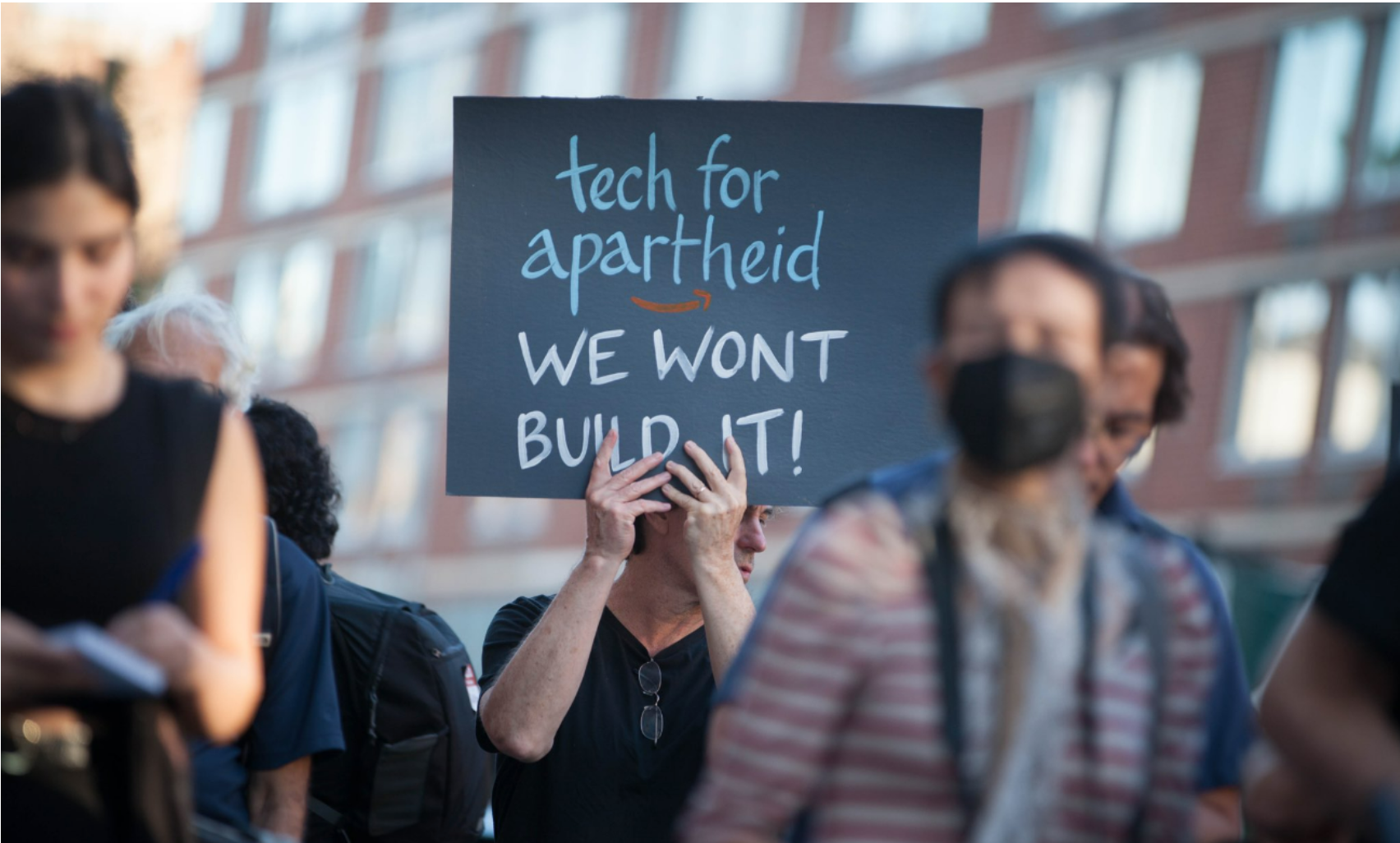
STEM graduates once clamored for jobs in Big Tech, but not so readily anymore. Since Israel began its genocide in Gaza, it has relied on AI and surveillance systems developed by once-dream-job companies like Google, Amazon, and Microsoft. Today, many students and workers, uncomfortable with the prospect of fortifying the Israeli war machine, are engaging in a concerted effort to build alternative futures in technology.

At the center of this organizing are UC Berkeley students, who are just miles away from Silicon Valley. On August 27, 2025, Berkeley Department of Electrical Engineering & Computer Sciences lecturer Peyrin Kao launched an open-ended hunger strike to protest the use of technology in Israel’s genocide in Gaza.

The hunger strike, which lasted 38 days, demanded that the university acknowledge its role in Israel’s genocide and occupation of Gaza and the West Bank, pledge to sever material or financial relationships with the US military, and institutionalize ethical standards aligned with international human rights law.

While Kao suspended his hunger strike because of health concerns, his demands highlighted the University of California’s long-standing entanglement with the military industrial complex. In May 2024, the UC system disclosed that they had $32 billion invested in assets that Palestine solidarity protesters called for divestment from. Research across UC campuses has received $5.6 billion from 2005 to 2022 from the Department of Defense, Lockheed Martin, Raytheon, General Atomics, Boeing, and the Israeli Ministry of Defense. From 2017 to 2022, UC campuses received 1,428 total military-funded research grants.

“There are a lot of moral questions behind what we make and whether they are being used for good or for occupation, apartheid, and genocide,” Kao said. “These things are happening with companies that our students aspire to work for, like Google, Amazon, and Microsoft, and with our university investment. When you don’t say something, you’re making a political choice to say that you’re OK with all of this going on.”

During the hunger strike, students and staff across Berkeley joined Kao on day-long solidarity strikes and a collective of students formed STEM for Palestine, a group that has been organizing for their labor to be used for social good, rather than state violence. The group has hosted teach-ins with former tech workers and has organized mutual aid efforts to support Palestinians in Gaza.

A month after Kao’s hunger strike was announced, UC Berkeley released the names of 160 students and staff who allegedly organized for Palestine to the Trump administration. Kao’s name was included on the list.

In an e-mailed statement to The Nation, UC Berkeley spokesperson Dan Mogulof wrote that the university “maintains an unwavering commitment to free speech and diversity of perspective.” However, in December, UC Berkeley administration suspended Kao for the spring 2026 semester without pay, claiming that he “misused the classroom for the purpose of political advocacy.

Since his suspension, STEM for Palestine has launched an “Open Letter for Peyrin’s Reinstatement,” which has reached nearly 2,000 signatures, mostly from faculty, students, and community members.

“My impression of UC Berkeley as a premier research institution has been greatly altered,” said Leela Mehta-Harwitz, a student and member of STEM for Palestine. Mehta-Harwitz attributes their reappraisal to an “increased realization of how much of that research is directly going into improving bonds, aircraft, and facial recognition systems—everything that allows the Israeli and US governments to directly target Palestinians and undocumented immigrants.”

To promote accountability, STEM for Palestine activists have been compiling research about UC finances on their website, mapping UC investments, listing UC employee wages, and developing a searchable Boycott, Divest, and Sanctions list. Stephen Okita, a UC Berkeley student and member of STEM for Palestine, believes making this research more accessible is critical to keeping divestment alive.

“When the encampments happened, it was the first time that I had hope that we could actually make real change, because we could target the money, which is what you need to target in any movement,” Okita said.

At Berkeley, STEM for Palestine has held teach-ins with former tech workers like Abdo Mohamed to inform students about Big Tech’s complicity in apartheid and hosted alternative career fairs to provide different possibilities in tech. In 2024, Mohamed was fired for organizing a vigil for Palestinians outside Microsoft’s headquarters alongside members of No Azure for Apartheid.

“Every CS student, before they decide where to work, needs to go through and understand the political role of tech, because the only information we receive when we are students is that tech is good,” Mohamed said. “Tech can be good. But we don’t receive the information that tech can be evil. Tech is mostly evil.”

To support ethical alternatives, the Tech for Palestine incubator backs projects and start-ups that either directly or indirectly advocate for Palestine through the form of marketing, mentorship, funding, and networks. Upscrolled, founded by Palestinian-Australian entrepreneur Issam Hijazi, is a social-media platform supported by the incubator. The app, which aims to create a platform free of shadow banning and censorship, has surpassed 2.5 million users globally.

Tech for Palestine also works with former tech workers to provide avenues for workers and students to organize. Hasan Ibraheem, a former Google employee who was fired and arrested during the No Tech for Apartheid sit-in in Google’s New York City office, began building Tech for Liberation, a network to provide students in tech and student organizers resources to connect with former tech workers to build ethical alternatives in the field.

“One of the things that Tech Liberation is trying to do is convince students to keep the mindset that organizing is not something that ends once you graduate,” Ibraheem said. “Hopefully, we can chip away at the culture that these large companies are seen as the place to go and instead see what they really are: companies that are taking contracts regardless of any real concern for human rights.”

Despite active attempts at suppression, students and workers continue to organize. For Peyrin, it is the belief and necessity in a liberated future that continues to be his moral compass.

“The road to an alternative future, as with many other social justice issues right now, leads through Palestine,” Kao said. “Palestine really is a litmus test for these tech companies and these universities in terms of what they’re willing to stand up for. The reason why so many of us are here organizing and putting our careers or our bodies on the line for this issue is because of the continued steadfastness and resilience of the Palestinian people.”

Khadeejah Khan is a writer and student at University of California, Davis.

This story was produced for StudentNation, a program of the Nation Fund for Independent Journalism, which is dedicated to highlighting the best of student journalism. 

/


Source: Jacobin

Amazon delivery drivers in New York wear the company’s uniforms, follow its routes, and are tracked by its software. Yet, legally, they don’t work for Amazon. The Delivery Protection Act (DPA), a bill introduced by socialist New York City Councilor Tiffany Cabán and with a committee hearing scheduled for April 9, would try to resolve that mismatch by requiring certain last-mile delivery facilities to be licensed by the city and, in practice, forcing companies like Amazon to take responsibility for the workforce they already direct. It is the next step in a series of city laws regulating the delivery economy — following minimum pay rules and workplace standards — that have improved conditions at the margins while leaving the structure of the system intact.

That structure is not especially difficult to describe. Amazon runs a delivery network in which drivers’ working conditions and schedules are determined by the e-commerce giant, yet they are formally employed by small contractors known as Delivery Service Partners (DSPs). The company determines how the work is done; the subcontractor absorbs the liability when something goes wrong.

The arrangement has the advantage, from Amazon’s perspective, of allowing it to present itself as both central and peripheral to the job, depending on the circumstance.

“Professional drivers like me power New York’s economy, but every day we have to deal with dangerous working conditions and an employer that acts like we don’t even work for them,” said Luc Rene, a driver at DBK4, an Amazon facility in Queens. “The only way to stop Amazon’s abuse of us and the communities we serve is to pass the Delivery Protection Act.”

“If there’s an issue, Amazon can always say those drivers don’t work for us,” Antonio Rosario, an International Brotherhood of Teamsters (IBT) organizer in the union’s Amazon division, explained. “But when their drivers do something good, all of a sudden they’re Amazon employees. You can’t pick and choose. You have to be responsible to your workforce.”

The same dynamic shows up in the day-to-day economics of the job. DSP owners operate under contracts they do not set, with rates and expectations that can shift, while drivers work under conditions they do not control. The costs accumulate in damaged vans, insurance premiums, fines, injuries — the steady wear and tear of moving packages through the city — while the company directing the system remains insulated from them.

The DPA is written to collapse that arrangement by fixing responsibility in place. “It would hold Amazon accountable to their workforce,” Rosario said. “When you have your hands so deep into the operation — you have your claws sunk into it — you cannot pretend these drivers don’t belong to you.” He describes the subcontracting layer bluntly: the DSP owner, in practice, “is no more than a low-level manager,” with Amazon dictating wages, routes, and conditions. The bill’s licensing requirement is central to that shift. If a company does not comply with the conditions attached to that license, it would not be allowed to continue making last-mile deliveries in the city. As part of the proposed licensing requirements, the bill also requires companies to give workers thirty-day dismissal notice before termination; protects them against retaliation from employers; and requires serious job and safety training by an outside organization.

Who Employs the Drivers?

The IBT’s organizing campaign has been working along the same fault line. The Teamsters have been building unions among DSP drivers by treating Amazon as the real employer behind the system — filing for union recognition, organizing strikes, and pressing joint-employer claims before the National Labor Relations Board (NLRB). In California, where some of those efforts have advanced furthest, labor board officials have already found that Amazon can qualify as a joint employer based on the degree of control it exercises over drivers’ work, even as the company continues to contest those findings.

The same question — who actually employs the drivers — now runs through both the NLRB cases and the New York City legislation. The DPA would not resolve that dispute, but it would shift the terrain on which it is being fought.

Amazon is treating the bill accordingly. The company is lobbying city hall while running a parallel campaign to shape how the work is understood. It has tried to produce a more favorable account from within its workforce. A recent promotion, offering $1,000 prizes to drivers who submit testimonials about why they like their jobs, frames the system as a matter of individual preference rather than one structured by quotas and surveillance. That messaging effort sits alongside a more direct push at elected officials.Responsibility for crashes, tickets, and injuries is pushed down onto the subcontractor — or the driver — rather than the company organizing the system.

“They are definitely going to city council members,” Rosario said. “They are trying to manipulate the narrative.” Amazon representatives have been bringing council members through delivery facilities, he said, with conditions staged in advance: “They usually have the place all cleaned up. . . . They want them to see it at their best.” Workers are selected ahead of time to speak, and what is presented is a controlled version of the operation rather than the conditions drivers describe on the job.

Cabán has described that effort as coordinated. In a video about the legislation, she said Amazon is deploying outside consultants, paid advertising, and a broader messaging campaign — a “full-court press” against the legislation. The scale of the response reflects what is at stake. The bill has majority support in the council for a second time.

National Stakes

For Amazon workers, the stakes extend beyond New York City. IBT leaders have framed the bill as a potential model for other jurisdictions, arguing that if it passes in New York, similar efforts will follow elsewhere.

“We’re confident that New York is going to be the first city in the country to get this done,” said Thomas Gesualdi, president of Teamsters Joint Council 16. “We’re in a new era of politics in the five boroughs — one where workers and their advocates are in the driver’s seat — and this bill embodies that spirit.”

“I’m committed to passing the Delivery Protection Act to protect New Yorkers from dangerous and exploitative last-mile delivery operations,” Cabán said. “With at least half a billion packages expected to be delivered to New Yorkers this year, it’s no surprise that big corporations are fighting tooth and nail to defeat this bill.”

The DPA is framed by its backers as both a labor measure and a public-safety one, tying workplace conditions to the streets those conditions run through — traffic, curb use, emissions — and addressing a regulatory gap that has allowed last-mile facilities to expand with relatively little oversight. A recent New York City Comptroller’s Office report on last-mile delivery impacts links the growth of those facilities to increased traffic risks and workplace hazards and recommends clarifying responsibility for the system as it exists. The DPA follows that logic by fixing responsibility in place.

The answer is not purely technical. The bill’s path runs through city hall, where Mayor Zohran Mamdani has positioned himself in favor of regulating the delivery industry and supporting delivery workers, winning significant wage settlements for workers and directing city agencies to pursue additional enforcement. At this stage, the DPA has not been a central priority of the administration, which is not unusual for a bill still moving through committee, but whether the mayor’s office decides to intervene more directly will matter as the vote approaches. The earlier round of delivery legislation showed that the council can move despite industry opposition; this bill goes further, into the structure of the employment relationship itself, and has drawn a response from Amazon to match.

What the bill targets is a system built on a separation that is visible in the work itself. Drivers move through dense neighborhoods under pressure to meet quotas set by software they do not control, while responsibility for crashes, tickets, and injuries is pushed down onto the subcontractor — or the driver — rather than the company organizing the system. The work is already organized this way; the DPA simply assigns responsibility for it.

Trump administration to rejoin offshore drilling agencies separated after 2010 Gulf oil spill

Lawmakers from both parties and outside critics accused the agency of lax oversight of drilling and cozy ties with industry. A 2008 report by the U.S. Interior Department’s inspector general said employees accepted gifts, steered contracts to favoured clients and engaged in drug use and sex with employees of the energy firms they regulated.

Published: April 03, 2026

Interior Secretary Doug Burgum speaks during a Cabinet meeting at the White House, Thursday, March 26, 2026, in Washington. (AP Photo/Alex Brandon)

WASHINGTON — The Trump administration said Friday it is combining two agencies that were separated in the aftermath of the 2010 Gulf oil spill. The U.S. Interior Department said the overhaul would increase efficiency and speed up permitting for offshore oil and gas drilling.

The new Marine Minerals Administration will bring together the functions of the current U.S. Bureau of Ocean Energy Management and Bureau of Safety and Environmental Enforcement, U.S. Interior Secretary Doug Burgum said. Doing so will enable a “streamlined approach” that will maintain existing regulatory protections and rigorous safety standards, he said.

The combined agency will “deliver clearer coordination, better service to the public and stronger, more integrated oversight of offshore energy development,” Burgum said in a statement.

The new name is reminiscent of the old Minerals Management Service, which for decades was the federal agency responsible for overseeing offshore drilling. In April 2010, a deadly explosion destroyed BP’s Deepwater Horizon drilling rig in the Gulf of Mexico, killing 11 people and discharging nearly five million barrels of crude oil into the sea over the next three months in the largest offshore oil spill in U.S. history.

Lawmakers from both parties and outside critics accused the agency of lax oversight of drilling and cozy ties with industry. A 2008 report by the U.S. Interior Department’s inspector general said employees accepted gifts, steered contracts to favoured clients and engaged in drug use and sex with employees of the energy firms they regulated.

The head of the agency resigned in May 2010 — less than a year into her tenure — under public pressure as the Obama administration moved to impose stricter control over drilling in the wake of the spill.

The U.S. Bureau of Ocean Energy Management and the Bureau of Safety and Environmental Enforcement replaced the disbanded Minerals Management Service in 2011. The former agency’s revenue management function was also separated into a new office. The Obama administration said the reorganization was designed to remove the complex and sometimes conflicting missions of the former agency.

BOEM oversees development of oil and gas, as well as renewable energy and mining on the U.S. Outer Continental Shelf, while BSEE enforces safety and environmental regulations.

Environmental groups slammed the reorganization as a replay of the agency’s troubled past.

The MMS was intentionally split up after the Gulf spill because regulators were too cozy with industry and “we couldn’t trust the integrity of their work,” said Miyoko Sakashita, oceans director at the Center for Biological Diversity.

The new set-up “sounds like yet another handout to the oil industry that will fast-track risky projects. It sure won’t make the people or wildlife on our coasts any safer,” she wrote in an e-mail Friday.

The National Ocean Industries Association, which represents offshore developers, said that two separate — yet overlapping — government agencies responsible for administering the Outer Continental Shelf Lands Act can understandably result in inconsistencies and delays.

“Bringing them back together should result in closer coordination and a more efficiently functioning government, for the benefit of American citizens who rely upon the energy produced from the U.S. Outer Continental Shelf to fuel our economy and lift society,” Association President Erik Milito said in a statement.

___

Jennifer Mcdermott And Matthew Daly, The Associated Press
Canada in the European Union? Poll suggests broad openness to the idea

BEFORE THE UK REJOINS

By The Canadian Press
Published: April 06, 2026 

Canadian Prime Minister Mark Carney takes part in a press conference during the Canada EU Summit in Brussels, Belgium on Monday, June 23, 2025. THE CANADIAN PRESS/Sean Kilpatrick

OTTAWA — New polling suggests a majority of Canadians think Canada ought to explore joining the European Union at a fraught time for geopolitical relations.

A survey of 4,000 people conducted by Spark Advocacy’s polling arm in March found that one in four respondents thought it would be a good idea for Canada to formally join the economic and political bloc of European nations.

A further 58 per cent indicated it was a proposal worth exploring further, while the remainder felt it was a bad idea.


Spark’s chief strategy officer Bruce Anderson says the survey suggests Canadians are increasingly open to finding ways to buck Canada’s reliance on the United States after more than a year of tariffs under U.S. President Donald Trump’s second administration.

France’s foreign minister last month openly floated the idea of Canada joining the EU, while Prime Minister Mark Carney has said he’s looking to deepen trade and security ties with the continent but not as a formal member of the bloc.

The Spark poll cannot be assigned a margin of error because it was conducted online.

This report by The Canadian Press was first published April 6, 2026.

-- with files from Dylan Robertson

Craig Lord, The Canadian Press