Tuesday, April 07, 2026

Pete Hegseth’s Crusade

 April 7, 2026

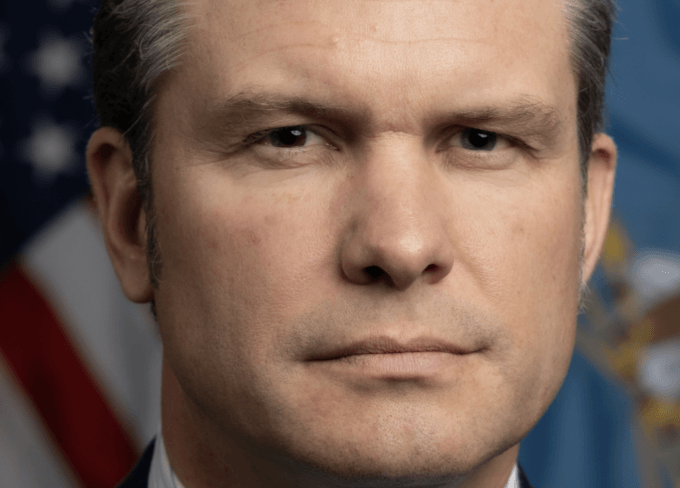
Image Wikipedia.

“When fascism comes to America, it will be wrapped in a flag and carrying a cross.”

– Sinclair Lewis

Sinclair Lewis would have recognized Pete Hegseth immediately—a Christian nationalist whose religious beliefs, tattoos, and now his policies let everyone know he’s on a crusade to do no good. And what more perfect position from which to crusade than secretary of war. This is a man who says: “There would be no Europe and no America” if not for the Crusades—a gross distortion of history that nevertheless shapes his view of the military and US national security.

The US military has become too soft, Hegseth says. It is infested with woke culture and needs to restore a “warrior ethos.” Liberal generals have been recruiting, retaining, and promoting all the wrong people. They need to be rooted out. He has fired or forced out several senior officers, most recently the army chief of staff, and he has blocked promotions of women and Black generals. On the other hand, Hegseth has pardoned soldiers who have been convicted of violating the laws of war. Military justice is wrongheaded when it jails soldiers who are heroes, he has said.

Hegseth and the Press

Like his commander-in-chief, Hegseth despises an inquiring press that raises uncomfortable questions about his policies and tends to support liberal military leaders. The press has been under attack at the Pentagon virtually from the moment he took office. As Michael Wilner and Ana Ceballos have written in the Los Angeles Times, reporters had to sign a 21-page agreement warning them “against ‘soliciting’ information, including unclassified material, without the Pentagon’s official authorization, characterizing individuals who do so as a ‘security risk.’” The policy would have forced journalists and media organizations to refrain from publishing any material that is not approved by the military — a clear violation of First Amendment protections to free speech. Nearly every media outlet joined in refusing to sign the agreement, though a few far-right journalists did sign.

Pentagon’s restrictions on press coverage were ruled unconstitutional by a federal judge on March 20, in a case brought by the Times and one of its reporters. The Times argued that the Pentagon’s new rules violated the First Amendment and the Due Process Clause, as well as the “founding principle that the nation’s security depends upon a free press.” Judge Paul Friedman agreed. He ruled that the Iran war made it “more important than ever that the public have access to information from a variety of perspectives about what its govt is doing.” He was incredulous at the justice department’s argument that journalists don’t have First Amendment protections when they solicit the “disclosure of unauthorized information.” “Why not?” the judge asked. Journalists may ask questions, officials may refuse to answer. End of story? Not quite; days later, the Pentagon ordered that journalists be hosted in an annex to the building, not inside it as has been customary.

God is On Our Side

First Amendment rights are equally under attack from Hegseth’s embrace of an explicitly Christian nationalist perspective, most recently with a speech asking support for US troops fighting in Iran. He urged people to pray “Every day, on bended knee, with your family, in your schools, in your churches,” he said, “in the name of Jesus Christ.” Hegseth truly believes the armed forces have a Christian mission endorsed by God—which includes bombing a Muslim nation back to the stone age—precisely Trump’s language in his April 1 address. As Hegseth has said, “We negotiate by bombing.” This truly un-Christian man has a visceral love of violence. Hegseth has framed the boat attacks, which have killed at least 157 people, as part of a broader war to defend Christian nations from the forces of godless “narco communism” and tyranny.

The New York Times adds to Hegseth’s religious brief: “He prayed to “King Jesus” in the White House at a February dinner for governors. Speaking to a group of largely evangelical broadcasters, he described the United States as a nation founded on Christian principles. “There’s a direct through line from the Old and New Testament Christian gospels to the development of Western civilization and the United States of America,” he told them. Hegseth has invited a Christian nationalist mentor to lecture and lead prayers at the Pentagon, in gross violation of separation of church and state principles.

“Let those who have the power to unleash wars choose peace!” Pope Leo said in his Easter message. “Not a peace imposed by force, but through dialogue! Not with the desire to dominate others, but to encounter them!” But Pete Hegseth isn’t listening.

Non-Christians in the military and chaplains who serve all soldiers are growing restless with Hegseth/s crusade. But his critics in the military fear retribution. “A senior Army civilian who has worked in the Pentagon for decades said people who work there are afraid to talk to one another or their superiors about concerns over Hegseth’s actions,” the New York Times reports. “Retired officers are speaking for them.”

The Times cites two: Retired Army Colonel Larry Wilkerson, who served as chief of staff to Colin Powell, said Hegseth violates “everything that transpired before it.” Retired Army Major General Randy Manner, who was second-in-command at the National Guard from 2011 to 2012, said he has talked with “dozens and dozens” of active-duty chaplains in recent weeks who say those who don’t identify with Hegseth “are being marginalized. They feel they can’t voice their concerns to their own superiors and feel their work as the primary advocate for troops’ spiritual, mental and moral health is being threatened.”

Invoking God and country in American interventions abroad is nothing new. But Pete Hegseth has taken that message a step farther by intertwining his religion with the nation’s military establishment. He should be next in line to be dismissed from the cabinet.

Mel Gurtov is Professor Emeritus of Political Science at Portland State University, Editor-in-Chief of Asian Perspective, an international affairs quarterly and blogs at In the Human Interest.

‘Macron – Whose Wife Treats Him Extremely Badly’: Trump’s Iran War Unraveling


 April 7, 2026

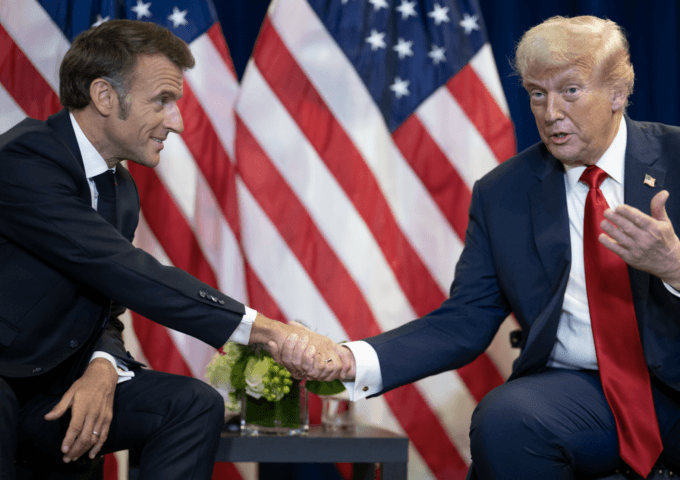
Image by Wikipedia.

“I call up France, Macron – whose wife treats him extremely badly. Still recovering from the right to the jaw.”

It is not the first time that Donald Trump has resorted to this kind of language. But the timing, as always, is everything.

His remarks about Emmanuel Macron, delivered during a private lunch in Washington, were crude and personal, yet also deeply political.

Macron’s response—measured but unmistakable—was to dismiss them as “neither elegant nor up to standard,” adding that they did not merit a reply.

But to treat this as merely another episode of improvised rhetoric is to miss its significance.

Trump’s attack on Macron did not emerge in a vacuum. It came as part of a broader complaint, one that placed France—and by extension other NATO allies—at the center of a narrative of absence.

“We didn’t need them, but I asked anyway,” Trump said, before mocking Macron’s supposed refusal to provide immediate military support in the Gulf.

France, in this framing, is no longer an ally acting according to its own calculations. It becomes something else: an explanation.

This, too, is not new. Trump has long directed extraordinary time and energy toward attacking individuals, often in language that is not only unfit for a president, but for any public figure claiming seriousness or dignity.

At various moments, this behavior was dismissed as style, as bluntness, or even as political theater. Critics pointed to belligerence, bullying, harassment. All true, of course—but not sufficient.

Because there is more to the story.

Another defining aspect of Trump’s political conduct is his relationship with truth. In US media, this is often softened as “contradiction.” But contradictions and lies are not the same. Contradictions can be strategic, even deliberate, aimed at confusing opponents.

What has emerged instead is something far less controlled.

Over time, a different kind of political literacy developed around Trump. His words were not taken at face value, but interpreted. When he lashed out, it was often read as a sign of weakness or insecurity. When he contradicted himself, it was not always confusion—but sometimes fear, or inexperience, or both.

In the early stages of the war with Iran, this unpredictability appeared to work in his favor. Negotiations were opened and undermined. Deadlines were set and broken. Strikes were launched in moments that suggested surprise, even deception. Iran, at least initially, was forced to react.

But that phase is now over.

Trump’s Wednesday speech was meant to restore clarity. Instead, it exposed the problem. He claimed that the war was “nearing completion,” suggesting that it could end within “two to three weeks.” At the same time, he pointed to the extensive destruction of Iran’s military capabilities, presenting the campaign as already successful.

Yet in the same breath, he warned of further escalation, including possible strikes on Iran’s critical infrastructure. The contradiction was not subtle. A war cannot be both nearing its end and preparing to expand.

Even before the speech concluded, events on the ground were moving in a different direction. Iran intensified its operations, expanding both the scope and coordination of its strikes. The conflict was not narrowing. It was widening—geographically, militarily, and politically.

It is here that France becomes central to the story.

If the war is not unfolding as promised, then the narrative must adjust. And in that adjustment, allies take on a new function. France’s hesitation—real or exaggerated—becomes evidence. Its refusal becomes an explanation of why the war is being lost – or won. Its absence fills the gap between what was declared and what is actually happening.

This is not simply rhetoric. It is a method.

Trump’s remarks about Macron were not incidental. They were corrective. They attempted to redistribute responsibility at a moment when the war itself was becoming harder to justify on its own terms. If victory has already been achieved, why does the war continue? If the war must continue, can victory really be claimed?

With his approval ratings declining and public support for the war weakening, Trump has increasing incentive to redirect attention. France, in this context, is a relatively safe target—an ally, but one that can be criticized without immediate political cost at home. By contrast, acknowledging strategic failure or miscalculation would carry far greater consequences.

Thus, the focus shifts. Not to Iran’s expanding capabilities, nor to the unresolved objectives of the war, but to the supposed shortcomings of allies.

This is how narratives are preserved under pressure.

Trump’s language, then, must be read not simply for what it says, but for what it does. It does not describe reality; it reorganizes it. It does not resolve contradictions; it moves them elsewhere.

Over time, this pattern has become increasingly visible. The insults, the contradictions, the shifting targets—all point to a presidency that governs through reaction rather than strategy. Each new statement attempts to impose coherence on events that resist it.

In the case of Iran, this effort is becoming more difficult to sustain. The war was framed as decisive, controlled, and necessary. It is now unfolding in ways that challenge each of those assumptions. The gap between rhetoric and reality is no longer subtle. It is structural.

Future historians are unlikely to write this history based on Trump’s own words. Not because those words are unimportant, but because they cannot be taken at face value. Instead, they will read them against events, against patterns, against the broader trajectory of a political moment defined by volatility.

What they will find is not simply a record of insults or contradictions, but a deeper logic: a presidency attempting to rewrite its own circumstances in real time.

In that effort, even allies are recast as obstacles, and mockery becomes a political weapon.

The attack on Macron is not an insult—it is a confession. Trump is not managing a war; he is managing its failure. What cannot be won on the battlefield is now being displaced onto allies, rewritten in real time, and stripped of any remaining coherence.

Dr. Ramzy Baroud is a journalist, author and the Editor of The Palestine Chronicle. He is the author of six books. His forthcoming book, ‘Before the Flood,’ will be published by Seven Stories Press. His other books include ‘Our Vision for Liberation’, ‘My Father was a Freedom Fighter’ and ‘The Last Earth’. Baroud is a Non-resident Senior Research Fellow at the Center for Islam and Global Affairs (CIGA). His website is www.ramzybaroud.net  

Trump’s barbarous war on Iran, part of a long history of  U.S. war crimes

Tuesday 7 April 2026, by Dan La Botz


President Donald Trump’s war on Iran is barbarous, cruel, vicious, undertaken and carried out without a bit of concern for the millions of human beings it is affecting in Iran, in the region, and throughout the world. The nature of the war was revealed on the first day, 28 February , when the United States hit a school in Minab and killed an estimated 175 people, 100 of them children. Attacks on civilians are a war crime, all too common a war crime in all modern wars. Now Trump is threatening an even greater war crime.

Trump announced a few days ago, “If for any reason a deal is not shortly reached, which it probably will be, and if the Hormuz Strait is not immediately ‘Open for Business,’ we will conclude our lovely ‘stay’ in Iran by blowing up and completely obliterating all of their electric generating plants, oil Wells and kharg Island (and possibly all desalinization plants!), which we have purposefully not yet ‘touched.” In a particularly crude comment he said, “We’re going to bring them back to the Stone Ages, where they belong.” There are 93 million people in Iran, more than 24 million of them are children. What makes these people deserve to live in the Stone Age?

Trump’s callous and cruel statement no doubt results from his racial and religious prejudices as well as from his frustration with the inability to win a clear victory in Iran either in terms of regime change or control of the region and its oil wealth. Frustrated, Trump is prepared to kill more civilians.

After all, the U.S. War on Iraq (2003-11), initiated by George W. Bush and based on the false argument that Saddam Hussein’s government had weapons of mass destruction, killed as many as one million people, 100,000 of them civilians. So why not do the same in Iran?

Trump’s statement is an echo of a remark by the notorious commander of the Strategic Air Command General Curtis LeMay who in his 1965 autobiography, written during the Vietnam War, wrote that North Vietnam should “draw in their horns and stop their aggression, or we’re going to bomb them back into the Stone Age. Adding “And we would shove them back into the Stone Age with Air power or Naval power — not with ground forces.” After LeMay’s retirement, other U.S. air force generals “carpet bombed” Vietnam, killing tens of thousands and perhaps hundreds of thousands of soldiers and civilians.

Twenty years before, during World War II, on March 10, 1945, LeMay had ordered about 300 B-29 bombers to carry out the fire-bombing of Tokyo, temperatures reaching 2,800 degrees Fahrenheit, destroying 16 square miles of the city and killing an estimated 100,000 men, women, and children. Of course, this example helped to make possible the dropping of the atomic bomb on Hiroshima and Nagasaki. Major General Curtis LeMay famously remarked: “If we lose the war, we’ll be tried as war criminals.”

In Europe during World War II, the United States and its allies also bombed the German cities of Hamburg, Dresden, Kassel, and Lubeck, killing tens of thousands of civilians. The bombing is estimated to have killed 600,000 people, including 70,000 children.

The point of making war on civilians, of killing women, children, and the elderly, has always been to demoralize the enemy, to make people miserable, helpless, afraid and prepared to surrender. This is the logic of war. But a people, fighting for their homeland, may not surrender no matter what, perhaps simply leaving a devastated population, as in Gaza.

Trump, like other American presidents—Franklin Roosevelt, Lyndon Johnson, Richard Nixon, and George W. Bush—is willing to kill as many civilians as necessary to win the war. But even so, he may lose it.

Trump’s war on Iran is barbaric and we should do everything possible to end it.