Saturday, February 28, 2026

Source: Waging Nonviolence

Across the country, high school students are organizing walkouts, coalitions and days of action to protest ICE and show solidarity with immigrants.

On Jan. 28, Jalysa, a 17-year-old student at William C. Overfelt High School in East San Jose, California, led a walkout during sixth period. More than half of the students in her school left class and walked 20 minutes to a local Target where people had been targeted by ICE. 

The students chanted “Si, se puede,” “La raza si, la migra no” and “Hey hey, ho ho, ICE has got to go” while waving Mexican flags. They were escorted by grassroots community groups Jalysa had reached out to, who came to show support and act as security. The walkout turned into a protest that included speeches and performances from the school’s mariachi and folklorico teams, as well as Aztec dancers.

“A lot of people, especially adults and Trump supporters, think that the youth are just gonna sit back and let this happen, but we are not for that at all,” said Jalysa, who asked that her last name not be shared due to safety and privacy concerns. “Walkouts raise awareness; it lets everybody know that youth really do care.”

The students at Overfelt High School are among thousands across the country, from California to IowaTexas and Maryland, who have walked out to protest ICE and show solidarity with immigrants in their communities. The walkouts began in early 2025 after Trump’s inauguration, and the tactic reemerged in January following the murders of Renee Good and Alex Pretti and the arrest of five-year-old Liam Ramos by federal immigration agents in Minnesota. Mostly led by juniors and seniors, the students organize on Instagram pages and group chats. While many of the walkouts occurred on or around the Nationwide Day of Action on Jan. 30, students have continued holding walkouts and are forming coalitions across schools to expand their reach.

The Jan. 28 walkout at Overfelt High School marked the first anniversary of a walkout Jalysa organized on Instagram after Trump took office in 2025, inspired by videos of other student walkouts. Since that action, which also drew more than half the school, “I felt like my community and my school just changed so much — we all know that we have something in common now,” Jalysa said. “People actually do want to say something — they just want to see somebody starting it, and then they want to continue it and keep going. I had people come up to me after the walkout and say, ‘I want to help.’”

Prior to the walkouts, Jalysa had conversations with her school administration. Her principal said that he would support the students, and nearly every teacher in the school let Jalysa do an in-class presentation to recruit participants.

Jalysa plans to coordinate with students at other schools to plan another big action for May Day.

“My hope would be to see some change, maybe the government will actually realize that what’s going on is bad,” Jalysa said. “Like, why are you taking families apart? Why are you taking people who obey the laws, who pay taxes? I just find that so devastating. They’ve been doing the same tactics for over 100 years with the Natives, with the Japanese and now with the Latinos. It’s really heartbreaking. I just want people to wake up.”

Building to a statewide walkout

Other coalitional efforts are in the works, like California Youth Unite, a group of students from more than 30 schools around the state organizing a walkout on Feb. 27. The coalition works in collaboration with Black Lives Matter Los Angeles and advocates for an end to policing and surveillance in addition to advocating for immigrant justice. California Youth Unite co-organizer Lauren Chew said she hopes that a mass mobilization of schools, rather than scattered walkouts, will send a message across California that the youth want ICE out of the state. 

“We were hoping that making this a statewide, coordinated but also decentralized movement would enable us to make sure that our politicians, our local governments and all of the people who are involved in ensuring that ICE operates know that we are still watching and that we didn’t just do it to skip school for one day,” said Chew, who is a high school senior in Orange County, California. “We genuinely care about the safety of our neighbors.”

Chew worked with students from San Diego to Sacramento to come up with a list of demands that include the abolition of ICE and transparency in local law enforcement policies, divestment from policing and investment in communities, and protections for students’ free speech. 

She notes that many adult organizers of actions like the Jan. 30 National Shutdown have talked about not going about business as usual — and that students’ business is attending school, so it is their best way to protest.

“We’re drawing attention for disrupting the traditional process [of] going to school,” Chew said. “And I think that’s a really powerful way for us to send a message that the lessons we’re being taught in school — or are supposed to be taught in school — about standing up for justice and freedom need to actually happen. In order for us to do that, we have to take action, even if it means not coming to a class.”

Chew hopes to continue building the network of schools and youth with recurring walkouts, not just a one-time action, and by expanding to offer mutual aid in the community. She also hopes the coalition will help students stay connected to each other once they graduate and go to different schools around the state and country.

Braving repercussions

While Jalysa received support from the Overfelt High School administration for the walkouts, Jaide Kaltenthaler, a 17-year-old student at Rosamond High School in Southern California, had a different experience. When she and a handful of other students approached the administration about their plan to walk out in protest of ICE raids and murders around the country, administrators said that any senior who participated could be banned from prom and barred from the graduation trip to Disneyland without a refund. 

Kaltenthaler and her co-organizers went through with their plan. After a week of promoting it on social media daily, around 100 students had pledged to join. The organizers also arranged an in-school protest for the students who didn’t want to leave school property. 

When Kaltenthaler arrived at school on Feb. 3, the planned day of action, she went straight to the drama room carrying multiple protest signs and supplies to make more. Other organizers brought snacks, water, a first aid kit and more signs. They worked until third period making signs and passed them out during their nutrition break, reminding people that they were walking out. 

Dozens of Rosamond High School students in Southern California walked out on Feb. 3.
Dozens of Rosamond High School students in Southern California walked out on Feb. 3. (Instagram/@rhs.actions

When Kaltenthaler walked out of class at 12:20 p.m., dozens of students were already waiting with signs in the quad. Her co-organizer, Isabel Rojas, played Bad Bunny, Green Day and Maná on a speaker. 

The students walked out of the campus gates and down the street waving their signs and chanting “one struggle, one fight, immigrant rights are human rights” in a protest that lasted two hours.

“I thought that it was important to do the walkout and to protest against ICE because they’re killing citizens, terrorizing neighborhoods and tearing apart families,” Kaltenthaler said. “I think that it’s so disheartening and hope to show that there are people who are holding out hope for and fighting for a better future.”

After the walkout, no students faced repercussions. Rojas said many teachers were supportive and said they were proud of the students. She also said many people encouraged them to continue their organizing, and that the support has inspired them to come up with future plans.

Meanwhile, students and faculty at other schools have seen repercussions. In a Virginia high school, 303 students were suspended for participating in a walkout (they responded by walking out again), and another 100 were suspended in a high school in Oklahoma. The attorney general of Texas launched investigations in four school districts, including Dallas and San Antonio, to see if teachers or administrators facilitated the protests. In Los Angeles, a high school teacher got fired for letting students walk out. 

Standing up for the community 

At Covina High School in Southern California, a small group of students attempted to walkout on the Nationwide Day of Action on Jan. 30, but the vice principal restricted them from doing so.

After witnessing their attempt, junior Mireya Rubio was inspired to organize another walkout with more lead time to prepare and promote it. She got the administration to agree to give students a day of excused absence for the walkout.

“This was something that I saw my school wanted to do, it just needed a lot more organization,” Rubio said. “I didn’t see anyone stepping up for it, so I decided that if no one was going to do it, I would.”

Like Jalysa and Kaltenthaler, Rubio made an Instagram page to promote the walkout. Students from her school quickly followed the page. Other nearby schools messaged her that they were also doing walkouts and asked to collaborate. They formed a coalition of seven schools and made a group chat to coordinate a walkout where they would meet in the same spot to draw more attention. They are timing their walkout for Feb. 27 to be part of California Youth Unite’s statewide action.

When Rubio learned about the East Los Angeles Walkouts of 1968 in her AP History class, she never imagined she would be leading one herself. But as the daughter of immigrants in a predominantly Latino community, she feels like it is important to stand up for immigrant justice. 

“I think that’s the big motivation for me, and why I push so hard to do good in school and organize things like this, because I feel like I want to reward my mom’s sacrifices and everything that she’s done for me and my sister,” Rubio said.

“Most of our community is made up of immigrants and Latinos, so I think people just feel connected to it due to affecting their loved ones, and then personally seeing the fear in our parents every time we go out or hear something,” she said. “I feel like that really motivates a lot of people to try to stand up for change.”

Email

Victoria Valenzuela is an independent journalist in California covering social justice and criminal justice issues. In the past, she has been published in The Guardian, BuzzFeed News, LAist, Bolts, and more. She is also a staffer at ScheerPost and has previously worked with the National Association of Hispanic Journalists, The Marshall Project, and was part of ProPublica's emerging reporter cohort.

From Toledo, Ohio to Rome, Italy: BDS and Grassroots Solidarity Defy the IHRA Smear and Israel’s Genocide

February 27, 2026

Photograph by Assopace Palestina

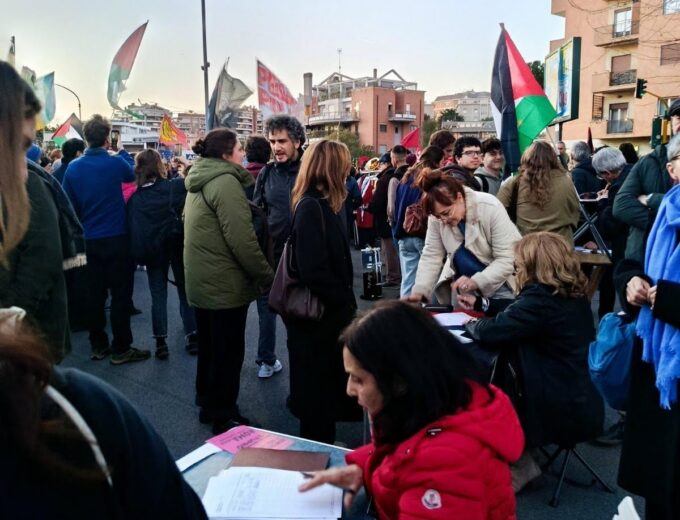
Two cities on opposite sides of the Atlantic—Toledo, Ohio, my hometown, and Rome, the ancient capital of Italy—are rising together in defiance of the same machinery of repression. In both places, local movements are demanding an end to all ties with apartheid Israel, while their respective governments—Ohio’s state legislature and Italy’s national government under Giorgia Meloni—are rushing to codify the controversial IHRA definition of antisemitism into law. This definition, pushed aggressively by pro-Israel lobbies, deliberately equates legitimate criticism of Zionism and Israel’s settler-colonial project with Jew-hatred. The result is a global campaign to criminalize solidarity with Palestine, silence BDS, and shield Israel’s ongoing genocide from accountability. From the banks of the Maumee River to the banks of the Tiber, ordinary people are refusing to be silenced.

The IHRA “working definition,” adopted in 2016 as a non-legally binding tool by the International Holocaust Remembrance Alliance, was never meant to be law. Drafted by Kenneth Stern under the auspices of the American Jewish Committee and the European Monitoring Centre on Racism and Xenophobia in the early 2000s, it defines antisemitism as “a certain perception of Jews, which may be expressed as hatred toward Jews.” However, its 11 examples—particularly those relating to Israel—have been weaponized by Zionist forces to stifle dissent. Examples include “denying the Jewish people their right to self-determination” (e.g., calling Israel a racist endeavor) or “applying double standards” to Israel. Stern himself has warned that it’s being abused to chill free speech, as pro-Israel groups use it to attack academics, activists, and even Jewish critics of Israel. Human Rights Watch, Amnesty International, and Jewish groups like Jewish Voice for Peace have condemned it as a tool for suppressing Palestinian rights advocacy, conflating anti-Zionism with antisemitism to delegitimize calls for justice.

In Italy, Meloni’s far-right government is advancing a bill that adopts an extreme interpretation of the IHRA definition, criminalizing criticism of Israel’s apartheid system and BDS campaigns with fines, prison time, and loss of public funding. In Ohio, Senate Bill 87 seeks to codify a nearly identical definition into state law for use in investigations and ethnic intimidation cases. Both moves are part of the same transnational effort to protect Israel from scrutiny while Gaza is starved and bombed. The message is clear: you may not call genocide by its name, you may not boycott the occupier, and you may not demand justice for Palestinians.

Yet the people are pushing back. In Rome, the committee “Roma sa da che parte stare” (Rome knows which side to take) has launched a citizens’ initiative petition to the City Council, calling for the immediate severance of all institutional, economic, and cultural ties between Roma Capitale and Israeli entities implicated in violations of international law and human rights in the Occupied Palestinian Territory and within Israel. The campaign specifically targets partnerships with companies such as TEVA, the Israeli pharmaceutical giant whose operations are intertwined with the occupation economy, and urges the city to suspend contracts, sponsorships, sister-city agreements, and any other forms of collaboration until the genocide ends and Palestinian rights are upheld. Comprising around twenty organizations united in the struggle for justice, an end to the occupation, and freedom for the Palestinian people, the committee insists that Rome must refuse complicity in Israel’s crimes. Elisabetta Valento of AssoPacePalestina, a key member of the committee, captures the moral clarity driving the campaign: “The committee ‘Roma sa da che parte stare’ presented a proposal for a popular initiative to the City Council of Rome, calling for the termination of collaborations between Roma Capitale and its subsidiaries with Israeli entities due to violations of international law and human rights in the Occupied Palestinian Territory and in Israel.” This citizens’ initiative stands as a bold, unflinching rejection of institutional complicity and a powerful assertion that the Eternal City will not remain silent or neutral while genocide continues.

In Toledo, a determined local campaign is pressing Lucas County to divest from Israeli bonds, refusing to let public money finance apartheid. An advisory committee has already voted to halt future investments, and activists continue to mobilize despite opposition from pro-Israel lobbies. Local activist attorney Terry Lodge, known in activist circles as “the professor,” is at the forefront of the statewide effort. “The Israel lobby’s days are numbered,” Lodge declares. He sharply criticizes Ohio’s Zionist lame duck attorney-general for sending threat letters to county councils, warning that divesting from bonds constitutes a “boycott” and that once purchased, counties can never leave — a “Hotel California” trap. Lodge exposes the hypocrisy of a provision snuck into the 3,100-page state budget bill that forbids local governments from making investment decisions with the primary purpose of influencing any environmental, social, personal, or ideological policy. “The cartoonish hypocrisy of ramming a law through the system with no public visibility, no public hearing and no debate to supposedly outlaw politics from investment decisions isn’t lost on anyone,” he says. Yet Lodge remains optimistic: if the committee maintains its majority, when $5 million in Israel Bonds matures in November, “investing in genocide will be over in Lucas County. And it will have been caused by a smart, diverse and exciting movement acting locally while thinking globally.”

Local Toledo activist Afaf Adwan, who originates from Gaza, embodies the clarity and urgency driving these movements. “It is important that the economic ties to Israel are exposed throughout the country and that these ties are broken,” she declared. “Through Boycotting, Divestment and Sanctioning of Israel we can truly and effectively stop them from continuing the genocide of the Palestinian people and stop their violation of International laws from the West Bank to Gaza.”

The parallels are striking. In both places, grassroots movements rooted in labor, student, faith communities, and immigrant voices are confronting the same IHRA weapon and the same demand for divestment. They understand what the powerful refuse to admit: supporting Israel today means supporting genocide, ethnic cleansing, and apartheid. These are not abstract gestures; they are concrete acts of solidarity from two cities that refuse to be complicit.

This is the real internationalism of our time—people-to-people solidarity that cuts through empire’s divide-and-rule tactics. From the river to the sea, from the Maumee to the Tiber, the struggle for Palestinian liberation is one struggle. The IHRA smear will not stop it. The bans and smears and bond investments will not stop it. The people are rising, and history is on their side.

Free Palestine. Divest from apartheid. Dismantle and block the IHRA criminalization of solidarity. From Toledo to Rome—and everywhere in between—the solidarity will not be silenced.

Michael Leonardi lives in Italy and can be reached at michaeleleonardi@gmail.com


New Tools Aim To Stop Tourism Industry’s Complicity With Genocide

Source: The Canary

Two new digital tools have been released for the sole aim of stopping the tourism industry’s complicity with Israeli apartheid and war crimes against Palestinians.

The coalition of Palestinian groups calling for Boycott, Divestment, Sanctions (BDS) against Israel began its “No Room for Genocide” campaign in 2025. And now, it has released new tools to support this, including:

  • website for “B&B, hostel, or hotel” hosts to make their accommodation “a Sanctuary of Peace”.
  • An Action Network petition for tourists to promise they will stop using Booking.com and Airbnb, which have profited from Israel’s crimes against humanity.

The BDS movement says many have already supported the No Room for Genocide campaign. But it wants even more people in the tourist industry to push government’s to fulfil their obligation under international law by ending “all forms of complicity” in Israel’s crimes.

Explaining its targeting of Booking.com and Airbnb, the campaign said:

Digital travel companies and aggregators, especially @bookingcom and @Airbnb , are complicit in Israel’s apartheid and ethnic cleansing of Indigenous Palestinian communities. They list illegal settlement properties built on stolen Palestinian land, a war crime under international law, as Israeli rentals on their sites.

No Room for Genocide!

The No Room for Genocide campaign, the BDS website explains, is:

calling on global civil society to pressure governments to amend immigration and visa policies to align with international legal standards and obligations… International law is clear on legal obligations of Third States to end all forms of complicity in the commission of Israel’s war crimes, crimes against humanity (including apartheid), and “plausible” genocide.

These include the responsibility to ensure war criminals are denied passage or haven by Third States and prosecuted for their crimes.

There is an overwhelming consensus among ethical experts that Israel has been committing genocide in Gaza. As the Canary has documented in detail:

Genocide scholars, human rights groups, and ethical legal experts agree that Israel is committing genocide against the Palestinian people in Gaza.

The BDS campaign laments, however, that the response of many governments has been woefully insufficient. And that’s why it has been calling for action from ordinary people:

Countering the wilful negligence of states in upholding this responsibility and responding to the Palestinian civil society call to ensure there is No Room for Genocide, small businesses in the hospitality and tourism sector as well as solidarity groups are taking courageous actions. To amplify this campaign and support hospitality business owners, ethical tourism movements and solidarity groups in taking effective action, read and share this campaign toolkit.