Showing posts sorted by relevance for query MayDay. Sort by date Show all posts

Sunday, May 18, 2025


A Tale of Two Maydays


 May 16, 2025
Facebook

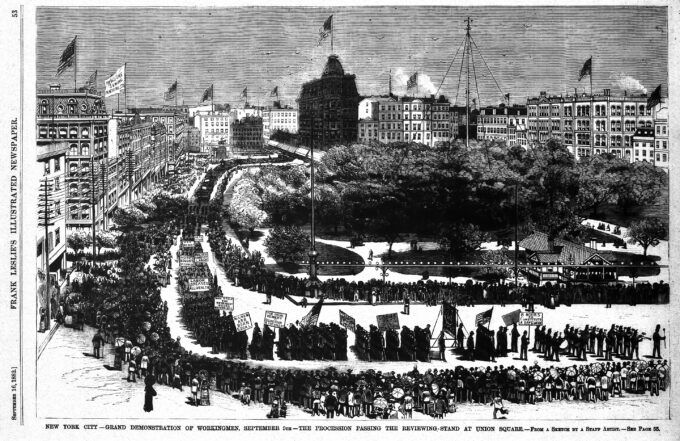
Illustration of the first American Labor parade held in New York City on September 5, 1882 as it appeared in the September 16, 1882 issue of Frank Leslie’s Illustrated Newspaper.

Mayday is a holiday dedicated to international working-class solidarity.

Born in the United States on May 1, 1886, during a time of intense class conflict, Mayday became the recognized labor holiday worldwide. However, it has rarely been celebrated in the US since the beginning of the first Cold War. The largest Maydays in recent history were organized not by unions but by the peace movement in 1971, by immigrant workers in 2006, and the Occupy movement in 2012.

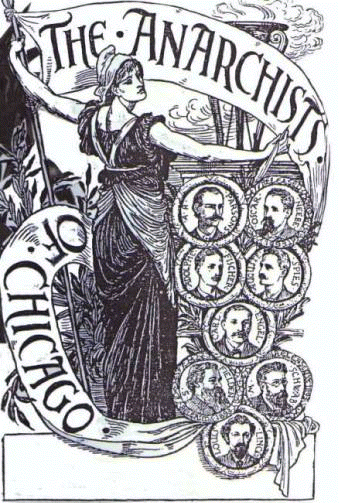
The original May Day was created by a huge mass movement and coordinated strike wave aimed at winning the eight-hour day — at a time when 60- to 80-hour workweeks were both common and deadly. Over 300,000 went on strike across the country. In Chicago, the center of the movement, anarchists, socialists, and union activists organized more than 40,000 to strike. Albert and Lucy Parsons led the Knights of Labor and 100,000 in a peaceful parade marking the first Mayday march. 

A few days later, on May 4, a much smaller rally was organized to protest police violence. As the cops rushed the stage, a bomb exploded. Those responsible for the blast have never been identified. The best-known leaders were rounded up, and four, including Albert Parsons, were hanged for a crime they did not commit. The anarchists were murdered for their ideas and leadership. 

During the late 19th Century, big ideas were widely discussed among everyday people. The biggest question they raised: Was capitalism the best system for running society, or was the new idea of socialism or anarchism a better alternative?

This is the tradition of Mayday, and it’s worth defending.

Mayday 2025

2025 was easily the largest Mayday in my lifetime, and the people prevailed, making it the best as well. Thousands of marchers remained true to its traditions as an international day of labor solidarity. 

The peace movement and calls to end the genocide in Palestine easily outnumbered the pro-war forces, which were quite visible in earlier “Hands Off” marches. ICE and its police state infrastructure were roundly condemned. The Vermont AFL-CIO urged labor to become “Strike Ready” to resist fascism. The rank and file raised positive issues — health care being the most popular. The opposition was there. The rank-and-file marchers made it a May Day to be proud of.

Most importantly, immigrant workers played a leading role in the streets. The last time Mayday was really big was in 2006, when Latino immigrants led a one-day general strike called the  “Great American Boycott.” Approximately one million people in 50 US cities participated in one of the largest days of protest in American history. The voices of that Mayday are still heard today.

Mayday and the Machine

Mayday was so large, in part, because it was sanctioned by the Democrats through their loyal organizations. This carefully permitted event was without a disruptive police presence, let alone the kind of brutality student protesters faced on Mayday 2024. Perhaps that allowed people to feel safe and was part of the reason the people, including the most vulnerable, showed up in such large numbers.

The size of the protest is all the more remarkable because most US unions rarely celebrated Mayday, sticking instead to the parades and picnics of Labor Day in September. To point to Trump’s very real threat against workers is obvious, true, and certainly speaks to the motivation of the rank and file. But does this embrace of Mayday mean a new, more class-conscious labor movement is being born? Time will tell, but the long, steady love affair between most labor officials and the Democrats casts that into serious doubt. This would hardly be the first time that the rank and file have run ahead of the official leaders.

The Democratic Party’s support for Mayday is truly unprecedented. Does it mean that the day to celebrate international working-class solidarity was actually organized by a political party dominated by big-money oligarchs and guilty of an ongoing genocide? Are we to believe that something historic is afoot, or is this a replay of the Democrats’ embrace of MLK Day — while undermining everything King ever stood for? Are the Democrats really going for the billionaires’ throat, or is this just get-out-the-vote?

Mayday 2025 was partly the work of loyal Democratic groups, such as 50501 and Indivisible. Maybe that is why some of the Mayday events seemed to vary little from the early Hands-Off rallies—all anti-Trump without a systematic critique or a positive program, but with a leadership hiding Palestine and supporting NATO and the war machine.

The Democratic Party’s version of Mayday was most famously represented by its evangelist extraordinaire: Senator Sanders. His ongoing attempts to redeem the Democrats are a self-described move to “strengthen American Democracy where faith in both the Democratic and Republican Parties is extremely low.” Now, would a leader true to the tradition of Mayday make it a day to challenge the system or prop it up?

All Sanders has to do to reclaim Mayday is say the following words: “The Israeli genocide against the Palestinian people could not have happened without the support and consent of the US government. I urge you to do everything you can to bring an end to genocide.” And, “We will never have leverage against the Democrats or Republicans until we create a real opposition and a credible threat of exit. I urge you to support and join the third party of your choice.” 

The redemption of the party of war, genocide, and austerity is not a price we have to pay for resisting Trump’s fascism. Genocide is fascism at its most evil. Redeeming the Democrats is just pushing lesser evil thinking to its final, lowest possible point — the lesser of two evil fascisms. Has it really come to that? Not if the tradition of Mayday holds.

What Are Workers To Make Of Dual Maydays?

The great Black intellectual W.E.B. Du Bois and Italian Communist Antonio Gramsci helped us to unlock the secrets of our collective mind with the concept of dual consciousness. We all have to contend with a volatile blend of ruling-class and oppositional ideas that make up what we believe to be “reality” or “common sense,” and even our sense of ourselves.

“It is a peculiar sensation, this double consciousness, this sense of always looking at one’s self through the eyes of others, of measuring one’s soul by the tape of the world that looks on in amused contempt and pity.”

– W.E.B. Du Bois, The Souls of Black Folks

This contradictory common sense allows for, and sometimes even encourages our resistance— just so long as we understand ourselves “through the eyes of others,” just so long as we accommodate ourselves to the established order in the end. 

The trap is set, and it will lure us in as long as Marx’s observation remains true: “The ideas of the ruling class are in every epoch the ruling ideas.” The idea that the problem is far greater than Trump—that a system of corporate power and empire managed by both ruling parties produced him and his fascism—bursts the bounds of ruling class thinking. 

The loyal left serves the existing order by diluting working-class consciousness with partisan loyalty, disciplining the movement to the machine. More than that, the loyalists who tried to steer Mayday into safe channels had one overriding effect: to make independent action by the working class seem inconceivable. But is it?

The Mayday marchers might just be harbingers of a real opposition. They hinted at what we should all know deep in our bones: the ruling class is neither pre-ordained nor eternal. Their rule is historical, and history is far from over. As we build a genuine opposition, our goal is to learn to think and act for ourselves. Mayday was a success not because of the intention of its leaders but because it may have helped unleash the forces of change. I double-dog dare the same leaders to call a general strike.

On Mayday, we recognize ourselves as a class of the vast majority who, through our labors, produce all wealth. We are aligned against Capital in whatever form big money takes. In our time, corporations and their merger with the state is the nursery for all oligarchs and all forms of fascism. 

Only by our actions can we legitimately claim to represent the aspirations of all people for a better life, from the concrete demands of daily life to the lofty goal of liberation.

Richard Moser writes at befreedom.co where this article first appeared.

Monday, May 01, 2006

The Origins and Traditions of May Day

I wrote the Origins and Traditions of Mayday in 1997. Yes way back then, it was one of my first web postings. It was used to launch MayDay on the Web and the Edmonton May Week celebrations that have continued since.

Here it is again and the original web page is here.

An Australian labour historian used it as the basis for his article on May Day which expands on my points.

THE ORIGINS AND TRADITIONS OF MAYDAY

By Eugene W. Plawiuk


The international working class holiday; Mayday,
originated in pagan Europe. It was a festive holy day
celebrating the first spring planting. The ancient
Celts and Saxons celebrated May 1st as Beltane or the
day of fire. Bel was the Celtic god of the sun.

The Saxons began their May day celebrations on the eve
of May, April 30. It was an evening of games and
feasting celebrating the end of winter and the return
of the sun and fertility of the soil. Torch bearing
peasants and villager would wind their way up paths to
the top of tall hills or mountain crags and then
ignite wooden wheels which they would roll down into
the fields

The May eve celebrations were eventually outlawed by
the Catholic church, but were still celebrated by
peasants until the late 1700's. While good church
going folk would shy away from joining in the
celebrations, those less afraid of papal authority
would don animal masks and various costumes, not
unlike our modern Halloween. The revelers, lead by the
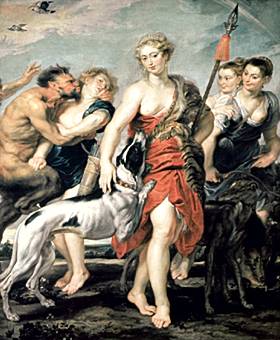
Goddess of the Hunt; Diana (sometimes played by a
pagan-priest in women's clothing) and the Horned God;
Herne, would travel up the hill shouting, chanting and
singing, while blowing hunting horns. This night
became known in Europe as Walpurgisnacht, or night of
the witches

The Celtic tradition of Mayday in the British isles
continued to be celebrated through-out the middle ages
by rural and village folk. Here the traditions were
similar with a goddess and god of the hunt.

As European peasants moved away from hunting gathering
societies their gods and goddesses changed to reflect
a more agrarian society. Thus Diana and Herne came to
be seen by medieval villagers as fertility deities of
the crops and fields. Diana became the Queen of the
May and Herne became Robin Goodfellow (a predecessor
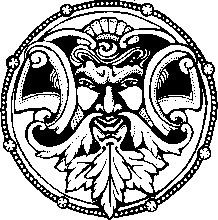
of Robin Hood) or the Green Man.

The Queen of the May reflected the life of the fields
and Robin reflected the hunting traditions of the
woods. The rites of mayday were part and parcel of
pagan celebrations of the seasons. Many of these pagan
rites were later absorbed by the Christian church in
order to win over converts from the 'Old Religion'.

Mayday celebrations in Europe varied according to
locality, however they were immensely popular with
artisans and villagers until the 19th Century. The
Christian church could not eliminate many of the
traditional feast and holy days of the Old Religion so
they were transformed into Saint days.

During the middle ages the various trade guilds
celebrated feast days for the patron saints of their
craft. The shoemakers guild honored St. Crispin, the
tailors guild celebrated Adam and Eve. As late as the
18th century various trade societies and early
craft-unions would enter floats in local parades still
depicting Adam and Eve being clothed by the Tailors
and St. Crispin blessing the shoemaker.

The two most popular feast days for Medieval craft
guilds were the Feast of St. John, or the Summer
Solstice and Mayday. Mayday was a raucous and fun
time, electing a queen of the May from the eligible
young women of the village, to rule the crops until
harbest. Our tradition of beauty pagents may have
evolved , albeit in a very bastardized form, from the
May Queen.

Besides the selection of the May Queen was the raising
of the phallic Maypole, around which the young single
men and women of the village would dance holding on to
the ribbons until they became entwined, with their (
hoped for) new love.

And of course there was Robin Goodfellow, or the Green
Man who was the Lord of Misrule for this day. Mayday
was a celebration of the common people, and Robin
would be the King/Priest/Fool for a day. Priests and
Lords were the butt of many jokes, and the Green Man
and his supporters; mummers would make jokes and poke
fun of the local authorities. This tradition of satire
is still conducted today in Newfoundland, with the
Christmas Mummery.

The church and state did not take kindly to these
celebrations, especially during times of popular
rebellion. Mayday and the Maypole were outlawed in the
1600's. Yet the tradition still carried on in many
rural areas of England. The trade societies still
celebrated Mayday until the 18th Century.

As trade societies evolved from guilds, to friendly
societies and eventually into unions, the craft
traditions remained strong into the early 19th
century. In North America Dominion Day celebrations in
Canada and July 4th celebrations in the United States
would be celebrated by tradesmen still decorating
floats depicting their ancient saints such as St.
Crispin.


Our modern celebration of Mayday as a working class
holiday evolved from the struggle for the eight hour
day in 1886. May 1, 1886 saw national strikes in the
United States and Canada for an eight hour day called
by the Knights of Labour. In Chicago police attacked
striking workers killing six.
The next day at a demonstration in Haymarket Square to
protest the police brutality a bomb exploded in the
middle of a crowd of police killing eight of them. The
police arrested eight anarchist trade unionists
claiming they threw the bombs. To this day the subject
is still one of controversy. The question remains
whether the bomb was thrown by the workers at the
police or whether one of the police's own agent
provocateurs dropped it in their haste to retreat from
charging workers.

In what was to become one of the most infamous show
trials in America in the 19th century, but certainly
not to be the last of such trials against radical
workers, the State of Illinois tried the anarchist
workingmen for fighting for their rights as much as
being the actual bomb throwers. Whether the anarchist
workers were guilty or innocent was irrelevant. They
were agitators, fomenting revolution and stirring up
the working class, and they had to be taught a lesson.


Albert Parsons, August Spies, George Engle and Adolph
Fischer were found guilty and executed by the State of
Illinois.

In Paris in 1889 the International Working Men's
Association (the First International) declared May 1st
an international working class holiday in
commemoration of the Haymarket Martyrs. The red flag
became the symbol of the blood of working class
martyrs in their battle for workers rights.

Mayday, which had been banned for being a holiday of
the common people, had been reclaimed once again for
the common people.


Find blog posts, photos, events and more off-site about:
, , ,
, , , ,

Wednesday, May 01, 2024

 The Origins and Traditions of May Day


I wrote the Origins and Traditions of Mayday in 1997. Yes way back then, it was one of my first web postings. It was used to launch MayDay on the Web and the Edmonton May Week celebrations that have continued since.

Here it is again and the original web page is here.

An Australian labour historian used it as the basis for his article on May Day which expands on my points.

THE ORIGINS AND TRADITIONS OF MAYDAY

By Eugene W. Plawiuk

The international working class holiday; Mayday,
originated in pagan Europe. It was a festive holy day
celebrating the first spring planting. The ancient
Celts and Saxons celebrated May 1st as Beltane or the
day of fire. Bel was the Celtic god of the sun.

The Saxons began their May day celebrations on the eve
of May, April 30. It was an evening of games and
feasting celebrating the end of winter and the return
of the sun and fertility of the soil. Torch bearing
peasants and villager would wind their way up paths to
the top of tall hills or mountain crags and then
ignite wooden wheels which they would roll down into
the fields

The May eve celebrations were eventually outlawed by
the Catholic church, but were still celebrated by
peasants until the late 1700's. While good church
going folk would shy away from joining in the
celebrations, those less afraid of papal authority
would don animal masks and various costumes, not
unlike our modern Halloween. The revelers, lead by the
Goddess of the Hunt; Diana (sometimes played by a
pagan-priest in women's clothing) and the Horned God;
Herne, would travel up the hill shouting, chanting and
singing, while blowing hunting horns. This night
became known in Europe as Walpurgisnacht, or night of
the witches

The Celtic tradition of Mayday in the British isles
continued to be celebrated through-out the middle ages
by rural and village folk. Here the traditions were
similar with a goddess and god of the hunt.

As European peasants moved away from hunting gathering
societies their gods and goddesses changed to reflect
a more agrarian society. Thus Diana and Herne came to
be seen by medieval villagers as fertility deities of
the crops and fields. Diana became the Queen of the
May and Herne became Robin Goodfellow (a predecessor
of Robin Hood) or the Green Man.

The Queen of the May reflected the life of the fields
and Robin reflected the hunting traditions of the
woods. The rites of mayday were part and parcel of
pagan celebrations of the seasons. Many of these pagan
rites were later absorbed by the Christian church in
order to win over converts from the 'Old Religion'.

Mayday celebrations in Europe varied according to
locality, however they were immensely popular with
artisans and villagers until the 19th Century. The
Christian church could not eliminate many of the
traditional feast and holy days of the Old Religion so
they were transformed into Saint days.

During the middle ages the various trade guilds
celebrated feast days for the patron saints of their
craft. The shoemakers guild honored St. Crispin, the
tailors guild celebrated Adam and Eve. As late as the
18th century various trade societies and early
craft-unions would enter floats in local parades still
depicting Adam and Eve being clothed by the Tailors
and St. Crispin blessing the shoemaker.

The two most popular feast days for Medieval craft
guilds were the Feast of St. John, or the Summer
Solstice and Mayday. Mayday was a raucous and fun
time, electing a queen of the May from the eligible
young women of the village, to rule the crops until
harbest. Our tradition of beauty pagents may have
evolved , albeit in a very bastardized form, from the
May Queen.

Besides the selection of the May Queen was the raising
of the phallic Maypole, around which the young single
men and women of the village would dance holding on to
the ribbons until they became entwined, with their (
hoped for) new love.

And of course there was Robin Goodfellow, or the Green
Man who was the Lord of Misrule for this day. Mayday
was a celebration of the common people, and Robin
would be the King/Priest/Fool for a day. Priests and
Lords were the butt of many jokes, and the Green Man
and his supporters; mummers would make jokes and poke
fun of the local authorities. This tradition of satire
is still conducted today in Newfoundland, with the
Christmas Mummery.

The church and state did not take kindly to these
celebrations, especially during times of popular
rebellion. Mayday and the Maypole were outlawed in the
1600's. Yet the tradition still carried on in many
rural areas of England. The trade societies still
celebrated Mayday until the 18th Century.

As trade societies evolved from guilds, to friendly
societies and eventually into unions, the craft
traditions remained strong into the early 19th
century. In North America Dominion Day celebrations in
Canada and July 4th celebrations in the United States
would be celebrated by tradesmen still decorating
floats depicting their ancient saints such as St.
Crispin.


Our modern celebration of Mayday as a working class
holiday evolved from the struggle for the eight hour
day in 1886. May 1, 1886 saw national strikes in the
United States and Canada for an eight hour day called
by the Knights of Labour. In Chicago police attacked
striking workers killing six.
The next day at a demonstration in Haymarket Square to
protest the police brutality a bomb exploded in the
middle of a crowd of police killing eight of them. The
police arrested eight anarchist trade unionists
claiming they threw the bombs. To this day the subject
is still one of controversy. The question remains
whether the bomb was thrown by the workers at the
police or whether one of the police's own agent
provocateurs dropped it in their haste to retreat from
charging workers.

In what was to become one of the most infamous show
trials in America in the 19th century, but certainly
not to be the last of such trials against radical
workers, the State of Illinois tried the anarchist
workingmen for fighting for their rights as much as
being the actual bomb throwers. Whether the anarchist
workers were guilty or innocent was irrelevant. They
were agitators, fomenting revolution and stirring up
the working class, and they had to be taught a lesson.

Albert Parsons, August Spies, George Engle and Adolph
Fischer were found guilty and executed by the State of
Illinois.

In Paris in 1889 the International Working Men's
Association (the First International) declared May 1st
an international working class holiday in
commemoration of the Haymarket Martyrs. The red flag
became the symbol of the blood of working class
martyrs in their battle for workers rights.

Mayday, which had been banned for being a holiday of
the common people, had been reclaimed once again for
the common people.


Monday, May 01, 2006

Sunday, April 30, 2023

The Origins and Traditions of May Day

Monday, May 01, 2006

I wrote the Origins and Traditions of Mayday in 1997. Yes way back then, it was one of my first web postings. It was used to launch MayDay on the Web and the Edmonton May Week celebrations that have continued since.

Here it is again and the original web page is here.

An Australian labour historian used it as the basis for his article on May Day which expands on my points.

THE ORIGINS AND TRADITIONS OF MAYDAY

By Eugene W. Plawiuk

The international working class holiday; Mayday,
originated in pagan Europe. It was a festive holy day
celebrating the first spring planting. The ancient
Celts and Saxons celebrated May 1st as Beltane or the
day of fire. Bel was the Celtic god of the sun.

The Saxons began their May day celebrations on the eve
of May, April 30. It was an evening of games and
feasting celebrating the end of winter and the return
of the sun and fertility of the soil. Torch bearing
peasants and villager would wind their way up paths to
the top of tall hills or mountain crags and then
ignite wooden wheels which they would roll down into
the fields

The May eve celebrations were eventually outlawed by
the Catholic church, but were still celebrated by
peasants until the late 1700's. While good church
going folk would shy away from joining in the
celebrations, those less afraid of papal authority
would don animal masks and various costumes, not
unlike our modern Halloween. The revelers, lead by the
Goddess of the Hunt; Diana (sometimes played by a
pagan-priest in women's clothing) and the Horned God;
Herne, would travel up the hill shouting, chanting and
singing, while blowing hunting horns. This night
became known in Europe as Walpurgisnacht, or night of
the witches

The Celtic tradition of Mayday in the British isles
continued to be celebrated through-out the middle ages
by rural and village folk. Here the traditions were
similar with a goddess and god of the hunt.

As European peasants moved away from hunting gathering
societies their gods and goddesses changed to reflect
a more agrarian society. Thus Diana and Herne came to
be seen by medieval villagers as fertility deities of
the crops and fields. Diana became the Queen of the
May and Herne became Robin Goodfellow (a predecessor
of Robin Hood) or the Green Man.

The Queen of the May reflected the life of the fields
and Robin reflected the hunting traditions of the
woods. The rites of mayday were part and parcel of
pagan celebrations of the seasons. Many of these pagan
rites were later absorbed by the Christian church in
order to win over converts from the 'Old Religion'.

Mayday celebrations in Europe varied according to
locality, however they were immensely popular with
artisans and villagers until the 19th Century. The
Christian church could not eliminate many of the
traditional feast and holy days of the Old Religion so
they were transformed into Saint days.

During the middle ages the various trade guilds
celebrated feast days for the patron saints of their
craft. The shoemakers guild honored St. Crispin, the
tailors guild celebrated Adam and Eve. As late as the
18th century various trade societies and early
craft-unions would enter floats in local parades still
depicting Adam and Eve being clothed by the Tailors
and St. Crispin blessing the shoemaker.

The two most popular feast days for Medieval craft
guilds were the Feast of St. John, or the Summer
Solstice and Mayday. Mayday was a raucous and fun
time, electing a queen of the May from the eligible
young women of the village, to rule the crops until
harbest. Our tradition of beauty pagents may have
evolved , albeit in a very bastardized form, from the
May Queen.

Besides the selection of the May Queen was the raising
of the phallic Maypole, around which the young single
men and women of the village would dance holding on to
the ribbons until they became entwined, with their (
hoped for) new love.

And of course there was Robin Goodfellow, or the Green
Man who was the Lord of Misrule for this day. Mayday
was a celebration of the common people, and Robin
would be the King/Priest/Fool for a day. Priests and
Lords were the butt of many jokes, and the Green Man
and his supporters; mummers would make jokes and poke
fun of the local authorities. This tradition of satire
is still conducted today in Newfoundland, with the
Christmas Mummery.

The church and state did not take kindly to these
celebrations, especially during times of popular
rebellion. Mayday and the Maypole were outlawed in the
1600's. Yet the tradition still carried on in many
rural areas of England. The trade societies still
celebrated Mayday until the 18th Century.

As trade societies evolved from guilds, to friendly
societies and eventually into unions, the craft
traditions remained strong into the early 19th
century. In North America Dominion Day celebrations in
Canada and July 4th celebrations in the United States
would be celebrated by tradesmen still decorating
floats depicting their ancient saints such as St.
Crispin.


Our modern celebration of Mayday as a working class
holiday evolved from the struggle for the eight hour
day in 1886. May 1, 1886 saw national strikes in the
United States and Canada for an eight hour day called
by the Knights of Labour. In Chicago police attacked
striking workers killing six.
The next day at a demonstration in Haymarket Square to
protest the police brutality a bomb exploded in the
middle of a crowd of police killing eight of them. The
police arrested eight anarchist trade unionists
claiming they threw the bombs. To this day the subject
is still one of controversy. The question remains
whether the bomb was thrown by the workers at the
police or whether one of the police's own agent
provocateurs dropped it in their haste to retreat from
charging workers.

In what was to become one of the most infamous show
trials in America in the 19th century, but certainly
not to be the last of such trials against radical
workers, the State of Illinois tried the anarchist
workingmen for fighting for their rights as much as
being the actual bomb throwers. Whether the anarchist
workers were guilty or innocent was irrelevant. They
were agitators, fomenting revolution and stirring up
the working class, and they had to be taught a lesson.

Albert Parsons, August Spies, George Engle and Adolph
Fischer were found guilty and executed by the State of
Illinois.

In Paris in 1889 the International Working Men's
Association (the First International) declared May 1st
an international working class holiday in
commemoration of the Haymarket Martyrs. The red flag
became the symbol of the blood of working class
martyrs in their battle for workers rights.

Mayday, which had been banned for being a holiday of
the common people, had been reclaimed once again for
the common people.