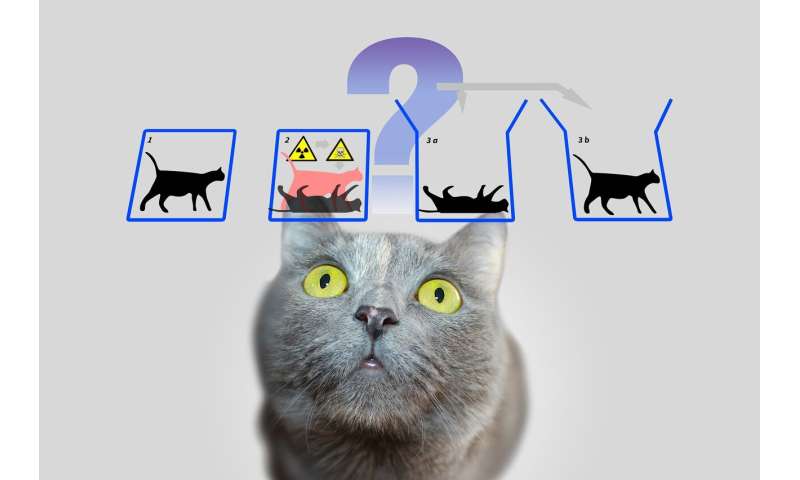
Showing posts sorted by relevance for query SCHRODINGER'S CAT. Sort by date Show all posts

Sunday, May 05, 2019


Fake mews? Confusion over cat at Thai king's coronation ceremony


A SCHRODINGER'S CAT CONUNDRUM; IS THE CAT REAL OR FAKE 


WORLD NEWS
MAY 5, 2019 


BANGKOK (Reuters) - Animal lovers in Thailand were thrown into confusion on Sunday over whether a Siamese cat presented to the newly crowned Thai king and his queen was a living feline - or not.

Royal officials place a chicken and a cat next to the bed of Thailand's King Maha Vajiralongkorn during the ceremony of Assumption of the Royal Residence inside the Grand Palace in Bangkok, Thailand, May 4, 2019. Picture taken May 4, 2019. The Committee on Public Relations of the Coronation of King Rama X via REUTERS

Thailand is holding three days of coronation events for King Maha Vajiralongkorn, 66, who was officially crowned on Saturday in elaborate ceremonies.

It is tradition at royal coronations to present a cat - as well as several symbolic household items - to a new monarch as part of the private Assumption of the Royal Residence blessing ceremony, which was held on Saturday at the Chakrabat Biman residence.

Cats are considered lucky by many Thais and the tradition of giving one as a housewarming gift signifies a stable home.

On Sunday morning, several Thai media outlets carried a photo of two uniformed palace officials next to what appeared to be a docile Siamese cat and a fluffy white rooster. The image, distributed by the Bureau of the Royal Household, was not captioned.

But by afternoon, the Thai-language news site Manager was reporting that the palace had used a “cat doll” instead of a live cat.


A palace official, contacted by Reuters, said: “The royal ceremony required the use of a rooster and a cat. It should not be the focus whether the animals were real or not, but instead the ritual itself is important.”

Reuters was unable to independently confirm whether live animals were used in the ceremony or the photograph


A Facebook page Maewthai.com - “ThaiCat.com” - posted a copy of the palace photo with a message from a well-known cat breeder saying he originally had been asked to select two gentle male Siamese cats for the ceremony but his cats were ultimately not used.

“I feel grateful for His Majesty’s kindness for feeling compassionate about the cats, fearing that the animal would suffer from waiting too long during ceremonies, so the cats were not used,” said the breeder, whose post did not identify him by name.

The breeder did not directly address whether the cat in the palace photo was a doll.

That ambiguity confused some Thais who posted comments online.

“So is it real or fake cat?” a Facebook user called Niphawan Rakpontee asked.

Another user named Krittaya Parichayanan said “It’s a real cat isn’t it?”

“This is likely a stuffed cat,” user Prapaporn Tongprasan said.


Thailand has strict lese majeste laws carrying prison sentences of up to 15 years for insulting the king, queen or the heir-apparent.

Historical images of the 1926 coronation of King Rama VII, the current monarch’s great uncle, show a group photo with female members of the royal family holding both a Siamese cat - a breed that originated in Thailand - as well as a rooster.

The tradition of using cats in royal household ceremonies dates back centuries, said historian and writer Sujane Kanparit.


“The meaning of having a cat is that it brings warmth to the household. It is an old court tradition that has appeared in the royal chronicles,” he told Reuters.

Asked if the cat in the palace photo was alive or a doll, Sujane said: “I have no idea.”
Writing by Kay Johnson; Editing by Frances Kerry

Sunday, May 25, 2025


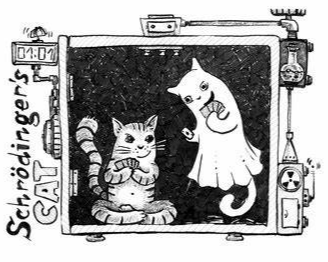
Making Sense of Schrodinger’s Cat


Review of "The Midnight Library"


How can a cat be alive and dead at the same time?

I love how science has rediscovered religion. Leaving aside the Big Bang theory of the origin of the universe, the universe itself is conscious. In the beginning was consciousness — inner light. Then there was outer light, etc. Mind you it took billions of years, but what’s that in divine reckoning? Religion was the first ‘science’, followed by astrology. Now both despised. How times have changed.

The scientific method, induction, deduction, math/physics, Darwin are all latecomers, though Darwin marks the beginning of the return to metaphysics. His theory was turned into a mindless, machine-like Nature, to be deconstructed, dissected (gruesomely for billions of guinea pigs), but a careful reading shows he was not so scientistic as the Darwinian Establishment that followed him. He admitted we’ll never understand the peacock. Beauty.

Henri Bergson started from there and developed a more lively ‘creative evolution‘ which was more or less politely ignored by science, though the Nobel committee awarded him the prize for literature in 1927, ‘in recognition of his rich and vitalizing ideas and the brilliant skill with which they have been presented.’ For a conscious being to exist is to change, to mature, i.e. to go on creating oneself endlessly. Realizing that, Bergson asked: Is it the same for existence in general? Nature is the epitome of creative change, leading to a dazzling, even outrageous variety and beauty.

Is beauty the end goal of a divine process that started with pure consciousness? We bemoan species extinction (rightly as we are here as stewards of Nature), but already 99% of species over time have gone extinct, replaced by others, better adapted to the changing environment (at least until humans starting wiping them out like a house on fire).

I’m okay with the idea of antimatter, dark matter, dark energy, quantum theory, being in two places at the same time, time slowing down the faster you go, everyone ‘marching to their own tune’, but I could never get a grip on multiverses, Schrodinger’s cat being alive and dead at the same time. I’d given up until today, finishing The Mindight Library (2020) by Matt Haig.

Who was that? Oh, just someone I knew in another life.

It starts with Nora’s countdown to her decision to commit suicide. Everything she wanted or tried to do seemed to lead to failure and when she backed out of her marriage, was fired and then her cat died (outside in the rain by the road, retrieved and buried by Ash) and when no one answered her texts/ phone – all this in a dank flat in dreary Bedford, she swallowed sleeping pills and passed out. Nora enters a twilight zone, a library run by her high-school librarian Mrs Elm, a soulmate that had seen her through parental death and her own depressive state.

Mrs Elm gives her The Book of Regrets, Nora’s own missed opportunities in life, roads not taken, and Nora begins her adventures, seeking out her one ‘true’ happy, successful life journey, which she can try out, as each missed opportunity represents an alternate universe in what science now insists is a multiverse, though no one really understands what that means.

Haig seems to, and puts meat on Schrodinger’s bones. Nora wants a live where she took better care of Voltaire, her rescue kitty, so it would live longer. Suddenly she’s lying in bed again, awake, calling for Volts, finally finding him under the bed, cold and dead. He’s still dead! Not the life she wants, so she’s spirited back to the library to try again.

Mrs Elm explains that Volts had a weak heart and no doubt knew its time was near, asked to go out and die alone in peace, i.e., it wasn’t her fault. ‘Some regrets,’ the prim librarian tells Nora, ‘are a load of bullshit. The only way to learn that is to live.’ So one regret down, many to go. In another alt-life, Voltaire, aka Schrodinger’s Cat, is still alive, a healthy Siamese.

The novel really just describes Nora’s last minutes before death as an out-of-body event, a fact that is well-documented. There are many instances of people who have experienced a near- or after-death experience (NDE), an alternate reality, where they could choose to stay or return to the ‘real’ world (though that would be painful).

Coppola’s Youth without Youth (1976) is based on Mircea Eliade’s eponymous novel explaining time, consciousness, and the fantastic foundations of reality. Protagonist Dominic manages to live a few alternate realities after lightning gave him a new life. This is also a take on Nietzsche’s eternal recurrence. I like Haig’s variation on this theme because, well, consciousness is enough of a miracle for me.

So the original Voltaire is dead in one universe and alive in another. Nora standing up her fiance turns out to have been a very wise decision, as were all but one of her alt-lives, where she is happily married to Ash, but …

You are the library card

I won’t ruin the plot for you, but I don’t think it’s a spoiler alert to say she felt each time it was like she had joined the movie halfway. And the prison wasn’t the place, but the perspective. The bluebird of happiness is actually you-know-where. Most/all of these alternate lives turned out to be what others thought Nora should do, not her ‘root life’, making her lose any sense of who she was.

I’ve been doing this sort of musing for a few years now, as I get closer to the end. I like the pro-activeness of The Book of Regrets. You work through each of your alternate universes in your mind, fantasizing happier alt-lives, realizing they wouldn’t ‘be me’, that I wouldn’t be who I am if, say, I had become a musician, or sportsman, or teacher. Probably no books written, no extreme travels, near deaths, polyglot/ polymath (even if half-assed).

I don’t know if these alt-lives exist in some multiverse, with angels and djinn from them occasionally making a visit ‘here’, but like much of science, they are useful constructs to help explain the mystery of consciousness, the mind. You don’t exist because of the library; this library exists because of you. This is just your brain translating something significant. I remember the sense of a new beginning after a near-death experience. I wasn’t in a library, but when I recovered, I had my blank library book to write in, and I’m slowly burning up my Book of Regrets. That’s freedom.

In old age, you must learn to travel, have adventures in you mind. You are only limited by your imagination. You don’t need booze or drugs like in your salad days. The real world experience is too much work and so often disappointing. Your time is short, precious.

Suicide comes a poor second. Nora thinks she wants to die, but you don’t go to death. Death comes to you. You are the library card. So long as there are still books on the shelves, you are never trapped. Every book is a possible escape. That’s what NDEs are all about. Coming back from one is like getting the only book left in your library, one with blank pages. Mrs Elm: That’s the beauty, isn’t it? You just never know how it ends.

Eric Walberg is a journalist who worked in Uzbekistan and is now writing for Al-Ahram Weekly in Cairo. He is the author of From Postmodernism to Postsecularism and Postmodern Imperialism. His most recent book is Islamic Resistance to ImperialismRead other articles by Eric, or visit Eric's website.

Friday, February 14, 2020

Deconstructing Schrödinger's cat

schrodinger's cat
Credit: CC0 Public Domain
The paradox of Schrödinger's cat—the feline that is, famously, both alive and dead until its box is opened—is the most widely known example of a recurrent problem in quantum mechanics: its dynamics seem to predict that macroscopic objects (like cats) can, sometimes, exist simultaneously in more than one completely distinct state. Many physicists have tried to solve this paradox over the years, but no approach has been universally accepted. Now, however, theoretical physicist Franck Laloë from Laboratoire Kastler Brossel (ENS-Université PSL) in Paris has proposed a new interpretation that could explain many features of the paradox. He sets out a model of this possible theory in a new paper in EPJ D.
One approach to solving this problem involves adding a small, random extra term to the Schrödinger equation, which allows the quantum state vector to 'collapse,' ensuring that—as is observed in the macroscopic universe—the outcome of each measurement is unique. Laloë's theory combines this interpretation with another from de Broglie and Bohm and relates the origins of the quantum collapse to the universal gravitational field. This approach can be applied equally to all objects, quantum and macroscopic: that is, to cats as much as to atoms.
The idea of linking quantum collapse to gravity has already been proposed by the great English physicist and philosopher Roger Penrose, but he never developed his ideas into a complete theory. Laloë proposes a model that goes in the same direction, agrees with physical observations and may one day prove testable experimentally. It is relatively simple—'naive," even—and introduces only one additional parameter to the standard equation. Laloë is planning to explore more consequences of his model in different situations. Furthermore, he suggests that a  that combines  with gravitation may have implications in astrophysics.Physicist disentangles 'Schrodinger's cat' debate

More information: Franck Laloë, A model of quantum collapse induced by gravity, The European Physical Journal D (2020). DOI: 10.1140/epjd/e2019-100434-1
Journal information: European Physical Journal D 

Thursday, December 18, 2025


Bazinga! Physicists crack ‘Big Bang Theory’ problem


Fusion reactors could help shed light on dark matter


University of Cincinnati

Zupan 

image: 

UC Professor Jure Zupan is a theoretical physicist who studies topics such as dark matter.

view more 

Credit: Joseph Fuqua II


A professor at the University of Cincinnati and his colleagues figured out something two of America’s most famous fictional physicists couldn’t: theoretically how to produce subatomic particles called axions in fusion reactors.

Particle physicists Sheldon Cooper and Leonard Hofstadter, roommates in the CBS sitcom “The Big Bang Theory,” worked on the problem in three episodes of Season 5 but couldn’t crack it.

Now UC physics Professor Jure Zupan and his theoretical physicist co-authors at the Fermi National Laboratory, MIT and Technion–Israel Institute of Technology think they have one solution in a study published in the Journal of High Energy Physics

Axions are hypothetical particles that physicists suspect could help explain dark matter. Researchers are interested in dark matter because it helps explain the evolution of the universe after its creation in the Big Bang nearly 14 billion years ago.

Dark matter has never been observed directly, but physicists believe it represents a majority of the mass in the universe that is attributed to matter, while only a fraction is due to normal, visible matter. Dark matter is called dark because unlike normal matter it does not absorb or reflect light.

Nevertheless, physicists have identified its existence through its gravitational effects, modifying motion of galaxies in the universe and stars in the galaxies. One of the main theoretical possibilities for dark matter is that it is a very light particle, the so-called axion. 

In their paper, Zupan and his colleagues considered a fusion reactor powered by deuterium and tritium in a vessel lined by lithium that is being developed in a global collaboration in the south of France. Such a reactor would produce not only energy but potentially also dark sector particles due to a large flux of neutrons that will be created in a fusion reactor.

“Neutrons interact with material in the walls. The resulting nuclear reactions can then create new particles,” he said.

The second way the new particles can get generated is when neutrons bounce off other particles and slow down, releasing energy in a process physicists call bremsstrahlung or “braking radiation.”

The new particles could be axions, or at least axion-like particles. And that’s where the show’s fictional physicists failed, Zupan said.

“The Big Bang Theory” ran from 2007 to 2019 and earned seven Emmys. It remains among the most-watched shows of any streaming service, according to Nielsen.

“The general idea from our paper was discussed in ‘The Big Bang Theory’ years ago, but Sheldon and Leonard couldn’t make it work,” Zupan said.

In one episode, a white board features an equation and diagram that Zupan said describes how axions are generated from the sun. In a subsequent episode, another equation appears on a different board. Below the calculations in a different marker color is an unmistakable sad face — a symbol of failure.

Zupan said Leonard and Sheldon’s equation estimates the likelihood of detecting axions from their proposed fusion reactor compared to the sun — with discouraging results, which explains the sad face.

“The sun is a huge object producing a lot of power. The chance of having new particles produced from the sun that would stream to Earth is larger than having them produced in fusion reactors using the same processes as in the Sun. However, one can still produce them in reactors using a different set of processes,” he said.

The characters in the show never talk about axions or the white boards in the episodes. They’re just an Easter egg for physicists in a show famous for incorporating scientific concepts like Schrodinger’s cat and the Doppler effect into its storylines, along with cameos by Nobel laureates and “Star Trek” alumni alike.

“That’s why it’s fantastic to watch as a scientist,” Zupan said. “There are many layers to the jokes.”


University of Cincinnati Profesor Jure Zupan is a theoretical physicist who studies topics such as dark matter.

Credit

Joseph Fuqua II

Saturday, September 24, 2005

Godel, Cantor, Wiener and Schrodinger's Cat

Capitalist Pig Vs. Socialist Swine does a very good job of introducing his/her readers to Godel's Theorm. Where science and philosophy collide: Part I

Godel was the theoritical mathematician who at the ripe young age of 21 proved the mathmatical equivalent of the philosophical conundrum: Nothing is True everything is Permitted.


Gödel's Incompleteness Theorem
In 1931, the Czech-born mathematician Kurt Gödel demonstrated that within any given branch of mathematics, there would always be some propositions that couldn't be proven either true or false using the rules and axioms ... of that mathematical branch itself. You might be able to prove every conceivable statement about numbers within a system by going outside the system in order to come up with new rules and axioms, but by doing so you'll only create a larger system with its own unprovable statements. The implication is that all logical system of any complexity are, by definition, incomplete; each of them contains, at any given time, more true statements than it can possibly prove according to its own defining set of rules.

So I posted in this in his comments section:

Godels Theorm my gawd man what are you on.

And you explained it so well too, which means a). you are a math major b) a theoritical math major c) a physics major d) a theoritical physics major
e) Robert Anton Wilson

Didn't expcet that outta ya swine...Godel is as obscure as they get unless one is reading about Quantum physics and Dr. Schrodinger and his cat.....
While you are at it for math theorms that disprove the proof of math/physics
(which I maybe mistaken in my usage of the term) see The Mystery of the Aleph- Mathematics, the Kabbalh and the search for infinity. by Amir D. Aczel, Pocketbooks 2000.

Its about mathmetician George Cantor, and like Godel he went mad too. Mad I say Mad, bwahhhahaha


Cantors Theorm1

Cantor's theorem2

Georg Cantor's achievement in mathematics was outstanding. He revolutionized the foundation of mathematics with set theory. Set theory is now considered so fundamental that it seems to border on the obvious but at its introduction it was controversial and revolutionary. The controversial element centered around the problem of whether infinity was a potentiality or could be achieved. Before Cantor it was generally felt that infinity as an actuality did not make sense; one could only speak of a variable increasing without bound as that variable going to infinity. That is to say, it was felt that n -> ∞ makes sense but n = ∞ does not. Cantor not only found a way to make sense out an actual, as opposed to a potential, infinity but showed that there are different orders of infinity.

Biographies of Mathematicians-Georg Ferdinand Ludwig Philipp Cantor

GEORG CANTOR (1845-1918) AND THE "DEGREES OF THE INFINITE"

Opps Godel didn't go mad he went to Princeton.

Kurt Godel (1906-1978), elected to Academy membership in 1955, was noted for his contributions to the foundations of logic and mathematics. In a celebrated paper published in 1931, Godel first put forward what came to be known simply as "Godel's Theorem": In certain formal systems, there exist propositions that cannot be proved or disproved using the axioms of that system. With this theorem, Godel had effectively demonstrated that some mathematical propositions are undecidable. Godel's Theorem made a deep impact in the fields of mathematics and logic, and has been called the most significant mathematical truth of the 20th century. Godel was born in Brunn (now Brno), in what is now the Czech Republic. He studied physics in Vienna, and emigrated to the US in 1939, where he took a position at Princeton's Institute for Advanced Study. In addition to other honors, in 1975 he was awarded the National Medal of Science, the US government's highest scientific honor.

GODEL'S THEOREMS AND TRUTH

Godel's theorem
To better understand the impact which Godel's findings must have had on his peers, we should first describe the mathematical climate of the time.
In the nineteenth century it had been discovered, through the work of Riemann, Lobachevsky and others, that coherent models of geometry could be constructed in which Euclid's parallel postulate (that, given a line L and a point P in the plane, exactly one line exists which contains P and is parallel to L) did not hold. This, in itself, was a shock to many mathematicians: for millenia it had been assumed that Euclid's description of geometry, founded as it was on a "self-evident" and minimal set of axioms, was one of the firmest, most trustworthy branches of mathematical knowledge. The existence of non-Euclidean geometries not only challenged mathematicians' geometrical intuition, but also the Platonist view that mathematics consisted of discoveries about eternal, pure forms whose existence was objective and unquestionable. More "monstrosities" such as continuous functions which were nowhere differentiable soon appeared, further fueling the general loss of faith in geometry.

The modern development of the foundations of mathematics

in the light of philosophy

Kurt Gödel (1961)

Now it is a familiar fact, even a platitude, that the development of philosophy since the Renaissance has by and large gone from right to left - not in a straight line, but with reverses, yet still, on the whole. Particularly in physics, this development has reached a peak in our own time, in that, to a large extent, the possibility of knowledge of the objectivisable states of affairs is denied, and it is asserted that we must be content to predict results of observations. This is really the end of all theoretical science in the usual sense (although this predicting can be completely sufficient for practical purposes such as making television sets or atom bombs).

It would truly be a miracle if this (I would like to say rabid) development had not also begun to make itself felt in the conception of mathematics. Actually, mathematics, by its nature as an a priori science, always has, in and of itself, an inclination toward the right, and, for this reason, has long withstood the spirit of the time [Zeitgeist] that has ruled since the Renaissance; i.e., the empiricist theory of mathematics, such as the one set forth by Mill, did not find much support. Indeed, mathematics has evolved into ever higher abstractions, away from matter and to ever greater clarity in its foundations (e.g., by giving an exact foundation of the infinitesimal calculus and the complex numbers) - thus, away from scepticism.


And to think I actually understand this stuff, when I hated math in school. Thats because mathematics and physics are an integral part of philosophy. And what we learned in school was NOT. That's because they taught New Math that incomprehensible clap trap of the sixties that made understanding math as easy as reading Egyptian Hieroglyphics.

Then I read Euclid and Pythagoras, and viola, or was it Eureka, and I understood math as philosophical constructs not just numbers. That the key to understanding the universe was the Golden Section or Golden Ratio, that its construct is the Pentagram, the most ancient symbol of man in the universe, as illustrated by Leonardo Da Vinci's famous drawing of Man, and the funadmental principle underlying both Magick and Science, since they are related. (and you just knew I would get around to mentioning magick)


The Golden Section


The first mathematical occurrence of the golden section and it's associated figures is found in the school of thinkers founded by Pythagoras. The Pythagoreans, as they are known, adopted the pentagram as the symbol of health in their brotherhood, and it eventually came to be the distinguishing badge of their school. Unfortunately, little of their actual mathematics survives, but it is highly likely that they were the ones who derived the construction of the pentagon and decagon from the golden section.

The Golden ratio


Euclid, in The Elements, says that the line AB is divided in extreme and mean ratio by C if AB:AC = AC:CB. Although Euclid does not use the term, we shall call this the golden ratio. The definition appears in Book VI but there is a construction given in Book II, Theorem 11, concerning areas which is solved by dividing a line in the golden ratio. As well as constructions to divide a line in the golden ratio, Euclid gives applications such as the construction of a regular pentagon, an icosahedron and a dodecahedron. Here is how the golden ratio comes into the construction of a pentagon.


Children need to read and be taught mathematics based on these and other original texts, not New Math interpretations of the theorms. Had I, or any of us, been taught properly we would begin with studying Pythagoras, move to Euclid etc. Any Grade Five or Six student can understand these authors, after all they write clearly and explain their ideas without artithmical obfustication. Then we would understand that math is not just some set of numbers but is the rational description of the phyical world, including art, music,biology, etc.


Oh by the way the reason you can read this is because of Godel's Theorm of chance as it applies to computers.

"Thus chance has been admitted, not merely as a mathematical tool for physics, but as part of its warp and weft" Norbert Wiener

And because of Norbert Wiener's classic founding work cybernetics:
Cybernetics or control and communication in the animal and the machine, MIT Press 1996

Weiner's work on cybernetics influenced the workers councils in Allende's Chile,to use computers to develop worker self management of industry, they were crucial to the rationalization of inputs and outputs!

Weiner stated the following in the 1950's and it still applies today
Our papers have been making a great deal of American "know-how" ever since we had the misfortune to discover the atomic bomb. There is one quality more important than "know-how" and we cannot accuse the United States of any undue amount of it. This is "know-what" by which we determine not only how to accomplish our purposes, but what our purposes are to be.

Norbert Wiener's personality was generous: "I want to be the master of nobody"
You knew I would get some sort of libertarian perspective into this article.

Since Leibniz there has perhaps been no man who has had a full command of all the intellectual activity of his day. Since that time, science has been increasingly the task of specialists, in fields which show a tendency to grow progressively narrower. A century ago there may have been no Leibniz, but there was a Gauss, a Faraday, and a Darwin. Today there are few scholars who can call themselves mathematicians or physicists or biologists without restriction.

A man may be a topologist or an acoustician or a coleopterist. He will be filled with the jargon of his field, and will know all its literature and all its ramifications, but, more frequently than not, he will regard the next subject as something belonging to his colleague three doors down the corridor, and will consider any interest in it on his own part as an unwarrantable breach of privacy.

- Wiener, Norbert; Cybernetics; 1948.


The Human Use of Human Beings- Norbert Wiener's Ideas at the Dawn of the Age of Computing
I have spoken of machines, but not only of machines having brains of brass and thews of iron. When human atoms are knit into an organization in which they are used, not in their full right as responsible human beings, but as cogs and levers and rods, it matters little that their raw material is flesh and blood. What is used as an element in a machine, is in fact an element in the machine. Whether we entrust our decisions to machines of metal, or to those machines of flesh and blood which are bureaus and vast laboratories and armies and corporations, we shall never receive the right answers to our questions unless we ask the right questions.

Saturday, March 27, 2021

The imaginary part of quantum mechanics really exists!

FACULTY OF PHYSICS UNIVERSITY OF WARSAW

Research News

IMAGE

IMAGE: THE PHOTON SOURCE USED TO PRODUCE QUANTUM STATES REQUIRING DESCRIPTION BY COMPLEX NUMBERS. view more 

CREDIT: SOURCE: USTC

For almost a century, physicists have been intrigued by the fundamental question: why are complex numbers so important in quantum mechanics, that is, numbers containing a component with the imaginary number i? Usually, it was assumed that they are only a mathematical trick to facilitate the description of phenomena, and only results expressed in real numbers have a physical meaning. However, a Polish-Chinese-Canadian team of researchers has proved that the imaginary part of quantum mechanics can be observed in action in the real world.

We need to significantly reconstruct our naive ideas about the ability of numbers to describe the physical world. Until now, it seemed that only real numbers were related to measurable physical quantities. However, research conducted by the team of Dr. Alexander Streltsov from the Centre for Quantum Optical Technologies (QOT) at the University of Warsaw with the participation of scientists from the University of Science and Technology of China (USTC) in Hefei and the University of Calgary, found quantum states of entangled photons that cannot be distinguished without resorting to complex numbers. Moreover, the researchers also conducted an experiment confirming the importance of complex numbers for quantum mechanics. Articles describing the theory and measurements have just appeared in the journals Physical Review Letters and Physical Review A.

"In physics, complex numbers were considered to be purely mathematical in nature. It is true that although they play a basic role in quantum mechanics equations, they were treated simply as a tool, something to facilitate calculations for physicists. Now, we have theoretically and experimentally proved that there are quantum states that can only be distinguished when the calculations are performed with the indispensable participation of complex numbers," explains Dr. Streltsov.

Complex numbers are made up of two components, real and imaginary. They have the form a + bi, where the numbers a and b are real. The bi component is responsible for the specific features of complex numbers. The key role here is played by the imaginary number i, i.e. the square root of -1.

There is nothing in the physical world that can be directly related to the number i. If there are 2 or 3 apples on a table, this is natural. When we take one apple away, we can speak of a physical deficiency and describe it with the negative integer -1. We can cut the apple into two or three sections, obtaining the physical equivalents of the rational numbers 1/2 or 1/3. If the table is a perfect square, its diagonal will be the (irrational) square root of 2 multiplied by the length of the side. At the same time, with the best will in the world, it is still impossible to put i apples on the table.

The surprising career of complex numbers in physics is related to the fact that they can be used to describe all sorts of oscillations much more conveniently than with the use of popular trigonometric functions. Calculations are therefore carried out using complex numbers, and then at the end only the real numbers in them are taken into account.

Compared to other physical theories, quantum mechanics is special because it has to describe objects that can behave like particles under some conditions, and like waves in others. The basic equation of this theory, taken as a postulate, is the Schrödinger equation. It describes changes in time of a certain function, called the wave function, which is related to the probability distribution of finding a system in a specific state. However, the imaginary number i openly appears next to the wave function in the Schrödinger equation.

"For decades, there has been a debate as to whether one can create coherent and complete quantum mechanics with real numbers alone. So, we decided to find quantum states that could be distinguished from each other only by using complex numbers. The decisive moment was the experiment where we created these states and physically checked whether they were distinguishable or not," says Dr. Streltsov, whose research was funded by the Foundation for Polish Science.

The experiment verifying the role of complex numbers in quantum mechanics can be presented in the form of a game played by Alice and Bob with the participation of a master conducting the game. Using a device with lasers and crystals, the game master binds two photons into one of two quantum states, absolutely requiring the use of complex numbers to distinguish between them. Then, one photon is sent to Alice and the other to Bob. Each of them measures their photon and then communicates with the other to establish any existing correlations.

"Let's assume Alice and Bob's measurement results can only take on the values of 0 or 1. Alice sees a nonsensical sequence of 0s and 1s, as does Bob. However, if they communicate, they can establish links between the relevant measurements. If the game master sends them a correlated state, when one sees a result of 0, so will the other. If they receive an anti-correlated state, when Alice measures 0, Bob will have 1. By mutual agreement, Alice and Bob could distinguish our states, but only if their quantum nature was fundamentally complex," says Dr. Streltsov.

An approach known as quantum resource theory was used for the theoretical description. The experiment itself with local discrimination between entangled two-photon states was carried out in the laboratory at Hefei using linear optics techniques. The quantum states prepared by the researchers turned out to be distinguishable, which proves that complex numbers are an integral, indelible part of quantum mechanics.

The achievement of the Polish-Chinese-Canadian team of researchers is of fundamental importance, but it is so profound that it may translate into new quantum technologies. In particular, research into the role of complex numbers in quantum mechanics can help to better understand the sources of the efficiency of quantum computers, qualitatively new computing machines capable of solving some problems at speeds unattainable by classical computers.

The Centre for Quantum Optical Technologies at the University of Warsaw (UW) is a unit of the International Research Agendas program implemented by the Foundation for Polish Science from the funds of the Intelligent Development Operational Programme. The seat of the unit is the Centre of New Technologies at the University of Warsaw. The unit conducts research on the use of quantum phenomena such as quantum superposition or entanglement in optical technologies. These phenomena have potential applications in communications, where they can ensure the security of data transmission, in imaging, where they help to improve resolution, and in metrology to increase the accuracy of measurements. The Centre for Quantum Optical Technologies at the University of Warsaw is actively looking for opportunities to cooperate with external entities in order to use the research results in practice.


CAPTION

Photons can be so entangled that within quantum mechanics their states cannot be described without using complex numbers.

CREDIT

Source: QOT/jch

CONTACTS:

Dr. Alexander Streltsov
Centre for Quantum Optical Technologies, University of Warsaw
tel.: +48 22 5543792
email: a.streltsov@cent.uw.edu.pl

SCIENTIFIC PUBLICATIONS:

"Operational Resource Theory of Imaginarity"
K.-D. Wu, T. V. Kondra, S. Rana, C. M. Scandolo, G.-Y. Xiang, Ch.-F. Li, G.-C. Guo, A. Streltsov
Physical Review Letters 126, 090401 (2021)
DOI: 10.1103/PhysRevLett.126.090401

"Resource theory of imaginarity: Quantification and state conversion"
K.-D. Wu, T. V. Kondra, S. Rana, C. M. Scandolo, G.-Y. Xiang, Ch.-F. Li, G.-C. Guo, A. Streltsov
Physical Review A 103, 032401 (2021)
DOI: 10.1103/PhysRevA.103.032401

LINKS:

https://qot.uw.edu.pl/

The website of the Centre for Quantum Optical Technologies, University of Warsaw.

LA REVUE GAUCHE - Left Comment: Godel, Cantor, Wiener and Schrodinger's Cat (plawiuk.blogspot.com)