Number of missing in Nepal floods passes 2,400 as UNICEF says 17,000 children need aid
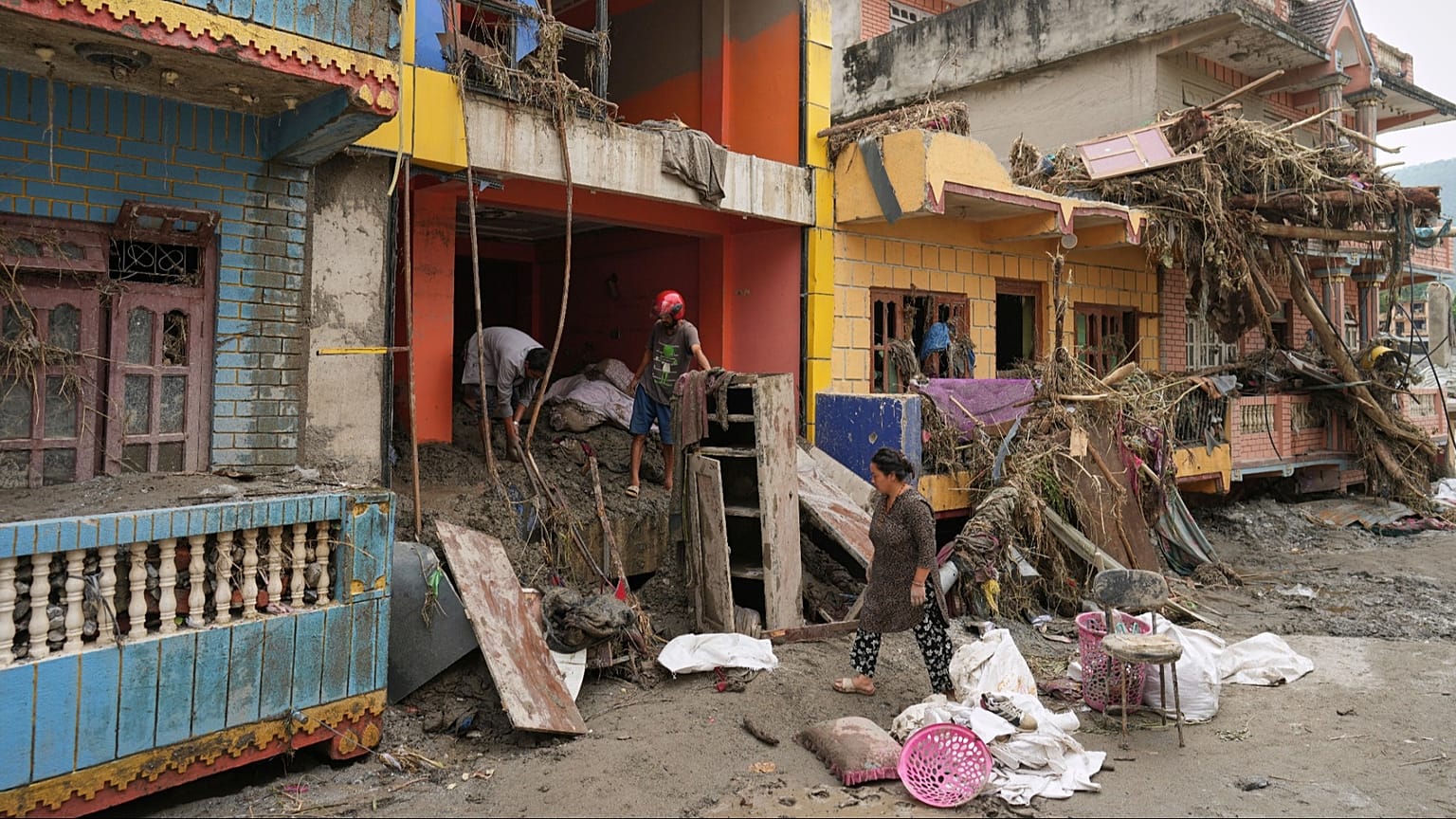
Rescuers were battling through mud even as the threat of new floods loomed, with emergency teams recovering 586 bodies so far and some of the dead swept downstream as far away as India.
The number of people missing in Nepal and China surpassed 2,400 on Friday, underscoring the scale of the disaster days after a tsunami-like wall of water and debris swept away villages and killed hundreds.
Rescuers were battling through mud even as the threat of new floods loomed, with emergency teams recovering 586 bodies so far and some of the dead swept downstream as far away as India.
The new figures came as Nepal's disaster authority added 933 hydropower workers to a missing persons list already including trekkers and pilgrims to Tibet's sacred Mount Kailash.
Relatives have crowded hospitals in Nepal's capital in a painful hunt for their loved ones, with posters on the walls bearing photos and names of the missing.
"Today is the third day and we don't know anything. Hopefully he is in a safe place," Samjhana Thing, 27, told the AFP news agency referring to her brother. "We lost everything. He is our everything."
The US Geological Survey said the disaster, the deadliest for Nepal since a 2015 earthquake, was caused by a glacial collapse that triggered a vast flow of icy debris.
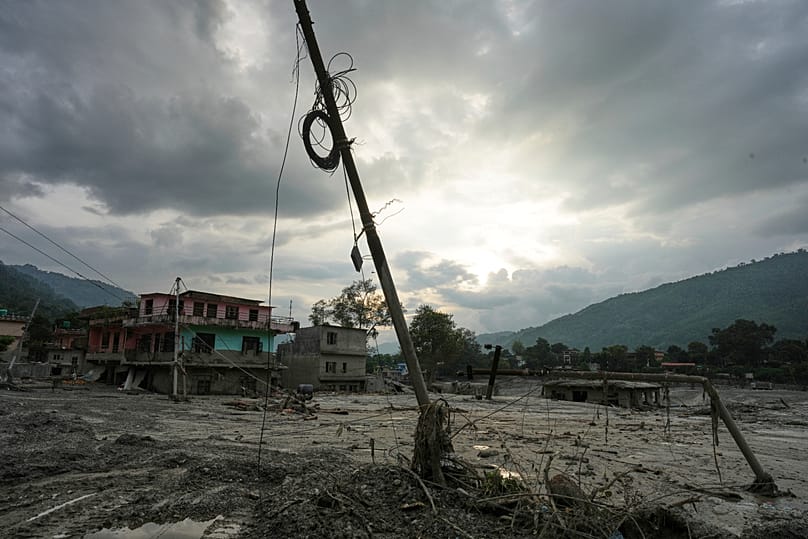
The deluge of ice and mud also caused huge lakes to form and one of these formations has become a direct threat to emergency workers scouring the region for survivors.
Nepali police urged all rescuers to "immediately move to a safe location", saying it had received information that "a water dam has burst again on the Tibetan side."
In Tibet, China was forced to suspend its rescue operation at the hardest-hit area of Gyirong over the risk of renewed flooding on Friday, before saying the threat had eased.
State broadcaster CCTV reported that a lake formed by immense piles of debris began overflowing toward where rescue teams were headed, but later said the water level of the pool had dropped.
Rescue operations were therefore "proceeding in an orderly manner", it added.
Chinese President Xi Jinping, who chaired a meeting on rescue efforts, offered Beijing's help to Nepal's emergency operations.
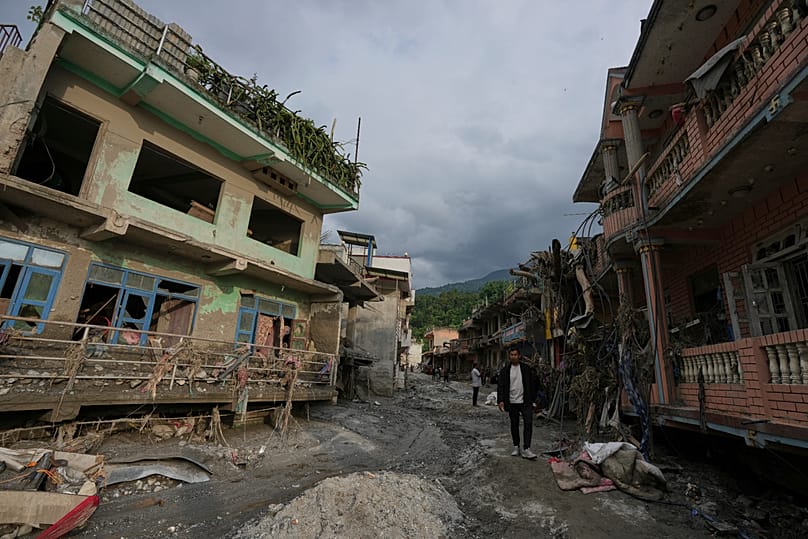
Swept away
Emergency teams had been racing to retrieve survivors from affected zones, where the widespread devastation meant food and water supplies were running out.
The Nepali military located people trapped in the tunnel of Trishuli 3A hydropower project, where they were working to find a way in to extract the survivors.
"Two helicopters have been dispatched but it is challenging because it is tough to even locate the entry points of the tunnel," army spokesman Raja Ram Basnet told AFP.
Some 350 workers and residents have been brought to safety from the site, he added, but efforts were ongoing to rescue more than 100 people trapped in the same area.
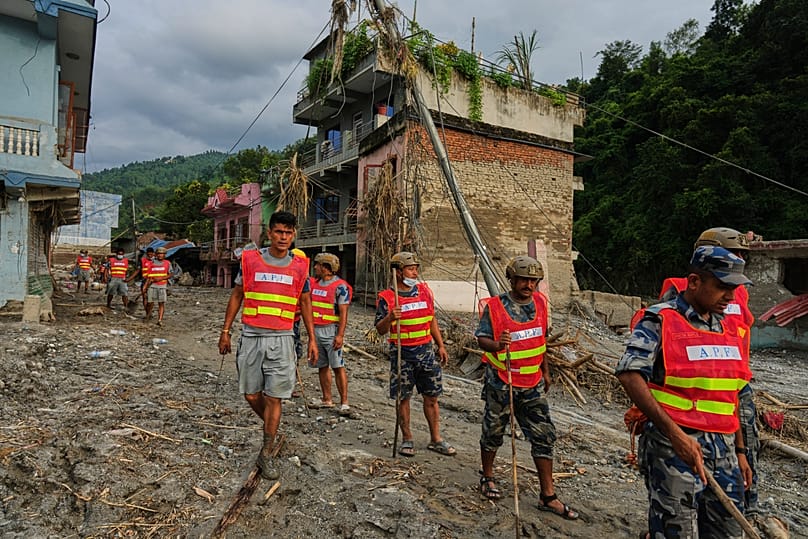
Workers rescued from other dam projects along the Trishuli valley described a disaster that unfolded with terrifying speed.
Buddha Tamang told AFP he survived only because he was inside a tunnel at the dam where he worked when the flood struck.
"The senior officers working on the other side, they were all swept away," Tamang, who was airlifted on Thursday after being marooned for more than 24 hours, said.
Aid trickles in
Aid began to reach some survivors in Nepal on Friday, as the full scope of the devastation continued to emerge and survivors sought shelter at makeshift army relief centres.
Children who have been separated from their families are being given shelter as attempts are made to reunite them with families.
The UN's agency for children UNICEF said at least 17,000 children are in urgent need of humanitarian assistance, while 18 schools have been destroyed and another 20 damaged.
The International Red Cross estimates that at least 93,000 people have been affected and are in “great need.”
Also on Friday, the European Union promised €2 million in aid for Nepal with European Commission chief Ursula von der Leyen writing on X that the "immediate humanitarian aid" would help "deliver life-saving assistance to families and communities hit hardest."
Nepal-China Death Toll Hits 579; Concerns Another Disaster Is Coming

Buildings are submerged in mud following flash floods in Rasuwa district in central-northern Nepal. Photo Credit: UNICEF
By Osama Ali
(Albawaba) — Catastrophic flash floods have ripped across communities along the Nepal-China border, killing at least 579 people, as rescue teams race to find survivors and authorities warn another major storm could be imminent.
More than 200 individuals are reported missing and hundreds have been rescued in the impacted areas. Dozens of injured people were being treated in Kathmandu.
Hundreds of foreigners have also been affected by the issue. Chinese state media reported 558 individuals missing in Gyirong County in Tibet, including 260 foreigners. But officials warned that some names may show up on missing-persons lists in both nations.
Another Disaster Could Be Coming
The current danger may not be past. Authorities are constantly watching lakes caused by landslides damming rivers, concerned that water and debris could suddenly break through.
Parts of Nepal, rescue operations were briefly delayed as villagers fled to higher ground after warnings of rising flood levels.
China predicted up to 3 million cubic meters of water, almost 1,200 Olympic swimming pools, might flood into an already choked lake, greatly raising the likelihood of another flood.
The calamity followed a major fall of a glacier that sent rocks, ice, mud and debris hurtling down the Himalayan valleys. Experts calculated the debris flow rates to be about 50 meters per second and the distance to be more than 20 kilometers.
The United Nations has begun mobilizing humanitarian assistance as Nepal and China conduct one of the region’s biggest search and rescue missions.
As The Himalayas Melt, Deadly Floods Become The New Normal

The Himalaya mountain range stretches across Nepal. Photo Credit: UN Nepal/Ajay Das
Key Takeaways:
- A Himalayan slope failure on Wednesday (registered as magnitude 5.2) sent ice, rock, and water down the Lhende Khola/Bhotekoshi system; by Friday more than 500 were reported dead in Nepal and Tibet and over 1,500 missing.
- UNU researcher Dipesh Chapagain says this was not a classic glacial-lake outburst but a mountainside collapse into the river; GLOMOS work finds those lake floods about five times more frequent since 1950 as ice and permafrost weaken.
- Settlement and hydropower have moved into valley corridors, so warning time is short; he urges glacier and slope monitoring plus China–Nepal data sharing, noting glaciers will keep shrinking for decades even if emissions fall.
A day before a wall of ice, rock and muddy water tore through Himalayan valleys along the Nepal-China border, Dipesh Chapagain was discussing with a colleague just how devastating such a disaster could be.
For the 40-year-old climate researcher, who grew up in the hills of eastern Nepal and now studies mountain hazards at the United Nations University in Bonn, Germany, the subject was both professional and deeply personal.
He has watched the risks facing the region change within his own lifetime.
“When I was kid, it was not like that,” he told me. “Or when my parents were kids or my grandparents, that was not the major challenge [they faced].”
A glacier fails, a mountain collapses
Then, on Wednesday morning at 8:37, a mountainside high in the Himalayas gave way.
The collapse was so vast that seismic instruments registered it as a magnitude-5.2 event, initially mistaking it for an earthquake. Bedrock beneath a glacier failed, carrying a huge mass of ice and rock roughly 1,200 meters toward the valley floor.
Water, sediment and boulders surged into the rivers below, sweeping through towns and villages along one of Nepal’s most important trade routes with China. At one monitoring station, the water rose as much as nine meters in half an hour.
By Friday, more than 500 people had been reported dead across Nepal and Tibet and more than 1,500 remained missing, including hundreds of foreign nationals.
Dr. Chapagain’s immediate family was spared. Still, the news took a toll on him.
“It’s always hard to get these devastating messages from back home,” he said. “It’s getting more frequent and more intense.”
The catastrophe is a brutal illustration of a problem climate scientists have been warning about for years. The frozen architecture of the Himalayas is changing, exposing millions of people to hazards that are becoming harder to predict and, in some cases, more destructive.
How a mountain collapse became a deadly flood
Experts are still piecing together the sequence of events that led to Wednesday’s disaster. Analysis of satellite imagery suggests that bedrock beneath a glacier gave way, sending a huge mass of ice and rock into the Lhende Khola, a tributary of the Bhotekoshi River, and triggering the destructive cascade that followed.
The mechanics differ from those of the glacial lake outburst floods that Dr. Chapagain and his colleagues at the Global Mountain Safeguard Research programme, known as GLOMOS, study across the Hindu Kush Himalaya. GLOMOS is part of UNU’s Institute for Environment and Human Security
Their recent research analyzed 493 such floods from the earliest available records through 2024. It found that these events have become roughly five times more frequent since 1950, rising from an average of about seven per decade to 34.
Such floods typically occur when meltwater collects in lakes around retreating glaciers, often held back by unstable ice or loose rock and sediment. When those natural dams fail, enormous volumes of water can be released almost instantaneously.
Wednesday’s disaster appears to have followed a different chain of events.
“This time, the intermediate step was skipped,” Dr. Chapagain said.
Rather than a glacial lake bursting, rock and ice collapsed from the mountainside, generating a torrent below. Researchers are investigating whether the debris temporarily dammed the river before the obstruction gave way, a sequence Dr. Chapagain cautioned had not yet been confirmed.
For scientists, the distinction matters. Downstream, the result can look frighteningly similar: a vast volume of water, ice and debris released with little warning into narrow, inhabited valleys.
It is unclear whether climate change caused Wednesday’s collapse. But global warming is rapidly transforming the high-altitude environment in which such disasters occur. As glaciers melt and permafrost thaws, rock once supported or bound by ice can become unstable, while increased meltwater can further weaken mountain slopes.
The consequences extend far beyond mountain villages. The Hindu Kush Himalaya feeds 10 major river basins on which some 2.1 billion people depend for water, food, energy and livelihoods.
As people move into harm’s way
But the mountains are not the only thing changing. So is the geography of human life below them.
When Dr. Chapagain was a child, he said, families in many of Nepal’s hilly areas traditionally built their homes higher on the slopes while cultivating rice and other crops on flatter land closer to rivers. His own family’s home garden was on a mountaintop. Its rice paddies lay below, near the river.
Over time, roads, businesses, hotels and hydropower projects have increasingly concentrated in river valleys, where construction is easier and economic opportunities are greater. Water sources in some higher settlements have also been drying up, Dr. Chapagain said, encouraging people to move downhill.
That has created a dangerous convergence: as warming alters the mountains above, more people and infrastructure are gathering in the corridors through which water and debris descend.
The valley devastated by Wednesday’s flood embodies that collision. The Bhote Koshi-Trishuli corridor carries a major trade route toward Kathmandu and is lined with hydropower plants, bridges, roads, hotels and settlements. The floods damaged power facilities and severed transport and communications links across the region.
The danger was already apparent. A glacial lake outburst struck the same river system last year, killing nine people and leaving 24 missing.
When minutes matter
For Dr. Chapagain, Wednesday’s catastrophe also exposed a critical weakness. How little warning communities may receive before a disaster born high in the mountains reaches them.
Nepalese authorities, he said, learned of the flood only as it was approaching the border. Alerts then went downstream through text messages, social media, telephone calls and alarms.
Reducing the danger, he argues, begins higher up: continuous monitoring of glaciers and unstable slopes, satellite observation, weather and river gauges, and early-warning systems capable of buying communities enough time to evacuate. Because rivers and glaciers cross national frontiers, China, Nepal and countries farther downstream must also exchange data quickly.
There is a deeper problem. Even if greenhouse gas emissions fell sharply, Dr. Chapagain said, glaciers would continue losing mass for decades because of warming already locked into the climate system. How much is eventually lost remains within humanity’s control. What happens in the near term, however, is far less so.
That makes adaptation, in his view, no longer preparation for a distant future.
For communities beneath the Himalayas, that future arrived Wednesday.

No comments:
Post a Comment