Caspian’s Water Level Decline Accelerating Despite Expectations That Sea’s Declining Surface Area Would Mean Less Evaporation – OpEd
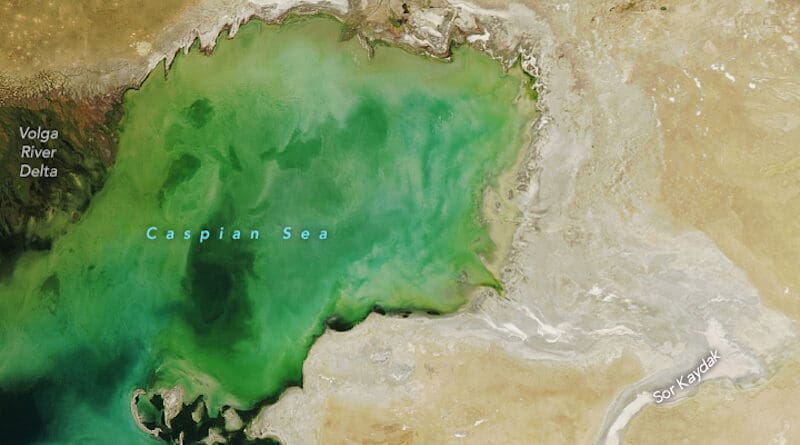
NASA image shows shrinking coastline of the Caspian Sea. Photo Credit: NASA
In 2020, the water level of the Caspian fell by eight centimeters; but last year, it fell by 23, despite the predictions of many experts that the decline would slow because the area of the sea had contracted by almost 30,000 square kilometers and thus the amount of evaporation would be reduced.
This change, experts from the littoral states say, reflects both rapidly rising air temperatures as a result of global warming and declines in the flow of rivers emptying into the Caspian as a result of increased human use (ritmeurasia.ru/news–2026-08-28–primorskie-strany-obespokoeny-zdorovem-melejuschego-kaspijskogo-morja-89919).
Because the Volga is the largest of these rivers – the Ural River is a distant second – many in the non-Russian countries are focusing on Russia’s failure to take steps to ensure that the decline in the flow of that river into the Caspian won’t increase. And their objections are infuriating many Russian experts and commentators.
Kazakhstan has called for a consortium to help regulate the flow of the Volga, something Moscow opposes; and Russian experts like Mikhail Bolgov of the Russian Academy of Sciecnes are now arguing that it is “impossible” to regulate the water levels of the Caspian, a confession of Russia’s failure to do something and something certain to infuriate other littoral states.
As a result, the Caspian’s water level is certain to decline and at an increasing rate. A much-ballyhooed proposal to spend 450 million rubles on the problem in the coming years turns out to be hollow: all that money is to go for research and not any of it for steps to limit let alone solve the problem.
Unless Moscow changes course or unless outside powers with an interest in transit across the Caspian get more actively involved, it is virtually certain that the inland sea is on course to follow the Aral into oblivion, a development with enormous and currently incalculable consequences for the littoral states and all those who rely on the Caspian.

No comments:
Post a Comment