COSMOLOGY: an unusual death
Ludwig-Maximilians-Universität München
A Faint X-ray Flash Exposes a Dying Star's Missing Jet —a surprising discovery for the international team, which includes researchers from LMU.
A rare cosmic explosion has given astronomers an unprecedented look at a massive star in its final moments, revealing a missing link between ordinary stellar explosions, so-called supernovae, and gamma-ray bursts, the brightest and most powerful phenomena in the Universe.
The event, named EP260321a, was first detected by the Einstein Probe satellite as a brief flash of X-rays from a galaxy about 500 million light-years away. Scientists interpret the signal as a “shock breakout,” the moment when the shock wave from a star’s collapsing interior bursts through its surface and releases the first light of a supernova.
Shock breakouts are thought to occur in every massive star’s death, but they’re notoriously hard to catch. They last only a short time and shine brightest in X-rays. In the past two decades, astronomers have confidently identified just one other clear X-ray shock breakout, making EP260321a an exceptionally rare find.
The X-ray flash set off a worldwide observing campaign. Among the first to catch it was LMU’s 2.1-meter Fraunhofer Telescope at Wendelstein Observatory, which spotted a rapidly brightening supernova later named SN 2026gzf. Observations of how its light evolved showed it belonged to the class known as broad-lined Type Ic supernovae. This class of supernovae typically has material shooting out in a jet at nearly the speed of light, producing gamma-ray bursts.
“Stars die on a daily basis somewhere in the Universe. But it’s rare that something unusual happens close enough for our observations to reveal fundamentally new insights. EP260321a rang an alarm bell right away - an X-ray flash but no gamma-ray alert? A supernova in a nearby galaxy, embedded in a blue knot that had already been getting brighter for years? That’s not what is expected, and it set off a chase around the globe. Fortunately, we were well prepared for exactly this kind of opportunity with LMU’s observatories,” says LMU astrophysicist Daniel Gruen, who led the observations with Wendelstein and with the Hobby-Eberly Telescope in Texas.
Not a typical dying massive star
As it turned out, SN 2026gzf was not your typical dying massive star. Researchers were surprised to find no evidence of a gamma-ray burst or relativistic jet following the explosion. This is even more unexpected because the explosion itself was not weak at all. In fact, its characteristics match well with other supernovae that did produce gamma-ray bursts.
Brendan O’Connor, an astronomer and McWilliams Fellow at Carnegie Mellon University (CMU) and lead author of one of the papers presenting the analysis, published in The Astrophysical Journal Letters, combined the telescope data with observations from NASA’s Chandra X-ray Observatory (CXO) and the NRAO’s Karl G. Jansky Very Large Array (VLA) radio observatory to reveal the full nature of the event.
“SN 2026gzf looks remarkably similar to other energetic supernovae that have been linked to gamma-ray bursts before. Yet multi-wavelength follow-up observations using the most sensitive facilities found no evidence of a jet or an afterglow that is typically seen in those events,” says O’Connor. “One possibility is that a jet was initially present, but ‘choked,’ either by the surface of the star or by material surrounding it.”
Another piece of the puzzle came from the spectra, the fingerprint of light emitted by the supernova and the stars in the galaxy around it. Using LMU’s share of the Hobby-Eberly Telescope, the team obtained an integral field spectrum, an image in which every pixel splits its light into a rainbow, revealing detailed information about its source. “What we found in the spectrum is that the star that exploded had been born from a cloud of pristine gas - mostly hydrogen, with only about 15% of the metals our Sun and local environment contain,” explains Malte Busmann, a graduate student at LMU and co-author of the study, adding, “Well those metals are being added right now. Just four days after the shock breakout, we’re already catching the first glimpses of metals forged by the dying star being flung outward in all directions.”
The site of the explosion is indeed one of the least metal-enriched environments known for this type of supernova. Low-metallicity environments are often thought to help massive stars retain the rotation needed to launch fast jets, yet SN 2026gzf produced no typical gamma-ray-burst jet. The Hobby-Eberly Telescope observations therefore show that low metallicity alone cannot determine whether a dying star successfully produces a gamma-ray burst.
"When a massive star forms from such almost pristine gas, we expect it to eject roughly half of its original mass before it eventually explodes. So this fits with the interpretation of the jet being choked by material surrounding the star" says Joachim Puls, expert on massive stars and their outflows at LMU.
With an exceptionally faint X-ray shock breakout, combined with the absence of the fast-moving jets that typically power gamma-ray bursts, EP260321a/SN 2026gzf acts as a unique bridge between ordinary, non-relativistic supernova shock breakouts and the far more extreme, relativistic explosions that generate gamma-ray bursts.
This discovery establishes that energetic broad-lined Type Ic supernovae do not always produce a gamma-ray burst, a bright relativistic shock breakout, and suggests that massive stars can die through a wider range of pathways than previously recognized.
A glimpse into the future of time-domain astronomy
Together with spectra obtained with CMU’s share in the Southern African Large Telescope and the Dark Energy Spectroscopic Instrument, and images taken by the Dark Energy Camera and Rubin Observatory that LMU participates in, and the Zwicky Transient Facility, a high-fidelity picture of the event emerged. Additional late-time observations have been approved with the James Webb Space Telescope to further reveal the inner workings of the explosion, its geometry, and ejecta composition.
“This sequence of observations offers a glimpse into the future of time-domain astronomy. By coordinating large, repeated sky surveys with smaller, dedicated telescopes, we can learn so much more from the surprises the Universe has in store for us,” says Xander Hall, a graduate student at CMU and second author of the study.
Journal
The Astrophysical Journal Letters
Article Title
EP260321a/SN 2026gzf: The Faintest Shock Breakout Associated with a Broad-lined Supernova
Two decades of blazar observations, and the mysteries keep piling up
The Henryk Niewodniczanski Institute of Nuclear Physics Polish Academy of Sciences
image:
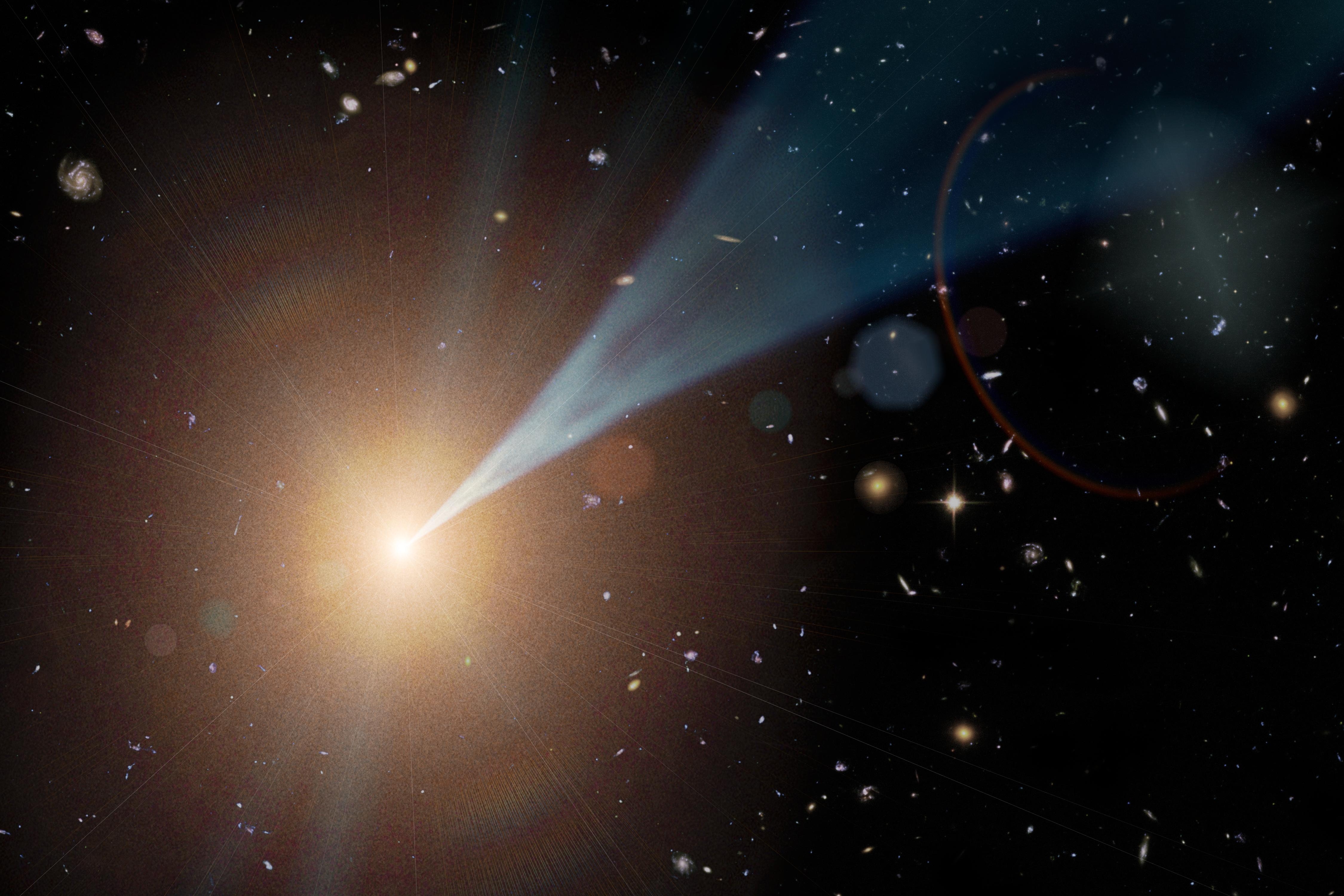
Artist's impression of a blazar – an active galaxy emitting jets of radiation and matter towards Earth.
view moreCredit: Source: NASA/JPL-Caltech
Cracow, 6 August 2026
Narrow jets of luminous matter may be emitted towards Earth from the nuclei of active galaxies, billions of light-years away. The galaxy then appears as a point source and is called a blazar. A Polish-German team of scientists has, for the first time, analysed the activity of one such blazar over a long period of time and instead of finding answers, they have been faced with an ever-increasing number of intriguing questions.
Distant, active galaxies that emit jets of matter at small angles towards Earth, known as blazars, present astronomers with numerous observational and interpretative challenges. Their immense distance and specific orientation, combined with the high variability of the emitted radiation – which, moreover, is generated across a very wide energy range – are the main reasons why understanding the phenomena responsible for the properties of blazars is particularly difficult. Are the current interpretations of the nature of these objects, based on short-term and rather sporadic observations, correct? A group of scientists from the University of Heidelberg and the Institute of Nuclear Physics of the Polish Academy of Sciences (IFJ PAN) in Cracow set out to answer this question. The research carried out on the Polish side, funded by a grant from the National Agency for Academic Exchange, focused on the blazar PKS 2155-304, located one and a half billion light-years away. It is situated in the southern celestial hemisphere, in the background of the constellation Piscis Austrinus.
Hundreds of billions of galaxies have already been discovered within the observable Universe. Some of them have been found to produce vast amounts of electromagnetic radiation, probably as a result of violent processes occurring as matter falls into a central supermassive black hole. The activity of some such galaxies takes on a particularly spectacular form: jets – narrow streams of ionised, luminous matter – shoot out from the vicinity of the black hole’s poles, sometimes extending for as far as tens of millions of light-years. Astronomers refer to active galaxies with jets pointing towards Earth as blazars. Blazars generate radiation across a very wide energy range, from radio waves through the optical and ultraviolet regions to X-rays and gamma rays.
“The variability of blazars is a characteristic feature that has long been recognised. Blazars are capable of emitting radiation not only in different ways during different observations, but even within the same observation, when variations in some energy ranges may differ from those in others,” notes Dr. Alicja Wierzcholska (IFJ PAN), lead author of the long-term analyses of observations of the blazar PKS 2155-304.
Observations of blazars have been carried out for several decades, but it would be difficult to describe them as precise monitoring. In the case of such variable objects, it would be necessary to use numerous instruments capable of detecting electromagnetic radiation across virtually the entire energy spectrum, and ideally on a continuous basis, at least for selected objects. However, such observatories simply do not exist at present. The reality is therefore that individual blazars are usually observed every few months or years, as part of campaigns lasting no more than a few to a dozen or so days, and the data collected relate to their activity only within narrow energy ranges of radiation detected by a specific instrument.
The present analysis covered measurements taken over a much longer period – almost two decades. The data, which complemented one another in terms of energy ranges, were obtained from the US satellite observatories: the Neil Gehrels Swift Observatory (in the optical, ultraviolet and X-ray ranges) and the Fermi Gamma-ray Space Telescope (in the gamma-ray range).
“The key conclusion from our analyses is that the currently most popular theoretical models, which assume that radiation is emitted within a single jet zone by a single population of electrons, can only describe the variability of our blazar over short time scales. However, something more complex is clearly happening in this object, which short observation campaigns are unable to capture,” says Dr. Wierzcholska.
An example? Intuition suggests that if the source of emission in the optical and X-ray ranges were the same population of electrons, changes in one part of the spectrum should be correlated with changes in the other, perhaps with a slight time delay. However, the analysed data failed to reveal any long-term correlation between events in different radiation ranges.
When blazars brighten rapidly in the X-ray range, the rule generally holds that the increase in brightness is more pronounced in the higher-energy part of the spectrum. In other words, during a flare, more hard X-ray photons are observed than during periods of low blazar activity. In the case of PKS 2155-304, this behaviour has not been observed over 20 years of monitoring. Such a correlation is visible for shorter observation periods, but it is of a different nature (the curves depicting changes in the distribution have different slopes). This fact suggests that slightly different physical mechanisms must be responsible for the course of each outburst of PKS 2155-304.
That was not the end of the surprises. The graphs showing the full energy spectrum of blazars have an interesting feature: they reveal two ‘peaks’ separated by an arched trough. The low-energy peak appears to be caused by electrons and the synchrotron radiation they emit, whilst there is no clear explanation for the high-energy peak. This may be the result of collisions between electrons and low-energy photons, leading to an increase in the photons’ energy (i.e. inverse Compton scattering), but it cannot be ruled out that it stems from phenomena involving hadrons – that is, quark aggregates such as protons or neutrons. However, in the case of two observations from 2012, something particularly strange appeared in the spectrum of PKS 2155-304: an additional, statistically significant dip.
“The presence of a new inflection in the blazar’s spectrum tells us that some additional physical mechanism must have been at work between the two observations – and this at a time when there was no outburst! Various theoretical considerations suggest that this mechanism was most likely hadronic in nature. This is extremely interesting, as theorists are increasingly arguing that neutrino production is possible in such situations,” explains Dr. Wierzcholska.
Neutrinos are particles with very small masses that fill the Universe in vast numbers. However, their presence is difficult to detect because they interact very weakly with ordinary matter. In the Earth’s environment, neutrinos produced during radioactive decays deep within the Earth, those arriving from the Sun, and high-energy neutrinos from deep space are observed. The origin of the latter is not entirely clear to astrophysicists. There are both theoretical and observational indications – in particular, the detection of neutrinos arriving from the direction of the blazar TXS 0506+056 during a powerful outburst from this source – that it is blazars that may be responsible for the emission of cosmic neutrinos.
The computational part of the research described here was carried out with the support of the Cyfronet AGH Academic Computing Centre in Cracow.
The Henryk Niewodniczański Institute of Nuclear Physics (IFJ PAN) is currently one of the largest research institutes of the Polish Academy of Sciences. A wide range of research carried out at IFJ PAN covers basic and applied studies, from particle physics and astrophysics, through hadron physics, high-, medium-, and low-energy nuclear physics, condensed matter physics (including materials engineering), to various applications of nuclear physics in interdisciplinary research, covering medical physics, dosimetry, radiation and environmental biology, environmental protection, and other related disciplines. The average yearly publication output of IFJ PAN includes over 600 scientific papers in high-impact international journals. Each year the Institute hosts about 20 international and national scientific conferences. One of the most important establishments of the Institute is the Bronowice Cyclotron Centre (CCB), which is an infrastructure unique in Central Europe, serving as a clinical and research centre in the field of medical and nuclear physics. In addition, IFJ PAN runs four accredited research and measurement laboratories. IFJ PAN is a member of the Marian Smoluchowski Kraków Research Consortium: “Matter-Energy-Future”, which in 2012-2017 enjoyed the status of the Leading National Research Centre (KNOW) in physics. In 2017, the European Commission granted the Institute the HR Excellence in Research award. As a result of the categorization of the Ministry of Education and Science, the Institute has been classified into the A+ category (the highest scientific category in Poland) in the field of physical sciences.
SCIENTIFIC PUBLICATIONS:
“20 years of monitoring: PKS 2155-304 and PKS 1510-089 in the eyes of Swift and Fermi. I. The case of PKS 2155-304”
A. Wierzcholska, M. Zacharias
Journal of High Energy Astrophysics 2026, 54, 100688
DOI: 10.1016/j.jheap.2026.100688
LINKS:
The website of the Institute of Nuclear Physics, Polish Academy of Sciences.
Press releases of the Institute of Nuclear Physics, Polish Academy of Sciences.
IMAGES:
HR: http://press.ifj.edu.pl/news/2026/08/06/IFJ260806b_fot01.jpg
Artist's impression of a blazar – an active galaxy emitting jets of radiation and matter towards Earth. (Source: NASA/JPL-Caltech)
Journal
Journal of High Energy Astrophysics
Article Title
20 years of monitoring: PKS 2155-304 and PKS 1510-089 in the eyes of Swift and Fermi. I. The case of PKS 2155-304
Dark and quiet skies at the 46th COSPAR Scientific Assembly
International Science Council Committee on Space Research
image:
A panel discussion during the Dark and Quiet Skies session at the 46th COSPAR Scientific Assembly. At the podium is Roberto Ragazzoni, INAF President. The rest of the panel can be seen behind him: Pascale Ehrenfreund (COSPAR President), Willy Benz (IAU President), Carole Mundell (ESA), Massimo Comparini (Leonardo) and Richard Anthony D’Souza (Vat. Observatory).
view moreCredit: INAF
The 46th COSPAR Scientific Assembly brought together experts from astronomy, the satellite industry, policy and law to examine one of the most important challenges arising from the rapid growth of activities in space: how to preserve dark and quiet skies while enabling satellite systems to continue delivering valuable services to society. The meeting was chaired by Marco Tavani.
By bringing together these different experts, the session provided an opportunity to consider the issue from scientific, technical, operational and regulatory perspectives. Panellists explored the progress already being made, the limitations of current approaches and the gaps to be addressed to ensure that the benefits of satellite technology can be realised without unnecessarily compromising astronomical observations or the wider value of the night sky.
In “Dark and Quiet Skies”, “dark” refers primarily to the effects of artificial light on optical astronomy, while “quiet” refers to interference affecting observations at radio frequencies. Together, optical and radio astronomy allow scientists to investigate some of humanity’s most fundamental questions like: How did the Universe develop into what we see today? What is our place within it? And could life exist elsewhere?
Satellites can affect both types of observation. In the optical domain, sunlight reflected from satellites and their components can leave bright trails across astronomical images or interfere with sensitive measurements. At radio frequencies, satellites may affect observations through their intended communication signals, unwanted emissions outside their assigned frequency bands, or unintended electromagnetic radiation generated by onboard electronic systems.
The session also recognised that these concerns form part of a broader discussion about the environmental and societal effects of activity in near-Earth space. Light pollution, possible atmospheric effects and the increasing risk of collisions in orbit are related challenges, although they were not the principal focus of the panel.
Some aspects of radio-frequency interference fall within the mandate of the International Telecommunication Union, which develops the international regulatory framework for the use of the radio-frequency spectrum. The session considered this work alongside the broader role of the United Nations Committee on the Peaceful Uses of Outer Space, or COPUOS, which addresses the peaceful uses of outer space and will continue to consider Dark and Quiet Skies under a dedicated agenda item over the next three years. The discussion highlighted the need for coordination between technical regulation and the wider consideration of how space activities can develop sustainably while preserving astronomy and the night sky.
Protecting dark and quiet skies is not solely a scientific concern. Naturally dark skies have cultural, educational and environmental value. Many species use natural patterns of light and darkness to navigate, reproduce or regulate their behaviour, while the night sky has inspired human curiosity, culture and scientific discovery throughout history.
This was the first time that Dark and Quiet Skies had been the subject of a dedicated discussion at a COSPAR Scientific Assembly. The strong interest in the session highlighted the role that COSPAR, with its broad international membership and multidisciplinary scientific expertise, can play in addressing this pressing issue and helping to develop solutions that balance the benefits of space activities with the protection of astronomy and the night sky. COSPAR will establish a dedicated Task Group on this topic to support the current initiatives.
We thank the esteemed speakers and panel for contributing to the wide-ranging and comprehensive discussion:
• Piero Benvenuti (CPS)
• Willy Benz (IAU President)
• Catherine Cesarsky (COSPAR Vice-President)
• Massimo Comparini (Leonardo)
• Federico Di Vruno (SKAO/CPS)
• Richard Anthony D’Souza (Vat. Observatory)
• Pascale Ehrenfreund (COSPAR President)
• Joseph Koller (Amazon Leo)
• Tanja L. Masson-Zwaan (Leiden University)
• Carole Mundell (ESA)
• Vadim Nozdrin (ITU)
• Roberto Ragazzoni (INAF President)
• Vijay Thakur (Eutelsat/Oneweb)
Media access
COSPAR 2026 is an in-person only event. Media accreditation for journalists, science communicators, freelancers and bloggers provides complimentary registration. All applications are subject to review based on the applicant’s professional media or communication output.
Opportunities for interviews with selected speakers, including space agency representatives, mission scientists and COSPAR leadership, may be arranged in advance and are subject to availability.
Useful links:
Scientific programme for 46th COSPAR Scientific Assembly
COSPAR website: https://cospar.world
Local Organising Committee www.cospar2026.org
Media contacts:
COSPAR 2026 Press Office: press.cospar2026@inaf.it
COSPAR Media contact: leigh.fergus@cosparhq.cnes.fr
About COSPAR
The Committee on Space Research (COSPAR) is an international scientific organization established in 1958, under the International Science Council (ISC). Its mission is to promote cooperation in space research, with an emphasis on the exchange of scientific results, information, and the development of global partnerships across disciplines for the benefit of all.
Through its scientific Commissions, Panels and Task Groups, COSPAR covers a wide range of space science fields, including Earth observation, planetary protection, astrophysics, and space life sciences and is a trusted advisor to the United Nations on critical issues in space research. It plays a key role in fostering collaboration between the global scientific community, space agencies, industry, and emerging space nations. Through specialized capacity building workshops, it supports the growth of space science expertise worldwide. Its biennial event, the COSPAR Scientific Assembly, brings together thousands of researchers from around the world, serving as a major platform for knowledge exchange and international dialogue.
COSPAR social media : Bluesky / Facebook / LinkedIn / YouTube / Instagram
A panel discussion during the Dark and Quiet Skies session at the 46th COSPAR Scientific Assembly. At the podium is Willy Benz, IAU President. The rest of the panel can be seen behind him: Moderator, Catherine Cesarsky (COSPAR Vice-President), and panelists Pascale Ehrenfreund (COSPAR President), Roberto Ragazzoni (INAF President), Carole Mundell (ESA), Massimo Comparini (Leonardo) and Richard Anthony D’Souza (Vat. Observatory).
COSPAR Vice-President Catherine Cesarsky speaks on Dark and Quiet Skies at the 46th COSPAR Scientific Assembly.
COSPAR President Pascale Ehrenfreund speaks on Dark and Quiet Skies at the 46th COSPAR Scientific Assembly.
Credit
INAF


No comments:
Post a Comment