
US growth leans on AI as rest of rich world stalls - Oxford Economics
Without the artificial intelligence boom, the US economy would have grown at a moderate annualised 1.4% in the first half of 2026, and other big advanced economies more slowly still, Oxford Economics estimated in a research briefing on October 29.
Should the AI boom slow or go into reverse, the risk of recession in the advanced economies would be substantial, according to Adam Slater, lead economist at the consultancy and author of the briefing, "The AI and non-AI economies - two different growth stories".
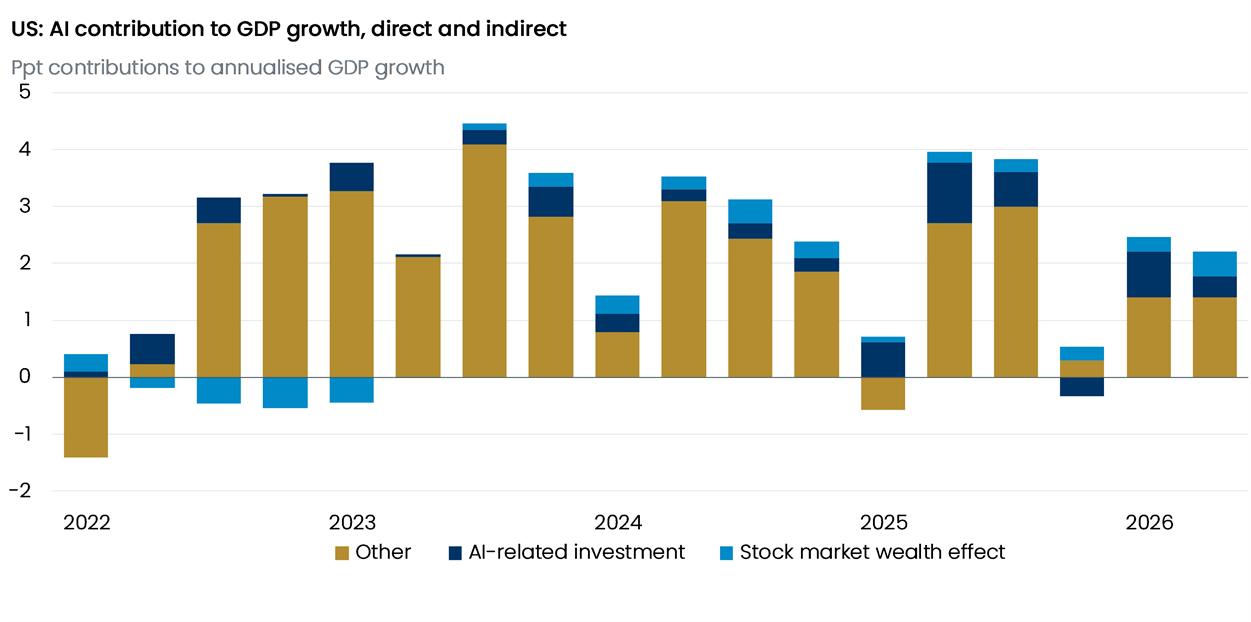
US: AI contribution to GDP growth, direct and indirect (ppt contributions to annualised GDP growth). Source: Oxford Economics. Note: investment is net of estimated imports
The estimate lands as investors grow nervous about how the AI build-out is being financed, after worries over AI debt triggered a chip sell-off across Asia in mid-October. It suggests that much of the strength in US output this year has come from a single sector, and that the rest of the rich world has little underlying momentum to fall back on.
A narrow US boom
Oxford Economics counts two main channels: investment in computer equipment, software, data centres and power generation, and the wealth effect of an AI-driven surge in share prices on consumer spending. Some estimates suggest AI-related stocks have accounted for about 75% of recent S&P 500 returns. Surging imports of the equipment used in the build-out partly offset the gain.
AI-related factors added about 1.1 percentage points to annualised US GDP growth in 1Q26 and about 0.8ppt in 2Q26, the consultancy estimates. In 2Q26 investment net of imports added 0.4ppt and stock market wealth effects a similar amount, so much of the headline 2.2% annualised growth rate can be put down to AI.
The US is leaning on technology far more than it did in the dotcom boom. That boom added about 0.8ppt a year to growth in 1996-2000, but underlying growth was strong too, at more than 3.0% a year. The narrow spread of today's gains, which accrue to a fairly small slice of US households, may help explain why consumer confidence has fallen since 2024 and sits below dotcom-era levels.
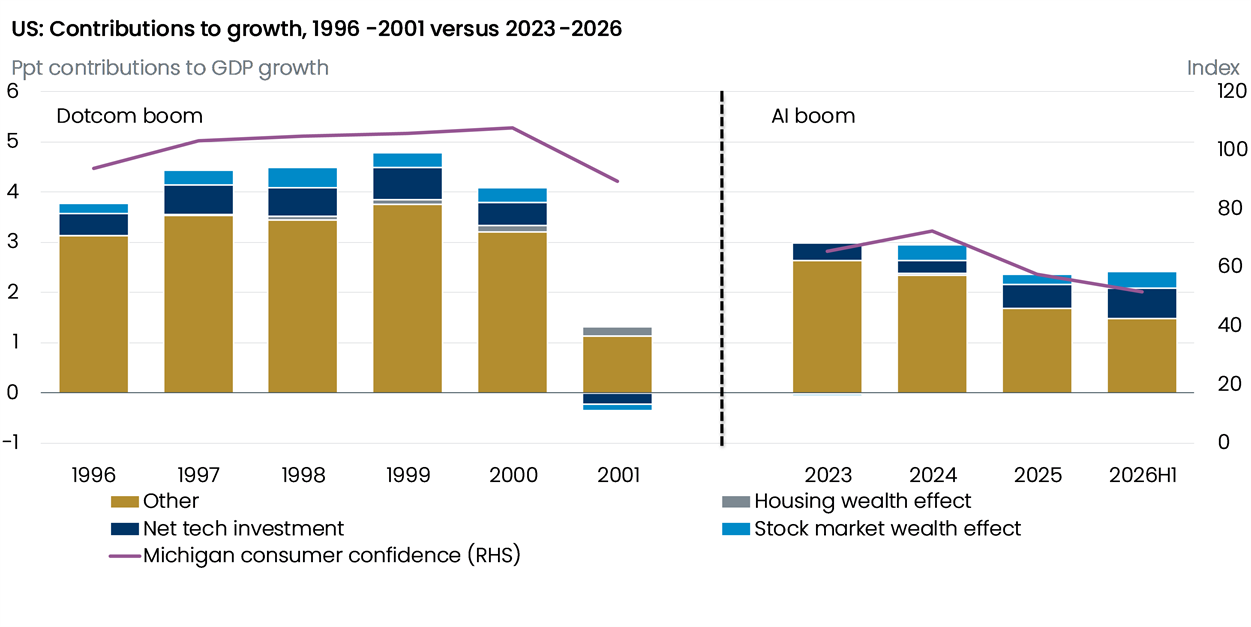
US: contributions to growth, 1996-2001 versus 2023-2026 (ppt contributions to GDP growth; Michigan consumer confidence index, right-hand scale). Source: Oxford Economics, Haver Analytics
Little to show elsewhere
Outside the US the effect is much smaller. Across six other advanced economies, AI-related factors added an average of 0.2ppt to growth in 2025-1H26, about a third of the US effect, ranging from about 0.1ppt in Germany to 0.3-0.4ppt in Sweden and Japan. Stripped of AI, growth in the group ran mostly at 0.5-1.0% a year.
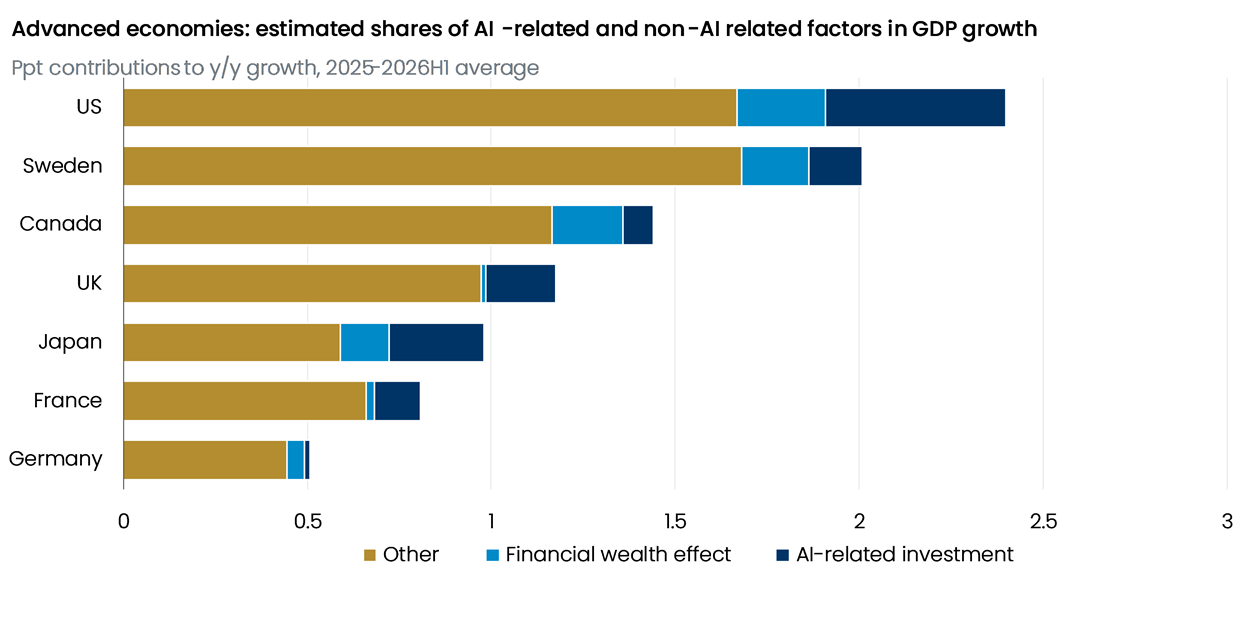
Advanced economies: estimated shares of AI-related and non-AI factors in GDP growth (ppt contributions to y/y growth, 2025-1H26 average). Source: Oxford Economics
US growth without AI would still beat most of its peers, but by a narrower margin. Part of the weakness lies in interest-sensitive spending, which has been flat for three years outside the US as rates rose from 2022. Residential investment has shrunk in most economies, with especially big falls in Canada, Germany, France and Italy.
In the US, interest-sensitive sectors have grown by about 5% since 2022, less than GDP as a whole, but they are a smaller drag than they once would have been. Their share of US investment has fallen from 50-55% in 1980-2005 to below 40%, partly because tech has taken a growing share of equipment spending, and they respond less to rate changes than before.
The cost of the build-out
Data centres' energy needs, which grew by more than 25% last year, are pushing up US wholesale electricity prices, one of several costs the boom imposes on the rest of the economy. The Dallas Fed estimated earlier this year that existing data centres had raised prices by 3-5% nationwide, and US power prices relative to the rest of the G7 had opened a gap of about 12% by 3Q26. That could add up to 0.3ppt to consumer prices and, other things equal, take about 0.2% off GDP, Oxford Economics estimates.
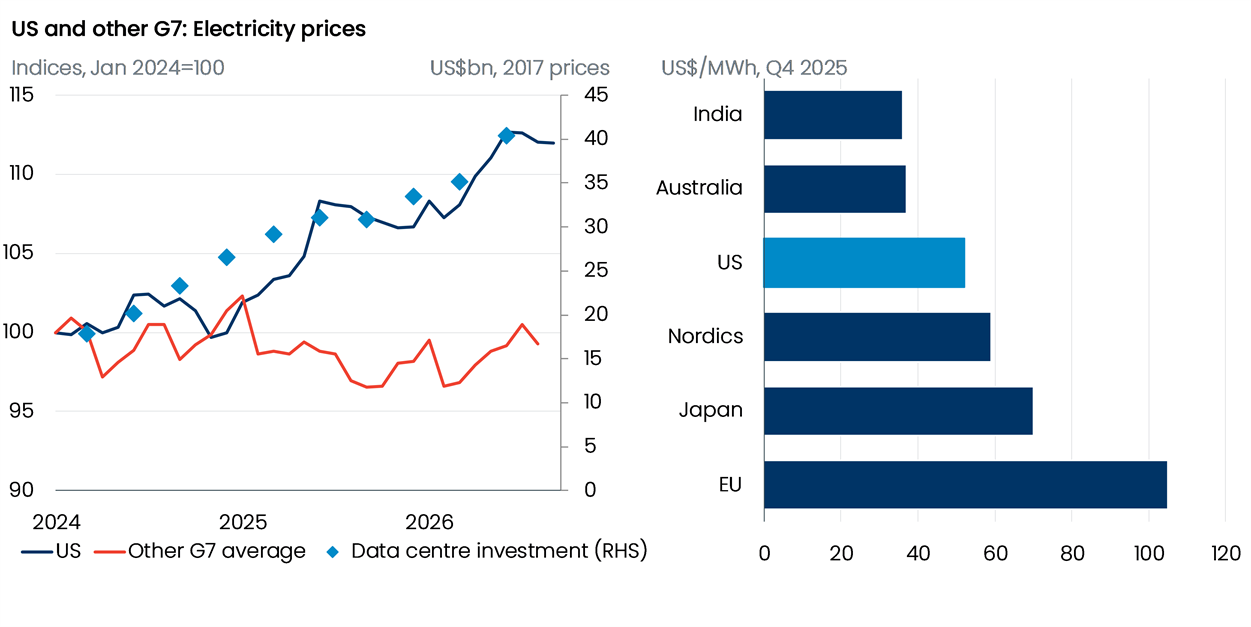
US and other G7: electricity prices (indices, January 2024=100; data centre investment, $bn at 2017 prices; $/MWh, 4Q25). Source: Oxford Economics, Haver Analytics, IEA
US prices of computers and peripherals are up 10% y/y and software nearly 30%, together adding about 0.04ppt to the consumer price index, while construction materials are rising about 5% y/y. More speculatively, heavy borrowing by AI companies may have helped push up bond yields: a 100bp rise in 10-year yields cuts US GDP by 0.1-0.3%, by the consultancy's modelling.
Altogether, these spillovers could cut 0.2-0.3% from US GDP. In economies that have gained little from the boom, they could wipe out much of what modest gains there have been, according to Oxford Economics.

Without the artificial intelligence boom, the US economy would have grown at a moderate annualised 1.4% in the first half of 2026, and other big advanced economies more slowly still, Oxford Economics estimated in a research briefing on October 29.
Should the AI boom slow or go into reverse, the risk of recession in the advanced economies would be substantial, according to Adam Slater, lead economist at the consultancy and author of the briefing, "The AI and non-AI economies - two different growth stories".
US: AI contribution to GDP growth, direct and indirect (ppt contributions to annualised GDP growth). Source: Oxford Economics. Note: investment is net of estimated imports
The estimate lands as investors grow nervous about how the AI build-out is being financed, after worries over AI debt triggered a chip sell-off across Asia in mid-October. It suggests that much of the strength in US output this year has come from a single sector, and that the rest of the rich world has little underlying momentum to fall back on.
A narrow US boom
Oxford Economics counts two main channels: investment in computer equipment, software, data centres and power generation, and the wealth effect of an AI-driven surge in share prices on consumer spending. Some estimates suggest AI-related stocks have accounted for about 75% of recent S&P 500 returns. Surging imports of the equipment used in the build-out partly offset the gain.
AI-related factors added about 1.1 percentage points to annualised US GDP growth in 1Q26 and about 0.8ppt in 2Q26, the consultancy estimates. In 2Q26 investment net of imports added 0.4ppt and stock market wealth effects a similar amount, so much of the headline 2.2% annualised growth rate can be put down to AI.
The US is leaning on technology far more than it did in the dotcom boom. That boom added about 0.8ppt a year to growth in 1996-2000, but underlying growth was strong too, at more than 3.0% a year. The narrow spread of today's gains, which accrue to a fairly small slice of US households, may help explain why consumer confidence has fallen since 2024 and sits below dotcom-era levels.
US: contributions to growth, 1996-2001 versus 2023-2026 (ppt contributions to GDP growth; Michigan consumer confidence index, right-hand scale). Source: Oxford Economics, Haver Analytics
Little to show elsewhere
Outside the US the effect is much smaller. Across six other advanced economies, AI-related factors added an average of 0.2ppt to growth in 2025-1H26, about a third of the US effect, ranging from about 0.1ppt in Germany to 0.3-0.4ppt in Sweden and Japan. Stripped of AI, growth in the group ran mostly at 0.5-1.0% a year.
Advanced economies: estimated shares of AI-related and non-AI factors in GDP growth (ppt contributions to y/y growth, 2025-1H26 average). Source: Oxford Economics
US growth without AI would still beat most of its peers, but by a narrower margin. Part of the weakness lies in interest-sensitive spending, which has been flat for three years outside the US as rates rose from 2022. Residential investment has shrunk in most economies, with especially big falls in Canada, Germany, France and Italy.
In the US, interest-sensitive sectors have grown by about 5% since 2022, less than GDP as a whole, but they are a smaller drag than they once would have been. Their share of US investment has fallen from 50-55% in 1980-2005 to below 40%, partly because tech has taken a growing share of equipment spending, and they respond less to rate changes than before.
The cost of the build-out
Data centres' energy needs, which grew by more than 25% last year, are pushing up US wholesale electricity prices, one of several costs the boom imposes on the rest of the economy. The Dallas Fed estimated earlier this year that existing data centres had raised prices by 3-5% nationwide, and US power prices relative to the rest of the G7 had opened a gap of about 12% by 3Q26. That could add up to 0.3ppt to consumer prices and, other things equal, take about 0.2% off GDP, Oxford Economics estimates.
US and other G7: electricity prices (indices, January 2024=100; data centre investment, $bn at 2017 prices; $/MWh, 4Q25). Source: Oxford Economics, Haver Analytics, IEA
US prices of computers and peripherals are up 10% y/y and software nearly 30%, together adding about 0.04ppt to the consumer price index, while construction materials are rising about 5% y/y. More speculatively, heavy borrowing by AI companies may have helped push up bond yields: a 100bp rise in 10-year yields cuts US GDP by 0.1-0.3%, by the consultancy's modelling.
Altogether, these spillovers could cut 0.2-0.3% from US GDP. In economies that have gained little from the boom, they could wipe out much of what modest gains there have been, according to Oxford Economics.
South Korea's chipmakers bank record AI profits as markets wobble
Samsung Electronics booked the biggest quarterly operating profit in its history on October 29, yet the AI spending behind the result looks shakier than it did a month ago.
The South Korean chipmaker (KRX: 005930) made an operating profit of KRW107.4 trillion ($80.2bn) in July-September, 782.8% more than a year earlier and the first time it has cleared KRW100 trillion in a single quarter. Heavy buying of AI hardware by the hyperscalers carried the figure past the KRW106 trillion consensus compiled by FnGuide.
Samsung now earns more in a quarter than Microsoft, Alphabet or Meta, the US groups whose data-centre budgets fill its order book. Memory makers have been the surest winners of the AI build-out so far, but their profits depend on those budgets holding, and investors spent October asking whether they will.
The rest of the income statement was less convincing. Revenue rose 126.9% to KRW195.3 trillion, short of the KRW200.3 trillion analysts had pencilled in, and net profit of KRW75.1 trillion fell well below the KRW87.4 trillion they expected.
SK hynix (KRX: 000660), the main supplier of high-bandwidth memory (HBM) to Nvidia, set the tone a day earlier. Its operating profit climbed 557.2% year on year to KRW83.33 trillion, at a margin above 80%, and it announced a fresh shareholder return plan worth KRW60 trillion on top of a KRW40 trillion programme it had just completed.
"Virtually all of our DRAM and HBM production capacity for the next three years through 2029 has already been sold out," the company told analysts on its results call.
Seoul took that as a licence to buy. The Kospi rose 6.6% to 6,012.44 on October 28, its steepest one-day gain in three months, as SK hynix shares added 10%, Saxo Bank said in a market note.
The rally came after a punishing month. The index lost 15.7% over the first three weeks of October, and on October 15 an 8% slide tripped a circuit breaker in Seoul as investors questioned the debt piling up behind US data-centre construction. SK hynix shelved a US listing of its Solidigm subsidiary on October 23, citing market conditions.
US results that evening clouded the picture again. Alphabet shares dropped about 10% in after-hours trading on disappointing revenue and negative free cash flow of $9.07bn for the third quarter, according to Saxo. Microsoft gained 3% as its Azure cloud sales grew 48%, but its capital spending of $39.4bn came in well below estimates, which is cold comfort to anyone selling it chips. Nasdaq 100 futures were down 0.9% in early Asian trade on October 29, and the Kospi opened flat at 6,017.22.
Swings of this size in both directions within a fortnight say more about investors' nerves than about the chipmakers' order books. Samsung's preliminary guidance put its operating margin at a record 55.1%, KB Securities expects its HBM prices to more than double in 2027, and SK hynix sees memory shortages lasting until 2030. The doubt lies with the buyers. While Alphabet, Microsoft and their peers keep their capex plans intact, Korea's memory makers will keep posting records. The first clear sign of a cutback would land hardest in Seoul, where the market's mood now rises and falls with two companies.
Samsung Electronics booked the biggest quarterly operating profit in its history on October 29, yet the AI spending behind the result looks shakier than it did a month ago.
The South Korean chipmaker (KRX: 005930) made an operating profit of KRW107.4 trillion ($80.2bn) in July-September, 782.8% more than a year earlier and the first time it has cleared KRW100 trillion in a single quarter. Heavy buying of AI hardware by the hyperscalers carried the figure past the KRW106 trillion consensus compiled by FnGuide.
Samsung now earns more in a quarter than Microsoft, Alphabet or Meta, the US groups whose data-centre budgets fill its order book. Memory makers have been the surest winners of the AI build-out so far, but their profits depend on those budgets holding, and investors spent October asking whether they will.
The rest of the income statement was less convincing. Revenue rose 126.9% to KRW195.3 trillion, short of the KRW200.3 trillion analysts had pencilled in, and net profit of KRW75.1 trillion fell well below the KRW87.4 trillion they expected.
SK hynix (KRX: 000660), the main supplier of high-bandwidth memory (HBM) to Nvidia, set the tone a day earlier. Its operating profit climbed 557.2% year on year to KRW83.33 trillion, at a margin above 80%, and it announced a fresh shareholder return plan worth KRW60 trillion on top of a KRW40 trillion programme it had just completed.
"Virtually all of our DRAM and HBM production capacity for the next three years through 2029 has already been sold out," the company told analysts on its results call.
Seoul took that as a licence to buy. The Kospi rose 6.6% to 6,012.44 on October 28, its steepest one-day gain in three months, as SK hynix shares added 10%, Saxo Bank said in a market note.
The rally came after a punishing month. The index lost 15.7% over the first three weeks of October, and on October 15 an 8% slide tripped a circuit breaker in Seoul as investors questioned the debt piling up behind US data-centre construction. SK hynix shelved a US listing of its Solidigm subsidiary on October 23, citing market conditions.
US results that evening clouded the picture again. Alphabet shares dropped about 10% in after-hours trading on disappointing revenue and negative free cash flow of $9.07bn for the third quarter, according to Saxo. Microsoft gained 3% as its Azure cloud sales grew 48%, but its capital spending of $39.4bn came in well below estimates, which is cold comfort to anyone selling it chips. Nasdaq 100 futures were down 0.9% in early Asian trade on October 29, and the Kospi opened flat at 6,017.22.
Swings of this size in both directions within a fortnight say more about investors' nerves than about the chipmakers' order books. Samsung's preliminary guidance put its operating margin at a record 55.1%, KB Securities expects its HBM prices to more than double in 2027, and SK hynix sees memory shortages lasting until 2030. The doubt lies with the buyers. While Alphabet, Microsoft and their peers keep their capex plans intact, Korea's memory makers will keep posting records. The first clear sign of a cutback would land hardest in Seoul, where the market's mood now rises and falls with two companies.
Mistral releases latest AI model for download, giving companies more control over their cybersecurity
 Copyright AP Photo/Aurelien Morissard
The French AI company says its Large 4 model offers advanced coding and cyber-defence capabilities and can be run on an organisation’s own computers and servers.
Mistral has released the weights for its latest large flagship AI model, Mistral Large 4 (ML4), nicknamed “Le Chonk”, claiming improvements in coding and cyber defence as Europe seeks to build alternatives to US and Chinese technology.
The French firm claims the model is “the best open agentic coding model in the world”, offering enterprises and governments “frontier AI cyber defence capabilities they can fully own and control” including the ability to “detect, analyse and respond to cyberthreats across code and IT infrastructure".
The release follows a preview of ML4 on 6 October. Since then, Mistral has spent the last three weeks reinforcing the model's learning, testing it with customers and partners under real-world conditions.
“ML4 OSS showcases our science team's ability to innovate at speed. Building on the ML4 Preview, the open weight version continues reinforcement learning training and delivers substantial gains with no signs of saturation," said Pierre Stock, Vice President of Science at Mistral.
"In under three weeks within the same reinforcement learning run, we integrated customer feedback by introducing two additional reasoning modes, while making ML4 more efficient and customisable,” he added.
Mistral says the latest release of ML4 rivals other leading open models for coding while using 47% fewer tokens per task on average than Chinese model GLM-5.3. Its score on Terminal-Bench 4.0, which tests AI agents’ ability to perform coding tasks in a terminal, also rose from 28% to 41% following further training.
The release also comes as Europe faces growing cybersecurity threats, such as the recent PHP programming security flaw, discovered using AI, as well as the recent cyber-attacks on the Belgian and Norwegian governments.
More control over AI
Making the model’s weights available allows organisations to download and run it on their own infrastructure, rather than relying exclusively on an external provider’s hosted service.
This could be particularly useful for companies handling sensitive information, such as proprietary software code, that they do not want to share with an external AI service.
Organisations would have greater control over where the model runs and how it is integrated into their systems, although they would still need suitable hardware and expertise to operate it securely.
Mistral says organisations running ML4 on their own infrastructure would also not face the risk of a third-party provider restricting access to or disabling the model.
The move comes amid concerns about European dependence on US AI providers. In June, the Trump administration ordered Anthropic to suspend access to its Fable 5 and Mythos 5 models for foreign nationals.
The restrictions were subsequently lifted for Fable 5, while access to Mythos 5 remained limited to selected organisations. The episode highlighted how decisions made outside Europe can affect access to advanced AI services.
Europe’s AI ambitions
Europe continues to lag behind the US and China in the development of large AI models and the resources needed to build them.
Mistral is one of Europe’s leading AI developers, but its reported valuation of around $24 billion (€20.9 billion) is far below those of US rivals OpenAI and Anthropic. [Insert verified, dated valuations and source.]
Mistral argues that despite the disparity in resources, “ML4 is now the best open model built in the West”.
The model was trained on 3,800 of US company Nvidia’s Grace Blackwell GPUs at Mistral’s European data centres. The company says ML4 achieves “state-of-the-art performance” while mobilising “a fraction of the compute and capital committed by closed labs” such as OpenAI and Anthropic.
The model’s European infrastructure could give customers greater operational control, but its reliance on Nvidia chips illustrates Europe’s continued dependence on foreign suppliers for key parts of the AI supply chain.
"Open source is essential to ensure state-of-the-art AI does not end up concentrated in the hands of a few actors," said Arthur Mensch, CEO and co-founder of Mistral.
"Other labs have raised hundreds of billions to develop equivalent capabilities; in three years, Mistral raised roughly $6 billion."
"We have taken the lead globally in compute efficiency and have widened the gap between Mistral and other labs in that area. Our approach is to deliver quality science and put the results in everyone's hands," he added.
A state-of-the-art model
ML4 has 1.05 trillion parameters in total, but activates around 52 billion, according to Mistral. This means it does not use all its parameters for every task, helping it process requests more efficiently.
The model also offers three reasoning modes — low, medium and high — allowing users to adjust the depth of reasoning to suit the task, from everyday requests to more complex problems.
Mistral says ML4 can turn 2D blueprints into usable 3D models using computer-aided design (CAD) software, analyse large volumes of data to support financial decision-making and use satellite and aerial imagery to detect wildfires, track crop health and monitor risks to power lines.
The French firm says the release of ML4 is part of a new generation of models spanning all modalities and that they plan to release more models from this generation in the coming months.
The model is now available through Mistral’s API, while its weights can be downloaded from Hugging Face.
US vs China: As the world splits into AI blocs, where does Europe stand?
 Copyright AP Photo
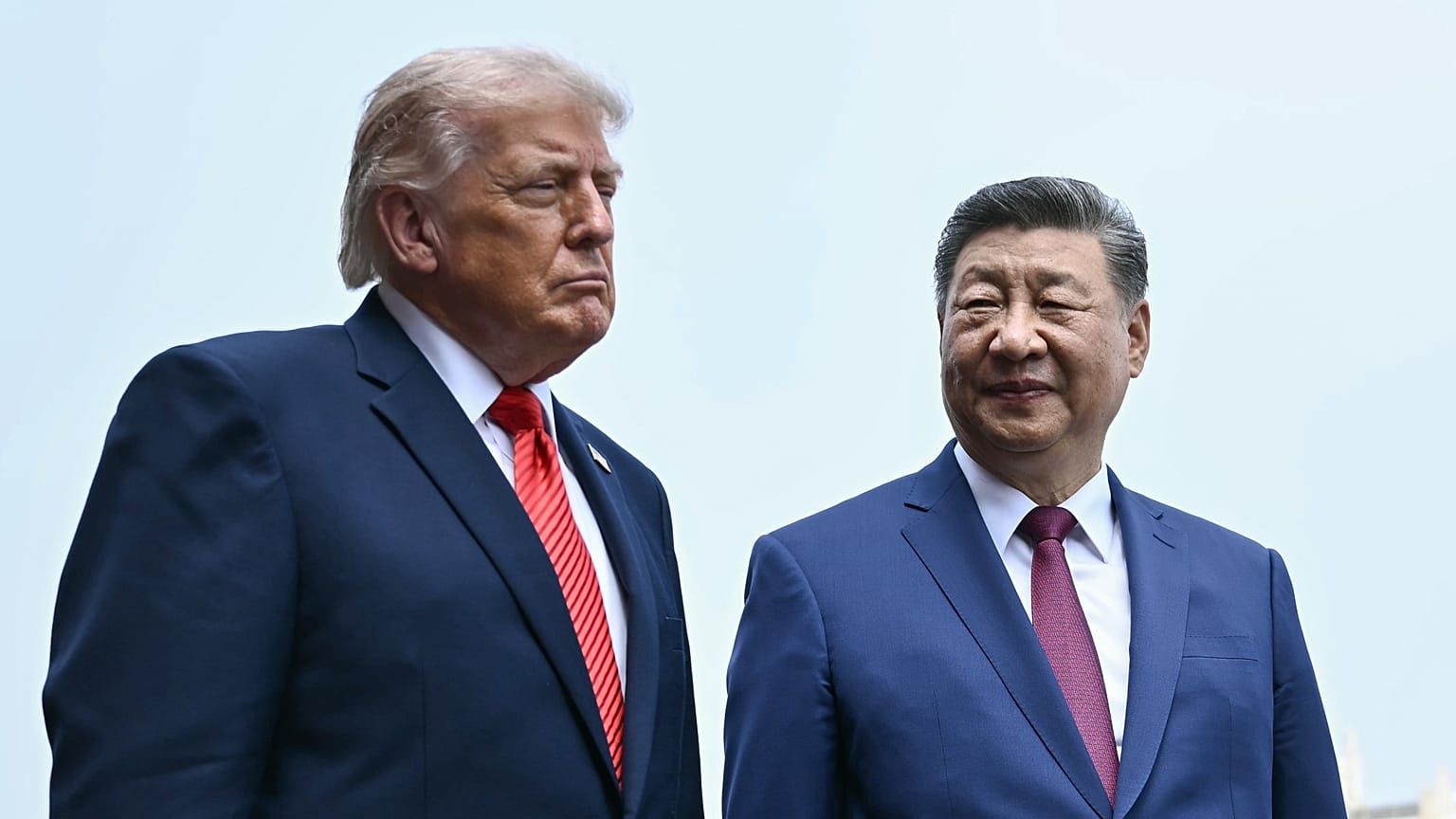
As the US and China build rival AI blocs, Europe is scrambling to reduce its dependence on both. But despite its ambitions to become a technological power in its own right, the EU still lacks the chips, infrastructure and homegrown AI models to compete on equal terms.
With the two leading AI powers, the United States and China, forming their own AI blocs, other countries are manoeuvring to harness the strengths of both groupings and avoid losing out.
Europe is trying to become a third force in AI, but sovereignty is harder to achieve than simply building a home-grown model. Its prospects depend on whether it can also secure the computing power, chips and infrastructure needed to develop and run AI at scale.
As the rivalry intensifies, experts say the window for countries to be able to choose freely between the AI superpowers may be narrowing, forcing them to at one point pick between the US-led Pax Silica, which the EU is already a part of, or the China-inspired World AI Cooperation Organization. But could Europe eventually offer an alternative?
US and China form separate AI blocs
In the artificial intelligence technology race, the United States and China have formed blocs with other nations seeking to set standards and reap AI's potential benefits
\\
Europe and many other countries are in a dilemma: Do they go with the US’s most advanced chips and AI technologies, or join China’s more affordable, open-source AI systems?
In the artificial intelligence technology race, the United States and China have formed blocs with other nations seeking to set standards and reap AI's potential benefits
Europe and many other countries are in a dilemma: Do they go with the US’s most advanced chips and AI technologies, or join China’s more affordable, open-source AI systems?
A European alternative
Views in Europe have changed sharply this year as fears mount over how vulnerable the European Union is to exploitation.
Trump’s forced shutdown of Anthropic’s Fable 5 and Mythos 5 models in June, as well as the more recent switching off of Elon Musk’s military-grade satellite network Starshield in Ukraine, have raised alarm bells in European capitals.
In June, the EU unveiled its European Technological Sovereignty Package, a wide-ranging set of proposals aimed at boosting the continent’s chip production capacity, expanding data centre capacity, supporting sustainable AI, promoting open-source software and integrating data centres into the energy grid to develop sovereign AI for energy management.
The EU has already made progress in boosting chip manufacturing capacity through its Chips Act. This includes a recent €319 million state aid package for Austrian firm Infineon Technologies to develop next-generation semiconductors, as well as €5 billion in Italy and €1.6 billion in Czechia for similar projects.
Europe also has established strengths in the semiconductor supply chain, thanks to firms such as ASML, which produces advanced lithography systems needed to manufacture chips, and Soitec, which supplies semiconductor substrates used to make them.
But the bloc’s ambitions extend beyond chipmaking. The EU is also building a federated cloud and artificial intelligence infrastructure that its architects say could fundamentally change the continent’s relationship with major US and Chinese technology providers.
Rather than building a single European cloud platform from scratch, the project connects existing national infrastructure into a federated network of nodes designed to operate across borders.
Yet Europe remains heavily dependent on foreign technology, particularly in AI. The EU has no dominant frontier AI model comparable to those developed by OpenAI, Anthropic or China’s DeepSeek, and has limited leverage over the companies building the technology. France’s Mistral is one of the few prominent European contenders.
The EU is also trying to rein in its €1 billion-a-day trade deficit with China, driven in part by the bloc’s reliance on Beijing for critical raw materials and electrical components needed for AI infrastructure. Up to 90% of Europe’s rare earth elements come from China, according to Euronews reporting on the cost of reducing that dependence.
Beijing has since agreed to create a “green channel” to streamline and expedite licence approvals for rare earths and permanent magnets destined for the EU, as part of an initial trade deal with the bloc.
Alongside efforts to build up its industrial capacity, Brussels has sought to position Europe as a global rule-setter for artificial intelligence.
In September, European Commission President Ursula von der Leyen vowed that Europe would help write the rules for AI, positioning the bloc as a rule-setter on a par with Washington and Beijing. The EU’s AI Act, adopted in 2024, is billed by Brussels as the “world’s first comprehensive rules on artificial intelligence”.
The Act regulates AI according to a four-tier risk framework, with obligations increasing according to the risks posed by a system. While limited-risk applications such as spam filters face relatively light requirements, certain practices deemed to pose unacceptable risks, including social scoring, are prohibited.
But European companies, concerned that the rules could stifle innovation as they race to catch up with US and Chinese rivals, lobbied hard and secured a delay to rules covering high-risk systems through the AI Omnibus bill, amid a broader shift in the Commission’s political priorities following the 2024 EU elections.
Amid growing global calls for greater control over AI, von der Leyen said the EU’s rules put “Europe in the position to shape global efforts”.
She also said she would invite the main frontier labs “for a discussion on how we can support ongoing industry efforts to pace the frontier”. European firms have been more wary of slowing down, fearing this could be an attempt by US giants to lock in their dominance.
Kazakhstan among countries hoping to harness the best of both blocs
Kazakhstan, a Central Asian nation of about 21 million people, is a rare example of a country that has sought to bridge that gap.
Just three weeks after its AI minister Zhaslan Madiyev visited Washington in June to join the US. group working to strengthen AI supply chains, he headed to Shanghai for a signing ceremony making the Central Asian country a founding member of China’s initiative to shape the global AI agenda.
Being in Pax Silica means more technological partnerships, high-tech manufacturing jobs and a place in global AI supply chains. At the same time, as part of China’s World AI Cooperation Organization alongside 28 other initial founding countries including Pakistan and Russia, Kazakhstan hopes to also have a voice in setting regional and global AI standards.
“Everyone is hedging,” said Dana Masalimova, a former Kazakhstan diplomat and independent scholar and center associate at the Kathryn W. and Shelby Cullom Davis Center for Russian and Eurasian Studies at Harvard University.
“We don’t want this binary choice,” she said.
Kazakhstan is benefiting from both US and Chinese investments, but is in a “very precarious spot,” Masalimova said.
It has rich critical mineral resources essential to AI development and has cheap electricity to power data centers, which have become politically fraught in the US.
Earlier this year, Kazakhstan’s government signed an investment deal worth up to $10 billion involving Nvidia to build a “data center valley” in the country.
Meanwhile, more Chinese companies are investing in Kazakhstan. Local officials say Chinese foreign direct investment in Kazakhstan reached a record $2.8 billion in 2025. Chinese leader Xi Jinping met with Kazakh President Kassym-Jomart Tokayev in July to expand cooperation under China’s global infrastructure building Belt and Road initiative.
Washington’s pressure campaign versus Beijing’s courtship
Both China and the US are leveraging access to AI to increase their global influence.
President Donald Trump insisted last month that “whoever wins AI, wins.” US officials and AI companies have accused China of large-scale “distillation,” or extraction of capabilities, from frontier American models.
Beijing has rejected those claims and says the US is pursuing an AI monopoly while restricting China’s access to some of the world’s most cutting-edge AI chips and chipmaking machinery.
Washington has signalled that Pax Silica — with China as its implicit target — is only for the trusted.
“Countries can’t be trusted partners in Pax Silica while substantively engaging in initiatives that advance a competing vision for super intelligence,” the US State Department said, using the Trump administration’s new preferred term for AI.
For its part, Beijing touts the openness and inclusiveness of its World AI Cooperation Organization. “As both major countries in AI, China and the United States should leverage respective strengths in AI rather than guarding against each other,” the Chinese embassy in Washington said in a statement. “AI should not be owned by major countries.”
The two AI powers have different messaging largely because Beijing needs to court third countries in its bid to build an alternative coalition, whereas Washington already has a powerful network of allies, said Kyle Chan, a fellow at The Brookings Institution’s John L. Thornton China Center.
That lends power to what he described as “swing countries.”
Indonesia, Singapore may also be caught between China and the US
Like Kazakhstan, Indonesia has resources vital for AI and other technologies, such as nickel and copper. It’s also seeking to make the most of both AI powers, having joined China’s World AI Cooperation Organization.
Indonesia wants to benefit from both, Mari Pangestu, the Indonesian National Economic Council’s vice chair, told reporters at a University of Hong Kong Business School event. “We should be able to be part of both, put it that way. And choose the best system.”
US AI firms are bringing investments to other countries like Singapore, where Anthropic is setting up its latest Asia office. The city-state says it is also considering joining China’s AI organization.
In Saudi Arabia, the AI startup Humain unveiled in September a platform built on an open model by a Chinese AI company. The kingdom also has a deal with Nvidia to expand AI computing with its advanced chips.
France, one of the most ambitious AI developers aside from the US and China, is attempting to go its own way with its startup Mistral, whose new model released this month outperforms some advanced Chinese models.
Japan is closely aligned with the US on strategic and security issues, including advanced semiconductors, trusted AI and standards. But it will not reject the more affordable Chinese AI models for “lower-risk applications,” said Takahiro Tsuchiya, a professor at Kyoto’s University of Foreign Studies.
Difficult to challenge the 2 leading powers
For countries which have substantial economic and military capacity but no self-developed powerful frontier AI models of their own, aligning with the US may be vital for their access to data centres and chip deals with US companies, said Anton Leicht and Sam Winter-Levy at the Carnegie Endowment for International Peace.
Essentially, their access to advanced AI systems “depends on the whims of policymakers in Washington and Beijing,” they said, while those countries may have limited influence over AI’s future.
China, meanwhile, has been closing the technology gap with the US when it comes to chipmaking and advanced AI capabilities, but it still trails top US technological capabilities, at least for now.
Also, Beijing’s open-source approach allows countries to be less reliant on the US, and China has been providing funding for developing countries to develop their own AI ecosystems, said Alberto Lemma, a research fellow at the think tank ODI Global.
To date, China has provided official sector grants and loans for projects and activities that use or enable AI technologies in at least 77 low- and middle-income countries, according to the AidData research lab at William & Mary, a public university in Virginia.
Some top recipients include Nigeria, Zambia, Ghana, Bangladesh, Senegal, Cameroon and Kenya.
Public perceptions are also changing. Recent study results from Pew Research Center have shown that people in middle-income countries are becoming more positive and trusting of China when it comes to AI and the technology’s regulation.
All things considered, many countries “don’t want to pick a side ... because there are advantages and disadvantages to each technology stack,” said Aalok Mehta, director of the Wadhwani AI Center at the Center for Strategic and International Studies.
Most countries may eventually lack a good option since they cannot compete on building AI frontier models, but “every country in the world in some way or another is thinking about AI sovereignty,” he said. After all, “maybe no other country than the US and China can really build these very large, powerful models.”
Nvidia CEO sees Kazakhstan as potential AI hub for Europe
During his first visit to Kazakhstan, Nvidia CEO Jensen Huang said the country's growing computing capacity could make it a major AI hub for Europe, as Kazakhstan expands its energy and digital infrastructure.
Nvidia founder and CEO Jensen Huang has visited Kazakhstan for the first time, saying the Central Asian country could emerge as a major AI computing hub for Europe.
 Nvidia CEO Jensen Huang visits Alem.ai with Kazakhstan's Deputy Prime Minister Zhaslan Madiyev in Astana. Copyright: Alem.ai
Huang made the remarks during a fireside chat with Zhaslan Madiyev, Kazakhstan's Deputy Prime Minister and Minister of Artificial Intelligence and Digital Development, at the Alem.ai International Artificial Intelligence Centre in Astana.
During the discussion, Madiyev said Kazakhstan plans to nearly double its installed power capacity to more than 40 gigawatts by 2035 as the country expands the infrastructure needed to support its growing AI sector.
One of its flagship projects is the Data Center Valley, a large-scale AI computing campus under development in Ekibastuz, one of Kazakhstan's main power-generating centres. Its first 50-megawatt phase is expected to begin operations in 2027, while the project's energy infrastructure could eventually scale up to one gigawatt.
Huang said Kazakhstan's energy resources and growing computing capacity could give the country a significant role in Europe's AI ecosystem.
“Kazakhstan has a lot of real estate. It also has a lot of energy,” Huang said. “You're going to have a lot of compute right here in Kazakhstan. It's going to be a hub, a computing hub, an AI factory hub for all of Europe.”
 A fireside chat with Nvidia CEO Jensen Huang at Alem.ai in Astana. Copyright: Alem.ai
Huang described the country's abundant energy resources as a potential competitive advantage in the AI economy, arguing that electricity could increasingly be used to generate computing power and AI rather than simply being exported as energy.
“Kazakhstan has a fundamental advantage because you have so much natural resource already. You have so much energy, and instead of just exporting energy in the future, you could transform the energy into intelligence and export intelligence,” Huang said.
Sovereign AI
But energy alone, Huang argued, will not be enough. Kazakhstan will also need to retain control over another resource — its data.
Madiyev said the country is already developing Kazakh-language large language models based on open-source foundation models and asked whether Kazakhstan should eventually build its own foundation model from scratch.
Huang said building a domestic foundation model “makes complete sense”, describing it as a national security concern.
 Kazakhstan's Deputy Prime Minister Zhaslan Madiyev and Nvidia CEO Jensen Huang during a fireside chat at Alem.ai in Astana. Copyright: Alem.ai
He argued that countries should retain control over both their data and the AI infrastructure used to serve their citizens, comparing it to other essential national infrastructure.
“In the future, you will have your own electric grid, your own internet, your own telecommunications and your own intelligence grid,” Huang said.
The potential of Physical AI
Beyond computing infrastructure and sovereign AI, Kazakhstan is also looking to position itself in the emerging field of Physical AI — systems that can interact with and operate in the physical world.
Pointing to Kazakhstan's industrial base in mining, agriculture, transport and logistics, Madiyev asked whether the country could become a hub for developing and training Physical AI models and robots. Huang called the idea “fantastic”, saying these industries could be among the first to benefit.
“Physical AI is not just robotics,” Huang said. “It includes everything from seismic understanding to mapping mines and wells, to understanding geography and geology — where to mine, how best to mine — understanding material science, the processing of chemicals.”
With the technology still at an early stage, Huang said Kazakhstan has an opportunity to help shape the emerging industry.
Investing in AI startups
The discussion also turned to Higgsfield AI, a Kazakh-founded generative video startup in which Nvidia has invested.
Asked what attracted Nvidia to the company, Huang said the decision ultimately came down to its founders.
“The first thing and the last thing is you invest in people, not companies,” Huang said, describing Higgsfield's founders as “visionary” and capable of competing with leading AI companies globally.
Huang also pointed to the company's presence in both Kazakhstan and the United States, saying it could help bridge the two ecosystems.
 Kazakhstan's President Kassym-Jomart Tokayev receives Nvidia CEO Jensen Huang in Astana. Copyright: Akorda Press Service
Later that day, Huang met President Kassym-Jomart Tokayev, who described the development of artificial intelligence and digitalisation as a national priority.
“This visit is very important for us in terms of giving a serious boost to cooperation with Nvidia,” Tokayev said.
Huang welcomed Kazakhstan's ambition to become an “AI nation” and said the country had the potential to become a global hub for Physical AI.
Huang's first visit to Kazakhstan came at the close of AI Month, a nationwide initiative launched in September as part of the country's Year of Digitalisation and Artificial Intelligence.
Nvidia founder and CEO Jensen Huang has visited Kazakhstan for the first time, saying the Central Asian country could emerge as a major AI computing hub for Europe.
Huang made the remarks during a fireside chat with Zhaslan Madiyev, Kazakhstan's Deputy Prime Minister and Minister of Artificial Intelligence and Digital Development, at the Alem.ai International Artificial Intelligence Centre in Astana.
During the discussion, Madiyev said Kazakhstan plans to nearly double its installed power capacity to more than 40 gigawatts by 2035 as the country expands the infrastructure needed to support its growing AI sector.
One of its flagship projects is the Data Center Valley, a large-scale AI computing campus under development in Ekibastuz, one of Kazakhstan's main power-generating centres. Its first 50-megawatt phase is expected to begin operations in 2027, while the project's energy infrastructure could eventually scale up to one gigawatt.
Huang said Kazakhstan's energy resources and growing computing capacity could give the country a significant role in Europe's AI ecosystem.
“Kazakhstan has a lot of real estate. It also has a lot of energy,” Huang said. “You're going to have a lot of compute right here in Kazakhstan. It's going to be a hub, a computing hub, an AI factory hub for all of Europe.”
Huang described the country's abundant energy resources as a potential competitive advantage in the AI economy, arguing that electricity could increasingly be used to generate computing power and AI rather than simply being exported as energy.
“Kazakhstan has a fundamental advantage because you have so much natural resource already. You have so much energy, and instead of just exporting energy in the future, you could transform the energy into intelligence and export intelligence,” Huang said.
Sovereign AI
But energy alone, Huang argued, will not be enough. Kazakhstan will also need to retain control over another resource — its data.
Madiyev said the country is already developing Kazakh-language large language models based on open-source foundation models and asked whether Kazakhstan should eventually build its own foundation model from scratch.
Huang said building a domestic foundation model “makes complete sense”, describing it as a national security concern.
He argued that countries should retain control over both their data and the AI infrastructure used to serve their citizens, comparing it to other essential national infrastructure.
“In the future, you will have your own electric grid, your own internet, your own telecommunications and your own intelligence grid,” Huang said.
The potential of Physical AI
Beyond computing infrastructure and sovereign AI, Kazakhstan is also looking to position itself in the emerging field of Physical AI — systems that can interact with and operate in the physical world.
Pointing to Kazakhstan's industrial base in mining, agriculture, transport and logistics, Madiyev asked whether the country could become a hub for developing and training Physical AI models and robots. Huang called the idea “fantastic”, saying these industries could be among the first to benefit.
“Physical AI is not just robotics,” Huang said. “It includes everything from seismic understanding to mapping mines and wells, to understanding geography and geology — where to mine, how best to mine — understanding material science, the processing of chemicals.”
With the technology still at an early stage, Huang said Kazakhstan has an opportunity to help shape the emerging industry.
Investing in AI startups
The discussion also turned to Higgsfield AI, a Kazakh-founded generative video startup in which Nvidia has invested.
Asked what attracted Nvidia to the company, Huang said the decision ultimately came down to its founders.
“The first thing and the last thing is you invest in people, not companies,” Huang said, describing Higgsfield's founders as “visionary” and capable of competing with leading AI companies globally.
Huang also pointed to the company's presence in both Kazakhstan and the United States, saying it could help bridge the two ecosystems.
Later that day, Huang met President Kassym-Jomart Tokayev, who described the development of artificial intelligence and digitalisation as a national priority.
“This visit is very important for us in terms of giving a serious boost to cooperation with Nvidia,” Tokayev said.
Huang welcomed Kazakhstan's ambition to become an “AI nation” and said the country had the potential to become a global hub for Physical AI.
Huang's first visit to Kazakhstan came at the close of AI Month, a nationwide initiative launched in September as part of the country's Year of Digitalisation and Artificial Intelligence.
Fluent language makes a hallucinatory chatbot just as credible as a curt, flawless one
An eloquent AI system that shares incorrect information is rated just as highly by users as a curt AI system that provides correct answers
A chatbot that speaks naturally is more likely to be perceived by users as intelligent and useful, even if it spouts nonsense, research by communication scientists at Radboud University shows. An eloquent AI system that shares incorrect information is rated just as highly by users as a curt AI system that provides correct answers.
Most people are by now quite familiar with ChatGPT, Gemini, Claude and other chatbots: every day, people ask millions of questions and receive neatly formulated answers in return. Yet these language models still tend to run wild with so-called ‘hallucinations’: unreliable, dubious answers that are presented with great certainty as the truth. Communication scientist Marianna de Sá Siqueira and her colleagues investigated the effects of elegant language use on the credibility of chatbots.
Nonsense in fluent language
For the experiment, participants were shown one of four variants of a conversation with a chatbot about The Lord of the Rings. Two variants featured fluent sentences and human-like language, one of which gave correct answers and the other did not. In addition, there were two variants with short, businesslike answers, one of which provided entirely correct information whilst the other presented (subtly) fabricated facts.
Unsurprisingly, users were most positive about the chatbot with elegant language and correct answers. However, a chatbot that writes fluently but spouts factual nonsense was rated by participants as just as intelligent and pleasant as a chatbot that communicates in a stilted manner but does provide factually correct information. It also emerged that as many as 80 per cent of participants did not notice the errors at all, even though they had been selected in advance for their basic knowledge of The Lord of the Rings.
"Above all, it shows how easily people can be led astray and how quickly we come to trust something that is actually spouting nonsense," says Barbara Müller, associate professor and co-author of the study. "If a text sounds elegant and natural, people automatically attribute intelligence to it. You then subconsciously tend to think: this is fine, I don’t need to check it any further."
Blind trust
The research highlights the danger of blind trust in artificial intelligence. Professor and co-author Tibor Bosse says: "So-called language models such as GPT and Claude are primarily trained to produce statistically plausible and easy-to-read sentences. These systems do not always take the truth very seriously. They are designed to sound human and convincing, but whether the information is factually correct is of secondary importance."
"People used to complain that chatbots were annoying and knew nothing. Now they sound so clever that we’re too quick to believe them," says Bosse. According to him, this cannot be solved with a simple disclaimer at the outset. "Most chatbots show a single line of text at the start stating that the output may not be entirely accurate, but those companies are certainly not going to indicate of their own accord with every answer that the system is uncertain. If we really want to protect users from chatbots spouting nonsense, we need to, for example, oblige tech companies to make that uncertainty visible. If a chatbot itself expresses doubt, you prevent people from taking nonsense as the truth."
Journal
Computers in Human Behavior Artificial Humans
Computers in Human Behavior Artificial Humans
DOI
Article Title
Users’ perception of chatbot language fluency and hallucination
Users’ perception of chatbot language fluency and hallucination
Article Publication Date
28-Oct-2026
28-Oct-2026
Hertz Fellow Owen Dugan helps launch AI company built for American factories
A new artificial intelligence company is working to help American factories bring products from design to production faster.
Arda, which launched Oct. 2026, is developing AI-powered software that turns product designs into assembly plans and updates those plans as designs change.
The technology aims to help manufacturers adapt production processes more quickly, reducing the time between designing a product and making it. Led by former OpenAI chief research officer Bob McGrew, Arda has raised $232 million, is valued at $1.5 billion, and plans to expand into robotic assembly, developing AI that could allow automated production lines to adapt to new designs in days rather than months.
Among the company’s founding researchers is 2024 Hertz Fellow Owen Dugan, who joined Arda in January as the first AI hire. During his intial weeks at Arda, he built a demo that became Arda’s first product.
“I joined Arda because I wanted to help American factories build faster. The Hertz Fellowship gave me the freedom to take a bet on a young company and the confidence that bold ideas are worth pursuing,” said Dugan. “Strengthening American manufacturing is one way I hope to honor the Hertz Fellows’ moral commitment to help the country in times of need.”
Dugan will present his recent AI model research at NeurIPS 2026 in Sydney on a framework for jointly training incrementally refinable Transformer widths with restart-free adaptive inference.
Dugan holds patents for algorithms that remove satellite trails from astronomical images, addressing a growing challenge for astronomers as more satellites enter orbit. He also co-founded a startup developing technology to verify the authenticity of digital images. These projects applied computational research to practical problems, experience he now brings to Arda, where he works alongside researchers and engineers from MIT, Palantir and Tesla to develop AI-powered manufacturing technology.
Dugan was one of 18 Hertz Fellows selected in 2024. The Hertz Fellowship is the nation’s most competitive doctoral fellowship in the applied sciences, engineering and mathematics. Awarded through a rigorous selection process honed over eight decades, Hertz Fellows receive up to five years of funding, providing the rare freedom to pursue bold ideas and a community of influential peers dedicated to their success.
Dugan’s involvement at Arda reflects a longstanding tradition of entrepreneurship within the Hertz Fellow community, where researchers apply their scientific expertise to build companies, develop new technologies and bring innovative ideas into practical use.
Throughout its history, the Hertz Foundation has supported generations of scientific entrepreneurs. Hertz Fellows have founded hundreds of companies, earned thousands of patents and made significant contributions to the nation’s economy. It continues to foster entrepreneurship through career support, mentorship, and up to $25,000 in funding through the Harold Newman and David Galas Entrepreneurial Initiative.
About the Hertz Foundation
The Hertz Foundation is the nation’s preeminent nonprofit organization committed to advancing American scientific and technological leadership. For more than 60 years, it has stood as an unwavering pillar of independent support through the renowned Hertz Fellowship, cultivating a multidisciplinary network of innovators whose work has positively impacted millions of lives. Learn more at hertzfoundation.org
Big data and AI drive the future of precision poultry nutrition
image:
Graphical abstract showing big data and AI-powered precision poultry nutrition, illustrating the cycle of data collection, AI modeling, precision farming, and biotechnologies.
Credit: HIGHER EDUCATION PRESS
LEAD
Integrating big data and artificial intelligence offers a sustainable solution to optimize feed efficiency and reduce the environmental footprint of global poultry farming.
BODY
[Paragraph 1 — The problem]
Global poultry production faces mounting challenges, including feed source shortages, environmental pollution, and the need to maintain animal welfare amid rising consumer demand. Traditional nutrition models often fail to accurately predict dynamic nutrient requirements, leading to wasted resources and excess greenhouse gas emissions. As the industry seeks sustainable expansion, there is an urgent need for more precise, data-driven nutritional strategies.
[Paragraph 2 — What was done]
Researchers from Jilin University, China Agricultural University and Jilin Academy of Agricultural Sciences conducted a comprehensive review of current precision nutrition technologies. They explored how the Internet of Things (IoT), computer vision, and sensor-based monitoring can be combined with advanced AI algorithms and machine learning. The team also summarized how biotechnologies, including omics techniques and biotechnology-derived proteins, can be integrated into modern poultry farming.
[Paragraph 3 — Key findings]
The review highlights that traditional linear regression models are insufficient for capturing the dynamic physiological states and environmental variations in poultry. In contrast, machine learning algorithms demonstrate superior performance in predicting feed energy values and nutrient requirements. Furthermore, the integration of big data allows for precise diet formulation and real-time adjustments, significantly enhancing the accuracy of nutritional supply. The authors emphasize that combining AI with omics technologies provides a deeper biological understanding of nutrient metabolism.
[Paragraph 4 — Significance and implications]
This integration promises to transform current poultry practices by improving feed efficiency and reducing production costs. By precisely matching nutrient supply to animal requirements, producers can significantly lower nitrogen and carbon emissions, mitigating environmental impacts. Ultimately, this data-driven approach supports sustainable agricultural development, ensuring food security while promoting better animal welfare.
Schematic diagram detailing the workflow of precision poultry farming.
Sankey diagram illustrating the application of AI and big data in poultry production based on a review of 32 articles.
Credit
HIGHER EDUCATION PRESS
HIGHER EDUCATION PRESS
Method of Research
Experimental study
Subject of Research
Not applicable
Article Title
Integration of Big Data and AI Empowered Precision Poultry Nutrition: A Review
New review illuminates the future of AI in pathology
Researchers bridge algorithms with clinical practice
image:
AI: Artificial intelligence; CNN: Convolutional neural networks; ResNet: Residual neural network.
view moreCredit: Xing-hua Gao from The First Hospital of China Medical University, China Image Source Link: https://www.ovid.com/jnls/cmj/fulltext/10.1097/cm9.0000000000004154~deep-learning-based-computational-pathology-technologies
Pathology, the gold standard for disease diagnosis, is undergoing a profound transformation. The shift from traditional microscopy to digital pathology, powered by whole-slide imaging (WSI), has opened the door for artificial intelligence (AI) to revolutionize diagnostic and prognostic workflows. However, a critical gap persists between the rapid advancements in AI algorithms and the practical demands of clinical practice. Pathologists need tools that are not only accurate but also interpretable, reliable, and seamlessly integrated into their work.
To bridge this divide, a team of researchers led by Prof. Xing-hua Gao from The First Hospital of China Medical University and Prof. Xiao-yu Cui from Northeastern University has published a comprehensive review. Their work introduces a novel framework for systematically connecting cutting-edge deep learning technologies with core clinical tasks in pathology. The review, which analyzes the field from 2020 to 2025, was made available online on July 22, 2026 and published in Chinese Medical Journal.
“The challenge isn’t just about creating powerful algorithms; it’s about making them clinically relevant and actionable,” explains Prof. Gao. “We introduced a dual-perspective framework that maps specific deep learning architectures—like CNNs, Vision Transformers, and Graph Neural Networks—to essential clinical needs such as diagnostic classification, tissue segmentation, and prognostic prediction. This provides a much-needed roadmap for developing AI solutions that truly address the challenges pathologists face every day.”
The review highlights how these advanced AI models are already making an impact. For instance, Vision Transformers can achieve over 94% accuracy in classifying oral epithelial dysplasia, while other models can predict cancer patient survival directly from standard H&E-stained slides, reducing the reliance on more expensive and time-consuming genetic tests. The paper also points to the landmark FDA approval of the Paige Prostate AI system as a sign that the digital era of pathology has truly arrived.
A significant hurdle for developing pathology AI is the need for vast amounts of expertly annotated data, which is both time-consuming and costly to produce. The review details emerging trends that tackle this bottleneck, including weakly supervised and self-supervised learning methods that minimize the reliance on these costly annotations. These approaches allow AI models to learn from large, unlabeled datasets, accelerating development and deployment.
“Our goal is to foster the development of AI systems that enhance, rather than replace, the invaluable expertise of pathologists,” notes Prof. Cui. “This means focusing on critical challenges like model interpretability, ensuring regulatory approval, and validating performance across multiple medical centers. The future lies in creating integrated, trustworthy, and equitable AI that becomes an indispensable partner in clinical decision-making.”
By providing a systematic overview and a clear algorithm-to-task mapping, the review serves as a vital resource for both researchers developing the next generation of AI tools and clinicians looking to integrate them into practice. The authors conclude with a forward-looking vision for a future where computational pathology tools are seamlessly woven into the fabric of clinical care, ultimately improving diagnostic accuracy and patient outcomes.
***
Reference
Title of original paper: Deep learning-based computational pathology: Technologies, clinical applications, and future directions
Journal: Chinese Medical Journal
DOI: 10.1097/CM9.0000000000004154
Funding
This work was supported by the National Key R&D Program of China (Grant No. 2023YFC2508200) and National Natural Science Foundation of China (Grant Nos. 82573977 and 82373483).
Journal
Chinese Medical Journal
Method of Research
Literature review
Subject of Research
Not applicable
Article Title
Deep learning-based computational pathology: Technologies, clinical applications, and future directions

No comments:
Post a Comment