Argentina's economy has slipped into a technical recession, with leading private consultancies estimating a second consecutive quarterly contraction in July-September, La Reforma reported on November 1.
The General Activity Index compiled by consultancy Orlando Ferreres y Asociados shows a 1.2% fall in the third quarter, while the Center for Quantitative Studies in Business (CECN) at the University of San Andres estimates a drop of up to 2.66% from the second quarter, the paper reported. Analysts have cut their forecasts for 2026 growth to about 1% or less: Eco Go now expects 0.8%, Equilibra, FIEL and Empiria about 1%, and LCG treats 1% as a ceiling.
The International Monetary Fund had already cut its forecast for Argentine growth this year to 2.1% from 3.5% in its World Economic Outlook on October 13 [5], and the central bank's own survey of analysts lowered its estimate to 1.5% in early October.
Nearly three years into President Javier Milei's programme, the shock therapy that balanced the budget and broke hyperinflation has not delivered growth. The data now point the wrong way on almost every front at once: output is falling, disinflation has stalled above 30%, formal jobs are disappearing, peso lending is shrinking in real terms and the country risk premium has more than doubled since July. Milei has rejected the diagnosis, insisting in September that "there is no recession", only "a slowdown in the pace of expansion", and has challenged the official data that show it.
Two quarters of contraction
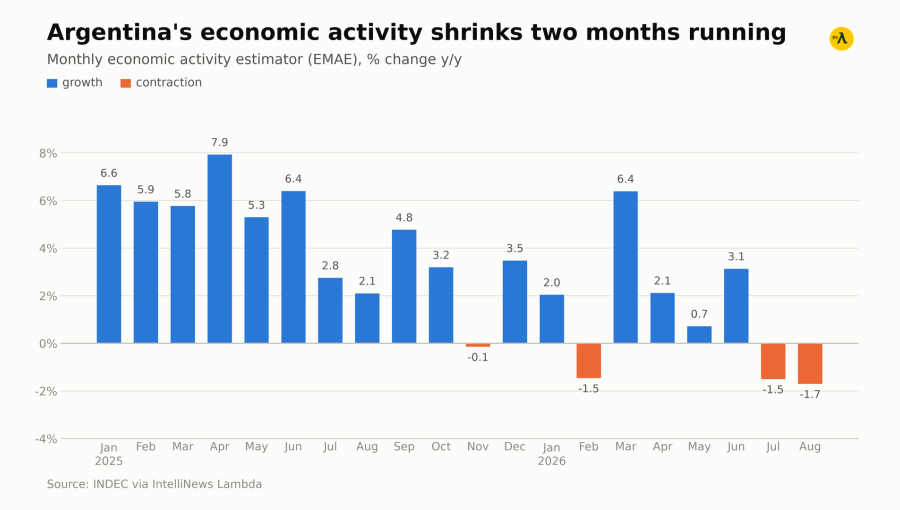
The official monthly economic activity estimator (EMAE) fell 2.8% m/m in seasonally adjusted terms in July and rebounded by only 0.1% in August, statistics agency INDEC reported on October 21 [1]. Activity was 1.7% lower y/y in August, the steepest annual fall of the year, after a revised 1.5% drop in July. Growth for the first eight months slowed to 1.2% from 1.7% in January-July. Manufacturing fell 3.2% y/y and wholesale and retail trade 3.5%, together knocking 0.9 percentage points off the annual rate, while mining grew 11.1%.
For the third quarter to avoid a fall, September would have needed growth of around 8.5%, which analysts considered unfeasible, La Reforma reported. Official third-quarter GDP figures are due in December. GDP had already contracted 0.6% q/q in seasonally adjusted terms in the second quarter, although it was still 2% higher than a year earlier [2]. Private consumption fell 2.4% q/q, and fixed investment has now fallen for five consecutive quarters and was 11.1% lower y/y [2].
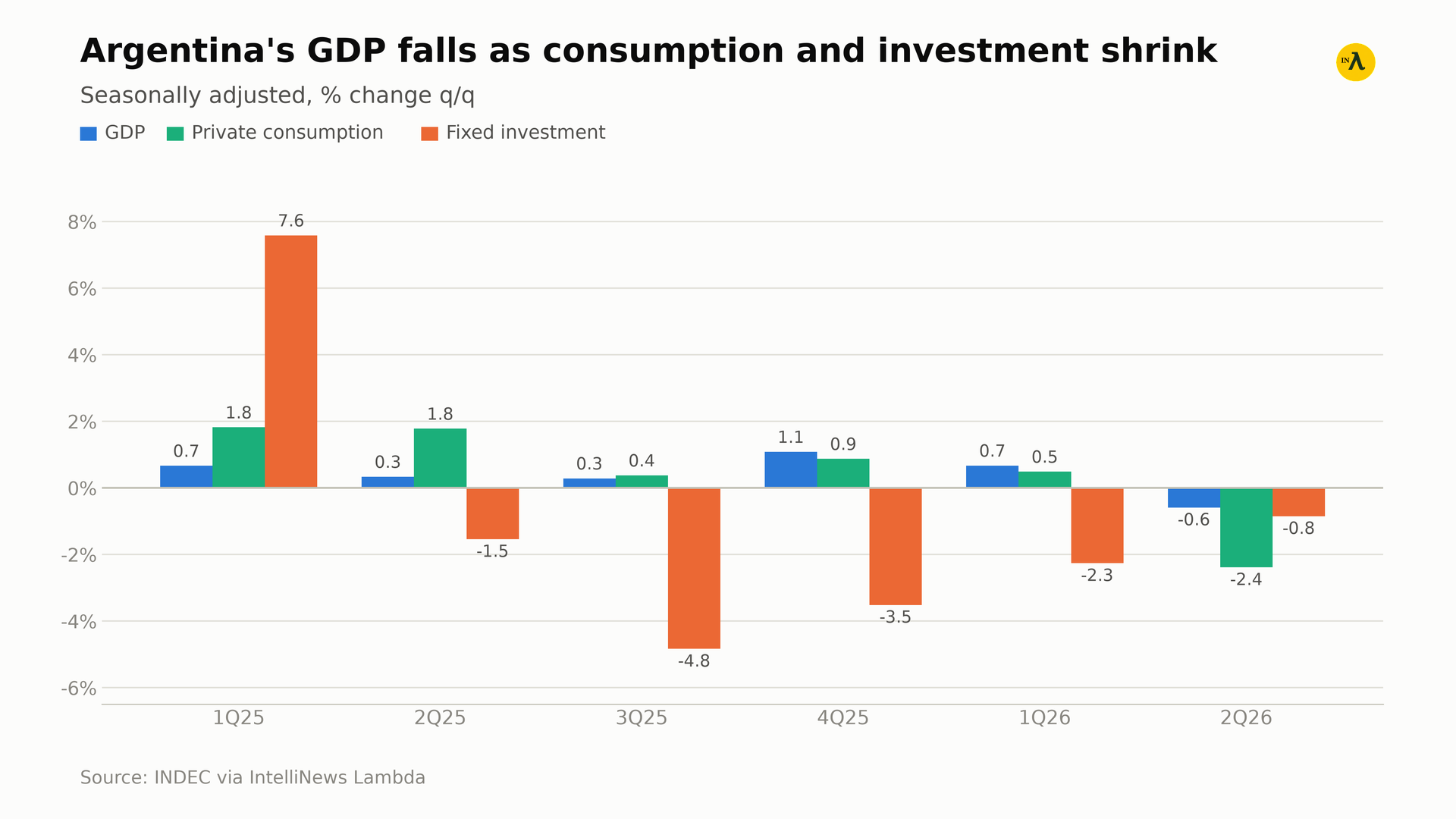
Argentina's GDP, private consumption and fixed investment, seasonally adjusted % change q/q. Source: INDEC via IntelliNews Lambda
Economy Minister Luis Caputo has argued that the country is not in recession but growing more slowly because of external shocks, and has said the government gives more weight to the EMAE's trend-cycle measure, which was flat in July and August [1]. "Argentina's economy is technically in a moderate recession," Ricardo Delgado, head of consultancy Analytica, told Reuters earlier this month as the austerity-hit economy drew warnings from economists.
Inflation stops falling
The fiscal shock delivered the fall in inflation that won Milei his political capital: annual consumer price growth dropped from 289.4% in April 2024 to 31.3% in October 2025 [3]. Since then it has gone sideways. Prices rose 33.4% y/y in September 2026, higher than a year earlier, and monthly inflation has not fallen below 1.7% this year [3]. It accelerated to 1.9% in September, and consultancy FIEL estimated October at 2%, a third consecutive monthly acceleration.
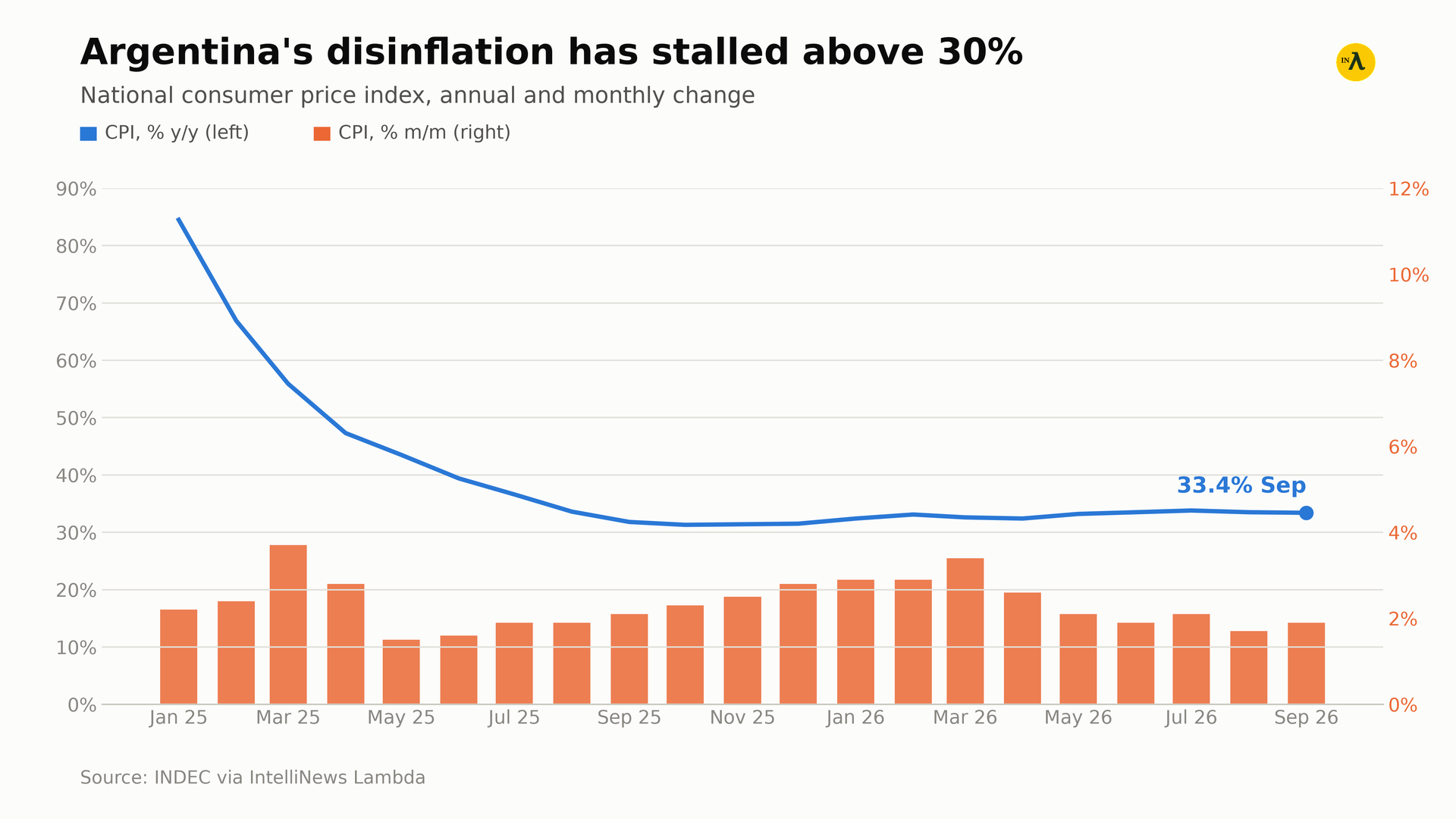
Argentina's consumer price inflation, annual and monthly. Source: INDEC via IntelliNews Lambda
The government's 2027 budget assumes inflation will fall to 18% next year alongside 4% growth.
Jobs and wages
About 13,000 registered private-sector salaried jobs were lost in July, according to La Reforma. Registered employment has fallen 0.9% since Milei's labour reform became law in March and private formal employment has declined for 13 months in a row, according to the Instituto Argentina Grande, while informal work has risen to a record 45% of the employed. Unemployment rose to 7.9% in the second quarter from 7.6% a year earlier [4].
Wages are the one brighter spot. The purchasing power of formal workers improved in June, July and August, rising by 1% in August, the paper reported.
Credit dries up
Lending, which was supposed to drive the recovery, has not picked up since mid-2025. Dollar loans have grown, but peso loans, including consumer credit lines, have fallen in real terms once seasonal effects are stripped out, La Reforma reported. Consumer lending was 9.6% lower y/y in real terms in September and retail sales tracked by the CAME business federation were down 9.2% in the first nine months, according to the ECOSUR Foundation.
Markets lose faith
Investors have taken fright. The JP Morgan country risk index for Argentina crossed 700 basis points in late October and hit 925 points on November 5, its highest since October 2025, before easing to 856 points on November 10. It stood at about 400 points in July.
Caputo has blamed political uncertainty over the October 2027 presidential election rather than the economy. Bond prices now imply a 41-52% probability of an adverse scenario after the election, up from 11-20% three months earlier, although that is not a default forecast, Morgan Stanley said. Investors are also questioning how the government will find the dollars to meet its 2027 foreign-currency debt payments.
The Brazil comparison
Next door, Brazil has taken the opposite route and is not doing worse for it. Its economy grew 2% y/y in the second quarter, the same pace as Argentina's, with inflation of 4.6% in October against Argentina's 33.4% [6]. Argentina has the cleaner budget, Brazil the deeper savings, a floating currency and a much wider spread of trade partners.
The fiscal surplus that anchors Milei's programme has not translated into the investment boom he promised. Argentina's public sector financial deficit could reach about 4% of GDP by the end of 2026 once capitalised interest on government securities is counted, Tiempo Argentino reported in October, and fixed investment is falling. Brazil's real weakened after Lula's re-election in late October, which poses challenges for Argentine exporters to their biggest market.
Exports are the part of the economy still growing, with agro-exports posting their best October in 25 years and mining and energy expanding. Those sectors employ few people and have not been enough to offset the slump in manufacturing, retail and construction, where most Argentines work, and the recession has arrived a year before voters decide whether Milei gets a second term.
Sources
[1] INDEC, Estimador mensual de actividad economica, August 2026, published October 21, 2026.
[2] INDEC, Informe de avance del nivel de actividad, second quarter of 2026, September 2026.
[3] INDEC, Indice de precios al consumidor, national coverage, series to September 2026.
[4] INDEC, Mercado de trabajo, Encuesta Permanente de Hogares, second quarter of 2026.
[5] International Monetary Fund, World Economic Outlook, October 2026.
[6] IBGE/Banco Central do Brasil, IPCA consumer price index, October 2026; IMF quarterly national accounts.
This article was produced with the help of the IntelliNews Lambda analytical tool

No comments:
Post a Comment